Introduction
Without a robust evidence base to support recommendations for first aid, health, and medical services at mass gatherings (MGs), levels of care will continue to vary. Under-serving an event’s health and safety needs may lead to preventable morbidity and mortality while over-serving may lead to wasted resources that might better support events (or the host communities) in a different manner. Streamlining and standardizing post-event reporting via MG medical services will improve inter-event comparability and the potential for meta-analysis, thereby supporting and promoting the growth of the evidence base of this discipline. Accordingly, post-event reporting would benefit from the support of robust conceptual modelling.
In a previous paper, the authors proposed a set of essential variables for post-event reporting on health outcomes. Reference Turris, Rabb and Munn1 However, a random list, or even a sequenced list, of data points is insufficient to advance theory to the point of being a usable model. Some variables will be independent, and others dependent. Some will relate chronologically (ie, in a sequence), others geographically. Some data points may increase the likelihood of the attendees/participants requiring health/medical services or be risk-reducing. These may influence other data points in a cause-and-effect manner; others may be simply correlative. Starting with (and then ever improving) a conceptual model of event health may permit the field of MG medicine to evolve beyond case reports and case series, into true investigational approaches to health-improving or risk-reducing interventions.
This paper is part of a series of nested papers focused on the current and future state of post-event medical reporting. The focus of the present paper is on theory building, providing an evolving conceptual model that lays the groundwork for exploring the relationships between categories of variables pertaining to MG health outcomes. Understanding the relationships between categories of variables, including a greater understanding of independent and dependent variables that impact health presentations and health interventions, may support the identification of causal relationships that ultimately influence health outcomes at MGs.
Methods
The methodology behind the creation of the Data Reporting, Evaluation, & Analysis for Mass-Gathering Medicine (DREAM) model was content analysis, which involves identifying general themes that arise within the literature and adding to those themes as analysis progresses. Reference Ryan, Bernard, Denzin and Lincoln2 Throughout the inquiry process, the authors sought out recurring themes and explored how those themes might be integrated to provide a conceptual model for post-event case reporting. Reference Dixon-Woods, Cavers and Agarwal3,Reference Sandelowski, Voils and Barroso4
Similarities and differences within the data were sought. Data from the literature review were loosely grouped together, matching data points with similar data points. Differences in the data generated new themes for analysis. As an additional step, relationality was explored through a close reading of the texts of published case reports. As clusters of data points continued to emerge, the question became: “How does a particular group of data points relate to each other and to groups of data points outside of the original grouping?”
The analytic process involved five phases: (1) familiarizing oneself with the data through “surface” reading the whole text (line-by-line analysis); (2) generating initial codes as a means of indexing and categorizing the text to establish a framework of ideas, allowing pattern, value, and evaluation coding techniques to establish frequency, relationship, and underlying meaning leading to the theming of data; (3) followed by searching for themes as they arose from coding labels; (4) reviewing themes for accuracy and consistency; and (5) defining and naming final themes. Reference Gibbs and Flick5,Reference Saldana6 A key step in the analysis was generating a thematic “map,” which provided a visual understanding of how the themes related to each other. Reference Harding, Whitehead, Schneider and Whitehead7 This process allowed patterns to appear, sub-themes to be grouped, and finally, key themes to emerge. Using this approach, the authors identified data points and drew links in regard to how they related to one another, with statements of correlation and/or causation. After the initial drafts of the conceptual model were created, data from the analysis of published data models for MG health were analyzed and the model was reviewed and adjusted.
Real-world planning and reporting have an implied chronological sequence, with Pre-Event, During, and Post-Event. Reference Ranse, Hutton, Turris and Lund8 Embedded in more robust planning and reporting documents is a risk mitigation approach, with known risks identified in the planning stages, and many operational plans described and implemented with an intention to eliminate or reduce harms. For a conceptual model to have face-validity in the “real world,” these familiar concepts should also be incorporated.
Findings
Overview of Conceptual Model
The DREAM model, a relational data model, was developed based partly on earlier work done to identify and describe essential data domains for post-event medical reporting (Table 1). Table 1 provides an itemized list of the domains and sub-domains organized according to the phases of an event, which are fully described in a previous paper. Reference Turris, Lund and Munn9
Data Domains for Post-Event Medical Reporting

Relational Data Model
The conceptual model for post-event medical reporting captures both macro and micro views of event data, as well as providing sequencing that has operational validity including “pre-event,” “during event,” “post-event,” and the “reporting and publications” phases of data collection, data management, and analysis. The various planning and production phases of a given event (ie, planning, risk mitigation, operations, analysis, and learning) are also captured.
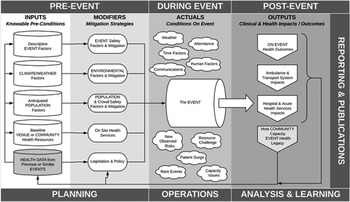
The DREAM model is organized according to five vertical columns arranged left to right, including: (i) Inputs, (ii) Modifiers, (iii) Actuals, and (iv) Outcomes, as well as Reporting and Publications. Figure 1 documents the relationships between domains of variables at the macro level.
DREAM (Lean Version)

Inputs (Figure 1; column 1) include what is known about an event, prior to the occurrence of the event, conceptualized here as variables that relate to both the event and capacity domains. Modifiers (Figure 1; column 2) represent the action plans and resource allocations to support identified risk and predicted health needs for the event population. Actuals (Figure 1; column 3) represent the important difference between data inputs during the planning phase, and the actual conditions on the day (or days) of the event, which may deviate from the inputs that were planned or predicted (eg, weather conditions, number of attendees/participants, size of medical team, or deliberate attack). Outcomes (Figure 1; column 4) capture the health impacts of a given event both at the level of the individual (eg, illnesses and injuries diagnosed or treated) and the health care system (eg, number of patients transported to the hospital, number of ambulances on standby). Outcome data are commonly, though variably, reported in most MG case reports and case series.
Figure 2 provides a populated version of the same model, which includes factors that likely play a role in shaping health outcomes from any given MGs, such as the event population and climate/weather conditions.
Relational Conceptual DREAM Model (Expanded Version).

Discussion
The purpose of the DREAM model is to illustrate the conceptual underpinnings that support comprehensive, yet lean, case reporting and to illustrate the relationships between domains and sub-domains. Much of the published literature is focused on describing specific health outcomes without a corresponding focus on understanding/explaining how the context of a given event shapes the health outcomes. The authors of this paper argue that this is akin to reporting that a patient had an acute myocardial infarction, without also reporting that s/he was obese, hypertensive, dyslipidemic, and diabetic. Similarly, in MG health, understanding the context is likely central to interpreting health outcomes.
In the present paper, the authors’ goal was to enlarge and extend existing work to provide guidance around reporting about the entire event as it relates to planning through to health outcomes. It is hoped that this expansion will provide the MG community with tools to focus not only on the reporting of health outcomes (outputs), but also on some of the factors that contribute to (inputs), or mitigate (modifiers and actuals), illness and injury rates (outputs).
Inputs
In terms of Inputs for the DREAM model, the focus is on knowable preconditions for a given event. Reference Agar, Pickard and Bhangu10-Reference Andersen, Clarsen, Johansen and Engebretsen13 What is known about the event type (eg, hot versus cold marathons) and about the event specifically (eg, What happened the last four times this event took place? What is the anticipated attendance?) would also be relevant. Local knowledge such as anticipated climate conditions and venue-specific factors/event geography would be equally important. In addition, in non-urban population centers, capacity may be affected by the occurrence of more than one MG on the same date(s).
Multiple sources of data can be mined in this case, including everything from proposals, event operational plans, web sites, marketing materials, academic, and grey literature to institutional memory and records from municipal bodies. Position statements and/or guidelines from affiliated event authorities should be considered as well. Reference Aitsi-Selmi, Murray and Heymann14-18 Of note, there was scarce mention of the event’s own history as a source of data about events. The omission of the history of an event is intriguing as this information theoretically provides operational, tactical, and clinical guidance with regard to planning subsequent health service models and creating safer MGs. Historical data may serve as an important starting point for planning. Reference Zeitz, Tan, Grief, Couns and Zeitz19
The Inputs column of DREAM describes and situates the MG in time and space, providing enough context for readers to begin to conceptualize the substance of a specific event or series of events. The Inputs column of DREAM primes event producers, clinicians, and researchers to begin thinking about what can be known prior to a given event and assists in determining required resources for the on-site health services. These services may incorporate health promotion, injury and illness prevention, and harm-reduction measures with the intention of decreasing patient presentations, as well as on-site emergency response services for patient presentations that are not prevented.
Modifiers
The Modifiers column directs the attention toward an analysis of existing/potential hazards and risks with the goal of mitigating the impact to reduce the incidence of negative health outcomes. The Modifiers column captures the dynamic and predictable nature of MGs and asks readers to consider:
-
“What resources are available to support the event?”
-
“What could cause harm (all hazards)?”
-
“What is the probability (risk) that a hazard will cause harm?”
-
“What is the consequence (impact) in the event that a harm does occur?”
-
“What nature and quantity of problems should the on-site medical team be prepared to handle?”
For a given event profile such as a marathon, Modifiers within the hazard and risk domain include what can be done to understand and mitigate risk for event attendees and participants. Reference Hutton, Ranse, Gray, Turris, Lund and Munn20,Reference Soomaroo and Murray21 For example, planning for extreme weather conditions such as excessive heat and introducing additional water stations to reduce the risk of dehydration is a risk-mitigation strategy, as is separation of traffic and pedestrians to reduce the risk of motor vehicle accidents during the event.
In terms of understanding modifiers for hazards and risks, knowledge about the on-site medical team and existing resources is also useful, as argued by Hutton, et al. Reference Hutton, Ranse, Gray, Turris, Lund and Munn20 Briefly, considerations would include the capacity of the on-site medical team in relation to professional credentials, numbers of various health care professionals, as well as available supplies and equipment to treat urgent and emergency patient presentations. Understanding external capacity during an event requires an understanding of factors such as the level of service provided at local hospitals, the distances between the event and local acute-care health services, the presence or absence of on-site (or standby) ambulances staffed by paramedics (public or private), and the ratio of the event population to the community population. Reference Ranse, Lenson and Keene22-Reference Turris, Callaghan, Rabb, Munn and Lund27 For example, if an event is taking place 1.5 hours away from a hospital, this has ramifications for planning the on-site medical response because acutely ill patients will have to be held on event for a substantial period of time. Similarly, if an event is taking place in a community with a single ambulance, event producers may be mandated to have additional ambulances on-site on a standby basis, avoiding disruption of service to the host community. Note that the above list of examples is illustrative, but not exhaustive.
Legislation and policy were almost entirely absent from accounts within the MG literature and is a placeholder within the DREAM model. The role of legislation and policy will undoubtedly evolve over the next decade as local, state/provincial, and national governments turn their attention to addressing recurrent safety issues vis a vis MGs. Examples of the ways in which legislation might play a role in improving health outcomes on event is the creation of a set of standards for event medicine, which would provide event producers and local communities with guidance around the size, type, and capacity of on-site medical teams in the context of existing community resources.
Arguably, an analysis of modifiers is potentially of great utility for event producers, medical directors, and researchers, yet few authors described an approach to identifying, then mitigating risks, whether according to event type (eg, music festival) or specific event. In fact, one of the reasons that mitigation is not always a strong theme in the literature on MGs may be that there is no validated, systematic approach to analyzing hazards and risks in the context of event medicine.
Actuals
The Actuals column of the model is meant to capture conditions on the day(s) of the event. Moving forward from the planning stage to execution, conditions on the actual day might differ quite substantially from what was expected. Weather conditions, event attendance, resource challenges (on-site and off-site), human behavior, and a host of other factors can influence what happens when the event is executed. The actuals column captures what happens when human, structural, environmental, and capacity challenges interact. Reference Westrol, Koneru, McIntyre, Caruso, Arshad and Merlin12,Reference Molloy, Brady and Maleady23,Reference Turris, Callaghan, Rabb, Munn and Lund27-Reference Ceyhan, Demir and Güler75
The gap, or “delta,” between the planned and the actual represents an interesting metric in understanding outcomes. For example, an event planned for a time of the year when weather is traditionally moderate may be confounded by unseasonably hot, cold, windy, or wet conditions. Or, an event may be planned with an anticipated attendance of 50,000, but 250,000 show up on the day of the event. The gap between planned data and actual data creates a potential for unmitigated risks or resource challenges that may have health consequences.
Outputs
The Outputs column of the DREAM model captures that which is most commonly reported in the literature. Of note, the focus is primarily on clinical outcomes at the level of the individual. Reference Westrol, Koneru, McIntyre, Caruso, Arshad and Merlin12,Reference Molloy, Brady and Maleady23,Reference Turris, Callaghan, Rabb, Munn and Lund27-Reference Ceyhan, Demir and Güler75 In contrast, less attention was directed at capturing and reporting outcomes at the systems level. Outputs for a given event include a description of patient presentations in sufficient detail to provide the reader with an in-depth understanding as to what occurred medically at an event. Clarity is required with regard to how these encounters are counted and reported, and with regard to the measurement of impact on local health services.
Mass-gathering researchers and medical service providers commonly report on the population of patients seen. As described by Lund, et al, patients are a sub-population of event attendees/participants who present for health services during an event. Reference Lund, Turris and Bowles76 A general description of the population of patients assessed and treated was provided by the majority of researchers (eg, number of patients seen, age, sex, and length of stay). An analysis of case mix was commonly provided; however, reports of patient clinical presentations were sometimes offered according to chief complaint, body system affected, or discharge diagnosis. Most commonly, a mix of several approaches was utilized. Reference Turris, Rabb and Munn1,Reference Ross, Başdere, Chan, Mehrotra, Smilowitz and Chiampas77,Reference Schwellnus, Kipps and Roberts78 Mixed reporting creates analysis issues because researchers and clinicians cannot easily or accurately compare health outcomes between events. An additional challenge in this category was determining what percentage of patient encounters were for “customer services” such as sunscreen requests or band aids. Issues related to descriptive statistics are not addressed here, but rather are discussed in the fourth paper of this series.
Increasingly, impact on the host community is reported in the literature as an important consideration. 18,Reference Molloy, Brady and Maleady23,Reference Lund, Turris and Bowles24,Reference Heiby, Barnhardt, Berry, Welcher and Brady26,Reference Botelho-Nevers and Gautret79-81 As discussed by Lund, Turris, and Bowles, the “cost” of hosting MGs includes accounting for the effects of events beyond the boundaries of a specific event, the “ripple effect.” Reference Lund, Turris and Bowles76 Transfers to hospital by ambulance and referrals to hospital by other means are captured in this domain. Both serve as proxy measures of additional burden on the host community during a MG. Very few papers contain data from both the on-site care team, the ambulance service, and the locally affected hospitals.
Finally, event health legacy is a place holder for the future. Other than mega-events such as the FIFA World Cup, the Hajj, or the Olympic Games, health legacy is seldom discussed in the literature. However, as MGs proliferate in number and grow in size, more and more attention will likely be focused on understanding the health legacy of events. This would serve as a counterpoint to balance accounts to the environmental and social impacts of MGs, which are often described as negative. As an example, the work in harm reduction in music festivals in many parts of the world is stimulating conversations around substance use and addiction, and has the potential to leave a positive health contribution, if not legacy, in this arena of health. Further examples of positive health legacy include a knowledge legacy, as health care professionals learn skills in risk assessment, planning logistics, operations, and emergency response.
The data domains (presented in a previous paper) provide a road map for event planners, clinicians, and researchers, suggesting essential data points that should be captured when reporting health outcomes post-event. In contrast, the purpose of the DREAM model is about understanding “the story of the event” and how the data domains may relate to one another temporally, operationally, and potentially causally. Based on the essential data points collected, how do all of the components of the event weave together to create ideal (or less than ideal), day-of-event conditions? And post-event, how might those conditions potentially have impacted health outcomes? The DREAM model supports conceptual modelling upon which hypotheses may be constructed, then evaluated and analyzed.
Limitations
The conceptual models presented in this paper are based on an analysis of ten years of event reports drawn from two journals and integration of pre-existing literature on event data modeling. It is possible that a broader literature search, going back decades, and/or a literature search that included additional journals would yield different results. Other models analyzed did not strive to describe the same breadth as the DREAM model, some focusing on predicting patient numbers, and more. Finally, the creation of a model requires a certain leap scientifically, bringing existing ideas together in a new way. The presented associations have not been prospectively validated, but hopefully provide a scaffold for validation activities going forward.
Conclusion
The DREAM model was developed with the goal of shifting data collection from pure description to collecting data that might support hypotheses about causation. The relational model presented in this paper encompasses four phases (INPUTS, MODIFIERS, ACTUALS, and OUTPUTS) and presents an approach for event planners, clinicians, and researchers to understand and to continue to investigate the relationship between event conditions and health outcomes. The development of conceptual models is a requirement for advancing the science underpinning event medicine through comparative studies and meta-analyses. The authors hope that the present relational data model will stimulate debate and provide a springboard for further theoretical development in the field of MG health.
Conflicts of interest
Turris is a shareholder with a medical services company that provides health care services for mass gatherings. Rabb, Chasmar, Ranse, and Hutton have no Conflicts of Interest to declare. Munn is the medical director for an annual major music festival and provides paid and volunteer services working as a director and clinician at other events. Lund is the medical director and a shareholder of a medical services company that provides health care services for mass gatherings. All the authors take on both paid and volunteer roles providing medical services at mass gatherings. None of the authors received income for this project, which is unfunded.