As Canadian neuromuscular specialists, pediatric endocrinologists and patient advocates, we collectively care for individuals living with Duchenne muscular dystrophy (DMD), a rare progressive neuromuscular disease caused by pathogenic variants in the DMD gene located on chromosome Xp21. The DMD gene encodes dystrophin, a cytoskeletal protein essential for maintaining muscle fiber integrity. Boys affected by DMD are typically diagnosed between 4 and 6 years of age, with loss of independent ambulation occurring by early adolescence if untreated. Progressive cardiomyopathy and respiratory compromise result in premature mortality, often in early adulthood.
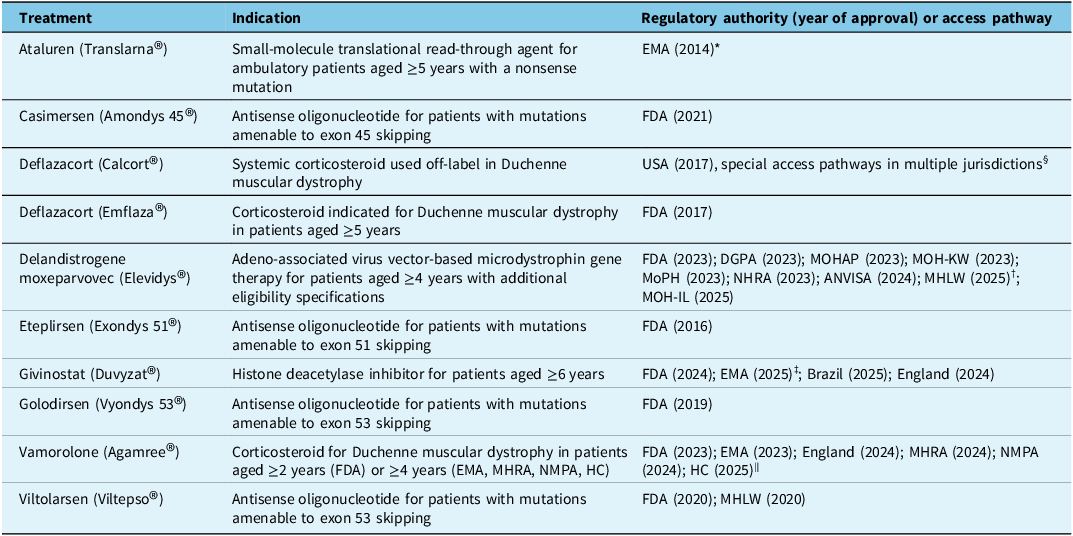
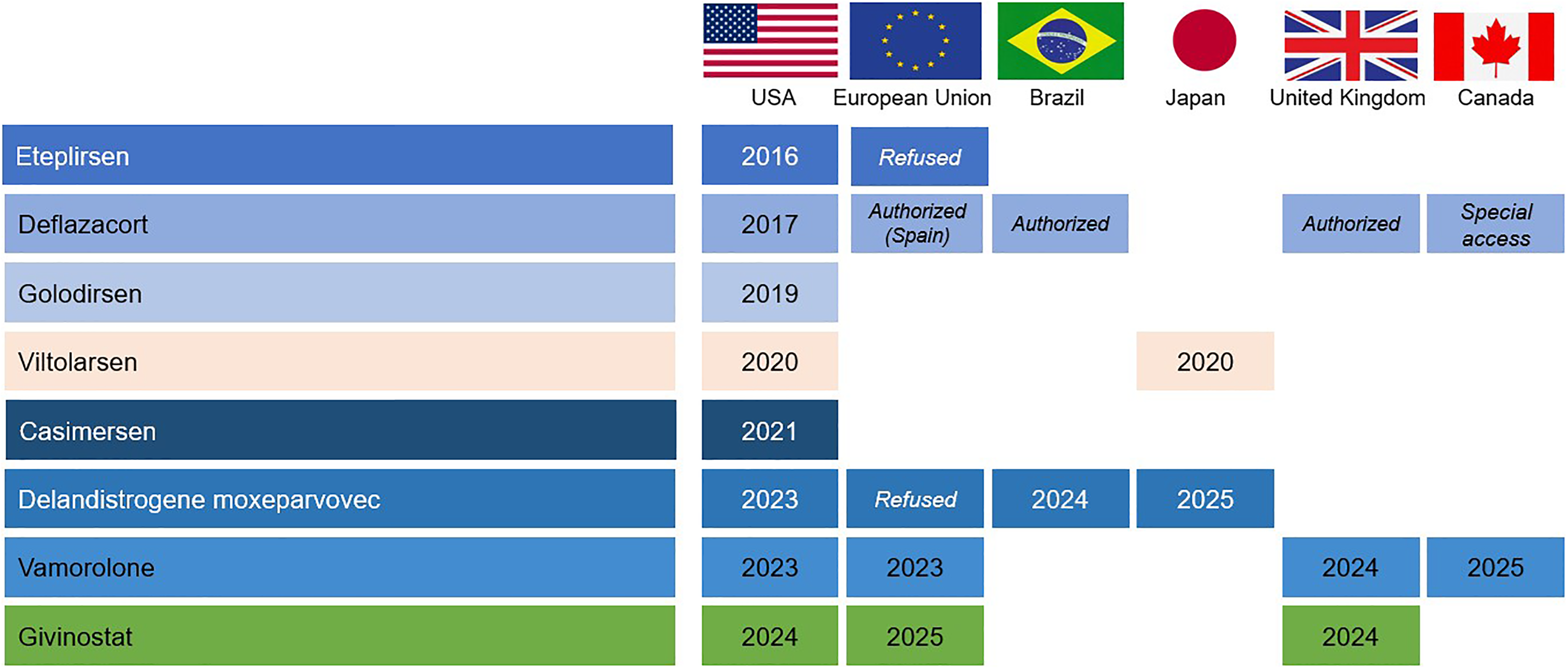
Over the past two decades, global multi-stakeholder collaborations have led to substantial advances in DMD research and the approval of multiple disease-modifying therapies worldwide. These include corticosteroids, exon-skipping agents, histone deacetylase inhibitors, small-molecule translational read-through agents and microdystrophin gene therapy (Table 1). Despite Canada’s long-standing leadership in neuromuscular research and the participation of Canadian patients in pivotal international clinical trials, access to many disease-modifying therapies for DMD in Canada remains variable and often limited outside of clinical trials and select access pathways (Figure 1). Therapeutic approvals for DMD have consistently occurred earlier in the USA than in Canada, contributing to significant disparities in timely access to emerging treatments.
Table 1.
List of approved therapies for Duchenne muscular dystrophy alphabetically, including therapeutic indication and international regulatory authorities where they are approved

Table 1. Long description
A table listing approved therapies for Duchenne muscular dystrophy, including treatment names, indications, and regulatory authorities. The table has 9 rows and 3 columns. The columns are labeled Treatment, Indication, and Regulatory authority (year of approval) or access pathway. Row 1: Treatment, Ataluren (Translarna); Indication, Small-molecule translational read-through agent for ambulatory patients aged 5 years with a nonsense mutation; Regulatory authority (year of approval) or access pathway, EMA (2014). Row 2: Treatment, Casimersen (Amondys 45); Indication, Antisense oligonucleotide for patients with mutations amenable to exon 45 skipping; Regulatory authority (year of approval) or access pathway, FDA (2021). Row 3: Treatment, Deflazacort (Calcort); Indication, Systemic corticosteroid used off-label in Duchenne muscular dystrophy; Regulatory authority (year of approval) or access pathway, USA (2017), special access pathways in multiple jurisdictions. Row 4: Treatment, Deflazacort (Emflaza); Indication, Corticosteroid indicated for Duchenne muscular dystrophy in patients aged 5 years; Regulatory authority (year of approval) or access pathway, FDA (2017). Row 5: Treatment, Delandistrogene moxeparovvec (Elevidys); Indication, Adeno-associated virus vector-based microdystrophin gene therapy for patients aged 4 years with additional eligibility specifications; Regulatory authority (year of approval) or access pathway, FDA (2023); DGPA (2023); MOHAP (2023); MOH-KW (2023); MoPH (2023); ANVISA (2023); MHRA (2024); MHRA (2025); MOH-IL (2025). Row 6: Treatment, Eteplirsen (Exondys 51); Indication, Antisense oligonucleotide for patients with mutations amenable to exon 51 skipping; Regulatory authority (year of approval) or access pathway, FDA (2016). Row 7: Treatment, Givinostat (Duvyzat); Indication, Histone deacetylase inhibitor for patients aged 6 years; Regulatory authority (year of approval) or access pathway, FDA (2024); EMA (2025); Brazil (2025); England (2024). Row 8: Treatment, Golodirsen (Vyondys 53); Indication, Antisense oligonucleotide for patients with mutations amenable to exon 53 skipping; Regulatory authority (year of approval) or access pathway, FDA (2019). Row 9: Treatment, Vamorolone (Agamree); Indication, Corticosteroid for Duchenne muscular dystrophy in patients aged 2 years (FDA) or 4 years (EMA, MHRA, NMPA, HC); Regulatory authority (year of approval) or access pathway, FDA (2023); EMA (2023); England (2024); MHRA (2024); NMPA (2024); HC (2025). Row 10: Treatment, Viltolarsen (Viltepso); Indication, Antisense oligonucleotide for patients with mutations amenable to exon 53 skipping; Regulatory authority (year of approval) or access pathway, FDA (2020); MHLW (2020).
Figure 1.
Regulatory approval for Duchenne muscular dystrophy therapeutics, mapping the historical timeline of when these events occurred across selected jurisdictions where these drugs have been approved or evaluated (USA, Europe, Brazil, Japan, England and Canada) from 1994 to 2025. Years denote the date of regulatory approval. “Authorized” refers to countries where the product has been available as generic or general-use and historically prescribed as “off-label.” “Refused” indicates a denied regulatory submission. “Special access” refers to the Canadian regulatory mechanism allowing healthcare practitioners to request unauthorized, non-marketed drugs for patients with serious or life-threatening conditions. See Table 1 for further details.
At present, treatment access in Canada is limited to clinical trial participation under stringent eligibility criteria, through pharmaceutical-supported patient programs or through Health Canada’s Special Access Program (SAP), which is currently restricted to deflazacort.
Multiple factors have contributed to Canada’s treatment access gap. A key contributor is the comparatively low rate of pharmaceutical submissions to Health Canada relative to other regulatory agencies. Gaudette and colleagues reported that only 67% of drugs approved by the US Food and Drug Administration or European Medicines Agency between 2016 and 2020 had been submitted for Health Canada review by 2023.
Reference Gaudette, Rizzardo, Wladyka, Rahman and Pothier1
This disparity is particularly pronounced for rare diseases, where approximately half of the drugs not submitted to Health Canada during that period were indicated for rare conditions.
Reference Gaudette, Rizzardo, Wladyka, Rahman and Pothier1,Reference Ward, Chambers, Mechichi, Wong-Rieger and Campbell2
In October 2025, the Canadian treatment landscape expanded with Health Canada’s approval of vamorolone (Agamree®) for the treatment of individuals with DMD aged 4 years and older. This milestone represents more than a regulatory success; it reflects long-awaited progress for Canadian families who have contributed to the generation of clinical evidence through trial participation. Vamorolone is a novel dissociative steroidal drug with anti-inflammatory and membrane-stabilizing properties; it preserves growth velocity and reduces bone and metabolic complications that are commonly associated with prednisone and deflazacort.
Reference Guglieri, Clemens and Perlman3
In a pivotal phase 3 randomized controlled trial (NCT03439670) of young (4 to <7-year-old) ambulant boys with DMD, vamorolone dosed at 6 mg/kg/day significantly improved motor outcomes at 24 weeks compared to placebo, with comparable efficacy to prednisone at 0.75 mg/kg/day.
Reference Guglieri, Clemens and Perlman3
These improvements were sustained at 48 weeks
Reference Dang, Damsker and Guglieri4
and at 30 months in a non-randomized open-label extension study (NCT03038399).
Reference Mah, Clemens and Guglieri5
Study data demonstrated that switching from prednisone to vamorolone was associated with favorable changes in serum bone turnover markers.
Reference Dang, Damsker and Guglieri4
While longer-term data are still pending, existing evidence supports the use of vamorolone as an alternative to conventional corticosteroids such as prednisone or deflazacort, with a favorable safety and tolerability profile and comparable efficacy in motor outcomes.
Now that vamorolone has received Health Canada approval, ensuring equitable access across jurisdictions is an important next step in expanding therapeutic options for individuals with DMD. As a relentlessly progressive disease, timely access to appropriate corticosteroid therapy is essential to help preserve muscle function and slow disease progression. Equitable, province-wide reimbursement has the potential to improve treatment tolerability and reduce the burden of care, while also strengthening Canada’s capacity to support future clinical research and therapeutic development, creating an integrated and forward-looking care pathway for DMD patients. Based on available evidence and international regulatory alignment, we support making vamorolone available as an additional therapeutic option for individuals with DMD aged ≥4 years who are steroid-naïve or who have discontinued prednisone or deflazacort due to intolerance or adverse effects.
While the Health Canada approval of vamorolone represents an important advancement in the Canadian DMD landscape, it should be viewed as part of a broader, layered treatment strategy. Vamorolone may not be suitable for every individual with DMD, underscoring the importance of maintaining access to other therapies, including deflazacort, where access in Canada often relies on Health Canada’s SAP and may vary across jurisdictions. Continued advocacy is also required to ensure that additional DMD therapies approved in other jurisdictions, or currently under development, are submitted for Health Canada review under its Priority Review framework. We commend Kye Pharmaceuticals for its commitment to navigating the regulatory pathways in Canada, and we acknowledge Health Canada for recognizing the unmet need within this patient population. However, regulatory approval alone is not enough; the true measure of success will be when every individual with DMD in Canada who may benefit from vamorolone is able to access it in a timely and equitable manner through appropriate access pathways, including publicly funded programs.
Parallel review is intended to accelerate patient access by allowing regulatory review by Health Canada and health technology assessment review by Canada’s Drug Agency to occur simultaneously. However, for rare disease therapies, this can create a data paradox: sponsors are encouraged to file early, often with a more limited data package. The review of vamorolone highlighted this challenge. As new evidence emerged that had the potential to inform treatment eligibility and improve understanding of the therapy’s benefits, incorporating that information into the review process added complexity and affected timelines. One potential solution is greater use of adaptive or conditional review pathways that allow new data to be incorporated throughout the assessment process while maintaining momentum toward regulatory and reimbursement decisions.
While Canada has made some progress, access to therapies still depends on separate provincial and territorial funding decisions. In contrast, many European countries, including France, Italy, Spain and Germany, make reimbursement decisions within a single national framework, generally resulting in more consistent access for eligible patients across each country.
Other areas of healthcare have shown that when governments prioritize timely access, patients benefit from more coordinated pathways. In oncology, mechanisms such as Time-Limited Recommendations, Ontario’s Funding Accelerated for Specific Treatments (FAST) pilot program and centralized cancer agencies support earlier access to promising therapies while additional evidence is generated. While challenges remain, these approaches demonstrate that more flexible and coordinated access pathways are possible when timely treatment is recognized as a priority. The same principle should apply to progressive rare diseases such as DMD.
A key opportunity is to strengthen the National Strategy for Drugs for Rare Diseases to support coordinated, pan-Canadian funding agreements and more consistent implementation timelines. While provinces would retain decision-making authority, greater coordination could help reduce inequities and delays, ensuring that Canadians with rare diseases can access approved therapies in a more timely and equitable manner regardless of where they live.
A more predictable and coordinated access pathway may also strengthen Canada’s position as a destination for rare disease innovation. Lengthy and fragmented reimbursement processes across multiple jurisdictions may reduce the attractiveness of the Canadian market for manufacturers seeking to launch new therapies. Streamlining access pathways could benefit both patients and the broader innovation ecosystem by helping ensure that Canadians gain access to new treatments in a timeframe more comparable to that of other jurisdictions.
As engaged stakeholders in the national DMD community, we urge both federal and provincial authorities to ensure equitable pricing and swift reimbursement decisions, and we commit to working with other pharmaceutical sponsors conducting DMD clinical trials in Canada to pursue timely regulatory approval for boys with DMD who would most benefit from novel therapies. Canadian patients have long contributed to advancing the science of DMD; we believe they must now be able to share equally in its benefits.
Acknowledgments
The authors acknowledge the administrative and logistical support provided by Defeat Duchenne Canada including support for the review and synthesis of the revisions by Jennifer DiRaimo. This commentary is endorsed by the Canadian Pediatric Neuromuscular Group. The views expressed in this manuscript are those of the authors in their individual capacities and do not necessarily reflect the positions or policies of their affiliated institutions or organizations. Funding was provided to KM from Defeat Duchenne Canada to support the scientific writing of the manuscript.
Author contributions
JM, HL, LW, KS, HG, AMS, HJM, CC, NW, JW and KM: Contributed to the conception, design and content of the manuscript. HJM contributed Figure 1 to the revised version. JM, HL, LW, KS, HG, AMS, HJM, CC and NW: Critically revised the manuscript and approved the final version for submission.
Competing interests
LW received research grants paid to her institution as a clinical trial investigator for Ascendis, Alexion, QED, Ultragenyx, Edgewise, Ascendis, Roche and Catalyst and consultancy fees from Amgen, Ultragenyx, Kyowa Kirin, BioMarin, Hoffmann-La Roche, AngiAa, Santhera, Ipsen and Catalyst.
JKM received research grants paid to her institution as a clinical trial investigator for Biogen, Italfarmaco SpA, NS Pharma, Pfizer, PTC Therapeutics, ReveraGen Biopharma and Hoffmann-La Roche.
KS received research grants paid to her institution as a clinical trial investigator for Biogen, Solid Biosciences, Italfarmaco SpA, NS Pharma, Hoffmann-La Roche and Santhera Pharmaceuticals and consultancy fees from Novartis, Biogen, Solid Biosciences and Hoffmann-La Roche.
NW and JW have not personally received any payment but report that Defeat Duchenne Canada received grant(s) from Agada Pharmaceuticals, Edgewise Therapeutics, Solid Biosciences, Regenx Bio, Avidity Biosciences and Kye Pharmaceuticals.
HG received research grants paid to his institution from Muscular Dystrophy Canada and payment for expert testimony from Kye Pharmaceuticals, Novartis, Hoffmann-La Roche and Solid Biosciences.
AMS was a site investigator for the vamoorlone clinical trials funded by Reveragen, has received support for attending meetings/travel from Parent Project Muscular Dystrophy, participates on the data safety monitoring board for Catalyst Pharmaceuticals and is the co-chair of the adrenal insufficiency working group for Optimize DMD.
HL has received consultancy fees and research support paid to his institution from AMO Pharma, Argenx, Avidity Biosciences, Biogen, Fulcrum Therapeutics, Harmony Biosciences, KYE Pharmaceuticals, Novartis, PepGen, Pfizer, PTC Therapeutics, Hoffmann-La Roche, Sanofi-Genzyme, Santhera, Sarepta, Satellos, Spark Therapeutics, Ultragenyx and Vertex Pharmaceuticals. HL is Editor-in-Chief of the Journal of Neuromuscular Diseases and participates on an advisory board for Satellos Biosciences Inc., KYE Pharma and Sanofi US. HL owns a patent for adeno-associated virus vector delivery of a fragment of microdystrophin to treat muscular dystrophy (US-20230049491-A1).
KM received consultancy fees, honoraria and travel support from PepGen; she also received funding from Defeat Duchenne Canada to write a portion of this manuscript.
CC participates on an advisory board for Pepgen and Edgewise Therapeutics. CC is a site investigator for Acceleron, AMO, Biomarin, Biogen, Dyne, Pfizer, Roche, PTC, Sarepta, Cytokinetics and Wave. He is a DSMB member for Catabasis, Edgewise and Solid. He received investigator-initiated grants from Genzyme, PTC, Therapeutics and Biogen.
HJM has received remuneration for consultancy work from Hoffmann-La Roche, Novartis, KYE Pharmaceuticals, Regenxbio and Solid Biosciences. He has served as a principal investigator for clinical trials sponsored by Hoffmann-La Roche, Italfarmaco, Biogen, Novartis, Dyne, PepGen, ReveraGen and Sarepta Therapeutics, with all funds paid to his institution.






 This is an Open Access article, distributed under the terms of the Creative Commons Attribution-NonCommercial-NoDerivatives licence (https://creativecommons.org/licenses/by-nc-nd/4.0/), which permits non-commercial re-use, distribution, and reproduction in any medium, provided that no alterations are made and the original article is properly cited. The written permission of Cambridge University Press or the rights holder(s) must be obtained prior to any commercial use and/or adaptation of the article.
 You have
Access
 Open access
As Canadian neuromuscular specialists, pediatric endocrinologists and patient advocates, we collectively care for individuals living with Duchenne muscular dystrophy (DMD), a rare progressive neuromuscular disease caused by pathogenic variants in the DMD gene located on chromosome Xp21. The DMD gene encodes dystrophin, a cytoskeletal protein essential for maintaining muscle fiber integrity. Boys affected by DMD are typically diagnosed between 4 and 6 years of age, with loss of independent ambulation occurring by early adolescence if untreated. Progressive cardiomyopathy and respiratory compromise result in premature mortality, often in early adulthood.
Over the past two decades, global multi-stakeholder collaborations have led to substantial advances in DMD research and the approval of multiple disease-modifying therapies worldwide. These include corticosteroids, exon-skipping agents, histone deacetylase inhibitors, small-molecule translational read-through agents and microdystrophin gene therapy (Table 1). Despite Canada’s long-standing leadership in neuromuscular research and the participation of Canadian patients in pivotal international clinical trials, access to many disease-modifying therapies for DMD in Canada remains variable and often limited outside of clinical trials and select access pathways (Figure 1). Therapeutic approvals for DMD have consistently occurred earlier in the USA than in Canada, contributing to significant disparities in timely access to emerging treatments.
List of approved therapies for Duchenne muscular dystrophy alphabetically, including therapeutic indication and international regulatory authorities where they are approved
Table 1. Long description
A table listing approved therapies for Duchenne muscular dystrophy, including treatment names, indications, and regulatory authorities. The table has 9 rows and 3 columns. The columns are labeled Treatment, Indication, and Regulatory authority (year of approval) or access pathway. Row 1: Treatment, Ataluren (Translarna); Indication, Small-molecule translational read-through agent for ambulatory patients aged 5 years with a nonsense mutation; Regulatory authority (year of approval) or access pathway, EMA (2014). Row 2: Treatment, Casimersen (Amondys 45); Indication, Antisense oligonucleotide for patients with mutations amenable to exon 45 skipping; Regulatory authority (year of approval) or access pathway, FDA (2021). Row 3: Treatment, Deflazacort (Calcort); Indication, Systemic corticosteroid used off-label in Duchenne muscular dystrophy; Regulatory authority (year of approval) or access pathway, USA (2017), special access pathways in multiple jurisdictions. Row 4: Treatment, Deflazacort (Emflaza); Indication, Corticosteroid indicated for Duchenne muscular dystrophy in patients aged 5 years; Regulatory authority (year of approval) or access pathway, FDA (2017). Row 5: Treatment, Delandistrogene moxeparovvec (Elevidys); Indication, Adeno-associated virus vector-based microdystrophin gene therapy for patients aged 4 years with additional eligibility specifications; Regulatory authority (year of approval) or access pathway, FDA (2023); DGPA (2023); MOHAP (2023); MOH-KW (2023); MoPH (2023); ANVISA (2023); MHRA (2024); MHRA (2025); MOH-IL (2025). Row 6: Treatment, Eteplirsen (Exondys 51); Indication, Antisense oligonucleotide for patients with mutations amenable to exon 51 skipping; Regulatory authority (year of approval) or access pathway, FDA (2016). Row 7: Treatment, Givinostat (Duvyzat); Indication, Histone deacetylase inhibitor for patients aged 6 years; Regulatory authority (year of approval) or access pathway, FDA (2024); EMA (2025); Brazil (2025); England (2024). Row 8: Treatment, Golodirsen (Vyondys 53); Indication, Antisense oligonucleotide for patients with mutations amenable to exon 53 skipping; Regulatory authority (year of approval) or access pathway, FDA (2019). Row 9: Treatment, Vamorolone (Agamree); Indication, Corticosteroid for Duchenne muscular dystrophy in patients aged 2 years (FDA) or 4 years (EMA, MHRA, NMPA, HC); Regulatory authority (year of approval) or access pathway, FDA (2023); EMA (2023); England (2024); MHRA (2024); NMPA (2024); HC (2025). Row 10: Treatment, Viltolarsen (Viltepso); Indication, Antisense oligonucleotide for patients with mutations amenable to exon 53 skipping; Regulatory authority (year of approval) or access pathway, FDA (2020); MHLW (2020).
EMA = European Medicines Agency; FDA = Food and Drug Administration; HC = Health Canada; MHRA = Medicines and Healthcare products Regulatory Agency; NMPA = National Medical Products Aministration; DGPA = Directorate General of Pharmaceutical Affairs & Drug Control; MOHAP = Ministry of Health and Prevention; MOH-KW = Ministry of Health-Kuwait; MoPH = Ministry of Public Health; NHRA = National Health Regulatory Authority; ANVISA = Agência Nacional de Vigilância Sanitária; MHLW = Ministry of Health, Labour and Welfare; MOH-IL = Ministry of Health - Israel.
* Conditional marketing authorization granted by the European Medicines Agency from 2014 to 2025. Market authorization was not renewed (March 2025).
† Time-limited conditional approval pathway for up to 7 years, contingent on submission of post-marketing data.
‡ Conditional approval requiring additional post-approval evidence to confirm clinical benefit.
§ Deflazacort (Calcort®) is approved in multiple jurisdictions for the treatment of inflammatory and autoimmune disorders. Although Calcort® does not carry a Duchenne muscular dystrophy–specific indication, it has been widely adopted as part of standard corticosteroid regimens for Duchenne muscular dystrophy and is accessed in Canada through Health Canada’s Special Access Program.
‖ Health Canada approval does not imply public reimbursement. In Canada, access following approval may occur through extension of clinical trials or pharmaceutical patient support programs pending provincial funding decisions.
Regulatory approval for Duchenne muscular dystrophy therapeutics, mapping the historical timeline of when these events occurred across selected jurisdictions where these drugs have been approved or evaluated (USA, Europe, Brazil, Japan, England and Canada) from 1994 to 2025. Years denote the date of regulatory approval. “Authorized” refers to countries where the product has been available as generic or general-use and historically prescribed as “off-label.” “Refused” indicates a denied regulatory submission. “Special access” refers to the Canadian regulatory mechanism allowing healthcare practitioners to request unauthorized, non-marketed drugs for patients with serious or life-threatening conditions. See Table 1 for further details.
At present, treatment access in Canada is limited to clinical trial participation under stringent eligibility criteria, through pharmaceutical-supported patient programs or through Health Canada’s Special Access Program (SAP), which is currently restricted to deflazacort.
Multiple factors have contributed to Canada’s treatment access gap. A key contributor is the comparatively low rate of pharmaceutical submissions to Health Canada relative to other regulatory agencies. Gaudette and colleagues reported that only 67% of drugs approved by the US Food and Drug Administration or European Medicines Agency between 2016 and 2020 had been submitted for Health Canada review by 2023. Reference Gaudette, Rizzardo, Wladyka, Rahman and Pothier1 This disparity is particularly pronounced for rare diseases, where approximately half of the drugs not submitted to Health Canada during that period were indicated for rare conditions. Reference Gaudette, Rizzardo, Wladyka, Rahman and Pothier1,Reference Ward, Chambers, Mechichi, Wong-Rieger and Campbell2
In October 2025, the Canadian treatment landscape expanded with Health Canada’s approval of vamorolone (Agamree®) for the treatment of individuals with DMD aged 4 years and older. This milestone represents more than a regulatory success; it reflects long-awaited progress for Canadian families who have contributed to the generation of clinical evidence through trial participation. Vamorolone is a novel dissociative steroidal drug with anti-inflammatory and membrane-stabilizing properties; it preserves growth velocity and reduces bone and metabolic complications that are commonly associated with prednisone and deflazacort. Reference Guglieri, Clemens and Perlman3 In a pivotal phase 3 randomized controlled trial (NCT03439670) of young (4 to <7-year-old) ambulant boys with DMD, vamorolone dosed at 6 mg/kg/day significantly improved motor outcomes at 24 weeks compared to placebo, with comparable efficacy to prednisone at 0.75 mg/kg/day. Reference Guglieri, Clemens and Perlman3 These improvements were sustained at 48 weeks Reference Dang, Damsker and Guglieri4 and at 30 months in a non-randomized open-label extension study (NCT03038399). Reference Mah, Clemens and Guglieri5 Study data demonstrated that switching from prednisone to vamorolone was associated with favorable changes in serum bone turnover markers. Reference Dang, Damsker and Guglieri4 While longer-term data are still pending, existing evidence supports the use of vamorolone as an alternative to conventional corticosteroids such as prednisone or deflazacort, with a favorable safety and tolerability profile and comparable efficacy in motor outcomes.
Now that vamorolone has received Health Canada approval, ensuring equitable access across jurisdictions is an important next step in expanding therapeutic options for individuals with DMD. As a relentlessly progressive disease, timely access to appropriate corticosteroid therapy is essential to help preserve muscle function and slow disease progression. Equitable, province-wide reimbursement has the potential to improve treatment tolerability and reduce the burden of care, while also strengthening Canada’s capacity to support future clinical research and therapeutic development, creating an integrated and forward-looking care pathway for DMD patients. Based on available evidence and international regulatory alignment, we support making vamorolone available as an additional therapeutic option for individuals with DMD aged ≥4 years who are steroid-naïve or who have discontinued prednisone or deflazacort due to intolerance or adverse effects.
While the Health Canada approval of vamorolone represents an important advancement in the Canadian DMD landscape, it should be viewed as part of a broader, layered treatment strategy. Vamorolone may not be suitable for every individual with DMD, underscoring the importance of maintaining access to other therapies, including deflazacort, where access in Canada often relies on Health Canada’s SAP and may vary across jurisdictions. Continued advocacy is also required to ensure that additional DMD therapies approved in other jurisdictions, or currently under development, are submitted for Health Canada review under its Priority Review framework. We commend Kye Pharmaceuticals for its commitment to navigating the regulatory pathways in Canada, and we acknowledge Health Canada for recognizing the unmet need within this patient population. However, regulatory approval alone is not enough; the true measure of success will be when every individual with DMD in Canada who may benefit from vamorolone is able to access it in a timely and equitable manner through appropriate access pathways, including publicly funded programs.
Parallel review is intended to accelerate patient access by allowing regulatory review by Health Canada and health technology assessment review by Canada’s Drug Agency to occur simultaneously. However, for rare disease therapies, this can create a data paradox: sponsors are encouraged to file early, often with a more limited data package. The review of vamorolone highlighted this challenge. As new evidence emerged that had the potential to inform treatment eligibility and improve understanding of the therapy’s benefits, incorporating that information into the review process added complexity and affected timelines. One potential solution is greater use of adaptive or conditional review pathways that allow new data to be incorporated throughout the assessment process while maintaining momentum toward regulatory and reimbursement decisions.
While Canada has made some progress, access to therapies still depends on separate provincial and territorial funding decisions. In contrast, many European countries, including France, Italy, Spain and Germany, make reimbursement decisions within a single national framework, generally resulting in more consistent access for eligible patients across each country.
Other areas of healthcare have shown that when governments prioritize timely access, patients benefit from more coordinated pathways. In oncology, mechanisms such as Time-Limited Recommendations, Ontario’s Funding Accelerated for Specific Treatments (FAST) pilot program and centralized cancer agencies support earlier access to promising therapies while additional evidence is generated. While challenges remain, these approaches demonstrate that more flexible and coordinated access pathways are possible when timely treatment is recognized as a priority. The same principle should apply to progressive rare diseases such as DMD.
A key opportunity is to strengthen the National Strategy for Drugs for Rare Diseases to support coordinated, pan-Canadian funding agreements and more consistent implementation timelines. While provinces would retain decision-making authority, greater coordination could help reduce inequities and delays, ensuring that Canadians with rare diseases can access approved therapies in a more timely and equitable manner regardless of where they live.
A more predictable and coordinated access pathway may also strengthen Canada’s position as a destination for rare disease innovation. Lengthy and fragmented reimbursement processes across multiple jurisdictions may reduce the attractiveness of the Canadian market for manufacturers seeking to launch new therapies. Streamlining access pathways could benefit both patients and the broader innovation ecosystem by helping ensure that Canadians gain access to new treatments in a timeframe more comparable to that of other jurisdictions.
As engaged stakeholders in the national DMD community, we urge both federal and provincial authorities to ensure equitable pricing and swift reimbursement decisions, and we commit to working with other pharmaceutical sponsors conducting DMD clinical trials in Canada to pursue timely regulatory approval for boys with DMD who would most benefit from novel therapies. Canadian patients have long contributed to advancing the science of DMD; we believe they must now be able to share equally in its benefits.
Acknowledgments
The authors acknowledge the administrative and logistical support provided by Defeat Duchenne Canada including support for the review and synthesis of the revisions by Jennifer DiRaimo. This commentary is endorsed by the Canadian Pediatric Neuromuscular Group. The views expressed in this manuscript are those of the authors in their individual capacities and do not necessarily reflect the positions or policies of their affiliated institutions or organizations. Funding was provided to KM from Defeat Duchenne Canada to support the scientific writing of the manuscript.
Author contributions
JM, HL, LW, KS, HG, AMS, HJM, CC, NW, JW and KM: Contributed to the conception, design and content of the manuscript. HJM contributed Figure 1 to the revised version. JM, HL, LW, KS, HG, AMS, HJM, CC and NW: Critically revised the manuscript and approved the final version for submission.
Competing interests
LW received research grants paid to her institution as a clinical trial investigator for Ascendis, Alexion, QED, Ultragenyx, Edgewise, Ascendis, Roche and Catalyst and consultancy fees from Amgen, Ultragenyx, Kyowa Kirin, BioMarin, Hoffmann-La Roche, AngiAa, Santhera, Ipsen and Catalyst.
JKM received research grants paid to her institution as a clinical trial investigator for Biogen, Italfarmaco SpA, NS Pharma, Pfizer, PTC Therapeutics, ReveraGen Biopharma and Hoffmann-La Roche.
KS received research grants paid to her institution as a clinical trial investigator for Biogen, Solid Biosciences, Italfarmaco SpA, NS Pharma, Hoffmann-La Roche and Santhera Pharmaceuticals and consultancy fees from Novartis, Biogen, Solid Biosciences and Hoffmann-La Roche.
NW and JW have not personally received any payment but report that Defeat Duchenne Canada received grant(s) from Agada Pharmaceuticals, Edgewise Therapeutics, Solid Biosciences, Regenx Bio, Avidity Biosciences and Kye Pharmaceuticals.
HG received research grants paid to his institution from Muscular Dystrophy Canada and payment for expert testimony from Kye Pharmaceuticals, Novartis, Hoffmann-La Roche and Solid Biosciences.
AMS was a site investigator for the vamoorlone clinical trials funded by Reveragen, has received support for attending meetings/travel from Parent Project Muscular Dystrophy, participates on the data safety monitoring board for Catalyst Pharmaceuticals and is the co-chair of the adrenal insufficiency working group for Optimize DMD.
HL has received consultancy fees and research support paid to his institution from AMO Pharma, Argenx, Avidity Biosciences, Biogen, Fulcrum Therapeutics, Harmony Biosciences, KYE Pharmaceuticals, Novartis, PepGen, Pfizer, PTC Therapeutics, Hoffmann-La Roche, Sanofi-Genzyme, Santhera, Sarepta, Satellos, Spark Therapeutics, Ultragenyx and Vertex Pharmaceuticals. HL is Editor-in-Chief of the Journal of Neuromuscular Diseases and participates on an advisory board for Satellos Biosciences Inc., KYE Pharma and Sanofi US. HL owns a patent for adeno-associated virus vector delivery of a fragment of microdystrophin to treat muscular dystrophy (US-20230049491-A1).
KM received consultancy fees, honoraria and travel support from PepGen; she also received funding from Defeat Duchenne Canada to write a portion of this manuscript.
CC participates on an advisory board for Pepgen and Edgewise Therapeutics. CC is a site investigator for Acceleron, AMO, Biomarin, Biogen, Dyne, Pfizer, Roche, PTC, Sarepta, Cytokinetics and Wave. He is a DSMB member for Catabasis, Edgewise and Solid. He received investigator-initiated grants from Genzyme, PTC, Therapeutics and Biogen.
HJM has received remuneration for consultancy work from Hoffmann-La Roche, Novartis, KYE Pharmaceuticals, Regenxbio and Solid Biosciences. He has served as a principal investigator for clinical trials sponsored by Hoffmann-La Roche, Italfarmaco, Biogen, Novartis, Dyne, PepGen, ReveraGen and Sarepta Therapeutics, with all funds paid to his institution.