1. Introduction
Emmerson and Smalley (Reference Emmerson and Smalley2001: 59–60) define live electronic music as follows:
In live electronic music the technology is used to generate, transform or trigger sounds (or a combination of these) in the act of performance; this may include generating sound with voices and traditional instruments, electroacoustic instruments, or other devices and controls linked to computer-based systems.
In this article we will restrict ourselves to the subset of this involving one or more performers of acoustic instruments, whose sound is processed electronically during performance, and who may additionally initiate controller-based input to the processing system. Given this definition, the possibilities for what may constitute a live electronics setup are vast, ranging from a single microphone with amplification to a large ensemble where every player has an individual microphone, going into a network of computers running complex real-time algorithms incorporating a multitude of performer-driven audio and control processing.
However, even the most basic setups can pose problems for performers. In the simple case of an amplification-only system, a performer may need to consider their own position and continuously adjust the proximity and angle of their instrument to the microphone. This kind of ‘microphone technique’ is common amongst popular music and jazz performers who are familiar with amplification (Hughes Reference Hughes2012), but may be non-obvious for a classically trained musician. Also, on a basic level, the performer will need to adjust to their awareness of their amplified sound – something that may at first be disconcerting, especially in a large auditorium where some latency may be introduced by the positioning of the speakers and the length of the audio cables. Giving a convincing musical performance with such a system where the performer feels ‘in control’ and can work expressively and homogeneously with the electronics requires practice and experience.
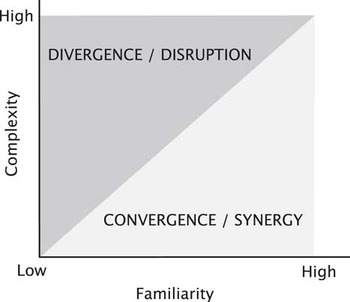
According to McNutt (Reference McNutt2003), technology in performance has a ‘disruptive’ effect, which is proportional to the performer's lack of familiarity with the electronic system being used. This relationship is shown diagrammatically in Figure 1. McNutt also notes that ‘practising with the equipment is therefore every bit as important as practising with the score’ (McNutt Reference McNutt2003: 299). One of the key hypotheses of this article is that the most common scenario in professional performance is that shown in the top left of Figure 1. Here the performer has a low level of familiarity with a highly complex system, creating a situation where performer and technology are ‘divergent’, and hence having a disruptive effect on the musical experience.
The effect of system complexity and performer familiarity on musical experience

Despite this predicament, formal training for instrumental performers in live electronics is rare. The use of technology has been integrated in the training and personal development of composers for over thirty years, whereas the training of professional performers in the use of new technologies has only been explored in a few select institutions worldwide. Even then, it has only been with the small number of professional performers most interested in developing their work in this direction. Likewise, attempts to design hardware and software modelled on the practical needs and expectations of instrumental performers have been rare. For example, a recent software-based system designed for computer-music pedagogy by a world-leading research centre aspires only to meet the needs of ‘composers, new media artists, computer scientists, and engineers’ (Zbyszynski, Wright and Campion 2007: 57). In the associated paper, words with the root ‘compos-’ (compose, composition, composer, etc.) appear seven times; ‘performer’, ‘performance’, ‘perform’, ‘instrument’ and ‘instrumental’ have no mentions at all.
The most commonly used software in live electronic music, Cycling 74's Max/MSP is even further from taking a performer-centric approach, advertising itself as a means to ‘create interactive and unique software’.Footnote 1 Thus, Max/MSP is not designed for live electronic music, but rather as a more general-purpose programming environment for audio, video and interactivity. Learning a programming language is a non-trivial task requiring a hierarchy of skills (Jenkins Reference Jenkins2002), many of which fall outside the domain of traditional musical performance. This presents a significant challenge for performers, most of whom have busy practice and concert schedules, and little ‘mental space’ for learning the multiple skills required for programming. A common solution is to provide performers with a ready-made Max/MSP patch or stand-alone application. However, this means that for every new piece performers must familiarise themselves with a different graphical user interface (GUI) and a different interaction model with its own bespoke workflow. Such GUIs, typically designed by composers, are of variable quality and often incomplete, esoteric, confusing and undocumented. This inevitably disempowers performers by forcing them to rely on composers and/or technical assistants who act as intermediaries to the technology. In practical terms this means the changes and adjustments inevitably required in rehearsals tend not to be made by performers, and responsibility for aspects of the musical result are ultimately delegated to someone else.
1.1. A practical problem
We therefore identify two main issues with live electronics pedagogy:
-
1. Training in live electronics for instrumental performers is not readily available.
-
2. There is a lack of performer-centred software to support learning and professional practice of live electronic music.
This leads to the following questions:
-
• How can we most effectively teach live electronics to instrumental performers?
-
• What should we teach to performers – what should the methods, objectives and outcomes be?
-
• Is a single approach possible, or a diversity of approaches required?
-
• What are the best software and hardware setups for teaching instrumental performers?
In order to explore these questions, we have conducted a series of practice-based studies over a period of two years. In the following sections we outline two approaches to live electronics training, and the teaching methods employed.
2. Two Distinct Methods For Live Electronics Teaching
Although conceived as separate methods and delivered in different contexts there is inevitably some overlap in the approaches used and this will be highlighted through the study survey. Both methods: ‘performer training workshops’ (‘workshops’ herein) and ‘curriculum pilot’ (‘pilot’ herein) took place as part of the Integra project, supported by the Culture 2007–2013 programme of the European Union (Rudi and Bullock 2011). The aim of the Integra project was to bring together new music ensembles, research centres and higher music education institutions from eight European countries and Canada, to promote the wider dissemination of live electronic music. Integra aimed to provide composers, performers, teachers and students with the software tools to interact with technology in a more user-friendly and musically meaningful way (Bullock, Beattie and Turner Reference Bullock, Beattie and Turner2011). The activities of the Integra project ran along four main strands:
-
1. Artistic: a series of commissions of new works, concerts and two international festivals (Birmingham 2008, Copenhagen 2011).
-
2. Scientific: the development of Integra Live, a new software application for composing, performing, teaching and preserving live electronic music.
-
3. Heritage: the migration of seminal live electronic music works that use obsolete technology to the Integra Live software, so that they can be performed again.
-
4. Education: a pilot to teach live electronic music technologies in conservatoires, training sessions for performers, public workshops and outreach initiatives.
Both of the methods outlined below formed part of the ‘Education’ strand of the Integra project.
2.1. Method 1: workshops
The Integra workshops were delivered to performers from five professional new music ensembles: Ensemble Ars Nova, Athelas Sinfonietta, Ensemble Court-Circuit, BIT20 Ensemble and Grup Instrumental de València. Each ensemble was paired with a corresponding Integra partner research centre,Footnote 2 responsible for delivering the training sessions. The aim was to provide the performers with core competencies in live electronics to enhance their own practice and also to further the promotion of new technologies in performance across Europe. A primary outcome was therefore not only to pass on knowledge, but also to instil confidence both in ability and the software being used.
The workshops were delivered in two phases. Phase one provided an opportunity for five performers from each Integra ensemble to travel to an Integra research centre for two days and gain small group and one-to-one instruction in the use of technology in performance. In phase two, the five original performers along with live electronics specialists from the associated research centre delivered a two-day interactive demonstration, open to all members of the ensemble. The aim of this second workshop was to consolidate the learning of the original five performers, and to inspire and engage the other ensemble members.
2.2. Method 2: pilot
The pilot aspect of this study was also delivered as part of the Integra project. The aim was to design and deliver a programme of study for the teaching of live music technologies for performers at higher education level in three institutions across Europe: Birmingham Conservatoire, Institut für Elektronische Musik und Akustik (IEM) at the Universität für Musik und darstellende Kunst Graz in Austria and the Malmö Academy of Music in Sweden. Initially designed by Gerhard Eckel, Peter Plessas, Kent Olofsson and one of the authors, the pilot was experimental in nature, with a view to eliciting qualitative findings about the most effective ways to establish a tradition of live electronics study and performance practice within the context of higher music education. Like the workshops, the pilot was delivered in two phases. In the three mentioned academic institutions, four instrumental teachers were chosen or self-nominated to be trained in the use of live music technologies. These teachers were then trained over four one-to-one sessions with live electronics specialists using the newly developed Integra Live software as a learning tool. The teachers, in partnership with the live electronics specialists then devised an appropriate programme of study to be delivered to instrumental students.
In phase two, small groups of students were recruited to receive four training sessions with their teachers (supported by the Integra technical team) across a year of study. The precise nature of these sessions was tailored towards the individual interests and aptitudes of the instrumental teachers and students concerned, in a manner intended to be analogous with one-to-one instrumental teaching. The pilot sessions delivered at Birmingham Conservatoire hence varied greatly. Below we describe three of the contrasting approaches taken.
2.2.1. Example 1: pianist
The first example illustrates a musical approach following the traditional performer-as-enactor paradigm, where the role of the performer is to ‘realise’ through performance the intentions of a composer as specified through a score.
The study focuses on an exploration of Roger Smalley's Monody for piano and ring modulator, with the aim of adding the piece to the student's repertoire. The piece has simple live electronic requirements and provides an ideal way to introduce an inexperienced musician to live electronic music. The piece asks for the piano to be ring modulated by a sine wave. A MIDI keyboard controls the pitch of the sine wave. A conservatoire piano tutor and one of the authors worked with a student performer, in a number of sessions spread over a period of nine months. During these sessions it was demonstrated how to connect each part of the system together and what each part's function was. The piece was performed a number of times during the pilot. After several sessions the student was able to setup the system without assistance when she needed to practice.
2.2.2. Example 2: percussionist
The second example illustrates a musical approach following the performer–improviser paradigm; the role of the performer here is more exploratory than in Example 1, with the performer having autonomy over the electronics used. In this study no specific piece was practised, but rather the student developed a ‘structured improvisation’ over the course of the sessions with their instrumental tutor. The sessions were experimental in nature, beginning initially with the student playing different percussion instruments through a range of Integra Live modules. As the sessions progressed, the student was able to build small networks of modules and save them as Integra Live ‘blocks’ so that each session built upon the work of the previous one. Finally, simple real-time controllers (such as foot switches and pedals) were incorporated into the sessions and basic performance instruments were developed, such as an ‘extended marimba’, where ‘sustain’ could be added artificially via the control of a foot switch.
2.2.3. Example 3: trumpeter
Like Example 1, our third example follows the performer-as-enactor paradigm, but in this case a new piece was composed in collaboration with an undergraduate trumpet student, and was incorporated into the performer's end of year major project. This enabled the performer to gain an insight into not only live electronics performance but also the process of developing a new work. The process took less than six months from experimentation and composition to rehearsal and final performance of the piece in concert. Of the three examples given, this was the most technically complex, requiring three microphones, a footswitch and expression pedal and vibrotactile feedback motors attached to the performer's body. The piece used Ableton Live and Max/MSP with pre-recorded material as well as interactive live sound processing.
3. Results
In the following section we present the findings gathered from the pedagogical methods described above. These will be presented in the form of results from a post-training survey, and qualitative findings gathered through interviews and observation.
3.1. Qualitative findings arising from the curriculum pilot examples
The qualitative findings of the research relate specifically to the ‘pilot’ teaching method outlined in section 2.2, specifically examples 1–3. These findings resulted from direct observation of teaching sessions as well as post-pilot interviews with participants.
It was observed by the authors that more time was needed in the pilot in order to train instrumental teachers prior to the teachers working with their students. This was corroborated by reports from Integra researchers in other countries, and was particularly evident when it came to using the Integra Live software. Though Integra Live claims to offer the user an easy way to compose and perform with live electronics, many of the instrumental teachers did not learn the software as quickly as anticipated. The reasons for this were observed to be lack of familiarity with the primary metaphors used by the software such as ‘timeline’, ‘scene’, ‘block’, ‘envelope’ and ‘module’ as well as a lack of a priori knowledge of ‘standard’ audio processing such as ‘delay’, ‘reverb’, ‘filter’, ‘synthesiser’ and their respective parameters. However, once the basic structure and operations of the GUI had been learned, teachers were able to experiment with the software without necessarily understanding the underlying operations.
There was also insufficient time across the pilots to cover a range of basic-level audio tasks such as microphone techniques, audio interfaces, mixing desks and diffusion. In some of the pilots, the students were nonetheless still able to operate the electronics on their own by learning a given setup sequence, without necessarily understanding the function of individual components. This was observed to be the case, for example, in the ‘pianist’ example described in section 2.2.1.
In the ‘trumpeter’ example (section 2.2.3) the performer was provided with significant additional time to familiarise himself with live electronics techniques, since the standard one-to-one sessions were supplemented by many sessions working with the composer on the development of the musical work. It is also an exception in that it did not use Integra Live, but rather Cycling ‘74/Ableton's Max for Live software. The regularity and quality of rehearsals and ‘tryout’ sessions in this pilot was observed as providing the performer with a high level of confidence and control over the electronics. A mock-up system was set up in a practice room to allow the performer to practise regularly and familiarise himself with the electronics. The mock-up system was put together so that the performer alone, through written guidance, would be able to rehearse the piece with the electronics, go into sections, and control the piece without assistance. The ability of the performer to regularly rehearse with the full concert setup had an impact not only on the actual performance but also on his learning outcomes. In relation to this, the performer made the following comments:
I did develop my music technology skill in terms of equipment set up and knowing the basic function of each component. I learnt most of this during the Easter holidays when I was setting up the equipment regularly to rehearse. As a result I also learnt the basic operations of the Ableton Live and Max/MSP software.
The approach in this pilot was directed towards the effectiveness of tangible outcomes such as a concert performance, and how these might have an impact in the overall pedagogy of live electronics. In this regard the performer noted:
I did not improve my technique in the conventional sense but the physicality of controlling the electronics has improved my technique in another way. I do feel that I did improve my performance presentation skills because the nature of the piece required it. The fact that the piece was not technically demanding allowed me to focus more on the performing aspect rather than worrying about the notes.
The performer also stated the following:
I have been extremely fortunate to have had the opportunity to perform a piece with live electronics and execute a successful Major Project. The journey was a steep learning curve but I have acquired skills in this genre of music that I can transfer to similar projects in the future. My initial interest in performing with live electronics has grown a lot since the very start of this process and I would gladly accept further collaboration in this field of music.
3.2. Project survey
In addition to the qualitative methods used, a post-training survey was provided to participants in both of pedagogical methods explored in the study: workshops and pilot. The purpose of the survey was to elicit feedback about the impact of the training across both approaches in order to identify potential patterns in responses to the training received. Participants were asked which of the two training methods they had undertaken, so where relevant, we are able to identify trends relating to specific methods.
3.2.1. Survey results
Fifteen people completed the survey; six of these were from the ‘pilot’ study and the remaining nine from the ‘workshop’ study. The majority of participants considered themselves ‘advanced’ musicians, had 15 (or more) years’ experience and were aged 21–39, with 66% of those being below the age of 29. Most of the participants over the age of 29 tended to be from Integra music ensembles, and were taught with the ‘workshop’ teaching method (section 2.1).
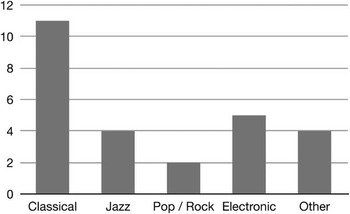
Of the participants, 80% defined themselves as classical musicians, 53% electronic musicians, with many of them working across other musical genres (Figure 2); 43% identified themselves as being students, whilst the remaining participants considered themselves professional musicians working as performers, teachers and academics; 47% of participants were female and 53% male.
Participant genre descriptors for musical practice

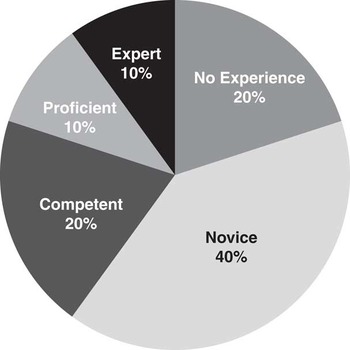
The groups’ levels of experience with music technology before the training mostly ranged from ‘no experience’ or ‘novice’ (60%) to ‘competent’ (20%), with only 20% considering themselves ‘proficient’ or ‘expert’ (Figure 3). The experience consisted mainly of using microphones, mixing desks, loudspeakers and MIDI keyboards/controllers with regard to hardware, whilst Sibelius and Cubase were pieces of software that the majority of the group was familiar with. Levels of experience prior to the training were higher in the ‘workshop’ study than the ‘pilot’, with average confidence levels of ‘competent’ and ‘novice’ respectively.
Participant ratings of music technology experience level before the training

The responses showed that the training had a positive impact on the participants’ confidence with music technology. Prior to the training, 41% of the sample had ‘some confidence’ using music technology, with 25% having ‘no confidence’ at all; the remainder of the sample felt ‘confident’ or higher. After training, the general level of perceived confidence using music technology was raised: 50% of the group had ‘some confidence’, with the remaining 50% identifying as being ‘confident’ or better. Average confidence levels across both study groups went up proportionally. The relative changes in confidence in relation to initial experience are shown in Table 1.
Comparison of average confidence levels before and after training

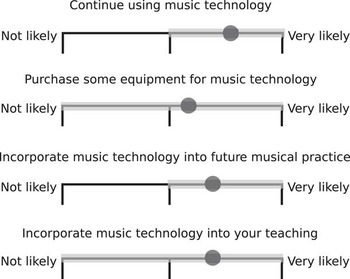
The impact of the training on the use of technology showed that participants were likely to continue using the technology demonstrated and to incorporate technology into their future musical practice (Figure 4); purchasing equipment and incorporating technology into participants’ teaching where relevant was also likely. Those most likely to incorporate technology into future practice and teaching were taught using the ‘workshop’ method, with 50% giving a response of ‘very likely’ for both of these questions compared to 50% giving a response of ‘quite likely’ for the ‘pilot’ method.
Likelihood ratings for music technology actions as a result of the training

Participants were asked to rank which aspects of the training they had learned the most from: 46% of participants ranked ‘actual performance’ most highly, with 31% ranking ‘workshopped examples’ most highly; 15% ranked ‘spoken training (lecture/presentation)’ most highly. The overall ranking based on rank averages was (highest first):
-
• actual performance
-
• preparing for live concert
-
• workshopped examples
-
• spoken training (lecture/presentation).
4. Discussion
From the survey results some general trends can be observed. The authors’ personal experiences reflect these trends and have helped to develop our own approaches to music technology pedagogy. The most pertinent discovery is that performers favour practical approaches that work towards a specific outcome such as a concert or informal performance. This was also reflected in the qualitative findings arising from the pilot. Setting up equipment, using software and repeating these tasks in different environments makes the learning process more meaningful and productive: learning should be relevant to musicians’ musical practice. For this reason, score notation software, MIDI keyboards/controllers, microphones and speakers were all aspects of technology that most musicians were familiar with.
Those who participated in the ‘workshop’ teaching method came from the Integra project professional ensembles. These participants were on average 10 years older than the ‘pilot’ participants, with higher music technology experience levels, and higher initial and final confidence levels. This suggests that learning music technology, as with learning an instrument, takes time and dedication, potentially entailing years, rather than months, of study. Like an instrumentalist, who must learn their instrument through hours of practice and performance experience, the discipline of live electronics may need to be approached in a similar manner. This is supported by qualitative data from ‘open’ fields within the survey. In response to the questions ‘Are there any other improvements you'd like to see in this training?’ and ‘Do you have any other comments about the training?’ answers included:
‘More time to try out the technology.’
‘More practical approach with more emphasis on the theatrical implications of using technology on stage. That is a very important part of performing (in my opinion) with technology that is not really explored yet.’
‘It would be interesting if it were a bit longer.’
‘More time needed.’
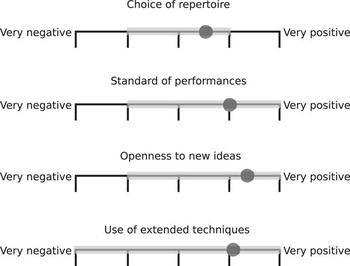
Our research did not show any transformational changes in musicians’ relationships with technology, suggesting that skills and knowledge are acquired gradually and accumulate over time. Long-term, gradual exposure to music technology is key to transforming musicians’ perceptions of it. However, the results did indicate a transformational impact on the general musicianship of some of the performers. This is illustrated in Figure 5, which shows the averages, minima and maxima for related Lickert-scale reponses. Over 80% of participants said the training had a ‘positive’ or ‘very positive’ effect on their standard of performances, openness to new ideas, and use of extended techniques. The survey results also show a significant increase in stated likelihood for performers to use and incorporate technology into professional practice following the training.
Likelihood ratings for effects of training on aspects of musicianship

In terms of the two distinct pedagogical methods explored in our study, no single method consistently showed ‘better’ results than the other. However, given methods did show patterns of greater effectiveness in certain areas. For example, the one-to-one sessions used in the ‘pilot’ method resulted in an at least half of participants indicating ‘positive’ or ‘very positive’ effect across ‘choice of repertoire’, ‘standard of performances’, ‘openness to new ideas’ and ‘use of extended techniques’. By contrast the ‘workshop’ method resulted in an average of one-third indicating ‘positive’ or ‘very positive’ effect in these areas. In terms of ‘impact on use of technology’, participants attending the workshops were more likely on average to ‘continue using music technology’, ‘purchase some music technology equipment’ and incorporate technology into future musical practice or teaching. Participants who attended the pilot consistently rated the quality of training as being higher, with a higher average score for ‘quality of tutors’, ‘equipment provided’, ‘length of session’, ‘quality of given information’ and ‘overall’.
The higher average scores for the curriculum pilot in the ‘effect on musicianship’ are thus correlated to the above average curriculum pilot scores for ‘quality of training’. This is perhaps unsurprising, since the pilot had a far higher teacher–student ratio – in most cases this was one-to-one or two-to-one. The higher average scores for the workshop participants’ ‘continue to use technology’ answers could be explained by factors such as the higher age of the workshop group, higher disposable income due to being in employment, and the practical requirements of working in professional artistic practice.
5. Conclusion
We outlined in our introduction the significant challenges that instrumental performers face when confronted with the performance of live electronics repertoire, and we offset this against an international shortage of live electronics training for performers at higher education level. We then presented two distinct pedagogical methods for teaching live electronics to instrumental performers: workshops given to professional ensembles and a pilot based on individual instruction. We described how these methods were implemented in practice, and presented results from a post-study survey in the context of tacit knowledge and personal experiences of the authors. Our results show a consistent incremental improvement in perceived confidence with technology, with all survey participants being ‘quite likely’ or ‘very likely’ to continue using music technology. This may seem intuitively obvious: training musicians in music technology improves their confidence and engagement with technology. However, what is perhaps more pertinent is the effect of training on ‘musicianship’, with the majority of participants identifying either a ‘positive effect’ or ‘very positive effect’ on ‘choice of repertoire’, ‘standard of performances’, ‘openness to new ideas’ and ‘use of extended techniques’. It could therefore be concluded that it may be beneficial to incorporate music technology instruction into programmes of study for performers at higher education, regardless of their intention to incorporate technology into their wider practice. That is, the addition of music technology instruction to performance curricula may be advantageous solely for its potential benefits on general musicianship.
A common thread across the study has been that a high-level software environment was used as the primary teaching tool. Without including a control group, it is difficult to draw firm conclusions about the significance of this. However, a previous study states the following in relation to the use of Max/MSP, the lingua franca of live electronic music:
The typical learning process of a student composing computer-based music involves encountering many of the same programming problems and inventing the same solutions as their predecessors. While solving basic problems in programming, signal processing, or music has a definite pedagogical value, much of this activity is counterproductive and often impedes serious musical or aesthetic investigation. (Zbyszynski, Wright and Campion 2007: 57)
This observation chimes with our own experiences, and we did find some evidence within our survey data that reflects this, with one student writing as a final comment: ‘The training was so simple in comparison with Max/MSP.’ Removing the requirement to learn a programming language as part of the process enabled the training to focus entirely on practical application and musical engagement. This meant the training had effects that reached beyond improving musicians’ music technology skills, resulting in a greater awareness of their instrument, performance practice, extended techniques and new repertoire possibilities.
We observed that participants primarily favoured pedagogical approaches involving a ‘hands on’, practice-led delivery style. As with conventional music study, live electronic music training can be provided through a combination of one-to-one lessons and group sessions delivered as practical workshops. The results of our third pilot example (trumpeter), also highlights the importance of the environment in the context of performer training. We propose that higher music education institutions should establish dedicated live electronics practice rooms for instrumentalists, where they can practise live electronics repertoire independently. Future work could include a longer-term study, implementing these proposals, and tracking progress over a number of years. This could be more effective if it involved a statistically significant number of students across a small consortium of partner organisations.