The history of Korean Sinology is a telling case study for how humanistic learning is connected to all aspects of a society's politics, economics, and culture. One of China's closest neighbors, Korea has a long tradition of Sinological learning and scholarship, reaching back to the introduction of Chinese characters and texts. Wooden slip manuscripts dated as early as the first century BCE such as the Analects were found in Chŏngbaekdong 貞柏洞, Pyŏngyang, which was then the Lelang 樂浪 (K. Nangnang) commandery.Footnote 1 It was not until the Japanese colonial period in the early twentieth century that Korean intellectuals began to view Chinese culture and history clearly as “other.” As students and enthusiastic supporters of the Chinese classics, for about two thousand years Koreans participated in producing academic writings which belong both to “Korean” studies and to Sinology in general.Footnote 2
Even after the powerful colonial impact, the road to modern scholarship was not easy for Korean Sinologists. In addition to economic poverty and dictatorship, anti-communism as a national policy in South Korea hindered direct contact with Chinese scholarship until the end of the 1980s. Taiwan was the only window to reach the Chinese world, although Japan and the United States were also useful transmitters of knowledge and methodology. It was not until the new diplomatic ties with China in 1992 that Korean scholars officially enjoyed freedom to pursue Sinology without any obstacles.
As a Korean Sinologist working on early Chinese history, I believe that the trajectory of Korean Sinology is as dramatic as that of Korea's own history, from a faithful periphery of Chinese civilization to a newly rising economic power in the modern world. This article begins with a survey of some distinctive features of premodern Korean scholarly works up to the end of the Chosŏn dynasty from the perspective of Sinology. I then move on to modern scholarship, focusing mostly on the field of Chinese history in South Korea, which I think is the most active and innovative among the several different fields in today's Korean Sinology.
Early Stages: Three Kingdoms to the Koryŏ
There is no question that in two of the Three Kingdoms, Koguryŏ and Paekje, the literate stratum started to emerge in the beginning of the fourth century CE. Refugees from China and the Lelang and Daifang commanderies influenced this emergence, and in the second half of the same century literate men developed a central bureaucracy, adopting the Chinese writing and system of governance and establishing, especially in the case of Koguryŏ, state universities (t'aehak 太學).Footnote 3 Although Silla, the ultimate victor among the Three Kingdoms with its unification in 676, was belated in instituting Chinese style civil administration, all three states, led by Koguryŏ, respectfully collected such Chinese texts as the Five Confucian Classics, histories such as the Shiji 史記, Hanshu 漢書, Hou Hanshu 後漢書 and Sanguozhi 三國志, dictionaries like the Yupian 玉篇, Zitong 字統 and Zilin 字林, and literary works such as the Wenxuan 文選.Footnote 4
But it is interesting to note that the first and probably foremost premodern Korean contribution to Sinology was not from Confucianism but from Buddhism. All three kingdoms had endorsed Buddhism as their state religion by the early sixth century. Many Buddhist pilgrims travelled west to China and even to India as the first international students in Korean history. The first Buddhist monk to be noted is Sŭng Nang 僧朗 (ca. 450–ca. 520) from Koguryŏ who sojourned in southern China to contribute toward reestablishing the Sanlun school 三論學 originating from Kumārajīva (344–413).Footnote 5 Other monks from Koguryŏ and Paekje played important roles as transnational Buddhist scholars in China and, especially, in Japan.Footnote 6
It was, however, the so-called “Western fever” of Silla Buddhism in the seventh and eighth century that led to the heyday in Buddhist scholarship.Footnote 7 Many scholars such Silla monks as Ŭisang 義湘 (625–702), Wŏnhyo 元曉 (617–686), Kyŏnghŭng 憬興 (ca. seventh century) produced doctrinal treatises and scriptural commentaries that deeply influenced Chinese Buddhist philosophers including Fazang 法藏 (643–712), the systematizer of the Chinese Huayan school.Footnote 8 Wŏnch’ŭk 圓測 (613–696) and Musang 無相 (684–762) further played crucial roles in the development of Tibetan Buddhist scholasticism and the earliest Ch'an tradition in the Sichuan area, respectively, by their exegeses and teachings.Footnote 9 Another notable contribution was the translation of Buddhist sutras from India. About eight Silla Buddhist monks are said to have substantially participated in the grand translation projects led by such eminent Buddhist monks as Xuanzang 玄奘.Footnote 10
Of all the contributions, the most noteworthy is perhaps the Book of Adamantine Absorption, or the Vajrasamadhi-sutra (K. Kŭmgang sammae-kyŏng 金剛三昧經; C. Jingang sanmei jing). Robert E. Buswell Jr. convincingly argues that the apocryphal text, one of the oldest and most crucial works of the nascent Chan (Zen) tradition, was a product of Korean Buddhism in the seventh century, which he believes rivals the Buddhist philosophy of contemporary China.Footnote 11 The finest commentary to the sutra, The Exposition of the Vajrasamadhi-sutra by Wŏnhyo,Footnote 12 and his other works such as Awakening of Faith (Kisillon hoebon), were also admired by Chinese scholars.Footnote 13 The fact that Wŏnhyo never visited ChinaFootnote 14 further indicates the domestic capacity of Silla Buddhism.Footnote 15
Considering that the inspiration for the development of Sinitic or East Asian Buddhism came from China rather than India, the early Korean contributions to Buddhist philosophy and exegesis indeed marked the major first Korean impact in Sinology. In later periods, it was rare for Koreans to have as much influence on Sinology. As for the main reason for such impressive contributions, Buswell proposes that the Buddhist monks at that time considered themselves “not so much as Korean Buddhists” but “instead as joint collaborators in a religious tradition that transcended contemporary notions of nation and time.”Footnote 16 The transnational achievement motivated by religious fervor could not be realized without the literate foundation built in the Three Kingdoms period. It is still a wonder that such scholarly erudition was achieved within two or three centuries after the adoption of Chinese characters and texts.
In this regard, it is interesting to note that the Koryŏ dynasty (918–1392) seems less significant in its contributions to Sinology. Except for the important role that Koryŏ monks, led by Ch'egwan 諦觀 (d. ca. 971), played in revitalizing the Tiantai Buddhism in China,Footnote 17 it is difficult to find any noticeable scholarly accomplishments comparable to those of the Silla period. King Kwangjong's (r. 949–975) introduction of the Chinese civil service examination in 958 must have encouraged Confucian education and studies in Koryŏ. The state libraries of Koryŏ seem to have had sizeable collections, to the extent that in 1091 Emperor Zhezong of the Northern Song presented the envoys of Koryŏ, including Yi Chaŭi, with a list of 128 books (about 5,000 volumes), possibly already damaged or lost in China, to copy from the good editions kept in Koryŏ.Footnote 18 The request seems to have been fruitful, as Wang Yinglin (1223–1296) notes in the Yuhai 玉海 “many books dedicated by Gaoli (in the seventh year of Yuanyou [1092]) were different editions which our libraries did not have.”Footnote 19 Although Korean scholars assume a certain level of Confucian scholarship in Koryŏ,Footnote 20 the general lack of extant textual sources for the period makes it difficult to identify many scholarly works important from the perspective of Sinology. The coexistence with the dominant non-Sinitic northern powers such as Liao (Khitan), Jin (Jurchen) and Yuan (Mongol) might have something to do with this situation.
Instead, two seminal texts for the origins of Korean studies, the History of the Three Kingdoms (Samguk sagi 三國史記) and the Memorabilia of the Three Kingdoms (Samguk yusa 三國遺事), were published in 1145 and 1281, respectively. Two accounts, from Wang Kŏn (r. 918–943), the founder of the dynasty, and Kim Pusik (1075–1151), the compiler of the History of the Three Kingdoms, seem to reflect at least in part the scholarly milieu during the Koryŏ period. Wang emphasizes the country's independent identity in the fourth of his “Ten Injunctions”:
In the past we have always had a deep attachment for the ways of China and all of our institutions have been modeled upon those of T'ang. But our country occupies a different geographical location and our people's character is different from that of the Chinese. Hence, there is no reason to strain ourselves unreasonably to copy the Chinese way.Footnote 21
Kim cites a quotation from King Injong (r. 1122–1146), in the preface to History of the Three Kingdoms, to underscore the importance of attention to indigenous scholarship against the preponderance of Sinology inherent among the Koryŏ intellectuals: “Of today's scholars and high-ranking officials, there are those who are well versed and can discuss in detail the Five Classics and other philosophical treatises as well as the histories of Ch'in and Han, but to the events of our country, they are utterly ignorant from beginning to end. This is truly lamentable.”Footnote 22
The interest in Koreanness that emerged in the Koryŏ periodFootnote 23 might be another reason for the apparent lack of distinctive contributions to Sinology. But the introduction of Neo-Confucianism in the late Koryŏ period paved a new road to the Sinological boom in the Chosŏn period.
Self-Sufficient Sinology in the Chosŏn
It is well known that the Neo-Confucian zeal of Chosŏn, which was unmatched even in China, inspired contemporary intellectuals to devote themselves to studies of Confucian values, especially those advocated by Zhu Xi (1130–1200). They produced copious academic writings and anthologies. It is natural that Neo-Confucian scholarship is one of the more popular areas in Korean studies during the Chosŏn period. But it may also be the case that, internalizing Sinocentrism and perusing the Sinitic texts in their everyday lives, Chosŏn intellectuals considered the scholarship and research they engaged in as nothing other than Sinology.
Although generalizations about the abundant secondary works on Chosŏn scholarship are impossible, I think one point of convergence might be the search for the “uniqueness” and “localization” of Korean Neo-Confucianism. William Theodore de Bary notes the “assimilation” of Neo-Confucianism in the early Chosŏn, but the creative adaptation to Korean needs and conditionsFootnote 24 seems to have been more prominent in studies of the late Chosŏn period, especially after the fall of the Ming dynasty in 1644.
Yet it is worth noting Kang Chiŭn's recent criticism of modern Korean scholarship, especially the obsession with highlighting the creativity and uniqueness of Neo-Confucianism in seventeenth-century Chosŏn. Seeing the root of this tendency in reactions against Japanese colonial scholarship that emphasized the lack of originality in Chosŏn Neo-Confucian scholarship, Kang is skeptical of the idea that in the late Chosŏn period scholarship could have developed in creative directions critical of Zhu Xi's ideas. Instead, seeing themselves as legitimate successors of the orthodox Way that the school of Zhu Xi pursued, the Chosŏn Confucian scholars had a strong sense of responsibility to take up the tasks as yet unfinished by Zhu Xi. This led them to concentrate on a meticulous analysis of Zhu Xi's teachings that were sometimes self-contradictory. A common methodology they employed was the so-called “to determine the settled discourses” (chŏngnon hwakjŏng 定論確定), which involved selecting a better idea from Zhu Xi's instructions. Kang asserts that persuasive power at the time came not from “arguing one's original idea as reasonable” but from “proving that what one wants to propose draws on Zhu Xi's sound arguments.”Footnote 25 There was little room for daring refutation or laying the slightest suspicion on the Neo-Confucian dogma, which after all was closely related with state policies.
After the fall of the Ming, late Chosŏn intellectuals invented a new idea of the “small central efflorescence” or “Little China” (so chunghwa 小中華), assuming that Chosŏn was the only legitimate heir of the Ming against the barbaric Manchu conqueror. The so-called “Chosŏn-centricism” (Chosŏn chunghwa chuŭi 朝鮮中華主義) based on the “respectful loyalty to the Ming” (chon Myŏng ŭiri 尊明義理) must have been an influential keyword to describe the scholarship of late Chosŏn. Surveying the controversies over “Chosŏn-centrism” in Korea, Kim Yŏngmin recently proposed that this ideology was a “fiction” reminiscent of James Scott's “weapons of the weak.”Footnote 26 It might have been an ideological tool used in internal politics. Nonetheless, most late Chosŏn intellectuals recognized the reality of the insurmountable Qing empire and its enviable high civilization. As with the historical situation, there is no question that contemporary Korean scholarship largely assumed an ambivalent position between elevating self-esteem and embracing reality.
Recent attempts to understand late Chosŏn scholarship within the larger East Asian context or the greater Sinographic sphere have produced intriguing arguments about the circulation and variety of books and knowledge transmitted from the Qing. An interesting example in this regard is Suyoung Son's transnational take on the localized reading by Yi Tŏngmu (1741–1793), an eminent writer and erudite scholar of eighteenth century Chosŏn, of the Liuxi waizhuan 留溪外傳 (Unofficial Biographies by Liuxi [Chen Ding 陳鼎]), biographies of 354 Ming loyalists compiled in 1698.Footnote 27 Meticulously analyzing Yi's adapted excerpts from the Liuxi waizhuan for his own multivolume records of Ming loyalists, the Noeroe nangnak sŏ 磊磊落落書 (Book of Piled Rocks) compiled in 1779, Son convincingly argues that Yi's local reproduction of the text suits contemporary Chosŏn agenda. However, she further notes Yi Tŏngmu's embrace and praise of Vietnam and Japan—two other states that used Sinitic scripts—to situate himself as a scholar who departed from the exclusive China-centered hierarchy. Instead, he envisioned a greater Sinographic civilization that encompassed not only Chosŏn but also the Qing, Japan, and Vietnam.Footnote 28 Given that Yi is generally understood as a stubborn loyalist to the Ming,Footnote 29 it is ironic that Son's analysis portrays Yi as a progressive thinker who embraced the entirety of East Asia.Footnote 30
Indeed, the contributions that the late Chosŏn scholars including Yi Tŏngmu made with the desire to promote “Chosŏn-centrism” are thought-provoking and valuable sources in their own right for understanding the regionalized intellectual history of the Chosŏn period. However, by putting too much weight on regionality and uniqueness in the history of “scholarship,” we may have neglected an important point, which is the search for “truth” and “academic excellence” that I believe is the essence of scholarly pursuit. If we consider late Chosŏn scholarship within the contemporary Sinological context, it is questionable how successful they were in the search for “truth” (as opposed to achieving their political agendas). While approving their great contributions as sources for Korean studies, we need simultaneously to reevaluate the scholarship from the contemporary perspective of Sinology.
In this regard, Suyoung Son, a Sinologist, provides us with an important case. The Noeroe nangnak sŏ is a massive biographical compilation of 528 Ming loyalists in ten volumes. With the experience of participating in compiling the biographies of the Song loyalists in the Songsa Chŏn 宋史筌 (Selected Excerpts from the History of the Song),Footnote 31 Yi Tŏngmu composed the book with excerpts from 176 Chinese books published in the late Ming and early Qing. Yi's ability to gather and reorganize such abundant materials clearly proves his erudition with regard to the contemporary Chinese sources. But a serious problem that Son points out is that most of the books that Yi relied on were far from authentic materials. Yi relied heavily on the Liuxi waizhuan, quoting more than seventy-three biographies and even adopting its format, but most contemporary and later scholars in China harshly criticized it, seeing its compiler Chen Ding as using it to promote the reputation of his family and coterie. Son points out that some members of Chen Ding's group, who did not participate in the Ming loyalist movements, are included in the Noeroe nangnak sŏ, and euphemistically comments that the Noeroe nangnak sŏ is filled “partly with questionable, over exaggerated, and self-promotional records that at least some Qing literati would not have completely trusted as credible historical materials.”Footnote 32 Although the audience Yi targeted seems to have been entirely Korean, how would serious contemporary Chinese scholars evaluate the book academically if they read it?
In spite of some misreading of Chinese books,Footnote 33 the Noeroe nangnak sŏ was well-received, and by the mid-nineteenth century renowned Chosŏn intellectuals desired to read it even in its incomplete form.Footnote 34 Many scholars have paid attention to the tribute mission trips to Beijing, the so called “Yŏnhaeng 燕行” (trips to Yanjing), in the late eighteenth and early nineteenth centuries. Yi Tŏngmu compiled the Noeroe nangnak sŏ a year after his mission trip to Beijing in 1778. Highlighting examples of international friendships and intellectual exchanges between Chosŏn travelers and Qing literati, Korean scholars underscore the mutual scholarly communication to such an extent that Chŏng Min compares it to “the Republic of Letters” in the “great” Sino-Korean intellectual setting.Footnote 35 The touching stories of international friendship and correspondencesFootnote 36 are fascinating in their own right, while offering a glimpse into an aspect of intellectual history and cultural exchange.
However, the current dominant trend to study the intellectual exchanges simply focusing on the friendships and stressing distinctive regionalization of Sinology may have neglected another important aspect of late Chosŏn scholarship, the “depreciation” and “lack” of empirical scholarship (kaozheng 考證), one of the steppingstones that led to modern Sinology. While Chŏng Min and many other Korean scholars have emphasized the florescence of intellectual exchanges, Kang Myŏnggwan's recent study on the considerable intellectual “gap” between Beijing and Seoul exposes a serious “lag” that the late Chosŏn scholarly circle may have faced.Footnote 37 Unlike China and Japan, the state monopolized printing in Chosŏn so only selected books from China were brought in to late Chosŏn. Pak Chiwŏn (1737–1805), one of the most distinguished scholars of the time, never heard of Gu Yanwu's (1613–1682) Rizhilu 日智錄 until his first tribute mission trip to Beijing in 1780. Chŏng Yagyong (1762–1836), the commonly acknowledged genius of Chosŏn, did not even know about the Shangshu guwen shuzheng, 尙書古文疏證, the iconoclastic masterpiece of the kaozheng scholarship by Yan Ruoju (1636–1704), when he first completed the Maessi sŏp'yŏng 梅氏書評 during his exile in 1810 and proposed that Mei Ze (fourth century) forged the ancient version of the Shangshu.Footnote 38 Kang concludes that kaozheng scholarship's negative reception from Chosŏn scholars was not based on scholarly analysis and understanding of its achievements, but was engendered by the intensification of Neo-Confucianism with the censorship of King Chŏngjo (1776–1800).Footnote 39 Fuma Susumu's study of the anachronistic criticism of Hanxue 漢學 or empirical scholarship by Sin Chaesik (b. 1770) during his mission trip to Beijing in 1836 shows how tenaciously the Chosŏn intellectuals were obsessed with the Songxue 宋學 or Neo-Confucianism.Footnote 40 There must have been only limited space for philological studies.
Of course, one should not dismiss the influences, though limited, of kaozheng scholarship on the rise of Han–Song eclecticism in the late eighteenth century, which led not only to Chŏng Yagyong's massive exegesis on the Confucian classics,Footnote 41 but also to the epigraphic studies of Kim Chŏnghŭi (1786–1856), with his academic exchanges with Qing literati.Footnote 42 It is still regrettable, however, that unlike the considerable number of works about Korea ascribed to the so-called Sirhak (practical learning) school, the Sinology of late Chosŏn rarely led directly to modern Korean scholarship. This seems to parallel Hyŏngyu Pak's research on the premodern Korean books circulated in China. The majority of the books by Chosŏn intellectuals printed in China was in the form of literary anthologies rather than classical and philosophical studies.Footnote 43 Even though Chosŏn intellectuals may have been admired in China for their literary erudition, their pursuit of Sinology was more or less self-contained, lacking universal vitality. This of course had nothing to do with the intellectual capability of the Chosŏn literati but with various internal and external factors, which the Chosŏn state must have confronted. However, an unprecedented impact that originated outside of Chosŏn severed the roots of traditional scholarship and prepared the transition to modern Korean Sinology.
Tōyōshi in the Colonial Period
The last decade of the nineteenth century marks an important turning point in the history of Korean Sinology. China's defeat in the Sino-Japanese war in 1894 must have been a finishing blow for the epistemological transition. A very good example of this comes from the semantic change of the term hanmun 漢文, which in the Chosŏn period denoted the true writings, jinsŏ 眞書, as opposed to vernacular writings in the Korean alphabet, ŏnmun 諺文. There is no question that most Chosŏn intellectuals used only hanmun in their writings. But after the Kabo Reforms beginning in 1894, official documents all used the hanmun with the Korean alphabet imitating, it would seem, the Japanese way of writing. Labeling the Korean alphabet as the national script, kungmun 國文, hanmun began to lose its dominant status and become an otherized foreign script.Footnote 44 Likewise, Hanhak (C. Hanxue), originally the Han school of classical philology or kaozheng scholarship in contrast to the Songhak (C. Songxue), Neo-Confucianism, was repositioned as foreign studies.Footnote 45 Having lost its official status in the modern academic and educational systems, Hanhak was transformed into a sort of general learning of Confucianism at the nonofficial level.Footnote 46 After liberation from Japanese colonial rule, Hanhak began to regain its elevated status, although this time, it was not as Sinology but as Korean literature written in Chinese characters, “Han'guk hanmunhak 韓國漢文學.”
Instead, two new branches of scholarship emerged in the field of modern Korean Sinology in the twentieth century. The first is Korean national history, led by Sin Ch'aeho, which not only signified separation from the Chinese world order but also indicated that Korea confronted new challenges resulting from Japanese colonialism.Footnote 47 The second is Japanese Tōyōshi (lit. Asian history) which without doubt gave birth to modern Korean scholarship on Chinese history. Both Korea and Japan faced similar situations, in that they had to position themselves as modern, sovereign states distinct from China, the foundation of their own civilizations. Yet such rubrics of their respective civilizations were not firmly established by the late nineteenth century. It is well known that Japanese scholars such as Shiratori Kurakichi (1865–1942) invented the new academic field of Tōyōshi to provincialize their neighbors, especially China, as their Orient. According to Stefan Tanaka, the symbolic term Chūgoku (C. Zhongguo), which had implied the center of the world, was superseded by the term Shina (C. Zhina) to indicate that China lagged behind Japan in modernization. Japan, the only modern nation in Asia, had eventually become the center of Tōyō and liberated itself from the antiquity of the outdated Chinese world order while nonetheless successfully internalizing the essences of Chinese civilization.Footnote 48
However politicized Japanese Tōyōshi may have been,Footnote 49 its methodologies and new disciplines strongly influenced modern Korean scholarship, especially in Chinese history and history in general. Such academic influences came mostly from two sources: Keijō Imperial University and studying abroad in Japan.
Established as the first university in Korea in 1926, Keijō Imperial University called itself the center for “research on Asian culture (Tōyō bunka kenkyū)” as advocated in the opening address by Hattori Unokichi (1867–1939), the first president of the university and a Sinologist himself. Emphasizing the geopolitical importance of Chosŏn between China and Japan, Hattori stressed the need to establish a special institution focusing research mostly on Chosŏn itself.Footnote 50 Modelled after Western academic disciplines, Korean Sinology was for the first time divided into literature, history, and philosophy at Keijō University.Footnote 51 It is interesting, however, to note that students in the Department of Chinese Literature including Kim T'aejun (1905–1949) did not consider Chinese literature a foreign subject of study until their admission to Keijō University.Footnote 52
The History Department of Keijō University had three different majors: Kokushi (National history, Japanese history), Chōsenshi (Korean history), and Tōyōshi (Chinese or Asian history). Although the scholars in the Tokyo and Kyoto Imperial Universities debated whether Chōsenshi was a part of Kokushi or Tōyōshi, Keijō University for the first time established a Korean history major reflecting the distinct characteristics of colonial Chōsen. Pak Kwanghyŏn has analyzed the number of Korean students majoring in the three different branches of history from 1929 to 1941.Footnote 53 While no Korean student majored in Kokushi (compared to eighteen Japanese students), fifteen studied Tōyōshi (along with thirty-four Japanese students) and another fifteen did Chōsenshi (along with twenty-eight Japanese students). It is significant to note that the number of Korean students majoring in Tōyōshi decreased sharply after 1937. As for the relative concentration of Korean students studying Tōyōshi in the early period, Pak speculates that Korean students chose Tōyōshi to overcome the ambivalent position of Korean history fostered by modern Japanese historiography. Recognizing that, unlike their Korean colleagues studying Chōsenshi, Korean students majoring in Tōyōshi were not enthusiastic in external group activities, he surmises that they found themselves caught between the realistic power of Kokushi and the potential power of Chōsenshi as Kokushi (national history; K. Kuksa). The academicism in studies of Chinese history or Sinology that generally continues to this day may be traceable to the birth of modern Korean scholarship.
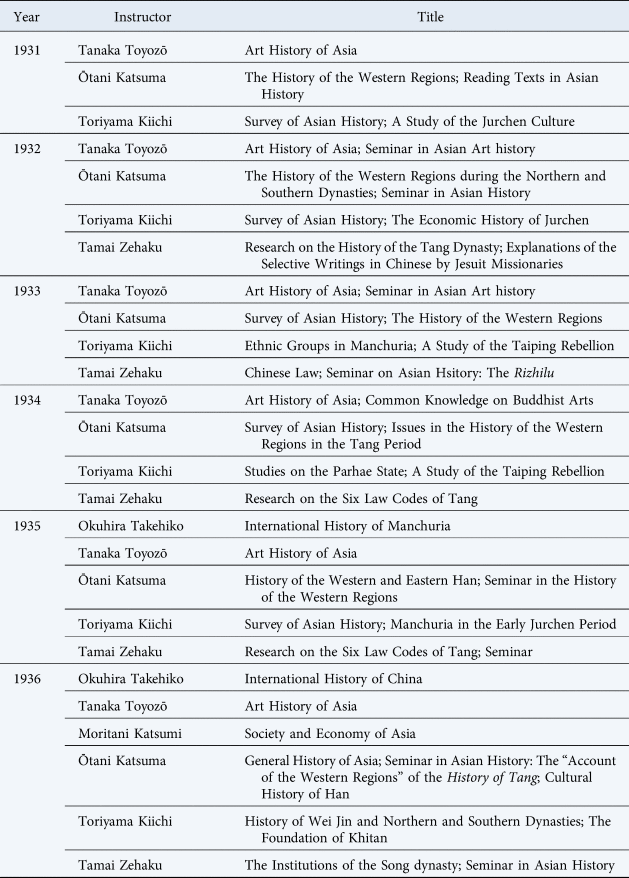
Table 1, showing the curriculum of Tōyōshi from 1931 to 1936 at Keijō University clearly demonstrates the origins of the studies of Chinese or Asian history in Korea.Footnote 54
Tōyōshi Curriculum at Keijō University, 1931–1936

The variety of courses on Tōyōshi that were offered during these six years do not differ much from present-day curricula in history departments of Korea. First, the basic survey courses on Asian or Chinese history and art history were offered almost every year. Second, the history of the specific periods such as the Han and Tang dynasties were offered. Third, more topical history courses such as Chinese law, institutions, and interstate relations were offered. Fourth, reading courses on original Chinese texts were offered. Last but not least were courses on border regions and border states, including the Western regions, the Jurchens, Khitans, Manchus, and Parhae. Locating Shina as only a part of Tōyō, Japanese historians may have been successful in manifesting their own Tōyōshi in Keijō University.
The following titles of graduation theses by Korean students majoring in Tōyōshi from 1931 to 1939 in Keijō University further indicate how effectively Japanese Tōyōshi was adapted to the nascent modern scholarship in colonial KoreaFootnote 55:
-
Ŏm Muhyŏn, “The Rise and Fall of the Xiongnu People in Asian History” (1931).
-
Kim Chongmu, “Rong and Di in Early China: Focusing on the Zhou and Chunqiu Periods” (1932)
-
Yi Wŏnhak, “Sima Qian's View of History in the Shiji”* (1932)
-
Ch'ae Kyut'aek, “The Land System of the Late (Northern) Wei Dynasty: Focusing on the Equal Field Law” (1933)
-
Kim Sŏnggyun, “The Relationship between Qing and Chosŏn during the Reign of Hong Taiji” (1934)
-
O Chinyŏng, “The Relationship between Rouran and the Northern Wei” (1934)
-
Yi Hŭngchong, “On the Regional Commanders of the Tang Period”* (1934)
-
Ch'ae Hŭisun, “On the Militia of the Northern Song”* (1935)
-
Sŏ Chŏngdŏk, “On the Canal Transportation of the Tang Period”* (1935)
-
Yi Ch'ang'ŏp, “Invading and Governing Manchuria in the Early Ming Period” (1935)
-
Yi Myŏngwŏn, “Wang Mang's Usurpation and His Politics from the Perspective of the Contemporary Thought at the End of the Former Han”* (1936)
-
Yun Yŏnggu, “The Granary of the Tang Period”* (1937)
-
Ch'oe Pyŏngmu, “The Policy of Suppressing Militarists in the Early Song Period”* (1937)
-
Sin T'aehyŏn, “A Study on the Problems of Land in the Jurchen Period” (1937)
-
Chŏng Chaegak, “Research on the Military System in the Early Ming Period”* (1937)
These fifteen theses must constitute the first studies by Korean students of Chinese history in the modern era. While the eight marked with an asterisk* could be classified as belonging to conventional topics in mainstream Chinese history, the remaining seven discuss the peripheral regions newly introduced by the Japanese Tōyōshi as indicated in the above curriculum. These talented Korean youngsters seem to have been satisfied with the evidential methodology and the extension of Asian history emphasized by modern Japanese historiography. According to Pak Kwanghyŏn, four of them (Kim Sŏnggyun, Ch'ae Hŭisun, Sin T'aehyŏn and Chŏng Chaegak) played important roles in South Korean historical circles after liberation from Japanese colonial rule.Footnote 56 Chŏng Chaegak (1913–2000) in particular was a pioneer in Chinese or Asian history at Korea University.
Another important group of scholars went to study abroad in Japan. They received similar influences as their contemporaries majoring in Tōyōshi at Keijō University. Among them, Kim Sanggi (1901–1977), a Sinologist who graduated from Waseda University, is noteworthy in that he became the founding father of Chinese or Asian history at Seoul National University (hereafter SNU).Footnote 57 Another important faculty member in Chinese history at SNU, who succeeded Kim Sanggi, Ko Pyŏng'ik (1924–2004), went to Tokyo Imperial University to study Tōyōshi at the end of the colonial period. Ko was the first Korean Sinologist to receive his PhD in the West, from Ludwig-Maximilians-Universität Munich in 1956.Footnote 58 Chŏn Haejong (1919–2018) is another important Sinologist to be mentioned, in that he went to Tokyo University to study political science but graduated from Keijō University (SNU from 1948) in Chinese history in 1947. Teaching at SNU from 1952 to 1967, Chŏn joined Sŏgang University, another leading Korean institution for history, as one of the founding members of the academic field of Chinese history. As the first generation of modern Korean scholarship on Chinese history, these three figures played very important roles in the early stage of the modern scholarship in Tongyangsa (J. Tōyōshi) after liberation.Footnote 59 Like all other academic fields in Korea, Chinese history was shaped by colonial legacies.
A New Branch of Research
Although Japanese Tōyōshi paved the way for Korean scholarship in Chinese history in the second half of the twentieth century, another important shift in direction was inevitable as part of further development. The eruption of nationalistic fever following liberation from Japanese colonial rule in 1945 inspired a boom in Korean studies, fueled especially by the hope of correcting and revising the historiography of Korea during the colonial period, which was believed to have been distorted by Japanese imperial historians. It is no coincidence that the three pioneers of the Tongyangsa mentioned above, who studied in Japan, also participated in this nationalistic trend in the 1960s.
Of more than 30 articles written by Kim Sanggi between the late 1940s and the early 1970s, only two or three could be classified as Chinese history.Footnote 60 Most of the other works are in fact on the interactions between Korea and China. Learning Sinitic texts from a young age, as well as philological methodology at Waseda in his late twenties, Kim was rare at that time for being versed in both old Sinology and new scholarship of Japan. He examined various topics such as the migrations of ancient Korean related tribes, the travle of Korean people to China and their trade, Koryŏ's independence movements from China and the Mongols, Koryŏ's cultural exchanges with China and its cultural superiority to the Khitans and Jurchens, foundation myths of Korea, and even the Tonghak Peasant Revolution at the end of the nineteenth century. Using the title “tongbang” 東方 rather than “hanjung” 韓中 in the two collections of his articles,Footnote 61 Kim may have wished to establish the independent roles Korea played in East Asian history or to understand East Asian culture from the perspective of Korea.Footnote 62
Like his contemporaries, Ko Pyŏng'ik's study in the field of Tongyangsa was disrupted by the Pacific War. Studying in the Department of Tōyōshi at Tokyo University for a year or so, he came back to Korea and continued his studies at Keijō University under the tutelage of Kim Sanggi. In spite of being strongly influenced by the meticulous Japanese evidential scholarship, Ko pursued interpretive historiography from a broader perspective. His BA thesis on the roles of Islamists in Yuan society was well-received.Footnote 63 After receiving his PhD with a thesis on the historiography of Liu Zhiji's Shitong 史通, Ko tried to break through the borders separating the three East Asian countries, China, Japan, and Korea, and engage in comparative history. The first topic he chose was the closed-door policies of the three countries. He further examined the common emergence of Confucian opposition to Buddhism in the three countries in the early modern age.Footnote 64 Another important aspect of Ko's scholarship includes Korea's cultural and diplomatic exchanges with other countries such as China, Mongolia, India, and Russia.Footnote 65
Chŏn Haejong's study is different from the other two pioneers discussed here in that, focusing on the diplomatic relationships between Korea and China, he tried, for the first time, to systematize the so-called “Han-Chung kwangyesa” 韓中關係史 (history of Korean-Chinese relations). Investigating the institutional changes in the relationships between China and neighboring countries including Korea from the ancient period, Chŏn closely analyzed the Tongmun hwigo 同文彙考 (Collection of Documents Exchanged between Korea and China, and Korea and Japan) compiled in 1788 to theorize the Sino-Korean tributary relations in the Qing period.Footnote 66 His contributions to the transnational history of Korea and China provided later scholars with the foundation for the new field.Footnote 67
It is important to note, on the one hand, that this new branch of research motivated by the strong nationalistic milieu enlarged the area of studies to which Korean scholars could contribute. On the other hand, it clearly demonstrates how difficult it was for Korean academia to advance in the realm of modern Sinology.
Min Tugi and Tongsakwa
The trajectory to modern Korean Sinology is to some degree a painful recovery of the collapsed tradition of premodern Sinology, with the important difference that the restoration took a completely different form from that of half of a century earlier. The dire economic conditions after the Korean War and, especially, the victory of communism in China further delayed revitalization. There were only four departments of Chinese Language and Literature at the college level by the 1960s: SNU from 1946, Kyunghee University from 1952, Hankuk University of Foreign Studies from 1954, and Sungkyunkwan University from 1955. A few other schools such as Korea University and Yonsei University established similar departments in the 1970s. Likewise, it was not until the 1960s that Korean scholars for the first time organized such academic associations in Sinology as the Han'guk Chungguk hakhoe 韓國中國學會 (The Korea Society for Chinese Studies) in 1962 and the Tongyang sahakhoe 東洋史學會 (The Society for Asian Historical Studies) in 1965. Modern Korean Sinology was only just starting to develop.
However, studies in Chinese history were marked by considerable growth during the 1970s and 1980s. Most history departments at the college level had at least one or two tenure-track Chinese history positions. Several universities, such as Korea, Sŏgang and Yonsei, developed their own graduate programs in Chinese history in their respective history departments.
I will focus here, however on SNU, where the History Department split into three separate departments in 1969: the Kuksa hakwa or Department of Korean history, the Tongyangsa hakwa (hereafter Tongsakwa) or Department of Asian history, and the Sŏyangsa hakwa or Department of Western history. Although the division reminds us of the beginning of a similar system at Tokyo Imperial University in 1889, the Tongsakwa was the biggest beneficiary of the division.Footnote 68 Only five master's degrees in Chinese history were granted before the division at SNU.Footnote 69 And whereas tongyangsa was identified with Chinese history at the time, the trisection has led to a gradual expansion of the scope of the department to entirety of Asia. Still, Chinese history seems to have remained the core of Tongsakwa by the end of the 1980s.
It is no exaggeration to say that the Tongsakwa played a critical role in the development of modern Korean Sinology. There is also no question that a single figure, Min Tugi (1932–2000), was at the forefront of the endeavor. He entered into the History Department of SNU around the time of the Korean War to study Chinese history under the tutelage of Kim Sanggi and Ko Pyŏngik. Joining the department at the time of the division in 1969, Min made the greatest contributions as a scholar and pedagogue not only to usher in the heyday of Tongsakwa but also for studies of Chinese and Asian history in Korea. The fact that Min's first publication, in 1953, is a book review of Cora Du Bois's Social Forces in Southeast Asia (1947)Footnote 70 foretold the diverse approaches in his future scholarship. His first contributions to Chinese history were on Han dynasty topics such as the relocation of the powerful families to the towns of royal mausoleums (lingyi 陵邑) and the formation and background of the Discourses on Salt and Iron (Yantielun 鹽鐵論).Footnote 71 There were several more articles on the central bureaucracy and the tax system of the Han empire. But by the end of the 1960s his interest moved to the Qing period, with various topics on the gentry, and later on the reform and revolutionary movements in the nineteenth and twentieth centuries, especially the “modern transformation of tradition.” Publication of a collection of his articles translated into English,Footnote 72 and the high acclaim that followed its publication in 1989,Footnote 73 clearly show him to be the first world class Korean Sinologist in the modern era. Min was proud of reviews by foreign scholars. In his autobiography that covers the period from his birth to retirement in 1997,Footnote 74 Min especially quotes Jonathan K. Ocko's comment: “Thus, although five essays in this volume of translations first appeared in Korea before 1970 and another essay appeared in 1978, they have not been superseded by subsequent scholarship and remain instructive, stimulating reading.” The second English collection of his articles was published at the time of his retirement.Footnote 75
In addition to producing many articles that have not been translated and are thus largely unknown to the West but deeply influential in the Korean studies of Chinese history,Footnote 76 Min was important as a teacher. As the tides of the Cultural Revolution gradually subsided in the late 1970s, China again attracted interest, so that many talented students applied to the Tongsakwa. Two more positions for late imperial and ancient Chinese history were filled by O Kŭmsŏng and Yi Sŏnggyu, respectively. Kim Yongdŏk in Japanese history and Pak Hanje in medieval Chinese history followed O and Yi in 1985. The number of graduate students increased rapidly totaling about thirty.
The Tongsakwa in the 1980s was notorious for the demanding course works designed by Min. In particular, the “Introduction to Asian History” for sophomores and “Supervising research (BA paper) on Asian History” for seniors, taught by Min, lived-up to their reputation in their strict training and heavy requirements. Other faculty members could not help but follow Min's example. Another important point Min stressed was foreign language education. There were few books and articles on Chinese history written in Korean by the 1980s. Most of the secondary scholarship that were dealt with in undergraduate classes of the Tongsakwa were written in Chinese, Japanese and English. Classical Chinese reading courses were another important part of the curriculum. Most undergraduate students in the department could read foreign languages by their junior year. Graduate seminars were organized even more rigorously. Min also stubbornly opposed his students choosing as their thesis topics the relationship between Korea and China. Instead, he instructed students to focus on China itself, reflecting the fact that the general trend in the first generation of modern scholars mentioned above overlooked the internal characteristics and developments of Chinese history.
It took about three years for the master's students of the Tongsakwa to pass the high standard Min set for the thesis requirements. Luckily, the Korean government doubled the university quota in the 1980s. More than half of the professor positions opened in Chinese history at that time may have been filled with the masters degree holders from the Tongsakwa. Many young scholars of Chinese history played active roles in the Society for the Asian Historical Studies. Among the many scholarly achievements of the graduates from the Tongsakwa, the single most important was the publication of the Kangjwa Chungguksa (Chinese history for lectures).Footnote 77 Composed of a total of thirty-five thematic articles covering the ancient to modern period in seven volumes,Footnote 78 this huge project with thirty participants commemorating the twentieth anniversary of the Tongsakwa provided Korean students in Chinese history (including me) with substantial in-depth guidelines for the study of Chinese history. Without Min's strong leadership, the project could not have been completed.
All of the junior faculty members of the department followed Min and became leading scholars in their own fields. Yi Sŏnggyu (b. 1946) is indeed the father of ancient Chinese history in Korea. He is one of the first Korean scholars working on bamboo slips such as the Qin legal statutes from Yunmeng 雲夢 in the late 1970s to study the ruling system of the Qin state during the Warring States period. Yi further synthesized his own view of “the organization and state control of commoners” or qimin zhipei tizhi 齊民支配體制 in the establishment of the Qin empire.Footnote 79 In the 1990s and 2000s, Yi's studies on the newly excavated bamboo slips of Qin and Han shifted their focus to the administration of state policies. His long-term endeavors finally came to fruition in 2019, as another masterpiece in the Qin and Han history, Qin and Han, the Empires of Numbers: Rule by Calculation and Measurement.Footnote 80 Many students have followed and developed Yi's idea and methodology, which has led me to believe that current Korean scholarship on Qin and Han history deserves more international attention.
Pak Hanje (b. 1946), who specialized in the Northern Dynasties such as the Northern Wei before the unification of the Sui in 589, proposed the theory of the Sino-Barbarian Synthesis or Hu-Han tizhi 胡漢體制 that emphasizes the creation of a new culture based on a fusion of the Chinese and northern ethnic groups rather than the simple assumption of Sinicization.Footnote 81 His interest further extended to the cities of Luoyang and Chang'an, the capitals of the Northern Wei and the Tang, respectively. Revealing cultural elements of the northern ethnic groups from the structures and city lives of the two capitals, Pak surmises that unlike Chang'an in the Han period, the two cities were also the products of the Sino-Barbarian Synthesis. Recently, Pak published two books of his articles on medieval Chinese cities: The Construction of Chinese Capitals and Their Positions: On the Eve of the Emergence of Chang'an in the Sui and Tang Periods and Medieval Chinese Capitals and the Sino-Barbarian Synthesis.Footnote 82 Needless to say, Pak played a leading role in the Korean studies of medieval Chinese history.
O Kŭmsŏng (b. 1941) followed Min Tugi's studies on the gentry in the Ming and Qing periods, especially focusing on the social changes between the gentry and the state. His first book, The Socio-Economic History of Early Modern China: The Formation of the Gentry Class in the Ming Period and their Socio-Economic Roles, was translated into Japanese in 1990.Footnote 83 Reading local gazetteers and anthologies from the Ming and Qing widely, O meticulously analyzed socio-economic issues such as the movement of population and the expansion of irrigation facilities region by region. He compiled his articles into the following two books in 2007: The State Law and Social Practice: Studies in the Socio-Economic History of the Ming and Qing Periods Footnote 84 and The Coexistence of Contradiction: Studies of Jiangxi Society of Jiangxi in the Ming and Qing Periods.Footnote 85 Both books were translated into Chinese.Footnote 86 O's work also contributed substantially to the next generation of scholars in Ming and Qing history, which I believe is one of the most advanced fields in modern Korean Sinology.
It is regrettable to skip the important roles many other scholars played in the growth of Chinese history in the 1970s and 1980s, but few Korean scholars working on Chinese history would deny the great contributions of Tongsakwa and Min Tugi. As mentioned by Yi Sŏnggyu in the essay on the 35-year history of the Tongsakwa,Footnote 87 however, the rigor of the department seems to have been weakened in the 1990s and 2000s, especially after Min's retirement in 1997. The heyday of the department was now in the past, bearing Min's unparalleled footprint, but a new age of Korean scholarship in Chinese history had begun. A good number of Korean students who studied abroad in Europe, the United States, Japan, and China in the last two decades of the twentieth century added an international flavor and raised the level of scholarship in Chinese history.
A New Age
A year before the establishment of diplomatic ties with China in 1992, the Korean Society for Asian Historical Studies (Tongyang sahakhoe) held a monumental workshop in Beijing. Organized by Pak Wŏnho (b. 1944), another leading scholar in the Ming and Qing periods at Korea University who spent his sabbatical at Beijing University at that time, fifty Korean scholars from twenty-two universities visited China mostly for the first time to attend the three-day workshop with Chinese scholars. Eight Korean scholars, including the four at SNU mentioned above,Footnote 88 presented papers and engaged in discussions with their Chinese counterparts.Footnote 89 As Korean scholars shared their own scholarship from the last several decades, Chinese scholars were amazed by the passion of the Korean participants as well as the high level of their scholarship. This first meeting culminated in a book that compiled eight papers and discussions.Footnote 90 Unlike their predecessors in late Chosŏn who dreamed of visiting Beijing as the center of their civilization, to the Korean participants in 1991, Beijing was a place for sharing their scholarly curiosity. The reopening of scholarly exchange marked the prelude to the subsequent flood of interchanges.
Indeed, Chinese history in Korea has rapidly grown both quantitatively and qualitatively since the establishment of diplomatic ties. Tongyang sahak yŏn'gu (the Journal of Asian Historical Studies) for the Korean Society of the Asian Historical Studies increased its publications from biannual to quarterly in 1992, and several academic branches of the society began to form around the same time. Starting as small research groups for specific periods such as the Pre Qin and Qin-Han in the 1980s and 1990s, the groups temporally adjacent to each other merged into larger associations covering broader historical periods by the early 2000s. In addition to the Society for Asian Historical Studies as the leading society covering the entire periods in Asian history,Footnote 91 the three major branch societies, the Society for Historical Studies of Ancient and Medieval China, the Society for Ming-Qing Historical Studies, and the Korean Association for Studies of Modern Chinese History, have published the following journals: Chungguk kochungsesa yŏn'gu 中國古中世史硏究 (Historical Studies of Ancient and Medieval China), published its sixtieth volume in May 2021 (it has been quarterly since 2014); Myŏng-Ch’ŏngsa yŏn'gu 明淸史硏究 (Journal of Ming-Qing Historical Studies published it's fifty-fifth volume in April, 2021 (biannual since 1994); and Chungguk kŭnhyŏndaesa yŏn'gu 中國近現代史硏究 (Korean Studies of Modern Chinese History), saw its 90th volume published in May 2021 (quarterly since 2003). Thirty-five articles were published in the latest issues of the four major journals in Chinese history, totaling about 120 papers in a year. The Journal of Asian Historical Studies has published the annual bibliographies of Asian history and Sinology in general in Korea since 1966 mostly in the last volume of each year. Among about 1,600 articlesFootnote 92 and 300 books published in 2019, more than 80 percent of the articles and about half of the books are on China. About fifteen PhD dissertations and twenty-seven Masters theses were in Chinese history.Footnote 93
Celebrating the fiftieth volume of the Journal of Asian Historical Studies in 1995 and recollecting the leap forward in the studies of Chinese history, Min Tugi appreciated the increase in the number of the monographs, the methodological diversification beyond political and intellectual history in a narrow sense, and the active interactions with foreign scholars. But he still expected to enhance the level of scholarship that focused on economic, socio-economic and cultural history, especially created by Korea's own academic tradition rather than depending on foreign methodologies.Footnote 94
Ten years after Min's overview, Yi Sŏnggyu further reviewed the development of study of Asian history in Korea for the previous sixty years as follows: expansion from Chinese history to East Asian history, ready access to materials, active international exchanges, multifaceted and complex understanding of China, the diversification in interests and topics, the emphasis on fieldwork, and the escape from excessive influence from Japanese scholarship. Celebrating the fiftieth anniversary of the Korean Society for the Asian Historical Studies in 2015, Yi praised the remarkable growth of scholarship and proudly listed the leading Korean contributions to Chinese history as follows: his own study of the “organization and the state control of commoners” for the Qin and Han, the syntheses of Sino-barbarian and immigrants-natives (qiaojiu 僑舊) for the Northern and Southern Dynasties, studies of the tributary orders, legal history, cities, the gentry, the merchants of Huizhou 徽州, the reform movements in the late Qing, the 1911 Revolution, the National Revolution in 1924–1928, Chinese warlords, regional studies focusing on the specific areas such as Shanghai, and finally the notable studies of nomadic empires such as the Turks, the Uyghurs, the Mongols and the Manchus.Footnote 95 Another important achievement Yi stressed is a number of annotated translations of unearthed texts, legal documents, travelogues, and especially, the biographies of foreign peoples in the Twenty-five Official Dynastic Histories.Footnote 96
This dramatic change is well attested in the articles published in the three period journals mentioned above. The following list of titles in the latest volumes of the three journals shows how Korean scholarship in Chinese history has entered a new age:
-
Historical Studies of Ancient and Medieval China 60 (May 2021)
-
Special Issue: The “Wuxing zhi” 五行志 in Official Chinese History:
-
Kwŏn Min'gyun, “The Textual Value and Significance of the ‘Hongfan wuxing zhuan’ 洪範五行傳 in the History of the Five Phase Theory in the Han Period,” 1–35.
-
Hong Sŭnghyŏn, “The Recognition of Sun Wu (Eastern Wu) as the Beginning of the Southern Dynasties Reflected in the ‘Wuxing zhi’ and the ‘Soushen ji’ 搜神記 of the Songshu 宋書,” 37–84.
-
Kim Hansin, “The Transition in the Theory of Calamity as a Warning Signal in the Tang and Song Periods: Based on the ‘Wuxing zhi’ of the Jiu Tangshu 新唐書 and the Xin Tangshu 舊唐書,” 85–107.
Articles:
-
Kŭm Chaewŏn, “The Bamboo Slips Passed on to the Families: A Reconsideration of the Nature of Qin Legal Documents from Shuihudi,” 109–43.
-
Chŏng Pyŏngjun, “The Rebellions and the Disturbance of the fanzhen 藩鎭 in the Jianghui 江淮 Region during the Reign of Tang Emperor Dezong: Focused on the Attitude of Chen Shaoyu 陳少遊, the Military Commissioner at Huainan 淮南,” 145–79.
-
Yŏm Kyŏng'i, “The Invasion of the Nan Zhao 南詔 State in Chengdu in 829 and Its Influence on the Relationship between Nan Zhao State and the Tibetan State,” 181–204.
-
Journal of Ming-Qing Historical Studies 55 (April 2021)
-
Ku Pyŏmjin and Chŏng Tonghun, “Re-reading Zhu Yuanzhang's ‘Speech of Denunciation’ and the Relationship between Koryŏ and Ming in 1372,” 1–41.
-
Yi Okja, “Hong Taiji's Reform of the Manchu Banner System and Military Campaigns on the Donghai Jurchen, 1634–1635,” 43–75.
-
Yim Kyŏngjun, “Tobacco Culture and the Prohibition of Smoking in the Early Qing,” 77–109.
-
Ch'ae Kyŏngsu, “The Qing Empire's Decision to Occupy Taiwan from the Maritime Historical Perspective: Focused on the Change in Penghu's 澎湖 Geopolitical Status from the End of the Ming and to the Early Qing,” 111–51.
-
Yi Miyŏng, “Mei Wending's 梅文鼎 Understanding of the Lü 律, Li 曆 and Tianwen 天文 in the Compilation of the ‘Li zhi’ 曆志 of the History of the Ming,” 153–205.
-
Kim Chunyŏng, “The Role of Clan Leaders in the Daily Lives of Manchus in the Mid Qing Period,” 207–39.
-
Chŏng Ŭnju, “Beijing through the Maps and Paintings of National Ceremonies during the Reign of Qianlong,” 241–78.
-
An Kwangho, “An Analysis of the Meaning of the benguan 本貫 in the Hongloumeng,” 279–302.
-
Kim Hyŏnmi, “The Influx of Cholera and the Subsequent Endemicity in Hubei and Hunan Provinces during the Nineteenth Century,” 303–36.
-
Korean Studies of Modern Chinese History 90 (June 2021)
-
Cho Pyŏngsik, “The Judicial Functions of the Tianjin Police, 1902–1911,” 1–34.
-
Kim, Chŏnghyŏn, “Father Vincent Lebbe's Indigenized Mission to China and Devotion to Saving China,” 35–62.
-
Hwang Yŏngwŏn, “A Pro-Japanese Faction Crossing the Borders: Yi Wanyong and the Discourse about Collaborators in Modern China,” 64–94.
-
Son Sŭnghŭi, “Changes in the Factors of Marriage Registration in the Republican Period: Focused on Marriage Contracts,” 95–132.
-
Son Sŏng'uk, “The Reports on the March First Movement Prior to the May Fourth Movement by English Language Newspapers in Shanghai,” 131–56.
-
Son Changhun, “Cadres in the Urban Grassroots of the People's Republic of China: Focused on the Neighborhood (lilong 里弄) Cadres in Shanghai,” 157–90.
-
Yi Sangho and Pak Sŏngjin, “The Changes in the Strategic Evaluations of Taiwan by the United States Before and After the Outbreak of the Korean War,” 191–214.
-
Yi Wŏnjun, “Mao Zedong's Perception of the World and the Variation of the ‘Intermediate Zone’ Theory, 1946–1976,” 215–42.
This list of the titles show that topics, materials, and methodologies applied in current Korean scholarship in Chinese history leaves almost no lacunae. In spite of the remarkable growth over the last three decades, there are still problems generally acknowledged in Korean academia. Yi Sŏnggyu's following criticism accords well with the situation.Footnote 97 First, the fragmentation of research has something to do with the excessively narrow topics as well as the lack of intellectual networks among scholars. Yi regrets the rarity of approaches crossing periods and regions as well. Second, sensitivity to current issues such as the dispute on history textbooks among the three East Asian countries had led scholars to waste their energy in non-scholarly works. Third, and most important I believe, the dearth of the culture of criticism constitutes the weakest point, something that most Korean scholars in Chinese history recognize. It is lamentable to find not a single book review in the latest volumes of the three journals mentioned above. Nor are many book reviews published in the other journals. Although the Korean review system for college professors does not involve book reviews, I think the lack of criticism largely prevalent in Korean academia is a topic worth examining historically. All the same, there is no question that the academic rigor Korean scholars in Chinese history have pursued since the colonial period has contributed to enhancing scholarship in Korean humanities more generally.
Concluding Remarks
Surveying the long history of Korean Sinology particularly focusing on Chinese history in the modern period brings to mind two important yet unconnected points. The first is the problem of “tradition” in the history of Korean Sinology. One may wonder why scholarship after liberation from Japanese colonial rule developed rapidly even in the underdeveloped economic and political condition of the 1970s and 1980s. In my opinion, the academic achievements in the second half of the twentieth century owe something to the Sinitic studies in the Chosŏn period. Although most of the Sinological works by Chosŏn scholars failed to find direct successors in the modern age, the strong enthusiasm and reverence they bore for studying the Chinese classics could not easily disappear. By the end of the twentieth century and even today, Hanhak, the studies of Chinese texts, seems to have maintained an ambivalent status as an outdated but important realm of scholarship and a sign of erudition. No Korean intellectual denies the profound influences from China in the premodern period. The general respect for studying the Chinese classics and culture that still remains strong among Korean intellectuals originated at least in part from the Sinological tradition that flourished in the Chosŏn period.
The second problem is more practical, and it stands on the assumption that Korean scholarship in Chinese history over roughly the last three decades is underestimated in the world of Sinology. Only a few studies have been introduced to foreign audiences. Because Korean is not a key language from a scholarly perspective, it is difficult for foreign Sinologists to overcome the significant language barrier. The quality of digital translation is still behind that of human translation especially between Korean and Chinese and Korean and English. But one useful tip in this regard is that digital translation from Korean to Japanese has already attained a dependable level. Korea is one of the most digitized countries in the world, providing most academic articles in digitized format through integrated search sites such as KISS (Korean-studies Information Service System: https://kiss.kstudy.com/index.asp), RISS (Research Information Sharing Service: http://www.riss.kr/index.do), DBpia (https://www.dbpia.co.kr/), and KCI (Korea Citation Index: https://www.kci.go.kr/). Putting in keywords in English or Chinese directly leads to related articles with abstracts either in English or Chinese. Another useful tool for searching articles in Chinese history is the annual bibliography generally issued in the last volume of the year in the Journal of Asian Historical Studies or Tongyang sahak yŏn'gu.
Conflicting interests
The author declares none.