I. INTRODUCTION
During the past decade, modification of carbon nanotubes (CNTs) has attracted great attention due to its intrinsic poor compatibility with polymer matrix.Reference Peng and Wong1–Reference Baskaran, Mays and Bratcher3 One of the intriguing directions is patterning semicrystalline polymers on CNTs surface. Occasionally, a novel nanohybrid shish kebab (NHSK) superstructure, in which fibrillous CNTs act as shish and induce polymer crystal lamellae (kebab) periodically decorating on its surface, can be achieved.Reference Li, Li, Cai, Kodjie and Tenneti4–Reference Garcia-Gutierrez, Hernandez, Nogales, Pantine, Rueda and Ezquerra11 This hybrid structure not only physically prevent CNTs from agglomeration in solvents and polymer matrix but also effectively bond polymer matrix and CNTs together.Reference Yang, Wang, Wang, Zhang, Chen, Du and Fu12–Reference Zhang, Lin, Wong, Bucknall and Kumar14 In addition, NHSK could realize the periodical functionalization of CNTs and provides a unique way to create functional ordered structures along one-dimensional CNTs for electrical and optical applications, which is a very attractive field of research.Reference Li, Li, Hood and Li15, Reference Li16
NHSK was first observed by Li et al.Reference Li, Li, Cai, Kodjie and Tenneti4, Reference Li, Li and Ni9 in polyethylene (PE) and Nylon 66 solution crystallization in the presence of CNTs. Since then, NHSK has attracted tremendous attention,Reference Li, Li and Ni9, Reference Garcia-Gutierrez, Hernandez, Nogales, Pantine, Rueda and Ezquerra11–Reference Mai, Wang, Yao, Deng, Chen and Fu13, Reference Li, Yang, Yang, Chen, Hsiao, Chu, Spanier and Li17, Reference Zheng and Xu18 with special attention paid to CNTs nucleation ability and polymer lamellae orientation on CNTs surface, which was reported to be mainly affected by the diameter and wall structure of CNTs.Reference Garcia-Gutierrez, Hernandez, Nogales, Pantine, Rueda and Ezquerra11, Reference Wang, Xie and Ye19, Reference Zhang, Chang, Zhang, Chen and Xu20 It has been reported that CNTs diameter could play a key role in polymer lamellae orientation on CNTs surface. For CNTs with a relatively small diameter (about 10 nm), NHSK with PE lamellae perpendicular to CNTs axis was achieved. In this case, polymer chains oriented exclusively parallel to the long axis of CNTs, due to the geometry confinement, thus a well-ordered patterning of polymer lamellae on CNTs surface was achieved.Reference Li, Li and Ni9 However, with increasing the diameter of CNTs, multiple orientations of PE lamellae on CNTs surface were formed, obeying the epitaxial growth mechanism. Recently, Li et al.Reference Li, Yang, Yang, Chen, Hsiao, Chu, Spanier and Li17 investigated the effect of CNTs sidewall structure on the formation of NHSK using solvent evaporation and thin-film crystallization. They observed that NHSK structure can be obtained in AD-MWNTs [multiwalled carbon nanotubes (MWNTs) synthesized by arc discharged method] systems with an ordered and less deficient wall structure, whereas NHSK is absent in CVD-MWNTs (MWNTs synthesized by chemical vapor deposition method) systems with a more deficient wall structure. From the crystallography point of view, the key point for NHSK formation is the orientation of polymer chains on CNTs surface and the lateral formation of stable nucleus. Therefore, the factors which hinder the orientation of polymer chains along CNTs axis and the formation of stable nucleus, such as the poor ordered wall structure of CNTs, could be an obstacle for the formation of NHSK structure.Reference Li, Wang, Laird, Li, Defaux and Ivanov5, Reference Li, Li, Yang and Li8 However, the factors which can facilitate the alignment of polymer chains on CNT surface and decrease the nucleation barrier, such as external shear or extension stress, may benefit the formation of NHSK.Reference Yang, Wang, Wang, Zhang, Chen, Du and Fu12
Furthermore, it has been observed that some special surface topography structure of CNTs such as shallow ditches or grooves could favor the orientation of polymer chains on there surface and make heterogeneous nucleation and crystallization much easier.Reference Binsbergen21, Reference Page and Sear22 Recently, a quantitative measurement of the nucleation rate in a groove has been studied via computer simulation by Sear and Page.Reference Page and Sear22 They found that nucleation in the grooves is many orders of magnitude faster than on a flat surface. These interesting results inspired us to ask the following questions. For CNT bundles, on the surface of which “groove structure” can be formed by the stacked CNTs in parallel arrays, will the nucleation ability of CNTs be improved? Is it easier to form NHSK? Can we obtain well-ordered polymer patterning on CNT bundles with a relatively large diameter? Therefore, in this work, we aim to explore the nucleation ability of CNT bundles on PE crystallization to deeply understand the formation mechanism of NHSK structure. Furthermore, we try to explore the effect of the unique “groove structure” formed by CNT bundles on the orientation of PE lamellae on the surface of CNT bundles to achieve more ordered pattern of polymers on CNTs, which are important for functional design in nanodevice applications.
II. EXPERIMENTAL SECTION
A. Materials
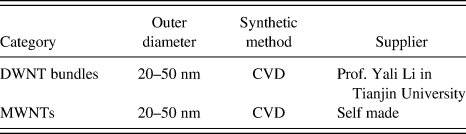
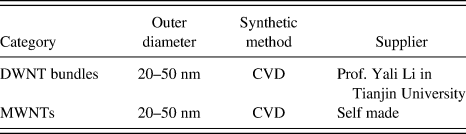
Two kinds of commercially available high density polyethylene with different molecular weight were used in this study and are listed in Table I. Two types of CNTs fibers with different surface topography structure were used in this study and are listed in Table II.
Summary of polymers used in this study.

Summary of CNTs used in this study.
B. Preparation of the sample
NHSK structure was obtained by solution crystallization method. For all the systems, p-xylene was used as the solvent. 3 mg PE was dissolved in 30 g p-xylene at 125 °C. A section of CNT fibers (about 0.1 mg) were then added into PE/p-xylene solution and hold at 125 °C for 10 min. The mixture was then quickly transferred into a thermostat oil bath pot and hold for 1 or 2 h for isothermal crystallization. The crystallization temperature was 95 or 100 or 105 °C. Samples were than filtered and washed by hot p-xylene after crystallization to remove uncrystallized PE.
C. Characterization
Transmission electron microscopy (TEM) (FEI Tecnai G2 30, Philips, Eindhoven, Netherlands) experiments were conducted with an accelerating voltage of 200 kV to obtain the high definition images of CNTs. A field-emission scanning electron microscope (SEM) (JSM-5900LV, operating at 10 kV, JEOL, Tokyo, Japan) was used to characterize the morphology of CNTs and polymer functionalized CNTs. A micro-Raman spectrophotometer (LABRAM HR800, Jobin-Yvon, France) with a wave length of 532 nm was used to characterize the wall structure of CNTs.
III. RESULTS AND DISCUSSION
A. Morphological observation of MWNTs and double-walled carbon nanotube bundles
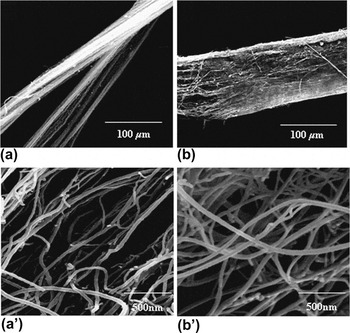
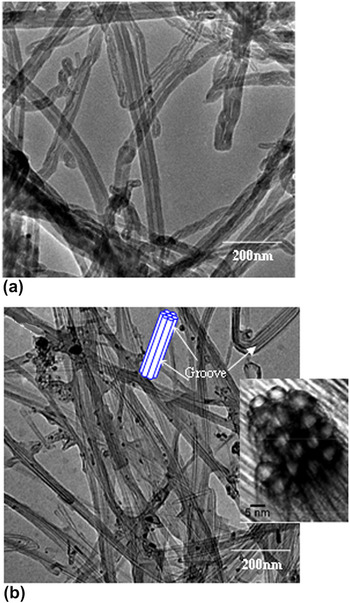
In this work, to investigate the effect of surface groove structure of CNTs bundles on nucleation ability and polymer crystallization, two types of CNTs fibers are used, as shown in Figs. 1(a) and 1(b), respectively. To see clearly the CNTs orientation and diameter, SEM images with higher magnification are shown in Figs. 1(a’) and 1(b’). For both fibers, not all the CNTs were aligned along the long axis of the fibers. In addition, both types of CNTs have the same diameter range of 20–50 nm. However, the surface topography structure of these CNTs is different, as can be observed from the TEM images shown in Fig. 2. One type of CNTs is actually separated MWNTs with a relatively smooth surface, as shown in Fig. 2(a), whereas the other type of CNTs is double-walled carbon nanotube (DWNT) bundles, which are formed by multiple stacked DWNTs with a surface “groove” structure, as shown in Fig. 2(b). From the inset in Fig. 2(b), we can observe the high definition TEM image of DWNT bundles, which shows the well-defined surface “groove” structure with a depth and width about 2–3 nm. It should be noted that the fibers formed by DWNTs bundles were originated from the layer-by-layer assembly of DWNTs with a diameter of 5–8 nm in the gas flow by CVD spinning process.Reference Zhong, Li, Liu, Qiao, Feng, Liang, Jin, Zhu, Hou and Li23
(a) Low and (a’) high magnification SEM images of CNT fiber formed by MWNTs; (b) low and (b’) high magnification SEM images of CNT fiber formed by DWNTs bundles.

TEM images to represent the surface topography structure of (a) MWNTs with a relatively smooth surface and (b) DWNT bundles with surface groove structure.

B. The wall structure of MWNTs and DWNT bundles
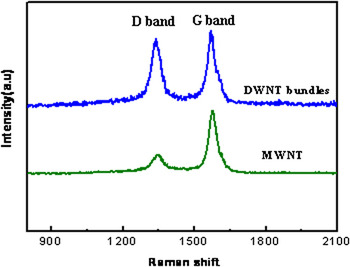
As the wall structure of CNTs could also dramatically influence its nucleation ability for polymer crystallization, therefore, in this work, the wall defect of MWNTs and DWNT bundles was characterized using Raman spectrums, as shown in Fig. 3. For both CNTs, two bands are clearly observed, one at ∼1576 cm−1(G band) and the other at ∼1350 cm−1 (D band). The CNT defect level is characterized by the intensity ratio of the D and G bands (R = I D/I G). From the figure, it is evident that MWNTs have very low D band intensity (R = 0.23), whereas DWNT bundles have much higher D band intensity (R = 0.91). Thus, MWNTs have a more perfect wall structure than DWNT bundles.
Raman spectrum of MWNTs and DWNT bundles.

C. Effect of surface groove structure of DWNT bundles on PE lamellae orientation
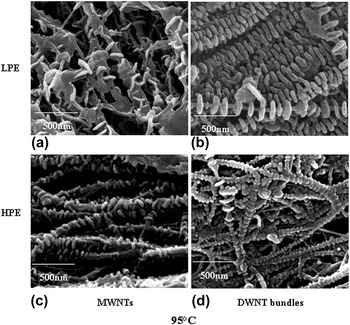
SEM images of two types of PE (with different molecular weight)-decorated MWNTs and DWNT bundles prepared by solution crystallization at 95 °C for 1 h using 0.01 wt% PE/xylene solution are shown in Fig. 4. For PE with a relatively low molecular weight (LPE; see Table I), as shown in Figs. 4(a) and 4(b), NHSK structure with LPE crystal lamellae (kebab) periodically decorated on CNTs (shish) is successfully obtained for both samples. However, by careful examination, the PE kebabs orientation is different. For MWNTs system, as shown in Fig. 4(a), PE crystal lamellae are not completely perpendicular to the long axis of MWNTs, some oblique to the MWNTs axis can be observed. This could be ascribed that for MWNTs with a diameter of 20–50 nm, NHSK formation could follow “epitaxy” mechanism, in which PE lamellae show multiple orientations on CNTs surface due to the crystallographic match between the polymer chain and the graphitic lattice, as proposed by Li et al.Reference Li, Li and Ni9 Nevertheless, when using DWNT bundles with the same diameter range as MWNTs (20–50 nm), almost all the PE crystal lamellae are perpendicular to the long axis of CNTs, as shown in Fig. 4(b). Since DWNT bundles have the same diameter range with MWNTs, and they even have a less perfect wall structure than MWNTs (see Fig. 3), this is most likely attributed to the surface “groove” structure of DWNT bundles, as shown in Fig. 2(b). To further demonstrate the effect of “groove” structure of DWNT bundles on PE lamellae orientation, with a relatively high molecular weight (HPE) are used to decorate MWNTs and DWNT bundles, as shown in Figs. 4(c) and 4(d), respectively. Similar to that, in the case of LPE/MWNTs systems, HPE crystal lamellae decorated on MWNTs surface show multiple orientations, whereas the lamellae decorated on DWNT bundles are almost perpendicular to the long axis of CNTs. This demonstrates again that the surface “groove” structure of DWNT bundles could dominate the polymer lamellae orientation on CNTs surface. The underline mechanism will be discussed in detail in the Sec. III. E. In addition, these results indicate that more ordered pattern of polymers on CNTs could be successfully obtained by using DWNT bundles with the unique surface “groove” structure, which are important for functional design in nanodevice applications.
SEM images to represent the NHSK structure with PE crystal lamellae decorated on CNTs prepared by solution crystallization at 95 °C for 1 h. (a) LPE/MWNTs; (b) LPE/DWNT bundles; (c) HPE/MWNTs; (d) HPE/DWNT bundles.

D. Effect of surface “groove” structure of DWNTs bundles on nucleation ability
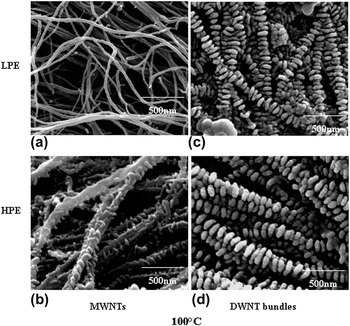
The surface “groove” formed by DWNT bundles is aligned along the long axis of CNTs, which could dominate the polymer lamellae orientation on their surface, as demonstrated in the above part. On the other hand, the surface “groove” formed by DWNTs bundles is of nanometer size (2–3 nm), which can provide the geometric confinement environment and thus could facilitate the formation of stable nucleus and promote polymer crystallization. Therefore, we further investigate PE-decorated MWNTs and DWNT bundles prepared by solution crystallization at a relatively high temperature (100 °C) for 2 h using 0.01 wt% PE/xylene solution, as shown in Fig. 5. For LPE/MWNT system, as shown in Fig. 5(a), NHSK structure is absent, which is obviously different from the sample crystallized at a relatively low temperature, in which NHSK structure is successfully obtained [see Fig. 4(a)]. The reason could be that LPE molecular chains absorbed on MWNT surface are easy to be dissolved into xylene solution due to the enhanced dissolving ability at a higher temperature, which leads to the sharply decreased stable nucleus on MWNTs surface. However, when using HPE with a relatively high molecular weight, as shown in Fig. 5(b), the number of HPE lamellae decorated on MWNTs surface is obviously increased comparing with LPE/MWNTs system, and the NHSK structure is successfully obtained. This could be ascribed that comparing with LPE, HPE molecular chains absorbed on MWNT surface are much more difficult to be dissolved into xylene solution even the dissolving ability of xylene solvent is enhanced with increasing crystallization temperature to 100 °C. Here, it should be noted that some fractionation of HPE molecular chains may occur, which could lead to the formation of PE kebabs from only the highest molecular weight fraction of the HPE, since the content of CNTs is much less than PE. Furthermore, as shown in Fig. 5(b), HPE lamellae coated on MWNTs surface show multiple orientations due to the crystallographic match between the polymer chain and the graphitic lattice. Nevertheless, when using DWNT bundles with surface groove structure, the fine NHSK structure with PE lamellae periodically decorated on CNTs surface is successfully obtained for both HPE and LPE systems, as shown in Figs. 5(c) and 5(d). This is obviously different from the MWNTs systems. And it indicates that the nucleation ability of DWNT bundles is indeed largely improved due to the surface “groove” structure, which could provide the geometric confinement effect and facilitate the formation of stable nucleus. In addition, we can also observe that almost all the PE lamellae decorated on DWNT bundles surface are perpendicular to CNTs long axis, which indicates again that the surface groove structure of CNT bundles could dominate the polymer lamellae orientation on CNTs surface.
SEM images of PE-decorated CNTs prepared by solution crystallization at 100 °C for 2 h. (a) LPE/MWNTs; (b) HPE/MWNTs; (c) LPE/DWNT bundles; (d) HPE/DWNT bundles.

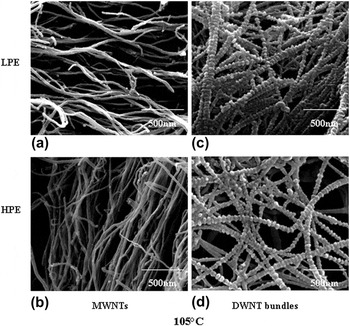
To further demonstrate the enhanced nucleation ability of DWNT bundles on PE crystallization caused by the surface groove structure, we further increase the crystallization temperature to 105 °C. The morphology of PE-decorated MWNTs and DWNT bundles are shown in Fig. 6. For MWNTs systems, we can clearly observe that NHSK structure is absent not only in LPE system but also in HPE system, as shown in Figs. 6(a) and 6(b), respectively. This means that the stable nucleus is difficult to be formed on MWNTs surface in xylene solution under such a high crystallization temperature even for HPE with a relative high molecular weight. However, for DWNT bundles systems, the fine NHSK structure with PE lamellae densely decorated on CNT bundles is obtained in both LPE and HPE systems. This further demonstrates that DWNT bundles with groove structure have very good nucleation ability on PE crystallization. On the other hand, almost all the PE lamellae decorated on DWNT bundles surface are perpendicular to CNTs long axis, which suggests again that more ordered pattern of polymers on CNTs could be successfully obtained by using DWNT bundles with the unique surface “groove” structure.
SEM images of PE-decorated CNTs prepared by solution crystallization at 105 °C for 2 h. (a) LPE/MWNTs; (b) HPE/MWNTs; (c) LPE/DWNT bundles; (d) HPE/DWNT bundles.

It should be noted that the much higher formation temperatures (T c) of NHSK for single-walled carbon nanotubes (SWNTs) bundles (104 °C) than that for MWNTs with a diameter of about 25 nm (97 °C) has also been reported by Li et al.Reference Li, Li and Ni9 This could be due to the more perfect wall structure of SWNTs. On the other hand, according to the results in this work, it could also be due to the surface groove structure of SWNT bundles, which shows a geometric confinement effect, thus could promote the formation of stable nucleus at a relatively higher crystallization temperature.
Here, one should also note that the crystallite size of the graphite lattice could also play an important role in nucleation efficiency of CNTs on polymer crystallization. In this work, the crystallite size of the graphite lattice may be different for the two types of CNTs. However, both these two types of CNTs have multiple orientations of the graphite lattice due to the existence of a variety of chiral configurations.Reference Li, Yang, Yang, Chen, Hsiao, Chu, Spanier and Li17 For PE/MWNTs systems, PE lamellae show multiple orientations on CNTs surface due to the crystallographic match between the polymer chain and the graphitic lattice. In this case, the crystallite size of the graphite lattice of MWNTs could play a major role in nucleation efficiency of MWNTs on PE crystallization. However, for PE/DWNTs bundles systems, almost all the PE crystal lamellae are perpendicular to the long axis of CNTs, indicating that PE lamellae growth on DWNTs bundles surface is not dominated by the graphite lattice of CNTs. In other word, the nucleation efficiency of DWNTs bundles on PE crystallization is not determined by the graphite lattice but by the unique surface “groove” structure, which will be discussed in detail in Sec. III. E.
E. Discussion on the enhanced nucleation ability and PE lamellae orientation by using DWNT bundles with “groove structure”
It is well known that the heterogeneous nucleation process of CNTs includes three stages: the adsorption of polymer chains on CNTs surface, the lateral chain orientation, and the formation of stable nucleus. Thus, the surface chemical and physical characteristics of CNTs could dramatically influence the nucleation ability and polymer lamellae orientation along CNTs long axis. For example, it is reported that the nucleation ability of CNTs on polymer crystallization could be largely decreased with the introduction of COOH groups onto CNTs surface. This could be ascribed that the existence of COOH group hindered the adsorption and orientation of polymer chains on CNTs surface.Reference Hu, An, Li, Geng, Li and Yang24 In addition, CNTs diameter and wall structure could also play a key role in nucleation ability and polymer lamellae orientation on CNTs surface, as described in Sec. I. A relatively low diameter (about 10 nm) and a more ordered wall structure could not only enhance the nucleation ability but also facilitate the polymer lamellar orientation along CNTs axis.
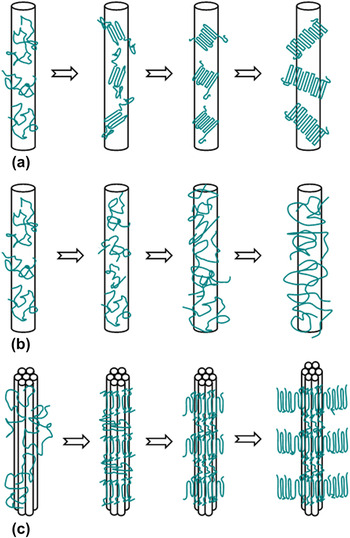
In this work, MWNTs and DWNT bundles have the same chemical structure and the same diameter range of 20–50 nm (see Figs. 1 and 2), but they have the different surface topography structure, as mentioned in Sec. III. A. In addition, MWNTs even have a more perfect wall structure than DWNT bundles. A hypothetic formation mechanism of PE-decorated MWNTs and DWNT bundles is shown in Fig. 7 and interpreted briefly as following. For PE/MWNTs systems crystallized at a relatively low temperature, NHSK structure could be successfully obtained, whereas PE crystal lamellae show multiple orientations on CNTs surface. With increasing crystallization temperature to a certain temperature, NHSK structure is even not able to be formed, whereas a thin layer of amorphous PE coating on MWNTs surface could be obtained. A schematic representation of the formation process of PE-decorated MWNTs in different crystallization temperature is shown in Figs. 7(a) and 7(b), respectively. In an initial situation, the polymer chains are random coils in solution, and a portion of chains near the MWNTs begin to be adsorbed onto the nanotube surface to reduce the high surface free energy of MWNTs. Then, they begin to adjust the conformation and orient on MWNTs surface following the crystallographic match between the polymer chain and the graphitic lattice. For a relatively low crystallization temperature, such as 95 °C, the further growth of oriented PE chains could easily form stable nucleus and then grow into NHSK structure, as shown in Fig. 7(a). However, for a relatively high crystallization temperature, such as 105 °C, the oriented PE chains could be easily relaxed and dissolved into solution due to the enhanced dissolving ability of xylene solution at a relatively higher temperature. In this case, only a thin layer of amorphous PE is decorated on MWNTs surface, as shown in Fig. 7(b). However, for PE/DWNTs bundles systems, NHSK structure with PE crystal lamellae almost perpendicular to CNTs surface could be successfully obtained even at a high crystallization temperature of 105 °C. The corresponding schematic representation is shown in Fig. 7(c). The formation process of NHSK structure follows the following four steps: the adsorption of random PE chains on CNTs surface, orientation of PE chains along CNTs axis via adjusting chain conformation, the formation of stable nucleus, and crystal growth. In this case, the stable nucleus could be easily formed even at a relatively high temperature of 105 °C, due to the surface groove structure of DWNT bundles. On the other hand, the absorbed PE chains on the surface of DWNTs bundles are oriented exclusively parallel to the long axis of CNTs bundles, which lead to the perpendicular growth of PE lamellae on DWNTs surface. These different results could be ascribed that compared with MWNTs, DWNT bundles with well-defined groove structure can provide a geometric confined environment with nanometer size, which could facilitate the orientation of PE molecular chains and the lateral formation of stable nucleus, and thus largely enhance the nucleation ability and make crystallization much easier. In addition, the “grooves” on DWNT bundles with nanometer size are aligned along the long axis of CNTs, which could facilitate the orientation of polymer chains along the axis.
Schematic representation (a) decoration process of PE on MWNTs at a relatively low temperature, (b) decoration process of PE on MWNTs at a relatively high temperature, and (c) formation process of NHSK structure in PE/DWNT bundles systems.

IV. CONCLUSION
In summary, the effect of surface topography structure of CNTs on nucleation ability and crystal lamellae orientation on CNTs surface is investigated. The enhanced nucleation ability and the PE crystal lamellae orientation on CNTs surface have been observed by using DWNT bundles with surface groove structure. For MWNTs systems with a relatively smooth surface, NHSK could be formed only using a relatively low crystallization temperature (T c), and PE lamellae are not completely perpendicular to the long axis of MWNTs due to the epitaxy match between the polymer chain and the graphitic lattice. However, for DWNT bundles systems with a groove structure, NHSK was obtained even at a much higher T c, and almost all the PE lamellae are perpendicular to CNTs long axis due to the unique “groove structure” formed by DWNTs bundles. The much better nucleation ability and the facilitated lamellae orientation on CNTs by using DWNT bundles with groove structure are not only of great crystallography interest but also are very important for functional design in nanodevice applications.
ACKNOWLEDGMENTS
We express our sincere thanks to the National Natural Science Foundation of China (NNSFC) (Grant Nos. 21034005, 51121001) and CAEP fund (Grant No. 2011B0302053) for financial support.