Introduction
Tonsillectomy is one of the commonest ENT operations. In 1990, the audit commission recommended that more surgical procedures should be done as day cases.1 In a drive to increase UK National Health Service (NHS) efficiency, more tonsillectomies are now being performed as day-case procedures.Reference Tewary2, Reference Lannigan, Martin-Hirsch and Basey3 This is particularly true in children, given the recognised lower incidence of complications compared with adults.Reference Tewary and Curry4, Reference Moralee and Murray5
Day-case surgery requires a shorter hospital stay and less nursing input, and enables cost savings, thus making it very appealing to UK NHS management. The benefits for patients and carers include shorter waiting times, reduced length of stay, and a reduction in cancellations due to bed shortages. Initially, the Royal College of Surgeons of England rejected day-case tonsillectomy due to the risk of reactionary haemorrhage.6 However, since then various studies have shown that the incidence of primary haemorrhage in children remains low, at 0.5–6.2 per cent,Reference Shah, Shahab, Robb and Roy7–Reference Hellier, Knight, Hern and Waddell10 and that the majority occur within the first 6 to 8 hours.Reference Tewary and Curry4, Reference Moralee and Murray5, Reference Kendrick and Gibbin11 The National Prospective Tonsillectomy Audit reported on 40 531 patients (adults and children), and found a post-operative haemorrhage rate of 1.3 per cent and a return to theatre rate of 1 per cent, for ‘cold steel’ dissection and haemostasis with ties.12 Clearly, the feasibility of day-case paediatric tonsillectomy depends on the safety of the procedure and its acceptance by the patients and their parents.Reference Kanerva, Tarkkila and Pitkaranta13
This study reports a prospective, three-year audit spiral of paediatric day-case tonsillectomies in a district hospital and compares the results with published data.
Patients and methods
All children undergoing tonsillectomy at the day surgery unit at Huddersfield Royal Infirmary under the care of the senior author (CN) were included in this study. A prospective audit spiral was carried out from January 2006 to December 2008. The children were listed for day-case tonsillectomy based on a protocol adapted from the Royal College of Surgeons of England guidelines for day-case surgery.6
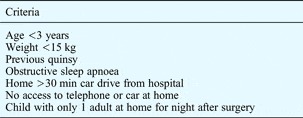
The exclusion criteria for this study are detailed in Table I. In this study, children were excluded if they had sleep apnoea, established from their clinical history or on the basis of a sleep study. These children were operated on as in-patients.
Exclusion criteria for day-case tonsillectomy

Min = minutes
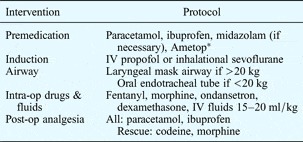
The anaesthetic protocol used for these procedures (Table II) was adapted from the protocol published by Church.Reference Church14 The main differences were the use of laryngeal mask airways and dexamethasone in our protocol.
Anaesthetic protocol

*Smith & Nephew Healthcare Ltd, Hull, UK. IV = intravenous; intra-op = intra-operative; post-op = post-operative
The tonsillectomies in this study were usually done by the same team of surgeons and anaesthetists. The operation was done in all cases using the cold steel dissection technique, with ties at the lower poles. Haemostasis was achieved with ties and minimal bipolar diathermy. All the operations were done in the morning, and children were observed for 6 hours post-operatively. If there was no bleeding and no other complications and they were managing to eat, they were discharged home. Patients' carers were then followed up by telephone the following day and a pain score was recorded for each patient using a Likert scale of 0–3 (0: no pain; 1: mild; 2: moderate; 3: severe pain). The carers were also asked about the child's oral intake, any episodes of bleeding or vomiting, and any other problems.
For each patient, prospective data were collected including age, complications encountered, overnight stay if required, post-operative pain score, and any episodes of post-operative bleeding.
Further telephone follow up was conducted by a nurse specialist at one month post-operatively, specifically asking about any episodes of bleeding during this period.
Results
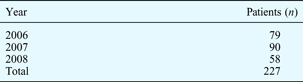
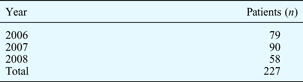
In this study, we report results for three separate prospective audits and also the cumulative results. Over the three years, the total number of patients included in this study was 227 (Table III). The age range was three to 15 years.
Tonsillectomy patient numbers
The main complications in this study were bleeding, nausea and vomitting. The most common complication was nausea and vomiting, which was seen overall in 5.3 per cent of patients (Table IV). The cumulative primary haemorrhage rate was 2.6 per cent, all of which occurred within the first 6 hours. None of these patients had to return to theatre for haemostasis, and all were treated conservatively. Post-operatively, 4.4 per cent of patients had problems with pain control and poor oral intake (Table IV). The overall complication rate within the first 24 hours was 13.2 per cent.
Complications after tonsillectomy

Data represent patient numbers (percentages). 1° haem = primary haemorrhage; N&V = nausea and vomiting; OI = oral intake
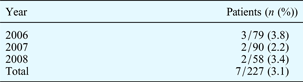
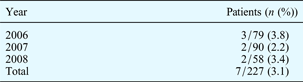
Over three years, 3.1 per cent of children had to be admitted overnight for observation (Table V). No cases of secondary haemorrhage were reported after the initial hospital discharge.
Overnight admissions
Telephone follow up was attempted for all the patients. Overall, 86.8 per cent (197/227) of carers could be contacted for follow up (86.1 per cent in 2006; 88.9 per cent in 2007 and 84.4 per cent in 2008). Their responses showed that the majority of patients had minimal pain during post-operative recovery (Table VI).
Post-operative pain on follow up

Data represent patient numbers (percentages).
Discussion
Most ENT operations are well suited to a day-case approach in a district hospital setting.Reference Pezier, Stimpson, Kanegaonkar and Bowdler15 The use of day-case surgery is increasing in order to improve efficiency in healthcare.Reference Moralee and Murray5 Day-case tonsillectomy in children has been demonstrated by numerous studies to be a safe alternative to in-patient surgery.Reference Postma and Folsom16, Reference Bhattacharya17 Children under three years of age require more careful observation and are more likely to have complications, especially reluctance to eat or drink; such children need to be observed overnight,Reference Postma and Folsom16 more so if they have obstructive sleep apnoea.Reference Statham, Elluru, Buncher and Kalra18 A similar study to ours has highlighted the role of a home-care team in improving the safety and efficacy of the procedure.Reference Shah, Shahab, Robb and Roy7 In our study, we used a telephone review of all the patients one day after the surgery, a method that has been previously reported in the literature.Reference Jones, Yoon and Licameli19
Our prospective audit spiral demonstrated a primary haemorrhage rate of 2.6 per cent over three years, which is comparable with other studies (reporting 0.5 to 6.2 per cent).Reference Shah, Shahab, Robb and Roy7–Reference Hellier, Knight, Hern and Waddell10 The overall complication rate in the first 24 hours post-operatively was 13.2 per cent, which was higher than reported in the literature (i.e. 5.6–9.3 per cent).Reference Granell, Gete, Villafruela, Bolanos and Vicent9, Reference Kendrick and Gibbin11, Reference Brigger and Brietzke20 However, the majority (73.3 per cent) of the complications in our study consisted of nausea and vomiting, poor oral intake, or poor pain control. The vast majority (89.3 per cent) of patients followed up by telephone complained of no or only mild pain. This demonstrates adequate analgesia on discharge, and is also comparable to other studies.Reference Mills, Anderson, Barber, White, Mahadevan and Salkeld8, Reference Panarese, Clarke and Yardley21 A recent Cochrane review concluded that nausea and vomiting were significantly reduced when non-steroidal anti-inflammatory drugs were used, compared with alternative analgesics, without causing any increase in bleeding requiring a return to theatre.Reference Cardwell, Siviter and Smith22 In this study, we observed the children for 6 hours post-operatively. The overall overnight admission rate was 3.1 per cent, which is in keeping with the published incidence of 3–8 per cent.Reference Shah, Shahab, Robb and Roy7, Reference Mills, Anderson, Barber, White, Mahadevan and Salkeld8, Reference Hellier, Knight, Hern and Waddell10, Reference Brigger and Brietzke20, Reference Lalakea, Marquez-Biggs and Messner23
In our study, all patients were anaesthetised by the same paediatric anaesthetist. These children were fit and healthy (i.e. American Society of Anesthesiologists category one or two). At the end of this audit spiral, we had resumed the use of the morphine; when its use was ceased for a time, patients' oral intake was not as good post-operatively, although there was less post-operative nausea and vomiting. In all our patients, anaesthesia was maintained with oxygen and sevoflurane. Nitrous oxide can contribute to post-operative nausea and vomiting, although not very much in children. It is a good intra-operative analgesic, which is why it is useful at the start of a stimulating procedure, to help keep the patient deeply anaesthetised while the gag goes in; after this point, we switch to air.
• Use of day-case surgery is increasing, in order to improve healthcare efficiency
• This prospective audit found a post-tonsillectomy primary haemorrhage rate of 2.6 per cent over three years
• The commonest complication was nausea and vomiting
• District hospital day-case tonsillectomy is a safe, efficient alternative to in-patient care
• Appropriate patient selection, a dedicated day-case team, good anaesthetic technique, adequate post-operative analgesia and on-site paediatric in-patient facilities are essential
Our study adds to the argument that, for a well selected group of children, day-case tonsillectomy is a safe and efficient alternative to an in-patient stay. It also demonstrates that, at a time in the UK when ENT services are becoming increasingly centralised, the district hospital has a significant role in providing easily accessible healthcare services.
Conclusion
Paediatric day-case tonsillectomy in a district general hospital setting is a safe procedure when performed with strict pre-operative criteria, a dedicated day-case team, good anaesthetic technique, adequate post-operative analgesia, and paediatric in-patient facilities on site.
Acknowledgement
We acknowledge Dr K Bartholomew and Dr J O'Riordan, consultant anaesthetists, for their useful comments about the anaesthetic techniques used in this study group.