Introduction
In response to the call for growing attention to person-centred care in nursing homes, Western scholars and practitioners have realised that caring relationships between residents and nursing staff are key to achieving person-centred care (Roberts and Bowers, Reference Roberts and Bowers2015; Forsgren et al., Reference Forsgren, Skott, Hartelius and Saldert2016; Poey et al., Reference Poey, Hermer, Cornelison, Kaup, Drake, Stone and Doll2017). Such caring relationships are critical to residents’ quality of life (Bowers et al., Reference Bowers, Fibich and Jacobson2001; Adra et al., Reference Adra, Hopton and Keady2015), their wellbeing (Street et al., Reference Street, Burge, Quadagno and Barrett2007), fulfilment of their needs (Custers et al., Reference Custers, Westerfhof, Kuin and Riksen-Walraven2010) and their social networks (Cheng, Reference Cheng2009).
In practice, a range of interpersonal skills is recommended for nursing staff seeking to achieve positive caring relationships with older residents; this is particularly the case for nurse aides, i.e. nurse assistants who work under a licensed nurse's supervision. Recommended skills include acknowledging residents’ personal needs (Nakrem et al., Reference Nakrem, Vinsnes and Seim2011), interactive story-sharing (Heliker and Nguyen, Reference Heliker and Nguyen2010), getting to know residents better (Brown-Wilson and Davies, Reference Brown-Wilson and Davies2009) and sharing personal information (Bergland and Kirkevold, Reference Bergland and Kirkevold2005). These interpersonal skills are essential to improving the quality of care provided by nursing staff (e.g. McGilton et al., Reference McGilton, O'Brien-Pallas, Darlington, Evans, Wynn and Pringle2003; Heliker and Nguyen, Reference Heliker and Nguyen2010).
Other studies have investigated residents’ and nursing staff's experiences and perceptions of caring relationships both to analyse their implications for residents’ quality of life and to advance nursing practice (e.g. Bergland and Kirkevold, Reference Bergland and Kirkevold2005; Nakrem et al., Reference Nakrem, Vinsnes and Seim2011; Chung, Reference Chung2012; Custers et al., Reference Custers, Westerhof, Kuin, Gerritsen and Riksen-Walraven2012; Roberts and Bowers, Reference Roberts and Bowers2015; Forsgren et al., Reference Forsgren, Skott, Hartelius and Saldert2016). However, these studies often investigate only residents or only nursing staff, missing the dyadic interactions between residents and nursing staff (Wong and Hsieh, Reference Wong and Hsieh2019). This points to the need for utilising a dyadic perspective to explore a more holistic understanding of caring relationships (Wong and Hsieh, Reference Wong and Hsieh2019). Additionally, most previous studies of these caring relationships have focused on a period of time, providing only snapshots of these relationships (e.g. Ryvicker, Reference Ryvicker2011; Roberts and Bowers, Reference Roberts and Bowers2015; Lung and Liang, Reference Lung and Liu2016). Overlooking the developmental aspect of caring relationships may miss their evolving dynamics. Thus, the present study asks two research questions to address these research gaps:
• What are the caring relationship experiences of residents and nurse aides in Shanghai?
• How do these caring relationships evolve over time?
Thus, this study employs a dyadic perspective to analyse the nuanced relational aspects of caring relationships (McGilton et al., Reference McGilton, O'Brien-Pallas, Darlington, Evans, Wynn and Pringle2003; Braun et al., Reference Braun, Scholz, Bailey, Perren, Hornung and Martin2009; Wong and Hsieh, Reference Wong and Hsieh2019) by exploring caring relationships from the perspectives and experiences of both members of the resident–nurse aide dyad. We used a phenomenological approach to interview 20 matched resident–nurse aide dyads in a nursing home in Shanghai. We identified four types of caring relationship and traced the evolution of these relationships, beginning with residents’ relocation to the nursing home, to better understand their developmental aspects.
This study enhances existing understandings of caring relationships in nursing home settings. First, it is among the first to employ a dyadic perspective to integrate both residents’ and nurse aides’ perspectives. Second, by tracing the evolution of these caring relationships over time, this study offers evidence for better understanding the developmental, nuanced interplay between residents and nurse aides.
Literature review
A growing body of scholarly work has recognised the importance of caring relationships to quality of care and quality of life for older residents in nursing home settings (e.g. Cook and Brown-Wilson, Reference Cook and Brown-Wilson2010; Nakrem et al., Reference Nakrem, Vinsnes and Seim2011; Custers et al., Reference Custers, Westerhof, Kuin, Gerritsen and Riksen-Walraven2012; Roberts and Bowers, Reference Roberts and Bowers2015). To date, these studies have investigated caring relationships primarily either from older residents’ perspectives (e.g. Bowers et al., Reference Bowers, Fibich and Jacobson2001; Custers et al., Reference Custers, Westerhof, Kuin, Gerritsen and Riksen-Walraven2012; Roberts and Bowers, Reference Roberts and Bowers2015) or from nursing staff's perspectives (e.g. Bowers et al., Reference Bowers, Esmond and Jacobson2000; Forsgren et al., Reference Forsgren, Skott, Hartelius and Saldert2016).
Research focused on older residents’ perspectives has emphasised that interpersonal interactions (e.g. greetings, staff showing respect and care) are key to achieving a positive caring relationship (Brown-Wilson and Davies, Reference Brown-Wilson and Davies2009; Bangerter et al., Reference Bangerter, Van Haitsma, Heid and Abbott2016). For older residents, caring relationships are fundamental to seeking service, connection and comfort (Bowers et al., Reference Bowers, Fibich and Jacobson2001), as well as a sense of competence (Custers et al., Reference Custers, Westerhof, Kuin, Gerritsen and Riksen-Walraven2012). In practice, however, these ideal characteristics may be difficult to achieve during the care-giving process (Bergland and Kirkevold, Reference Bergland and Kirkevold2005; Nakrem et al., Reference Nakrem, Vinsnes and Seim2011). For example, Roberts and Bowers (Reference Roberts and Bowers2015) found that older residents often developed caring relationships with nursing staff unintentionally, based on their personal preferences and needs, and they considered such caring relationships to be either friendly or unfriendly based on nursing staff's responses. In fact, while some residents agree that caring relationships can be beneficial (Bowers et al., Reference Bowers, Fibich and Jacobson2001; Haugan, Reference Haugan2014), others do not wish to have caring relationships with nursing staff (Bergland and Kirkevold, Reference Bergland and Kirkevold2005), and even avoid them to protect their autonomy and dignity (Nakrem et al., Reference Nakrem, Vinsnes and Seim2011). These mixed views from residents suggest the need for exploring nursing staff's perceptions and reactions to caring relationships.
Nursing staff, especially frontline nurse aides, have likewise presented mixed views on their caring relationships with older residents. Previous studies have found that nurse aides were aware that their caring attitudes could comfort residents during care-giving (Bowers et al., Reference Bowers, Esmond and Jacobson2000; Forsgren et al., Reference Forsgren, Skott, Hartelius and Saldert2016) and their own burnout could distress residents and strain caring relationships (Hunt et al., Reference Hunt, Corazzini and Anderson2014). Further, nurse aides’ regular interpersonal interactions with residents have been shown to enhance residents’ physical health and psycho-spiritual functioning in the nursing home (Huagan, Reference Haugan2014). Interactions initiated by nurse aides are particularly meaningful to residents and important for achieving quality care in nursing homes (Ryvicker, Reference Ryvicker2011; Forsgren et al., Reference Forsgren, Skott, Hartelius and Saldert2016). In a study of two nursing homes, Ryvicker (Reference Ryvicker2011) identified three types of nurse aides’ interactions with residents: encouraging residents to participate in activities, emotional bonding with residents and fulfilling residents’ needs. The study suggested that even nurse aides who initiated interactions still needed to establish interaction mechanisms to adapt to residents’ responses, in order to support their ongoing caring interactions (Ryvicker, Reference Ryvicker2011).
Despite the benefits of caring relationships, nurse aides have also reported that this relationship-building can be time consuming and they may not be able to offer continuous emotional support to residents (Lung and Liu, Reference Lung and Liu2016). In Chung's (Reference Chung2012) study, nurse aides reported that caring relationships with residents could be too nuanced to be standardised, thus difficult to guarantee for every resident and often neglected during the care-giving process. Nurse aides have also reported doubts about whether streamlined regulations on caring relationships would help them ensure quality care, given the varied interpretations and applications of the regulations by different practitioners (Putnam et al., Reference Putnam, Tang, Brooks-Danso, Pickard and Morrow-Howell2007). Thus, an overemphasis on caring relationships required by the nursing home may in fact lead to superficial interpersonal relationships (Lung and Liu, Reference Lung and Liu2016). Thus, these mixed views on caring relationships from nurse aides call for a holistic understanding from both residents’ and nurse aides’ sides.
Regardless of residents’ or nurse aides’ perspectives, various categorisations of caring relationships in existing literature usually neglect the developmental aspect of the relationship. Exploring the evolution of caring relationships between residents and nurse aides can enhance our understanding and provide support for relevant practices in the nursing home (Gubrium and Holstein, Reference Gubrium and Holstein1999), such as diverse and tailored care-giving and interaction skills corresponding to residents’ differing psychological and mental status, as well as their perceptions of nursing home care and the process of adaptation to nursing home.
Conceptualising caring relationships
The conceptual framework of this study is informed by theoretical perspectives from nursing, gerontology and psychology. Nursing practice has long considered an interpersonal relationship to be the foundation of quality care (e.g. Nolan et al., Reference Nolan, Davies, Brown, Keady and Nolan2004, Reference Nolan, Brown, Davies, Nolan and Keady2006; Brown-Wilson, Reference Brown-Wilson and Davies2009). For instance, Nolan et al. (Reference Nolan, Davies, Brown, Keady and Nolan2004, Reference Nolan, Brown, Davies, Nolan and Keady2006) proposed the Senses Framework, which emphasises that the interpersonal relationship between older adults and their care-givers should cultivate a caring environment that promotes residents’ senses of security, continuity, significance, achievement, purpose and belonging.
Gerontologists and psychologists have also paid much attention to the implications of the physical nursing home environment for older adults, as well as the human environment (e.g. relationships with nurse aides; Kahana, Reference Kahana, Lawton, Windley and Byerts1982; Lawton, Reference Lawton, Bengtson and Schaie1989; Wahl and Weisman, Reference Wahl and Weisman2003; Bergland and Kirkevold, Reference Bergland and Kirkevold2005; Wahl, Reference Wahl and Pachana2015). In this study, we posit that the human environment plays an important role for older residents. Specifically, we employ the integrative framework of ageing well to depict the evolving person–environment (P–E) interchanges during later life (Wahl et al., Reference Wahl, Iwarsson and Oswald2012). P–E resources, referring to ‘the most immediate interface between the person and his/her environment’ (Wahl et al., Reference Wahl, Iwarsson and Oswald2012: 309), centre on older adults’ agency and environmental belonging, which are crucial to their ability to adapt to specific environments (Wahl et al., Reference Wahl, Iwarsson and Oswald2012). Namely, when facing a new P–E situation (e.g. relocating to a nursing home), older adults utilise the agency they have accumulated through their lifecourse, as well as P–E resources, to adapt and to maintain autonomy, wellbeing and competence (Wahl et al., Reference Wahl, Iwarsson and Oswald2012). Adapting to a new P–E interchange also involves older adults’ psychosocial assimilation and accommodation (Chao et al., Reference Chao, Lan, Tso, Chung, Neim and Clark2008; Reker and Woo, Reference Reker and Woo2011). Older adults remain active in this process to seek belonging, continuity and self-value (Chao et al., Reference Chao, Lan, Tso, Chung, Neim and Clark2008; Haugan, Reference Haugan2014).
In this study, we explore the important role of the human environment (e.g. relationships with nurse aides) in the nursing home for older residents, combining insights of the Senses Framework, the integrative framework of ageing well and psychosocial adaptation. Specifically, this study conceptualises the caring relationship between residents and nurse aides as a dynamic, evolving process of emotional and environmental interactions, during which residents utilise their agency and P–E resources to adapt to the human environment (e.g. nurse aides) in the nursing home to maintain their autonomy, wellbeing and various fundamental senses.
Nursing home care policy and practice environment in China
Compared with Western countries, nursing home care in China remains underdeveloped, even as the nation experiences unprecedented rapid growth in its ageing population (United Nations, 2019). In 2015, China had approximately 144 million people aged 65 or older, accounting for 10.5 per cent of the national population, and this number is projected to more than double to 366 million by 2050 (National Bureau of Statistics of China, 2016; United Nations, 2019). As the ‘oldest’ city in China (i.e. housing the highest proportion of older adults with the longest life expectancy nationwide), Shanghai was home to approximately 3.62 million people aged 65 and over in 2019, accounting for 24.6 per cent of the total municipal population (Shanghai Civil Affairs Bureau, 2020). Correspondingly, since 2000 Shanghai has experienced a surge in social support for older adults, via both community-based services and nursing home care (Chen and Han, Reference Chen and Han2016). Although both aim to complement family care-giving, in reality, policy implementations have tended to primarily promote nursing home care (Feng et al., Reference Feng, Liu, Guan and Mor2012, Reference Feng, Li, Glinskaya, Zheng, Wiener, Glinskaya and Feng2018).
Unfortunately, a persistent shortage of professional nursing staff, particularly nurse aides, continually impedes nursing home care in China (Feng et al., Reference Feng, Glinskaya, Chen, Gong, Qiu, Xu and Yip2020). Nurse aides primarily provide custodial and instrumental care for older residents, such as dressing, bathing, feeding, mouth and hair care, toileting, making beds, and regularly turning and positioning bedridden residents (Huang, Reference Huang2013). Nurse aides usually face unattractive working conditions, such as demanding workloads, low wages, limited career development opportunities and unfavourable (sometimes stigmatised) social treatment, all of which have contributed to the profession's chronic workforce shortage and high turnover rate (Zhang et al., Reference Zhang, Glinskaya, Gong, Zhang, Glinskaya and Feng2018). The current average aide-to-resident caring ratio in China is 1:8, which is much higher than the international standard of 1:4 (workercn.cn, 2016). In Shanghai specifically, over 10 per cent of private nursing homes reported that insufficient supplies and a high turnover rate of nurse aides have challenged their daily operations (workercn.cn, 2016). Recognising this workforce gap, in 2019, the Chinese Ministry of Civil Affairs renewed The National Professional Standards for Long-term Care Nursing Staff to attract more workers to the field (Ministry of Civil Affairs, 2019). In particular, the standards relax nurse aides’ entry requirements by shortening the internship requirement from two years to one year, expanding their career development opportunities by adding one more advanced level of salaries and reducing their promotion time by one year for each level (Ministry of Civil Affairs, 2019).
Beyond challenges related to workforce recruitment and retention, nursing home care in China is also challenged by variations in local criteria, rating systems and emphases on quality of care, which can vary significantly across the country (Feng et al., Reference Feng, Liu, Guan and Mor2012, Reference Feng, Glinskaya, Chen, Gong, Qiu, Xu and Yip2020). The nursing homes in Shanghai, in particular, emphasise safety issues. Shanghai's three-year (2019–2022) action plan for advancing the quality of nursing home care prioritises safety issues such as identification of hazards, fire-fighting equipment installation and residents’ personal safety, while other services and standards receive comparatively less oversight (Shanghai Civil Affairs Bureau, 2019). Exploring how nurse aides in Shanghai develop interpersonal relationships with older residents will allow us to better understand this gap between policy and actual care-giving delivery.
Methods
Study design
A phenomenological approach informed the study design to explore the experiences of caring relationships between dyads of residents and nurse aides. Phenomenology aims to describe the meaning of individuals’ lived experiences, in particular, the core meanings shared by those who have had similar experiences (Moustakas, Reference Moustakas1994). These are referred to as ‘essences and essential relations’ (Husserl, [1911] Reference Husserl and Laurer1965: 116).
Study setting
The study setting was purposively selected from a public nursing home in Shanghai. It is a municipal-level, government-sponsored nursing home, receiving subsidies directly from the Shanghai Civil Affairs Bureau. At the time of the interviews, it housed 486 older residents, of whom 167 were without cognitive impairment. A total of 89 nurse aides cared for residents with no cognitive impairment, which is significantly better than the 1:8 national average caring ratio. These nurse aides were assistants to nurses, undertaking custodial, instrumental and non-medical care-giving tasks. This nursing home was similar to a skilled nursing facility in the United States of America (USA). The rationale for selecting a public nursing home was its strong emphasis on government-monitored services (Zhang et al., Reference Zhang, Glinskaya, Gong, Zhang, Glinskaya and Feng2018). To follow the municipal government guidelines, the nursing home emphasised residents’ personal safety and required nurse aides to form caring relationships to better cater to residents’ needs.
Recruitment and sampling
After receiving ethical approval from the university with which LC is affiliated and the research ethics committee of the study funder, the research team contacted the nursing home and obtained its ethical approval. We held an information briefing session with a group of ten nursing supervisors to introduce the study purpose and address their concerns. We aimed to recruit frontline nursing staff who provide direct care-giving and have direct, interpersonal interactions with residents on a daily basis. Nursing supervisors advised the research team to recruit nurse aides. We posted flyers in the nursing home and in-house social workers helped us to disseminate information.
We recruited participants by dyad; the dyads had already been in place and formed by the nursing home. Social workers suggested that the research team invite older residents first and provided a roster of 35 potentially eligible residents. A total of 26 residents who agreed to participate in the study fell into our inclusion criteria: (a) age 65 years or older, (b) had lived in the nursing home for at least six months, and (c) no cognitive impairment symptoms assessed by in-house physicians.
Once the older residents agreed to participate, we invited their nurse aides to join the study. A total of 24 nurse aides agreed to participate. All of them fell into the inclusion criteria: (a) providing direct care for residents on a daily basis, (b) working as a nurse aide for at least six months, and (c) caring for residents with no cognitive impairment. However, four nurse aides and two older residents declined because of privacy concerns and another four residents dropped out because of illness at the time of the interview.
When both the older resident and the nurse aide in a dyad agreed to participate, we considered them study participants. Thus, we were able to recruit resident–nurse aide dyads (i.e. care-giving pairs) based on their willingness to participate. The rationale for recruiting participants by dyad was to capture the caring relationships in their entirety for as long as possible. Ultimately, 20 resident–aide dyads agreed to participate in the study (N = 40).
Informed consent and power dynamics in the study
The research team obtained each participant's informed consent individually before the interviews began. We talked to older residents individually, with no nurse aides present, before the interview took place and made sure that they understood the purpose of the study and interview procedures. We addressed their concerns and questions about the interview and the study in general. We read the consent form to them line by line, making sure they understood the study purpose, interview format and process, sample questions and their rights before they signed the form. We also made sure that all the residents’ interviews were kept confidential and anonymous, and were not disclosed to nurse aides or the nursing home.
For nurse aides, we explained the study purpose and their rights to make sure they understood the study process before they signed the consent form. We also discussed sample questions with nurse aides to gain their insider's perspective on daily life in the nursing home, which helped the research team refine the interview guide. We made sure that all aides’ interviews were kept confidential and anonymous, and were not disclosed to residents or the nursing home.
We realised that the power dynamics between participants and the research team might potentially influence residents’ consent and/or their interview answers (Anyan, Reference Anyan2013). We tried several strategies to obtain an egalitarian status with each participant as much as possible (Anyan, Reference Anyan2013). First, we shared sample questions with residents and nurse aides, with the aim of refining the interview guide and encouraging participants to share their opinions on the interview topics, and at the same time not leading or restricting their answers. Second, the research team spent time with participants in the nursing home before the interviews began. The observations and interactions helped the research team have a holistic understanding of life in the nursing home. Third, QZ created an easy-going atmosphere as much as possible during the interview to let participants go with their own flow, in order to minimise participants’ defences. As such, the research team was able to convey respect and to build rapport and mutual trust between the participants and the research team.
Data collection and analysis
QZ conducted all the interviews in a private conference room in the nursing home. These face-to-face, in-depth interviews were all conducted with individual residents and nurse aides, respectively, to avoid potential concerns about freedom to express their opinions as well as any potential violation of privacy and confidentiality. Participants were fully aware of their opportunity to refuse to answer questions or withdraw from the study with no consequences.
Interviews began with residents’ placement history and nurse aides’ work history, then moved on to specific questions about how their caring relationships with each other began and developed, what changed and what remained constant during the process, how they interacted with each other, and how the relationship influenced their life or work in the nursing home. All the interviews were audio-recorded with permission. Each interview lasted for 30–60 minutes.
QZ transcribed each interview verbatim into Chinese immediately after the interview. The research team carried out thematic analysis by following the data analysis spiral (Creswell and Poth, Reference Creswell and Poth2017). LC and QZ did initial line-by-line open-coding for the Chinese transcripts. We identified all the meaningful segments and grouped them into various categories around the evolving caring relationships and types of caring relationship (Strauss and Corbin, Reference Strauss and Corbin1998; Creswell and Poth, Reference Creswell and Poth2017). We discussed these categories in terms of relationship-building, emotional connections, attitudes towards each other and nursing home regulations, forming themes (Guest et al., Reference Guest, MacQueen and Namey2011). We then labelled and defined themes through extensive discussion between LC and QZ. We further compared and contrasted across dyads to identify dyadic characteristics of these caring relationships (Guest et al., Reference Guest, MacQueen and Namey2011). The research team reviewed these themes and dyadic characteristics through extensive discussion. We began interpreting themes only when the entire team reached consensus on the definition of each theme (Creswell and Poth, Reference Creswell and Poth2017). Because the LC and LX are proficient in both Chinese and English, we translated all the themes, including their dimensions and properties, into English for the purpose of writing up the results. YL and BJK served as ‘peer scrutiny’ to strengthen the trustworthiness of the data analysis (Shenton, Reference Shenton2004: 67). We kept all the memos and discussion notes as an audit trail.
Findings
We first present the characteristics of the participants. Then we illustrate four types of caring relationship identified by residents and nurse aides, and provide detail of the dyadic perspectives on the relationships. We situate these four types in relation to residents’ chronological experiences of nursing home care to show the evolution of these caring relationships.
Characteristics of participants
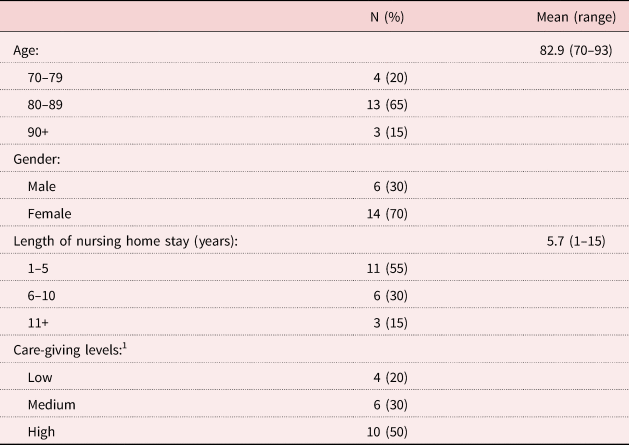
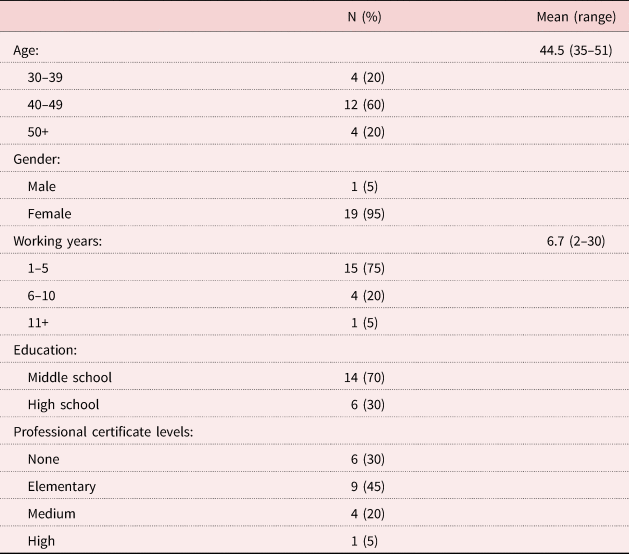
On average, participating older residents were 82.9 years old and 70 per cent of them were female. On average, they had spent five and a half years living in the nursing home, ranging from one to 15 years. Participating nurse aides were 44.5 years old on average. Except for one male, all of them were female. They had generally worked in the nursing home for approximately five years. All the nurse aides were migrant workers, mainly from the provinces of Anhui, Jiangsu, Jiangxi and Zhejiang. Tables 1 and 2 present demographic characteristics of residents and nurse aides, respectively.
Demographic characteristics of the older residents

Notes: N = 20. 1. This classification was based on the 2016 assessment in the nursing home, which was according to the ‘Nursing Home Care Level Assessment’ published by the Shanghai Bureau of Civil Affairs (2013).
Demographic characteristics of the nurse aides

Note: N = 20.
Types of caring relationship
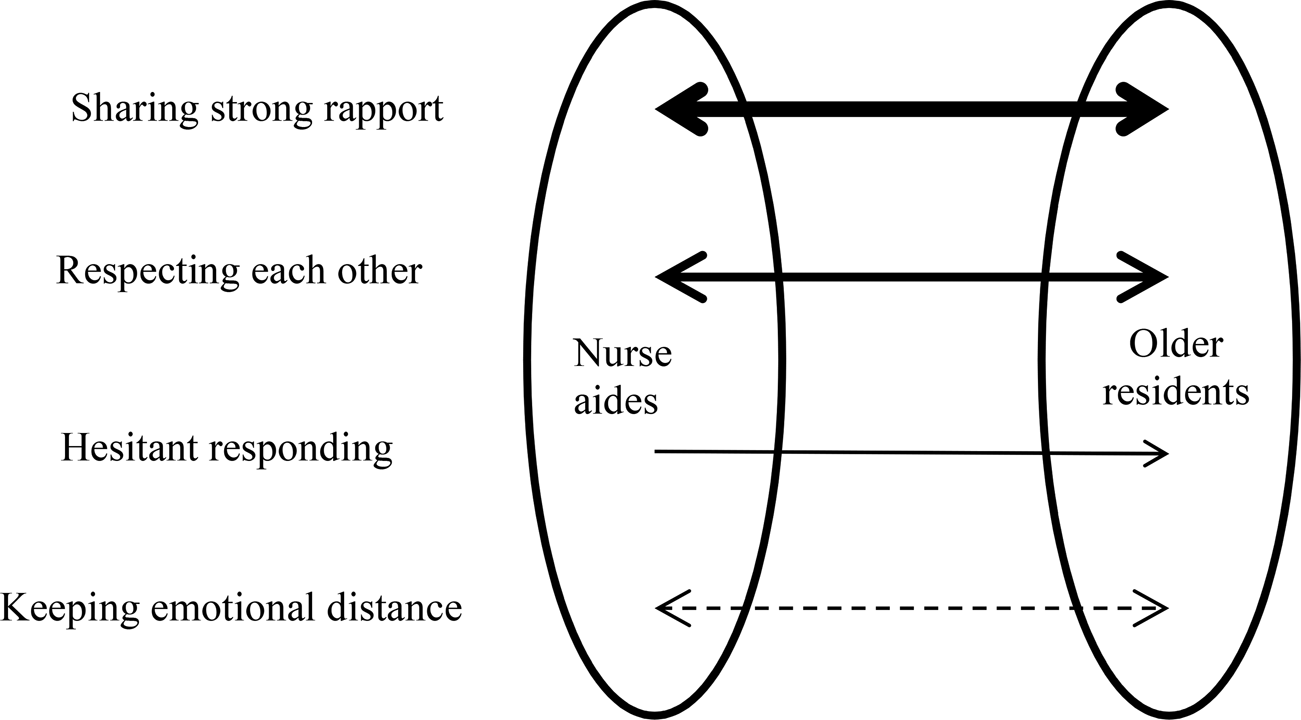
Based on residents’ and nurse aides’ perceptions, we identified four types of caring relationship among participating dyads: (a) sharing strong rapport, (b) respecting each other, (c) hesitant responding, and (d) keeping emotional distance (Figure 1). The boldness of the arrows represents the strengths of emotional interactions within dyads. The heavier in colour, the stronger the emotional connections. The direction of the arrows represents which side initiated such interactions.
Four types of caring relationship among resident–nurse aide dyads.
Notes: The heavier in colour, the stronger the interactions on the emotional level within dyads. The direction of arrows represents which side initiates such interactions.

Sharing strong rapport
In this type of caring relationship, nurse aides reported treating older residents like their parents, following the Chinese filial tradition. This family-like environment for residents fostered strong emotional bonding within the dyad. For example, 83-year-old Mrs Qiao (all participants’ names are pseudonyms) was grateful for Ms Shi's care after her hip surgery, ‘She brought cage-free eggs from her village and made chicken soup for me. She's like my niece.’ Ms Shi believed care-giving in the nursing home should follow the filial tradition, ‘I treat all my residents like my own parents. We are like family.’ Mrs Wu, who just turned 80, praised Ms Feng for her diligent care-giving, ‘Honestly, my children wouldn't want to do so much.’ Ms Feng admitted that she had had concerns about the stigmatised social attitudes towards migrant workers, especially nurse aides, but she also found that some residents were very friendly and warm, like her parents. Nurse aides in this type of relationship were devoted to building a meaningful caring relationship and were keen on emotional interactions. Residents also treated nurse aides like their relatives and shared close bonds with them.
Respecting each other
In this type of caring relationship, older residents and nurse aides respected each other, in terms of residents’ care preferences and nurse aides’ job requirements. Residents appreciated nurse aides’ hard work and tried not to ‘make extra trouble’ for them. Correspondingly, nurse aides provided support and services. For example, 87-year-old Mrs Wang commented, ‘I can still manage [most of the time]. If I boss her around for every little thing, I'll feel embarrassed.’ Ms Zhou appreciated Mrs Wang's consideration: ‘Mrs Wang only requires very light care-giving and she always says “Thank you” to me.’ Mrs Yu, who was 79 years old, described things that she could manage herself, such as going to the toilet and going to the cafeteria. She believed, ‘If I rely on nurse aides for everything, my capacity [to take care of myself] will decline.’ Ms Jiang said, ‘Mrs Yu has her own ideas of living in the nursing home and I respect that. I do whatever I can to help.’ Residents acknowledged nurse aides’ support, while still trying to take care of themselves. Nurse aides also valued residents’ self-determination and autonomy. Such mutual understanding created a respectful and attentive caring relationship within dyads.
Hesitant responding
In this type of caring relationship, nurse aides felt the pressure of nursing home regulations to establish some interpersonal relationship with residents, even though residents were sometimes difficult to please. Some residents believed that they were superior to nurse aides because they paid for all the services in the nursing home and thus expected nurse aides to be as attentive as possible. For example, 75-year-old Mrs Fang felt it was her right to ask her nurse aide, Ms Yuan, for whatever help she wanted and whenever she wanted it. She tended to stereotype migrant workers as inferior and thought of Ms Yuan as her own servant. Ms Yuan, who had worked in the nursing home for three years, hesitated to interact with Mrs Fang:
Whenever she wants something, you have to do it right away, otherwise she can be very grumpy. She always complains that [nurse aides] don't care about her but when I ask about what she needs, she usually ignores me.
Several nurse aides mentioned that residents could be fault-finding. However, ‘If [requirements] are not too unreasonable, I would try to meet their needs as much as I can’, Ms Zhao commented. Based on the Chinese filial tradition of respecting older adults, as well as nursing home regulations, nurse aides often tried to avoid arguing with residents; they were hesitant about interacting with residents on an emotional level as they could be easily disappointed and frustrated by residents’ attitudes. This type of caring relationship tended to focus on providing instrumental support with limited emotional involvement.
Keeping emotional distance
In this type of caring relationship, both residents and nurse aides showed little interest in interacting with each other on an emotional level, despite the nursing home regulations. Some residents preferred to interact with fellow residents who shared similar experiences. For example, 92-year-old Mr Gu, who had been cared for by Mr Chen for five months, enjoyed talking with a few residents who had also gone to college in Shanghai in the 1940s. When their needs for socialising and emotional support were met by fellow residents, residents’ interactions with nurse aides were often restricted to daily routines. Mr Chen, who had worked in the nursing home for over six years, shared his experience caring for Mr Gu, ‘Every day he only asks me to do the things that he is not capable of, such as laundry and bathing. We don't talk that much.’ When residents and nurse aides only interacted around daily, custodial routines, limited emotional interactions occurred within dyads.
However, several residents kept their distance with nurse aides because of their negative impressions of them. For example, Mrs Qian, who was 74 years old, candidly expressed her unwillingness to interact with nurse aides: ‘I don't see what we can talk about. They are not Shanghai locals.’ Her nurse aide, Ms Hu, was used to this situation: ‘[Mrs Qian]'s attitudes are not uncommon among residents.’ Residents’ unfavourable attitudes prevented nurse aides from interacting with them. Nurse aides reasonably chose to maintain their professional distance while providing essential services.
Evolving caring relationships
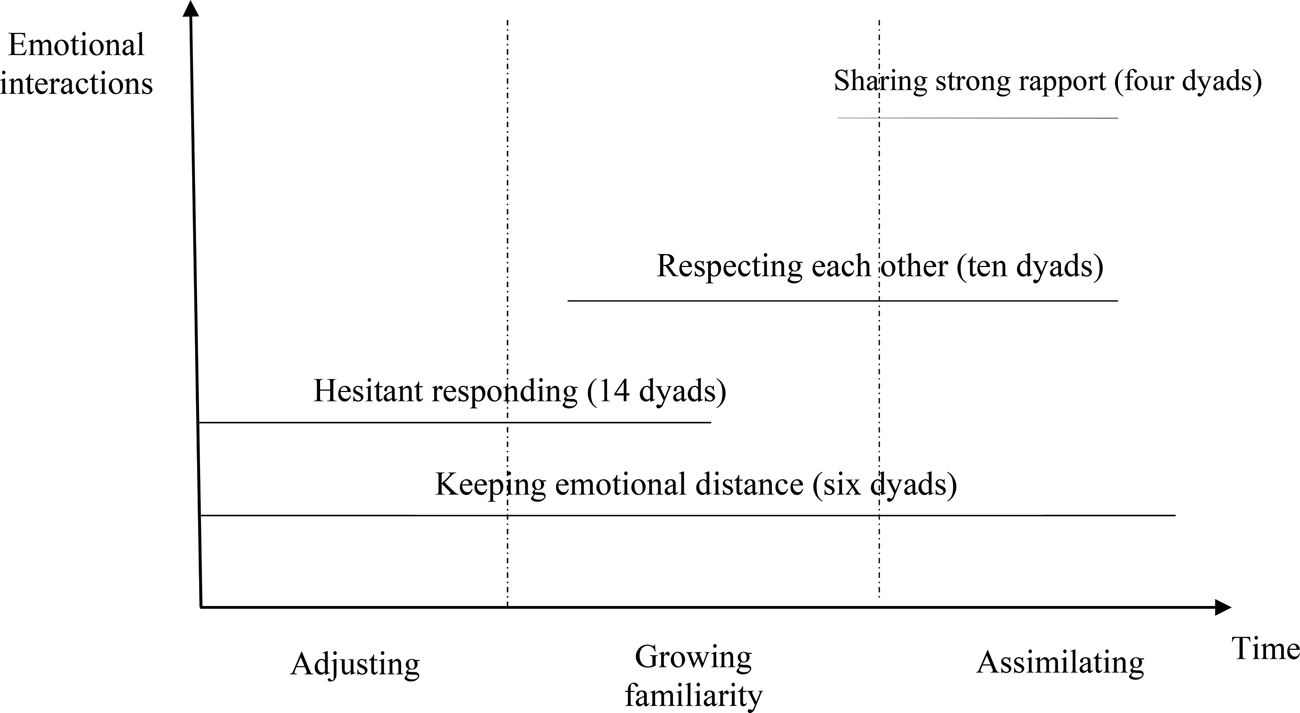
The four types of caring relationship evolved and differentiated as residents lived through different stages in the nursing home, including their initial adaptation to the nursing home or to new nurse aides; growing familiar with nurse aides; and finally, assimilating to nursing home care (Figure 2). When residents first moved into the nursing home, most caring relationships began with keeping an emotional distance or hesitant responding from the nurse aides’ side, as residents were not particularly eager to interact with them emotionally. Gradually, residents adapted to life in the nursing home and began to expand their social networks to include nurse aides and fellow residents. The hesitant responding relationship type transformed into the respecting each other type and, finally, some dyads became the sharing strong rapport type.
Evolving caring relationships among resident–nurse aide dyads.

Adapting to the nursing home or nurse aide placement
Almost all the older residents expressed their struggle to adapt to nursing home care and to the frequent changes in nurse aides because of their high turnover rate. The nursing home placement process was taxing and the high turnover of nurse aides was equally stressful, potentially threatening a good caring relationship from the beginning. All dyads described the beginning of their caring relationships as either the keeping an emotional distance type (six dyads) or the hesitant responding type (14 dyads), with relatively limited emotional interactions. For example, 85-year-old Mrs Shi recalled the first time she met her aide, Ms Peng:
Since I moved into this nursing home, I have had eight nurse aides in five years. It is challenging for me to tell each of them about my preferences. When I first saw Ms Peng, I was very annoyed that my previous aide had left again. I had to teach the new girl about my routine all over again.
Nurse aides, on the other hand, had to comply with nursing home regulations, regardless of residents’ attitudes. Ms Peng, who had worked in the nursing home for two years, also recalled the moment when she met Mrs Shi for the first time:
When I saw Mrs Shi, she was obviously reluctant. I was her eighth aide – yet another stranger to her. Regardless, I was careful about following all her instructions and all the tips from other aides who had worked here for a longer time.
Upon nursing home placement or adapting to a new nurse aide, residents kept a clear distance with nurse aides, which challenged the initial interpersonal interactions and the establishment of their caring relationships. Such a rough start caused some nurse aides to focus solely on providing instrumental support. For example, Ms Wei, who had worked in the nursing home for three years, said, ‘It's okay that residents don't talk to us much. We can focus on keeping them safe and comfortable. That's what we are here for anyway.’ Given residents’ interpersonal distance in the beginning, nurse aides reported that they worked by the book and that their interactions with residents were primarily around essential instrumental support and residents’ personal safety monitoring.
Growing familiarity with each other
It took time for residents to become accustomed to life in the nursing home and become increasingly familiar with their assigned nurse aides. Nurse aides’ strict compliance with regulations on providing timely and regular instrumental support also helped them to learn about residents’ needs, routines and preferences. Staying observant and interactive began to foster emotional bonds between nurse aides and residents. For example, Ms Zhou, who had worked in the nursing home for five years, described her daily interactions with Mrs Tang:
When I care for her, or whenever I have spare time, I talk to her. The most important thing is to know what her needs and her routines are. I walk around [all my assigned residents’] rooms all the time to check on them and chat with them. It is our responsibility to adapt to residents, not the other way around.
Ms Zhou's effort paid off and won her residents’ favour. Mrs Tang, 87 years old, praised Ms Zhou highly, ‘I appreciate her care very much. She's done a lot for me.’ Mrs Tang and Ms Zhou created mutual respect and appreciation for each other. Gradually, emotional bonding grew within the dyad.
Several dyads continued to keep an emotional distance with each other. In these cases, residents did not seem to want to have frequent interactions with their nurse aides, other than instrumental and custodial support. For example, 81-year-old Mr Song said, ‘I don't ask much for assistance. I myself am doing just fine.’ His nurse aide, Mrs Zhu, who had worked in the nursing home for almost four years, was perplexed:
To be frank, I don't quite get [Mr Song]. I'm here to help him but he insists on being on his own, like dressing and getting up from the bed. He had a stroke six months ago … but I'll do whatever suits him. [Nurse aides] cannot argue with residents.
Although familiarity grew within all the dyads, some dyads made progress on emotional interactions, forming closer caring relationships, while others still kept a certain amount of interpersonal distance, and their caring relationships remained on the instrumental level. Thus, caring relationship types evolved and differentiated as residents spent more time in the nursing home, including the respecting each other type (six dyads), the hesitant responding type (eight dyads) and the keeping an emotional distance type (six dyads).
Assimilating to nursing home care
When residents became increasingly accustomed to life in the nursing home and their understanding of nurse aides’ services increased, the aides took this as a sign of achieving a good caring relationship. For example, Ms Tian, who had cared for Mrs Lou for five months, recalled:
Mrs Lou didn't let me touch her nightstand at first … as if I could steal something from her. Now, she trusts me. I can help her to organise and clean her wardrobe.
Mrs Lou, 79, responded, ‘[Ms Tian] has been very considerate and attentive. I'm very satisfied with her [care-giving] now.’ Residents’ trust was an important sign of respect and recognition to nurse aides. With growing familiarity, residents and nurse aides respected each other more than they did in the beginning of their caring relationships, creating mutual trust within dyads. Residents’ reciprocity accrued emotional bonding within dyads as the caring relationship type transitioned from nurse aides complying with regulations to the respecting each other type, and finally sharing strong rapport (four dyads), solidifying emotional interactions as the caring relationships evolved.
However, the keeping emotional distance type (six dyads) remained persistent despite residents’ growing familiarity with life in the nursing home. These residents wanted to exercise their remaining autonomy and avoid bothering nurse aides too much. For example, 80-year-old Mr Xu stressed his capability: ‘It's not necessary for [nurse aides] to do everything for me. I try to take care of myself as much as I still can. It's important for me to stay physically capable.’ Ms Sun, who had cared for Mr Xu for almost six months, said:
Mr Xu has clear rules on what I can do for him and what I don't need to do. I just do what he wants me to do. There's not much else we would talk about but that's fine.
Discerning ideal caring relationships
Based on their caring relationship experiences, residents and nurse aides shared their views on the ideal caring relationship in the nursing home. Because participating residents had no cognitive impairment and were relatively high functioning, they stressed the importance of maintaining their autonomy. That is, despite having been placed in the nursing home, they believed that they were still capable of taking care of themselves under most circumstances. These residents expressed frustration about losing freedom and complying with routines in the nursing home, especially when nurse aides were keen on monitoring them. Residents realised that their functional levels would decline and their dependence levels would increase. Maintaining limited interactions with nurse aides became a way for some residents to preserve autonomy. For example, 83-year-old Mrs Pan stated, ‘It's not necessary to have a close relationship with nurse aides. I'm doing pretty well by myself now and I expect to stay like this until I can't.’ Some residents took a more inclusive view of developing caring relationships with nurse aides. For example, Mrs Wang said, ‘I'm going to spend the rest of my life in this place. Why not let myself be happy by knowing more people?’ Thus, whether or not residents initiated caring relationships and engaged in emotional interactions with nurse aides related to their functional levels and their perceptions of life in the nursing home.
Similar to residents’ differing views, nurse aides presented seemingly contradictory views on the ideal caring relationship. On the one hand, they had to comply with the nursing home regulations to keep residents safe. Their work performance was highly related to residents’ personal safety. For example, Ms Zhao, who had worked in the nursing home for four years, commented, ‘Keeping them safe is the most important [work].’ Residents’ children also demanded high quality of care and safety from the nursing home. Ms Ye, a ten-year nurse aide veteran, described this vividly: ‘Adult children believe the nursing home is an air-tight safe.’ The emphasis on safety from both the nursing home and adult children created pressure for nurse aides. As a result, most of them admitted prioritising physical safety at the cost of older residents’ autonomy, which may have challenged forming ideal caring relationships and meaningful emotional interactions.
Still, such frequent reminders and close monitoring of residents’ safety required nurse aides to develop certain levels of connections with residents to facilitate the actual care-giving process. For example, Ms Mao, who had worked in the nursing home for almost four years, said:
True, some residents are very much capable of taking care of themselves, but they may not be aware of potential risks, such as uneven and slippery surfaces. We have to watch out for them. We have to remind them. That's why I want to build some connections with residents to let them know that we want to do what's best for them.
Nurse aides reminded residents of potential falls, medication times, meal times and other daily routines. They were concerned about residents’ increasing frailty, which residents themselves may not have realised or been willing to admit.
Thus, both residents and nurse aides held different views on the ideal caring relationship. Residents focused on individual preferences and autonomy while nurse aides were more pragmatic about forming caring relationships by following nursing home regulations. These differing perceptions are reflected in the different types of caring relationship and their evolution.
Discussion
This study explored evolving caring relationship experiences among 20 matched resident–nurse aide dyads in the Shanghai nursing home care context. We conceptualised four types of caring relationship across these dyads and situated the evolution of the four types at different stages. We also compared residents’ and nurse aides’ perceptions of ideal caring relationships. Distinctions emerged between nurse aides’ compliance with nursing home regulations and older residents’ emphasis on maintaining autonomy.
Diverse and evolving caring relationships
Employing the dyadic perspective, the four types of caring relationship in this study depict a holistic picture of resident–nurse aide interactions in the nursing home. The sharing strong rapport type shows that understanding and reciprocity between residents and nurse aides can enhance interpersonal relationships and promote quality of care (Nolan et al., Reference Nolan, Davies, Brown, Keady and Nolan2004). The respecting each other type shows that regular activities can facilitate caring relationships (Bowers et al., Reference Bowers, Fibich and Jacobson2001; Heliker and Nguyen, Reference Heliker and Nguyen2010; Lung and Liu, Reference Lung and Liu2016). Nurse aides in these two types were keen on adapting to residents’ preferences and on relational engagement (Ryvicker, Reference Ryvicker2011; Bangerter et al., Reference Bangerter, Van Haitsma, Heid and Abbott2016). The hesitant responding type indicates that regardless of residents’ attitudes, nurse aides were required by nursing home regulations to initiate interpersonal interactions and establish caring relationships. This requirement has also been reported in American nursing homes (e.g. Bowers et al., Reference Bowers, Esmond and Jacobson2000; Putnam et al., Reference Putnam, Tang, Brooks-Danso, Pickard and Morrow-Howell2007; Chung, Reference Chung2012). The keeping emotional distance type suggests that residents may not be interested in developing meaningful interpersonal relationships with nurse aides, similar to their Norwegian counterparts (Bergland and Kirkevold, Reference Bergland and Kirkevold2005). Compared with the three types of nursing staff-initiated interactions identified by Ryvicker (Reference Ryvicker2011; i.e. activating, relating and attending), the four types of caring relationship identified in this study indicate that residents’ perceptions and attitudes towards caring relationships may more strongly influence the development of these relationships than nurse aides’ efforts to build them.
Residents’ differing attitudes towards caring relationships may relate to their need for maintaining autonomy. Caring relationships in nursing homes should balance residents’ physical and psychosocial needs through interpersonal interactions (Nakrem et al., Reference Nakrem, Vinsnes and Seim2011). In addition, some residents’ stigmatising and stereotyping of migrant workers may also contribute to their keeping emotional distance with nurse aides. This finding is buttressed by a recent systematic review, which found that stigmatisation of care workers may relate to chronic workforce shortage, low quality of care and negative psychological consequences for these workers (Manchha et al., Reference Manchha, Walker, Way, Dawson, Tann and Thai2021).
In terms of the evolution of caring relationships, this study contributes to the existing scholarly work by tracing the differentiation of the four types at various stages, starting with residents moving into the nursing home and/or their adaptation to a new nurse aide. Given residents’ unfamiliarity with the nursing home, all of them appeared to keep relative interpersonal distance from nurse aides initially. Residents may also have been nervous about adapting to new nurse aides even when they had been veterans of the nursing home. Complying with the nursing home regulations, nurse aides initially interacted with residents through daily instrumental care-giving. These attempts helped nurse aides became familiar with residents’ care preferences and monitor their safety. They sought a balance between quality of care and safety concerns. In turn, some residents observed nurse aides’ efforts and they reciprocally responded to these interactions (Roberts and Bowers, Reference Roberts and Bowers2015; Andersson and Hjelm, Reference Andersson and Hjelm2017). They gradually built up close caring relationships with nurse aides, respecting their care-giving and sharing a strong rapport.
However, several residents consistently kept their distance from nurse aides, regardless of the length of their stay in the nursing home or nurse aides’ care-giving. This may relate to the fact that these residents valued preserving their autonomy more than relying on nurse aides (Bergland and Kirkevold, Reference Bergland and Kirkevold2005; Nakrem et al., Reference Nakrem, Vinsnes and Seim2011). This finding suggests that how older residents utilise services and interact with nurse aides relates primarily to their health conditions and levels of autonomy (Custers et al., Reference Custers, Westerhof, Kuin, Gerritsen and Riksen-Walraven2012). Maintaining long-term emotional distance may also relate to nurse aides’ emphasis on the outcomes of care-giving, such as safety issues (Chung, Reference Chung2012). Nurse aides should explore more mutuality with residents, rather than focusing exclusively on immediate and visible outcomes of care and/or regulation compliance.
One way to better engage residents who are relatively reluctant to forge caring relationships with nurse aides is to create a family environment in the nursing home. For older Chinese adults, nursing home placement can feel shameful, given China's tradition of filial piety, in which children become care-givers for older family members (Cheng, Reference Cheng2009; Chen Reference Chen2017). When nurse aides treated Chinese residents like family members by paying special respect and diligently attending to them, these residents reported that it was comparatively easy to accept and engage with them emotionally (Lung and Liu, Reference Lung and Liu2016). Similarly, spontaneous emotional interactions initiated by nurse aides (e.g. polite greetings and compliments) have been found to significantly improve caring relationships for older residents in the USA (Bangerter et al., Reference Bangerter, Van Haitsma, Heid and Abbott2016). Indeed, care-giving in nursing homes should not be limited to providing instrumental services, but should extend to creating a sense of home (Cheng, Reference Cheng2009; Wada et al., 2019).
Conceptual reflection
The four types of caring relationship we identified in this study display the variety of residents’ perceptions and attitudes towards nurse aides and life in the nursing home. In light of the integrative model of ageing well, these differences suggest that residents possessed varying degrees of agency accumulated through their lifecourse and utilised different P–E resources to face their relocation to the nursing home. Residents’ different preferences for P–E resources (e.g. preferences for interactions with nurse aides versus with fellow residents) may also have influenced their adaptation to nursing home care. Namely, residents in the sharing strong rapport type and respecting each other type may have proactively adapted to life in the nursing home, while residents in the hesitant responding type and keeping emotional distance type may have adapted to the new P–E interchange more reactively (Wahl et al., Reference Wahl, Iwarsson and Oswald2012). As a part of the human environment, nurse aides also exercised their agency to respond to residents’ various attitudes towards caring relationships and nursing home care.
The dyadic perspective suggests a mutual adaptation process, that is, residents showed different attitudes towards caring relationships and nurse aides provided corresponding relationship-building. For residents who proactively used P–E resources in the nursing home, nurse aides helped foster a sense of security and belonging. For residents who adapted reactively to the new P–E interchange, nurse aides tried to support these residents’ need for continuity and autonomy.
Practice implications
Our findings suggest care-giving practice recommendations for nursing homes in urban China. First, nursing homes should understand that placement challenges residents’ emotional adaptation. When they move into a nursing home, residents’ assessments should integrate physical, instrumental and emotional needs, which can inform the assignment of compatible nurse aides. It is important for nurse aides and other nursing staff to understand that the evolving nature of caring relationships with residents’ ability and inclination to develop caring relationships with nurse aides may not progress at the same pace as their adaptation to the nursing home; it may take more time for them to assimilate emotionally to the nursing home environment.
Second, nursing home regulations should expand and strengthen nurse aides’ interactions with residents. Current nursing home regulations and guidelines in Shanghai focus more on residents’ personal safety than on their emotional needs. Residents’ safety should be understood more expansively to include residents’ participation and trust, as well as their sense of physical security (Andersson and Hjelm, Reference Andersson and Hjelm2017). Despite residents’ potentially limited interest in developing caring relationships, relational care-giving should be emphasised (Nolan et al., Reference Nolan, Davies, Brown, Keady and Nolan2004, Reference Nolan, Brown, Davies, Nolan and Keady2006; Brown-Wilson and Davies, Reference Brown-Wilson and Davies2009; Cheng, Reference Cheng2009; Funk and Outcalt, Reference Funk and Outcalt2020). Bergland and Kirkevold (Reference Bergland and Kirkevold2005) found that caring relationships with individual nurse aides might not be essential for some residents, but the overall care-giving environment was essential for the quality of care and might help reduce residents’ stigmatising and stereotyping of nurse aides.
Relevantly, nursing homes in Shanghai should enhance nurse aides’ interpersonal skills and develop interaction programming, such as collaborative story-telling and autobiography projects, to create opportunities for extended dyadic emotional interactions among residents and nurse aides (Heliker and Nguyen, Reference Heliker and Nguyen2010). Furthermore, given the dyadic and evolving nature of caring relationships, it is critical for care-giving and nursing practice in Shanghai to establish a mechanism for adapting to residents’ differing attitudes and responses to nurse aides’ efforts to promote meaningful caring interactions (e.g. incorporating interaction practices into care-giving manuals and training). Indeed, strong interpersonal interactions are the foundation of caring relationships (Forsgren et al., Reference Forsgren, Skott, Hartelius and Saldert2016).
Study limitations
Several limitations should be noted when interpreting our study findings. First, this study was cross-sectional. We were only able to capture caring relationships in the nursing home over a limited period of time. Also, given the turnover rate of nurse aides in this nursing home, the caring relationship between a resident and a nurse aide could be relatively short or unstable. Longitudinal follow-ups are needed to monitor how these caring relationships evolve over time. Second, this study took place in a government-sponsored nursing home in Shanghai. The resident-to-nurse aide caring ratio was higher than the national average, so it may not reflect the overall situation of nursing home care in urban China. The variety of nursing home care in Shanghai and urban China, including private facilities, and the range and quality of caring relationships still need further investigation. Also, it is important to examine the overall human environment in nursing homes, including all kinds of nursing staff members who interact with residents on a regular basis. Third, purposively sampled residents and nurse aides might be more outgoing than those who did not participate in the study. This may have resulted in a selection bias. Also, although residents with cognitive impairment may not be able to understand interview questions fully or participate in the study, the caring relationships between cognitively impaired residents and nurse aides still deserve further investigation. Fourth, the nature of qualitative research made it difficult to quantify the emotional interactions between nurse aides and residents. Further investigation is warranted. Finally, translation of the interviews may have potentially influenced the meanings of themes.
Conclusion
This study used a dyadic perspective to explore the evolution of caring relationships among residents and nurse aides in a nursing home in Shanghai. From our examination of their daily interpersonal interactions, four types of caring relationship emerged across the 20 matched resident–nurse aide dyads. Upon placement, all the residents in our study kept emotional distance from nurse aides, and nurse aides provided care-giving by following nursing home regulations. As time passed, however, some residents began to respond to nurse aides’ interactions; others still hesitated to be over-dependent on aides in an effort to protect their own autonomy. Differing perceptions of the ideal caring relationship existed between residents and nurse aides, whose priorities differed: residents were concerned about preserving their autonomy, while nurse aides focused on protecting residents’ safety. This study provides support for recognising the evolving and relational aspects of caring relationships among residents and nurse aides to improve quality of care in nursing homes.
Acknowledgements
We thank all the older residents and nurse aides for sharing their stories and experiences. This study also received support from Fudan University's ‘Double First Class’ initiative key project ‘Sociology and Method Innovation Platform for Social Transformation and Governance.’
Author contributions
LC designed the study, analysed data, and wrote and revised the manuscript. QZ collected and analysed data. LX, YL and BJK critically reviewed the manuscript and approved the manuscript to be published.
Financial support
This study was supported by the Shanghai Pujiang Program (16PJC006).
Conflict of interest
The authors declare no conflicts of interest.
Ethical standards
This study was approved by the research ethics committees of the School of Social Development and Public Policy at Fudan University and of the Shanghai Pujiang Program.