Introduction
Wasps of the genus Trichogramma are minute egg parasitoids, mainly of moths and butterflies, and are applied worldwide in biological-control programs. Their economic importance, coupled with a lack of clear morphological methods for their identification, has stimulated a considerable number of taxonomic studies on this genus (Nagarkatti and Nagaraja, Reference Nagarkatti and Nagaraja1971; Brun et al., Reference Brun, de Moraes and Soares1986; Pinto et al., Reference Pinto, Stouthamer, Platner and Oatman1991; Monje, Reference Monje1995; Birova and Kazimirova, Reference Birova and Kazimirova1997; Pintureau et al., Reference Pintureau, Stefanescu and Kenis2000; Querino and Zucchi, Reference Querino and Zucchi2003a; Reference Querino and Zucchi2003b; Polaszek, Reference Polaszek, Cônsoli, Parra and Zucchi2010). Morphologically, the species of Trichogramma are identified mainly through characters of the male genitalia (Nagarkatti and Nagaraja, Reference Nagarkatti and Nagaraja1971; Pinto et al., Reference Pinto, Velten, Platner and Oatman1989). In addition, reproductive compatibility has been used as a species indicator in morphologically very similar species (Hall et al., Reference Hall, Schlinger and Van den Bosch1962; Pinto et al., Reference Pinto, Stouthamer and Platner1997; Stouthamer, Reference Stouthamer1989; Sorati et al., Reference Sorati, Newman and Hoffmann1996; Stouthamer et al., Reference Stouthamer, Luck, Pinto, Platner and Stephens1996; Reference Stouthamer, Jochemsen, Platner and Pinto2000). For example, Trichogramma minutum Riley, 1871 and Trichogramma platneri Nagarkatti, Reference Nagarkatti1975 are morphologically identical but reproductively incompatible (Nagarkatti, Reference Nagarkatti1975; Stouthamer et al., Reference Stouthamer, Jochemsen, Platner and Pinto2000).
According to Pinto (Reference Pinto1999), the majority of Trichogramma species are geographically restricted. As an example, the author noted that less than 25% of North American species are recorded from other continents, and not a single cosmopolitan species occurs in the genus. In contrast to these typical geographic constraints, some species are more widely distributed. Trichogramma pretiosum Riley, 1879 has the broadest distribution, occurring naturally throughout the New World and as an introduced species in Australia and Hawaii (Pinto, Reference Pinto1999). This species is also highly polyphagous. In South America, across its distribution from Argentina to Venezuela, 39 hosts are recorded for T. pretiosum (Zucchi et al., Reference Zucchi, Querino, Monteiro, Cônsoli, Parra and Zucchi2010). Moreover, Pinto (Reference Pinto1999) reported 240 host records for T. pretiosum occurring from southern Canada to Argentina, confirming the generalist nature of this parasitoid.
Incompatibility between members of Trichogramma has been well described for morphologically identical species such as T. minutum and T. platneri (Nagarkatti, Reference Nagarkatti1975; Pinto et al., Reference Pinto, Stouthamer, Platner and Oatman1991; Stouthamer et al., Reference Stouthamer, Jochemsen, Platner and Pinto2000) and strains of T. deion, T. minutum, and Trichogramma nr. brassicae (Pinto et al., Reference Pinto, Stouthamer, Platner and Oatman1991; Sorati et al., Reference Sorati, Newman and Hoffmann1996; Stouthamer et al., Reference Stouthamer, Luck, Pinto, Platner and Stephens1996). Nevertheless, Pinto et al. (Reference Pinto, Stouthamer, Platner and Oatman1991) failed to find strong evidence for reduced compatibility among T. pretiosum from eight populations, collected across five states of the USA and the Yucatan Peninsula of Mexico, and from a variety of hosts. These findings were based on a single genetic variant (an isofemale line) from within each population. Considering that a wide geographic distribution and host range of T. pretiosum may present opportunities for selection and/or genetic drift, which may potentially result in divergence and subsequently reduced reproductive compatibility between allopatric populations, the present study investigated the reproductive compatibility of T. pretiosum populations from the USA and Brazil. The crosses studied were between two sympatric isofemale lines of T. pretiosum from the city of Irvine, California, USA, and an allopatric isofemale line from the municipality of Piracicaba, São Paulo, Brazil. These allopatric lines not only represented different continents, but also were from different hosts, agricultural crops, and environments. Irvine has a Mediterranean climate (Köppen Csa), and Piracicaba has a tropical climate (Köppen Cwa) (Kottek et al., Reference Kottek, Grieser, Beck, Rudolf and Rubel2006). Given these differences, we hypothesized that the sympatric isofemale lines from California would show greater compatibility with each other than with the South American line. In addition, we looked for evidence of phenotypic divergence among these isofemale lines. Subtle morphological differences in the structure of male and female genitalia may contribute to incompatibility (Eberhard, Reference Eberhard1985), and indeed, intraspecific genital variation has been described in Trichogramma (Querino and Zucchi, Reference Querino and Zucchi2002 and Reference Querino and Zucchi2004). Herein, we combined the results of reciprocal crossing experiments with morphometric analyses to investigate the effects of geographic and phenotypic distance (divergence) on sexual compatibility among isofemale lines of T. pretiosum.
Materials and methods
Lines of Trichogramma pretiosum Riley, 1879
Trichogramma pretiosum is a tiny wasp (<1 mm long) that parasitizes the eggs of many insects, primarily lepidopterans (Pinto et al., Reference Pinto, Oatman and Platner1986). Development can be solitary or gregarious, depending on host size. The time from oviposition to adult emergence is 9–10 days at 24 °C, and the mean longevity of adult females in the laboratory is reported to range from 1.6 to 7.0 days, depending on the availability of host eggs and the provision of honey (Bai et al., Reference Bai, Luck, Forster, Stephens and Janssen1992).
Two North American isofemale lines were obtained from eggs of the tobacco hornworm Manduca sexta (Linnaeus) (Lepidoptera: Sphingidae) collected from tomato plants at the University of California's South Coast Station, Irvine, in the summer of 2008 (Coelho Jr. et al., Reference Coelho, Rugman-Jones, Reigada, Stouthamer and Parra2016). The Brazilian isofemale line was collected using trap-cards with eggs of Ephestia kuehniella (Zeller) (Lepidoptera: Pyralidae) in a cornfield in Piracicaba (Coelho Jr., Reference Coelho2015). All three isofemale lines were naturally arrhenotokous and not infected by Wolbachia. Each line was initiated using a single mated female wasp, and was reared under the following laboratory conditions: temperature 25 ± 1 °C, RH 40 ± 10%, photophase 14 h, using 24-h-old UV-irradiated eggs of E. kuehniella as factitious hosts, in glass tubes (Ø 1.5 X h 7.5 cm). In each subsequent generation, a single female, <24 h old, was paired with a brother for 12 h to mate, and then used to initiate the next generation. This inbreeding protocol was followed for nine generations, after which the resulting isofemale lines were expected to have an inbreeding coefficient of at least 86% (Li, Reference Li1955). Genetic variation between the three lines was confirmed by comparing a sequenced fragment of their mitochondrial COI gene (GenBank accessions: Irvine 37 = OP142530; Irvine 47 = OP142531; Piracicaba-AC002 = OP142532). We assumed that variation in the mitochondrial genome was also indicative of variation in the nuclear genome of these three arrhenotokous lines.
Reproductive compatibility of the T. pretiosum isofemale lines
The method for evaluating sexual compatibility was based on Pinto et al. (Reference Pinto, Stouthamer, Platner and Oatman1991) and Sorati et al. (Reference Sorati, Newman and Hoffmann1996). The three isofemale lines were maintained in laboratory conditions as described above. All possible crosses were performed between males and females from each line, resulting in 9 treatments (Table 1). Hereafter, we refer to crosses between males and females drawn from the same line as homogamic, those involving males and females drawn from different California lines (47A and 37B) as sympatric heterogamic, and those involving males and females drawn from either California line and the Brazilian line as allopatric heterogamic. Each treatment was replicated 15 times. Mating pairs were isolated in glass tubes, provided an abundance of E. kuehniella eggs in which to oviposit, and maintained under the conditions described above. Following their emergence, the numbers of male and female offspring were recorded.
Crosses between isofemale lines of Trichogramma pretiosum from North and South America

47A and 37B: North American isofemale lines; Piracicaba: Brazilian isofemale line.
The performance of the different crosses was evaluated in terms of the number of adult offspring produced (fertility), offspring sex ratios, and relative compatibility (RC). Reduced reproductive compatibility may be evident as a simple decrease in the number of offspring. However, since Trichogramma are haplodiploid, any incompatibility may not affect total offspring production, but instead may affect fertilization success, resulting in fewer female offspring (from fertilized eggs) but more male offspring (from unfertilized eggs). Thus, the mean sex ratio (MSR) of the offspring (proportion female) from each cross was also determined using formula 1;
Formula 1:

Subsequently, the MSR was used to estimate the RC of the heterogamic crosses, as proposed by Pinto et al. (Reference Pinto, Stouthamer, Platner and Oatman1991), with the modification proposed by Sorati et al. (Reference Sorati, Newman and Hoffmann1996, see data analyses section). Under this method, the RC of females of one line (A) with males of another (B) is calculated by taking the MSR of the AxB cross, separately dividing it by the MSR of each homogamic cross (AxA and BxB), and taking the mean of these two numbers (see formula 2). Pinto et al. (Reference Pinto, Stouthamer, Platner and Oatman1991) arbitrarily considered an RC lower than 0.75 (75%) as partially incompatible, in the direction tested. However, following Sorati et al. (Reference Sorati, Newman and Hoffmann1996), we ignored this arbitrary value and instead used non-parametric Mann–Whitney U tests to identify the heterogamic crosses as partially incompatible if their RC value was significantly different from the respective homogamic crosses.
Formula 2:

Thus, we considered: heterogamic crosses with RC values that were not significantly different from homogamic crosses to be fully compatible; those with an RC that was significantly lower than the respective homogamic crosses to be partially incompatible; and any that resulted in the production of only male offspring to be fully incompatible (since the production of males does not require successful fertilization).
Morphological character analyses
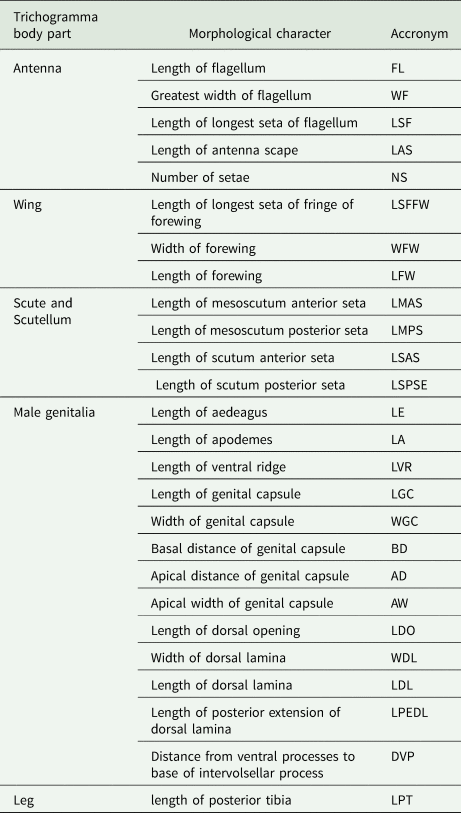
Morphological analysis followed by multivariate analysis is commonly used in systematics to detect and evaluate subtle morphological differences between populations (Blackith and Reyment, Reference Blackith and Reyment1971; Reyment et al., Reference Reyment, Blackith and Campbell1981; Querino and Zucchi, Reference Querino and Zucchi2004). The morphological features and terminology follow the usage of Pinto (Reference Pinto1999), and the specimens were prepared according to Querino and Zucchi (Reference Querino and Zucchi2011). Morphometric data taken for the isofemale lines were based on Querino (Reference Querino and Zucchi2002). Twenty-six characters were measured, using an ocular micrometer attached to a Zeiss Axioskop, with the measurement program Axio Vision version 3 (Table 2).
Trichogramma pretiosum Riley morphological characters measured

Data analyses
All analyses were carried out in R software (R Core Team, 2021).
Total offspring and mean sex ratio (MSR)
In order to evaluate the effect of heterogametic mating on total offspring (fertility) and MSR, the identities of each sex in these crosses were considered as independent variables. Generalized linear models (Demétrio et al., Reference Demétrio, Hinde, Moral, Ferreira and Godoy2014) were fitted using the paternal and maternal isofemale line as factors in the linear predictor, as well as their two-way interactions. A quasi-Poisson model was fitted to the total offspring data and a quasi-binomial model to the sex ratio data. Goodness-of-fit was assessed using half-normal plots with simulation envelopes (Moral et al., Reference Moral, Hinde and Demétrio2017). Multiple comparisons were performed by obtaining the 95% confidence intervals for the linear predictors, with the GLHT package (Hothorn et al., Reference Hothorn, Bretz and Westfall2008).
Variance analyses for morphological characters
Gaussian models were fitted to the data for morphological traits, separately for each response variable. Multiple comparisons were performed using Tukey's test at a 5% significance level.
Multivariate morphometry
A principal components analysis was carried out with the multivariate data, and a bi-plot was produced. A factor analysis was also carried out to describe the variability and correlation of the observed variables (Blackith and Reyment, Reference Blackith and Reyment1971).
Results
Compatibility of the T. pretiosum crosses
The total adult offspring produced from the different crosses was affected by the maternal isofemale line (F 2,166 = 30.33, P < 0.001) but not the paternal isofemale line (F 2;164 = 1.87, P = 0.16). Furthermore, there was no interaction effect of the maternal and paternal isofemale lines. Regardless of the male isofemale line, females from the Piracicaba isofemale line always produced a larger number of adult offspring than those from the Irvine-37B line, and females from Irvine-47A always fell somewhere between these extremes (fig. 1).
Total adult offspring produced (fertility) following homogamic and heterogamic crosses among Trichogramma pretiosum isofemale lines from the USA (Irvine) and Brazil (Piracicaba). Paternal line is indicated in the x-axis maternal line is indicated by different colored points.

In contrast to number of adult offspring produced, the MSR of the offspring resulting from the different crosses was significantly influenced by the interaction between the maternal and paternal isofemale lines (F 4;160 = 5.96; P < 0.001), although neither line had a significant main effect by itself. All homogamic crosses produced a MSR higher than 0.71. Crosses between Brazilian males and North American Irvine 47A females (T4), resulted in the lowest MSR (a higher proportion of offspring were male), a value significantly lower than the offspring MSR when Brazilian males were involved in homogamic crosses (T1), or in crosses with females from the other Irvine line, 37B (T7) (fig. 2). The MSR of this cross was also significantly lower than that following a homogamic 47A cross (T5). Finally, in heterogamic crosses, the MSR of the offspring produced by 37B females was significantly higher when the heterogamic male was allopatric (Brazilian; T7) as opposed to sympatric (47A; T8) (fig. 2). The homogamic 37B cross (T9) was not significantly different from either, T7 or T8.
Mean sex ratio of the offspring resulting from homogamic and heterogamic crosses among Trichogramma pretiosum isofemale lines from the USA and Brazil. Paternal line is indicated on the x-axis, maternal line is indicated by different colored points.

The RC of the different crosses is shown in fig. 3. Only the sympatric heterogamic crosses between lines 47A and 37B showed a significant reduction in RC, consistent in both directions (T6, W = 316.5, P = 0.03; and T8, W = 388.5, P = 0.04). The remaining heterogamic crosses showed lower RCs but only in one direction. For instance, mating between females from 47A and males from Piracicaba had a lower RC than either homogamic (T4 W = 418.5; P < 0.01), but when the source of the heterogamic sexes was switched, the RC was unaffected. Finally, the combination of females from Piracicaba with males from 37B also resulted in a significant reduction in RC (T3 W = 205.5, P = 0.01).
The relative compatibility (RC) of heterogamic matings between three isolines of Trichogramma pretiosum; dark gray portion of arrows corresponds to male individuals and light gray portion, to female ones. RC was calculated based on total offspring production and offspring sex ratios, relative to homogamic matings (see text). RC numbers with asterisks indicate that they significantly differed from the MSR of homogamic crosses by a Mann–Whitney U test (P < 0.05) Sorati et al. (Reference Sorati, Newman and Hoffmann1996).

Analyses of morphological characters
The analysis of variance of morphological characters of these T. pretiosum isofemale lines indicated significant differences in one character of the antenna (LF) between the two American isolines (Table 3). Most wing characters differed between the American isolines and the Brazilian isoline. The exception was the greatest width of the antennal flagellum (WF), which differed between isolines 47A and 37B. However, the mean size of this character in the Brazilian isoline was similar to the values found for the two American isolines (Table 3). Two genitalia characters also showed differences: the length of apodemes (LA) contrasted in the isolines Irvine 47A and Piracicaba, while the distance from the ventral processes on the genital capsule (DVP) differentiated the American from the Piracicaba isolines (Table 3).
Mean sizes (μm) of morphological characters of isolines of Trichogramma pretiosum

1 Means followed by the same letter do not differ by the Tukey test (P < 0.05).
2 SEM, standard error of the mean.
47A and 37B are American isolines; Piracicaba is a Brazilian isoline.
WF, greatest width of antennal flagellum; LSFFW, length of longest seta of fringe of forewing; WFW, width of anterior wing; LFW, length of anterior wing; LA, length of apodemes of genital capsule; DVP, Distance from ventral processes to base of intervolsellar process.
Multivariate morphometry
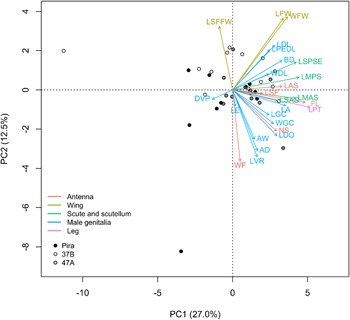
Our results for distance from the ventral processes to the base of the intervolsellar process (DVP) were negatively correlated to other morphological features of the T. pretiosum isolines (fig. 4). No significant differences could be detected among the morphological characters of the three isolines (Table 2; Fig. 4). The factor analysis results showed that the first factor, which explained 23.5% of the total variability, somewhat distinguished the DVP and antennal flagellum (WF) from the other factors; and the second factor, which explained 9.8% of the variability, separated the length of the posterior extension of the dorsal lamina (LPEDL) from the other characters (fig. 5).
Score projection of Trichogramma pretiosum specimens within the first two principal components PC1 and PC2. Pira, isoline Piracicaba; 47a, isoline Irvine-47A; and 37B, isoline Irvine-37B.

Biplot of the factor analyses carried out on the morphological characters of Trichogramma pretiosum isolines.

Discussion
The biological species concept proposed by Mayr (Reference Mayr1942), defines a species as a group of individuals, living in one or more populations, which can interbreed to produce healthy, fertile offspring. New species arise through a process called speciation, in which, an ancestral species splits into two or more descendant groups that evolve in such a way that individuals from the descendent groups can no longer interbreed. One promoter of speciation is allopatry, in which the descendent groups first become physically isolated from one another by a barrier such as a mountain range or ocean. Without gene-flow between the groups, each may evolve differently based on the demands of the habitat in which it finds itself, and/or random differences in the initial genetic characteristics of the groups, eventually becoming separate species. During the interim period, divergence between the groups may affect a variety of prezygotic and postzygotic barriers that influence reproductive isolation, evidenced by a reduction of fitness in crosses between the allopatric groups (outbreeding depression).
Among populations of the parasitoid wasp T. pretiosum, we found that heterogamic mating had no significant effect on the total number of offspring that survived to adulthood. However, in both the Piracicaba and 47A females, there was a trend for heterogamic mating's to result in an increase in the survival of more offspring to adulthood (fig. 1). In both cases, this slight increase in offspring was the result of an increase in the number of male offspring, but not female offspring, and this was reflected in significant differences in the MSR (figs 1 and 2). The lowest MSR was recorded when males from Piracicaba mated with females from 47A. Indeed, three out of six heterogamic crosses resulted in a reduction in the proportion of females in the resulting offspring, although not in the actual number of female offspring. We hypothesized that post-zygotic incompatibilities might reveal themselves by altering offspring sex ratios as a result of a reduction in the number of females, not by an increase in the number of males. Under that hypothesis, fertilized eggs (i.e., female offspring) would die as a result of developmental abnormalities, resulting in reduced fertility and altering the sex ratio because male offspring (unfertilized eggs) are unaffected. This hypothesis has previously been put forward to explain incompatibility in a related species, T. deion (Stouthamer et al., Reference Stouthamer, Jochemsen, Platner and Pinto2000). Contrary to this, our findings suggested that incompatibility most likely is the result of some pre-zygotic mechanism (see below). The changes in MSR, but not in the number of adult offspring produced (fertility), suggest that heterogamic males fertilize fewer eggs when mating with a sympatric heterogamic female rather than an allopatric heterogamic one. This would support the idea that selection against hybridization is expected to be stronger in sympatry as reviewed by (Howard, Reference Howard1999).
At least two, not mutually exclusive mechanisms could account for this. First, intraspecific differences in traits such as sperm size, sperm number, or ejaculate size may affect the ability of a male's sperm to access or exit a female's spermatheca (sperm storage organ). These traits have been shown to vary among Trichogramma populations (Martel et al., Reference Martel, Darrouzet and Boivin2011). Thus, heterogamic mating may result in the storage of fewer sperm, which then becomes depleted, resulting in an increase in unfertilized eggs (i.e., males). Even if females do not become sperm-depleted, heterogamic sperm may be less equipped to negotiate the female's reproductive tract. Assuming that the decision to fertilize an egg is under the female's control in T. pretiosum, she may release sperm from storage, but it may not reach the egg in a timely fashion, thereby missing some fertilization ‘window’. Should a sperm successfully reach an egg, fertilization success may be further impacted by divergence in sperm/egg recognition sites. Under this scenario, the female may be viewed as a somewhat ‘unconscious’ arbiter of a male's mating success. However, a second mechanism, cryptic female choice, confers a much more ‘conscious’ role on the female. Females of many species, particularly insects, have been shown to favor the sperm of some males over that of others, based on a variety of pre- and post-copulatory behaviors (see Eberhard, Reference Eberhard1996). Our morphological measurements revealed differences in two genital structures; the length of the apodemes (LA) and the distance from the ventral processes to the base of the intervolsellar process (DVP). Perhaps these structures directly or indirectly influence aspects of sperm delivery, uptake, storage, and/or use (Eberhard, Reference Eberhard1996; Martel et al., Reference Martel, Darrouzet and Boivin2011). Future research might seek to investigate characters relating to differences in sperm and ejaculate size, sperm storage, sperm depletion, and copulatory behavior in these lines.
Heterogamic crosses among three isofemale lines of T. pretiosum from the USA and Brazil showed levels of RC greater than 0.75, such that earlier studies (Pinto et al., Reference Pinto, Stouthamer, Platner and Oatman1991) would have classified these lines as being fully compatible. However, ignoring Pinto's arbitrary boundaries in favor of statistically valid differentiation (Sorati et al., Reference Sorati, Newman and Hoffmann1996), we found evidence that a low but significant degree of reproductive incompatibility did in fact exist between the three isofemale lines (fig. 3). Given the relative geographic isolation of Piracicaba, we expected heterogamic crosses involving this line to show lower levels of compatibility than those involving only the two Californian lines. However, sympatric heterogamic crosses between the two Californian lines, Irvine-47A and Irvine-37B, were the only ones in which the RC was significantly reduced in both directions (fig. 3). In the allopatric heterogamic crosses, involving a Piracicaba male or female with a Californian counterpart, RC was affected in only one direction (fig. 3). The advantages and disadvantages of inbreeding in Trichogramma are unclear. However, experiments carried out with Trichogramma brassicae Bezdenko and T. pretiosum have previously found no evidence for inbreeding depression (Sorati et al., Reference Sorati, Newman and Hoffmann1996; Prezotti et al., Reference Prezotti, Parra, Vencovsky, Coelho and Cruz2004). If there is actually some advantage to inbreeding in these wasps, we might expect mechanisms that depress outbreeding to be more prevalent among sympatric lines.
Although the RC of certain heterogamic combinations was reduced, overall, the T. pretiosum lines used in the present study still retained a surprising amount of compatibility. Despite originating from different lepidopteran host species, under different climatic conditions, and the separation of the collection sites of the USA and Brazilian lines by an enormous geographic distance (more than 9000 Km), no consistent incompatibility (i.e., both directions) was found in our allopatric heterogamic crosses. Note that our lines are naturally arrhenotokous, i.e., truly sexual. Pinto et al. (Reference Pinto, Stouthamer, Platner and Oatman1991) previously described relatively low levels of incompatibility for T. pretiosum from mutually distant sample sites (different continents), but full incompatibility for lines from relatively close sites (California and New Mexico, USA). Nevertheless, all T. pretiosum lines used by Pinto et al. (Reference Pinto, Stouthamer, Platner and Oatman1991) were thelytokous, converted permanently to arrhenotoky by feeding them antibiotics, which might explain why no evidence for incompatibility was found for the geographically distant lines, since no selection pressure exists on the original wild population. Whereas, Pinto et al. (Reference Pinto, Stouthamer, Platner and Oatman1991) found incompatibility between adjacent (close) T. pretiosum populations, our results showed a lower MSR value in the cross between Piracicaba males and 47A females (fig. 2). While these lines differed genetically (see GenBank OP142531 and OP142532), the lines also showed more robust differences in the sexual characters LA and DVP (Table 3), reinforcing our hypothesis that these structures could influence the sperm delivery. Clearly, much work is still required if we are to elucidate the mechanisms that influence reproductive compatibility in these wasps.
Acknowledgements
We thank the São Paulo Research Foundation (FAPESP) for financial support provided to ACJr, process 2011/17397-5 and as part of the São Paulo Advanced Research Center for Biological Control (SPARCBIO), process 2018/02317–5; hosted at the Luiz de Queiroz College of Agriculture (ESALQ) of the University of São Paulo (USP), sponsored by FAPESP, Koppert, and USP. We also thank the National Institute of Science and Technology Semiochemicals in Agriculture (INCT) (FAPESP 2014/50871–0; CNPq 465511/2014–7) for funding.
Conflict of interest
The authors declare no conflicts of interest.