Introduction
Pseudoaneurysms, or false aneurysms, may occur after damage to all layers of an artery wall, and result in extravasation of blood and formation of a haematoma. Communication of flowing blood from the artery to the haematoma persists. In contrast to true aneurysms, pseudoaneurysms are not contained by the vessel wall. Complications include ischaemia of local structures due to direct pressure, and thromboembolism.
Case report
A 61-year-old man presented to the otolaryngology clinic with a painless, pulsatile lump anterior to the pinna, four weeks following superficial parotidectomy (Figure 1). Needle aspiration in the clinic revealed fresh blood under pressure.
Right superficial temporal artery pseudoaneurysm.

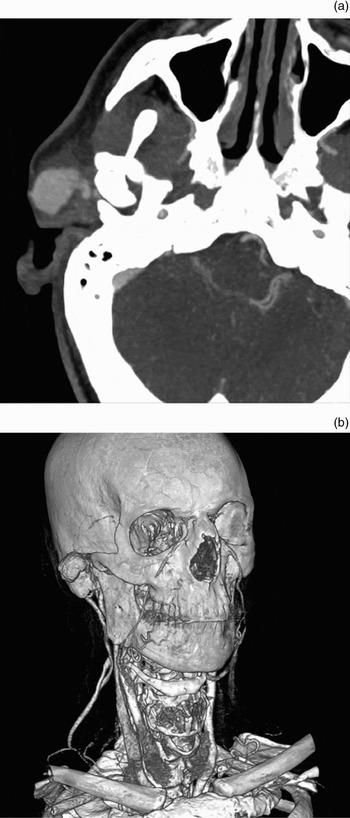
Contrast-enhanced computed tomography demonstrated an aneurysm of the superficial temporal artery (Figure 2).
(a) Axial computed tomography scan demonstrating right superficial temporal artery pseudoaneurysm. (b) Three-dimensional computed tomography reconstruction demonstrating right superficial temporal artery pseudoaneurysm.

The patient underwent excision of a pseudoaneurysm and ligation of the superficial temporal artery and feeding vessels, under general anaesthesia.
Histopathological examination confirmed the diagnosis of pseudoaneurysm.
Discussion
This patient represents the first reported case of pseudoaneurysm of the superficial temporal artery following parotid surgery. The cause may have been intra-operative vessel trauma. However, pseudoaneurysms of the superficial temporal artery usually develop secondary to blunt trauma.Reference Winslow and Edwards1, Reference Riaz, Ismail, Sheikh, Ahmed, Atkin and Richman2 True aneurysms of the superficial temporal artery generally occur spontaneously due to structural weakness caused by atherosclerosis.Reference Riaz, Ismail, Sheikh, Ahmed, Atkin and Richman2 A review by Peick et al. concluded that 90 per cent (124 cases) of superficial temporal artery aneurysms were caused by trauma.Reference Peick, Nichols, Curtis and Silver3 In one review of 48 Japanese cases reported between 1969 and 1997, 75 per cent (36 cases) were considered to be due to trauma, 6.2 per cent (three) occurred secondary to craniotomy and 18.8 per cent (nine) were considered spontaneous.Reference Uchida and Sakuma4
The femoral artery is the most common site for pseudoaneurysm, which may complicate up to 8 per cent of vascular interventional procedures.Reference Tisi and Callam5 Less commonly, pseudoaneurysm may occur due to an inflammatory or infective process; however, an infective cause of superficial temporal artery pseudoaneurysm has not been reported.
True aneurysms and pseudoaneurysms of the superficial temporal artery may be diagnosed clinically as a pre-auricular, pulsatile mass with a bruit or thrill. Pulsation will cease with proximal compression of the artery.Reference Pipinos, Dossa and Reddy6 Colour-flow Doppler ultrasound features include the ‘yin-yang sign’, in which blood swirls inside a partially thrombosed aneurysm, and the ‘to-and-fro’ sign as blood enters and leaves.Reference Lupattelli7, Reference Abdu-Yousef, Wiese and Shamma8 As in our case, computed tomography angiography confirms the diagnosis (Figure 2a and 2b).
The differential diagnosis includes arteriovenous fistula, facial nerve neuroma, abscess and parotid lesion. A pseudoaneurysm may be non-pulsatile if completely thrombosed.Reference Riaz, Ismail, Sheikh, Ahmed, Atkin and Richman2
Indications for surgical treatment of a superficial temporal artery pseudoaneurysm include pain, rapid enlargement, cosmesis and ischaemic effects.Reference Riaz, Ismail, Sheikh, Ahmed, Atkin and Richman2 Treatment with percutaneous thrombin has been reported in a child with a superficial temporal artery pseudoaneurysm.Reference Mann and Heran9 In a Cochrane review of the treatment of pseudoaneurysm of the femoral artery, injection of bovine thrombin appeared to be more effective than compression, but concern exists over the risks of transmissible infection and intraluminal thrombosis.Reference Tisi and Callam5 In a series of three cases of superficial temporal artery pseudoaneurysms caused by trauma, one case was successfully treated with surgical resection and two with coil embolisation.Reference Isaacson, Kochan and Kochan10
• Pseudoaneurysm (false aneurysm) of the superficial temporal artery is a rare cause of parotid swelling, and is usually caused by blunt trauma
• Pseudoaneurysm of the superficial temporal artery may develop after parotidectomy, possibly due to intra-operative, sharp trauma
Conclusion
Pseudoaneurysm of the superficial temporal artery is rare. It has been reported after facial trauma but, to the authors' knowledge, has not previously been reported after parotid surgery. Pseudoaneurysm should be considered as a rare cause of facial swelling following parotidectomy.