There is substantial variation in the distribution of conflict across the globe through time.Footnote 1 Consider, for example, the likelihood of conflict in Europe and North America versus Central Asia or the Middle East. While many regions seem to have been pacified, the likelihood of conflict remains high in other areas. Most dyadic studies of conflict suffer from omitted variable bias because they do not directly model this spatial variation.Footnote 2 We argue that this bias is especially severe for democratic peace studies, due to the endogeneity between democracy and peace. In standard studies of the influence of joint democracy on conflict outcomes, the estimated effects are likely to be overstated because models typically pay no regard to how peace and territorial settlements (both at home and in the near neighbourhood) influence the prospects for democracy at home in the first place.
Territorial disputes tend to recur, and are more likely than other issues to cause regimes to centralize, which is why unstable regions tend to be associated with border disputes and autocratic states. Absent territorial issues, however, regimes are not prone to the centralizing forces of external threats, and those states that are able to democratize do so. This pattern creates a correlation between peace and democracy, both of which are symptoms of prior territorial settlements. Although there is growing support for this argument,Footnote 3 no study has yet examined the effects of joint democracy after controlling for regional stability. If our argument is correct, we would expect to find that the relationship between joint democracy and peace is conditioned by the presence of regional territorial stability. That is, dyadic democracy reduces the likelihood of conflict only if the dyadic partners reside in peaceful neighbourhoods.
To assess this hypothesis we developed a new measure of regional stability: the ‘territorial hot spot’. First created in the conflict diffusion literature,Footnote 4 the conflict hot spot identifies regions and times during which territorial disputes have concentrated. By identifying the precise location of these clusters, we effectively create a proxy for regions that are territorially unstable. This proxy can also control for spatial and temporal concentration in the conflict data, and eliminates the substantial omitted variable bias that most conflict models produce.
We begin in the next section with a brief review of the territorial peace literature and the research linking territorial conflict, peace and democracy in the region. We then discuss our research design, with a particular focus on identifying territorial hot spots. Finally, we present the results of our tests and conclude with a discussion of possible future research.
Territorial Peace, Regional Conflict and Regime Type
Karl Deutsch originally argued that political communities could develop in which peace and stable relations prevailed among members.Footnote 5 The key was the guarantee that no member of the regional security community had an incentive to wage war against another member. Political integration among member states, such as what Deutsch found developing between North America and Western Europe at the time, was the prime method of providing such assurances, and potentially explained the growth of both peace and democracy in the North Atlantic community.
Kristian Gleditsch builds on this early theory of integration and argues that the strength of regional democracy is essential for understanding variations in both conflict and democratization at the state level.Footnote 6 According to Gleditsch, the spatial and temporal distribution of democracies around the world cannot be adequately explained by either factors internal to the state or within the international system writ large.Footnote 7 This regional variation also reliably predicts which dyads are least likely to be involved in conflict, suggesting a relationship between a region's democratic integration, peace and more democracy. Gleditsch and Michael Ward developed mechanisms to help explain regional influences on democratization processes.Footnote 8 They argue that the strength of regional democracy can alter the evaluations of domestic institutions made by competing elites within the state. The demonstration effect of strong democracies nearby also makes authoritarian institutions harder to protect. Similarly, aid provided by democracies – and the slow integration of democracies with non-democratic neighbours – can alter the balance of power among elites in favour of parties that are trying to democratize the state.
Though not originally intended as a theory with expectations for regional effects, the transition of the democratic peace research program to a Kantian peace perspective has changed that significantly.Footnote 9 Within the Kantian tripod, recursive effects are expected among democracy, peace, trade, and inter-governmental (IGO) membership, and the integration of states (through both trade and IGO membership) most often occurs at the regional level.Footnote 10 Recasting the original democratic peace arguments in this way helps explain the regional clustering of democracies; an added theoretical advantage is the new focus on the reciprocal relationship between international cooperation and domestic democracy.
Of course, there are some criticisms of the argument that the strength of regional democracy adequately explains peaceful regions. Arie Kacowicz argues that Latin America since the 1880s, and Western Africa more recently, have developed ‘zones of peace’ that cannot adequately be explained solely by the presence of democracy.Footnote 11 The problem with this critique, however, is that it ignores some rather bloody international conflicts in South America as well as multiple state failures and civil conflicts in Western Africa.Footnote 12 Errol Henderson contends that the presence of joint democracy in regions such as sub-Saharan Africa forces an inversion of politics in which regimes that have full control of their state – including many democratic states – are better able to send their troops abroad and go to war.Footnote 13 This finding may be one reason why Benjamin Goldsmith finds that the democratic peace is not a consistent predictor of peace/conflict across regions.Footnote 14
William Thompson provides one of the strongest arguments that regional conflict predicts regime type, rather than the more commonly argued democracy-to-peace hypothesis.Footnote 15 For Thompson, states are more likely to liberalize their state and, ultimately, their governing regimes when the foreign policies of the leadership no longer reflect attempts to dominate the region. The quest for regional primacy leads states to centralize in order to prosecute their wars, and authoritarian governments are better suited to take advantage of these resources. Hence conflict drives regime type. As Thompson's case studies demonstrate, democratization prospered in regions where the pursuit of primacy was settled or constrained – North America and Scandinavia – but lagged in regions where primacy remained contested – France and Taisho Japan.
Thompson's argument that peace is derived from repudiating attempts to dominate the region can also be restated as recognizing a region's territorial status quo, which is consistent with recent work by Gibler that connects border legitimacy with decentralization, democracy and peace.Footnote 16 Gibler argues that territorial threats to the state are unlike other types of threats because of the high salience of the issue domestically and the types of preparedness needed to conquer and hold land. Threats to territory create a domestic political environment that favours the leader, both among the public and within intra-institutional bargaining.Footnote 17 Leaders may take advantage of this political environment to remove domestic checks to their power and strengthen the army to occupy and hold the contested lands. Together, the favourable political climate, reinforced by a strong standing army, makes authoritarian turns and repression more likely, which is why recurrent, territorial conflicts become associated with centralized, authoritarian governments.Footnote 18
The settlement of territorial issues also has implications for regime types. Territorial settlement implies an absence of external forces affecting the centralization of the state, and, when combined with the proper precursors of democracy (wealth, a middle class, etc.), should encourage democratization.Footnote 19 Absent the dangerous issue of territorial conflict in the dyad, peace should also be more likely. Together, this logic suggests that peace between democracies is really only a symptom of a larger, territorial settlement.
Despite these criticisms, the strength of regional democracy has remained the best empirical predictor of peace and democratization in a region. However, no one has controlled for issue type and the effects of unstable borders at the regional level. We offer such a test and examine Thompson's regional revisionism argument and Gibler's territorial peace theory at the regional level. We use the next section to develop this test of existing theories and describe how our identification of regional clustering is important for correcting a common cause of omitted variable bias found in most studies of international conflict.
Research Design
We use a sample of all non-directed dyads for the years 1960–1998 to test whether a region's territorial stability affects the relationship between joint democracy and peace. The time period is constrained by the availability of location data for conflicts in the Militarized Interstate Dispute (MID) dataset;Footnote 20 however, nearly forty years of cross-sectional data from the international system (which includes over 445,000 non-directed dyads) should be adequate to test the effects of territorial hot spots and the democratic peace on interstate conflict. Next we describe our dependent variable and the independent variables we used to estimate our models.
Measuring Conflict
The dependent variable for each of our models measures the presence or absence of a fatal MID between dyadic partners in a given year. This is a fairly common specification of conflict in the dyadic peace literature.Footnote 21 We code this dichotomous variable as positive (1) only when the dyadic partners are participants in a new MID onset that results in at least one battle-related fatality. We do not include MIDs that are ongoing at the start of a new year, cases of MID joining or MIDs that do not result in at least one fatality. There are 300 dyadic onsets of fatal MIDs in our sample between 1960 and 1998.
Identifying Territorial Hot Spots in the International System
The conflict literature has established a considerable role for geographic factors in processes determining when and where conflicts emerge and diffuse. We know, for instance, that interstate wars and disputes cluster within geographic regions, evolve alongside regions of democracy and integration, and appear to be ‘contagious’.Footnote 22 We continue this emphasis on geography but, unlike these previous studies, we identify the precise locations (that is, battlefields) where conflicts actually occur. Most prior studies of geography focused on state participation in a conflict and assumed the geographic context from the distribution of actors in a conflict. These assumptions may be misleading, however, especially in the 20th century, when states often fought in far-flung conflicts. The United States currently rests comfortably in a region of stability, for example, even though it has involved itself in wars in the Middle East and Asia. We therefore account for unstable regions by identifying the actual location of conflicts and define a conflict hot spot as any geographic area in which the observed level of conflict exceeds a chance expectation.Footnote 23
Hot spots are evidence of the spatial-temporal aggregation of disputes in the same way that disputes are, themselves, an aggregation of individual incidents determined by a shared issue and a sufficient temporal proximity.Footnote 24 Thus, just as we assume that incidents in disputes are connected – even though they can be (and often are) geographically separate – the disputes in a hot spot are connected by both temporal and geographic proximity. Hot spots are therefore the aggregation of geographically related disputes that occur within a sufficiently proximate period of time. In this respect, the conflict hot spot provides a mechanism that causally links past and future episodes of conflict.
From a practical point of view, conflict hot spots are statistical summaries of the extent to which violent phenomena concentrate within confined geographic spaces, but the hot spot mechanism has considerable potential to carry more than mere descriptive value. Statistically, hot spots provide evidence that the assumption of independence across cases is violated. As we demonstrate later, there is substantial spatial correlation across dispute cases during most years. Theoretically, geographic hot spots can contain important insights into the processes that lead to conflict. By identifying a concentration of disputes in a specific geographic location, hot spots can provide evidence of an underlying cause of conflict that links multiple disputes together. These linkages could be due to unusually belligerent regimes, difficult-to-resolve policy questions or an intractable dispute over territorial control. Thus current studies that do not control for spatial correlation produce biased results; more importantly, the spatial correlation itself provides an opportunity for important insights into the underlying causes of repeated conflict.
We constrain the hot spot concept to territorial conflicts only in order to create a proxy for border instability in a region. Put differently, the spatial dependence problem that plagues most large-N studies of conflict becomes an independent variable in a model that controls for undue heterogeneity across dyads. Unstable borders are likely to be found in regions where an inordinate number of territorial conflicts are taking place, and if our argument is correct, territorial hot spots will affect the association between conflict and democracy.
Recent advances in spatial analysis have facilitated the precise identification of hot spots of various violent political phenomena. For example, new techniques have been applied to account for the regional concentration of terrorism,Footnote 25 international conflictFootnote 26 and the co-evolution of conflict and democracy.Footnote 27 Following similar definitions, we identified conflict hot spots in the data by first isolating the numerous ‘neighbourhoods’ within the international system. Within the international system, we labelled geographically contiguous countries as distinct neighbourhoods for each state. We then defined conflict hot spots as neighbourhoods that experience a larger number of territorial MIDs on their territoriesFootnote 28 than one would expect of an average neighbourhood in the international system, according to a random process.Footnote 29
We used the  $$$G_{i}^{\ast} $$$ statistic to help identify the precise geographic location of hot spots of territorial disputes. It has been used elsewhere to detect hot spots in co-evolving zones of conflict and democracyFootnote 30 and the occurrence of transnational terrorism.Footnote 31 The popularity of this particular statistic stems from the fact that it considers values (of the variable of interest) of countryi as well as countriesj in its calculation of the presence of a localized hot spot. Technically,
 $$$G_{i}^{\ast} $$$ offers a country-by-country measure of spatial association, identifying hot spots as areas with a high combined number of MIDs hosted by countries in the neighbourhood. The indicator intuitively reflects the spatial clustering of MID locations and determines whether a country rests in a conflict hot spot. The
 $$$G_{i}^{\ast} $$$ statistic is specified as:Footnote 32
 $$G_{i}^{\ast} \, = \,\frac{{\mathop{\sum}\limits_j {{w}_i}_{j} {{x}_j}{\rm{ - }}\mathop{\sum}\limits_i ({{w}_i}_{j} \, + \,{{w}_i}_{i} )\bar{x}}}{{{{\theta }_x}\sqrt {n\mathop{\sum}\limits_j w{{{_{i}^{2} }}_j}\,{\rm{ - }}\mathop{\sum}\limits_i w{{{_{i}^{2} }}_j}/(n{\rm{ - }}1)} }}$$
where wij Footnote 33 denotes element i, j in a binary contiguity matrix, xj is an observation at location j and  $$$ \bar{x} $$$ and θ 2 denote the sample mean and variance.
 $$$G_{i}^{\ast} $$$ can be compared to the standard normal distribution and indicates the extent to which high-valued observations of an event are clustered around a particular country, i. A positive and statistically significant value for the
 $$$G_{i}^{\ast} $$$ statistic at a particular location implies a spatial clustering of high values around that location.Footnote 34
Consistent with our hypothesis, we focused only on territorial conflicts and defined territorial MID hot spots as neighbourhoods that have a positive and statistically significant  $$$G_{i}^{\ast} $$$ statistic. This statistic details the differences between summed numbers of territorial MIDs in all contiguous pairs of countries and the mean value of these numbers as a proportion of the global variability in the numbers of territorial MIDs. As such,
 $$$G_{i}^{\ast} $$$ measures the concentration of the sum of the numbers of territorial MIDs spatially. If, for example, large numbers of territorial MIDs occur in a neighbourhood consisting of country i and its neighbours j, the value of
 $$$G_{i}^{\ast} $$$ will be high. Because this statistic approximates a standard normal distribution as the sample size increases, one can identify rigorously whether a country is located in a conflict hot spot by using a standard statistical significance test. Therefore our territorial MID hot spot variable takes the form of a dichotomous variable that is positive if the
 $$$G_{i}^{\ast} $$$ for either state in the dyad in the previous year is statistically significant (p < 0.5).
We aggregated the territorial hot spot measure to create a legacy variable of border stability that indicates the past conflict history of the area surrounding the dyad. This aggregated variable counts the total number of years during the previous decade in which there was a territorial hot spot within the region that involved at least one of the two members of the dyad. We conceive of this as a legacy variable of border stability. We lagged this variable by one year (t − 1) from the dyad year analysed (t), so the measure covers years (t − 1) through (t − 10). Since the aggregated measure provides a ten-year count of hot spot concentration, the variable ranges from 0 to 10.
Democracy and Conflict
We measured the effects of regime type using two methods. First, we used the combined 21-point democracy-autocracy scale from the Polity IV dataset and identified the lowest level of democracy in the dyad.Footnote 35 This ‘weak link’ specification of joint democracy is consistent with much of the democratic peace literature, and probably provides the most valid dyadic operationalization of democracy.Footnote 36
Recent scholarship on the democratic peace has also identified a pattern of co-evolution between regions or zones of peace and democracy.Footnote 37 This nascent literature suggests that democratic regimes pacify regions as well as states and dyads. We therefore identified the level of democracy in the region based on the proportion of the state's neighbours that are classified as democracies by the Polity IV dataset (defined as a combined score greater than 6). These data are also coded according to a weak-link specification within the dyad.Footnote 38
In order to directly test the conditional logic of our hypothesis – that democracy's pacifying effects are conditional upon prior border stability – we also included a variable that interacts the weak-link democracy score with the legacy variable, which measures the number of years in the past decade with a territorial hot spot in the region.
Common Predictors of Conflict and Model Correctives
We estimated a rather simple model of conflict, with few controls, so as to highlight the relationship between regional conflict and democracy. Our controls included contiguity, the presence of a defence pact in the dyad and the capability ratio between the states. We defined contiguous dyads as states that share a land border with one another or states that are separated by not more than 125 km of open water, using the Correlates of War (CoW) measure of direct contiguity.Footnote 39 We used COW formal interstate alliance data for the defence pact measure.Footnote 40 Finally, the parity measure is the ratio of capabilities between the weaker and the stronger state in the dyad; ratios near 1 represent complete parity.Footnote 41
All of our estimated models include peace splines that correct for temporal dependence.Footnote 42 We report the estimated effects of years of peace in the dyad since this is also, in some way, an imperfect measure of border stability. Regardless, the inclusion of both the peace year count and its splines enables us to address potential endogeneity problems since, by controlling for years of peace, we are more confident that the influence of past dyadic MID experience on state regime types has been controlled.Footnote 43
The Effects of Territorial Hot Spots on Dyadic Conflict
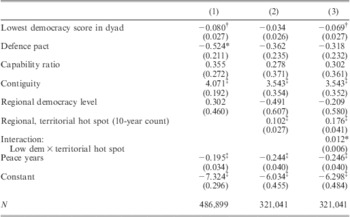
We estimated the effects of regional instability and dyadic and regional patterns of democracy on the onset of fatal MIDs using three separate logistic regression models, which are presented in Table 1. The first column presents Model 1, which provides a set of baseline predictions. The lowest democracy score in the dyad, defence pacts, and longer peace spells are all associated with peace in this model, while contiguity is linked to fatal MID onset. Each of these predictions is consistent with the general conflict literature. Surprisingly, we found no effect for the level of democracy in the region or capability ratios in this sample of data. Only the level of dyadic democracy matters with regard to regime type.
Territorial ‘Hot Spots’, International Conflict and Democracy

Note: Logistic regression, clustered on dyad with robust standard errors in parentheses. Splines of peace years omitted for space considerations.
*p < 0.05, †p < 0.01, ‡p < 0.001
Model 2 introduces our measure of neighbourhood instability and provides strong confirmation for the proposition that territorial MID hot spots, as a proxy for unstable borders, increase the likelihood of dyadic conflict. In particular, we found that dyads in which at least one state was located within a neighbourhood that experienced a high concentration of territorial MIDs over the past decade are also more likely to experience a new fatal MID onset. This model shows, moreover, that neither dyadic nor regional democracy is associated with a reduction in the likelihood of conflict once controls for regional stability are included in the estimation. The presence of a defence pact also no longer has a statistically significant effect, but contiguous states remain quite conflict prone.
We further examined the nature of the relationship between regional instability, democracy and dyadic conflict by specifying a third model, which introduces an interaction term between the number of territorial hot spots affecting the dyad and the lowest level of democracy in the two states. This interaction term allows us to directly examine the pacifying effects of democracy in the dyad as levels of territorial instability in the region vary. Model 3 again confirms that territorial hot spots are conflict prone at a statistically significant rate. The negative and statistically significant sign on the newly introduced interaction term additionally suggests, however, that the level of democracy within the dyad does play a role in determining whether a conflict will occur. Moreover, the constituent term that measures the low democracy score within the dyad is now statistically significant again, which suggests that when there is no territorial instability in the region, higher levels of democracy do reduce the likelihood of fatal MID onsets within the dyad.
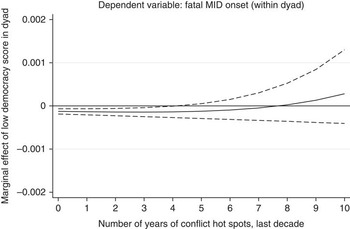
To determine the substantive significance of the interaction term in this model – and, most importantly, to quantify the size of the effect associated with dyadic democracy – we estimated the marginal effect of the lowest democracy score on the likelihood of a fatal MID onset across the range of the regional territorial hot spot parameter. In Figure 1, all variables were held at their mean, and we plotted a smoothed graph of the effects of a change in the level of democracy of one standard deviation across each possible value of the territorial hot spot indicator.Footnote 44 There is a decrease of approximately 0.02 per cent in the probability of a fatal MID with a one standard deviation increase in dyadic democracy in a region with one territorial hot spot. That is the largest possible effect across variations in regional conflict level. After four years of hot spots, the interaction term is no longer statistically significant, as the conflict environment seemingly overwhelms any pacifying effects of joint democracy. For context, consider that the probability of a fatal MID in our sample is 0.0167 per cent when all variables in the model are held at their respective means. This rate becomes approximately 0.0163 per cent when the lowest level of democracy is increased from its mean by one standard deviation. In other words, the pacifying influence of democracy is very small when the region is territorially unstable.
Marginal effect of democracy as neighbourhood instability changes

In pacified regions, the level of democracy does have substantial effects. A change in the lowest level of democracy from −3.75 (its mean) to 2.58 (an increase of one standard deviation) decreases the likelihood of a fatal MID to 0.009 per cent, which is a substantive decrease in the likelihood of fatal conflict of 46 per cent. Again, however, this strong effect does not influence dyads in territorially unstable regions. In territorially unstable regions, the probability of conflict is mostly influenced by the number of territorial MIDs that occurred in the previous decade. Indeed, changing the territorial hot spots variable from its mean by one standard deviation increases the rate of conflict by 80 per cent.
Together, our logistic regression and post estimation tests demonstrated rather starkly that localized territorial hot spots of conflict have an important effect on dyadic relations. These findings – particularly the strong destabilizing effect associated with unstable borders more generally – warrant the re-examination of several common predictors of conflict, including dyadic and regional democracy.
Discussion and Future Research
We began our discussion by detailing a hypothesis that claimed dyadic peace is predicated on the sustained absence of territorial conflict within the neighbourhoods of dyadic partners. Specifically, we argued that the common observation of a dyadic democratic peace is contingent upon the earlier establishment of a stable region. A series of empirical models confirmed these expectations and provided ample evidence of a regional territorial peace. Democracy's influence is strongest in regions that have stable borders. In regions without stable borders, the likelihood of conflict is high, and the level of democracy has, at most, only a minimal effect.
This article has also demonstrated the central importance of regional (in)stability in conflict processes – which has often been excluded from consideration in the conflict processes literature and, most notably, the democratic peace literature. These findings clearly warrant additional consideration of the role of regional/border stability during other phases of the conflict process. Regional instability may hasten patterns of war expansion as joiners multiply after threats to their border security. Regional instability may also affect both recurrent conflict and the likelihood of settlement. Ultimately, the key question is whether regional stability matters more than democracy for providing peace in the dyad. If this is so, as our findings appear to suggest, the policy consequences of such evidence would force a reconsideration of foreign policies that focus on democracy promotion as a path to regional peace.
Finally, further research is required to address the multiple feedback loops that could potentially exist between regional stability, dyadic democracy and fatal MIDs. Future studies could specify the nature of the role of democracy in the pacific settlement of disputes, the role of regional stability in enabling domestic state development and the detrimental impact of recurrent territorial disputes on nascent patterns of democratization. Our initial examination of data from the end of the 20th century suggests these would be useful areas of research.