Introduction
Representatives of the genus Porpidia Körb. (lichenized Ascomycota) form continuous to areolate-cracked crustose thalli and typically occur on siliceous, or, more rarely, on calcareous rocks, pebbles and stonework. Depending on the species, the thallus can be epilithic and conspicuous, being white, orange or various shades of grey; it may also be scarcely apparent or even endolithic. Fertile specimens produce lecideine, black and half-immersed to sessile apothecia, emerging from small dots on the thallus, with a distinct proper margin. Porpidia is a cosmopolitan genus, abundant predominantly in the mountainous and cool-temperate regions of both hemispheres. Because members of the genus grow most frequently on non-vegetated rock surfaces, they play an important role as pioneer organisms. Despite the fact that the genus is one of the segregates of Lecidea subjected to the greatest investigation (e.g. Fryday Reference Fryday2005 and literature cited therein), including molecular studies (e.g. Buschbom & Mueller Reference Buschbom and Mueller2004), many of the taxa are still poorly understood and many collections remain difficult to place. The enormous variability of the macroscopic characters, even within a single species, causes many difficulties for their proper delimitation. Identification to species level often requires detailed microscopic observation, involving the sectioning of the apothecia, and chemical examination to determine secondary metabolites.
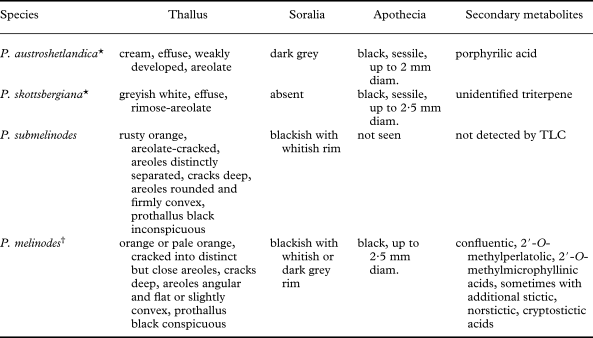
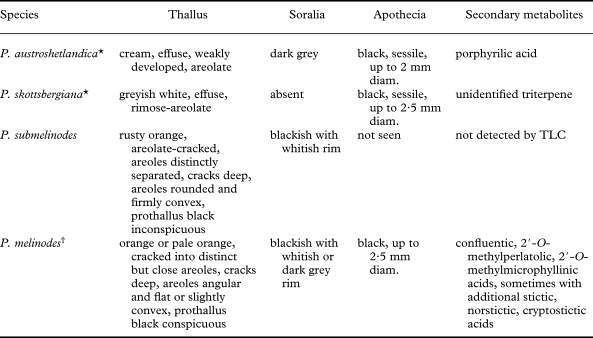
Compared with other lecideoid lichen genera, the number of species in Porpidia is relatively low, probably because the genus is poorly documented in many parts of the world; the total number of species has been estimated to be approximately fifty (after Smith et al. Reference Smith, Aptroot, Coppins, Fletcher, Gilbert, James and Wolseley2009). It is surprising that only two representatives, namely P. austroshetlandica Hertel and P. skottsbergiana Hertel, have been recognized in the Antarctic region. Both lichens are treated as Antarctic endemics and occur in the South Orkney and South Shetland Islands (Øvstedal & Lewis Smith Reference Smith, Aptroot, Coppins, Fletcher, Gilbert, James and Wolseley2001; Olech Reference Olech2004). The second of the two species was first described by Hertel (Reference Hertel1984) as indigenous to South Georgia. The selected diagnostic features of all the species are compared in Table 1.
Selected diagnostic characters for species of Porpidia recorded in Antarctica
* after Øvstedal & Lewis Smith (2001) and Olech (2004)
† after Fryday (2005).
Although most of the lichens assembled during several Antarctic expeditions have been subsequently identified and the findings published by the author in a series of papers (e.g. Olech Reference Olech1989a, Reference Olech1989b, Reference Olech1990, Reference Olech and Rakusa-Suszczewski1993, Reference Olech1994, Reference Olech2001 and literature cited therein, 2004), the huge collection also conceals unidentified and undescribed species. In this paper, we describe a new species of Porpidia from Antarctica distinct from those Porpidia hitherto recorded in the region. Recognition of this species was based initially on several specimens, representing two large populations, gathered by the second author in the southern region of King George Island (South Shetlands, maritime Antarctica). In addition, we found that two specimens determined and reported as Miriquidica atrofulva (Sommerf.) A. J. Schwab & Rambold from Signy Island (South Orkneys, maritime Antarctica) by Øvstedal & Lewis Smith (Reference Øvstedal and Lewis2001), with an annotation indicating uncertainty as to their identification. These are, in fact, related to the new species described in this paper.
Material and Methods
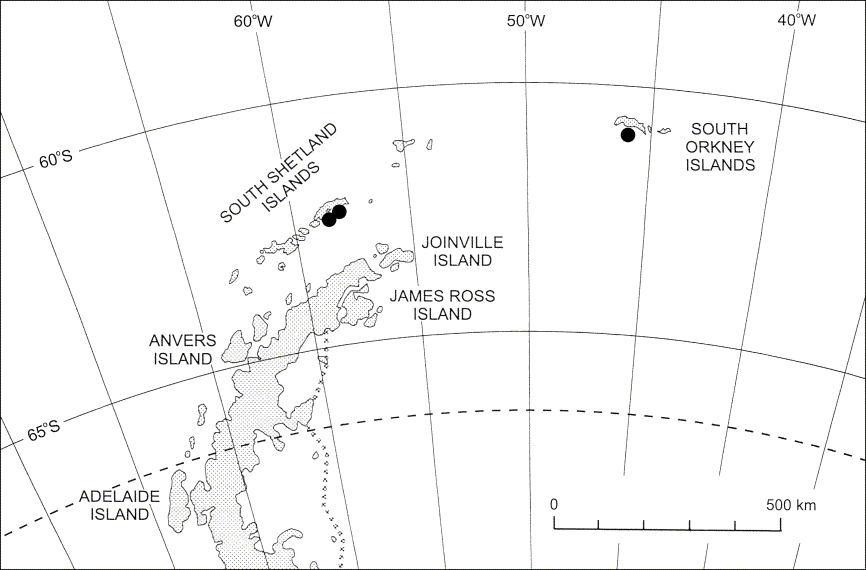
The samples from the South Shetlands were collected by the second author and originate from two sites in the area of King George Island: the volcanic Penguin Island, which lies close to the south coast of the island at the entrance to King George Bay, and the Upłaz massif situated on the west shore of Admiralty Bay near the ‘Arctowski’ Polish Antarctic Station. The specimens have been deposited in the lichenological herbarium of the Jagiellonian University in Cracow (KRA). A further two specimens from the South Orkneys originating from Signy Island, a small isle located in the southern part of the archipelago, near the south coast of Coronation Island and held in the herbarium of the British Antarctic Survey (AAS) were also studied. The map in Fig. 1 shows the places of origin for the materials examined.
Part of the maritime Antarctica, showing the known occurrence of Porpidia submelinodes in the South Shetlands and South Orkneys.

Morphology and anatomy were examined using standard microscopic techniques. The dimension of the thalli areoles, well-developed soralia and soredia are based on 350, 100 and 50 measurements, respectively. Microscopic measurements were made in 10% KOH solution, and 120 photobiont cells were examined.
Lichen substances were sought using thin-layer chromatography (TLC), in accordance with the methods summarized by Orange et al. (Reference Orange, James and White2001). Solvent systems A, B, C and G were used.
The Species
Porpidia submelinodes Osyczka & Olech sp. nov
MycoBank No.: MB519968
Thallus crustatus, areolatus, arciter ferrugine-aurantiace coloratus. Porpidia melinodes similis, sed areolae convexae, rotundatae et bene separatae. Areolae diameter (0·2–)0·4–0·8(–1·2) mm est. Soralia multa et dispergata, pulla cum margine albula. Soredia diameter 20–35 µm, N+ purpura. Prothallus niger et exiguus. Thallus sine substantiis lichenibus, medulla I−.
Typus: Antarctica, South Shetland Islands, Penguin Island, at the foot of the Deakon Peak, 62°05′59·3″S, 58°55′35·4″W, on volcanic boulder, 35 m alt., 29 December 2006, M. Olech AO10003 (KRA—holotypus).
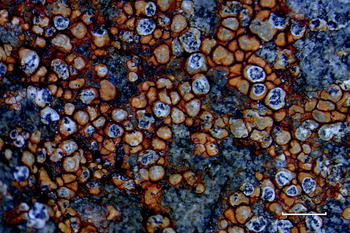
(Fig. 2)
Specimen of Porpidia submelinodes (M. Olech AO9501) from Antarctica. Scale = 2 mm.

Thallus epilithic, crustaceous, thin to moderately thick, 0·2–0·5 mm, ranging from intense orange to rusty-tinged hue, distinctly cracked into irregular areoles, areoles (0·2–)0·4–0·8(–1·2) mm diam., firmly convex, circular or roundish; if polygonal, then the corners are rounded; the surface smooth or occasionally shallowly papillate, matt or slightly shiny in part, the cracks between the areoles deep and frequently wide (up to 0·1 mm), the areoles distinctly separated; prothallus black and inconspicuous sometimes visible at the thallus margin and the edges where adjoining other lichens; soralia numerous and scattered, arising from the areoles, 0·2–0·5(–0·7) mm diam., delimited by a whitish rim; soredia coarsely granular, blackish, 20–35 µm diam., N+ red-purple. Photobiont chlorococcoid, the cells relatively large, (4–)6–10 × 8–12(–20) µm diam.
Apothecia and pycnidia not seen.
Chemistry. K−, C−, KC−, Pd−. No substances detected by TLC. Medulla I−.
Etymology. The name reflects the morphological similarities of the new species to P. melinodes.
Distribution and ecology. South Shetlands: on lava or volcanic stones, usually with a porous surface and located on gently sloping hills or the horizontal tops of ridges, at 30–60 m altitude, normally on dry and exposed sites on inland hills. It was associated with Lecanora polytropa (Hoffm.) Rabenh., L. intricata (Ach.) Ach., Carbonea assentiens (Nyl.) Hertel, Buellia anisomera Vain. South Orkneys: on boulders and quartz-tremolite rocks, at 75 m altitude, associated with Fuscidea sp. and Tremolecia atrata (Ach.) Hertel.
Notes. All the material examined was sterile. Although placement of this taxon in Porpidia seems to be the most appropriate, the absence of apothecia and a lack of resolution based on molecular studies mean that the generic affinity has not been definitively determined and should be considered as provisional. Undoubtedly the morphology and soralia (character and formation) of the species correspond, to a high degree, to those of Porpidia melinodes (Körb.) Gowan & Ahti, which is known from both the arctic and upland areas of the Northern Hemisphere (e.g. Gowan & Ahti Reference Gowan and Ahti1993; Fryday Reference Fryday2005; Smith et al. Reference Smith, Aptroot, Coppins, Fletcher, Gilbert, James and Wolseley2009). It belongs to the Porpidia speirea group, which is divided into the speirea and flavicunda subgroups (Buschbom & Mueller Reference Buschbom and Mueller2004; Fryday Reference Fryday2005). Members of the first subgroup have white or grey thalli with an amyloid (I+) medulla and apothecia with a poorly developed exciple with a pale medulla, whereas those of the second subgroup, including P. melinodes, have obligate orange thalli with a non-amyloid (I−) medulla and apothecia with a well-developed exciple with darkly pigmented medulla (Fryday Reference Fryday2005). Perforce, we are unable to discuss or examine the microscopic characteristics of the apothecia; on the other hand, the formation of vegetative reproductive structures only could be a constant characteristic of P. submelinodes. Although there are morphological similarities between P. melinodes and P. submelinodes, a precise comparison allows appreciable differences to be observed (Table 1). The thallus of P. submelinodes consists of distinctly convex, rusty-tinged and rounded areoles that are clearly separated by deep and wide cracks; some of the areoles are even solitary, or in groups of 2–4. The thallus of P. melinodes is cracked into distinct but close areoles, which are angular and rather flat or only slightly convex. The black prothallus of P. melinodes is conspicuous and visible in a distinct byssoid marginal zone, whilst that of P. submelinodes is inconspicuous. Moreover, their chemistry differs; no lichen substances were detected in P. submelinodes, whilst all the species from the P. speirea group typically have the confluentic acid chemosydrome as their primary chemotype (e.g. Fryday Reference Fryday2005). The morphological features of our material suggest an affiliation with the P. speirea group and, because these are similar to, but distinct from, those of P. melinodes, and also because our material is chemically distinct in lacking lichen substances, we took the decision to describe a new species from Antarctica. It is represented by at least two large and stable populations in the South Shetlands and also occurs in the South Orkneys. The geographical isolation is favourable for speciation and this fact also suggests that the lichen material studied refers to a separate species.
Other comments. According to the key to sterile leprose, granulose sorediate taxa on rock from Antarctica (Øvstedal & Lewis Smith Reference Gowan and Ahti2001), the feature defined as rust-coloured thallus leads to Miriquidica atrofulva. Moreover, the description of the species provided in that work is partly consistent with the characteristics given here for P. submelinodes. It should be pointed out that the authors added a note regarding the uncertainty of the identification. After revision of the material, it became clear to us that the two specimens cited from Signy Island do not correspond to Miriquidica atrofulva and are, in fact, similar to P. submelinodes. We thus regard the specimens from Signy Island as typical representatives of P. submelinodes.
Selected specimens examined. Antarctica: South Shetland Islands: Penguin Island, above Gonzales Point, 62°05′539″S, 57°55′041″W, 30 m, 2006, M. Olech AO9501 (KRA); King George Island, Admiralty Bay, Upłaz, N slope, 62°09′30″S, 58°29′35″W, 55 m, 2001, M. Olech AO9504 (KRA). South Orkney Islands: Signy Island, Moraine Valley, 60°72′S, 45°62′W, 75 m, 1989, R. I. Lewis Smith RILS8067 (AAS); north-west side of the ridge leading to Moyes Point, 60°73′S, 45°67′W, 75 m, 1992, R. I. Lewis Smith RILS8675 (AAS).
We would like to thank Helen Peat (Cambridge, Curator of AAS) and Tor Tønsberg (Bergen, Curator of BG) for providing us with the material required for this study. We are also indebted to the anonymous reviewers for their most helpful comments on, and corrections of, the manuscript.