Introduction
Sweetpotato is a valuable commodity in the United States, and was worth over $733 million in gross farm value in 2017 with North Carolina, California, Mississippi, and Louisiana farmers planting more than 89% of the production area (USDA 2018). The majority of the sweetpotato acreage (>90%) in North Carolina is planted to ‘Covington’ (NCDACS 2015), a cultivar released by North Carolina State University in 2008 (Yencho et al. Reference Yencho, Pecota, Schultheis, VanEsbroeck, Holmes, Little, Thornton and Truong2008). The wide adoption of Covington is due to its disease resistance and consistency to produce a high percentage of no.1 grade roots that result in greater economic return (Yencho et al. Reference Yencho, Pecota, Schultheis, VanEsbroeck, Holmes, Little, Thornton and Truong2008). ‘Beauregard’ was the standard cultivar that dominated the U.S. market since the 1990s, soon after its release in 1987 (Rolston et al. Reference Rolston, Riley, Wilson, Robbins, Clark, Cannon and Randle1987) and continues to be an important orange-fleshed variety in Mississippi and internationally.
Sweetpotato yield, quality, and subsequent value can be negatively affected by weeds (Barkley et al. Reference Barkley, Chaudhari, Jennings, Schultheis, Meyers and Monks2016; Coleman et al. Reference Coleman, Chaudhari, Jennings, Schultheis, Meyers and Monks2016; Meyers et al. Reference Meyers, Jennings, Schultheis and Monks2010b). Although cultivation, mowing, and hand-weeding are important weed management practices in sweetpotato production, herbicides are the major component of a weed management program in sweetpotato (J. Haley and J. Curtis, unpublished data). However, few herbicides are registered for use in sweetpotato (Kemble Reference Kemble2017). The standard herbicide program used by North Carolina sweetpotato growers is flumioxazin pretransplant followed by S-metolachlor 10 to 14 d after transplanting (DAP) (KM Jennings, personal communication), but weeds may become established if S-metolachlor is not applied timely and to a weed-free field (Coleman et al. Reference Coleman, Chaudhari, Jennings, Schultheis, Meyers and Monks2016; Meyers et al. Reference Meyers, Jennings, Schultheis and Monks2010a). If S-metolachlor is applied too soon after transplanting and followed by moderate to heavy rainfall, injury (short and round storage roots) to the developing sweetpotato storage roots may occur and yield may be reduced (Meyers et al. Reference Meyers, Jennings, Monks, Miller and Shankle2013). As a result, some sweetpotato growers are not comfortable using S-metolachlor. Clomazone and napropamide are also registered for use before or after transplant prior to weed emergence in sweetpotato. However, control of Palmer amaranth (Amaranthus palmeri S. Watson) and other pigweed species is not consistent with clomazone and napropamide (Barkley et al. Reference Barkley, Chaudhari, Jennings, Schultheis, Meyers and Monks2016; Scott et al. Reference Scott, Weston and Jones1995).
The investigation of potential herbicides for weed control in sweetpotato is critical due to the limited number of registered herbicides and the development of populations of herbicide-resistant weeds. Oryzalin is a soil-applied dinitroaniline herbicide (WSSA group 3) that is registered PRE in fruit and nut trees, berries, vineyards, and Christmas tree plantations (Anonymous 2014; Derr Reference Derr1994; Hanson and Schneider Reference Hanson and Schneider2008; Kadir and Al-Khatib Reference Kadir and Al-Khatib2006). Oryzalin kills susceptible plants by inhibiting cell division in roots restricting root development, and causing plants to produce short and swollen roots (Shaner Reference Shaner2014). Gossett et al. (Reference Gossett, Murdock and Toler1992) reported that 0.8 kg ha–1 soil-incorporated oryzalin provided 100% control of dinitroaniline-susceptible Palmer amaranth. Kadir and Al-Khatib (Reference Kadir and Al-Khatib2006) reported no injury to grape (Vitis vinifera L.) and ≥80% control of broadleaf weeds until three months after application from spring-applied oryzalin 2.72 kg ha–1. Similarly, Hanson and Schneider (Reference Hanson and Schneider2008) reported no injury to emerging peach (Prunus persica L.) seedlings from oryzalin applied PRE.
Limited research has been conducted to determine the response of sweetpotato to oryzalin PRE application timing and rate in production systems in the Southeastern UnitedStates. Glaze and Hall (Reference Glaze and Hall1990) reported that oryzalin at 0.8 kg ha–1 did not injure ‘Georgia Jet’ sweetpotato and provided 69 to 95% weed control over 4 years depending upon environmental conditions and weed species present. Meyers et al. (Reference Meyers, Jennings and Monks2017) reported that oryzalin applied immediately after sweetpotato transplanting at 560 or 1,121 g ha–1 resulted in less than 10% crop injury and ≥98% Palmer amaranth control until 4 wk after treatment. Crop injury was transient, and no. 1 and marketable sweetpotato yields were no different than a hand-weeded control. Oryzalin applied PRE in sweetpotato would be beneficial to growers because it controls broadleaf weeds including Palmer amaranth and annual grasses. Thus, the objective of this research was to determine the influence of oryzalin application rate and timing on sweetpotato tolerance and storage root yield.
Materials and Methods
Studies were conducted at Horticultural Crops Research Station, Clinton, North Carolina (35.0227°N, 78.2794°W) and Pontotoc Ridge–Flatwoods Branch Experiment Station in Pontotoc, Mississippi (34.1420°N, 88.9945°W) in 2017. Soil was a Norfolk loamy sand (fine-loamy, kaolinitic, thermic Typic Kandiudults) with pH 6 and organic matter 0.6% at Clinton and Atwood silt loam (fine-silty, mixed, thermic Typic Paleudalfs) with pH 6.5 and organic matter 1.5% at Pontotoc. On May 31, 2017, nonrooted Covington sweetpotato vine cuttings (slips) were transplanted 30-cm apart into rows 1-m wide by 6-m long at Clinton. On June 14, 2017, Beauregard sweetpotato slips were transplanted 30-cm apart into rows 1-m wide by 9-m long at Pontotoc. Plots consisted of two (Clinton) and three (Pontotoc) ridged rows; the second and middle rows of each plot were used for data collection at Clinton and Pontotoc, respectively. At Clinton, the first row of each plot was nontreated and served as a border row. At Pontotoc, all rows were treated. All plots were maintained weed-free throughout the growing season with an application of 107 g ai ha–1 flumioxazin (Valor SX, Valent U.S.A. Corporation, Walnut Creek, CA) pretransplant, between-row cultivation, and hand-removal of weeds as needed. The experimental design was a randomized complete block with four replications.
Treatments consisted of a factorial arrangement of five oryzalin (Surflan® 4AS, United Phosphorus, Inc., King of Prussia, PA) rates (0.6, 1.1, 2.2, 3.4, and 4.5 kg ai ha–1) by two application timings (0 [immediately after transplanting] or 14 DAP). Additionally, a nontreated check was included for comparison. At Clinton, herbicide applications were made with a CO2-pressurized backpack sprayer calibrated to deliver 187 L ha–1 at 173 kPa with a 2-nozzle boom equipped with TeeJet XR 8003VS flat fan nozzles (Spraying Systems Co., Wheaton, IL). At Pontotoc, herbicide applications were made with a tractor-mounted CO2-pressurized sprayer calibrated to deliver 144 L ha–1 at 152 kPa with a 6-nozzle boom equipped with TeeJet XR 8002VS flat fan nozzles. Other production practices, including fertility, insect, and disease management, were conducted in accordance with recommendations by Kemble (Reference Kemble2017).
Visual estimates of foliar sweetpotato injury (leaf distortion and stunting) were rated on a scale of 0 (no crop injury) to 100% (crop death). Sweetpotato storage roots were harvested at 105 (Pontotoc) and 110 DAP (Clinton) with a chain digger, hand-graded into jumbo (≥8.9 cm in diam), no. 1 (≥4.4 cm but <8.9 cm), and canner (≥2.5 cm but <4.4 cm) (USDA 2005), and weighed. Total marketable yield was calculated as the sum of jumbo, no. 1, and canner yields.
Data were subjected to ANOVA using SAS 9.3 (SAS 9.3, SAS Institute Inc., Cary, NC) PROC GLIMMIX with the fixed effects of oryzalin application rate and timing and their interaction. Location and replication within location were included as random effects where data were combined for both locations; otherwise, replication was considered as the only random effect. All data were checked for homogeneity of variance before statistical analysis by plotting residuals. Means were separated by Fisher’s protected LSD at a significance level of 0.05. The nontreated check was not included in sweetpotato injury analysis because crop injury was 0% and had a variance of 0. However, the nontreated check was included in yield analysis.
Results and Discussion
Sweetpotato Tolerance
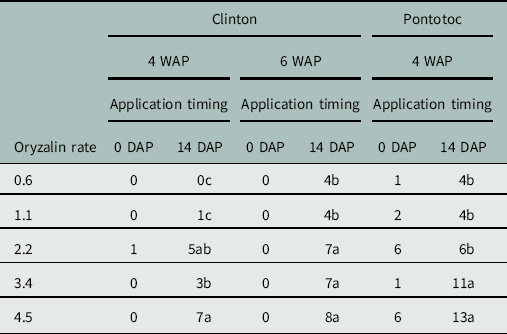
Injury from oryzalin presented as leaf distortion and stunting. At both locations, an oryzalin rate effect for sweetpotato leaf distortion was only observed when oryzalin was applied 14 DAP (Table 1). At Clinton, oryzalin applied immediately after transplanting resulted in ≤1% leaf distortion 4 and 6 wk after transplanting (WAP), regardless of application rate. However, when oryzalin was applied 14 DAP, greater sweetpotato leaf distortion was observed from 2.2, 3.4, and 4.5 kg ha–1 (3 to 7%) than 0.6 and 1.1 kg ha–1 (≤1%). At Pontotoc, oryzalin applied immediately after transplanting resulted in ≤6% leaf distortion 4 WAP, regardless of application rate. However, when oryzalin was applied at 14 DAP, greater leaf distortion was reported from 3.4 and 4.5 kg ha–1 (11 to 13%) than 0.6, 1.1, and 2.2 kg ha–1 (4 to 6%).
Sweetpotato leaf distortion as influenced by oryzalin application rate and timing at Clinton, NC and Pontotoc, MS in 2017.Footnote a , Footnote b

a Abbreviations: DAP, d after transplanting; WAP, wk after transplanting.
b Means within columns followed by the same letter are not significantly different according to Fisher’s Protected LSD Test at P≤0.05. The nontreated check was not included in the statistical analysis.
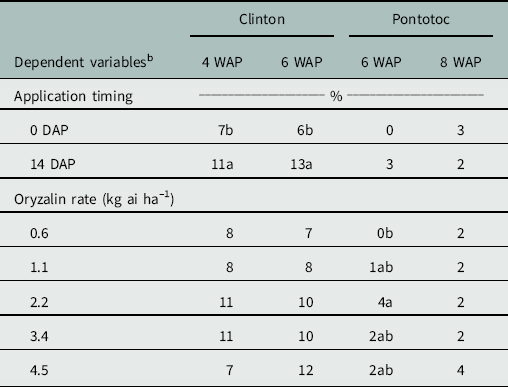
The interaction for oryzalin application rate and timing was not significant for sweetpotato stunting; therefore, data are presented by main effects (Table 2). At Clinton, stunting at 4 and 6 WAP was greater when oryzalin was applied at 14 DAP (11 to 13%) than immediately after transplanting (6 to 7%). The effect of application rate was not significant for stunting and stunting was ≤12% regardless of oryzalin application rate. At Pontotoc, 6 and 8 WAP, stunting was ≤4% regardless of oryzalin application rate and timing. Both leaf distortion and stunting from all treatments was transient and no injury was reported later in the season at 10 and 14 WAP (data not shown). Similarly, Meyers et al. (Reference Meyers, Jennings and Monks2017) reported less than 10% sweetpotato injury from oryzalin applied immediately after sweetpotato transplanting at 560 or 1,121 g ha–1.
Sweetpotato stunting as influenced by oryzalin application timing and rate at Clinton, NC and Pontotoc, MS in 2017.Footnote a

a Abbreviations: DAP, d after transplanting; WAP, wk after transplanting.
b Means within columns for dependent variables (application timing or rate) followed by the same letter are not significantly different according to Fisher’s Protected LSD Test at P≤0.05. The nontreated check was not included in the statistical analysis.
Sweetpotato Yield
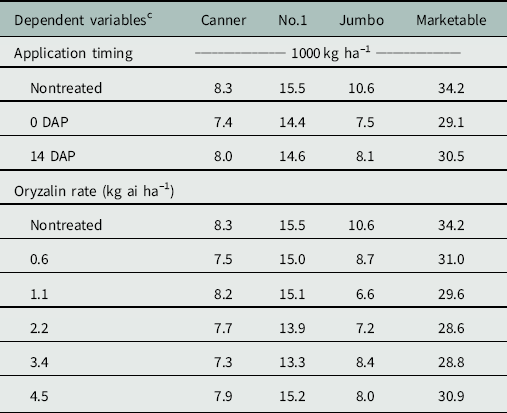
The treatment-by-location interaction was not significant for sweetpotato yield; therefore, data from both locations were combined for analysis. Canner, no.1, jumbo, and marketable sweetpotato yield of the nontreated check was 8.3, 15.5, 10.6, and 34.2×10³ kg ha–1, respectively (Table 3). There was no impact of oryzalin rate or application timing on canner, no.1, jumbo, or marketable sweetpotato yield.
Sweetpotato yield as influenced by oryzalin application timing and rate at Clinton, NC and Pontotoc, MS in 2017.Footnote a , Footnote b

a Abbreviations: DAP, d after transplanting; WAP, wk after transplanting.
b Data were combined for both locations.
c Means within columns for dependent variables (application timing or rate) are not significantly different according to Fisher’s Protected LSD Test at P ≤0.05.
Overall, these results indicate that early-season sweetpotato injury following oryzalin application is temporary, and sweetpotato is able to recover from injury with no effect on yield when compared to a nontreated check, regardless of application rate and timing. Based on these results demonstrating crop tolerance and the findings of others (Glaze and Hall Reference Glaze and Hall1990; Gossett et al. Reference Gossett, Murdock and Toler1992; Meyers et al. Reference Meyers, Jennings and Monks2017) demonstrating efficacious weed control in sweetpotato production systems, oryzalin has the potential to be a useful herbicide in an overall weed management program. Nelson et al. (Reference Nelson, Meggitt, Penner and Ladlie1983) reported that herbicide placement with respect to the germinating seed and soil moisture content are important factors for oryzalin efficacy. Additional research should be conducted to determine the potential impact of soil incorporation and rainfall, which may place oryzalin in direct contact with sweetpotato during the storage root initiation phase of crop development. Future research should also focus on designing effective weed management programs in sweetpotato production system with the use of oryzalin in combination with other herbicides.
Acknowledgments
The authors would like to thank United Phosphorus, Inc. for providing herbicide and funding, Dr. Lucky Mehra for providing assistance with the statistical analysis, and the staff of the Horticultural Crops Research Station and Pontotoc Ridge–Flatwoods Branch Experiment Station for the cultural management of sweetpotato research plots throughout the studies. No conflicts of interest have been declared.