Introduction
Terra Nova, on returning to Antarctica in January 1912, relieved Scott's Northern Party after nearly 12 months at Cape Adare. The six men, led by Victor Campbell, moved south down the coast for five week's sledging in the Wood Bay area. Terra Nova landed them at Evans Cove on 4 January and was to return in late February. However, bad ice-conditions prevented this, so that the party was abandoned and left to survive the 1912 winter alone. With little food and only summer equipment, they dug a snow-cave and survived on mainly seals and penguins. In the early spring, after seven months in a snow-cave, weak and with only enough food for half the journey, they sledged south down the coast to re-join Scott's main party at Cape Evans.
The Memorial University of Newfoundland Library holds the papers of Victor Campbell. The collection consists of items relating to Campbell's time in the Antarctic, his involvement in World War 1, and his life in Black Duck, Newfoundland from 1922 until his death, in nearby Corner Brook, in 1956. Among the Antarctic items is one small notebook. A simple hardcover book described as ‘Item 5.08 Notebook containing stores lists, computations and other notes referring to B's illness, probably used in 1912 in ice-cave’ (Grenville Reference Grenville1988).
This is no ordinary notebook, but one Campbell took into the snow-cave and then used for private conversations between himself, George Levick, and Raymond Priestley. The writings are not personal notes or diary entries as previously thought (King Reference King2001: 132, 136), but two-way conversations written for privacy. Authors have mentioned how Campbell divided the small-cave area into two virtual messes, one for the ratings, the other for the officers, and both with the associated naval implications that conversations in one mess were not to be ‘paid attention to’ in the other. Still, at times, private conversations were needed. Hooper describes one silent conversation between Campbell and Levick, carried out in writing in the latter's cave-diary, and also mentions some others relating to health matters (Hooper Reference Hooper2010: 261–262).
This paper describes the individual conversations found in Campbell's note-book and attempts to determine when they were written. The conversations are viewed in the context of the party's daily life huddled in their snow-cave on Inexpressible Island, and surviving the harsh Antarctic winter of 1912. The conversations are presented in date-order to follow the flow of events in the cave. Dates and context were resolved using published Northern Party material as access to the original diaries was difficult in New Zealand. The conversations and drawing, covering ten pages of the notebook, are between Campbell and Levick, with some involving Priestley. The pages are referred to by the page-numbers which were created to identify the photographs when Memorial University of Newfoundland copied the notebook. Several pages torn from the book were ignored and not numbered. The numbering-system used to identify pages and individual notes (each individual's segment of a conversation) is of the form <page number>.<note number>.
Background
The Northern Party comprised six men. The leader, Victor Campbell, Lieutenant RN (35), was the surveyor, and from time spent in Norway, had a good knowledge of snow, mountains, glaciers, and skis. Second in command was George Murray Levick, Surgeon, R.N. (33), a doctor, zoologist and photographer specialising in physical and recreational training. The geologist Raymond Edward Priestley (24) was the only civilian and, although the youngest, brought Antarctic knowledge having been with Shackleton's British Antarctic Expedition in 1907–1909. Support was provided by three naval ratings: George Percy Abbott, Petty Officer R.N. (30), had joined the Royal Navy at 15 and was an outstanding athlete and gymnastic instructor; Frank Vernon Browning, Petty Officer, 2nd Class, R.N. (28), had serious problems with the high-meat low-carbohydrates diet, and owed his survival to the efforts of the doctor and his own positive outlook; Harry Dickason, Able Seaman R.N. (25), was the cook at Cape Adare, expert in using the primus stove and instrumental in conserving fuel-oil.
After a few weeks sledging, the party returned to their main depot at Hell's Gate to wait, though in vain, for Terra Nova. With no ship, they knew they were on their own. With little food, and only summer equipment, they now prepared to survive the coming winter. In addition they knew that in early spring, unaided, they would have to make the trip back to Scott's main party at Cape Evans. For this trip they cached most of their food, fuel-oil and spare clothing. The food set aside for winter was less than a biscuit a day, a thin mug of cocoa five nights a week, a mug of tea once a week, a little chocolate and sugar, possibly twice a week, and twenty-five raisins per man each month and on birthdays. Their survival would rely on the seals and penguins they could kill. With most fuel-oil cached, the primus could be used for only one meal each day. A blubber-stove, constructed from an empty oil-can, would be used for the rest of the cooking and for thawing the meat.
Campbell made Priestley quartermaster then split the party into two groups, one to stock pile seals and penguins while the other dug and prepared a snow-cave. The seal-kill started on 1 March; digging the snow-cave on 5 March; they moved into their cave on 18 March; and departed the cave after surviving the winter on 30 September. On entering the cave, they had less than half the seals needed. Survival meant that throughout the winter, when the weather allowed and in the dark, they would have to hunt for additional seals and penguins.
The cave, just 12 × 9 feet, had room for six sleeping-bags and a cooking area in one corner. However, once in the cave, they moved the entrance to the end of an extended passage way. The inclusion of two small doorways to reduce cold-air flows, improved the temperature in their living area and meat preparation moved to this passage. Meat preparation, during the early days in the cave, simply involved use of a geological hammer to shatter the frozen blocks. Later, with improvements made to the blubber stove, the meat blocks could be thawed and then cut ready for cooking. Two small lateral extensions were later made to the passage, one used for storing meat and the other for a toilet. The cave initially had no chimney but, after the party nearly suffocated, one was installed. Although this solved the ventilation problem, the cave became extremely cold once the blubber-stove was extinguished. It quickly became the mess-man's job at the end of cooking to plug the chimney and so prevent the freezing outside air from cooling the living area. The main area was cold and cramped, with the only light coming from the blubber-stove and small blubber-lamps. Over time, the build-up of soot and grease from handling and burning blubber increased the squalor. Along with this hygiene deteriorated and outbreaks of dysentery and food-poisoning caused serious problems.
The party had two meals each day consisting of hoosh. However, unlike normal hoosh (a rich sustaining stew-like meal made with pemmican) the party's hoosh was a thin, oily, tasteless gruel made with seal-meat, blubber and salt-water ice. At times, without success, they attempted to flavour it with seaweed and various items from the doctor's medicine chest.
Throughout their time in the cave, all had problems with their high meat-diet and lack of carbohydrates. Browning was affected more seriously due to the after-effects of the enteric fever (typhoid) he had suffered during the Boer war. In particular, the salt-ice used for boiling the seal-meat aggravated this condition. Late in the winter, as they managed to butcher more seals and penguins, he ate fried meat and a special fresh-water hoosh. Although this did not fully resolve his problem, he did improve slightly.
September, their last month in the cave, proved terrible. Bad weather, high winds, blown snow, dysentery, and two outbreaks of food-poisoning were to debilitate the party. After six months living in filthy, bitterly cold, cramped conditions, working by the glimmer of burning blubber, they would have been feeling desperate and alone. Despite this, they were trying hard to build up their strength for the journey home. This was a time of increasing stress, added to by the worries of the forthcoming sledge journey back to Cape Evans, a trip that would present new perils but that also gave them hope. It would mean they would be free of the squalor and darkness of their ice-cave. It was during this last month, in semidarkness that these conversations were pencilled with frozen fingers.
Written conversations
Each of the conversations is listed below. The format for each is as follows: first, the transcription headed by the notebook page number; secondly, the interpretation, including the probable date; finally, the explanation of the dates and context of the conversation derived from published accounts of the Northern Party.
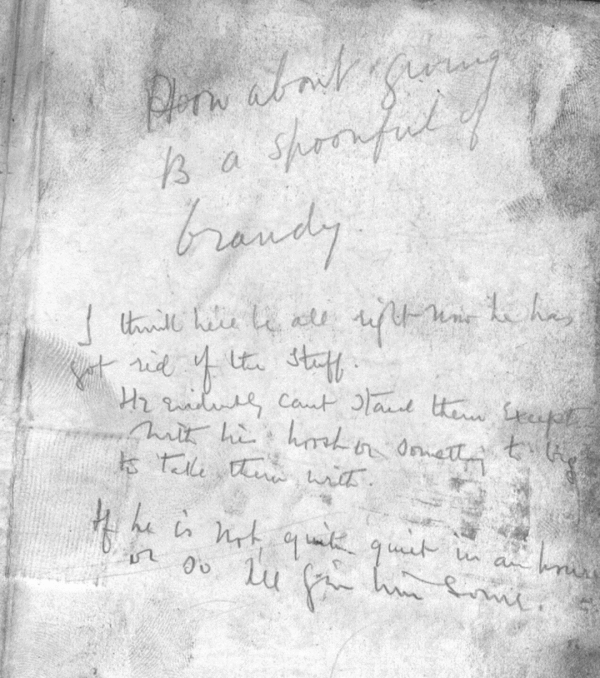
1. Page 80 – 1 September 1912 (Fig. 1)
An example of a notebook page in which Campbell writes to Levick and his reply (page 80).

Note 80.1 - Campbell writes to Levick.
‘How about giving
B [Browning] a spoonful of
brandy’
Note 80.2 - Levick replies.
‘I think he’ll be all right now he has
got rid of the stuff.
He evidently can't stand them except
with his hoosh or something to big
to take them with.
If he is not quite quiet in an hour
or so I’ll give him some.’
Interpretation. Campbell is suggesting to Levick that they give Browning some brandy. Levick's reply shows that Browning was bad but should now be alright. He then explains that Browning is having a problem with some pills, and finally agrees to use the brandy if Browning has not improved in an hour or so. This conversation between Campbell and Levick was on the evening of 1 September.
Explanation. Neither Campbell nor Levick gives any direct clues as to when these notes were written. Furthermore, Levick does not tell us what it is that Browning cannot stand: merely something referred to in the plural. Although, Browning had a problem with salt-water used in cooking (Priestley, Reference Priestley1915: 329), and that penguin meat agreed with him better than seal meat (King, Reference King2001: 152), he was along with the others, eating seal-meat, penguin and possibly liver.
None of these would normally be referred to in the plural, although penguin breast could be; but Campbell indicates that Browning accepted penguin meat (King Reference King2001: 152). On 1 September Priestley mentions not only that Dickason joined Browning on the sick list, but that he also dropped one of ‘Levick's ill-flavoured pills into his hoosh’ and ruined it (Priestley Reference Priestley1915: 331). As both were ill, it is reasonable to assume that Browning too was given some of these pills. They are therefore probably what Levick is talking about in the plural. Assuming this, then, the note was written during the evening of 1 September.
2. Page 76 – 5 September 1912
Note 76.1 - Levick's proposed menu.
‘Proposed menu for
today Nov 5th
Best fried steak 3 p.m.
Thin oxo-hoosh 4 p.m.
or thereabouts
Cocoa’
Note 76.2 - Campbell replies
‘P [Priestley] +I think the above
change of diet would be
good
Steaks can be those I cut
yesterday 1 each
the oxo hoosh enough for one
mug each’
Interpretation. This conversation occurred on 5 September, probably in the morning or early afternoon. Levick writes to Campbell outlining a new menu, and Campbell replies suggesting which steak and a full mug of Oxo.
Explanation. The first note in Levick's hand is puzzling because of ‘Nov 5th’. On 5 November 1912 the party was camped 7 nautical miles from Hut Point and had plenty of food from the Butter Point depot: steak (seal) and Oxo hoosh would certainly not have been on the menu.
In his book Priestley writes that on 5 September, after an outbreak of food-poisoning from a tainted seal liver, ‘. . .Levick ordered a change of diet, and we had a steak each instead of our first hoosh, with a thin Oxo-flavoured hoosh to follow’ (Priestley Reference Priestley1915: 334).
Both Levick's note and Priestley's book refer to the 5th and, a November date being unlikely, ‘Nov’ is a mistake or means something other than the month November. Furthermore, from the text, the note was written on the day of the menu-change recorded by Priestley as 5 September.
3. Pages 73 and 74 – The oven and blubber stove
Note 74.1 - Campbell, not very good for the tea
‘The bottom of the meat box
picks up a lot of dirt in the passage
which is not very good for the tea’
Note 73.1 - Levick's instructions for the mess man
‘Please make your cook keep a good warm
temperature in here even at the expense
of a drip or two, as otherwise it makes
it hard for the following mess man as the
big joint wont thaw right through only the
outside.
B+D [Browning and Dickason] have been grumbling at A [Abbott] for yesterdays
drip + I have had to give D a rap over the
knuckles over it, I will do the same to B the earliest
opportunity”
Interpretation. These two conversations took place between 7 and 9 September. Although the notes do not appear as statement and reply, the connection is the thawing of meat and the meat-box used to thaw it. Campbell in note 74.1 writes about the ‘meat box’ (thawing oven), a large biscuit-tin, normally suspended above the pot on the blubber-stove, using the rising heat for thawing the meat. Debris picked up by this meat-box from the floor in the passage could easily drop into the cooking-pot when the box was returned. In the second, note 73.1, Levick is saying ‘keep the temperature up to ensure the meat is thawed all the way through.’ His reference to ‘Abbott’ and ‘yesterday’ shows that the mess-team of Campbell and Abbott had been on duty the day before.
Explanation. Priestley had previously set aside boneless joints of seal-meat to be prepared for the journey home. These needed to be thawed, sliced, diced into one-inch cubes, and bagged (Priestley Reference Priestley1915: 336). Priestley also writes how the floor in the passage was extremely dirty from the build-up of chipped meat, blubber and soot (Priestley Reference Priestley1915: 271). Each day, the mess-man would take the meat-box into the passage where the thawed meat was removed for cutting, replaced with a new frozen block, returned to the cooking area and suspended above the blubber stove. Any debris picked up from the passage floor could easily drop into what was cooking below. This period in the snow cave involved two serious outbreaks of food-poisoning, the cause and solution of which would have been a major topic of conversation, with the role of the oven, the ‘meat box’ referred to in Campbell's note 74.1, figuring prominently. Finally, on 7 September, the oven, a major cause of the food-poisonings was replaced (Priestley Reference Priestley1915: 335). The replacement was a shiny new biscuit-tin, so shiny that it reflected like a mirror. A photograph taken during the rediscovery of the snow-cave in 1963 shows such a biscuit tin still with a mirror-like surface after fifty years (Skinner Reference Skinner1962–1963). This tin was something new, something clean, something that stood out in the dark grimy cave, a highlight which, even if not a topic of conversation, would nevertheless have been in the forefront of their minds.
The sources listed in the references make no reference to Campbell's note 74.1. However, it is reasonable to assume that the two entries are connected as, elsewhere in the notebook, older writings not associated with a conversation are crossed out. The note appears to be a statement, possibly a thought he put into writing to Levick. Either note could have prompted the other.
The second note 73.1 written by Levick is ensuring that the joints of meat were thawed properly. Priestley in his book mentions that to thaw the meat properly needed more heat, which he found could be provided by reducing the cooling draughts. More heat also resulted in some melting of the ceiling ice with water dripping on to him and everything below. He states this resulted in him ‘. . .sitting in a bath of ice water. . .’(Priestley Reference Priestley1915: 336).
Two-man teams handled the food preparation and cooking in the snow cave. In September, the teams consisted of one officer and one seaman: Campbell with Abbott, Priestley with Dickason, and Levick with Browning (Hooper Reference Hooper2010: 250). This note could have been either to Campbell or to Priestley, since both were team leaders. If it was to Campbell then possibly Abbott had not kept the temperature high enough the day before. Or possibly it was reinforcement to have Campbell ensure that Abbott continued in spite of his mess-mates’ criticism. However, if to Priestley and Dickason then it is possible it resulted in the former ‘. . .sitting in a bath of ice water. . .’
Preparation of seal-meat for the journey home started in the first week of September (Priestley Reference Priestley1915: 335). Priestley's note about working in ice water and drips from the ceiling is not dated. However, he mentions this was just after they had recovered from the food-poisoning and it occurs sequentially in his book before 10 September (Priestley Reference Priestley1915: 336). On 9 September Campbell mentions a great improvement in public health (King Reference King2001: 149) which suggests that Priestley's ‘ice bath’ episode was around this date. Then Levick's note requesting more heat was written before 9 September and, from above, after 7 September.
4. Page 72 – 10 September
Note 72.1 - Campbell writes to Levick
‘I meant to tell you P. [Priestley]
got rather exhausted out
today so I suggested his
coming in: he tells me
he feel very run down
after this last attack.’
Note 72.2 - Levick replies
‘I had a yarn with him when he came
in: I told him a tonic he was
taking would set him up. I hope
it will.’
Interpretation. This conversation between Campbell and Levick was on 10 September. Campbell remembers to tell Levick that Priestley was exhausted while outside that day, and Levick replies that he knew and had it in hand.
Explanation. There are two occasions during September when Priestley writes about being exhausted. Of the first, on 10 September he writes, ‘The 10th was the first day that I got beyond the drift since the beginning of the month, and I found, as the others did also, that the illness had taken all the strength out of me.’ Then later he writes about the same episode, ‘. . .when I had carried up two loads of sledging meat I was beaten to the world. . .’ (Priestley Reference Priestley1915: 336–337). The second mention, on 17 September, was that after digging for two or three hours he had to ‘desist early’ because of a slight relapse (Priestley Reference Priestley1915: 337). This latter reference indicates tiredness rather than being ‘beaten to the world.’ Of the two events the first, on 10 September, would have been the one that Campbell's conversation refers to. Campbell, in his published diary, has no entries for several days during early September, including the 10th. Priestley's failure to mention being with anyone on 10 September suggests that he was alone and this implies that Campbell made the suggestion to ‘come in’ not in the field but when Priestley returned to the cave for his cup-of-hot water lunch.
5. Pages 67 and 68 – 14 September
Note 68.1 - Campbell writes to Priestley
‘We had better put a tin of Oxo at Levick’s
disposal to feed B. on, if necessary,
if he can't manage seal meat’
Note 68.2 – Campbell writes to Levick (continued on p. 67)
‘P. tells me there is enough Oxo in one of
service ration
these small pots to make eleven pints
I would suggest therefore that in order to
save all we can he is limited to 1 pint of
Oxo tea per day which should keep him
going till he gets his steak. Does this meet
with your approval, if so will you tell him?
it would also avoid waste as if I know
anything of the ‘Brit. Blue’ he likes everything
with a good ‘bite’ to it + unless watched will put in too much.’
Note 67.1 - Levick writes to Campbell
‘Yes that ought to be quite enough. I don't think there
is any need for anxiety about him at present + that this
morning was a little panic + nothing more, as he went
only once last night about 9, + once this morning after
he got up. I am going to stop his steak as he is having
the evening hoosh - it is quite enough’
Interpretation. These conversations, on 14 September, are concerning Browning's health and what dietary change might be beneficial. Campbell first talks to Priestley, the quartermaster, suggesting they release a tin of Oxo to Levick the doctor. Then he talks to Levick, informing him that a tin of Oxo is available and suggesting that some of it be given to Browning. Campbell shows his concern that the scarce Oxo should not be wasted by suggesting that a check be kept of the amount used. The final note is Levick's reply. Here he is downplaying Browning's sickness, probably because of his belief that Campbell tended to hypochondria (Lambert Reference Lambert2004: 150). Levick's reference to ‘. . .his [Browning’s] steak. . .’ relates to the seal-steaks being specially cooked for Browning at that time. This had been happening since the beginning of September, in an effort to build up his strength for the journey home.
Explanation. Campbell's diary entry for 13 September mentions that both Browning and Dickason ‘. . . still very bad with diarrhoea. . .’ Then on 14 September he writes that Browning ‘. . .was very bad in the night. . .’ and that ‘we have some Oxo. . .’ (King Reference King2001: 150). Furthermore, during the previous week there was, as Campbell states, ‘. . .an epidemic of [a] sort of dysentery. . .’ (King Reference King2001: 149). Browning and Dickason were the most seriously affected, with Browning's health still of concern to Campbell on 14 September.
When talking to Levick, Campbell uses the phrase ‘Brit. Blue,’ a slang term for a British sailor. He also shows his concern that the Oxo should not be wasted: food was scarce. After a winter of watery and fatty boiled seal-meat, the craving for tasty food would have been enormous as would also have been the temptation to make an extra-strong Oxo broth. Anything that improved their tasteless hoosh would have been seized upon. Good ideas, tried during the winter with no success, included old dried seaweed from the beach, ginger, citric-acid tabloids and even a mustard plaster from Levick's medicine box. The addition of a seal brain did prove successful, but unfortunately the supply was limited (Priestley Reference Priestley1915: 286–288).
6. Page 78 – Early September and again about 18 September
Note 78.1: Campbell writes
‘In view of the amount of
snow about, I think it would
be safer & more comfortable
to sleep with the middle
bag out & the inner curtain
slightly open.’
Note 78.2: Campbell writes how about brandy?
‘Are you anxious about
B. ? [Browning]
If you think it would
steady him give him
brandy. We can afford it.’
Note 78.3: Levick suggests sodium lactate.
‘I am going to give him some
sodium lactate which I’ve got – it
may improve him: also these fresh
hooshes, I think we might
wait another day to see how he
goes on.’
The first note, 78.1, has been crossed out as it is not associated with the second conversation (notes 78.2 and 78.3) between Campbell and Levick. It was therefore written earlier.
Interpretation. Note 78.1: The first message, written by Campbell, is referring to the two doorways between the outside entrance to the snow-cave and the living area of the cave. These openings, just 760mm by 460mm (2 feet 6 inches by 18 inches), were both closed with sack curtains. Here Campbell is suggesting they remove the first sack curtain from the doorway near the outside entrance, and slightly open the second curtain to ensure good air-circulation. This would allow the air from the rest of the cave, a large air-mass, to circulate in the sleeping-area. This was necessary, as they knew from experience that a prolonged wind-blow would seal up the cave (King Reference King2001: 145). A sealed cave could mean suffocation. This first message would have been written between 1 and 8 September. There is no indication of to whom this note was directed.
Notes 78.2 and 78.3: The second and third entries are a conversation between Campbell and Levick concerning Browning's health, most probably on 18 September. Campbell is suggesting brandy. Levick seems to have the situation under control by planning to dose Browning with sodium lactate and, having started him on fresh-water hooshes, waiting a day to see if he improves.
Explanation. Note 78.1: As mentioned above, they knew from experience that strong winds and blown snow could easily seal up the snow-cave. During previous storms, a night-watch had been introduced to protect them from such an eventuality. This time Campbell was ensuring that the air from the rest of the cave-complex would be available to them in the enclosed sleeping-area. The note must have been written during a period of high winds of which, in September, there were two. First, Campbell mentions on 5 September that a ‘. . .very heavy gale has been blowing since the 1st. . .’ and, on 9 September, writes that the ‘vile’ weather has improved (King Reference King2001: 149). In Campbell's diary and Priestley's book there is no other mention of strong winds until 21 September, when Priestley notes, ‘. . .the old westerly gale back with us again. . .’ (Priestley Reference Priestley1915: 339). This second gale can be disregarded, since the first note is crossed out as not being associated with the later conversation (note 78.2 and 78.3), which means it was written earlier; and the last conversation between Campbell and Levick took place on 18 September (see below) before the 21 September gale started.
Notes 78.2 and 78.3: Levick indicates in his reply that Browning is having fresh-water hooshes. The suggestion to ‘. . . wait another day to see. . .’ indicates that these fresh-water hooshes were a recent event. From Priestley we know that Browning started cooking his own fresh-water hooshes about 17 September. Browning had been sick all month, but on 17 September was well enough to help Priestley kill and butcher a seal. This event, as described by Priestley, was extremely hard work: killing and butchering a seal with blunt knives would have been exhausting even for a fit person. But Browning was a sick man, just recovering from two recent bouts of food-poisoning. Priestley, not sick but also recovering from food-poisoning, had that day in his own words ‘. . .a slight relapse. . .’ Priestley later writes that, when they finally left the cave and started sledging, the exercise caused Browning to relapse (Priestley Reference Priestley1915: 337–338). From this it is reasonable to assume that on the night of 17 September Browning would have been unwell from the exertions of the day. His problems during the night or next day would have precipitated this conversation.
7. Page 64 – 24 September
Note 64.1: Campbell writes to Priestley the quartermaster.
‘As B [Browning] seems so much better
now he is off seal meat
what do you say to giving
him the Emperor penguin
if L [Levick] thinks fit it best.
It would be everything
to get the poor chap right
for sledging,’ [crossed out writing]
Interpretation. This entry, written by Campbell to Priestley on the evening of 24 September, relates to improving Browning's health and fitness. At this time they were in the snow-cave making preparations for the sledge-trip back to Scott's main party at Cape Evans. Browning, in addition to his continued sickness, was still suffering from a second bout of food-poisoning in three weeks.
Explanation. Priestley, as quartermaster and in charge of the food, would be the person for Campbell to have this type of conversation with. Furthermore, the conversations in this notebook all appear to be between the officers Campbell, Levick, and Priestley (who as a civilian scientist was treated as an honorary officer). Since Campbell refers to Levick as if he is not in the conversation, then this communication must be to Priestley.
On 24 September Campbell, Levick and Abbott were out of the cave, loading part of the prepared seal-meat on to the sledges in preparation for the journey home. While outside, the trio found, killed, and butchered an emperor penguin (Priestley Reference Priestley1915: 339; King Reference King2001: 152). In addition, Priestley states in his book that, on the night of 24 September, part of the penguin went into the hoosh while half the breast-meat was put aside for Browning, to ‘. . .make his insipid, salt-less hoosh more palatable’ (Priestley Reference Priestley1915: 339).
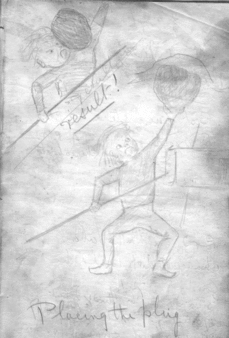
8. Page 77 – Drawing by Campbell (Fig. 2)
Page 77, two drawings by Campbell.

On page 77 are two drawings of the mess-man blocking up the chimney. The artist drew these pictures on the right-hand page with the notebook upside down. The previous three pages have been roughly torn out of the notebook.
The handwriting in the top centre of page reads: ‘Result!’
The writing at the bottom of the page reads: ‘Placing the plug’
Interpretation. The drawing, possibly of Abbott, shows the bamboo pole removed from the chimney and an attempt to block the chimney opening. The drawing exaggerates the stretching needed to place the plug, as the ceiling was only about five and a half feet high.
Explanation. When this was drawn is hard to say, but must have been later in the winter when the chimney entrance-hole had enlarged. Comparing the drawing with the photograph of the six outside the snow-cave (King Reference King2001: 154–155) before leaving for Cape Evans shows a resemblance to Abbott. The importance of this page is that it shows that, even while weak, cold and in dark and squalid conditions, they could laugh at themselves (Priestley Reference Priestley1915: 292–293).
9. Page 29 – The last week of September
Note 29.1 - Campbell writes to Levick
‘On any food questions
I will go by your
opinion, but I’
[four crossed out lines]
Note 29.2 - Levick writes to Campbell
‘He B [Browning] has most
probably got a dammed
bad mouth + his
opinion is unreliable’
Interpretation. With what can be read of them, these notes between Campbell and Levick (the doctor) do not appear to be connected by anything other than being on the same page. The four crossed-out lines would probably alter this. The crossed out lines are difficult to read. The first line could start with ‘think that I. . .’ or ‘have to. . .’ The second-line starts with a ‘q’. The ‘dammed bad mouth’ Levick uses is most probably related to a medical condition rather than to a verbal one, while ‘his opinion is unreliable’ is hard to fathom without knowing what is crossed out in note 29.1. Access to Levick's cave-diaries could provide a better explanation of this conversation.
Explanation. The page these notes were written on has Campbell's moon-shot calculations (King Reference King2001: 151) written on the back and showing through. These calculations, dated 21 September, do not produce any markings on the facing page, possibly indicates that the notes were written after 21 September as the heavy crossing-out would have acted like carbon paper to produce some imprint of the calculations on the facing page. Furthermore, the heavy crossing-out on page 29 caused parts of the figures on the back of the page to be imprinted on its facing page, showing that these calculations were there when Campbell crossed out the four lines. Assuming that the crossing-out was done at the time of writing, these two notes will have been written after 21 September, sometime during the last week in the snow-cave.
10. Page 66 – During September
Note 66.1: Levick writes
‘I am feeling so awfully fit on my present
ration please don't cut it much.’
Note 66.2: Campbell writes
‘Has A [Abbott] done his Swedish? He has had his
double hoosh !! If he has not I hope you
will make him + I will give him a dressing
down tomorrow for not remembering himself’
Interpretation. The first conversation was written by Levick, possibly sometime in September after the food-rations had been increased in preparation for the sledge-journey back to the main party at Cape Evans.
In the second conversation, written during September 1912, Campbell asks Levick if Abbott has done his exercises. The Swedish exercise regime started at the beginning of September (Lambert Reference Lambert2004: 160) again to prepare the party for the sledge-trip home. The ‘. . .dressing down tomorrow. . .’ shows Campbell was serious— justifiably, as the journey home could be easily jeopardised by any individual not fully joining in the fitness programme.
Explanation. Campbell had designated 22 September as the day they would leave the snow-cave and start the return journey (Lambert Reference Lambert2004: 163), but weather and sickness would delay this. At the beginning of September the party started preparing for the journey to Cape Evans. Fitness was their first concern: after six months of little activity and minimal food they were all in a weak state. Food rations were adjusted and an exercise-regime was started to improve both their health and fitness. The daily hoosh-ration was increased as indicated by ‘double hoosh’ in the second conversation. The one-biscuit-a-day ration was reinstituted on 1 September after a month of no biscuits (King Reference King2001: 149). Campbell asked Levick to start the party on an exercise-programme. Levick, the doctor, had specialised in exercise-medicine, and Abbott, a naval physical-training instructor, modified traditional Swedish-exercise routines to fit the cramped space and low ceiling of the snow-cave. Most exercises were done sitting, or lying on sleeping bags, and standing stretches were done while kneeling (Priestley Reference Priestley1915: 332).
Conclusions
The nine conversations and one drawing produced during September add to what is known about the life of the party during their time in the snow-cave. This notebook shows that silent conversations, written for privacy, were part of cave life, a fact that has been only recently commented by Hooper, in which is mentioned a note between Campbell and Levick scribbled across a page of the latter's diary, as well as private notes between Levick and Campbell (Hooper Reference Hooper2010: 261–262). These conversations in Campbell's notebook show that Priestley was also involved.
Past authors such as Harrowfield (Harrowfield Reference Harrowfield1995: 29), Huxley (Huxley Reference Huxley1977: 266), King (King Reference King2001: 129), Lambert (Lambert Reference Lambert2004: 143), Hooper (Hooper Reference Hooper2010: 208), and Raeside (Raeside Reference Raeside2009: 148) have written about how Campbell divided the nine-by-twelve-feet living-area in half by an imaginary line, one half as the men's mess and the other as the officers’. In good naval tradition, each was free to say what he liked in his mess, and what was said in one was not to be heard or acted on in the other. Some use this to criticise the class-system in the early twentieth-century navy, while others have seen it as a factor in their survival. Whatever the pros and cons, the implication has been that in the close confines of the cave, private conversations were possible. Now, this notebook shows that the idea of what could and could not be heard was not as simple as adopting the two-mess concept. Some conversations in the close confines of the snow-cave had to be made in private. The notebook shows that conversations between Campbell, Levick, and Priestley could be carried out silently, in writing.
In these ten pages, Campbell's concern for Browning's health and his sense of fun shown in the drawing ameliorate some of his ‘wicked mate’ image.
Finally, more of these silent conversations could still be found in other Northern Party notebooks now in archives or private ownership. To find them is important as, written at the time, they bring us as close as we will ever come to being with them in their snow-cave during the winter of 1912.
Acknowledgements
I am indebted to the Memorial University of Newfoundland archivists for their help during my visits. Thanks need to go to Linda White for arranging the photographing and some re-photographing of the field-notebook. Thanks also to Meredith Hooper for helping translate two lines of writing that were baffling me.