Introduction
Human onchocerciasis (river blindness), a debilitating disease caused by a nematode, Onchocerca volvulus Bickel (Spirurida: Onchocercidae), is transmitted by females of the blackfly Simulium genus (Diptera: Simuliidae) (Boakye et al., Reference Boakye, Back, Fiasurgbor, Sib and Coulibaly1998). The disease is one of the leading causes of blindness in the world, and it is prevalent in 37 countries, of which 28 are found in Africa. The disease affects about 18 million people worldwide with 123 million people at risk of infection (CDC, 2006). Nigeria has the highest number of people affected with onchocerciasis, accounting for about a third of the global prevalence (WHO, 1995; Opara et al., Reference Opara, Usip and Akpabio2008).
Simulium damnosum s.l. is known to consist of nine sibling species (Boakye, Reference Boakye1993). The siblings of the S. damnosum complex were grouped into three pairs: S. damnosum s.s./Simulium sirbanum (savanna flies), Simulium sanctipauli/Simulium soubrense and Simulium squamosum/Simulium yahense (forest flies). The first group transmits the savanna strain of O. volvulus that most often causes blindness, and the remaining two pairs transmit the forest strain of the parasite, which is more of a skin disease in its pathogenicity than an eye disease (Toé et al., Reference Toé, Tang, Back, Katholi and Unnasch1997; Idowu et al., Reference Idowu, Awolola, Mafe and Otubanjo2008; Adeleke et al., Reference Adeleke, Mafiana, Sam-Wobo, Akinwale, Olatunde, Sanfo, Adjami and Toé2010a).
The transmission of onchocerciasis varies significantly from one site to another as different siblings of S. damnosum s.l. carry heavier O. volvulus infective worm loads than others (Mafuyai et al., Reference Mafuyai, Post, Molyneux and Davies1997; Lévêque et al., Reference Lévêque, Hougard, Resh, Statzner and Yaméogo2003; Opara et al., Reference Opara, Fagbemi, Ekwe and Okenu2005). Thus, the capture and dissection of the adult flies in different localities may provide invasive means of monitoring the level of disease transmission of the parasite and assessment of the control measures (Opara et al., Reference Opara, Fagbemi, Ekwe and Okenu2005; Opoku, Reference Opoku2006).
Studies on dispersal and migration of blackflies have implicated some members of S. damnosum s.l. in the cross-border movement (Mafuyai et al., Reference Mafuyai, Post, Vajime and Molyneux1996; Yameogo et al., Reference Yameogo, Toe, Houghard, Boatin and Unaasch1999). Such movement, which is often brought about by environmental degradation and climatic conditions, alters the epidemiological pattern of disease transmission and impedes any ongoing control measures through re-invasion of the controlled areas by the infected flies. The Republic of Benin was endemic for onchocerciasis and the endemic areas had undergone vector control through weekly larviciding during Onchocerciasis Control Programme (OCP) activities, coupled with ivermectin distribution in the affected communities (Boakye et al., Reference Boakye, Back, Fiasurgbor, Sib and Coulibaly1998). Nigeria shares a common border with the Republic of Benin in the south-western part of the country, and the tendency of the cross-border movement of blackflies in the rivers along the border of the two countries has been suspected since both the S. soubrense and S. damnosum s.s. Beffa forms have been found in the Ogun River system in Nigeria and the Okpara River in Benin Republic (Mafuyai et al., Reference Mafuyai, Post, Vajime and Molyneux1996). This observation was the result of re-invasion of blackflies in the controlled river banks of the Republic of Benin along the Nigerian border, which were presumed to have migrated from the river systems there. This study, therefore, assesses the seasonal fluctuations of the S. damnosum complex and the prevalence of Onchocerca filarial worms in blackflies in river systems along the Nigeria–Benin border, which may have a direct impact on the epidemiology of onchocerciasis in South-western Nigeria.
Materials and methods
Study area
The study was carried out in the Ogun and Yewa river systems along the Nigeria–Benin border in the south-western part of Nigeria. The Yewa River takes its source water from Ogun State and empties into Lagos lagoon, while the Ogun River takes its source water from Oyo State, transverses Ogun State, before emptying its water in Lagos lagoon. Both Oyo and Ogun States share boundaries with the Republic of Benin. South-western Nigeria usually experiences two seasons: wet season (April to October) and dry season (November to March). Derived savanna is the predominant ecological zone along the two river systems with patchy forest galleries in few areas. The populations along the river are mainly Yoruba and engage in farming activities. However, some of the communities along the river play host to some Hausa fishermen from northern Nigeria during the late dry season and the early wet season.
Selection of the catching points
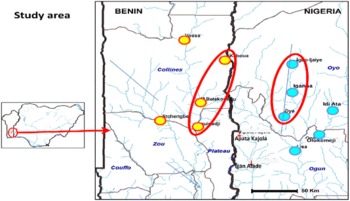
Figure 1 shows the selected capture sites for the study in both Nigeria and the Republic of Benin. In Nigeria, six capture sites were chosen near the first-line communities, which comprised two communities along the Yewa River system (Apata-Kajola and Igan-Alade) and four along the Ogun River system (Igbojaye, Oyee, Olokemeji and Lisa) as catching points. The selection was based on the hydrophysical features of the sites to support the breeding of S. damnosum s.l. and the accessibility of the communities. Due to the paucity of flies in the Yewa River system, the two catching points on the river were discontinued for the 2009 study, while two new sites (Iganna and Idiata) were selected along the Ogun River system. The inhabitants of the communities are predominantly farmers and they usually have contact with the river for domestic and fishing activities.
Selected capture sites for the study in Nigeria and the Republic of Benin (a colour version of this figure can be found online at: journals.cambridge.org/jti).

Ethical clearance and mobilization of the communities
The Ministries of Health in Oyo and Ogun States were informed of the study. The communities were mobilized with the assistance of the State Co-ordinators of the OCP of the two states and the Health Personnel of the Ministries of Health for Oyo and Ogun States. Informed consent was sought and obtained from the communities and subjects used for the study.
Collection of adult flies
Adult flies were collected using two trained flycatchers in each of the six sites. The flycatchers worked alternately between 07.00 and 18.00 h once every 2 weeks. The Opara et al. (Reference Opara, Fagbemi, Ekwe and Okenu2005) procedure for fly collection was used. The flies collected were pooled on an hourly basis and recorded accordingly. The fly collection was carried out between October and December 2007, July and December 2008 and May and December 2009.
Bulk catching was also carried out simultaneously by two flycatchers during this time. Blackflies were preserved in 80% alcohol and transported to the Multi-Disease Surveillance Centre, WHO Molecular Biology Laboratory, Ouagadougou, Burkina Faso, for identification of blackfly populations using heteroduplex assay (HDA) techniques.
Morphotaxonomic identification and fly dissection
All the flies were identified morphologically into savanna and forest flies using the colours of the wing tufts, fore coxa, abdominal tergite, scutellum and antennae as described by Wilson et al. (Reference Wilson, Post and Gomulski1993).
Each identified fly was dissected using dissecting pins and a microscope. The ovaries of the dissected fly were stretched and classified as parous or nulliparous after observing characters such as the transparency of the Malpighian tubules and the presence of fat bodies. For parous flies, the ovaries are elastic with transparent Malpighian tubules and absence or fewer fat bodies as described by Cupp and Collins (Reference Cupp and Collins1979) and Mokry (Reference Mokry1980). The head, thorax and abdomen of parous flies were dissected separately for the presence of different stages of O. volvulus larvae.
Statistical analysis
The difference in the abundance of adult flies caught in all the study sites was assessed by the χ2 test while a t-test was used to compare the abundance of savanna flies and forest flies in each catching site. The cut-off was taken as 5% and all data were analysed using SPSS version 16.0.
Results
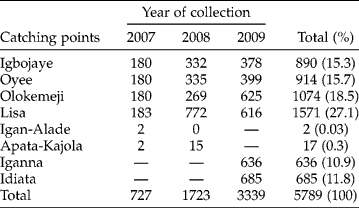
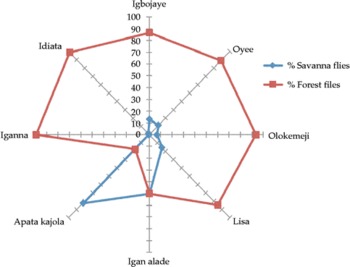
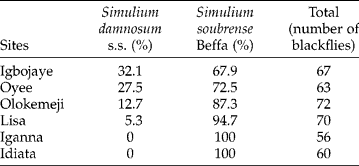
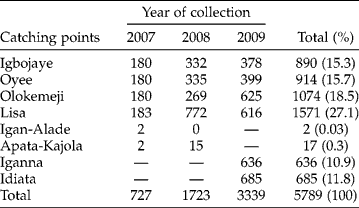
A total of 5789 flies were caught during the study period, of which 727 (12.6%) were caught in 2007, 1723 (29.8%) were caught in 2008 and 3339 (57.6%) were caught in 2009. Flies were caught in all the catching points in all the study sites except Igan-Alade where no fly was caught in 2008 (Table 1). There was a significant difference in fly abundance in the study sites (P< 0.05). The data obtained for the relative abundance of the savanna and forest flies are shown in Fig. 2. The majority of flies captured (5228; 90.3%) were forest flies, while 561 (9.7%) were savanna flies. The difference in the abundance of forest and savanna flies in the catching points was significant (P< 0.05).
Relative abundance of blackflies at the catching points during the study period
Proportion of the forest and savanna flies at the catching points during the study period (a colour version of this figure can be found online at: journals.cambridge.org/jti).

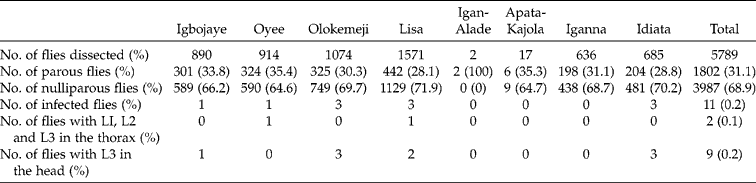
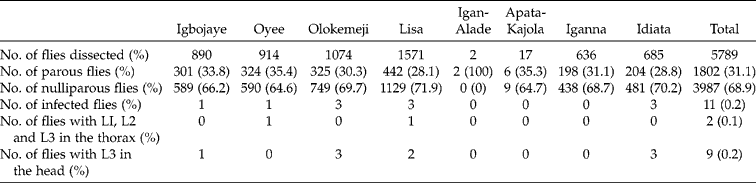
The summary of the result of dissection is presented in Table 2. Of the 5789 flies dissected, 1802 (31.1%) were parous and 3987 (68.9%) were nulliparous. The proportion of nulliparous flies was also higher than parous flies in all the sites except Apata-Kajola and Igan-Alade. Out of the 727 flies dissected in 2007, only one fly was infected with L2 of the O. volvulus parasite in Oyee, while none of the flies dissected in 2008 was infected with O. volvulus larvae. However, 10 (0.3%) out of the 3339 flies dissected in 2009 were infected with O. volvulus larvae. In total, 11 (0.2%) flies were infected, of which nine (0.2%) were infected with L3 larvae in the head.
Summary of the fly dissection at the catching points during the study period
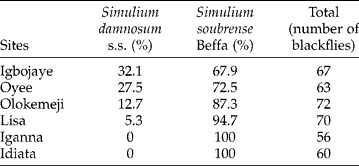
The HDA analysis revealed that the Beffa form of S. soubrense was the dominant cytospecies present in all the capture sites with very high percentage levels compared with the S. damnosum s.s. (Table 3).
Vector identification of blackflies using HDA techniques
Discussion
There was presence of flies in all the catching points located along the Ogun River system (Igbojaye, Olokemeji, Lisa and Oyee). The high abundance of flies along the Ogun River and its tributaries may be related to the hydrophysical features of the river. It was observed that some river-like conditions that create favourable breeding sites for blackflies are common where the African Precambrian basement rocks break the flow of water and thereby create rapids (Crosskey, Reference Crosskey1981; Mafuyai et al., Reference Mafuyai, Post, Vajime and Molyneux1996; Ibeh et al., Reference Ibeh, Nwoke and Adegoke2005; Adeleke et al., Reference Adeleke, Sam-Wobo, Mafiana and Olatunde2011). The Ogun River and its tributaries have rocky basements and submerged substrata that create rapids and provide support for the aquatic stages of the insect, unlike the Yewa River system with muddy basement and no submerged substrata.
The molecular HDA revealed that the Beffa form of S. soubrense was the dominant cytospecies present in all the capture sites when compared with the percentage levels of S. damnosum s.s. Though the numbers of savanna flies caught were extremely low, the sympatric existence of savanna flies with forest flies in the study area is worrisome due to the vectorial capacity of the flies. The massive deforestation of some parts of Nigeria is turning the ecological phase of such areas to derived savanna, therefore creating conducive environments for savanna flies to thrive. Adeleke et al. (Reference Adeleke, Mafiana, Sam-Wobo, Olatunde and Akinwale2010b) also reported similar observation along the Osun River in South-western Nigeria. Such changes are risky because the highly pathogenic savanna form of onchocerciasis could soon be prevalent in the area where hitherto only the benign forest forms of the disease existed (Opoku, Reference Opoku2006).
A high proportion of the flies dissected were nulliparous in all the catching points. This high proportion, according to WHO (1995), may indicate incomplete vector control or high productivity of the breeding sites, while a high abundance of parous females indicates successful vector control or the presence of migratory flies. Since no vector control programme was implemented in the study area, the high proportion of nulliparous females may reflect the high productivity of the breeding sites. For the high number of parous flies observed in Igan-Alade and Apata-Kajola, this could plausibly be due to the presence of migratory flies. This is possible because flies were only caught in October 2007 in Igan-Alade and in October 2007 and July 2008 at Apata-Kajola, and no breeding of Simulium was detected throughout the study period. It is worthy to note that flies were caught throughout the months of the study in other sites along the Ogun River system. The inability of the study to span for a complete year is one of the limitations of the present study, but despite this limitation, the study remarkably recorded more flies in catches during the wet season when compared with the dry season, which is of importance in understanding the population dynamics of the flies and in planning further studies.
The low proportion of the infected flies with L3 larvae that had migrated to the head (0.2%) may suggest the low transmission of O. volvulus in the communities along the Ogun and Yewa river systems. This hypoendemicity recorded in flies dissected in these communities may be associated with the low microfilarial load of the residents as a result of the effectiveness of ivermectin microfilaricidal treatment, for the past 5 years.
Ivermectin has been shown to contain active ingredients that eliminate microfilariae and interrupt the reproductive rate of adult worms, thus lowering the level of transmission (Guevara et al., Reference Guevara, Vieira, Lilley, Lopez, Vieira, Rumbea, Collins, Katholi and Unnasch2003). Recent epidemiological examination of the communities also revealed an extremely low community microfilarial load, indicating that elimination is achievable at the study areas (Sam-Wobo et al., Reference Sam-Wobo, Adeleke, Jayeola, Adeyi, Oluwole, Ikenga, Lawniye, Gazama, Kagni, Kosoko, Agbeyangi, Bankole, Toé, Mafiana and Yameogo2012). The high biting rate of the flies observed in the study sites could be more of a nuisance than a threat as transmitters of the disease.
We therefore recommend constant surveillance on species composition and fly infectivity in the study area to curtail the adverse effect of intruding savanna flies. Health education and the use of repellents should be instituted in the study areas. This will go a long way to complement the ongoing control efforts of the WHO/APOC.
Acknowledgements
The authors appreciate the training and funding support of the WHO/APOC (reference no. OU/ICP/CPC/504/AP/07/831/02) for this study. The authors also regret the passing away of Professor J.C. Anosike, a team member, on 24 December 2008.