Implications
Although glycerol, as a by-product of biodiesel production, can be an attractive alternative energy source for poultry diets, there is a need to determine what level of glycerol could be used in laying hen diets. Its effect on performance, egg quality and egg yolk fatty acid composition should be investigated. According to the results of this study, 75% of soya bean oil can be replaced by glycerol without a negative effect on performance and egg quality in laying hens. However, high level glycerol in the diets potentially decrease PUFA and linoleic acid percentages in the egg yolk.
Introduction
In the poultry industry, because of increasing prices of energy-rich feedstuffs, there has been a remarkable effort made to search out energy alternatives for chicken diets. In this context, researchers have focused on the use of glycerol as a less expensive energy source in poultry diets (Abd-Elsamee et al., Reference Abd-Elsamee, Abdo, El-Manylawi and Salim2010; Suchy et al., Reference Suchy, Strakova, Kroupa and Herzig2011). Due to the importance of glycerol in energy metabolism and its high availability due to biodiesel production, its inclusion in animal diets has generated interest. Several authors have shown that glycerine has a high energy value for poultry (Lammers et al., Reference Lammers, Kerr, Honeyman, Staldre, Dozier, Weber, Kidd and Bregendahl2008; Dozier et al., Reference Dozier, Kerr and Branton2011; Jung and Batal, Reference Jung and Batal2011; Lima et al., Reference Lima, Rodrigues, Alvarenga, Bernardino, Makiyama, Lima, Cantarelli and Zangerônimo2013), regardless of compositional differences resulting from fat sources, processing methods and reagents used for biodiesel production. Lammers et al. (Reference Lammers, Kerr, Honeyman, Staldre, Dozier, Weber, Kidd and Bregendahl2008), in metabolism experiments, used 48 Hy-Line W-36 laying hens, fed 0%, 5%, 10% and 15% crude glycerol in their ration and found an apparent metabolisable energy (ME) value of 15.92 MJ/kg (3805 kcal/kg). Nemeth et al. (Reference Nemeth, Zsedely and Schmidt2013) calculated that the energy value of glycerol was 15.30 MJ/kg for products containing 86.8% glycerol for laying hens. Swiatkiewicz and Koreleski (Reference Swiatkiewicz and Koreleski2009) placed 20 Bovan Brown laying hens (five per treatment) into individual cages, feeding them daily ratios containing 0%, 2%, 4% and 6% crude glycerol to determine the AMEn value of crude glycerol (73.8% DM and 69.7% glycerol content). The established 16.6 MJ/kg AMEn value exceeds Lammers et al.’s (Reference Lammers, Kerr, Honeyman, Staldre, Dozier, Weber, Kidd and Bregendahl2008) measurements. Swiatkiewicz and Koreleski (Reference Swiatkiewicz and Koreleski2009) studied the effect of glycerol in the diet on egg production and egg quality in laying hens aged 28 to 53 weeks. It was found that glycerol (obtained from the production of bio-oil) could be included in a diet of laying hens at a level of 6%, without any negative effect on egg production and egg quality. Yalçın et al. (Reference Yalçın, Erol, Özsoy, Onbasilar, Yalçın and Üner2010) showed that including 7.5% glycerol in the laying hen diets had no adverse effect on laying performance, egg quality characteristics or value of saturated and unsaturated fatty acids in eggs. Nemeth et al. (2013) reported that egg production, egg weight and egg mass were not affected by dietary treatments (5%, 7.5% and 10% glycerol supplementation) in laying hens. However, a 10% glycerol supplementation significantly reduced feed conversion. They concluded that crude glycerol’s energy was efficiently used by laying hens, which was more efficient than what was used by broilers. Cerrate et al. (Reference Cerrate, Yan, Wang, Coto, Sacakli and Waldroup2006) reported that glycerol could be effectively used in broiler diets up to 5%, whereas the use of 10% glycerol reduced performance. However, in Simon et al. (Reference Simon, Bergner and Schwabe1996) study, the highest BW gains were observed in broiler chickens supplied between 5 and 10% dietary glycerol. In addition to its use as an energy source, the inclusion of glycerol in poultry diets could also be considered due to its high fatty acid levels, which may improve egg lipid profiles (Duarte et al., Reference Duarte, Murakami, Boso, Eyng, Ospina-Rojas and Matumoto-Pintro2014). Enriching eggs with n-3 fatty acids can promote human health by reducing the incidence of cardiovascular disease, cancer and diabetes, among other conditions (Woods and Fearon, Reference Woods and Fearon2009). Enriching eggs with flaxseed and fish oil has been proposed, but these ingredients are not viable due to the high cost of feed when such ingredients are added. Yalçın et al. (Reference Yalçın, Erol, Özsoy, Onbasilar, Yalçın and Üner2010) showed that including 7.5% glycerol in laying hen diets increased feed and egg linolenic acid concentrations by 15.8% and 38.9%, respectively. Therefore, the objective for this study was to evaluate the effect of inclusion of glycerol in laying hen diets on performance parameters, egg quality and fatty acid compositions of egg yolk.
Material and methods
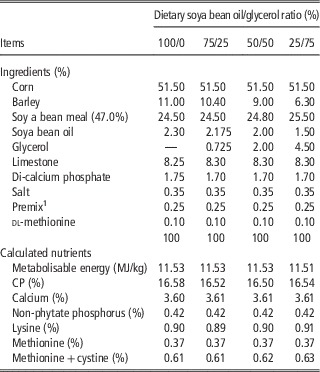
A total of 60 44-week-old Hy-Line W36 hens were distributed according to a completely randomised experimental design into four treatments, consisting of four levels of dietary glycerol with five replicate cages of three hens each. Layers were fed with a complete feeding mixture in a mash form. Experimental diets included: (1) control (no glycerol), (2) 25% of glycerol replaced by soya bean oil, (3) 50% of glycerol replaced by soya bean oil and (4) 75% of glycerol replaced by soya bean oil. The experimental diets contained 0%, 0.725%, 2% and 4% glycerol. The glycerol sample (90% glycerol, 8% moisture, 0.3% methanol, 1.5% to 2% ash) used in this study was obtained from a commercial biodiesel production facility (Yes Company, Adana, Turkey). Glycerol used in this experiment contained 15.90 MJ ME/kg. ME levels of glycerol were estimated using Carpenter and Clegg’s (Reference Carpenter and Clegg1956) equation: ME (kcal/kg)=53+38 [(CP, %)+(2.25×ether extract, %)+(1.1×starch, %)+(sugar, %)]. The experimental diets were formulated to be isocaloric and isonitrogenous. Ingredient and nutrient composition of experimental diets are shown in Table 1. The control diet was formulated to meet or exceed nutrient recommendations (National Research Council, 1994). Cage dimensions were 40×50 cm, equalling 2.000 cm2 of total floor space. During the experiment, hens were provided with water and feed ad libitum and were exposed to a 16 l : 8D lighting schedule. The experiment lasted 84 days. All procedures in this study complied with the ethical principles of animal rights.
Composition of experimental diets (% as fed)

1 Premix provided the following per kg of diet: vitamin A, 8.800 IU; vitamin D3, 2.200 IU; vitamin E, 11 mg; nicotinic acid, 44 mg; Cal-d-pantothenate, 8.8 mg; riboflavin 4.4 mg; thiamine 2.5 mg; vitamin B12, 6.6 mg; folic acid, 1 mg; d-biotin, 0.11 mg; choline, 220 mg; manganese, 80 mg; copper, 5 mg; iron, 60 mg; zinc, 60 mg; cobalt, 0.20 mg; iodine, 1 mg; selenium, 0.15 mg.
BW was obtained by weighing hens at the beginning and end of the experiment. Feed intake and egg weight were recorded biweekly. Egg production was recorded daily and egg mass was calculated from collecting data of egg production and egg weight at biweekly via: egg mass=(egg production×egg weight)/period (days). The feed conversion ratio was calculated via: feed conversion ratio=feed intake/egg mass. Specific gravity and egg quality characteristics measurements were made on all collected eggs obtained during the last 2 days of the 28-day periods. Specific gravity was determined on the day of collection using graded salt solutions ranging from 1.080 to 1.090, with gradations of 0.005 (Holder and Bradford, Reference Holder and Bradford1979). The egg shape index was calculated by the width : length ratio as a percentage using a digital calliper (Mitutoyo Inc., Kawasaki, Japan). Egg yolk and albumen height were determined using a digital height calliper (Mitutoyo Inc.). Yolk index (%)=(yolk height/yolk diameter)×100. Albumen index (%)=(albumen height/albumen length and width)×100. Haugh unit=100×log (AH+7.57–1.7×EW0.37), where AH=albumen height and EW=egg weight. A colorimeter (Minolta Chromameter CR 400; Minolta Co., Osaka, Japan) to assess the egg yolk colour and the CIELAB colorimetric (Romero et al., Reference Romero, Brenes, Garcia and Garrido2002). Eggshell breaking strength was measured using a cantilever system by applying increased pressure to the broad pole of the shell using a Force Reader instrument (Orka Food Technology Ltd, Ramat Hasharon, Israel). Eggs were then broken, and the eggshell, albumen and yolk were separated and weighed. The eggshells were rinsed in running water and dried in an oven at 60°C for 12 h. The eggshells were weighed using a 0.001 g precision scale. Eggshell thickness (including the membrane) was determined on three points on the eggs (one point on the air cell, and two randomised points on the equator) using a micrometre (Mitutoyo Inc.).
At the end of the experiment, 15 eggs per group (three eggs from each replicate) were randomly chosen to determine yolk fatty acid composition. Triacylglycerides were methylated using the ISO 5509 method (ISO, 1978) and fatty acid methyl esters were collected. The methyl esters of the fatty acids (1 µl) were analysed in a gas chromatography (Agilent 7890 A, Agilent Technologies, Santa Clara, CA, USA), equipped with a flame ionising detector and a fused silica capillary column (100 m×0.25 mm i.d; film thickness 0.20 µm). It was operated under the following conditions. The oven temperature was held at 140°C for 5 min and was then raised to 240°C at a rate 4°C/min before then being kept at 240°C for 15 in. Injector and detector temperatures were 260°C and 280°C, respectively. The carrier gas was helium and the flow rate of helium was 1.51 ml/min. The split ratio was 30/1 µl per min.
A statistical analysis of the results was performed using the ANOVA of MINITAB (2000) according to the following general model:
Yij: μ+αi+eij, where Yij was the observed dependent variable, μ was the overall mean, αi the effect of glycerol and eij the random error. Duncan’s multiple range tests were applied to the separate means. Statements of statistical significance were based on a probability of P<0.05. The results are presented as least square mean values with pooled standard error of the mean (SEM).
Results
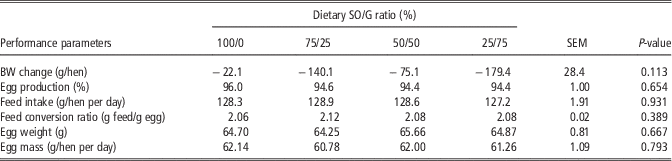
Dietary treatments had no significant effect on BW change, egg production, feed intake, feed conversion ratio, egg weight and egg mass of laying hens (Table 2).
Effect of different levels of glycerol addition to diets on performance in laying hens from 44 to 56 weeks of age

SO=soybean oil; G=glycerol; SEM=standard error mean.
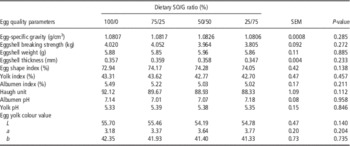
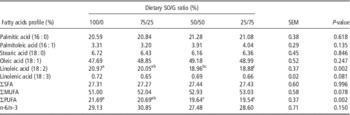
Though egg production tended to decrease in hens fed with glycerol compared with the control group, there was no significant effect on egg production. The inclusion of glycerol in the diet of laying hens had no significant effect on egg specific gravity, eggshell breaking strength, eggshell weight and eggshell thickness, egg shape index, albumen index, yolk index and haugh unit, albumen pH, yolk pH and egg yolk colour value (Table 3). The effects of dietary supplementation with glycerol on yolk fatty acid composition are shown in Table 4. The inclusion of glycerol in the diet of laying hens had no significant effect on the palmitic, palmitoleic, stearic, oleic and linolenic acid contents of egg yolk. The linoleic acid and PUFA contents of the egg yolk were significantly decreased with dietary glycerol supplementation (P<0.05). The polyunsaturated fatty acid content of the egg yolk was lower in the group fed diets containing levels of 50% and 75% glycerol compared with that of the control group. Glycerol supplementation had no significant effect on the total saturated fatty acid monounsaturated fatty acid (MUFA) content of the egg yolk or the ratio of n6/n3.
Effect of different levels of glycerol addition to diets on egg quality parameters in laying hens from 44 to 56 weeks of age

SO=soybean oil; G=glycerol; SEM=standard error mean.
Effect of different levels of glycerol addition to diets on egg yolk fatty acid compositions in laying hens from 44 to 56 weeks of age

SO=soya bean oil; G=glycerol; SEM=standard error mean.
a,b,cValues within a row with different superscripts differ significantly at P<0.05.
Discussion
The results demonstrate that the inclusion of 4.5% glycerol (soya bean oil/glycerol ratio; 25/75) in laying hen diets is feasible. Performance parameters did not differ among treatments. These data are consistent with the findings of other studies involving laying hens (Coşkun et al., Reference Coşkun, Şehu, Küçükersan and Köksal2007; Lammers et al., Reference Lammers, Kerr, Honeyman, Staldre, Dozier, Weber, Kidd and Bregendahl2008; Swiatkiewicz and Koreleski, Reference Swiatkiewicz and Koreleski2009; Yalçın et al., Reference Yalçın, Erol, Özsoy, Onbasilar, Yalçın and Üner2010). The results of the present study are similar to those reported by Lammers et al. (Reference Lammers, Kerr, Honeyman, Staldre, Dozier, Weber, Kidd and Bregendahl2008) in an experiment with White Leghorn hens. Lammers et al. (Reference Lammers, Kerr, Honeyman, Staldre, Dozier, Weber, Kidd and Bregendahl2008) found crude glycerol levels of 5%, 10% or 15% did not affect egg production, egg weight, egg mass and feed intake. Coşkun et al. (Reference Coşkun, Şehu, Küçükersan and Köksal2007) observed that feed intake in laying hens was significantly increased by the use of 5% glycerol, but the use of a combination of 5% and 10% crude glycerol had no significant effect on the feed intake of laying hens. Yalçın et al. (Reference Yalçın, Erol, Özsoy, Onbasilar, Yalçın and Üner2010) reported that the study hens fed diets of 7.5% glycerol consumed significantly less feed than did those of other groups, but the inclusion of 2.5% and 5% glycerol in diets had no significant effects on feed intake during the experimental period. Swiatkiewicz and Koreleski (Reference Swiatkiewicz and Koreleski2009) reported that the inclusion of 2%, 4% or 6% glycerol had no significant effect on laying performance parameters compared with the control group. Duarte et al. (Reference Duarte, Murakami, Boso, Eyng, Ospina-Rojas and Matumoto-Pintro2014) reported that egg production and feed conversion were not affected by mixed glycerol inclusion. In quail, the inclusion of up to 10% glycerol did not affect reproductive performance (Erol et al., Reference Erol, Yalçın, Midilli and Yalçın2009). In the present study, egg quality parameters did not change by including 4.5% glycerol in the diet. Similar results were reported by Swiatkiewicz and Koreleski (Reference Swiatkiewicz and Koreleski2009), who observed the inclusion of 2%, 4% and 6% glycerol in the diets had no effect on albumen height, haugh unit, egg shell thickness and egg shell breaking strength. In Coşkun et al.’s (Reference Coşkun, Şehu, Küçükersan and Köksal2007) study, the values of yolk index, albumen index and haugh unit of eggs were not affected by the inclusion of glycerol at levels of 5% and 10% in the diets, but shell thickness of the egg decreased with the use of 10% glycerol. Duarte et al. (Reference Duarte, Murakami, Boso, Eyng, Ospina-Rojas and Matumoto-Pintro2014) reported that egg quality parameters were not affected by the inclusion of glycerine, indicating that up to 7.5% glycerine can be added to commercial laying hen diets. In a similar study, glycerol included in laying hen diets at levels between 1.5% and 7.5% did not affect egg quality parameters (Boso et al., Reference Boso, Murakami, Duarte, Nascimento, Matumoto-Pintro and Ospina-Rojas2013).
In our study, the egg fatty acid profile changed with dietary glycerol. Linoleic acid levels linearly decreased with increasing glycerol levels in the diet. Also, the PUFA content of egg yolk decreased when hens were fed with 2% and 4.5% levels of glycerol (soya bean oil/glycerol ratio; 50/50 and 25/75) compared with groups fed other diets (P<0.05). The fatty acid profile of eggs is highly dependent on the diet of laying hens (Yannakopoulos et al., Reference Yannakopoulos, Tserveni-Gousi and Christaki2005; Sosin et al., Reference Sosin, Borowiec, Strzetelski and Smulikowska2006). The present study demonstrates that MUFA tended to increase with increasing levels of dietary glycerol, but this increase was not significant. Duarte et al. (Reference Duarte, Murakami, Boso, Eyng, Ospina-Rojas and Matumoto-Pintro2014) reported that linolenic acid percentages in eggs from glycerol fed laying hens linearly decreased with increasing glycerol levels. In a similar study (Suchy et al., Reference Suchy, Strakova, Kroupa and Herzig2012), the total fatty acid content of egg yolk significantly decreased when hens were fed with 2% and 4% levels of glycerol (crude oil replacement with glycerol). In addition, researchers reported that linoleic acid and linolenic acid levels of egg yolk decreased with increasing glycerol levels in the diet. In contrast, Boso et al. (Reference Boso, Murakami, Duarte, Nascimento, Matumoto-Pintro and Ospina-Rojas2013) reported that the percentage of PUFA in the eggs of laying hens fed with glycerol increased as the levels of inclusion increased. Duarte et al. (Reference Duarte, Murakami, Boso, Eyng, Ospina-Rojas and Matumoto-Pintro2014) reported that linoleic acid and PUFA percentages linearly increased with increasing glycerine levels in laying hen diets. The differences in fatty acid profiles among studies may be due to the differences in the amount and profile of fatty acids remaining in glycerol or the reduction in crude oil due to the addition of glycerol. In the present study, the decrease in linoleic acid in the eggs may be partially attributed to increases of dietary glycerol because glycerol contains less linoleic acid than does soybean oil. Soy bean oil is an important linoleic acid source (Oliveira et al., Reference Oliveira, Baião, Cançado, Grimaldi, Souza, Lara and Lana2010). The egg yolks of laying hens fed soy bean oil presented higher amounts of linoleic (n-6) fatty acids (Oliveira et al., Reference Oliveira, Baião, Cançado, Grimaldi, Souza, Lara and Lana2010). Thus, the low level of dietary soy bean oil may have lowered the PUFA of eggs. Also, high n-6 consumption is associated with increased risk of cardiovascular disease in humans (Petrović et al., Reference Petrović, Gačić, Karačić, Gottstein, Mazija and Medić2012). Therefore, according to the results of the present study, dietary glycerol enriched eggs with n-6, while also reducing the n-3 fatty acid content. Omidi et al. (Reference Omidi, Rahimi and Torshizi2015) reported that the optimal ratio of n-6 to n-3 should not exceed 2 : 1 to 4 : 1. The dietary imbalance in fatty acids (excessive n-6 and insufficient n-3) is an underlying cause of many chronic diseases, including cardiovascular disease, cancer, inflammatory disease, autoimmune disease and many physiological disturbances. Milinsk et al. (Reference Milinsk, Murakami, Gomes, Matsushita and De Souza2003) reported that the decreasing order of nutritional quality of eggs occurs with various diets, as follows: flaxseed>canola>soybean and sunflower oil.
Conclusions
In conclusion, the results of this study show that it is possible to replace 75% of soybean oil with glycerol (4.5% in diet), serving as an alternative energy source for feeding mixtures intended for utility laying hens without any significant effects on egg production and egg quality. In addition, by increasing the glycerol level in the diets of hens, there is a significant decrease in PUFA and linoleic acid percentages.
Acknowledgements
The authors thank Dr Ahmet Ünver and his laboratory for knowledge and support and for providing equipment to analyse the fatty acids in our samples.