Coronavirus disease 2019 (COVID-19) has been considered a significant problem in health care across the world, causing particular problems for elderly individuals. Indeed, age is the single most crucial variable affecting the odds of surviving against this illness, with people aging 65 y and above being the most susceptible. Reference Cho and Kang1 Senescence, on the other hand, is a normal occurrence that has varied connotations in different cultures and has long been regarded as a risk factor for infection with COVID-19. Reference Aksay2 In general, chronic illnesses result from aging, which reduce individuals’ ability to do their daily tasks. Another element that drives the request for rehabilitation programs is a rise in comorbidities and acute diseases (cardiovascular disease, stroke) as well as the aging population’s expectations. Reference Velayati, Ayatollahi and Hemmat3
During the pandemic, health precautions such as wearing masks, keeping a safe distance from sick people, and quarantining infected people helped to keep the outbreak under control. Quarantine, on the other hand, caused individuals to spend more hours at home, sleep more, and consume more food and alcohol. Among elderly adults with physical and functional insufficiencies, these were the root causes of physical and mental deterioration, making rehabilitation services even more critical. Reference Aksay2 Nonetheless, face-to-face counseling, time, and money are required for most rehabilitation treatments. In rural regions, rehabilitation professionals are poorly trained and there is an imbalance in access to rehabilitation services. Reference Moriichi, Fujiya and Ro4 There were many elderly individuals who were unable to get rehabilitation treatments prior to the outbreak, because they had a variety of clinical limitations and situations. Nevertheless, throughout the pandemic, access has grown increasingly restricted owing to a reduction in face-to-face contacts and other societal initiatives aimed at reducing the disease prevalence. Reference Hawley, Genovese and Owsiany5 Hence, telerehabilitation has become more important in these situations. Reference Omboni, McManus and Bosworth6 As the term suggests, “telerehabilitation” is the practice of providing medical services across long distances without physically bringing the patient and the caregiver together. Reference Doraiswamy, Jithesh and Mamtani7 People who adhere to “social distancing” concepts in the pandemic will find it appealing. Patient assistance, different rehabilitation services, management of individuals with impairments and chronic diseases, comprehensive remote care, and nursing home care for patients in acute sickness have all been made possible by means of the use of this service. Reference Murphy, Dennehy and Costello8 Before COVID-19, evidence had revealed the usefulness of telerehabilitation for the older adults. Reference Saito and Izawa9,Reference Bernocchi, Giordano and Pintavalle10 Nevertheless, adoption of the service was restricted for a variety of reasons including patients’ and caregivers’ worries about its use, security difficulties, unavailability of face-to-face assessment, data privacy, legal obstacles, lack of connection to technology, insurance strategies, Reference Doraiswamy, Jithesh and Mamtani7 misunderstandings about older adults and their preferences, technological knowledge, Reference Hawley, Genovese and Owsiany5 resource restrictions, complicated medical situations, patient care considerations, linguistic barriers, low health awareness, chronic diseases, cultural and psychological considerations, Reference Weiss, Malik and Santos11 difficulties with the suitability and adaptability of these services, and cognitive, behavioral, and attentional issues. Reference Omboni, McManus and Bosworth6 However, the exceptional numbers, complexity of COVID-19, and significance of continuous care have compelled health-care systems throughout the world to rethink how they deliver present and future health-care services to their populations. The eligibility, availability, and possible use of telerehabilitation for the elderly population have been hastened as a result of epidemics. Reference Sorinmade, Kossoff and Peisah12 During the COVID-19 pandemic, countries have started to remove legislative limits on its use, and insurance firms have broadened the extent and breadth of the services they provide to customers. Reference Doraiswamy, Jithesh and Mamtani7 Likewise, the pandemic has placed a strong emphasis on “appropriate comprehension and use” notwithstanding the difficulties associated with adopting telerehabilitation Reference Sorinmade, Kossoff and Peisah12
To date, telerehabilitation has been chiefly used for middle-aged individuals with multiple sclerosis, cardiovascular problems, and stroke. As a result, it is unclear whether this treatment would be effective in the elderly population. Reference Moriichi, Fujiya and Ro4 The rehabilitation of elderly people, in particular, is expected to witness an increase in the global use of telerehabilitation. Insurance companies have also expended their coverage of telerehabilitation services during the COVID-19 pandemic. Reference Doraiswamy, Jithesh and Mamtani7 To assist older adults during the COVID-19 pandemic in 2022, the present systematic research aims to discover and assess the publications involving telerehabilitation.
Methods
Eligibility Criteria and Search Strategy
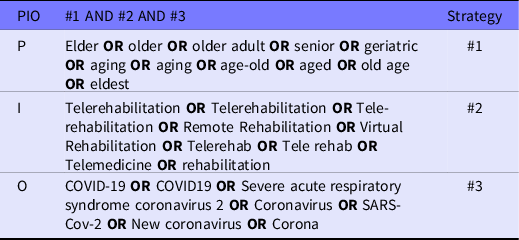
Initially, the protocols for this investigation were submitted to the PROSPEROFootnote a database under the identification number CRD42022314866. PRISMAFootnote b search guidelines were followed for this systematic review. The study question, that is, what are the publications associated with the use of telerehabilitation for the elderly population throughout COVID-19, was answered by conducting a systematic search for peer-reviewed and English-language papers published between September 1, 2019, and December 1, 2021. First, to determine that no previous systematic reviews existed on the issue, a rapid and comprehensive search was done in the Cochrane Library, and no matching publications were found. The databases searched were PubMed, Web of Science, Cochran Library, Scopus, Science Direct, and ProQuest. Gray literature, such as books, websites, conference articles, and dissertations, was searched as well. When searching between the sets of words each of which was regarded to be a different notion, the “AND” operator was used. The “OR” operator was also used between synonymous terms. Titles, abstracts, and keywords of the documents were searched for the relevant results. It should be noted that Mesh Terms were used to search for publications in the PubMed database.
The search approach used in this study has been presented in Table 1. Because there was no comparison group, C (the identical comparison group) was not taken into consideration in PICO analysis. Furthermore, the researcher chose the terms for the search, and the variables were retrieved from the publications chosen for the study. In the following phase, the investigators created a comprehensive reference collection for all the papers and assessed the titles. The publications that were not related to the study objectives were subsequently excluded. All search procedures were repeated to ensure accuracy. To manage the references, ENDNOTE edition X9 program was used.
Search method for the application of telerehabilitation among elderly individuals during the COVID-19 pandemic

Inclusion Criteria
Several publications were chosen since telerehabilitation for the elderly population during the COVID-19 pandemic was mentioned in their titles, keywords, or abstracts. Then, the abstracts were assessed before reading the complete manuscripts using assessment tools.
To conduct this study, a comprehensive search was conducted among the publications recovered from 2019 to the first day of December of 2021. Unreported documents (gray literature), procedures, conference papers, directions, recommendations, and reports from respectable institutions were reviewed, as well. Review publications were chosen on the basis of both quantity and quality. Titles, abstracts, and keywords all had to include the relevant search terms. Additionally, papers had to be relevant to the study topic. Peer-reviewed articles were also included during the selection procedure.
Exclusion Criteria
Variables irrelevant to the research topic were omitted from the study findings.
Screening
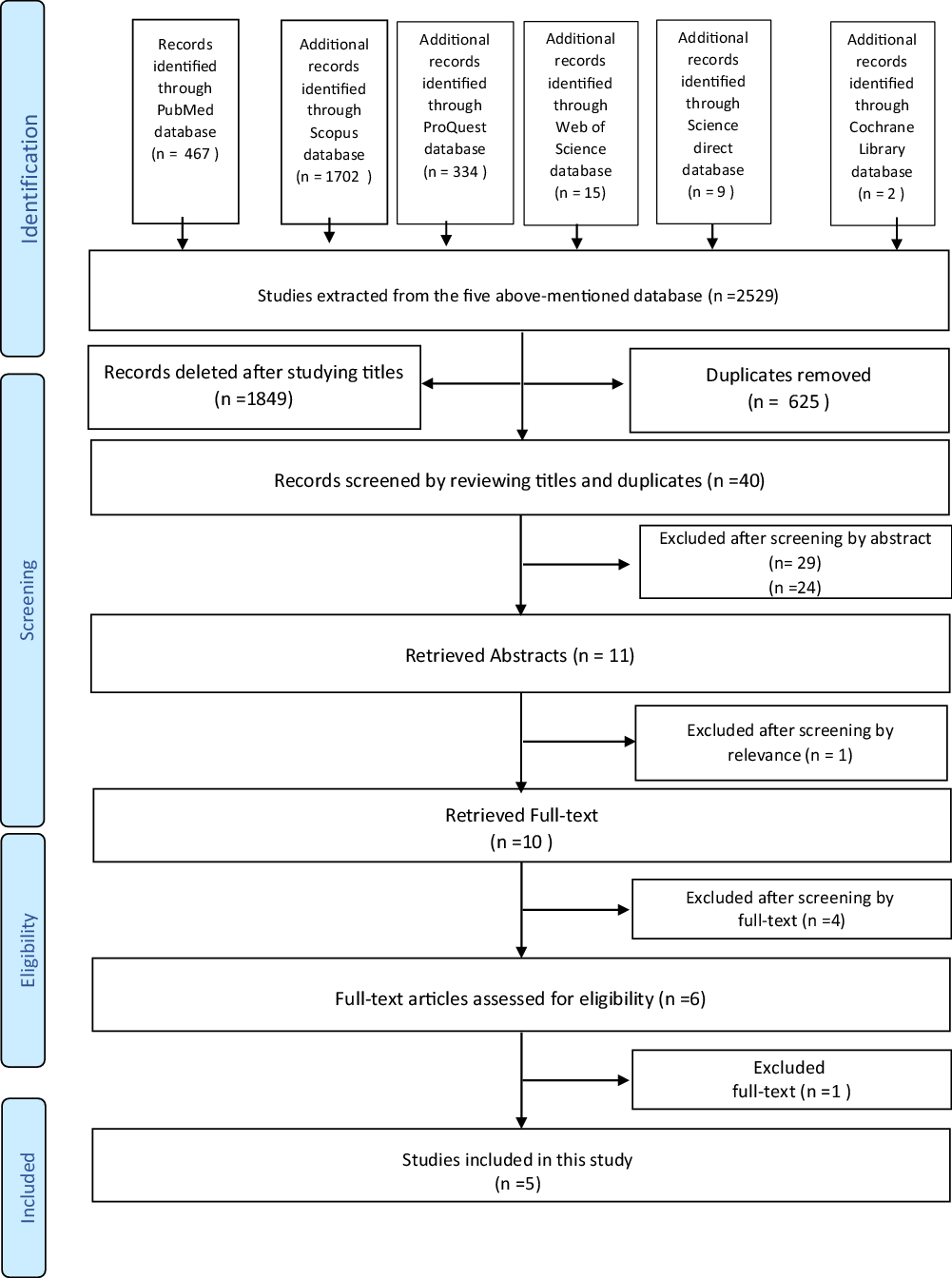
First, the titles of all the papers in the database were checked and those that matched the inclusion criteria and were related to the study objectives were selected. Then, the abstracts were reviewed and the papers that were consistent with the study objectives and inclusion criteria were chosen. After that, the full text of each paper was reviewed and analyzed. This was followed by a selection of the publications discussing the use of telerehabilitation in the elderly population during the COVID-19 pandemic. The papers were then assessed in accordance with the PRISMA benchmarks. Citation and printing prejudice were also taken into consideration, and papers with a large number of citations were given special attention. Each of the preceding stages was carried out twice. There was no conflict of interest between the reviewers of the articles (Figure 1).
PRISMA diagram for the article screening procedure.

Data Extraction
The relevant data were gathered from the papers after being thoroughly read using the summary and collecting form. This form included title, corresponding author, study sampling(s), country(ies), study duration(s), study design(s), method(s), result(s), and conclusion(s), and was completed for each of the papers. Following a thorough analysis of all the publications, the forms were assessed by 2 authors and were organized in a single table. Finally, other researchers involved in the investigation provided their comments on the publications. It is worth mentioning that the summary forms were created using the Microsoft Office Word 2016.
Results
A total of 2529 documents were gathered from the databases. Nevertheless, due to their duplication across many databases, 625 papers were excluded. Additionally, 29 of the 40 original publications were excluded, because their titles did not align with the study objectives. After reviewing the abstracts of the remaining 11 publications, 1 was ruled out for the lack of relevance to the research. Among the remaining 10 full texts, 5 were found to be totally in accordance with the study objectives. The process of selecting papers for the study has been depicted in Diagram 1 (Figure 1).
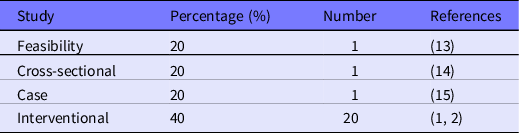
The types of the papers that were extracted have been shown in Table 2. Accordingly, cross-sectional, feasibility, case, and interventional studies comprised 20%, 20%, 20%, and 40% of the papers, respectively.
Types of the selected papers

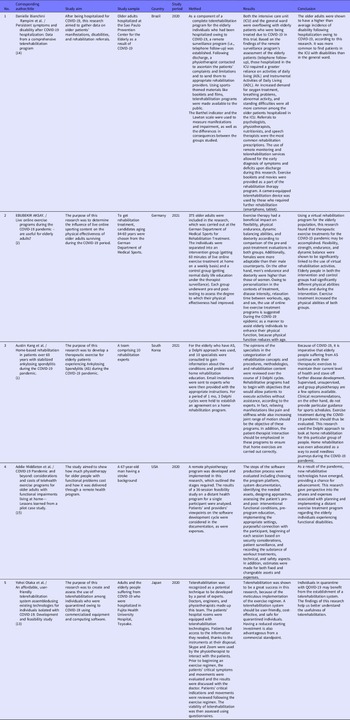
The findings obtained after reading all the 5 publications have been presented in Table 3. The data include title, corresponding author, country, period of study, study objectives, study sampling, research plan, methodology, findings, and conclusions.
Summary form of the ultimately selected papers

Discussion
The present systematic review was conducted on the studies that used telerehabilitation to assist elderly individuals during the COVID-19 pandemic. According to the findings, telerehabilitation was used to identify Reference Aksay2 and enhance elderly people’s physical performance, Reference Leite, Rampim and Jorge13 which resulted in a rise in their level of satisfaction. Reference Mukaino, Tatemoto and Kumazawa14
The proportion of individuals aging 60 y and above is expected to grow by 2050, making the issue of aging a major concern for the world. Reference Velayati, Ayatollahi and Hemmat3 Comorbidities, weakness, incapacity, reduced physical activity, lower quality of life, increasing public demands, and a rise in the need for rehabilitation services are all related to senescence. To satisfy their needs for lifespan, excellence, and independence, this endangered population presents difficulties to health-care systems, which in turn affects the systems’ long-term viability. To address the rehabilitation needs of the elderly population, it is vital to use effective solutions. Rehabilitative services for these individuals have been useful in both health and financial aspects. In numerous low- and middle-income nations with restricted resources, distance, economic constraints, lack of rehabilitation staff, and epidemic circumstances have prohibited older adults from receiving rehabilitation treatments. Telerehabilitation that uses the Information and Communication Technology (ICT) to deliver high-quality, low-cost, and adaptable treatments to elderly people is a novel approach to meeting the rehabilitation needs of this population. Individuals suffering from COVID-19, in particular, can conveniently make use of these services. An alternative to standard treatment during a pandemic is to use telemedicine to deliver services without the requirement for in-person visits in health centers and to reduce the spread of the virus. It is also effective in the early diagnosis and management of infected individuals. Telerehabilitation has been highlighted for the elderly population during the COVID-19 pandemic. Reference Velayati, Ayatollahi and Hemmat3,Reference Omboni, McManus and Bosworth6,Reference Doraiswamy, Jithesh and Mamtani7,Reference Saito and Izawa9,Reference Kalhori, Bahaadinbeigy and Deldar15–Reference Keshvardoost, Bahaadinbeigy and Fatehi20 Accordingly, immediate presence and rescue operations are essential for the effectiveness of disaster management. Disaster rehabilitation methods have improved as a result of the adoption of innovative ways. Reference Nejadshafiee, Bahaadinbeigy and Kazemi21,Reference Salehinejad, Jannati and Ershad Sarabi22 In the majority of research conducted on the issue, telerehabilitation has proved helpful to the elderly population and has been linked to increased contentment. Reference Aksay2,Reference Leite, Rampim and Jorge13,Reference Mukaino, Tatemoto and Kumazawa14 However, only 2 projects were focused on the obstacles and circumstances of the telerehabilitation system for elderly people Reference Cho and Kang1 and the expenses and progression procedures of the system. Reference Middleton, Simpson and Bettger23 To properly apply this technology and maximize patient satisfaction, such factors as safety, ease of access, cost-effectiveness, user-friendliness, and conformity with rehabilitation objectives are recommended to be taken into account. To provide telerehabilitation services, 2 of the research pappers included in this study Reference Aksay2,Reference Mukaino, Tatemoto and Kumazawa14 used Zoom video, a widely used and freely accessible video conferencing program, while 3 studies used tablets. Tablets can connect to a pulse oximeter and other medical services by means of Bluetooth. Pre-installed physical therapy applications are also available for patients with limited or no Internet access. Reference Leite, Rampim and Jorge13,Reference Mukaino, Tatemoto and Kumazawa14,Reference Middleton, Simpson and Bettger23 Furthermore, 2 investigations used telerehabilitation to evaluate critical manifestations and impairment, Reference Leite, Rampim and Jorge13,Reference Mukaino, Tatemoto and Kumazawa14 and 1 research used this technology to enhance patient efficiency by means of exercise therapy. Reference Aksay2
The majority of the included studies in the current systematic review were carried out in developed countries such as the United States, Germany, Korea, and Japan. Reference Cho and Kang1,Reference Aksay2,Reference Mukaino, Tatemoto and Kumazawa14,Reference Middleton, Simpson and Bettger23 Developed nations’ interest in this technology seems to be mostly due to such factors as a well-developed infrastructure of hardware and software, a high level of computer knowledge, and specific governmental legislations. Reference Velayati, Ayatollahi and Hemmat3,Reference Keshvardoost, Bahaadinbeigy and Fatehi16 However, only 2 of the papers were interventional in nature and used exercise treatment for older adults’ rehabilitation. Reference Cho and Kang1,Reference Aksay2 According to clinical principles, nonsurgical and nonpharmacological approaches with an emphasis on active care are recommended in the first line of rehabilitation. To alleviate discomfort, improve performance, and enhance the quality of life, exercise therapy is essential. Physiotherapists often suggest exercise treatment during face-to-face consultations. Nonetheless, face-to-face rehabilitation treatments are heavily affected by factors such as expense, duration, and location.
Due to the social isolation caused by the pandemic, various channels of communication have been severely restricted. Reference Aily, Barton and Mattiello24–Reference Yerlikaya, Öniz and Özgùren27 Manifestations and impairments caused by COVID-19 among elderly individuals were only explored in 1 Brazilian cross-sectional research. Reference Leite, Rampim and Jorge13 As a component of a telerehabilitation approach, they used distant surveillance by means of phone and evaluated the signs using Barthel and Lawton markers. Considering the absence of computer knowledge and practicality concerns in poor nations, telephone conversations have become a popular alternative to Internet-based telerehabilitation services. Reference Keshvardoost, Bahaadinbeigy and Fatehi16,Reference Adhikari, Shrestha and Dev28 In the United States, an investigation was done as a case study. The study findings shed light on the methods and expenses associated with aged and functionally impaired patients undergoing distance exercise treatment. Reference Middleton, Simpson and Bettger23 Mukaino et al. also conducted a study on the elderly individuals experiencing coronary heart disease in Japan in 2020. In that study, remote management of the patients’ computers was carried out by means of the TeamViewer software by a physiotherapist using Skype and Zoom software. TSQ and FIM questionnaires were used to gather information on the capability of the software to provide sports workouts and monitor critical manifestations as well as the degree of user happiness. Reference Mukaino, Tatemoto and Kumazawa14 Overall, telerehabilitation procedures (simple or complicated) have been used to treat elderly people in a broad variety of ways during the COVID-19 pandemic. The availability of care services at any moment and from any location has been made possible in part through asynchronous platforms (offline). To the best of our knowledge, telerehabilitation for the elderly population had not been investigated during the COVID-19 pandemic.
One of the main limitations of the present research was the selection of publications in English language. Additionally, Embase database were not accessible. As a result, the following recommendations are given to improve telerehabilitation for elderly people during the COVID-19 pandemic. First, during the initial stages, telerehabilitation programs and systems for sensitive populations, including elderly and physically and functionally impaired individuals, shoud be implemented. Second, in developing nations, the installation of this technology should be made as easy as possible, so that it may be used to address the fundamental requirements of handicapped and elderly individuals, allowing them to gain autonomy and improve their overall living standards. Third, attempts should be undertaken to instruct and persuade older adults to use this technology. Fourth, in accordance with rehabilitation objectives, telerehabilitation procedures should be as uncomplicated and user-friendly as possible. Fifth, telerehabilitation platforms and applications are suggested to be developed in compliance with standards and evidence-based practices.
Conclusions
The older adults are a vulnerable group for whom receiving timely and adequate rehabilitation services is very important. Before COVID-19, this people faced challenges in responding to their rehabilitation needs, but COVID-19 exacerbated the situations. Thus, telerehabilitation can considered as a complementary option to traditional treatments during pandemic and beyond. In fact, COVID-19 should be a chance for rehabilitative service organizations to be strengthened. Our findings showed that telerehabilitation can work equally or sometimes even more effectively than traditional treatments. Also, health-care organizations and policy makers can gain new insight in to the potential benefits of this technology and plan future uses.
Acknowledgments
The authors thank Ms. A. Keivanshekouh at the Research Consultation Center (RCC) of Shiraz University of Medical Sciences for improving the use of English in the manuscript.
Author contributions
Milad Ahmadi Marzaleh and Fatemeh Sarpourian were responsible for the study conception and design. Milad Ahmadi Marzaleh and Fatemeh Sarpourian searched the relevant databases and selected the appropriate articles according to the study objective. At the same time, Milad Ahmadi Marzaleh supervised the whole thesis. All authors prepared the first draft of the manuscript. All authors did the data analysis, made critical revisions to the study for important intellectual content, and supervised the study. All authors have read and approved the final manuscript.
Funding statement
None declared.
Conflict of interest
The authors have no conflict of interests to declare.
Informed Consent
Nil.