Introduction
Many industrial sectors are now benefitting from the possibility of fabricating intricate structures using additive manufacturing (AM) technologies to achieve the objectives of lightweighting, increased functionality, and part number reduction. They also have the potential to fulfill demands for reducing the cost and design-to-manufacture time through savings on raw materials and replacement of a series of production processes by a single-step process, Reference Das, Bourell and Babu1–Reference Baumers, Tuck, Wildman, Ashcroft, Rosamond and Hague3 hence reducing lead times in multiprocess fabrication. Reference Zhang, Liao and Coddet4–Reference Baumers, Tuck, Wildman, Ashcroft and Hague8 Selective laser melting (SLM) is part of the family of powder bed AM techniques. SLM involves a series of steps, principally powder deposition and laser scanning, Reference Gibson, Rosen and Stucker9 conducted within an inert controlled-atmosphere chamber to avoid oxidation. Reference Loeber, Biamino, Ackelid, Sabbadini, Epicoco, Fino and Eckert10 The parts are normally built on a temperature-controlled build plate (substrate) that acts as a heatsink and aids in heat dissipation by lowering the thermal gradient, Reference Kempen, Vrancken, Thijs, Buls, Van Humbeeck and Kruth11 avoiding part curling due to nonuniform thermal expansion. Reference Buchbinder, Meiners, Pirch, Wissenbach and Schrage12
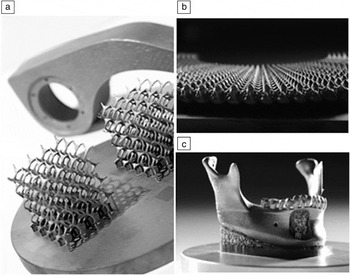
Modern AM dates back to the mid-1980s; its use expanded during the late 1980s and early 1990s, mainly as a method for manufacturing prototypes quickly. Reference Frazier13,Reference Bourell, Rosen and Ming14 Only recently has AM been considered part of a new industrial revolution. Reference Matilainen, Piili, Salminen, Syvänen and Nyrhilä15 A description of the evolution of AM can be found in Reference Reference Bourell, Joseph, Beaman, Leu and Rosen16. SLM is gaining wide popularity across industrial and scientific research sectors Reference Bourell, Rosen and Ming14,Reference Hofmann, Roberts, Otis, Kolodziejska, Dillon, Suh, Shapiro, Liu and Borgonia17 for applications in the aerospace, automotive, and biomedical fields. Reference Guo and Leu18 AM components are fabricated from loose powder, and have physical shapes and properties comparable to, and often even superior to, conventionally manufactured (CM) components. Reference Ferrar, Mullen, Jones, Stamp and Sutcliffe5,Reference Leuders, Thöne, Riemer, Niendorf, Tröster, Richard and Maier19 Part of the interest in SLM is driven by the increasing level of automation in the manufacturing sector along with production rates. Reference Schleifenbaum, Meiners, Wissenbach and Hinke20 As a powder bed process, SLM offers the geometrical flexibility to fabricate parts Reference Brandl, Heckenberger, Holzinger and Buchbinder21 that in many cases cannot be manufactured using CM5,15 (some examples are shown in Figure 1 ). SLM promotes the possibility of producing highly customized products Reference Matilainen, Piili, Salminen, Syvänen and Nyrhilä15 in low-to-medium quantities. Reference Leuders, Thöne, Riemer, Niendorf, Tröster, Richard and Maier19,Reference Tuck, Hague, Ruffo, Ransley and Adams22 Another benefit is eco-design optimization (optimizing the design to meet the functional requirements while using fewer resources during manufacturing and usage phases for a reduced impact on the environment), where significant structural lightweighting is possible, with a typically 50% weight reduction. Reference Buchbinder, Schleifenbaum, Heidrich, Meiners and Bültmann23 SLM is also a promising technique to manufacture functionally graded multimaterial parts. Reference Yadroitsev, Bertrand and Smurov6,Reference Yadroitsev and Smurov24,Reference Maskery, Aboulkhair, Aremu, Tuck, Ashcroft, Wildman and Hague25
Examples of complex structures manufactured using selective laser melting at the Centre for Additive Manufacturing Laboratories at The University of Nottingham. (a) A stainless-steel diamond lattice structure, (b) titanium designer necklace designed by Carrie Dickens, and (c) a jaw bone made from stainless steel.

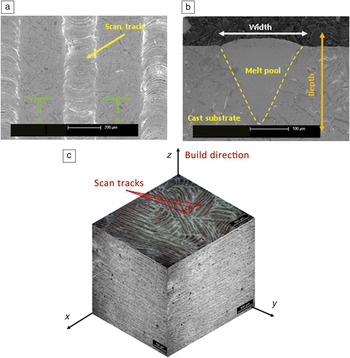
In SLM, a thin layer of feedstock powder is deposited by a wiper or roller mechanism. A laser then scans across the powder bed line by line, melting the powder into cylindrical segments; Reference Yadroitsev, Gusarov, Yadroitsava and Smurov26 referred to as scan tracks ( Figure 2a) or melt pools (Figure 2b). Scan tracks are similar to laser welds with the characteristic chevron pattern on top. Reference Aboulkhair, Maskery, Tuck, Ashcroft and Everitt27 SLM samples are built up through metallurgical bonding of scan tracks overlapping in the horizontal and vertical directions (Figure 2c). Reference Aboulkhair28
(a) Characteristic chevron pattern on top of an AlSi10Mg single track processed by selective laser melting on an AlSi12 as-cast substrate and (b) cross-sectional view (A–A) of a single melt pool showing evidence of keyhole-mode melting. (c) Isometric view for the orthogonal planes of a selectively laser-melted cube from AlSi10Mg showing the overlapping tracks building up the part. Reference Aboulkhair, Maskery, Tuck, Ashcroft and Everitt27

There are numerous reviews on metal AM, such as References Reference Frazier13 and Reference Herderick29. The reader is directed to Reference Reference Wong and Hernandez30 for a generic review of AM processes; a review focusing on SLM of Al alloys Reference Olakanmi, Cochrane and Dalgarno31 was published in 2015. Much progress has been made in this area of research since then. The present article attempts to integrate the various aspects of the SLM process for Al alloys in the literature, which is beneficial to the academic community and various industrial sectors interested in SLM of Al alloys, such as the automotive and aerospace industries. A focus is the correlation between the process and the resultant microstructure, which is mainly governed by the mode of melting and the solidification behavior, as well as the local and bulk mechanical behaviors of the material.
Suitability of aluminum alloys for SLM
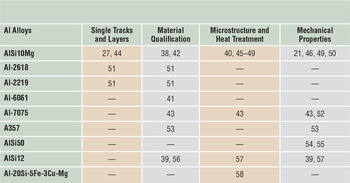
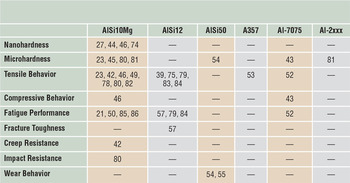
A great deal of SLM research has focused on the fabrication of steel and titanium components. Paving the way for SLM to become an attractive alternative to subtractive processes and forming CM components requires widening the range of usable materials. Aluminum alloys are characterized by low density (2.7 gm/cm3), high strength, Reference Tisza32 adequate hardenability, Reference Li and Gu33 good corrosion resistance, Reference Totten and Mackenzie34–Reference Hosford36 and excellent weldability, Reference Li and Gu33 making them suitable for use in a range of applications, Reference Dadbakhsh and Hao37 such as automotive, defense and aerospace equipment manufacturing, and machinery and tools production. Reference Li and Gu33,Reference Totten and Mackenzie34,Reference Hosford36 The possibility of manufacturing advanced lightweight Al parts using SLM opens up additional application opportunities and promotes the use of difficult-to-machine alloys. Examples of Al alloys examined for manufacture by SLM are shown in Table I , Reference Brandl, Heckenberger, Holzinger and Buchbinder21,Reference Aboulkhair, Maskery, Tuck, Ashcroft and Everitt27,Reference Aboulkhair, Everitt, Ashcroft and Tuck38–Reference Ma, Jia, Prashanth, Scudino, Yu and Eckert58 with AlSi10Mg having received the most attention to date. Further details on the classification of the Al alloys studied for SLM in the literature are available in Reference Reference Ding, Muñiz-Lerma, Trask, Chou, Walker and Brochu59.
Summary of work done in the field of selective laser melting of Al alloys in different focus areas, by reference number.

Challenges of processing aluminum alloys by SLM
As much as SLM is finding its way into commercialization at a fast rate, not many materials are currently processable. Reference Bourell, Rosen and Ming14,Reference Guo and Leu18 Compared to many other SLM candidate materials, Al alloys are challenging to process. Reference Aboulkhair, Everitt, Ashcroft and Tuck38 Aluminum powders are inherently light, have poor flowability, Reference Aboulkhair, Everitt, Ashcroft and Tuck38,Reference Aboulkhair, Maskery, Ashcroft, Tuck and Everitt60 show high reflectivity in the typical SLM laser wavelength range, and have high thermal conductivity. Reference Polmear35,Reference Ion61 Laser absorption of Al is poor, Reference Ion61 suggesting the need for high laser power to overcome the rapid heat dissipation. Reference Hosford36 Aluminum powders are highly susceptible to oxidation, Reference Gibson, Rosen and Stucker9,Reference Totten and Mackenzie34,Reference Wang, Zhang, Fang and Sercombe39,Reference Totten and MacKenzie62 which promotes porosity Reference Thijs, Kempen, Kruth and Van Humbeeck40,Reference Louvis, Fox and Sutcliffe41,Reference Ion61 alongside their low melt viscosity. Reference Ion61 The major challenges addressed in the literature include minimizing porosity Reference Buchbinder, Schleifenbaum, Heidrich, Meiners and Bültmann23,Reference Aboulkhair, Everitt, Ashcroft and Tuck38,Reference Read, Wang, Essa and Attallah42 and cracking. Reference Montero Sistiaga, Mertens, Vrancken, Wang, Van Hooreweder, Kruth and Van Humbeeck43
Numerous processing parameters are associated with SLM. These are known to affect the quality of the manufactured parts, Reference Aboulkhair, Everitt, Ashcroft and Tuck38 with “unoptimized” parameters introducing defects, mainly porosity. Reference Li and Gu33,Reference Kamath, El-dasher, Gallegos, King and Sisto63 The set of optimized parameters varies from one SLM machine to another and between materials. Therefore, “material development/qualification research” Reference Matilainen, Piili, Salminen, Syvänen and Nyrhilä15,Reference Schleifenbaum, Meiners, Wissenbach and Hinke20 is crucial for the success of the process. The most frequently examined parameters Reference Gibson, Rosen and Stucker9 are the processing environment, powder properties, layer thickness, laser power, scan speed, hatch spacing, and scan strategy. Reference Aboulkhair28
SLM is conducted in an inert atmosphere, typically argon. Reference Aboulkhair, Everitt, Ashcroft and Tuck38,Reference Read, Wang, Essa and Attallah42 Wang et al. Reference Wang, Zhang, Fang and Sercombe39 reported the type of inert gas to have no effect on densification. Ferrar et al., Reference Ferrar, Mullen, Jones, Stamp and Sutcliffe5 however, stated that the gas flow rate within the SLM chamber controls the amount of condensate and spatter removed during processing; these ejecta are generated by the laser–material interaction, Reference Tuck, Maskery, Simonelli, Aboulkhair, Ashcroft, Everitt, Wildman and Hague64,Reference Simonelli, Tuck, Aboulkhair, Maskery, Ashcroft, Wildman and Hague65 with the amount of spatter related to the laser power and spot size. Reference Matilainen, Piili, Salminen, Syvänen and Nyrhilä15 Simonelli et al. Reference Simonelli, Tuck, Aboulkhair, Maskery, Ashcroft, Wildman and Hague65 demonstrated the structure and chemical composition of the ejected material to be different from the feedstock powder. Aboulkhair et al. Reference Aboulkhair, Maskery, Tuck, Ashcroft and Everitt50 observed inefficient removal of the spatter, which may lead to its entrapment as inclusions in the final parts, affecting the final densities.
There are some prerequisite powder properties to accommodate the successive deposition of uniform powder layers. Reference Yadroitsev, Bertrand and Smurov6,Reference Aboulkhair, Everitt, Ashcroft and Tuck38 The powder of a particular alloy can have different properties depending on the method of its manufacture and its processing history. Low porosity, higher-quality parts are generally achieved by SLM when using powders complying with the process requirements. Reference Aboulkhair, Maskery, Ashcroft, Tuck and Everitt60 These requirements include spherical morphology, good flowability and packing density, minimal gas pores, and Gaussian particle-size distribution. The flowability and apparent density of powders are improved by having particles with a spherical morphology Reference Li, Shi, Wang, Wang, Liu and Jiang7 and with uniform Gaussian size distribution. The presence of gas phases in the starting powder significantly suppresses densification. Reference Kempen, Thijs, Yasa, Badrossamay, Verheecke and Kruth66,Reference Dai and Gu67 Preheating the powder is recommended to improve its laser absorptivity Reference Yadroitsev, Krakhmalev, Yadroitsava, Johansson and Smurov68 and enhance densification. Reference Li, O’Donnell and Sercombe56
The use of the presinter scan strategy, Reference Aboulkhair, Everitt, Ashcroft and Tuck38 which involves scanning each layer twice with the first scan at a lower laser power than the second one, has been shown to significantly remedy powder-induced defects when using powder that does not fully comply with the previously mentioned requirements, yielding parts with a relative density comparable to those processed from higher-quality powders. Reference Aboulkhair, Maskery, Ashcroft, Tuck and Everitt60 It is important to consider the chemical composition of an alloy to be used in SLM, since some chemical elements can make an alloy susceptible to cracking, as is common in difficult-to-weld alloys such as Al-7075. Altering the chemical composition by adding elements that hinder cracking has been demonstrated to improve the processability. Si addition to Al-7075 was shown to improve fluidity, thereby reducing cracks. Reference Montero Sistiaga, Mertens, Vrancken, Wang, Van Hooreweder, Kruth and Van Humbeeck43
The consolidation of continuous single tracks can be used to determine a suitable range for laser power and scan speed for low porosity manufacture, as well as to define the layer thickness and hatch spacing through examination of the melt pool shape. Reference Pupo, Delgado, Serenó and Ciurana69 The basic requirements of single tracks can be found in References Reference Aboulkhair28 and Reference Kempen, Thijs, Yasa, Badrossamay, Verheecke and Kruth66. The stability of the melt pool is controlled by the processing parameters. Reference Yadroitsev, Gusarov, Yadroitsava and Smurov26,Reference Ahuja, Karg, Nagulin and Schmidt51 The laser power and speed affect the width and depth of a scan track (Figure 2b), whereas its length is governed by the laser power and absorptivity of the material. Reference Kamath, El-dasher, Gallegos, King and Sisto63 Defects such as satellites (particles from the fresh powder sticking to the surface of the scan track Reference Aboulkhair, Maskery, Tuck, Ashcroft and Everitt27 ), balling, irregularities, and discontinuities Reference Aboulkhair, Maskery, Tuck, Ashcroft and Everitt27 can arise in Al tracks when the laser scan speed increases beyond a critical limit. Slower speeds are favored because they increase the melt volume and enhance wettability rather than balling. Reference Li and Gu33
The conductivity-reflectivity balance of aluminum Reference King, Barth, Castillo, Gallegos, Gibbs, Hahn, Kamath and Rubenchik70 results in keyhole-mode melting rather than conduction-mode melting, Reference Aboulkhair, Maskery, Tuck, Ashcroft and Everitt27 as demonstrated by the high depth-width ratio of the melt pool Reference King, Barth, Castillo, Gallegos, Gibbs, Hahn, Kamath and Rubenchik70 in Figure 2b. The mode of melting depends on the energy transfer efficiency during irradiation of the material with a laser beam. The energy-transfer efficiency is the ratio of the energy absorbed by the material to the power used. Conduction mode melting occurs when this ratio is equal to the material’s absorptivity. On the other hand, keyhole mode takes place if the ratio is larger than the material’s absorptivity due to high reflectivity within the melt pool. Reference Aboulkhair, Maskery, Tuck, Ashcroft and Everitt27 The shape of the melt pool, whether spherical or conical, is an important factor when optimizing the process parameters; the objective is to ensure sufficient overlap of the melt pools to create a consolidated, defect-free layer through metallurgical bonding of adjacent scan tracks. Reference Su and Yang71 The conically shaped melt pool in the case of Al requires the use of a narrow hatch spacing to create a consolidated layer, avoiding the formation of gaps toward the bottom through diminished intralayer bonding. Reference Aboulkhair, Everitt, Ashcroft and Tuck38 However, narrow hatch spacing results in slower rates of production, while larger hatch spacing imposes a limitation on the maximum layer thickness. Reference Su and Yang71 Increasing the layer thickness promotes the formation of defects in tracks and layers, Reference Aboulkhair, Maskery, Tuck, Ashcroft and Everitt27 hindering the deposition of uniform layers to build a multilayered part. Furthermore, a large layer thickness results in reducing the re-melted depth. Reference Aboulkhair, Maskery, Tuck, Ashcroft and Everitt27
Two types of pores form during Al SLM, metallurgical and keyhole pores, depending on the scan speed. A critical scan speed can be defined, Reference Aboulkhair, Everitt, Ashcroft and Tuck38 below which metallurgical (spherical) pores form and above which keyhole (irregular) pores are created. Altering the scan strategy has been employed with the aim of controlling the microstructure, minimizing the residual stresses, Reference Thijs, Kempen, Kruth and Van Humbeeck40,Reference Simonelli, Tse and Tuck72 and remedying defects, such as porosity. Reference Aboulkhair, Everitt, Ashcroft and Tuck38
The metallurgy of SLM Al alloys
A series of thermal processes during SLM Reference Frazier13 affect the resulting microstructure. Solidification occurs at a fast rate, producing a typically fine microstructure Reference Aboulkhair, Everitt, Ashcroft and Tuck38 and metastable phases. Reference Hatch73 The fine microstructure of SLM parts is in stark contrast to the generally coarse microstructures developed by CM processes, Reference Li and Gu33 and can be useful for some applications. In addition, the material is re-melted more than once due to penetration of the laser beam and heat transfer.
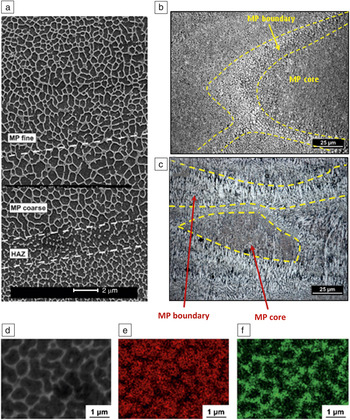
The microstructure within the melt pools of the scan tracks, Reference Aboulkhair, Maskery, Tuck, Ashcroft and Everitt27 layers, Reference Aboulkhair, Maskery, Tuck, Ashcroft and Everitt27,Reference Everitt, Aboulkhair, Maskery, Tuck and Ashcroft74 and multilayered parts Reference Aboulkhair, Everitt, Ashcroft and Tuck38,Reference Thijs, Kempen, Kruth and Van Humbeeck40,Reference Read, Wang, Essa and Attallah42,Reference Aboulkhair, Maskery, Tuck, Ashcroft and Everitt46 has been repeatedly reported. Each melt pool is divided into three regions; the melt pool core (MP fine), the melt pool boundary (MP coarse), and the heat-affected zone (HAZ) ( Figure 3a). The layer-based manufacturing approach results in microstructures that are nonhomogeneous. Viewed perpendicular to the build direction (BD), the grains are equiaxed; being finer toward the melt pool core Reference Thijs, Kempen, Kruth and Van Humbeeck40 (Figure 3b). Parallel to the BD, the grains at the melt pool boundaries are elongated, with finer equiaxed grains at the cores Reference Aboulkhair, Everitt, Ashcroft and Tuck38,Reference Thijs, Kempen, Kruth and Van Humbeeck40 (Figure 3c). Cellular-dendritic solidification produces fine equiaxed grains in the melt pool core due to proximity to the heat source and rapid solidification, with Si in the form of a continuous segregation on the boundaries of α-Al cells, Reference Prashanth, Scudino, Klauss, Surreddi, Löber, Wang, Chaubey, Kühn and Eckert75 whereas grains at the melt pool boundary are columnar with interdendritic Si. Reference Thijs, Kempen, Kruth and Van Humbeeck40 The dendritic growth indicates directional solidification along the thermal gradient (i.e., pointing toward the moving heat source). Fast solidification also results in a fine and quite homogeneous dispersion of the alloying elements Reference Aboulkhair, Tuck, Ashcroft, Maskery and Everitt45 (Figure 3d–f).
The microstructure of AlSi10Mg created by selective laser melting (SLM). (a) Three regions of microstructure within the melt pools (MPs) divided into fine grains, coarse grains, and heat-affected zone (HAZ). Reprinted with permission from Reference Reference Thijs, Kempen, Kruth and Van Humbeeck40. © 2013 Elsevier. (b) Equiaxed grains observed on the plane perpendicular to the build direction with coarser grains at the MP boundary. (c) Fine equiaxed grains at the MP core and coarser elongated grains at the MP boundary as seen in the plane parallel to the build direction. Reference Aboulkhair, Tuck, Ashcroft, Maskery and Everitt45 (d) Scanning electron microscope image demonstrating a similar microstructure achieved for AlSi12 using SLM with (e–f) energy-dispersive x-ray maps showing good dispersion of the alloying elements. Reprinted with permission from Reference Reference Prashanth, Scudino, Klauss, Surreddi, Löber, Wang, Chaubey, Kühn and Eckert75. © 2014 Elsevier.

Prashanth et al. Reference Prashanth, Scudino, Klauss, Surreddi, Löber, Wang, Chaubey, Kühn and Eckert75 provided a clear explanation of the solidification process in SLM of Al-Si alloys, attributing the formation of the cellular structure to the amount of undercooling. During solidification, Si is rejected into the liquid, increasing the solute concentration. As per the Al-Si phase diagram, the solubility of Si in Al is reduced at lower temperatures, but it can be extended by fast cooling. Therefore, the amount of Si rejected in the liquid during rapid cooling is reduced, decreasing the solute concentration in the liquid as well as the amount of undercooling. Rapid solidification changes the solute distribution drastically. Reference Kurz and Trivedi76 Thus a cellular structure is favored in which α-Al solidifies first in a cellular morphology, leaving the remaining Si as segregations at the boundaries.
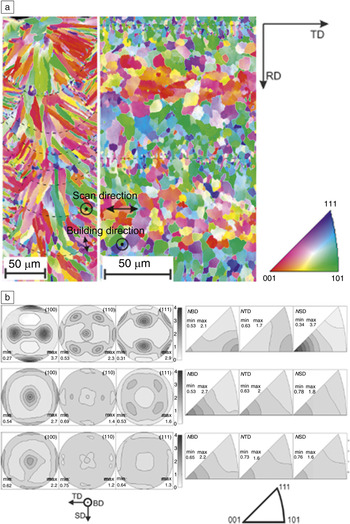
During solidification, a fraction of the grains grow faster in preferred orientations (i.e., formation of a crystallographic texture develops in the material) Reference Thijs, Kempen, Kruth and Van Humbeeck40 due to the directional solidification and layer-by-layer fabrication ( Figure 4a). Thijs et al. Reference Thijs, Kempen, Kruth and Van Humbeeck40 reported that the crystallographic texture of AlSi10Mg changed from a strong fiber texture to a weak cubic texture by changing the scan strategy (Figure 4b).
(a) Electron backscatter diffraction (EBSD) orientation maps for selective laser melting (SLM) of AlSi10Mg samples, processed using the meander scan strategy showing the growth of grains in the preferred orientation parallel to the BD, with these grains seen as equiaxed when viewed from the plane perpendicular to the BD, and (b) the effect of changing the scan strategy on the crystallographic texture of the SLM AlSi10Mg material as demonstrated by the pole figures (left) and inverse pole figures (right). The pole figures are for samples produced using unidirectional, alternating meander, and island scanning strategies from the top to the bottom, respectively. Reprinted with permission from Reference Reference Thijs, Kempen, Kruth and Van Humbeeck40. © 2013 Elsevier. Note: BD, build direction; RD, conventional rolling direction; SD, scanning direction; TD, transverse direction.

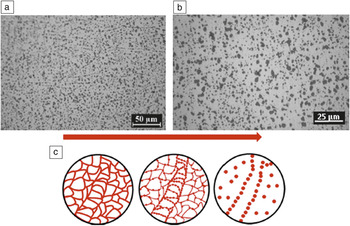
The response of SLM Al to various post-manufacture heat treatments has been investigated. Annealing SLM Al-20%Si, Reference Ma, Prashanth, Scudino, Jia, Wang, Zou, Wei and Eckert77 Al-12%Si, Reference Prashanth, Scudino, Klauss, Surreddi, Löber, Wang, Chaubey, Kühn and Eckert75 and AlSi10Mg Reference Maskery, Aboulkhair, Corfield, Tuck, Clare, Leach, Wildman, Ashcroft and Hague47,Reference Li, Li, Liu, Zhang, Zhou, Wei, Yan and Shi78 led to Si diffusion to form particles ( Figure 5a). As the treatment temperature or duration increased, the microstructure coarsened. Reference Prashanth, Scudino, Klauss, Surreddi, Löber, Wang, Chaubey, Kühn and Eckert75 Heat treating AlSi10Mg Reference Brandl, Heckenberger, Holzinger and Buchbinder21,Reference Aboulkhair, Tuck, Ashcroft, Maskery and Everitt45 and Al-7075 Reference Montero Sistiaga, Mertens, Vrancken, Wang, Van Hooreweder, Kruth and Van Humbeeck43 using solution heat treatment followed by artificial aging (known as the T6 treatment) also returned the same phase transformation (Figure 5b) and spheroidization (Figure 5c). Both heat-treatment procedures dissolved the melt pools and dendritic structure. As the treatment duration increased, Si had a longer duration to diffuse and formed larger particles, decreasing their spatial density and increasing their size. Reference Aboulkhair, Tuck, Ashcroft, Maskery and Everitt45
(a) The microstructure of selective laser melted AlSi10Mg after annealing heat treatment Reference Maskery, Aboulkhair, Corfield, Tuck, Clare, Leach, Wildman, Ashcroft and Hague47 and (b) solution heat treatment followed by artificial aging. Reference Aboulkhair, Tuck, Ashcroft, Maskery and Everitt45 (c) Both heat treatments promoted spheroidization phase transformation. Reprinted with permission from Reference Reference Prashanth, Scudino, Klauss, Surreddi, Löber, Wang, Chaubey, Kühn and Eckert75. © 2014 Elsevier.

The mechanical performance of SLM Al alloys
Material–laser interactions and rapid solidification due to high cooling rates (∼105 K/s57) lead to microstructural modifications that can yield enhanced material properties Reference Dadbakhsh and Hao37 compared to CM material (e.g., cast material). Reference Read, Wang, Essa and Attallah42 Mechanical characterization to assess the feasibility of SLM for structural parts is ongoing, as demonstrated in Table II . Also, a summary of the tensile properties of SLM Al alloys reported in the literature can be found in Reference Reference Ding, Muñiz-Lerma, Trask, Chou, Walker and Brochu59.
A list of the studies in the literature that investigated the various mechanical properties of selective laser melting Al alloys, by reference number.

Generally, SLM parts are characterized by high residual stresses arising from high energy density and rapid solidification. Reference Edwards and Ramulu87 High residual stresses in SLM AlSi12 (∼36 MPa) were reduced by almost 90% by using a heated build plate and postprocess stress-relief treatment. Reference Siddique, Imran, Wycisk, Emmelmann and Walther79 The microstructure and porosity controlled by the process parameters influence the mechanical behavior. Reference Brandl, Heckenberger, Holzinger and Buchbinder21 The fine microstructure and good distribution of alloying elements (at the scale of several tens of microns) in SLM yield uniform local mechanical properties across the melt pools. Reference Aboulkhair, Maskery, Tuck, Ashcroft and Everitt46
The global mechanical properties of SLM materials are comparable to those of their conventionally processed counterparts. Mechanical anisotropy is affected by the material’s crystallographic texture, Reference Kempen, Thijs, Van Humbeeck and Kruth80,Reference Kanagarajah, Brenne, Niendorf and Maier88 which is attributed to the process parameters. Reference Thijs, Kempen, Kruth and Van Humbeeck40,Reference Kempen, Thijs, Van Humbeeck and Kruth80 The layer-by-layer fashion in which the parts are built in SLM results in a number of factors leading to anisotropy, Reference Buchbinder, Meiners, Wissenbach and Poprawe89 including (1) the shape and size of voids; (2) the grain orientation and crystallographic texture with respect to the build orientation; and (3) the interface regions between scan tracks and layers. When anisotropy is observed, better properties are generally seen along axes perpendicular to the BD, Reference Brandl, Heckenberger, Holzinger and Buchbinder21,Reference Tuck, Hague, Ruffo, Ransley and Adams22,Reference Kempen, Thijs, Van Humbeeck and Kruth80 with the density of dislocations being dependent on the BD. Reference Kanagarajah, Brenne, Niendorf and Maier88 However in some cases, no significant BD effect was observed. Reference Brandl, Heckenberger, Holzinger and Buchbinder21,Reference Read, Wang, Essa and Attallah42
Although several studies reported high tensile strengths for SLM parts compared with CM parts, this often comes at the expense of low ductility. However, heat treatments such as annealing Reference Ma, Prashanth, Scudino, Jia, Wang, Zou, Wei and Eckert77 and T6 procedures (solution heat treatment followed by artificial aging) Reference Aboulkhair, Maskery, Tuck, Ashcroft and Everitt46 can recover some of the ductility without significantly reducing strength, providing a good compromise for applications that require both properties. The compromise between the SLM material’s strength and ductility that can be achieved via heat treatment is appealing for numerous applications when considering the material’s comparatively low density. A T6 heat treatment has been shown to soften SLM AlSi10Mg Reference Aboulkhair, Tuck, Ashcroft, Maskery and Everitt45 and Al-7075. Reference Montero Sistiaga, Mertens, Vrancken, Wang, Van Hooreweder, Kruth and Van Humbeeck43 The strengthening factors in the as-built and heat-treated materials were similar except for the grain-size refinement factor in the former being replaced by the strengthening effect of dispersoids (Orowan strengthening: bowing of dislocations at the interaction with a dispersoid) in the latter. The higher hardness in the SLM material indicates that the grain-size refinement effect outweighed the dispersoid effect in this case.
The presence of unbonded powder inside SLM parts was reported for AlSi10Mg, Reference Aboulkhair, Everitt, Ashcroft and Tuck38,Reference Louvis, Fox and Sutcliffe41 Al-6061, Reference Louvis, Fox and Sutcliffe41 and Al-7075. Reference Reschetnik, Brüggemann, Aydinöz, Grydin, Hoyer, Kullmer and Richard52 Although these regions are relatively small (i.e., they will not significantly reduce the load-bearing area under tension), Reference Read, Wang, Essa and Attallah42 they might influence fatigue properties. Defects in SLM parts act as stress concentrations, depressing fatigue life due to crack nucleation and growth. Reference Brandl, Heckenberger, Holzinger and Buchbinder21,Reference Edwards and Ramulu87,Reference González, González, Talamantes-Silva, Valtierra, Mercado-Solís, Garza-Montes-de-Oca and Colás90–Reference Suresh92 SLM Al has shown good performance under cyclic loading. Reference Brandl, Heckenberger, Holzinger and Buchbinder21,Reference Aboulkhair, Maskery, Tuck, Ashcroft and Everitt50 The potential of machining by turning and polishing to improve the fatigue performance was emphasized in some studies in the literature. Reference Frazier13 Aboulkhair et al. Reference Aboulkhair, Maskery, Tuck, Ashcroft and Everitt50 provided evidence that machining may not improve the fatigue performance, but rather, increases the scatter in lifetime data. Heat treatment has been shown to considerably improve the fatigue performance Reference Brandl, Heckenberger, Holzinger and Buchbinder21,Reference Aboulkhair, Maskery, Tuck, Ashcroft and Everitt50 due to the transformation of Si dendrites to spheroids that hinder crack initiation and propagation. Reference Brandl, Heckenberger, Holzinger and Buchbinder21,Reference Aboulkhair, Maskery, Tuck, Ashcroft and Everitt50 Optimum fatigue life can be achieved by a combination of heat treatment and surface machining. The enhancement in fatigue life via heat treatment was attributed to the induced ductility and relaxation of residual stresses. Failure under tensile and cyclic loading always originated at subsurface defects and propagated along the melt pool boundaries, this being the weaker region since it is Al-rich.
The future
Despite the significant amount of work that has been done in SLM of aluminum alloys, many areas remain that require the attention of the research and development community for a more mature impact on the industrial sector.
SLM commonly uses readily available pre-alloyed metal powder. The development of new SLM tailored powder mixtures has strong potential. Blending metal powders with different properties is a promising route. This could be in the form of altering the composition of pre-alloyed powder through adding modifiers or designing new alloys, as in the case of SCALMALLOY-RP (AlMgSc). 93 Coating Al or mixing it with elements that would enhance its absorptivity or surface tension could be a means for better material processability. The laser surface alloying literature Reference Razavi, Gordani and Ahmed94–Reference Tomida, Nakata, Saji and Kubo96 is rich with examples for improving the laser absorptivity through suitable additives. Depositing Cu on Al particles yielded particles with intermediate absorptivity and reflectance compared to the original elements. Reference Sachs, Hentschel, Schmidt, Karg, Schmidt and Wirth97 Sistiaga et al. Reference Montero Sistiaga, Mertens, Vrancken, Wang, Van Hooreweder, Kruth and Van Humbeeck43 added Si to Al-7075 alloy to improve fluidity, reduce thermal expansion, and decrease the solidification range, thereby successfully hindering the cracking common in SLM of Al-7075, and producing defect-free parts. Vora et al. Reference Vora, Mumtaz, Todd and Hopkinson98 compared processing pre-alloyed AlSi12 powder to blended Al and Si powder to the same composition, demonstrating lower residual stresses when using blended powders. One method of mixing powders without just blending them is satelliting, Reference Clare and Kennedy99,Reference Gasper, Catchpole-Smith and Clare100 which is a new technique recently patented to coat powders with smaller particles that can enhance their processability by SLM, however; this is yet to be applied in SLM.
Several studies have stated the importance of using metal powders that have properties suitable for SLM. Standardizing properties of powders to be used for SLM is essential to cope with the process needs by producing powder with specifications meeting the process requirements. One of the appealing features in SLM is the ability to recycle the leftover powder. However, the literature on Al alloys lacks information on the threshold limit for powder recycling after which the quality of the produced parts and their mechanical performance is compromised. There are several studies on powder recycling for other metal powders used in SLM, Reference Ardila, Garciandia, González-Díaz, Álvarez, Echeverria, Petite, Deffley and Ochoa101,Reference Seyda, Kaufmann and Emmelmann102 but the findings cannot be generalized for all materials. This is due to the presence of laser spatter in the leftover powder that has been found to have different properties from one alloy to another. Reference Simonelli, Tuck, Aboulkhair, Maskery, Ashcroft, Wildman and Hague65 For example, the laser spatter from Ti-6Al-4V is not significantly different from the fresh powder, unlike AlSi10Mg spatter, which has a distinct morphology and chemical composition.
As demonstrated in Table I, most of the research to date has been carried out on Al-Si casting alloys, with less consideration of high-strength alloys. This is due to the relative ease of processing the former compared to the latter, which in most cases is not easily weldable, also indicative that they cannot be easily processed by SLM. Success in processing a hard-to-process alloy, such as Al-7075, by changing the chemical composition is a promising approach to widen the range of aluminum alloys used in SLM. In addition to changing the chemical composition of alloys for better processability, chemical elements can be mixed into Al alloys with the aim of in situ production of reinforced Al-based composites. Reference Dadbakhsh and Hao103,Reference Dadbakhsh, Hao, Jerrard and Zhang104 Examples include AlSi10Mg and SiC with multiple reinforcements yielding superior mechanical properties, Reference Gu, Chang and Dai105,Reference Gu, Wang, Chang, Dai, Yuan, Hagedorn and Meiners106 TiC-reinforced Al-Si-Mg nanocomposite from a mechanically alloyed AlSi10Mg and TiC, Reference Gu, Wang, Dai, Yuan, Meiners and Poprawe107 and TiC-reinforced composite from mechanically alloyed titanium, aluminum, and graphite. Reference Gu, Wang, Shen, Li and Li108

Nesma T. Aboulkhair is a research fellow in the Centre for Additive Manufacturing at The University of Nottingham, UK. She obtained her BSc degree in mechanical engineering from Cairo University, Egypt, in 2008, her MSc degree in mechanical engineering from The American University in Cairo, Egypt, in 2012, and her PhD degree in materials engineering and materials design from The University of Nottingham in 2015. She was awarded the best student manuscript in the Industrial Laser Applications Symposium 2015, The University of Nottingham Dean of Engineering Scholarship for International Research Excellence, and The American University in Cairo Laboratory and University fellowships. Her current research focuses on various additive manufacturing processes. Aboulkhair can be reached by phone at +447539519516 or by email at nesma.aboulkhair@nottingham.ac.uk.

Nicola M. Everitt is an associate professor at The University of Nottingham, UK, in the Department of Mechanical, Materials, and Manufacturing Engineering. She received her BSc degree in materials science from the University of Bath in 1985, and her D.Phil. degree in materials from the University of Oxford in 1990. In 2016, she received the International Association of Advanced Materials Scientists Medal. Her current research includes micro- and nanoindentation testing, and dynamic materials analysis. Everitt can be reached by email at nicola.everitt@nottingham.ac.uk.

Ian Maskery has been a postdoctoral researcher at The University of Nottingham, UK, since 2013. He obtained his MPhys degree from the University of York, UK, in 2009, and his PhD degree in physics from the University of Warwick, UK, in 2013. His research focuses on the properties of materials produced by selective laser melting, and the use of lightweight cellular structures in additive manufacturing, examining relationships between their design, manufacture, and mechanical performance. Maskery can be reached by email at ian.maskery@nottingham.ac.uk.

Ian Ashcroft is a professor of solid mechanics at The University of Nottingham, UK. He received his B.Eng. degree in Materials Engineering from Loughborough University, UK, and was awarded a D.Phil degree from the University of Oxford, UK. His current research focuses on the application of solid mechanics to additive manufacturing, particularly in developing multiphysics modeling techniques for additive manufacturing (AM) processes, and the postprocessing performance of parts and the development of design and optimization techniques for various AM technologies. Ashcroft can be reached by email at ian.ashcroft@nottingham.ac.uk.

Chris Tuck is the director of the Engineering and Physical Sciences Research Council Centre for Doctoral Training in additive manufacturing (AM) at The University of Nottingham, UK. He is also a co-founder of Added Scientific. He received his B.Eng. degree in materials science and engineering from Brunel University, UK, and his Eng.D. degree from Cranfield University, UK. His current research focuses on multimaterial and multifunctional AM systems, and the development of metallic AM systems for use in industry. Tuck can be reached by email at christopher.tuck@nottingham.ac.uk.