1. INTRODUCTION
Although social mobility has attracted the attention of scholars since the 1920s, today there is little consensus as to whether the economic modernisation of nineteenth-century Western societies stimulated individual social mobility as labour markets became more differentiated and commerce expanded.Footnote 1 Scholars who subscribe to the ‘logic of industrialism’ thesis associate this economic development with a higher level of structural openness in society, which in turn led to a higher level of social mobility, with the occupational status of individuals decreasingly associated with that of their fathers.Footnote 2 This thesis and its emphasis on the structural openness of society lost support in the 1960s as the interest of American scholars in ‘new urban history’ led to historians analysing social mobility further back in time. Although their conclusions vary depending on the type of region, data and mobility – whether social fluidity, marital mobility, intra- or intergenerational career mobility – on which they focus, most historical studies present results showing that a modest and constant level of social mobility characterised nineteenth- and twentieth-century Europe and America.Footnote 3 Research on the detailed population records of Sweden also suggests that there was continuity rather than change, as industrialisation did not markedly stimulate social movement either between generations or over individual lifespans.Footnote 4 Regardless of time, location or conclusion, however, most studies on social mobility in the past are gender-biased, with most results concerning only the movement of men through the social hierarchy.
This study therefore aims to include the movements and experiences of women in the landscape of social mobility. It explores the intergenerational social mobility of business- and craftswomen in the Swedish town of Sundsvall between 1860 and 1893, a period of rapid urban–industrial change. Identifying 156 women and comparing their occupational activities and statuses with those of their fathers, this study analyses whether economic modernisation brought with it increased structural openness and expanded opportunities for women to engage in commerce, and, if so, whether this improved their occupational status beyond that of their fathers. Examining the occupations of their fathers is revealing, as having a father in a business or craft could benefit a woman's career and this explanation may serve as an alternative to social ‘openness’ for the career paths and successes of these women.
1.1 Women's social mobility in nineteenth-century society
Little is known about women's social mobility in the past. In the mid-1980s, William Sewell surmised that this was the case largely because women and their careers did not occur as a research topic until the resurgence of the feminist movement in the late 1960s.Footnote 5 Surveying the literature on social mobility in 1998, Katherine Lynch concluded that studies on the subject were still ‘notorious for their exclusion of women’.Footnote 6 More recent surveys of the literature have also mentioned this omission.Footnote 7 Marco van Leeuwen argues that this oversight persists in research because historical sources often provide insufficient occupational data on women in comparison with men.Footnote 8
Female social mobility does appear in some historical studies where women are particularly central, such as examinations of the ‘bridging’ occupation of domestic service,Footnote 9 or analyses of inherited status transmission that compare the social standings of bridegrooms and their fathers-in-law.Footnote 10 These studies and their quantitative analyses indicate that women were able to improve their social status, and that they did so to a slightly greater degree than men. Women, however, tend to be ignored by quantitative analyses that estimate the openness of societies by measuring occupational opportunity and mobility. Additionally, linking women to their male relatives implies that they were appendages of the social status of their fathers or husbands.
There is, however, a small literature on female social mobility that is particularly relevant to the current study. These studies paint a mixed picture of social mobility for nineteenth-century women. Valérie Piette's analysis of Brussels tradeswomen shows that many female servants achieved social advancement by opening various kinds of small shops, and studies from other towns in Europe and the United States support Piette's contention that many women desired to be their own mistress.Footnote 11 Alison Kay argues that dressmaking and millinery in particular were desirable career routes for single daughters in the British lower middle classes and aspirant working classes. These trades ‘provided a strategy not just for survival, but also for independence and social mobility’.Footnote 12 In the nineteenth-century textile town of Verviers, Belgium, George Alter showed that unmarried women had few occupational choices and little career opportunity, but that it was not impossible for them to move out of domestic service into occupations in the needle trade. Alter also found that women's careers were strongly affected by the socio-economic impact of their family background. Daughters of unskilled textile workers followed their fathers into the factory, whereas skilled labourers directed their daughters to the needle trades, which, Alter argued, were held in higher regard.Footnote 13
Alter's findings echo Pierre Bourdieu's argument that the socio-economic and cultural capital of family background influences individual occupational opportunities.Footnote 14 Studies of nineteenth-century Europe support Bourdieu: Richard Zijdeman's study of intergenerational status transfer in the Dutch province of Zeeland 1811–1915, for instance, suggests that there was a marked association between the occupational status of a father and his son, even in industrialised areas.Footnote 15
The importance of considering the intergenerational transfer of occupation and status when analysing the work and careers of women is evident in the 53 businesswomen who Stana Nenadic examines in nineteenth-century Edinburgh. Of those businesswomen, 19 women (almost 36 per cent) had fathers or brothers engaged in businesses which, Nenadic argues, gave them ‘privileged points of contact with suppliers and makers’.Footnote 16 According to the economic theory of ‘occupational following’, individuals with a father in the same occupation were in an advantageous position compared with colleagues without, because such a father could transfer his skills to his children and/or influence his employer to hire them.Footnote 17 ‘Occupational following’, however, is shown to be more complex in the historical literature. In their recent analysis of Swedish tobacco workers around 1900, Tobias Karlsson and Maria Stanfors detected only a low incidence of occupational following (about 7 per cent).Footnote 18 Based on a data sample drawn from the 1910 US census, Sharon Sassler and Michael White find that a father's status determined that of both his sons and daughters, but that the latter attained higher occupational status through work than their brothers did.Footnote 19 Women were less likely to follow in their fathers' footsteps and less likely to enjoy higher earnings from doing so in comparison with men.
2. MATERIALS AND METHODS
As most historical material under-reports the occupational activities of women, scholars studying female social mobility confront great difficulties when trying to identify the exact nature of women's work.Footnote 20 This is particularly true for past censuses, population and parish registers, which although they usually account for every man and woman, do not generally provide complete information on women's work. To analyse fully the business activities of women in Sundsvall, therefore, this study makes use of three other sources. The first of these is the local newspapers from 1879.Footnote 21 In addition to reports of news and events in Sweden and abroad, the newspapers contain much information and comment on individuals in Sundsvall and their activities, especially in advertisements for work and services. The size and frequency of the advertisements and announcements indicate that they were posted by both large- and small-scale businessmen and -women, both established and new. The names of the poster were frequently given, and women also appeared in advertisements that indicated their business or craft, information particularly useful for this study.
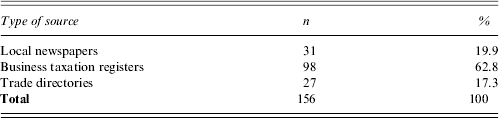
Two further business sources are also consulted: Sweden's trade directories (Sveriges handelskalender) and the business registers of the National Board of Trade (Primäruppgifter till näringsstatistiken). The latter material was collected for tax liability assessment, and annually documented individuals in Sweden who owned a retail business; records covering Sundsvall are examined for the period 1860–1890. Due to the problem of tax evasion, however, it is possible that these registers do not cover every small-business owner.Footnote 22 Sweden's trade directories include men and women in trade or crafts as well as some civil officials. Listing in a trade directory publicly advertised the goods or services a business offered. Trade directories were to be found nationwide and were published approximately every second or third year during the period 1860–1893. As a self-reporting source, however, the directories do not necessarily list every person involved in retailing or handicrafts.Footnote 23 While all three of these sources have limitations, taken together they provide some redress for the under-enumeration of women's trades and crafts inherent in most other historical sources. In our final data, we report the occupation of women at the first (often the only) occasion or year they appear in the local press or business sources during the 1860–1893 period.Footnote 24
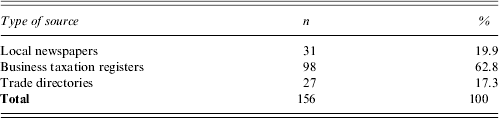
We supplement these sources with the parish registers. These registers are unique in reporting continuous information about the migrations, marriages, families, deaths and births of individuals, and formed the basis for the Swedish census, first taken in 1749. Parish registers provide demographic data about the situation of the women we have identified and their family background. The registers provide information on the occupational status of the fathers of these women, essential for exploring intergenerational career mobility. For the nineteenth century, the Demographic Data Base (DDB) at Umeå University has digitised the parish registers of Sundsvall.Footnote 25 The digitisation includes a transcription of the original records that are linked together for every individual. Using the DDB, it was possible to find many of the women reported in the newspapers and business sources in the digitised parish records. Due to name identification difficulties we have excluded a small number of women from the analysis, but in all 156 (about 85 per cent) of the individual business- and craftswomen identified in the other sources were linked to entries in the town's parish registers (see Table 1).Footnote 26
Number and percentage of the business- and craftswomen under study in Sundsvall 1860–1893 who are documented in the local newspapers, business taxation registers or trade directories and then identified in Sundsvall's parish registers
Sources: Local newspapers 1879, i.e. Sundsvalls-Posten and Sundsvalls Tidning, University Library, Umeå University, Sweden; Business taxation registers, Sundsvall 1860–1890, National Archives (Riksarkivet), Stockholm, Sweden; Trade directories, Sundsvall 1860–1893, University Library, Umeå University, Sweden; Digitised parish registers, Sundsvall, Demographic Data Base, Umeå University, Sweden.
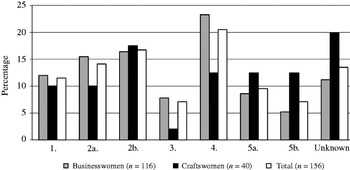
To account for the fact that not all of the women had been born in Sundsvall – some had travelled long distances to start up their business or take up a craft in the parish – a number of other sources are used. The DDB's digitised records report data from the registers of parishes neighbouring Sundsvall, and these are used for the women who originated from nearby areas. To trace the socio-economic background of those born farther afield, further population registers are utilised. These registers include scanned Swedish parish records, the Swedish censuses (folkräkningar), and the civil population registers (rotemansinstitutionen) established in Stockholm in 1878, all accessible digitally.Footnote 27 Using the names and information recorded about these women in the Sundsvall parish registers upon their arrival in Sundsvall (such as their parish and date of birth), it was possible to identify fathers of many of the women and their occupations. In only about 13 per cent of the cases (see Figure 1) were the father's name and data not discovered, either because the woman had been born out of wedlock, or because her father had died or deserted her mother before she was born.
Occupational status of the women's fathers by social group: a comparison between business- and craftswomen (percentages). Key to social group of the women's fathers (see Table 2): 1, large-scale entrepreneurs and higher civil officials; 2a, small-scale entrepreneurs in trade and industry; 2b, farmers, tenant farmers; 3, lower civil officials; 4, skilled labourers, craftsmen and artisans; 5a, unskilled labourers; 5b, farm workers. (Sources: Women's occupational status based on information from local newspapers, business taxation registers and trade directories in Sundsvall (see Table 1). Occupational data on their fathers generated from the digitised parish registers of Sundsvall and the neighbouring parishes, Demographic Data Base, Umeå University, Sweden; Population registers digitised by the Swedish National Archive, Stockholm, Sweden; Roote's Archives (Rotemansarkivet) digitised by Stockholm's Historical Database, Stockholm, Sweden.)

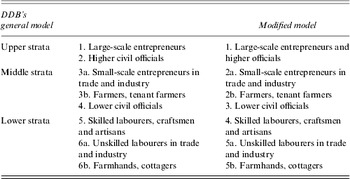
A number of analytical and methodological issues must be considered in studies of social status and intergenerational mobility.Footnote 28 The social status of the 156 women in this study and that of their fathers are based on their occupations as these appear in the sources. The occupations of the 156 women have been coded to permit some descriptive statistics and to define their status as belonging to one of the social groups of small-scale businesswomen or craftswomen, the latter being equivalent to skilled labourers. We use the occupational codes that researchers at the DDB have developed from the parish registers, which correspond to those outlined by the HISCO (Historical International Standard Classification of Occupations) project.Footnote 29 These codes facilitate the construction of three social strata: ‘higher’, ‘middle’ and ‘lower’. In the DDB's scheme the higher strata comprise occupations associated with large-scale entrepreneurs (group 1) and higher civil officials (group 2). However, as there were so few fathers holding these occupational positions in our study population, these two groups are collapsed into one category in our modified model (group 1) (see Table 2). Due to their owning or running of a farm or business, small-scale entrepreneurs or farmers (groups 3a/2a and 3b/2b) in the middle strata are allocated above lower civil officials (group 4/3), whose occupational titles suggest that they did not possess any property of their own. The lower strata distinguish between fathers labelled skilled labourers (group 5/4) and those recognised as unskilled workers employed in trade and industry (group 6a/5a) or who held occupations associated with agriculture (group 6b/5b).
Social classification scheme used in this study, based on a modification of the Demographic Data Base (DDB)'s occupational codes
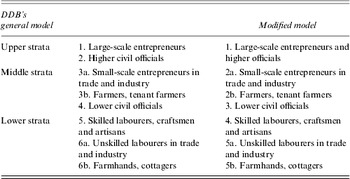
As any categorisation implies generalisation, classifying individuals into social groups has received criticism, particularly in the case of women because their occupations are poorly detailed in historical sources and do not fit neatly into a scheme based on men's work.Footnote 30 In this case, the codes used by the DDB mean that milliners, drapers and innkeepers, for example, are assigned to group 2, small-scale entrepreneurs, whereas seamstresses and hairdressers, for instance, are assigned to group 4, skilled labourers (see Table 2). We may question whether there was really any considerable difference in status between these two occupational groups, especially since our sources show that the 156 women under study were mostly self-employed. A similar issue appears when it comes to intergenerational mobility as this considers differences or similarities in social status between two generations that can result in upward or downward mobility, or stability. Of course, upward mobility can be as little equal to success as downward mobility can be equated with failure.
Our intention is to examine the nature of intergenerational mobility among this particular group of women. The occupational data we use are based on the occupations reported in the first description of a woman in the newspapers and two business sources as either a business- or craftswoman. According to the social classification scheme, this places her in the category of small-scale entrepreneurs or the group of skilled labourers where craftsmen and artisans are found. Her occupational status by social group is compared with that of her father. His occupational status is collected from the above-mentioned parish and population registers, usually at the point when his daughter was born. Of course, fathers might have changed occupation subsequently, but as Sweden's population registers are not interlinked with each other or with the parish records of the Sundsvall region, there are difficulties in tracing the fathers and their occupations over time and space. In the few cases where information about a father was unavailable at the time of his daughter's birth, he was allocated the social rank of the highest status occupation in which he was observed in the population registers.
3. RESULTS: BUSINESS- AND CRAFTSWOMEN IN SUNDSVALL 1860–1893
Sundsvall is a coastal town situated in a parish of the same name, some 400 kilometres north of Stockholm. Free trade and an abundance of natural resources (especially timber, for which there was growing European demand) had stimulated industrial development in the area surrounding Sundsvall during the 1860s and 1870s. Sawmills were established near the town, whose banks and harbour made it the region's urban centre of trade and commerce during the second part of the nineteenth century. Whereas Sundsvall had only about 4,500 inhabitants in 1860, this figure had tripled to 13,500 by 1890.Footnote 31 Based on the area's demographic and economic expansion from the sawmill industry, it was characterised as an ‘America in Sweden’. At the time, few areas in northern Europe had experienced similar growth. The development of the sawmill industry had stimulating knock-on effects on the town's commercial life. This included both the traditional retail trade and new sectors catering for the needs of the growing local bourgeoisie, especially those of women. According to official statistics, between 1865 and 1890 the number of retailers and wholesalers in Sundsvall increased from 90 to 252, 14 per cent of whom were women.Footnote 32 There were also, of course, women whose business activities were never registered, and some of these are discussed below.
3.1 Economic activities and some demographic features of the women
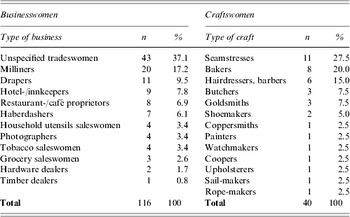
Based on the occupational information provided by the newspapers and two business sources, Table 3 shows the 156 women according to social group and type of occupation at their first appearance in these sources between 1860 and 1893. Small-scale businesswomen dominate Table 3. Unfortunately, in almost 40 per cent of the 114 cases their line of business is not further defined in the sources. Of the 60 per cent of cases where an occupation was specified, a high number were milliners, drapers, restaurateurs, innkeepers and café owners, and a few were haberdashers and photographers.Footnote 33 Among the smaller group of 40 craftswomen, the main occupations were seamstress, hairdresser and baker. Some were involved in handicrafts more usually associated with men, such as goldsmith, butcher or cooper. The reason for this is that these women, as with some of the businesswomen, were married or widowed and were probably working alongside their husbands (or had taken over his job).Footnote 34 The marital status of these women is explored further below, as are some of their other demographic features.
Type of businesses and crafts found among the women under study in Sundsvall 1860–1893a
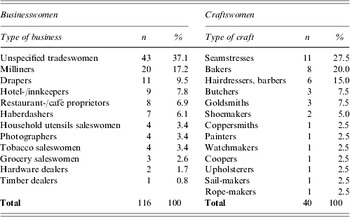
a The type of business or craft for each woman is based on her first appearance in the sources between 1860 and 1893 (see footnote 24). As for the ‘unspecified tradeswomen’, the sources do not detail their line of business, but report them as being ‘handlare’ or ‘handelsidkerska’, which informs us that they were shopkeepers but not of what kind.
Sources: Local newspapers 1879, i.e. Sundsvalls-Posten and Sundsvalls Tidning, University Library, Umeå University, Sweden; Business taxation registers, Sundsvall 1860–1890, National Archives (Riksarkivet), Stockholm, Sweden; Trade directories, Sundsvall 1860–1893, University Library, Umeå University, Sweden; Digitised parish registers, Sundsvall, Demographic Data Base, Umeå University, Sweden.
According to the results shown in Table 3, the women were primarily involved in the retail, fashion, catering and grocery trades, or in crafts. These findings echo research from elsewhere in Europe and in North America, suggesting that women operated within feminised segments of the business sector, in a commercial world also shaped by the ideology of separate spheres.Footnote 35 In Sundsvall, women were welcome to earn money if their business involved an extension of the domestic skills and activities associated with their gender in the private sphere. However by extending these private female roles – by running cafés and restaurants as well as fashion and barber shops – these women stepped out into the public space of the town.
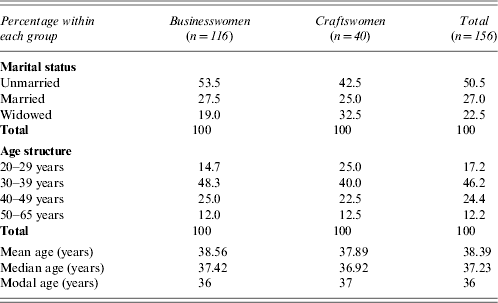
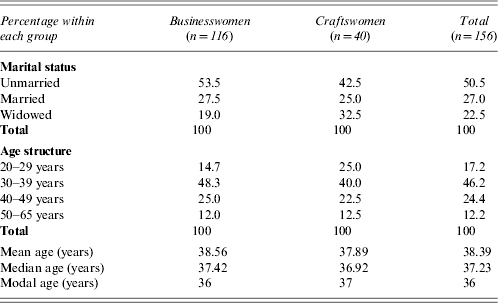
Table 4 shows some demographic information on the 156 women who performed their trades or crafts in Sundsvall. The varied distribution of their age structure indicates that in the latter half of the nineteenth century women could benefit from small business as a source of income throughout their lives.Footnote 36 However, most of them were aged in their 30s and 40s when they were observed in the sources offering goods or services, well beyond the average age of first marriage for women, which was 25.3 years in late nineteenth-century Sundsvall.Footnote 37 Approximately half of the women were unmarried. In comparison with craftswomen, businesswomen were more likely to be unmarried. Among businesswomen, widows also constituted the smallest group. The absence of a breadwinner husband coupled with mature age suggests that a majority of the women ran their retail business or workshop to earn their own living. However, Table 4 shows that about one woman in four combined her occupation with being married. Married women's work is poorly documented in historical sources. This study recognises at least 42 married women who were involved in a trade or craft in Sundsvall at some point between 1860 and 1893. The next section discusses the liberalisation of the legal context in Sweden that encouraged women's business, married or not.
Demographic information (marital status and age structure) of the women as they run their business or craft in Sundsvall 1860–1893
Sources: Local newspapers 1879, i.e. Sundsvalls-Posten and Sundsvalls Tidning, University Library, Umeå University, Sweden; Business taxation registers, Sundsvall 1860–1890, National Archives (Riksarkivet), Stockholm, Sweden; Trade directories, Sundsvall 1860–1893, University Library, Umeå University, Sweden; Digitised parish registers, Sundsvall, Demographic Data Base, Umeå University, Sweden.
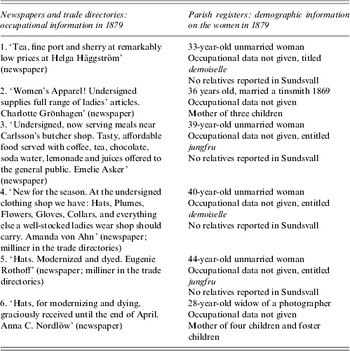
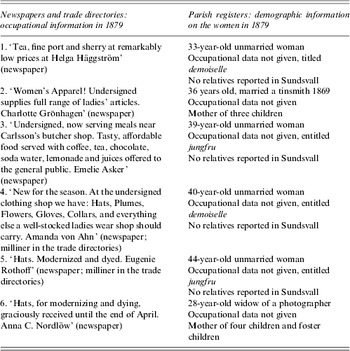
To examine some individual cases, Table 5 highlights six particular women. The table combines and compares the occupational information that the local newspapers and trade directories provided on these women in 1879 with demographic data from Sundsvall's parish registers for the same year. According to these registers, Helga Häggström (case 1) was a 33-year-old demoiselle (see jungfru below) and Charlotte Grönhagen (case 2) was a 35-year-old wife married to a tinsmith. Whereas there is no evidence of their businesses in the parish registers, the local newspapers from 1879 tell us that Helga Häggström was involved in the catering or grocery trade, as she advertised that she offered tea and alcoholic drinks at low prices. The same year, Charlotte Grönhagen advertised that she supplied ladies' articles. She was also married to a tinsmith and was mother to three small children. One of the milliners in Table 5, Amanda von Ahn (case 4), appears as a ‘non-working’ demoiselle in the parish registers of the town, as do Emelie Asker (case 3) and Eugenie Rothoff (case 5), who were entitled jungfru. Such titles imply that a woman was a daughter of a man in the middle social strata or above. Whether or not this was true will become evident below.
Some occupational and demographic information on six business- and craftswomen in Sundsvall in the year of 1879
Sources: Local newspapers 1879, University Library, Umeå University, Sweden; Trade directories, Sundsvall 1879–1880, National Archives (Riksarkivet), Stockholm, Sweden; Digitised parish registers, Sundsvall, Demographic Data Base, Umeå University, Sweden.
3.2 Intergenerational social mobility among the women
This section examines whether the 156 women experienced a change in social standing in comparison with their status at birth, here represented by their fathers' occupational position. As was discussed in the Introduction, the transition towards urban–industrial society may have opened up greater possibilities for people to improve their status through work as they experienced more diverse labour markets and became less influenced by the occupational position of their fathers. Concurrently with economic modernisation and the urban–industrial transformations in Sweden, legal reforms reduced the barriers that had prevented women from engaging in small-scale businesses and handicrafts. In 1845, daughters were granted an equal inheritance share of their parents' estate. One year later, the guild system was abolished, which meant that anyone could open a workshop and call him- or herself an artisan. In 1864, the government introduced freedom of trade, and women were formally granted the same rights as men to conduct a business when they reached the age of majority. In 1863, this was at the age of 25 years for women, but, in 1884, this was lowered to age 21 years, equal to men. As long as a woman remained unmarried, she had the right to dispose of her property and income as she saw fit, and from 1874, legislation allowed even married women to control their own earnings.Footnote 38 Historians have argued that such reforms were primarily introduced to deal with the increasing ratio of permanent female celibacy in the populations of Western Europe.Footnote 39 Similarly, studies from Sweden contend that the Swedish government introduced liberal legal reforms of female commercial life because neither the state nor their male relatives were willing to pay for single women's subsistence.Footnote 40
Figure 1 details the occupational status of the fathers of the 156 women by social group. The business- and craftswomen originated from social backgrounds ranging across the social hierarchy, indicating that intergenerational social mobility was attainable for them. For example, only about 15 per cent of the businesswomen had a father recognised as a small-scale entrepreneur, whereas 12 per cent of the craftswomen were daughters of men labelled craftsmen or skilled labourers. Through their trades and crafts, the majority of the women had thus left the occupational group into which they had been born. Almost a quarter of the businesswomen had a father who was labelled a skilled labourer. For instance, Helga Häggström (case 1, Table 5), who sold fine port and sherry, was the daughter of a pastry baker (sockerbagare), whereas Emelie Asker (case 3, Table 5), who served affordable drinks and meals near Carlsson's butcher shop, had a father who was a shoemaker. Figure 1 further shows that about 17 per cent of the businesswomen were daughters of farmers. Another 12 per cent of the tradeswomen had fathers recognised as large-scale entrepreneurs or civil officials of both high and low rank. The fathers of two of the milliners, Amanda von Ahn and Eugenie Rothoff (cases 4 and 5, Table 5), are found among the latter, as they were labelled ship pilot (lots) and government official (kanslipostmästare), respectively.
Figure 1 shows that more than 10 per cent of the tradeswomen originated from the two social categories comprising fathers classified as unskilled labourers or farm workers. The milliner, Anna C. Nordlöw (case 6, Table 5), the widow of a photographer, was one of them. Albertina Edstedt exemplifies another such woman: in 1868, she was born in a neighbouring parish of Sundsvall where her father was a crofter (torpare). According to the business taxation registers in 1890, Albertina had used her culinary skills to become the owner of a café in Sundsvall. A number of other women shared her experience of achieving what was considered a higher social standing than that of their fathers.
The craftswomen show a slightly different pattern in Figure 1. Except for those women whose father fell into the ‘unknown’ occupation category (which might comprise women of poor origins), the largest number of craftswomen (17.5 per cent) were daughters of farmers or tenant farmers. As for the other social groups, their distribution is quite evenly spread between small-scale entrepreneurs, skilled or unskilled labourers, and agricultural workers.
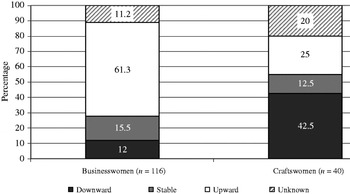
Figure 2 displays the direction of the women's intergenerational social mobility to a greater extent than Figure 1, as it compares the occupational status of the business- and craftswomen with that of their fathers by considering movements by social group. These movements could take either an upward or a downward direction, and cases in which the occupation of the father is unknown are treated separately. The findings presented in Figure 2 suggest that more than 60 per cent of the tradeswomen experienced upward mobility, i.e. they had moved up the social ladder compared with the occupational position of their fathers. This was true for only 25 per cent of the craftswomen, who had more often experienced downward mobility. Given the social classification scheme, which places them below their sisters in business, this result is not surprising. Inevitably, the daughters of men labelled small-scale entrepreneurs or lower civil officials in Figure 1, for example, would experience downward mobility if they took up handicrafts. This happened to 17 women, slightly more than 40 per cent of the craftswomen according to Figure 2. Of the businesswomen, 14 (12 per cent) moved downwards by having attained a lower occupational position than that of their fathers. Overall, the proportion of the women we know to have experienced downward intergenerational mobility was thus relatively low, about 20 per cent.
Direction of the women's intergenerational mobility based on the social group of their fathers: a comparison between business- and craftswomen (percentages). (Sources: Women's occupational status based on information from local newspapers, business taxation registers and trade directories in Sundsvall (see Table 1). Occupational data on their fathers generated from the digitised parish registers of Sundsvall and the neighbouring parishes, Demographic Data Base, Umeå University, Sweden; Population registers digitised by the Swedish National Archive, Stockholm, Sweden; Roote's Archives (Rotemansarkivet) digitised by Stockholm's Historical Database, Stockholm, Sweden.)

Due to the occupational expectations associated with their gender, women could rarely take up the same employment or run the same line of business or craft as their fathers did, or attain his status through their own work efforts. However, a woman's business aspirations could benefit from her father's occupation if he had skills in making money from trade and handicraft, and knew how to attract customers. These types of fathers are found among the women in our study, but most of their daughters made their own way into small business. Even though farmers and men employed as higher and lower officials did not represent the same cultural and commercial capital as businessmen did, for example, their occupational status suggests that there was a chance that their daughters inherited money from them or attained education that facilitated their economic activities. There might also be another reason why daughters of lower-middle-class men became involved in trade and craft. It is possible that some of these men could not afford to keep their female relatives outside gainful employment.Footnote 41 To escape being an economic burden, the women had little choice but to find a means of earning their own living.
Even accounting for these factors, the high degree of intergenerational career mobility found among the Sundsvall women is slightly surprising. A great many of them engaged in business without being daughters of wealthier or middle-class men: about 35 per cent of the businesswomen had fathers labelled skilled labourers or below (Figure 1). These women might have benefitted from the opportunities created by the economic development of Sundsvall in the second half of the nineteenth century. It is difficult, however, to assess the speed of their social rise, due to the difficulty in determining their working career years from the sources.Footnote 42 Their involvement in business might have occupied only a short period of their lives. Yet even if their business careers were short, this study has uncovered a large number of women who found their own way into the commercial sector, challenging not only the gendered expectations they faced, but also their socio-economic origin by experiencing primarily upward intergenerational social mobility. This finding is difficult to interpret due to the many issues discussed above, but it is nonetheless important.
4. CONCLUDING REMARKS
By making use of an unusual and varied combination of sources, this study examines the economic activities and intergenerational social mobility of late nineteenth-century women in a deeper way than most of the existing literature on the history of female social mobility. Analysis of the occupational status of the fathers of 156 working women suggests that only about 15 per cent of businesswomen and 12 per cent of craftswomen were daughters of a business- or craftsman and therefore did not experience any intergenerational career mobility. In fact, the most striking finding was that most of the women moved up from the occupational status of their birth, with more than 60 per cent found to be daughters of fathers in lower social positions than the one they themselves held through their business. This evidence of women's high and mostly upward social mobility is challenging for two reasons: first, because their business achievements cannot be explained by socio-economic, occupational or cultural capital through having access to a father doing business himself; second, because recent mobility research questions the ‘logic of industrialism’ thesis and contends that social stability characterised late nineteenth-century economic development. The information on high female social mobility in this analysis is revealed by the use of sources that capture female work beyond that reported in population and parish registers, which form the most common data source for studies of social mobility. Women took up work that these registers never acknowledge, and, as a result, studies of mobility in past societies have been very limited in what they can say about the actual occupations and social mobility of women.
That this study is different from most of the existing literature in sources and findings makes the outcome somewhat difficult to assess from a comparative research perspective. Furthermore, that the study is restricted to just 156 cases which only show the intergenerational mobility associated with women labelled business- or craftswomen further jeopardises generalisation. Despite these limitations, the research reported here may serve as a baseline against which to assess future findings on women's social mobility, as well as that of men. It also illustrates how increasing access to digitised data and records online assists scholars seeking to investigate women's experiences in history by combining historical sources.
We conclude from our study that the high level of social mobility associated with the ‘logic of industrialism’ thesis held true for the businesswomen we study in Sundsvall. Even though the women may have turned to trade or work in crafts in order to escape poor economic circumstances, it appears that the businesswomen in particular benefitted from the contemporary opportunities of Sundsvall, not from being the daughters of fathers occupied in business. While it is true that the kinds of trades and crafts in which these participated suggest that the ideology of ‘the separate spheres’ still persisted, as milliners, barbers, drapers, haberdashers, restaurateurs, café owners and photographers, the women became increasingly visible in the commercial life and public sphere of Sundsvall. Although we cannot conclusively determine if the structural openness of society facilitated the careers and social advancement of these women, their public presence and their evident change in social mobility – and indeed possibly their empowerment – must be emphasised. A possible way of assessing this ‘openness’ and the impact of socio-economic origin on women's occupational opportunities would be to examine the intergenerational mobility of the brothers of the women analysed in this study. Such sibling comparisons would test the thesis that women in particular experience great social mobility during times of major social change. Future research to take this issue further will need to incorporate multiple sources that provide information about the work and lives of women as well as their family and social backgrounds, and will need to develop approaches that allow adequate comparison between male and female social mobility. The issue of social mobility will, no doubt, continue to interest and challenge scholars for many decades.
ACKNOWLEDGEMENTS
The authors particularly wish to express their gratitude to the Swedish Research Council for having recognised their affiliation (the Centre for Population Studies, Umeå University, Sweden) as a ‘strong research environment’. The council's funding for this recognition has helped to finance the authors' research. An earlier version of this paper was presented at a career session at the 2010 European Social Science History (ESSH) conference in Ghent, Belgium, where Richard L. Zijdeman acted as discussant. We are most grateful for his and the other panel participants' comments and for the useful suggestions made by the three anonymous reviewers. We also thank our colleagues at the Centre for Population Studies and Demographic Data Base, Umeå University, Sweden, for providing us with constructive criticism during seminars and for being so helpful in preparing the data files.