Introduction
Increasing body of evidence suggests a role of the immune system in psychosis (Goldsmith et al., Reference Goldsmith, Rapaport and Miller2016). To date, it remains unclear whether the immune activation present at the onset of psychosis is mainly to be ascribed to genetic predisposition or to the exposure to environmental factors, such as childhood maltreatment, which is well-known to be associated with both onset of psychosis and inflammatory abnormalities (Baumeister et al., Reference Baumeister, Akhtar, Ciufolini, Pariante and Mondelli2015; McGrath et al., Reference McGrath, McLaughlin, Saha, Aguilar-Gaxiola, Al-Hamzawi, Alonso, Bruffaerts, De Girolamo, De Jonge, Esan, Florescu, Gureje, Haro, Hu, Karam, Kovess-Masfety, Lee, Lepine, Lim, Medina-Mora, Mneimneh, Pennell, Piazza, Posada-Villa, Sampson, Viana, Xavier, Bromet, Kendler and Kessler2017).
Increased inflammation in psychosis has been supported by a number of meta-analyses demonstrating enhanced levels of cytokines and cytokines receptors in chronic schizophrenia, as well as in drug-naïve patients in their first episode of psychosis (FEP) (Goldsmith et al., Reference Goldsmith, Rapaport and Miller2016; Pillinger et al., Reference Pillinger, Osimo, Brugger, Mondelli, McCutcheon and Howes2018). Supporting the contribution of genetic predisposition, genome-wide association studies (GWAS) suggest an association between schizophrenia and the major histocompatibility complex on chromosome 6p22.1, which is strictly linked to the immune system (Ripke et al., Reference Ripke, Neale, Corvin, Walters, Farh, Holmans, Lee, Bulik-Sullivan, Collier, Huang, Pers, Agartz, Agerbo, Albus, Alexander, Amin, Bacanu, Begemann, Belliveau, Bene, Bergen, Bevilacqua, Bigdeli, Black, Bruggeman, Buccola, Buckner, Byerley, Cahn, Cai, Campion, Cantor, Carr, Carrera, Catts, Chambert, Chan, Chen, Chen, Cheng, Cheung, Chong, Cloninger, Cohen, Cohen, Cormican, Craddock, Crowley, Curtis, Davidson, Davis, Degenhardt, Del Favero, Demontis, Dikeos, Dinan, Djurovic, Donohoe, Drapeau, Duan, Dudbridge, Durmishi, Eichhammer, Eriksson, Escott-Price, Essioux, Fanous, Farrell, Frank, Franke, Freedman, Freimer, Friedl, Friedman, Fromer, Genovese, Georgieva, Giegling, Giusti-Rodríguez, Godard, Goldstein, Golimbet, Gopal, Gratten, de Haan, Hammer, Hamshere, Hansen, Hansen, Haroutunian, Hartmann, Henskens, Herms, Hirschhorn, Hoffmann, Hofman, Hollegaard, Hougaard, Ikeda, Joa, Julià, Kahn, Kalaydjieva, Karachanak-Yankova, Karjalainen, Kavanagh, Keller, Kennedy, Khrunin, Kim, Klovins, Knowles, Konte, Kucinskas, Ausrele Kucinskiene, Kuzelova-Ptackova, Kähler, Laurent, Keong, Lee, Legge, Lerer, Li, Li, Liang, Lieberman, Limborska, Loughland, Lubinski, Lönnqvist, Macek, Magnusson, Maher, Maier, Mallet, Marsal, Mattheisen, Mattingsdal, McCarley, McDonald, McIntosh, Meier, Meijer, Melegh, Melle, Mesholam-Gately, Metspalu, Michie, Milani, Milanova, Mokrab, Morris, Mors, Murphy, Murray, Myin-Germeys, Müller-Myhsok, Nelis, Nenadic, Nertney, Nestadt, Nicodemus, Nikitina-Zake, Nisenbaum, Nordin, O'Callaghan, O'Dushlaine, O'Neill, Oh, Olincy, Olsen, Van Os, Pantelis, Papadimitriou, Papiol, Parkhomenko, Pato, Paunio, Pejovic-Milovancevic, Perkins, Pietiläinen, Pimm, Pocklington, Powell, Price, Pulver, Purcell, Quested, Rasmussen, Reichenberg, Reimers, Richards, Roffman, Roussos, Ruderfer, Salomaa, Sanders, Schall, Schubert, Schulze, Schwab, Scolnick, Scott, Seidman, Shi, Sigurdsson, Silagadze, Silverman, Sim, Slominsky, Smoller, So, Spencer, Stahl, Stefansson, Steinberg, Stogmann, Straub, Strengman, Strohmaier, Stroup, Subramaniam, Suvisaari, Svrakic, Szatkiewicz, Söderman, Thirumalai, Toncheva, Tosato, Veijola, Waddington, Walsh, Wang, Wang, Webb, Weiser, Wildenauer, Williams, Williams, Witt, Wolen, Wong, Wormley, Xi, Zai, Zheng, Zimprich, Wray, Stefansson, Visscher, Adolfsson, Andreassen, Blackwood, Bramon, Buxbaum, Børglum, Cichon, Darvasi, Domenici, Ehrenreich, Esko, Gejman, Gill, Gurling, Hultman, Iwata, Jablensky, Jönsson, Kendler, Kirov, Knight, Lencz, Levinson, Li, Liu, Malhotra, McCarroll, McQuillin, Moran, Mortensen, Mowry, Nöthen, Ophoff, Owen, Palotie, Pato, Petryshen, Posthuma, Rietschel, Riley, Rujescu, Sham, Sklar, St Clair, Weinberger, Wendland, Werge, Daly, Sullivan and O'Donovan2014).
However, genetic predisposition may not be the only factor playing a role in immune dysregulation. There is now robust cross-national epidemiological evidence that childhood maltreatment increases the risk of psychotic experiences across the life span in more than two-fold and in a dose-response fashion, with the highest association attributed for sexual and physical abuse (McGrath et al., Reference McGrath, McLaughlin, Saha, Aguilar-Gaxiola, Al-Hamzawi, Alonso, Bruffaerts, De Girolamo, De Jonge, Esan, Florescu, Gureje, Haro, Hu, Karam, Kovess-Masfety, Lee, Lepine, Lim, Medina-Mora, Mneimneh, Pennell, Piazza, Posada-Villa, Sampson, Viana, Xavier, Bromet, Kendler and Kessler2017). Furthermore, patients with psychosis are almost three times more likely to have been exposed to childhood maltreatment, and the prevention of traumatic experiences could reduce the incidence of psychosis by 33% (Varese et al., Reference Varese, Smeets, Drukker, Lieverse, Lataster, Viechtbauer, Read, Van Os and Bentall2012). Interestingly, one of the possible biological mechanisms underlying the association between childhood maltreatment and psychosis is the trigger of an immune dysfunction characterised by abnormal production of inflammatory cytokines (in particular IL-6 and TNF-α) (Coelho et al., Reference Coelho, Viola, Walss-Bass, Brietzke and Grassi-Oliveira2014; Baumeister et al., Reference Baumeister, Akhtar, Ciufolini, Pariante and Mondelli2015). Studies suggest that not all the types of trauma may affect the immune system in the same way and that physical and sexual abuse is associated with the strongest effects (Baumeister et al., Reference Baumeister, Akhtar, Ciufolini, Pariante and Mondelli2015).
Few studies have attempted to investigate whether augmented inflammation in psychosis could be attributed to childhood maltreatment, and the current evidence is limited and conflicting. Earlier studies reporting increased IL-6 (Dennison et al., Reference Dennison, McKernan, Cryan and Dinan2012) and TNF-α (Dennison et al., Reference Dennison, McKernan, Cryan and Dinan2012; Di Nicola et al., Reference Di Nicola, Cattaneo, Hepgul, Di Forti, Aitchison, Janiri, Murray, Dazzan, Pariante and Mondelli2013) in patients with psychosis exposed to childhood maltreatment were limited by sample sizes (n < 50) and lacked control for confounders.
Subsequent studies conducted in larger samples of patients with diagnoses of chronic schizophrenia/bipolar disorder reported associations between C-reactive protein and childhood abuse severity (combined as effects of sexual, emotional and physical abuse) (Aas et al., Reference Aas, Dieset, Hope, Hoseth, Mørch, Reponen, Steen, Laskemoen, Ueland, Aukrust, Agartz, Andreassen and Melle2017) or sexual abuse only (Quidé et al., Reference Quidé, Bortolasci, Spolding, Kidnapillai, Watkeys, Cohen-Woods, Berk, Carr, Walder and Green2018), but the significant associations disappeared when controlling for body mass index (BMI) (Aas et al., Reference Aas, Dieset, Hope, Hoseth, Mørch, Reponen, Steen, Laskemoen, Ueland, Aukrust, Agartz, Andreassen and Melle2017). An important limitation of these studies is the sample, composed by patients suffering from chronic schizophrenia, in whom the inflammatory markers could have been largely affected by the effects of chronic antipsychotic treatment on metabolic parameters or BMI (Baumeister et al., Reference Baumeister, Ciufolini and Mondelli2016; Calevro et al., Reference Calevro, Cotel, Natesan, Modo, Vernon and Mondelli2018).
In the present study, we investigated the association between childhood maltreatment and inflammation in psychosis in an epidemiological sample of FEP patients recruited in Brazil, where the estimates of childhood maltreatment can reach figures over 40% in the southeast part of the country (Rates et al., Reference Rates, Melo, de Mascarenhas and Malta2015), and government's budget for childhood maltreatment prevention has been considered inadequate (ISPCAN, 2014).
We used a number of strategies to overcome the methodological limitations identified previously. First, we studied FEP patients in order to reduce possible confounding related to illness duration, weight gain and long exposure to pharmacological treatment. Second, we included community-based controls to reduce risk of selection bias. Third, we investigated the different subtypes of childhood maltreatment, which were before considered as one phenomenon. Fourth, we controlled for a broad range of confounders (age, gender, BMI, tobacco smoking, psychoactive substance use, pharmacological treatment, years of study and relationship status) that were not taken into account in previous investigations. Fifth, we included unaffected siblings of FEP patients in order to investigate the possible role of familial liability to immune activation. The inclusion of high-risk groups provides the advantage of controlling for possible effects of shared environmental and genetic risks in the context of inflammatory dysregulation that has not been explored elsewhere. Sixth, we considered a comprehensive innate and adaptive immune-related profile, representing activation of the inflammatory response system (monocyte (M) type-1: IL-1β, TNF-α, IL-6; T helper 1: IFN-γ) and the compensatory system (M-2: IL-10; T helper 2: IL-4; and T regulatory: IL-10, TGF-β).
We aimed to: (i) investigate plasma cytokine levels among patients, siblings, and community-based controls, controlling for a set of confounders; and (ii) investigate the role of childhood maltreatment and recent stress in determining the differences in cytokine levels shown among the above groups, controlling for confounders. We inferred that: (i) FEP patients would have increased levels of inflammatory cytokines when compared with controls, and unaffected siblings would represent an intermediate group; (ii) reports of traumatic events would be associated with increased levels of inflammatory markers in all groups; and (iii) the subtypes of childhood maltreatment would impact differently on the levels of the inflammatory markers.
A better understanding of the low-grade inflammatory profile and its association with environmental stressors can improve risk stratification in groups with illness as well as in high- and average-vulnerability groups, in order to improve the effectiveness of interventions.
Methods
This case-sibling-control study is part of the epidemiological investigation named STREAM (Schizophrenia and Other Psychoses Translational Research: Environment and Molecular Biology) conducted in Ribeirão Preto catchment area (comprised of 26 counties with around 1.3 million inhabitants, located in the São Paulo state, Brazil) between April 2012 and March 2015 (Del-Ben et. al., Reference Del-Ben, Shuhama, Loureiro, Ragazzi, Zanatta, Tenan, Santos, Louzada-Junior, Santos, Morgan and Menezesaccepted). The STREAM study is part of the international multicentre consortium EU-GEI (European Network of National Schizophrenia Networks Studying Gene-Environment Interactions; http://www.eu-gei.eu/), an incidence and case-sibling-control study investigating biological and environmental interactions in psychosis (Jongsma et al., Reference Jongsma, Gayer-Anderson, Lasalvia, Quattrone, Mulè, Szöke, Selten, Turner, Arango, Tarricone, Berardi, Tortelli, Llorca, de Haan, Bobes, Bernardo, Sanjuán, Santos, Arrojo, Del-Ben, Menezes, Velthorst, Murray, Rutten, Jones, van Os, Morgan and Kirkbride2018).
Participants
As previously described (Loureiro et al., Reference Loureiro, Shuhama, Fachim, Menezes, Del-Ben and Louzada-Junior2018), we recruited patients in their first contact with mental health services due to psychotic symptoms during the study period. Any patients with psychotic symptoms originated from other medical condition or substance intoxication/withdrawal were excluded.
Siblings were invited to participate in the study considering patients' agreement and the absence of lifetime history of psychotic symptoms.
Community-based controls were recruited considering the demographic characteristics of the Ribeirão Preto catchment area stratified by age and gender, according to the Brazilian Official Census Bureau 2010 (Instituto Brasileiro de Geografia e Estatística, IBGE, www.ibge.gov.br). Controls with lifetime history of psychotic symptoms were not included.
All the participants aged between 16–64 years old and were living in the Ribeirão Preto catchment area. This study was approved by the local research ethics committee.
Initially, we recruited 507 participants with blood collection (166 FEP, 76 siblings, 265 community-based controls). From these, we excluded 17 participants (eight patients, one sibling and eight controls) presenting with any of the following: nephropathy, urinary tract infection, dengue fever, rheumatic fever, human immunodeficiency virus, syphilis, Crohn's disease, throat infection, pregnancy, corticosteroid treatment, multiple sclerosis, pneumonia, and hidradenitis suppurative. BMI data were missing in 42 patients, 18 siblings, and six controls, and two patients did not answer the childhood trauma questionnaire completely, and therefore were also excluded from the study.
Clinical assessment
Clinical assessment was conducted by trained researchers (psychologists and nurses with experience in mental health) and during all the study period weekly meetings were held with the senior staff (one psychiatric nurse, two psychologists and three senior psychiatrists).
Diagnosis was obtained for all participants using the Structured Clinical Interview for DSM-IV, clinical version (SCID-CV) (First et al., Reference First, Spitzer, Gibbon and Williams1997; Del-Ben et al., Reference Del-Ben, Vilela, de Crippa, Hallak, Labate and Zuardi2001). We used the Brief Psychiatric Rating Scale (BPRS) for the clinical assessment of symptom severity at the moment of blood collection (Overall and Gorham, Reference Overall and Gorham1962; Crippa et al., Reference Crippa, Sanches, Hallak, Loureiro and Zuardi2001), and the Nottingham Onset Schedule (Singh et al., Reference Singh, Cooper, Fisher, Tarrant, Lloyd, Banjo, Corfe and Jones2005) to register psychosis onset date and the pharmacological treatment starting date. History of lifetime and/or current psychoactive substance use (cannabis, alcohol, cocaine/crack, inhalants, sedatives, amphetamine and hallucinogens) was assessed by The Cannabis Experience Questionnaire-Modified Version (CEQmv) (Di Forti et al., Reference Di Forti, Morgan, Dazzan, Pariante, Mondelli, Marques, Handley, Luzi, Russo, Paparelli, Butt, Stilo, Wiffen, Powell and Murray2009).
Stress measurements
We used the Childhood Trauma Questionnaire (CTQ) (Bernstein et al., Reference Bernstein, Stein, Newcomb, Walker, Pogge, Ahluvalia, Stokes, Handelsman, Medrano, Desmond and Zule2003; Grassi-Oliveira et al., Reference Grassi-Oliveira, Stein and Pezzi2006) to assess the history of childhood maltreatment. The CTQ short form is a self-report questionnaire consisting of 25 items rated on a 5-point Likert scale (1 = never true; 5 = very often true) ranging from 5 to 25 points in order to assess the exposure to emotional, physical and sexual abuse, and physical and emotional neglect. The sum of values of the five scales generates the CTQ total score, which ranges from 25 to 125 points. In addition, four cut-off scores are provided for each scale: none to low; low to moderate; moderate to severe and severe to extreme. We used a pre-defined cut-off score based on the moderate to severe threshold (⩾13 for emotional abuse; ⩾10 for physical abuse; ⩾8 for sexual abuse; ⩾15 for emotional neglect; and ⩾10 for physical neglect) to classify participants in the maltreated (moderate to severe; severe to extreme) or non-maltreated (none to low; low to moderate) groups (Bernstein et al., Reference Bernstein, Stein, Newcomb, Walker, Pogge, Ahluvalia, Stokes, Handelsman, Medrano, Desmond and Zule2003).
The occurrence of adverse life events over the past 12 months was assessed by a questionnaire proposed by the EU-GEI, which was based on the List of Threatening Experiences (Brugha et al., Reference Brugha, Bebbington, Tennant and Hurry1985). The translation and adaptation of this questionnaire to Portuguese was performed by the STREAM research team, and the final version was submitted for backtranslation by a bilingual researcher associated with the EU-GEI. The proposed questionnaire comprises 21 questions assessing the occurrence of the following adverse events: personal problems; relational problems; work related and financial problems; severe events in family or friends; problems with law. Participants reporting any of these were classified as having experienced recent stress.
Cytokines measurement
Peripheral blood was collected after the diagnosis evaluation and the samples were processed as previously described (Loureiro et al., Reference Loureiro, Shuhama, Fachim, Menezes, Del-Ben and Louzada-Junior2018). Cytokines (IL-1β, IL-6, TNF-α, IFN-γ, IL-4, IL-10 and TGF-β) were quantified in plasma (25 µL) using the Milliplex MAP Human Cytokine/Chemokine magnetic bead panel (#HCYTOMAG-60K; #HTH17MAG-14K; #TGFBMAG-64K-01 EDM Millipore, Billerica, MA, USA; https://www.emdmillipore.com/US/en). The assay was performed in 96-well plates according to the manufacturer's instructions and the results were expressed in pg/mL. Briefly, each assay plate layout consisted of seven standards, two positive controls, two blank wells, all run in duplicate, and up to 76 samples. Results were analysed on a Luminex-200 System (Luminex, Austin, TX, USA) and reported on xPOTENT software version 3.1. Cytokines concentrations were calculated through the five-parameter logistic curve-fitting method using the median fluorescence intensity (MFI). All data were corrected using Milliplex Analyst software.
Statistical analysis
Data were analysed using SPSS version 24.0 (IBM Corp: Armonk, NY, USA). Demographic and clinical data were analysed using descriptive statistics. Statistical associations between categorical variables were analysed by Pearson's χ2 tests with column proportions compared by the z-test (adjusted p values with Bonferroni method), and for continuous variables by analysis of variance with Bonferroni correction.
Plasma cytokines were logarithmically transformed for the statistical analyses, while the raw values are provided (adjusted means ± s.e.m.). To test the overall difference among the groups on the cytokine levels, we used general linear model (GLM) with Bonferroni corrections, adjusted for age, gender, BMI, tobacco smoking, years of study, relationship status and psychoactive substance use. The effects of childhood maltreatment or recent stress were also analysed by GLM to test for the between-group interaction and the within-group differences, controlling for the same confounders. When results were significant, recent stress or childhood maltreatment were also entered as possible confounders. In the patient group, we also explored whether associations could have been influenced by pharmacological treatment, and significant associations between cytokines and childhood maltreatment were also further explored by taking into account the trauma severity. Statistical significance was set at α < 0.05 (two-tailed).
Results
Sample characteristics
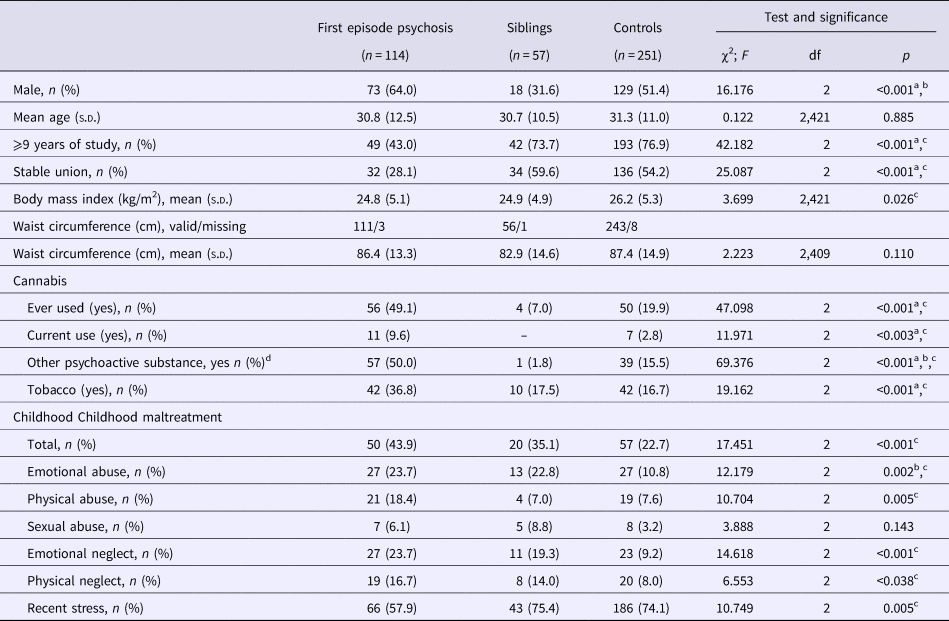
The final sample was comprised of 114 FEP patients, 57 siblings and 251 controls (n = 422) (Table 1). The groups did not significantly differ for age (p > 0.05), but differed for gender; in particular, siblings had a higher proportion of females when compared with FEP or controls (p < 0.001). Patients had lower BMI than controls (p = 0.026) but presented the highest frequency of cannabis (49.1%), tobacco (36.8%) and other psychoactive substances use (50.0%), whereas siblings presented the lowest frequency, with significant differences among the groups (p < 0.001).
Socio-demographic characteristics of the sample (n = 422)

Post-hoc analysis significance is reported as follows:
a First-episode psychosis v. siblings.
b Siblings v. controls.
c First-episode psychosis v. controls.
d Other psychoactive substance including the following: alcohol, cocaine/crack, inhalants, sedatives, amphetamine, and hallucinogens.
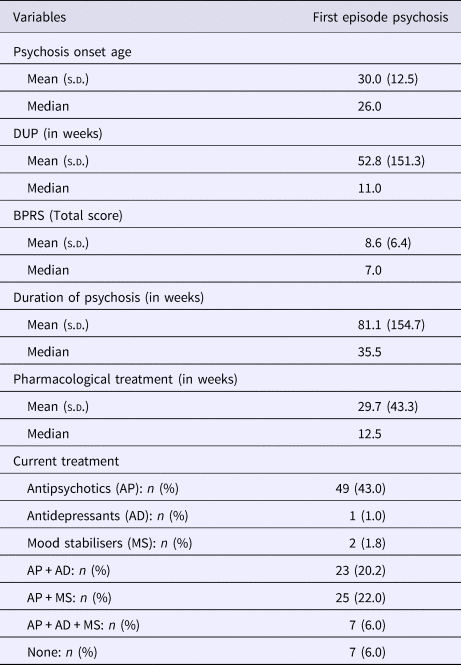
Clinical characteristics of the patients are presented in Table 2. Half of the patients were under pharmacological treatment for less than 12.5 weeks.
Clinical characteristics of the FEP sample (n = 114)

FEP, first-episode psychosis; DUP, Duration of untreated psychosis; BPRS, Brief Psychiatric Rating Scale.
Stress measurements
The groups differed in the proportion of experience of childhood maltreatment (p < 0.001), with patients having the highest proportion (43.9%), followed by their unaffected siblings (35.1%), and controls (22.7%). This pattern was observed for all the subtypes of childhood maltreatment, except for sexual abuse (Table 1).
Controls had a significantly higher frequency of recent stress than patients (p = 0.005) (Table 1).
Cytokine levels in FEP patients, siblings and community-based controls
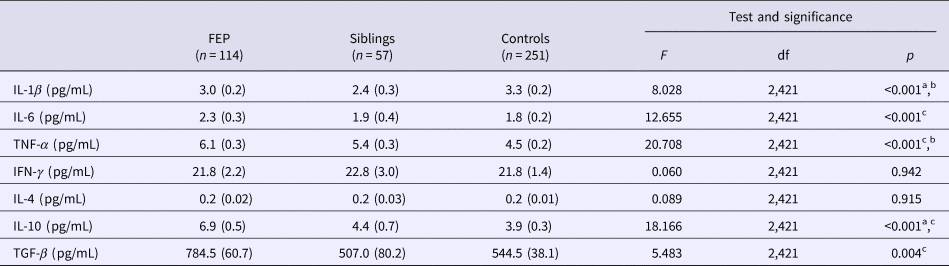
Table 3 shows the results of the plasma cytokines among the groups controlling for age, gender, BMI, tobacco smoking, psychoactive substance use, years of study and relationship status. We found differences among the groups in plasma concentrations of IL-1β, IL-6, TNF-α, IL-10 (p < 0.001) and TGF-β (p = 0.004), but not IFN-γ (p = 0.942) or IL-4 (p = 0.915). FEP had significantly higher levels of IL-6, TNF-α, IL-10 (p < 0.001) and TGF-β (p = 0.003) when compared with controls. Patients also had higher levels of IL-1β (p = 0.011) and IL-10 (p = 0.014) when compared with their siblings. Siblings (p = 0.006) and patients (p < 0.001) had higher levels of TNF-α when compared with controls but siblings presented decreased IL-1β when compared with controls (p < 0.001).
Cytokines plasma levels in FEP, unaffected siblings and community-based controls

FEP, First-episode psychosis.
GLM analysis with Bonferroni corrections, adjusted for age, gender, BMI, tobacco smoking, years of study, relationship status, and psychoactive substance use. Cytokines levels are presented as raw values (adjusted mean ± s.e.m.) with statistics performed on the logarithmically transformed values. Post-hoc analysis significance is reported as follows:
a First-episode psychosis v. siblings.
b Siblings v. controls.
c First-episode psychosis v. controls.
Cytokines and history of childhood maltreatment
Cytokines found to be different among the groups (IL-1β, IL-6, TNF-α, IL-10, TGF-β) were further tested to investigate the between-group interaction with history of childhood maltreatment (global and subtypes) and the within-group differences, adjusted for age, gender, BMI, tobacco smoking, psychoactive substance use, years of study and relationship status. Significant results were found for TGF-β only (Figs 1 and 2).
TGF-β plasma levels in first-episode psychosis patients (n = 114), siblings (n = 57) and community-based controls (n = 251) with and without childhood maltreatment. Plasma cytokines were logarithmically transformed and data are expressed as mean ± s.e.m. and given as pg/mL. *p < 0.05 represents results for the GLM between-group interaction analysis adjusted for age, gender, BMI, tobacco smoking, years of study, relationship status, psychoactive substance use and recent stress. FEP, first-episode psychosis.

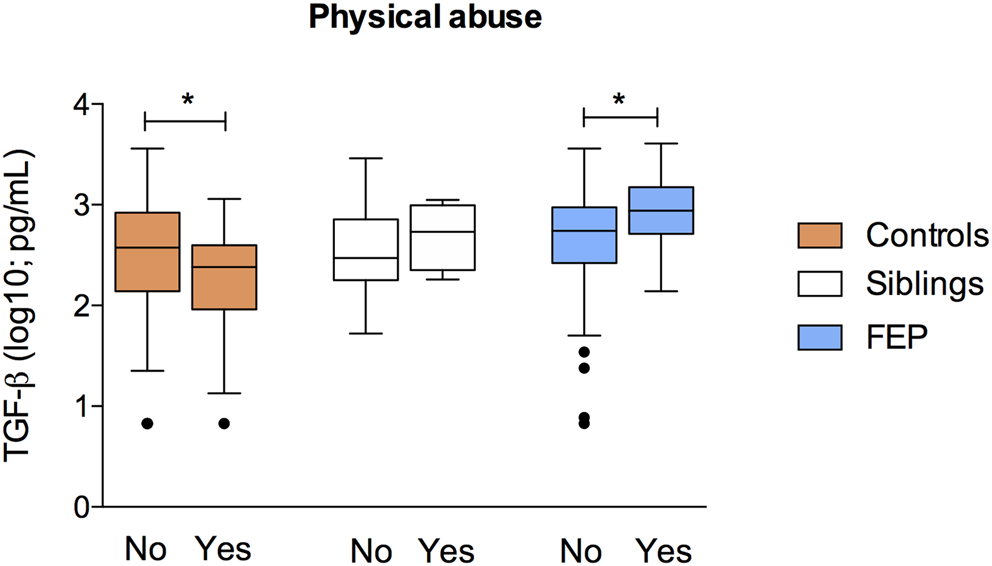
TGF-β plasma levels in first-episode psychosis patients (n = 114), siblings (n = 57) and community-based controls (n = 251) with and without physical childhood abuse. Plasma cytokines were logarithmically transformed and data are expressed as mean ± s.e.m. and given as pg/mL. *p < 0.05 represents results for the GLM within-group interaction analysis adjusted for age, gender, BMI, tobacco smoking, years of study, relationship status, psychoactive substance use and recent stress. FEP, first-episode psychosis.

Our between-group comparison showed a significant interaction between groups and childhood maltreatment for TGF-β (F 2,421 = 3.969; p = 0.020), even after adjusting for recent stress (F 2,421 = 4.257; p = 0.015). In post-hoc analysis (F 2,126 = 6.250; p = 0.003), both patients and their siblings had higher levels of TGF-β when compared with controls (p = 0.020 and p = 0.023, respectively). When looking at childhood maltreatment subtypes, only physical abuse yielded significant results (F 2,421 = 4.411; p = 0.013), remaining significant after adjusting for recent stress (F 2,421 = 4.571; p = 0.011). Post-hoc analysis revealed higher levels of TGF-β in patients when compared with controls (F 2,43 = 4.237; p = 0.030). Within each group, FEP patients with physical abuse had higher levels of TGF-β when compared with FEP without physical abuse (F 1,113 = 6.119; p = 0.015), even after adjusting for recent stress (F 1,113 = 6.630; p = 0.011). There was longer duration of pharmacological treatment, in weeks, in those with physical abuse (58.7 ± 69.2 v. 23.1 ± 32.1; F 1,113 = 12.739; p = 0.001). The results remained significant after including the duration of treatment in the model (F 1,113 = 6.548; p = 0.012). Furthermore, when we stratified physical abuse by different dimensions of severity [none to minimum (n = 80), low to moderate (n = 13), moderate to severe (n = 13) or severe to extreme (n = 8)], we found that the higher cut-offs of severity were associated with higher levels of TGF-β (F 3,113 = 3.510; p = 0.018). Patients reporting the two highest cut-offs of severity had higher levels of TGF-β than patients reporting the low to moderate cut-off (moderate to severe: p = 0.040; severe to extreme: p = 0.039 v. low to moderate, respectively).
Control subjects with experience of childhood maltreatment had lower TGF-β levels than controls without childhood maltreatment (F 1,250 = 5.916; p = 0.016), even after adjusting for recent stress (F 1,250 = 6.220; p = 0.013). When focusing on subtypes of childhood maltreatment, controls with physical abuse showed lower TGF-β levels (F 1,250 = 3.965; p = 0.048) when compared with controls without physical abuse, remaining significant after adjusting for recent stress (F 1,250 = 4.010; p = 0.046).
There was no association between reports of childhood maltreatment and inflammatory cytokines in the sibling group.
The remaining cytokines IL-6, IL-1β, TNF-α, IL-10 were not associated with reports of childhood maltreatment in any of the groups (p > 0.05 for all).
Cytokines and history of recent stressors
Cytokine levels were not significantly different whether subjects experienced or not recent stress in none of the groups (p > 0.05).
Discussion
The present study showed that FEP patients have a high pro- and anti-inflammatory cytokine profile (IL-1β, TNF-α, IL-6, IL-10 and TGF-β), which was not observed in unaffected siblings. Nevertheless, in those exposed to childhood maltreatment, both patients and unaffected siblings showed increased levels of TGF-β when compared with controls. Physical childhood abuse was associated with increased levels of TGF-β in FEP patients but with decreased levels in controls.
Low-grade inflammatory profile of FEP patients
Our findings suggest an inflammatory profile characterised by activation of the inflammatory response system (M1: IL-1β, TNF-α, IL-6) and the compensatory system (M2 and T-regulatory cells: IL-10 and TGF-β) in psychosis. The inflammatory profile reported in our study adds important information to meta-analysis of peripheral cytokines in psychosis. For instance, whereas increased IL-6 and TNF-α are the most replicated findings (Goldsmith et al., Reference Goldsmith, Rapaport and Miller2016), the participation of well-known anti-inflammatory cytokines are still vastly ignored. In this sense, we demonstrate the co-existence of an up-regulation of anti-inflammatory cytokines in FEP. The existence of an anti-inflammatory profile complements previous findings of enhanced levels of two cytokine receptors (sIL-2R and IL1-Ra) facilitating anti-inflammatory actions (Goldsmith et al., Reference Goldsmith, Rapaport and Miller2016), and is also consistent with data showing higher percentages of both pro- and anti-inflammatory monocytes/T cells in recent-onset schizophrenia, including activation of CD4+CD25highFoxP3+ T-regulatory cells, which produce both IL-10 and TGF-β (Drexhage et al., Reference Drexhage, Hoogenboezem, Cohen, Versnel, Nolen, van Beveren and Drexhage2011). In this sense, the concomitant up-regulation of pro- and anti-inflammatory cytokines may provide a compensatory response and may be favourable in preventing the detrimental effects of chronic inflammation.
Familial liability and low-grade inflammation
Overall, increased pro- and anti-inflammatory cytokines were not observed in unaffected siblings, which could indicate that familial liability does not play a major role in determining the inflammatory profile found in FEP. However, our results could have been largely affected by the relatively reduced sample size of siblings who took part in our study. Alternatively, immune dysregulation in siblings may exist during vulnerable periods for the development of psychosis (e.g. adolescence) but when the increased risk does not lead to full-blown psychosis, cytokine levels normalise to the level of those without familial risk. Longitudinal studies are needed to test this hypothesis. Given that siblings not only did not show increased inflammatory profile, but they instead showed lower levels of IL-1β – one of the main pro-inflammatory cytokines – when compared with both patients and controls, we could speculate that the relative lack of immune activation in siblings may represent a protective factor. Considering the higher proportion of females in our sibling sample and that higher vulnerability to psychosis is observed among males (Jongsma et al., Reference Jongsma, Gayer-Anderson, Lasalvia, Quattrone, Mulè, Szöke, Selten, Turner, Arango, Tarricone, Berardi, Tortelli, Llorca, de Haan, Bobes, Bernardo, Sanjuán, Santos, Arrojo, Del-Ben, Menezes, Velthorst, Murray, Rutten, Jones, van Os, Morgan and Kirkbride2018), future studies with a balanced sex distribution and larger sample size could help to clarify sex differences related to IL-1β.
One possible argument regarding the increased immune activation in our patients compared to both siblings and controls could be the exposure of our FEP patients to antipsychotic treatment. The immunomodulatory effects of antipsychotic treatment are not always consistent across studies and large part of these effects has been recently suggested to be partly consequence of their metabolic side effects (Baumeister et al., Reference Baumeister, Ciufolini and Mondelli2016; Calevro et al., Reference Calevro, Cotel, Natesan, Modo, Vernon and Mondelli2018). In order to reduce the confounding effect of antipsychotics on the inflammatory markers, we focussed on the study of FEP patients, who had limited exposure to antipsychotic treatment, and we controlled all our analyses for important metabolic confounding factors, which have been discussed to contribute to cytokine abnormalities in the general population, specially the effects of age, gender, BMI and smoking (Goldsmith et al., Reference Goldsmith, Rapaport and Miller2016). Hence, the identified inflammatory profile points towards a pathophysiological component of psychosis.
Childhood maltreatment and low-grade inflammation
Early-life stress has been argued as an important factor in the immune activation of psychosis (Baumeister et al., Reference Baumeister, Ciufolini and Mondelli2016), but our results do not support previous studies reporting enhanced TNF-α (Dennison et al., Reference Dennison, McKernan, Cryan and Dinan2012; Di Nicola et al., Reference Di Nicola, Cattaneo, Hepgul, Di Forti, Aitchison, Janiri, Murray, Dazzan, Pariante and Mondelli2013) and IL-6 (Dennison et al., Reference Dennison, McKernan, Cryan and Dinan2012) in reduced sample sizes of psychotic patients exposed to childhood maltreatment. In accordance, larger studies in patients with chronic schizophrenia/bipolar disorder also failed to report associations of childhood maltreatment with TNF-α, IL-6 (Quidé et al., Reference Quidé, Bortolasci, Spolding, Kidnapillai, Watkeys, Cohen-Woods, Berk, Carr, Walder and Green2018), the soluble TNF-1 receptor or gp130 (the IL-6 signal-transducing component) (Aas et al., Reference Aas, Dieset, Hope, Hoseth, Mørch, Reponen, Steen, Laskemoen, Ueland, Aukrust, Agartz, Andreassen and Melle2017). Inconsistent findings could possibly relate to methodological limitations observed (sample size, lack of control for confounders) or geographical and economic factors (high v. low-middle income countries). In our sample, the non-significant associations could be due to the non-specific effects of childhood maltreatment, as it is likely that the observed inflammatory profile may arise from cumulative risk factors, which should be the focus of future investigations.
Interestingly, we found that both FEP patients and their unaffected siblings exposed to childhood maltreatment exhibited higher levels of TGF-β when compared with controls exposed to childhood maltreatment, implying TGF-β as a possible biological candidate of familial risk for psychosis, which may result from the interplay between shared genetic and environmental factors. We also found that exposure to physical childhood abuse was associated with increased levels of TGF-β in FEP patients but with decreased levels in controls, and that the severity of childhood physical abuse was positively associated with the levels of TGF-β in patients. With regards to siblings, although we did not find significant differences in TGF-β between those with and without physical abuse, the pattern of TGF-β in the exposed group was similar to their FEP peers, further supporting TGF-β as a possible biological candidate of familial risk for psychosis. The lack of statistical significance could be explained by the relatively low number of siblings reporting physical abuse (n = 4).
The specificity for physical abuse, but not other subtypes, in augmenting TGF-β is intriguing is several ways, and may suggest exposure-specific mechanisms. Indeed, physical abuse is the most prevalent subtype of childhood maltreatment in subjects reporting psychotic experiences, contributing to the highest odds ratio for a subsequent psychotic episode in males (McGrath et al., Reference McGrath, McLaughlin, Saha, Aguilar-Gaxiola, Al-Hamzawi, Alonso, Bruffaerts, De Girolamo, De Jonge, Esan, Florescu, Gureje, Haro, Hu, Karam, Kovess-Masfety, Lee, Lepine, Lim, Medina-Mora, Mneimneh, Pennell, Piazza, Posada-Villa, Sampson, Viana, Xavier, Bromet, Kendler and Kessler2017). This is also consistent with previous findings of a stronger association of physical and sexual childhood abuse, rather than other childhood maltreatment, with increased levels of inflammatory markers in adulthood (Baumeister et al., Reference Baumeister, Ciufolini and Mondelli2016).
We found an opposite effect in community-based controls, with low levels of TGF-β in those who reported general childhood maltreatment but also in the subtype physical abuse. A possible explanation behind this would further support the role of the immune system in mediating the association between childhood maltreatment and psychosis, with controls showing opposite immune activation as a possible protective factor.
GWAS implicate TGF-β in schizophrenia (Jia et al., Reference Jia, Wang, Meltzer and Zhao2010; Sanders et al., Reference Sanders, Drigalenko, Duan, Moy, Freda, Göring, Gejman, Levinson, Shi, Buccola, Mowry, Freedman, Olincy, Amin, Black, Silverman, Byerley, Cloninger and Svrakic2017), and increased TGF-β protein (Kim et al., Reference Kim, Myint, Lee, Han, Lee, Kim and Leonard2004; Borovcanin et al., Reference Borovcanin, Jovanovic, Radosavljevic, Djukic Dejanovic, Stefanovic, Arsenijevic and Lukic2013), gene expression (Amoli et al., Reference Amoli, Khatami, Arzaghi, Enayati and Nejatisafa2019) and lymphocyte receptor (Numata et al., Reference Numata, Ueno, Iga, Yamauchi, Hongwei, Hashimoto, Takeda, Kunugi, Itakura and Ohmori2008) were described before in medication-free and FEP patients, although previous findings were not corrected for confounders as in our study. TGF-β is a pleiotropic cytokine and a master regulator of the immune system, orchestrating the balance between innate and adaptive immune components (Th1, Th2, Th17, monocytes), and mediating the differentiation of naïve CD4+ T-cells towards Treg-cells producing anti-inflammatory cytokines (IL-10, TGF-β) (Kim et al., Reference Kim, Myint, Lee, Han, Lee, Kim and Leonard2004; Borovcanin et al., Reference Borovcanin, Jovanovic, Radosavljevic, Djukic Dejanovic, Stefanovic, Arsenijevic and Lukic2013). However, TGF-β can also contribute to pro-inflammatory reactions and to a heightened risk of inflammation (Chen et al., Reference Chen, Jin, Hardegen, Lei, Li, Marinos, McGrady and Wahl2003). In the brain, TGF-β controls the excitatory/inhibitory transmission balance, facilitating neuronal hyperexcitability (Sun et al., Reference Sun, Gewirtz, Bofenkamp, Wickham, Ge and O'Connor2010). Genetic liability for increased TGF-β, would therefore, facilitate immune and neuronal dysregulation and consequent increased risk for psychosis, with childhood maltreatment acting as a possible trigger. Thus, screening for childhood maltreatment and subtyping the immune profile among low-and high-liability groups may provide insights for personalised interventions for better clinical outcomes.
Recent stress and low-grade inflammation
Lastly, our study does not support that recent stress (past 12 months) may have an effect on cytokines. It has been reported that acute psychological stress may induce short-term systemic inflammations, whereas chronic stress may be associated with more permanent inflammatory changes (Rohleder, Reference Rohleder2014). A longitudinal study showed that childhood maltreatment but not recent stress accounted for the association between increased inflammation and depression in patients with cancer (Archer et al., Reference Archer, Hutchison, Dorudi, Stansfeld and Korszun2012). We are also in accordance with a study reporting association between cytokines and childhood maltreatment but not recent stress in depression (Grosse et al., Reference Grosse, Ambrée, Jörgens, Jawahar, Singhal, Stacey, Arolt and Baune2016). If that is true, these findings may inform about sensitive periods in stress-induced immune changes.
Strengths and limitations
In this study, we attempted to overcome several methodological limitations identified previously. First, this is the largest sample yet to test the association between childhood and recent stress in FEP patients, siblings, and community-based controls adjusting for a broad range of confounders. Second, participants' recruitment in this study followed the National Census of Brazil for a representative sample, which is distinctive from the previous investigations including convenience samples sensitive to selection bias. Third, we tested for different subtypes of childhood maltreatment, which were before considered as one phenomenon. Fourth, our cytokine profile was much broader, allowing us to test both pro- and anti-inflammatory cytokines. Fifth, we included siblings in the study in order to test more specific confounding effects of shared environment and genetic risk than the classic case-control design. The results presented herein provide strong additional support for an association between childhood maltreatment and cytokine abnormalities in adulthood across the different diagnostic groups.
Our study has some limitations. First, we relied on retrospective self-reports, and therefore recall bias can be an issue. Despite that, studies have shown the validity of retrospective self-reports in both patients and controls (Grassi-Oliveira et al., Reference Grassi-Oliveira, Stein and Pezzi2006), and siblings' reports contributed towards validation of patients' reports in this study. Still, our results should be interpreted in the context of a retrospective measurement. Second, the majority of patients in this study were not drug-naïve. However, cytokine abnormalities have been reported in drug-naïve FEP (Pillinger et al., Reference Pillinger, Osimo, Brugger, Mondelli, McCutcheon and Howes2018), and longitudinal studies have demonstrated association between inflammatory markers during childhood/adolescence and future risk for psychosis in young adulthood (Khandaker et al., Reference Khandaker, Pearson, Zammit, Lewis and Jones2014; Metcalf et al., Reference Metcalf, Jones, Nordstrom, Timonen, Mäki, Miettunen, Jääskeläinen, Järvelin, Stochl, Murray, Veijola and Khandaker2017); therefore, it is unlikely that the cytokine changes found in our study may be solely from medication effects. Moreover, we controlled for duration of antipsychotic treatment in the within-group analyses for the patients when looking at the effects of childhood maltreatment and we controlled for metabolic factors (contributing to the effects of antipsychotic on inflammatory markers) in all our analyses.
Conclusion
We found increased pro- and anti-inflammatory cytokines in FEP patients but not in unaffected siblings who, similarly to patients, were exposed to higher childhood maltreatment than community-based controls, suggesting that the identified inflammatory profile can be a real pathophysiological component of psychosis and that normal or reduced immune activation may be protective in siblings.
Remarkably, our study suggests that individuals at high genetic liability for psychosis may be susceptible to immune dysregulation when exposed to childhood maltreatment, implicating increased TGF-β as a possible biological candidate of shared familial risk. Whether the opposite effects of childhood maltreatment on TGF-β reflect important biological mechanisms increasing risk or resilience to psychosis would need to be further explored in future studies.
Author ORCIDs
Fabiana Corsi-Zuelli, 0000-0001-9202-3987.
Acknowledgements
The authors acknowledge Giuliana Bertozzi for the technical support in the cytokines measurement.
Financial support
This work received financial support from the São Paulo Research Foundation – FAPESP, Brazil (grant number 2012/05178-0); the National Council for Scientific and Technological Development – CNPq, Brazil (grant number 476945/2012-7); and the Center for Research in Inflammatory Diseases (CRID grant number 2013/08216-2). F.C.-Z. receives grants from FAPESP (2016/12195-9; 2017/17480-6) and Coordenação de Aperfeiçoamento de Pessoal de Nível Superior – Brazil (CAPES) – Finance Code 001; C.M.L. receives grant from CAPES – Finance Code 001; H.A.F. and R.S. received grant from FAPESP (grants 2015/02948-7; 2013/11167-3); P.R.M., P.L.-J., and C.M.D.-B. are recipients of fellowships from CNPq. V.M. received funding support from the National Institute for Health Research (NIHR) Mental Health Biomedical Research Centre at South London and Maudsley NHS Foundation Trust and King's College London. V.M. is also supported by MQ: Transforming Mental Health (Grant: MQBF1) and by the Medical Research Foundation (Grant: MRF-160-0005-ELP-MONDE). The views expressed are those of the authors and not necessarily those of the NHS, the NIHR or the Department of Health.
Conflict of interest
None.
Ethical standards
The authors assert that all procedures contributing to this work comply with the ethical standards of the relevant national and institutional committees on human experimentation and with the Helsinki Declaration of 1975, as revised in 2008.