Colorectal cancer is one of the most common cancers in the Western world. In the United Kingdom, it is the second most common cancer in women and the third most common cancer in men.
Colorectal cancer cases typically arise sporadically in individuals over the age of 50 (12), with only a small proportion of patients having a strong inherited predisposition. Further risk factors relate to diet, body weight, physical exercise, tobacco use, and alcohol consumption (4).
Surgical resection of the cancer is the main treatment and is almost always performed as an open surgical procedure. Open resection involves one long incision through the abdominal wall and is associated with high complication rates. These complications include wound infection, postoperative pain, anastomotic leakage, urinary tract infection, and long-term complications such as incisional hernia. Some of the main disadvantages of open resection include incisional pain and an often lengthy hospitalization. Laparoscopic surgery, a minimally invasive approach, might provide an alternative. Compared with open surgery, it is believed to offer short-term quality of life benefits (12). Concerns over its longer-term effectiveness and cost, however, have led to a slow up-take. Furthermore, laparoscopic surgery is technically more complicated to perform, and its success may be influenced by the experience of the surgical team.
Laparoscopic surgery involves several small incisions to the abdominal wall, in which ports are inserted, allowing the surgical instruments to be manipulated. A variant is laparoscopically assisted resection where the bowel is accessed laparoscopically but then a port site incision is enlarged, which allows the excision of the diseased tissue. Anastomosis is then performed externally. In practical terms, laparoscopic and laparoscopically assisted resections can be considered comparable as the incision sizes are relatively similar (hereafter, they are collectively known as laparoscopic surgery). This study estimated the relative cost-effectiveness of laparoscopic compared with open surgery for the treatment of colorectal cancer as well as exploring the cost-effectiveness of the different modes of surgery by stage of disease.
Methods
Markov Model
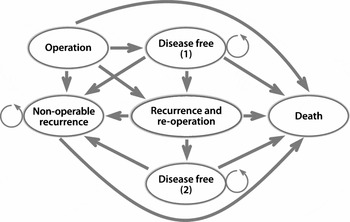
A Markov model was constructed to estimate the long-term costs and benefits of a cohort of typical patients for the alternative surgical treatments (Figure 1). The model followed a cohort of patients from initial operation through convalescence (operation state) to return to usual activities (“disease-free” state). The patients may remain in this state until they die or they suffer a recurrence or metastasis and therefore have a re-operation or some other form of management. Theoretically, the patients could move between states until they all eventually die. For the purposes of the analysis, the cohort of patients have been modeled for a maximum of 25 years (the likely maximum survival for the majority of patients). The cycle length was set at 6 months.
Model structure.

The main cost components included in the model were the initial operative procedure and the costs of subsequent re-operations or management. If a recurrence occurred and a re-operation indicated, the patient is assumed to receive an open procedure. Death is the only state within the model that a patient cannot leave (it is an absorbing state).
The short-term surgical complications were principally captured through increased operating times and longer hospitalization. The risk of an emergency re-operation within the first few weeks after surgery was explicitly modeled due to the additional operation costs incurred. Similarly, where the cost of managing other complications were not captured through increased operating time and length of stay, their probability of occurrence and cost was factored into the cost of a state.
Derivation of Model Parameters of Clinical Effectiveness
The strongest source of data required for each parameter in the model was derived from a systematic review of randomized controlled trials (RCTs) of the two interventions in the treatment of colorectal cancer (12). Data on mortality, recurrence rates, re-operation rates, emergency operations, and the long-term risk of hernia were all taken from this review (12). In brief, this review, an update of a previous review conducted in 2000 (20), involved a systematic literature search, restricted to the years 2000 onward. Full details of the search strategy are available from the authors (12). All included studies needed to meet prespecified eligibility criteria. Standard meta-analysis techniques were used to obtain overall estimates of effectiveness, where appropriate, and are reported in detail elsewhere (12). The review included a total of forty-six reports describing twenty studies (nineteen RCTs and one individual patient data [IPD] meta-analysis). The IPD meta-analysis (2), synthesized data from a subset of patients from four of the main RCTs included within the systematic review of effectiveness; (6;7;9;19).
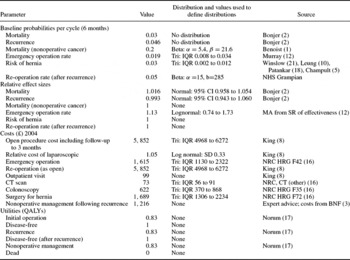
The risk of death and recurrence were taken from the IPD meta-analysis (2) and were assigned a constant rate based on consideration of the survival curves that showed a similar rate, for both interventions (see Table 1 for parameter values used in the model). The risk of mortality following the recurrence of nonoperative cancer was based on data derived from Benoist and colleagues (1). A beta distribution was used to reflect the uncertainty in this estimate. Other baseline parameters required for the model included the risk of hernia, emergency re-operation for a postoperative complication, and re-operation for recurrent disease. The risk of hernia was identified as an important long-term complication. The severity and rates of port site hernia and incisional hernia were included in the model. As data were sparse, it was not possible to draw any distinction between the two types of hernia. The rate of hernia for open resection was derived from the rates reported in the open arms of those trials (10;21) identified by the systematic review of effectiveness and a further focused search of nonrandomized studies (5;18). The risk of hernia per cycle was estimated for each study and the median of these was used. A triangular distribution based on the estimated 25 and 75 percentile estimates from the identified studies was used (Table 1).
All Parameters Used within the Model

Tri, triangular distribution; IQR, interquartile range; MA, meta-analysis; SR, systematic review; CI, confidence interval; SD, standard deviation; NRC, national reference costs; HRG, health-related group; CT, computed tomography; BNF, British National Formulary; QALYs, quality-adjusted life-years.
It was believed that the risk of emergency surgery for most postoperative complications would be low. The one complication for which an emergency re-operation would generally be required was anastomotic leakage and, based on clinical advice, the risk of an emergency re-operation was taken to be equal to the risk of an anastomotic leakage (personal communication: Professor Z. Krukowski and Ms. A. McKinley, 2005). The baseline risk of an anastomotic leakage was based on the rates reported in the open arms of those trials identified by the systematic review of effectiveness (12). The point estimate and distribution were defined using the same method as described above.
Should the cancer recur, the individual might have a re-operation but data on this were not available from any of the included studies. Data from Grampian University Hospitals National Health Service (NHS) Trust, however, suggested that, of over 300 resections per year, approximately fourteen to fifteen are re-operations (personal communication: Professor Z. Krukowski and Ms. A. McKinley, 2005). A beta distribution was used to reflect uncertainty of the point estimate.
Data on relative effect sizes of laparoscopic versus open surgery were derived from the systematic review of effectiveness (12) and the IPD meta-analysis (2). The relative effect size of the risk of death and recurrence for laparoscopic versus open resection were based on the interpretation of the IPD meta-analysis (2) to provide an estimate of the relative difference between laparoscopic and open surgery. A normal distribution was defined using information on the confidence interval surrounding the relative difference.
A relative risk of one was assumed for the mortality rate for individuals with noncurative cancer as prognosis was taken to be the same regardless of the initial method of resection (Table 1). The relative risk of an emergency operation was based on that for anastomotic leakage, which came from the systematic review of effectiveness (12). Based on the confidence interval reported, a lognormal distribution was used to define the imprecision around this estimate (Table 1).
The relative risk of hernia and the relative risk of a re-operation after a recurrence were also required. In both cases, a relative risk of one was assumed. In the former case, the evidence from the review of effectiveness was limited but there was no statistically significant difference between the rates of both types of hernia (12). In the latter case, this was assumed because the initial method of resection would not affect the method of management subsequent to a recurrence.
Data on Resource Use and Cost
Total costs included initial operation costs, hospital ward costs, and any further follow-up costs. The analysis was taken from a UK NHS perspective and focused on direct medical costs. Table 1 shows the estimated costs for laparoscopic and open resection. These costs were derived using data based on a UK RCT comparing laparoscopic with open surgery within an enhanced recovery program (8). The follow-up costs from this RCT were only up to 3 months and related to a fast-track recovery program. They do not, therefore, reflect typical length of stay estimates. These data, therefore, were combined with more typical estimates of length of stay and postoperative complications from the systematic review of effectiveness (12) to estimate the operation cost incurred in the first 6 months (i.e., the first cycle of the model). Added to this cost were the costs of follow-up visits, based on consultation with clinical experts to reflect the frequency of visits. Costs of two potential complications were also modeled (risk of emergency surgery and risk of incisional or port-site hernia). The cost per patient was the product of the probability of those complications occurring, combined with standard UK unit costs (16). The cost of care for those patients suffering a recurrence, where re-operation would not be indicated, was the cost of medications used to control symptoms. These were based on a typical drug regimen of care for a patient, defined following consultation with a MacMillan Cancer Nurse (personal communication: Flora O'Dea—Hospital Specialist Palliative Care Team 2005) (3).
Cost-Effectiveness
The base-case analysis was based on the costs and outcomes faced by a cohort of typical patients. Results are presented as incremental cost per additional life-year gained. The data are also presented as cost-effectiveness acceptability curves (CEACs), which reflect the statistical variability in the model's input parameters. These curves illustrate the likelihood that a strategy is cost-effective at various threshold values for society's willingness to pay for an additional life-year. All costs and benefits were discounted, at a rate of 6 percent for costs and 1.5 percent for benefits (13). Costs were based on 2004 prices, and the analysis was conducted from the perspective of the UK NHS.
Sensitivity Analysis
In addition to the probabilistic sensitivity analysis used to generate CEACs, sensitivity analysis focused on varying key assumptions and/or parameters in the base-case model. Sensitivity analyses surrounding the relative survival and disease-free survival estimates for laparoscopic resection were performed, as they are important drivers within the model and subject to considerable uncertainty. To further evaluate these estimates, a second analysis using alternative survival and disease-free survival estimates for both open and laparoscopic patients, based on the meta-analysis of all relevant trials was conducted (12). These estimates were manipulated to allow the mortality and recurrence rates for laparoscopic compared with open resection to be established giving point estimates of 0.97 (standard deviation of 0.03) and 0.99 (standard deviation of 0.03), respectively. Given the nature of the data, the imprecision around the relative risk was assigned a normal distribution. Further analysis also considered the use of various quality of life estimates to estimate QALYs. Sensitivity analyses surrounding the base-line risk of hernia, mortality rates for patients with nonoperative cancer, and rates of re-operation after recurrence were also conducted.
Results
Base-Case and Equal Survival
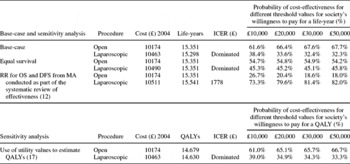
For the base-case model, laparoscopic is dominated by open resection over the 25-year time horizon; that is, laparoscopic resection is more costly and less-effective in comparison to open resection (Table 2). One interpretation of the data provided by the IPD meta-analysis, however, is that there is no difference between laparoscopic and open resection in terms of survival and disease-free survival at 3 years (2). An analysis assuming equal survival and disease-free survival showed that laparoscopic resection was, again, more costly and no more effective (Table 2). Based on these data alone, it would be unlikely that a policy maker would recommend increasing the uptake of laparoscopic surgery. The point estimates of the incremental cost-effectiveness provided do not, however, provide any indication of the uncertainty that surrounds the model parameters.
Base-Case and Sensitivity Analysis Results (Deterministic and Probabilistic)

RR, relative risk; OS, overall survival; DFS, disease-free survival; MA, meta-analysis; ICER, incremental cost-effectiveness ratio; QALYs, quality-adjusted life-years.
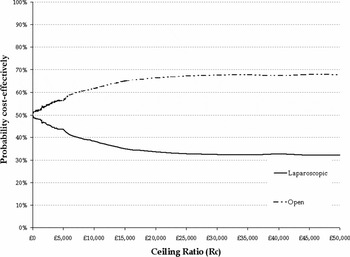
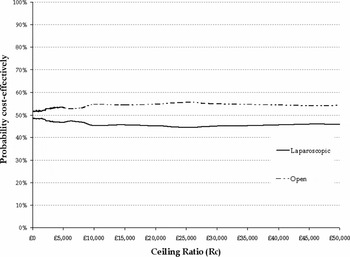
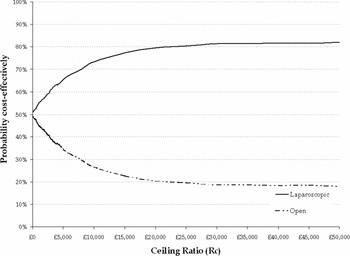
Figures 2 and 3 report the CEACs comparing laparoscopic to open surgery in terms of life-years for the base-case model and for the equal survival analysis. Open surgery has a greater chance of being considered cost-effective, for the base-case analysis, at the various threshold values of society's willingness to pay for a life-year. If society was willing to pay £30,000 for a life-year then laparoscopic resection has approximately a 30 percent chance of being considered cost-effective (Figure 2). The results are driven by very small differences in survival and disease-free survival estimated to exist at 3 years follow-up. Therefore, an alternative interpretation of the data on survival and disease-free survival is that there are no meaningful differences and, in this situation, the likelihood that laparoscopic surgery might be considered cost-effective is greater compared with the base-case analysis (Figure 3).
Cost-effectiveness acceptability curve showing society's willingness to pay for a life-year for the comparison of laparoscopic with open surgery (base-case analysis).

Cost-effectiveness acceptability curve showing society's willingness to pay for a life-year for the comparison of laparoscopic with open surgery assuming equal survival and disease-free survival.

Sensitivity Analysis
Using the two pooled estimates derived for overall survival and disease-free survival from the meta-analysis resulted in laparoscopic surgery being more costly (by approximately £350) but more effective, with an incremental cost-effectiveness ratio of £1778 (Table 2 and Figure 4). This result is as would be expected given the pooled estimates on survival and disease-free survival used (12). This analysis serves to highlight the sensitivity of the model to these particular parameter estimates.
Cost-effectiveness acceptability curve showing society's willingness to pay for a life-year for the comparison of laparoscopic with open surgery using pooled estimates of survival and disease-free survival from the systematic review of effectiveness (12).

Utility data, although sparse, were sought in an attempt to capture the quality of life differences that might be apparent after the two forms of resection. Data were taken from one published study using the EQ-5D questionnaire to obtain utility scores (17). On the basis of these data, it has been assumed that the recovery from both open and laparoscopic surgery was associated with a value of 0.83. It has also been assumed that, by definition, the time spent free from disease was associated with a value of 1. The value associated with the other states (except death) was also 0.83. These utility estimates were applied to the base-case model. Both the deterministic and probabilistic analyses are similar to the base-case results (see Table 2).
The estimates of QALYs do not capture any potential QALY gain that might be associated with an earlier recovery following laparoscopic surgery. Some indication of the relevance of this finding was assessed by looking at the QALY gain required for laparoscopic surgery to be judged worthwhile. Assuming a threshold value for society's willingness to pay for a QALY of £30,000 (14), and given the mean incremental cost of laparoscopic surgery of £289, then the suggested value of the QALY gain would need to be 0.010 QALYs (approximately 3.5 days in full health).
The results from much of the other sensitivity analyses were similar to the base-case results. The model was, however, highly sensitive to changes in the relative effect sizes associated with nonoperable cancer mortality and re-operation rates, but there is no evidence to suggest that the management of patients would differ between the comparators. Finally consideration was given to the effect of stage of disease on the results using data presented in the IPD meta-analysis (2). Results were broadly similar to the base-case analysis, although there was considerable uncertainty surrounding parameter estimates. Further evidence on these outcomes, therefore, is warranted.
DISCUSSION
It is likely that laparoscopic and open resection are similar in terms of long-term survival and disease-free survival. It is also likely that laparoscopic resection has some short-term advantages in terms of recovery in the postoperative period (12). When the cost-effectiveness measure was presented in terms of either cost per life-year or QALY, laparoscopic surgery was, on average, dominated by open surgery. These results reflect the very small differences in overall survival that were apparent at 3 years and also the lack of available utility data in which to gauge the impact of earlier recovery following laparoscopic surgery. The results would be greatly strengthened if longer term randomized data were available. With respect to utilities, the data available to estimate QALYs were meager and should be treated with extreme caution. Further work in this area is warranted to determine just what level of QALY gain might be apparent following a shorter postoperative recovery and in the long-term. The importance of this can be ascertained from the fact that only a 0.01 gain in QALYs would be necessary for laparoscopic surgery to be considered cost-effective at a £30,000 threshold. It is quite plausible that a gain of this magnitude might exist when it is noted that, in a comparison between laparoscopic and open groin hernia repair, the observed QALY gain was 0.006 (11).
Sensitivity analyses were performed to determine the effect of changing assumptions around the input parameters of the economic model. In doing so, the probability that laparoscopic surgery might be considered cost-effective ranged from 30 percent to 80 percent. The analysis where laparoscopic surgery had an 80 percent chance of being considered cost-effective was when the base-case survival and disease-free survival estimates were replaced with the pooled estimates taken from the systematic review of effectiveness (12). It should be noted, however, that this pooled analysis does not take into account any potential differential timing of events.
There was little information on long-term wound-related morbidities such as hernias. It is likely that the types of hernias and subsequently the costs, management, and risk of hernia would also be different after both forms of resection. Because of the lack of data, however, the cost, management, and associated risks were assumed to be the same for both forms of surgery. A sensitivity analysis that addressed the impact of this assumption showed little impact on results. Similarly in relation to all costs, few data were available. With respect to the main component of costs (the initial operation), these were based on data from a very small UK RCT (8). Further cost data from a larger sample would be beneficial.
One important event associated with laparoscopic surgery that was not modeled explicitly, owing to a lack of useable data, was the effect of conversion. Laparoscopic patients might be converted to open surgery for various reasons. Often these patients have worse outcomes than those not converted (12). It is unclear, however, whether patients converted to open surgery would have experienced similar complications regardless of which form of surgery had first been undertaken (i.e., they were inappropriately considered eligible for laparoscopic surgery). The effects of conversion also relate to the level of experience of the particular surgeon and their team. Less experienced surgeons and surgical teams might be expected to have a higher rate of conversion than those who are more experienced. The level of conversion (and, hence, cost-effectiveness) is likely, therefore, to be determined not only by appropriate patient selection but also by operator experience.
The results were sensitive to changes in the assumption that care for recurrent disease would be the same for both forms of surgery. There is, however, no evidence to suggest that the management would differ between surgeries. Should new data emerge indicating this finding, then further work to develop this aspect of the model would be warranted.
A subgroup analysis focusing on stage of disease was also conducted. Its results were based on very meager data and are unreliable. Other subgroups that would be relevant to investigate are age, gender, and cancer site, although it was not possible to incorporate these outcomes into the model owing to a lack of useable data. Further analysis and research for these subgroups is warranted.
CONCLUSION
This study has explored the cost-effectiveness of laparoscopic surgery for colorectal cancer. This study is the first economic evaluation, using a Markov model to predict long-term outcomes, to be conducted within this area. Laparoscopic surgery is more costly and has a likelihood of being considered cost-effective of between 30 percent and 80 percent, depending on the assumptions made. The implied valuation conducted found that, assuming a willingness to pay threshold of £30,000, laparoscopic surgery would need to be associated with a QALY gain of 0.01 to be considered cost-effective. Further data are required relating to utility values to assess QALYs, longer term data with regard to survival and disease-free survival, evidence relating to relevant subgroups and on the risk and value of “secondary” outcomes such as hernias.
POLICY IMPLICATIONS
A judgment must be made as to whether the guidelines on open surgery should change. Currently, less than 1 percent of all colorectal cancer surgeries are performed laparoscopically. Given the evidence that laparoscopic surgery appears to have similar long-term outcomes compared with open surgery, as well as being associated with potential short-term benefits, there is a case to increase the current level of service provision. On the basis of evidence presented in this study, and other evidence, the National Institute for Health and Clinical Excellence recommended that laparoscopic surgery is an acceptable method of surgery for colorectal cancer in the United Kingdom (15).
Very few surgeons or surgical teams are trained in this particular form of surgery, and the implications for training of increasing the number of laparoscopic resections performed needs to be considered. Any decision that might be taken by policy makers with regard to this change, however, must take into consideration the extra costs associated with laparoscopic resection and indeed whether the probable quality of life gains are worth this increased cost.
CONTACT INFORMATION
Robyn M. de Verteuil, MSc (r.deverteuil@abdn.ac.uk), Research Assistant, Rodolfo A. Hernández, MSc (r.a.hernandez@abdn.ac.uk), Research Fellow, Luke Vale, PhD (l.vale@abdn.ac.uk), Professor, Health Economics Research Unit, University of Aberdeen, Polwarth Building, Foresterhill, Aberdeen AB25 2ZD, United Kingdom