Introduction
Suicide is one of the leading causes of death for individuals of all ages (WHO, 2000), accounting for an even greater proportion of deaths among males younger than 40 years of age (Mao et al. Reference Mao, Hasselback, Davies, Nichol and Wigle1990; WHO, 2000). Suicide is a complex behaviour that is probably the result of the interaction of several different factors. Well-investigated suicide predictors and risk factors include, among others, a positive history of suicide attempts, certain demographic variables, clinical symptoms and issues related to medical and social support (Barraclough et al. Reference Barraclough, Bunch, Nelson and Sainsbury1974; Barraclough & Pallis, Reference Barraclough and Pallis1975; Beck et al. Reference Beck, Steer, Kovacs and Garrison1985, Reference Beck, Brown, Berchick, Stewart and Steer1990; Fawcett et al. Reference Fawcett, Scheftner, Clark, Hedeker, Gibbons and Coryell1987, Reference Fawcett, Scheftner, Fogg, Clark, Young, Hedeker and Gibbons1990; Goldacre et al. Reference Goldacre, Seagroatt and Hawton1993). Although of low specificity, the presence of psychopathology is probably the single most important predictor of suicide. Accordingly, approximately 90% of suicide cases meet criteria for a psychiatric disorder, particularly major depression, substance use disorders, cluster B personality disorders and schizophrenia (Cavanagh et al. Reference Cavanagh, Carson, Sharpe and Lawrie2003; Arsenault-Lapierre et al. Reference Arsenault-Lapierre, Kim and Turecki2004).
Over the last decades, it has become increasingly clear that people who commit suicide have a certain predisposition (Roy et al. Reference Roy, Rylander and Sarchiapone1997; Turecki et al. Reference Turecki, Zhu, Tzenova, Lesage, Seguin, Tousignant, Chawky, Vanier, Lipp, Alda, Joober, Benkelfat and Rouleau2001; Mann, Reference Mann2003), whose relationship with suicide does not seem to be direct, but rather, appears to be mediated and moderated by a number of factors, with growing interest in the role of personality variants, notably impulsivity and aggressive behaviours (Marttunen et al. Reference Marttunen, Aro, Henriksson and Lonnqvist1991; Brent et al. Reference Brent, Johnson, Perper, Connolly, Bridge, Bartle and Rather1994; Lesage et al. Reference Lesage, Boyer, Grunberg, Vanier, Morissette, Menard-Buteau and Loyer1994; Soloff et al. Reference Soloff, Lis, Kelly, Cornelius and Ulrich1994; Nordstrom et al. Reference Nordstrom, Schalling and Asberg1995; Beautrais et al. Reference Beautrais, Joyce, Mulder, Fergusson, Deavoll and Nightingale1996; Isometsa et al. Reference Isometsa, Henriksson, Heikkinen, Aro, Marttunen, Kuoppasalmi and Lonnqvist1996; Duberstein et al. Reference Duberstein, Conwell, Seidlitz, Denning, Cox and Caine2000; Dumais et al. Reference Dumais, Lesage, Alda, Rouleau, Dumont, Chawky, Roy, Mann, Benkelfat and Turecki2005a,Reference Dumais, Lesage, Lalovic, Seguin, Tousignant, Chawky and Tureckib). Accordingly, several studies suggest that suicide completers have higher levels of impulsivity and aggressive behaviours (Brent et al. Reference Brent, Johnson, Perper, Connolly, Bridge, Bartle and Rather1994, Reference Brent, Bridge, Johnson and Connolly1996, Reference Brent, Oquendo, Birmaher, Greenhill, Kolko, Stanley, Zelazny, Brodsky, Bridge, Ellis, Salazar and Mann2002), an association that seems to be independent from psychopathology (Dumais et al. Reference Dumais, Lesage, Alda, Rouleau, Dumont, Chawky, Roy, Mann, Benkelfat and Turecki2005a).
It has long been suggested that younger and older suicides may represent different populations (Rich et al. Reference Rich, Warstadt, Nemiroff, Fowler and Young1991; Rifai et al. Reference Rifai, Reynolds and Mann1992; Heikkinen et al. Reference Heikkinen, Isometsa, Aro, Sarna and Lonnqvist1995; Henriksson et al. Reference Henriksson, Marttunen, Isometsa, Heikkinen, Aro, Kuoppasalmi and Lonnqvist1995; Conwell et al. Reference Conwell, Duberstein, Cox, Herrmann, Forbes and Caine1998; Brent et al. Reference Brent, Baugher, Bridge, Chen and Chiappetta1999) and it remains to be better understood whether suicide is the same phenomenon across the life cycle, or whether it is characterized by a different meaning and set of risk factors when it occurs in youth or in older age. A previous study by Rich et al. (Reference Rich, Young and Fowler1986) comparing a sample of suicides dichotomized as a function of age suggested that the importance of impulsive aggression, inferred from levels of substance abuse and personality disorders associated with such traits, was greater among younger suicides. Even among adolescent suicides, younger suicides appear to have lower levels of intent (Brent et al. Reference Brent, Baugher, Bridge, Chen and Chiappetta1999), and such successful suicides are thought to be accompanied by higher levels of impulsivity. Unfortunately, most researchers studying suicide have viewed age as a confounding variable to be controlled for, rather than as a variable of interest (Conwell et al. Reference Conwell, Duberstein, Cox, Herrmann, Forbes and Caine1998). As a result, with but a few additional exceptions (Marttunen et al. Reference Marttunen, Aro, Henriksson and Lonnqvist1991; Conwell et al. Reference Conwell, Duberstein, Cox, Herrmann, Forbes and Caine1996) examining major psychiatric diagnoses, most studies have investigated risk factors irrespective of age or examined completed suicide in discrete age groups, such as in youth or in the elderly, and most data regarding age differences in suicide comes from post-hoc or comparative analyses between samples.
In spite of the importance and growing interest on the role of impulsive-aggressive behaviours in suicide risk, it is not known if the role of these or other related suicide risk factors is similar across the lifespan; no study has investigated differences in the relationship between suicide, impulsivity and aggression as a function of the age at which individuals die by suicide in a representative and unselected sample. Similarly, little is known on the relationship between age, impulse discontrol psychopathology, such as personality disorders, and suicide. Thus, the purpose of our study was to investigate the relationship between impulsive and aggressive behaviours and associated psychopathology as a function of continuous age in a sample of suicide completers aged 11–87 years.
Method
Subjects
From 1997 to 2005, we consecutively collected data on 645 suicides (540 males, primarily Caucasian) between the ages of 11 and 87 years (38.75±15.38) in Quebec, Canada. Suicide completion was determined through the Coroner's Office and inclusion was limited only by participation rate. The participation acceptance rate by suicide families was 75%. Suicide cases of families who chose not to participate were not different from those included in the study with regards to age, race or suicide method. Families were interviewed, on average, 4 months after the suicide.
To ensure that any behavioural and temperament findings were not attributable to the design employed (as a result of differentially framed proxy perceptions), we investigated a control group comprising 246 (169 male) living individuals aged 18–73 years from the same population as the suicide cases. As 90% of suicides meet criteria for a psychiatric diagnosis, we investigated controls recruited from out-patient clinics and among affected individuals from the community to create a group with comparable diagnostic distribution to suicides. Controls were diagnosed by proxy-based interviews carried out on average 5 months following recruitment.
This project was approved by institutional review boards at the Douglas Hospital and Sainte-Justine Hospital; all participants and suicide families signed written informed consents.
A psychological autopsy method was employed to collect all information. This methodology, whereby the person best acquainted with the deceased is selected as an informant for the interview process, has been validated for Axis I and II diagnoses (Kelly & Mann, Reference Kelly and Mann1996; Conner et al. Reference Conner, Conwell and Duberstein2001; Zhang et al. Reference Zhang, Conwell, Wieczorek, Jiang, Jia and Zhou2003). In the current study, informants included parent [suicide cases ⩽25 years (83.2%), 26–40 (34.5%), 41–60 (2.6%), >60 (2.2%)], spouse [⩽25 years (1.5%), 26–40 (17.3%), 41–60 (25.9%), >60 (6.5%)], sibling [⩽25 years (3.6%), 26–40 (24.4%), 41–60 (34.7%), >60 (17.4%)], child [⩽25 years (0.0%), 26–40 (0.0%), 41–60 (10.9%), >60 (34.8%)] and other [⩽25 years (11.6%), 26–40 (23.8%), 41–60 (25.8%), >60 (39.2%)]. Our group has previously shown that the type of informant does not influence the rate of specific disorders identified (Lesage et al. Reference Lesage, Boyer, Grunberg, Vanier, Morissette, Menard-Buteau and Loyer1994), consistent information between multiple informants (Dumais et al. Reference Dumais, Lesage, Alda, Rouleau, Dumont, Chawky, Roy, Mann, Benkelfat and Turecki2005a) and that proxy-based information and directly obtained information does not significantly differ (Dumais et al. Reference Dumais, Lesage, Alda, Rouleau, Dumont, Chawky, Roy, Mann, Benkelfat and Turecki2005a; McGirr et al. Reference McGirr, Tousignant, Routhier, Pouliot, Chawky, Margolese and Turecki2006, Reference McGirr, Paris, Lesage, Renaud and Turecki2007). Nevertheless, in this study we controlled for type of primary informant in the analyses of this study.
Psychiatric diagnoses and behavioural measures
Psychiatric diagnoses were obtained using the Kiddie-Schedule for Affective Disorders and Schizophrenia (K-SADS) for suicides aged <19 years, while the SCID-I (Spitzer et al. Reference Spitzer, Williams, Gibbon and First1992) and SCID-II (First et al. Reference First, Spitzer, Gibbon, Williams and Lorna1996) were administered for suicides aged >18 years. We did not diagnose personality disorders in subjects aged <18 years. Current (last 6 months) and lifetime diagnoses were obtained. We have previously reported a perfect concordance between K-SADS and SCID diagnoses (Kim et al. Reference Kim, Lesage, Seguin, Chawky, Vanier, Lipp and Turecki2003). Two or more interviewers were asked to rate the same subject. Kappa coefficients for key diagnoses ranged from very good to excellent: 0.87 depressive disorders, 0.87 substance abuse/dependence, 1.0 schizophrenia, 0.80 cluster B personality disorders and 0.78 generalized anxiety disorder and panic disorder. Similar kappas and agreements have been previously reported by our group (Lesage et al. Reference Lesage, Boyer, Grunberg, Vanier, Morissette, Menard-Buteau and Loyer1994; Dumais et al. Reference Dumais, Lesage, Lalovic, Seguin, Tousignant, Chawky and Turecki2005b) and are probably the result of regular training sessions to avoid inter-rater drifting.
The Brown–Goodwin History of Aggression (BGHA; Brown & Goodwin, Reference Brown and Goodwin1986) is an 33-item assessment of lifetime aggressive behaviours. The Barratt Impulsiveness Scale (BIS; Barratt, Reference Barratt1965) consists of 30 items and has been commonly used in the investigation of impulsive behaviours. The Buss–Durkee Hostility Inventory (BDHI; Buss & Durkee, Reference Buss and Durkee1957) is a 75-item assessment of hostility. Last, the Temperament and Character Inventory (TCI; Cloninger et al. Reference Cloninger, Przybeckm, Svrakic and Wetzel1994) was used to complete information by assessing four basic temperament dimensions. The internal consistency estimates were overall excellent with the informant version for the BGHA (α=0.89), the BIS (α=0.90), the BDHI (α=0.84), and the TCI (α=0.90). The literature on the validity of behavioural assessments by means of informants consistently demonstrates the similarity of informant and subject reports (Kelly & Mann, Reference Kelly and Mann1996; Conner et al. Reference Conner, Conwell and Duberstein2001; Zhang et al. Reference Zhang, Conwell, Wieczorek, Jiang, Jia and Zhou2003; Dumais et al. Reference Dumais, Lesage, Alda, Rouleau, Dumont, Chawky, Roy, Mann, Benkelfat and Turecki2005a; McGirr et al. Reference McGirr, Paris, Lesage, Renaud and Turecki2007). We have also carried out studies in this regard, which are reported in detail elsewhere (Dumais et al. Reference Dumais, Lesage, Alda, Rouleau, Dumont, Chawky, Roy, Mann, Benkelfat and Turecki2005a; McGirr et al. Reference McGirr, Paris, Lesage, Renaud and Turecki2007).
The concurrence of information from multiple informants for the same individual was re-examined for this study among a subset of suicide cases (n suicide=9, n informant=20); good to very good levels of agreement were obtained for measures of impulsivity and aggression (0.566>γ>0.543) and the temperament subscales of the TCI (0.850>γ>0.544), with the exception of reward dependence (γ=0.246), which was therefore excluded.
Statistical analyses
Our goal was to examine age-related characteristics of suicide using the following strategy. First, we examined the relationship between suicide completers' characteristics and age of suicide (Correlates of age among suicide completers). Second we investigated whether or not the characteristics of suicides' informants influenced our results by repeating analyses controlling for the characteristics of informants (The influence of informant characteristics). Third, we examined the relationship between personality variants and age in a sample of living individuals to ensure that our results do not reflect the normal process of ageing (Specific to suicide?: personality correlates of age among living individuals). We then tested the independence of personality variants and age of suicide by controlling for age differentiating psychopathology (Test of independent association). Last, we investigated the relationship between age, personality characteristics and suicide using a case-control examination by testing the interaction of personality variants and age in predicting suicide and directly controlling for the presence of primary psychopathology (Personality and age: case-control prediction of suicide).
Statistical analyses were performed using the SPSS statistical package version 11.5 (SPSS Inc., Chicago, IL, USA). For all regressions, diagnoses or personality traits served as the dependent variable, with age as the independent variable. Age was used as a continuous variable (years) in regression analyses to provide the strictest test. Linear analyses were employed as our primary analytical approach, results from nonlinear analyses are presented for informative purposes. Univariate logistic regressions were used to examine dichotomous variables across age (odds ratios are presented for 1-year increases [OR(1)] and 10-year increases [OR(10)]), while univariate linear regressions were used in the analysis of continuous variables. As some diagnoses presented nonlinear relationships with age of suicide, the age of maximum prevalence was identified using the curve estimation function in SPSS, and odds ratios for ages preceding and following the maximum were estimated by piecewise linear functions.
We conducted case-control analyses of the interaction between age and personality variants in predicting suicide, directly controlling for major psychopathological diagnoses. More specifically, among suicides and controls meeting criteria for depressive disorders, we conducted logistic regressions in which suicide status served as the dependent variable. In these logistic regressions, the interaction between age, as a continuous variable, and personality traits was included as a predictor, while forcing the main effects of age and personality traits as control variables. In other words, we examined the interactive effect of stable traits thought to be associated with suicide in association with age as a function of suicide status, while controlling for the independent contributions of age and the trait in question.
Results
Correlates of age among suicide completers
Linear analyses
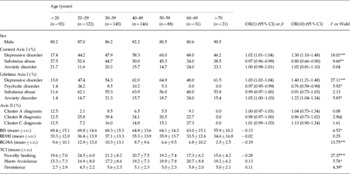
The characteristics of completed suicides by decade are presented in Table 1. Gender did not influence the age at which individuals died by suicide. With respect to Axis I and II characteristics, individuals who committed suicide at an older age were less likely to have met criteria for a psychotic disorder [OR(1) 0.97, 95% CI 0.95–0.99; OR(10) 0.76, 95% CI 0.59–0.90], more likely to have currently met criteria for a depressive episode [OR(1) 1.02, 95% CI 1.01–1.04; OR(10) 1.30, 95% CI 1.10–1.48] and in their lifetime [OR(1) 1.03, 95% CI 1.02–1.04; OR(10) 1.40, 95% CI 1.21–1.48]. At the same time, older suicides were less likely to have met criteria for a current substance abuse disorder [OR(1) 0.97, 95% CI 0.96–0.99; OR(10) 0.80, 95% CI 0.66–0.90]. They were also more likely to have met criteria for an anxiety disorder in their lifetime [OR(1) 1.02, 95% CI 1.00–1.03; OR(10) 1.22, 95% CI 1.04–1.34]. A trend emerged with respect to cluster B personality disorders [OR(1) 0.98, 95% CI 0.97–1.00; OR(10) 0.86, 95% CI 0.73–1.02]. Age did not differentiate any other of suicides' psychopathology.
Correlates of age among suicide completers

OR(1), Odds ratios for 1 year increases; OR(10), odds ratios for 10-year increases; CI, confidence interval; BIS, Barratt Impulsiveness Scale; BDHI, Buss–Durkee Hostility Inventory; BGHA, Brown–Goodwin History of Aggression; TCI, Temperament and Character Inventory.
* p<0.05, ** p<0.01, *** p<0.001
§ p=0.085.
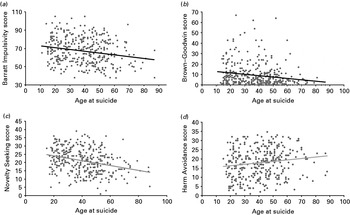
Concerning personality trait measures, individuals who committed suicide at a later age scored significantly lower on measures of impulsivity (BIS, β=−0.13; Novelty Seeking, β=−0.28) and lifetime history of aggression (BGHA) (β=−0.19), while older individuals scored significantly higher on Harm Avoidance (β=0.13) and Persistence (β=0.11) (Fig. 1a–d).
(a) Barratt Impulsivity score and age of suicide. (b) Brown–Goodwin lifetime history of aggression and age of suicide. (c) Novelty Seeking and age of completed suicide. (d) Harm Avoidance and age of completed suicide.

Piecewise linear analyses
With respect to psychiatric diagnoses, quadratic relationships appeared to characterize the relationship between age of suicide, current and lifetime depression, current and lifetime substance abuse, psychotic disorders and cluster B personality disorders.
Ages of maximum prevalence (maximum ages) were identified: current depression 42.2 years, lifetime depression 52.6 years, current substance abuse 41.3 years, lifetime substance abuse 48.4 years, psychotic disorders 25.9 years, and cluster B personality disorders 34.7 years. Increasing rates of diagnoses were associated with older age of suicide for ages of suicide preceding the maximum for current depression [OR(1) 1.06, 95% CI 1.03–1.09, p<0.001], lifetime depression [OR(1) 1.05, 95% CI 1.03–1.07, p<0.001], current substance abuse [OR(1) 1.03, 95% CI 1.00–1.06, p<0.05] as well as lifetime substance abuse [OR(1) 1.05, 95% CI 1.03–1.08, p<0.001]. For these diagnoses, however, the prevalence of each diagnosis was sustained after the maximum age. With respect to psychotic disorders, an increasing relationship was found prior to the asymptotic age [OR(1) 1.41, 95% CI 1.15–1.71, p<0.001], while a decreasing relationship was found posterior to this age [OR(1) 0.94, 95% CI 0.91–0.98, p<0.01]. Finally, a constant level of cluster B personality disorders was found among individuals younger than the maximum age, while these disorders became less prevalent with increasing age following the maximum [OR(1) 0.94, 95% CI 0.91–0.98, p<0.01].
The influence of informant characteristics
As our findings could also result from systematic variation in the characteristics of informants interviewed for suicides of different ages, we conducted additional analyses controlling for possible effects of the characteristics of the informant on the relationships observed between age at suicide, impulsivity, aggression, novelty seeking, harm avoidance and persistence.
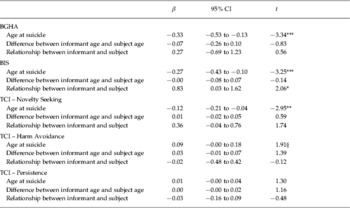
To address this possible confound, we conducted analyses in which the relationship between suicide completers' history of aggression, impulsivity, novelty seeking, harm avoidance and persistence were examined while controlling for the relationship between subject and informant as well as the difference in age between informant and suicide case (Table 2). In these analyses, the relationship between harm avoidance (p=0.057), lifetime history of aggression (p<0.001), impulsivity (p<0.001) as well as novelty seeking (p<0.01) and age of suicide completion remained significant. The relationship between age of suicide and persistence, however, did not. Therefore, we subsequenly excluded persistence scores.
The influence of the characteristics of informants: controlling for the relationship with suicide cases and age difference with suicide cases

CI, Confidence interval; BGHA, Brown–Goodwin History of Aggression; BIS, Barratt Impulsiveness Scale; TCI, Temperament and Character Inventory.
* p<0.05, ** p<0.01, *** p<0.001
§ p=0.057.
Specific to suicide?: personality correlates of age among living individuals
Although personality variants are correlated with the age at which individuals die by suicide, it is plausible that this may instead be the result of normal changes associated with ageing rather than age-related differences in suicide.
Controls' (n=246) lifetime prevalence of major diagnoses and their relationship with age was as follows: major depressive disorder, 67.7% [OR(1) 1.04, 95% CI 1.01–1.07, p<0.01], alcohol abuse, 26.7% [OR(1) 1.03, 95% CI 1.01–1.06, p<0.01], schizophrenia, 10.0% [OR(1) 0.94, 95% CI 0.90-0.98, p<0.01], borderline personality disorder, 17.4% [OR(1) 0.97, 95% CI 0.94–1.00, p=0.089]. Prevalence and age relationships, with the exception of alcohol abuse, were similar to that found among suicides. History of suicidal behaviour was available for 187 controls, 17 (9.1%) of whom had previously attempted suicide.
We examined the relationship between age, harm avoidance, impulsivity (BIS as well as the Novelty Seeking subscale of the TCI) and history of aggression among living individuals (n=246), as reported by informants. No relationships emerged between age, BIS (β=−0.00, p=0.920), BGHA (β=−0.09, p=0.125), Novelty Seeking (β=−0.02, p=0.484), or Harm Avoidance (β=−0.00, p=0.850).
Test of independent association
To determine whether the relationship between personality variants and age of suicide was confounded by varying levels of psychopathology at different ages of suicide, multivariate linear regressions were employed. For these analyses, the significant personality variants each served as dependent variables, while significant psychopathological diagnoses were included in addition to age as independent variables. Even after accounting for current and lifetime depression, psychotic disorders, lifetime anxiety disorder, current and lifetime alcohol as well as illicit substance abuse disorders and cluster B disorders, age of suicide was significantly associated with levels of impulsivity (β=−0.16, p<0.01), lifetime history of aggression (β=−0.09, p<0.01), novelty seeking (β=−0.14, p<0.001), and harm avoidance (β=0.11, p<0.01).
Personality and age: case-control prediction of suicide
Next, we aimed to determine whether age interacted with levels of personality variants to predict suicide status. To this end, we selected a subset of living controls assessed by proxy who also currently met criteria for depressive disorders (n=176) and an equal number of suicides who met criteria for depressive disorders (n=176), therefore directly controlling for major psychopathology. As expected, among depressed suicide completers, impulsivity (β=−0.20, p<0.01), aggression (β=−0.24, p<0.001), and novelty seeking (β=−0.11, p<0.01), were associated with age; unexpectedly harm avoidance (β=0.00, p=0.925) was not associated with age among depressed suicides. Among depressed controls, impulsivity (β=−0.01, p=0.869), aggression (β=−0.13, p=0.117), novelty seeking (β=−0.00, p=0.956) and harm avoidance (β=0.00, p=0.893) were not associated with age.
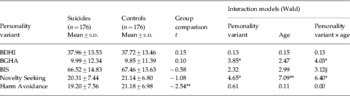
Results of multiple logistic regressions predicting suicide status by the interaction between personality variants and age while controlling for the independent contribution of these are presented in Table 3. For the following variants, the interaction between personality and age predicted suicide status after controlling for main effects for BIS (p=0.07) and BGHA (p<0.05), as well as Novelty Seeking (p<0.05). Harm Avoidance, however, did not interact with age to predict suicide status, yet group differences emerged between suicide and controls with respect to Harm Avoidance (p<0.01).
Interaction of personality variants and age to predict suicide status, directly controlling for major psychopathology

BDHI, Buss–Durkee Hostility Inventory; BGHA, Brown–Goodwin History of Aggression; BIS, Barratt Impulsiveness Scale.
* p⩽0.05, ** p⩽0.01
§ p=0.07.
Discussion
In this study, impulsive aggression and associated psychopathology was examined in a sample of 645 suicide cases aged 11–87 years. Although impulsivity and aggression have been associated with an earlier age of suicide attempts (Brent et al. Reference Brent, Oquendo, Birmaher, Greenhill, Kolko, Stanley, Zelazny, Brodsky, Firinciogullari, Ellis and Mann2003), this is, to the best of our knowledge, the first study to examine the effect of age on levels of impulsive aggression, a hypothesized vulnerability for suicide. Further, this study examines the relationship between age of suicide and predispositions to suicide while directly controlling for major psychopathological diagnoses using a case-control design.
Impulsivity and aggression
It has long been suggested that younger and older suicides are characterized by different diatheses, particularly by behaviours such as impulsivity and aggression, that predispose to suicide (Conwell et al. Reference Conwell, Duberstein, Cox, Herrmann, Forbes and Caine1996, Reference Conwell, Duberstein, Cox, Herrmann, Forbes and Caine1998). In this study, impulsivity and aggressive behaviours emerged as characteristics discriminating suicides of different ages in both univariate and multivariate analyses. Moreover, in a case-control examination of impulsive and aggressive behaviours directly controlling for major psychopathology, impulsive and aggressive behaviours interacted with age to predict suicide status above and beyond the independent contributions of each of these. Our findings suggest that impulsive-aggressive behaviours represent a mechanism whereby risk for suicide is increased primarily among younger suicides. This is consistent with previous results from our group (Kim et al. Reference Kim, Lesage, Seguin, Chawky, Vanier, Lipp and Turecki2003; Dumais et al. Reference Dumais, Lesage, Lalovic, Seguin, Tousignant, Chawky and Turecki2005b; Zouk et al. Reference Zouk, Tousignant, Seguin, Lesage and Turecki2006), and others (Brent et al. Reference Brent, Oquendo, Birmaher, Greenhill, Kolko, Stanley, Zelazny, Brodsky, Bridge, Ellis, Salazar and Mann2002, Reference Brent, Oquendo, Birmaher, Greenhill, Kolko, Stanley, Zelazny, Brodsky, Firinciogullari, Ellis and Mann2003), indicating that impulsive suicides tend to be younger than non-impulsive suicides and that non-violent suicide methods, potential markers of lower levels of lifetime aggression (Dumais et al. Reference Dumais, Lesage, Lalovic, Seguin, Tousignant, Chawky and Turecki2005b), are associated with older suicides.
Although one study has reported higher levels of aggression among older suicides compared to elder living individuals, this effect was less pronounced than among younger subjects and was limited to the ‘youngest’ of the elder sample (Conner et al. Reference Conner, Conwell, Duberstein and Eberly2004). Higher levels of these traits are also likely to similarly predispose older individuals to suicide, yet our results suggest that the higher one's level of these traits, the earlier in life one will engaged in lethal suicidal behaviour, perhaps as a result of decreased severity of stressors required to induce such behaviour.
Impulsive-aggressive behaviours have been defined as a tendency to react with animosity or overt hostility without consideration of possible consequences. Suicide researchers typically assessed this spectrum via a composite of constructs, namely impulsivity, hostility and aggression and used these interchangeably when referring to impulsive aggression. Recently, the important issue of which of these constructs is most strongly associated with suicidal behaviour has been raised (Keilp et al. Reference Keilp, Gorlyn, Oquendo, Brodsky, Ellis, Stanley and Mann2006). This is a valid question, for hostility is a mood state, aggressive acts may be impulsive or premeditated, and impulsivity is a trait encompassing spontaneous, poorly planned and situationally inappropriate behaviours, without necessarily including aggression. The difficulty in distinguishing between these aspects is that, from a suicidology perspective, they are all facets of the same underlying predisposition, none a necessary and sufficient cause of the other, never precluding the other, but each a manifestation of a predisposition to suicide subsumed under the impulsive aggressive suicide diathesis. Suicides have been often found to present a history of impulsivity co-morbid with other personality traits, particularly aggressive behaviours, and high levels of impulsivity correlate with high levels of aggressive behaviour/hostility. Moreover, there is evidence to suggest that suicide is the result of an interplay between trait-impulsivity and an individual's readiness to engage in aggressive behaviour (McGirr et al. Reference McGirr, Paris, Lesage, Renaud and Turecki2007). At the same time, it is important to bear in mind that the impulsive aggressive vulnerability does not necessarily characterize vulnerable individuals' attempts (Baca-Garcia et al. Reference Baca-Garcia, Diaz-Sastre, Basurte, Prieto, Ceverino, Saiz-Ruiz and de Leon2001). Instead, higher levels of these traits seem to afford greater consideration to suicide as a course of action, and so these traits seem to primarily facilitate acting out on suicidal ideation. The above-mentioned question, however, highlights the need to further refine the impulsive-aggressive phenotype.
It has been suggested that impulsivity may serve as the heritable mechanism whereby individuals' risk for suicide is increased (Kety, Reference Kety and Roy1986). Support for this proposition has been obtained among suicide attempters (Brent et al. Reference Brent, Oquendo, Birmaher, Greenhill, Kolko, Stanley, Zelazny, Brodsky, Bridge, Ellis, Salazar and Mann2002) and completers (Brent et al. Reference Brent, Bridge, Johnson and Connolly1996; Kim et al. Reference Kim, Seguin, Therrien, Riopel, Chawky, Lesage and Turecki2005). It has also been reported that the offspring of suicide attempters score higher on measures of impulsive aggression in addition to attempting suicide at a younger age (Brent et al. Reference Brent, Oquendo, Birmaher, Greenhill, Kolko, Stanley, Zelazny, Brodsky, Firinciogullari, Ellis and Mann2003). It is possible that impulsivity and aggression serve as intermediate phenotypes of suicide principally among younger individuals. Moreover, our results imply that heterogeneity may be reduced in genetic studies of suicide by restricting samples to more narrowly defined age groups.
Biological and genetic markers of impulsivity and aggression, especially serotonin and the serotonergic system have been largely studied (Roy & Linnoila, Reference Roy and Linnoila1988; Linnoila & Virkkunen, Reference Linnoila and Virkkunen1992; Coccaro et al. Reference Coccaro, Silverman, Klar, Horvath and Siever1994). These studies have implicated reduced serotonergic neurotransmission in impulsive behaviour (Stein et al. Reference Stein, Hollander and Liebowitz1993; Herpertz et al. Reference Herpertz, Sass and Favazza1997), as well as violent suicide methods (Asberg et al. Reference Asberg, Traskman and Thoren1976), which, as previously discussed, are indicators of higher levels of lifetime aggression and younger age of suicide (Dumais et al. Reference Dumais, Lesage, Lalovic, Seguin, Tousignant, Chawky and Turecki2005b). Thus, impulsivity and aggression may serve as intermediate phenotypes of suicide, that is, as behaviours that mediate, at least in part, the relationship between genes and suicide outcome. It remains to be determined what other genetic determinants and intermediate phenotypes predispose younger individuals to suicide and what mechanisms play a greater role in predisposition to suicide among older individuals.
Psychopathology
In line with previous findings, we found that depressive disorders were more prevalent among older suicides (Henriksson et al. Reference Henriksson, Marttunen, Isometsa, Heikkinen, Aro, Kuoppasalmi and Lonnqvist1995). It has been suggested that suicide may occur as a result of impulsive aggressive predispositions increasing the likelihood of acting on suicidal ideation. In line with such a proposition, tThe age-dependent prevalence of depression in conjunction with differential levels impulsivity and aggression may reflect an opportunistic relationship for the expression of impulsivity and aggression by way of suicide earlier in the life cycle. Although older suicides are more likely to meet criteria for depression (Conwell et al. Reference Conwell, Duberstein, Cox, Herrmann, Forbes and Caine1996), mood reactivity has emerged as a potent predictor among suicide attempters with psychopathology associated with impulse discontrol (Yen et al. Reference Yen, Shea, Sanislow, Grilo, Skodol, Gunderson, McGlashan, Zanarini and Morey2004), and may play a larger role in youth suicide. As such, depressed mood may represent a threshold interacting with impulsive aggression to result in suicide. Thus, while older individuals were more likely to have been depressed according to DSM-IV criteria, younger individuals may have been equally likely to have died during a depressive episode without presenting distinctly persistent depressed mood, as a result of mood valence interacting with impulsive and aggressive dispositions. Alternatively, as multivariate analyses did not reveal an independent effect for depression, younger and older suicides may manifest qualitatively different forms of depression or different levels of severity. This is an interesting issue that deserves further investigation.
In the current sample, individuals who met criteria for psychotic disorders were more likely to commit suicide at a younger age. This finding is consistent with current knowledge of the course of psychotic disorders and their relationship with suicide (Caldwell & Gottesman, Reference Caldwell and Gottesman1990). Previous studies have reported a decreasing risk for suicide with increasing age among this population (Black et al. Reference Black, Warrack and Winokur1985; Palmer et al. Reference Palmer, Pankratz and Bostwick2005) and that the period of greatest risk for suicide among psychotic individuals is in the first 10 years following illness onset (Brown, Reference Brown1997).
Limitations
The limitations to this study are inherent to post-mortem studies involving proxy-based interviews. This study's results on validity, however, are consistent with previous reports supporting the assessment of traits using behavioural measures by means of informants (Kelly & Mann, Reference Kelly and Mann1996; Conner et al. Reference Conner, Conwell and Duberstein2001; Zhang et al. Reference Zhang, Conwell, Wieczorek, Jiang, Jia and Zhou2003). Despite concerns that informant's age or the relationship with the subject might influence the recollection of lifetime history of aggression and perception of impulsivity, we have demonstrated that the relationship observed is not an artefact of the psychological autopsy design. Further, examinations of aggression and impulsivity among living individuals support our claim that the decreasing relationship with age is specific to individuals who die by suicide rather than a normal product of ageing. Stringent case-control analyses directly controlling for major psychopathology examining the interaction between age and impulsive aggressive behaviours confirm that impulsive and aggressive behaviours are mechanisms primarily increasing suicide risk earlier in the life cycle.
Conclusion
To the best of our knowledge, this is the first study to investigate the relationship between impulsive and aggressive behaviours and age of suicide completion among unselected suicides. We did so among 645 cases between the ages of 11 and 87 years. Our analyses indicate that higher levels of impulsivity and aggression characterize younger suicides. Our analyses indicate an inverse relationship between impulsive aggression and the age at which individuals die by suicide. Impulsive aggression may, as has been previously suggested, predispose individuals to the development of psychopathology strongly associated with suicide (e.g. substance abuse and cluster B personality disorders), yet in addition, our results suggest that impulsive aggression is itself associated with suicide earlier in life.
Acknowledgements
This study was supported by the Canadian Institute of Health Research (CIHR) and Fonds de Recherche en Santé du Québec (FRSQ). G. T. is a CIHR scholar.
Declaration of Interest
None.