Whereas most adverbs in English are formed with -ly or -Ø morphemes, a (albeit limited) set of adverbs ends in -s, predominantly adverbs ending in -ward(s), like forward(s), afterward(s), and inward(s), or -way(s), such as anyway(s) or halfway(s). An interesting attribute of these endings is that they are potentially two suffixes in one.Footnote 1 In what follows, we will refer to -ward(s)/-way(s) as suffixes, though we are noncommittal as to whether the suffix is -s or -ward(s)/-way(s).
Both have long been variable, -ward(s) since Old English (OED s.v. -s, suffix1) and -way(s) somewhat later. Attested variation (1, 2, 3) can be found from Early Modern English (1). Most of these forms can also be used with adjectival meaning (4), and some of them have gained additional functions (5, 6).
1. Variation in Early Modern English (examples from OED s.v. anyway):
a. Appease and ende all strifes, that anie waie touch the state. (1593, Thomas Bilson, The perpetual gouernement of Christes)
b. If any waies I haue erred vnto you..it was but..by ignoraunce. (1592, Angell Day, The English secretorie).
2. So you're going around the circle so you go forward, and then you have to switch to backwards (F, 19, Toronto)
3. But anyways, he was dead there, anyway (M, 86, Swords)
4. It's backwards engineering, if you want to talk about that. (M, 33, Kapuskasing)
5. toward(s) as a preposition:
Generally speaking, our orientation was out toward Clayton. We didn't come much to Perth. (M, 65, Almonte)
6. anyway(s) as a discourse-pragmatic (DP) marker (also see Ferrara, Reference Ferrara1997):
And ah my neighbourhood was ah suburban but there was still a fair amount of crime. Like I- I lived close to the- oh, I can't even remember the name of the mall. Anyway. But there was a- there was a fair amount of petty crime, and- and even some fairly violent crime. (M, 39, Kapuskasing)
Previous literature generally does not agree on the use of -s versus -Ø. On the one hand, scholars like Bauer, Lieber, and Plag (Reference Bauer, Lieber and Plag2013:328) argued that functional differentiation plays a role, with -Ø making an adjectival reading of the word available. On the other hand, other studies indicate that differences between varieties are more important (e.g., British versus American English, cf., Huddleston & Pullum [Reference Huddleston and Pullum2002:615, 688, fn. 8]; Quirk, Greenbaum, Leech, & Svartvik [Reference Quirk, Greenbaum, Leech and Svartvik1985:667]), or even that the use of -s or -Ø is “at the whim of the speaker” (Dixon, Reference Dixon2014:376). However, a systematic study of the use of these adverbs in spoken vernacular language is, to our knowledge, lacking. In this paper, we focus on data from contemporary Ontario English, mostly collected between 2003 and 2018, but with some historical data that were collected in the 1970s, 1980s, and 1990s, offering an apparent-time perspective for over 100 years. We will argue that the forms in -ward(s) and -way(s) have evolved differently in the last century, with linguistic and social factors playing contrasting roles depending on the suffix and on the word.
This paper is structured as follows. First, we provide an overview on adverbial -s. It will show that the literature is unclear about the variable use of this morpheme. Then, we describe the data and methods used in the analysis, followed by the results. Finally, we discuss and explain our findings in light of variationist sociolinguistic theory and principles of language change.
BACKGROUND
The use of -s and -Ø since Old English
According to the OED, -s (originally -es) was used in Old English to form adverbs of several masculine or neuter nouns (e.g., dæges ‘by day’, OED s.v. -s, suffix1) or of neuter adjectives (e.g., sóðes ‘truly’). It was identical to the genitive singular -es suffix of these nouns. Analogously to these adverbs, -es was also added to feminine nouns for marking adverbial usage (e.g., nihtes ‘by night’). At the same time, adverbs existed that were formed by the preposition to, which governed the genitive (e.g., tó-middes ‘tomids, in or into the middle [of]’), and synonymous adverbs that consisted of a dative or accusative form governed by a preposition (e.g., on-middan ‘amid’). In early Middle English, this resulted in the existence of mixed forms (e.g., a-middes ‘amidst,’Footnote 2 ‘in or into the middle of’). According to the OED (s.v. -s, suffix1), the coexistence of synonymous forms with and without -s (7) led to -s increasing in productivity, as it was added to other adverbs, to disambiguate their function (8).
7. John Milton, (1667). Paradise Lost. (OED, s.v. amid and amidst):
a. And all amid them stood the Tree of Life. (iv. 218)
b. The Fruit of this fair Tree amidst The Garden (ix.661)
8. This thinge I oftens talke vpon, And oft I thinke of this. (1567, Horace, Horace his arte of poetrie, pistles, and satyrs Englished (translated by Thomas Drant), sig. Hvv, OED, s.v. oftens, adv.)
To avoid data sparsity, this paper only focuses on words that can take -way(s) or -ward(s) in present-day vernacular Canadian English. The OED already indicated that the dominance of forms with -s vis-a-vis forms without -s depends on the adverbial suffix (e.g., -ward(s), -way(s), and -ling(s)) or on the word or dialect. Eftsoons ‘often, again, repeatedly,’ for instance, mostly occurred with -s, but oftens is only frequent with -s in Scottish (OED s.v. -s, suffix1). This contrasts with popular belief, such as Webster (Reference Webster1828; s.v. forward, adverb), who indicated that the use of forwards for forward is “a corruption.” Crucially, however, the history of the forms with and without -s is largely identical. The -ward and -wards suffix both arose from an Indo-Germanic stem *wert- ‘to turn’ and carried the meaning of ‘in the direction of the first part of the compound’ (e.g., backward(s) ‘in the direction of the back,’ OED s.v. -wards, suffix and -ward, suffix). Parallel forms with and without the -s have always coexisted and are nearly synonymous. The suffix -way(s) is considered a combining form in the OED that evolved from the noun way, originally used for routes or directions (e.g., ōðres weges ‘by another route,’ ānes weges ‘in one direction,’ OED, s.v. -ways, comb. form and s.v. -way, comb. form). In early Middle English it evolved more figurative uses that refer to “manner, means or way of acting” (OED, s.v. -ways, comb. form), which is the more frequent use in contemporary English (e.g., alway(s), someway(s) [9, 10]). The form with -s is generally considered the older variant, as the productivity of the -way(s) form as an adverbial marker arose from adverbial noun phrases in the genitive singular, which were reinterpreted as a single adverb (OED s.v. way, n.1 and int.1, P3a):
9. Moniwalde summes weis þolien flesches hardschipe. ‘Many are willing to undergo hardships of the flesh in some way.’ (ca. 1200, The English text of the Ancrene Riwle: edited from B.M. Cotton MS. Cleopatra C.vi (ed. Eric John Dobson), 261, OED s.v. someways, adv.)
10. God wyl be vengyd on us sum way. (ca. 1450, Ludus Coventriae, 40, OED s.v. someway, adv.)
Perspectives on the use of -s versus -Ø in present-day English
To our knowledge, very little research has been conducted on the use of -s versus -Ø for words in -ward(s) and -way(s). One exception is Ferrara (Reference Ferrara1997), who employed discourse analysis techniques to distinguish different uses of anyway in a corpus of oral narratives from Texas. While she did not analyze variation between -s versus -Ø in adverbial contexts further (ibid.: fn. 6), she reported, in passing (ibid.: 368–369), that anyways as a discourse marker is used more by individuals with a rural background and from lower social groups in comparison to the semantically equivalent variants anyway, anyhow, and at any rate.
There are a number of reference works (including work on English grammar, morphology, and the historical lexicon), that aim to explain cases in which the -s is preferred over -Ø. In general, these works are more explicit about words in -ward(s): only rarely is possible variation for two variants of the same word in -way and -ways acknowledged (e.g., Dixon, Reference Dixon2014:§10.6.2, OED, s.v. ways comb. form). If variation is acknowledged, it generally only applies to the word anyway(s) (e.g., Bauer et al., Reference Bauer, Lieber and Plag2013:329). For this reason, the discussion below extrapolates from influences that have been identified with regard to variation in the -ward(s) suffix.
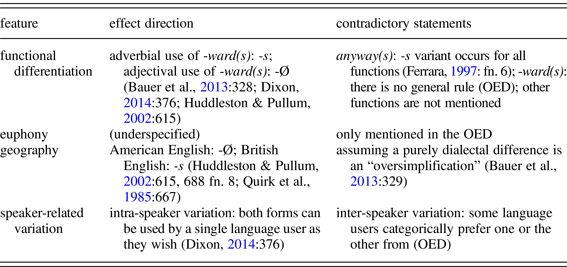
Interestingly, there is little agreement on the factors that explain the variation. Table 1 shows an overview of all the features that have been discussed.
Factors that influence -s versus -Ø in the -ward(s) suffix according to reference works
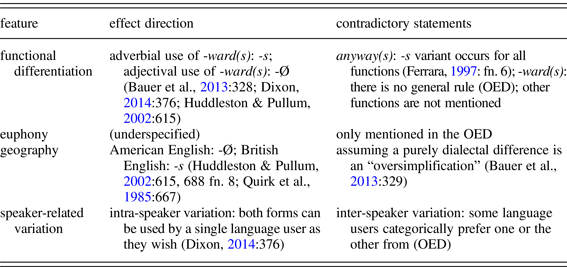
The first feature that is often mentioned is functional differentiation. Functional differentiation has been an important explanation for language change in historical linguistics and can be considered a result of the principle of isomorphism (cf., De Smet, D'Hoedt, Fonteyn, & Van Goethem, Reference De Smet, D'Hoedt, Fonteyn and Van Goethem2018), the tendency for natural languages to have a one-to-one mapping between meaning and function (e.g., Bolinger, Reference Bolinger1977; Haiman, Reference Haiman1980). Regarding anyway(s), functional differentiation is not considered important, as Ferrara (Reference Ferrara1997: fn. 6) indicated that the -s and -Ø variants occur for all functions of the word. For the -ward(s) suffix, however, most reference works (Bauer et al., Reference Bauer, Lieber and Plag2013:328; Dixon, Reference Dixon2014:376; Huddleston & Pullum, Reference Huddleston and Pullum2002:615) argue that adjectives occur with the -Ø form (e.g., The up-ward climb was tiring, [Dixon, Reference Dixon2014:376]) whereas adverbial tokens occur with -s (e.g., We climbed up-wards, [Dixon, Reference Dixon2014:376]). However, the reference works do not discuss whether -ward(s) words with functions other than adverbial or adjectival are differentiated with regard to the presence of -s or -Ø. Bauer et al. (Reference Bauer, Lieber and Plag2013:328), for example, noted that toward(s) and forward(s) are formed on prepositional bases but are semantically opaque, whereas most other words ending in -ward(s) retain their compositional semantics, if they are formed on a prepositional base (e.g., afterward(s), inward(s)), or are formed on a nominal base (e.g., productive examples like bedward(s), seaward(s)) or (directional) adjectival base (e.g., eastward(s), leftward(s)). They argue that toward(s) is particularly odd because it is the only word that functions as a preposition. Nonetheless, they go on to say that each of these words has variants in -s and in -Ø with the -Ø morpheme making an adjectival reading available (although afterward forms an exception, as it cannot be used as an adjective). Furthermore, the OED denies that functional differentiation plays any significant role. While it mentions that “the shade of meaning conveyed” may serve as an explanation for some uses of -wards versus -ward (in particular whether a notion of manner is involved, and whether or not the adverb refers to a definite or indefinite direction), it claims that the two forms are “nearly synonymous” and that “it would not be possible to give any general rule that would be universally accepted” (OED, s.v. -wards suffix). A feature that is mentioned by the OED (but not by any of the other reference works) to explain variation between -s and -Ø for the -ward(s) suffix, is euphony, ease of pronunciation, which in particular contexts may play a role for some individuals. However, the OED does not detail what this feature entails exactly.
While the two features above are language-internal characteristics, the third and fourth features mentioned in the literature concern external factors. More specifically, some of the reference works (Huddleston & Pullum, Reference Huddleston and Pullum2002:615, 688, fn. 8; Quirk et al., Reference Quirk, Greenbaum, Leech and Svartvik1985:667), claim that the use of -s versus -Ø depends on the variety of English, with American English using -Ø more and British English preferring -s. However, Bauer et al. (Reference Bauer, Lieber and Plag2013:329) argued that this distinction “is an oversimplification. Not only are the -wards forms used in [North American English], but the -ward forms are also used in [British English]. We can only say that there is variation between the forms.”
Following from the contradictions outlined above, a final oft-mentioned feature is that the use of -s versus -Ø is speaker-dependent or even random. Dixon (Reference Dixon2014:376), for example, argued that the use of the morphemes is “at the whim of the speaker.” The OED (s.v. -wards, suffix) seems to agree to some extent with this view, although it suggests that particular individuals prefer one form across the board, rather than specific forms in specific contexts: “some persons, apparently, have a fixed preference for the one or the other form.”
In sum, while the reference works contain some factors that may influence the variation between -s and -Ø, they do not agree on which ones are relevant, nor do they always agree on the direction of the effect. Additionally, the literature review has not revealed any research that has examined whether the use of -s versus -Ø has changed over time. This is relevant, because, since the -s as a marker of grammatical function has become redundant, it could be expected that the use of forms ending in -s would decrease, or that these words might take up a new function (exaptation). While most scholars indicate that the -s ending itself has become nonproductive, the -ward(s) suffix as a whole has not (Bauer et al., Reference Bauer, Lieber and Plag2013:328; Whitehead, Reference Whitehead1887). Additionally, except for Ferrara's (Reference Ferrara1997) study on discourse marker anyway(s), no one has examined whether social factors are involved or whether speaker-dependent variation occurs in empirical data. We aim to fill this gap in this paper by examining the use of words in -ward(s) and -way(s) in a corpus of spoken vernacular Canadian English.
DATA AND METHODS
Corpus and data retrieval
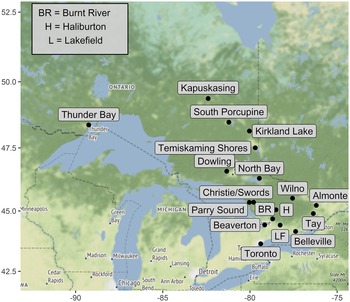
The data come from the Ontario Dialects Project (most recently Tagliamonte [Reference Tagliamonte2013–2018]). The aim of this ongoing project is to document the rich diversity of Ontario dialects and to investigate the patterns of language variation and change across Ontario, Canada (Tagliamonte, Reference Tagliamonte, Green and Meyers2014). The data were collected in diverse locations in the province (Figure 1), from the largest urban center of the region, Toronto, to a multitude of smaller communities in the north and southeast of Ontario. The data were collected between 2003 and 2018 by means of sociolinguistic interviews with locals, although there are also diachronic materials available for some communities, offering an apparent-time perspective for over 100 years. In total, the extent of the archive at the time of writing comprised 18 communities, 1087 individuals, and 11,034,676 words (June 2019).
Communities included in the Ontario Dialects project at the time of this study (June 2019).

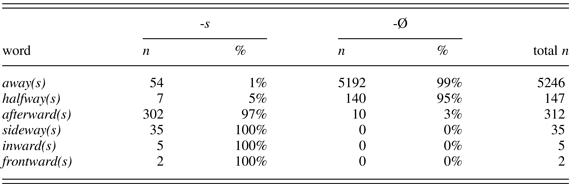
We limited the variable context under investigation to variable words ending in -ward(s) or -way(s).Footnote 3 To determine which of these were variable, we queried the corpus for all tokens ending in -wards and -ways using AntConc, a tool for corpus extraction and concordancing (Anthony, Reference Anthony2019). This resulted in a list of 14 words. As a next step, we extracted the forms of these words without -s from the corpus (e.g., afterward as the counterpart for afterwards). Then we excluded -ward(s) and -way(s) words that cannot be considered variable as they (nearly) categorically take -s or -Ø, that is, in at least 95% of all observations (see Guy [Reference Guy, Ferrara, Brown, Walters and Baugh1988:131–2] and Tagliamonte [Reference Tagliamonte2006:70–98] for discussion). There were six words in this group (see Table 2).
Excluded (non-variable) words (listed by increasing rate of -s)
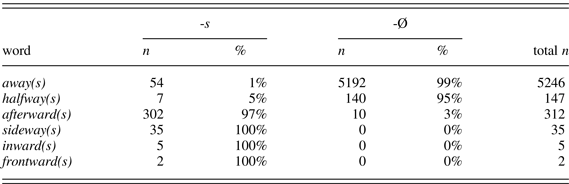
Interestingly, the table shows that all words in -way(s) (except for anyway(s), see below), viz. away(s), halfway(s), and sideway(s), show very little variation. This indicates that most words in -way(s) have become fixed in Ontario English. With the exception of anyway(s), none of them can be considered variable. The token counts for frontwards, inwards, and sideways are too low to draw any general conclusions about their lack of variability, but we can assume that afterward(s), halfway(s), and away(s) are more grammaticalized than the other -ward(s) and -way(s) words. While these words showed variation in the past, they are nearly categorically used with -s or -Ø, suggesting that they have undergone nearly complete split by adverbial suffix in present-day spoken Canadian English. Similarly, halfways with -s is only used by older individuals in the data (4 individuals, all aged 70 or older at the time of their interview). Additionally, the high degree of grammaticalization of afterward(s) and away(s) is further confirmed by their low degree of compositionality (cf., Brinton & Traugott, Reference Brinton and Traugott2005). Afterwards no longer clearly retains the original meaning of the -ward(s) suffix, ‘in the direction indicated by the first element of the compound’ (OED, s.v. -wards, suffix). Instead, its meaning has bleached to a more general notion of ‘later in time’ (OED, s.v. afterwards, adv.). Similarly, the meaning of away has bleached from ‘on (his or one's) way’ to a general sense of removal (OED, s.v. away, adv.). Thus, both of these words have undergone an additional semantic change and are at present interpreted holistically rather than as derivations or compounds.Footnote 4
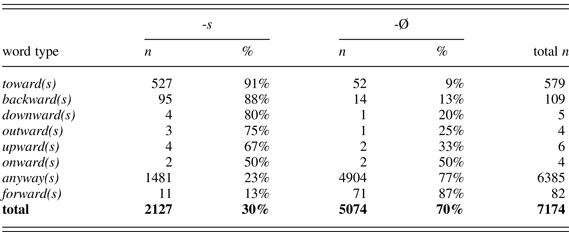
Finally, we excluded false starts from the dataset, as well as tokens where the word immediately following the -ward(s) or -way(s) word starts with a sibilant, as it is generally not feasible to determine whether the sibilant belongs to the -ward(s) or -way(s) word, and tokens in nonvariable contexts. Nonvariable contexts in the dataset include fixed compounds (11), specific (grammaticalized) nonvariable uses of forward as a verb (12), and fixed expressions (13). There were ten fixed expressions in the data, most of which are look forward (n = 150), or move forward (n = 37), all without -s. The others include aiming/geared/gravitate/inclined/work towards, come/pay it forward, and forward thinking. All of these fixed expressions occur with noncompositional (i.e., nondirectional) meaning. Using this data retrieval procedure and exclusions, we ended up with a dataset of 7174 tokens for eight variable words in -ward(s) or -way(s).
11. - and then you know fast-forward to grade ten I can remember a dude from Rail Cycle North coming to Kirkland-Lake and doing a presentation to the high-school students (T. Skarsgard, M, Kirkland Lake)
- The clean-up is going to be a lot more uh straight-forward (K. Macangus, M, Kapuskasing)
12. I have your e-mail, I can forward you the page where all of the stuff we have is put-up (S. Ermak, F, Toronto)
13. - So, it's just kind of that respect and pay it forward kind of mentality, I would assume (P. Stewart, F, Kapuskasing)
- So, my Grandmother Corr was very forward thinking (L. Draper, F, Almonte)
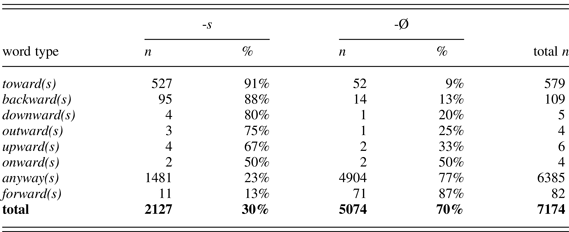
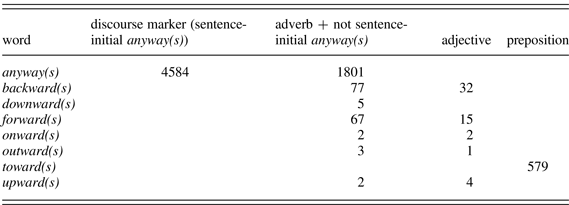
Table 3 shows the eight words that were found to be variable in the corpus. The table shows that there is robust variation in the dataset, with 30% -s overall. It also shows that this variation is highly dependent on the word, with the highest proportion of -s occurring with toward(s) and the lowest proportion with forward(s). Anyway(s) is by far the most frequent word in the dataset. If this word is excluded from the analysis, the proportion of -s increases dramatically, to 82% (n-s = 646, n -Ø = 143).
Distribution of -s and -Ø per word (words listed by decreasing frequency of -s)
Independent variables
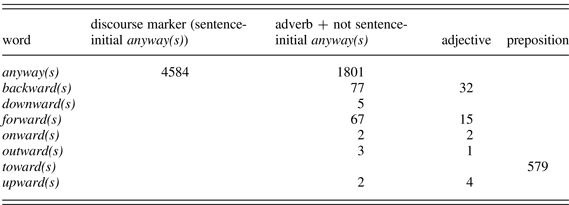
The data was coded for the factors from the literature mentioned above. The first factor is the function of the token. As indicated above, some scholars argue that functional differentiation affects the use of -s versus -Ø, with adjectival tokens taking -Ø and adverbial uses occurring with -s. For the seven words in -ward(s), we manually disambiguated each token for its function. For anyway(s), Ferrara (Reference Ferrara1997) distinguished discourse-pragmatic uses from adverbial tokens. She observed that discourse marker tokens always occur in sentence-initial position, whereas adverbial tokens can be sentence-medial or sentence-final (also see Haselow, Reference Haselow, Smith, Trousdale and Waltereit2015; Tabor & Traugott, Reference Tabor, Traugott, Ramat and Hopper1998:253–60). Thus, we coded each token of anyway(s) for its position: sentence-initial (discourse-pragmatic marker) or not sentence-initial (adverb). In total, the independent variable function has four categories (see Table 4), but due to the semantics of the different words, some words are predominantly used with particular functions. For example, as explained above, one of the word types in the dataset, viz. toward(s), is only used as a preposition. However, functional differentiation is expected to play a role solely for adverbial versus adjectival usages of the -ward(s) words. For each of these functions, multiple words are available.
Observed functions per word
Second, because the OED suggests that the use of -s versus -Ø depends on euphony, we coded the phonological context of each token in two ways. First, we examined the effect of the first character that follows the word in -ward(s) or -way(s). This predictor, first following character, has three possible levels: consonant, vowel, or other (e.g., sentence-final, followed by a pause, etc.). Additionally, we coded the length of the word following the -ward(s) or -way(s) word, under the assumption that, in spoken language, longer words influence the rhythmic flow of the sentence. By coding for this predictor, we can therefore examine whether rhythmic differences affect the variation. This predictor, number of following characters, has three levels: five or less, six or more, or disfluent (e.g., sentence-final, followed by a pause, etc.).
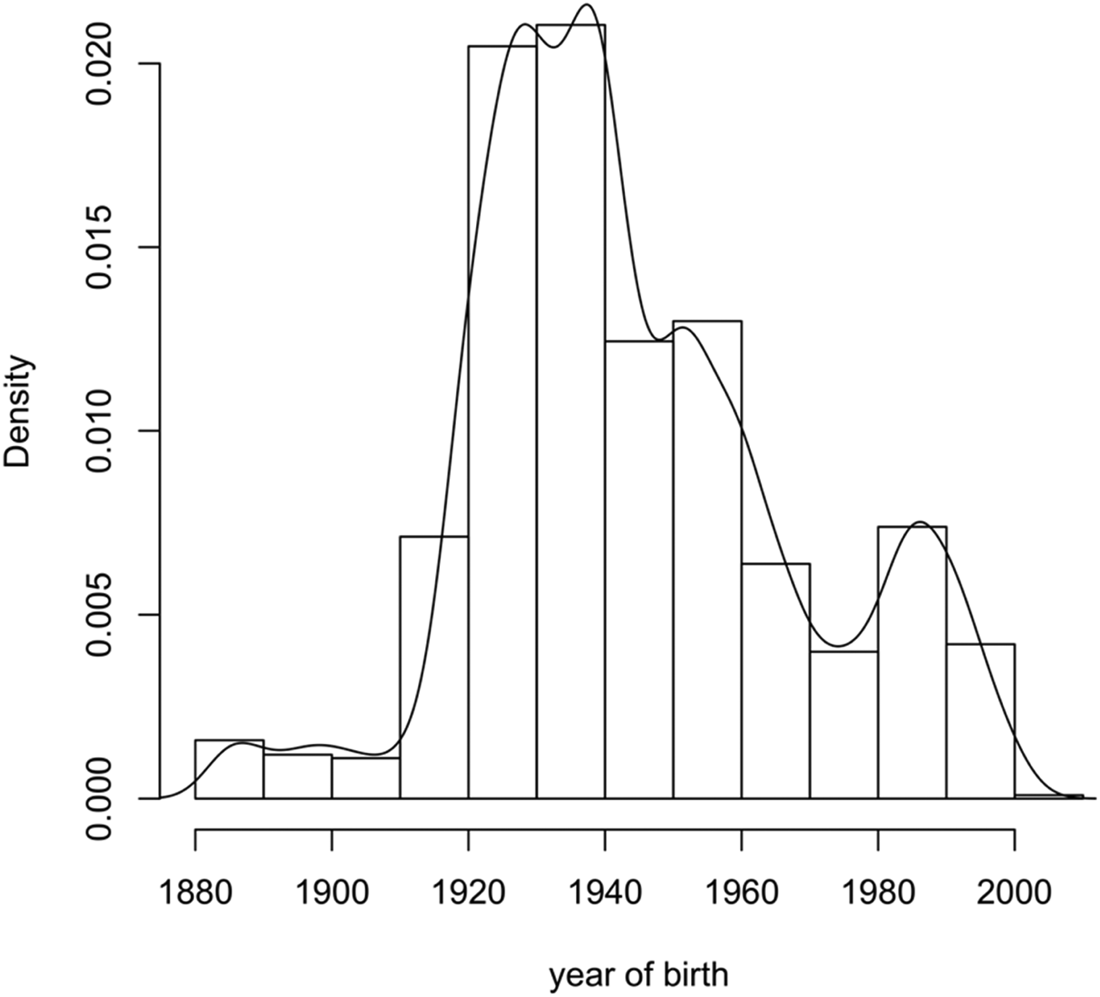
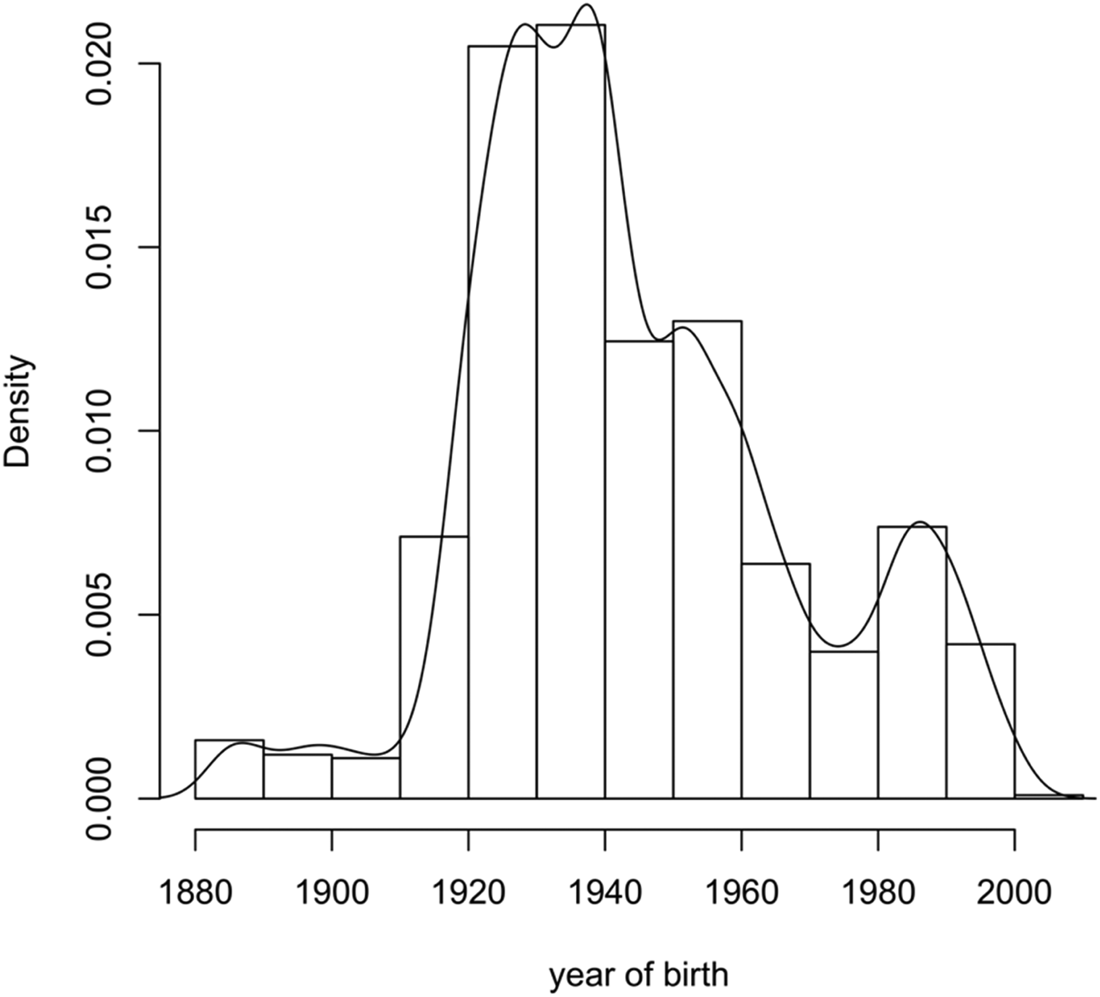
Finally, we also include social factors, more specifically, each individual's perceived gender (male or female), education level (with or without post-secondary education), and occupation level (blue-collar, white-collar, or student). Additionally, because the individuals in the dataset were born between 1884 and 2001, we test whether the use of -s versus -Ø can be considered a change in progress using an apparent-time perspective. For this reason, the individual's year of birth was included in the regression model. We center this predictor around its mean (1944) to reduce microlevel multicollinearity with the other predictors, particularly the interaction terms considered in the model (cf., Iacobucci, Schneider, Popovich, & Bakamitsos, Reference Iacobucci Dawn, Matthew, Popovich and Bakamitsos2016). Figure 2 shows a histogram of the years of birth of the individuals in the data.
Histogram of year of birth.
Methodology
To analyze the contribution of each of these variables, we rely on a three-step procedure. All analyses were carried out with R (R Core Team, 2019). First, we construct a conditional inference tree that includes all the words under scrutiny and all the independent variables. As a second step, we analyze only the data for anyway(s), which makes up the largest part of our data (n = 6385 tokens or 89%) with a generalized linear regression model. To select the variables included in this model, we start from a model that includes an interaction between all the independent variables and year of birth of the speaker and interactions between the sociolinguistic features gender, education level, and occupation level.Footnote 5 We subsequently remove interaction effects and main effects from the model that to do not reach significance (alpha level = 0.05).
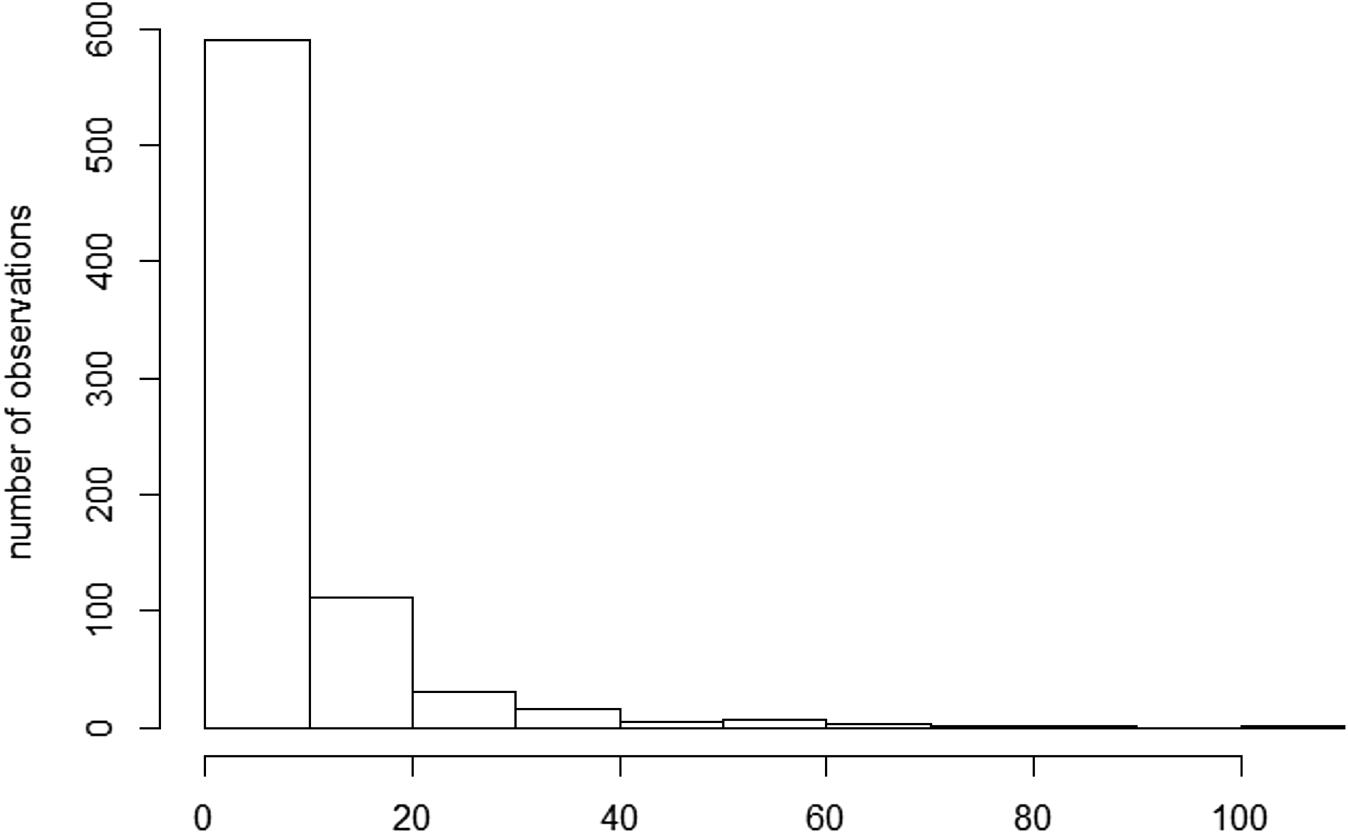
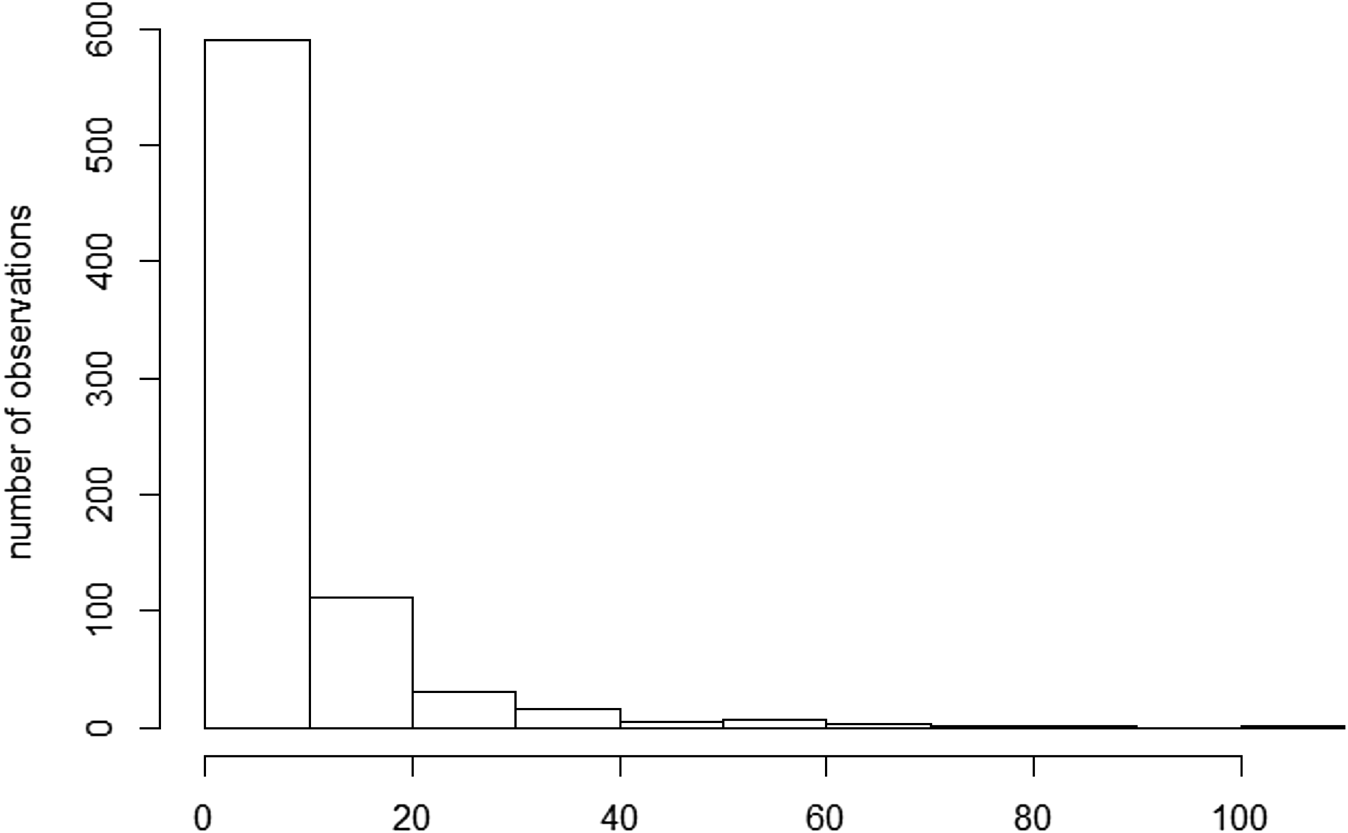
On a theoretical level and on a methodological level, we would like to include a random effect for speaker in the model for anyway(s): theoretically, several reference works argue that differences between individuals exist, and methodologically, we have multiple observations for many individuals in the data, which will probably be correlated. However, with this particular variable, the tokens are extremely unevenly distributed across the individuals in the data, with only 25% of the individuals (n = 194 out of 768 individuals) having ten or more observations (see Figure 3). Additionally, analyzing the responses of individuals with at least ten tokens indicates that some of these individuals categorically use the -s variant (6% or 13 individuals) and many often categorically use the -Ø variant (57% or 111 individuals).
Number of tokens per speakers for the word anyway(s).
To cope with this problem, we take the following approach: we first conduct a nonmixed regression analysis of all the data for anyway(s). Then, we use a bootstrapping procedure to verify that this model is not overly influenced by within-speaker variation. More specifically, we conduct 1000 bootstrap runs (using an adapted version of the algorithm in Baayen [Reference Baayen2008:307], available in the online appendix), with about 25% of the individuals randomly removed from the data in each run. Although this procedure does not control for within-speaker variation for the individuals for which multiple observations are available as much as would ideally be desired, we believe it has merit for a dataset as complicated as this one. This procedure confirms that the predictors are important enough to remain significant, even when individuals are randomly excluded from the dataset. The bootstrapping analysis demonstrates that we do not have enough data to support the inclusion of two interaction effects (viz. between year of birth and gender and between gender and education level). These interaction effects are therefore removed from the final model.
RESULTS
Conditional inference tree for all words in -ward(s) and -way(s)
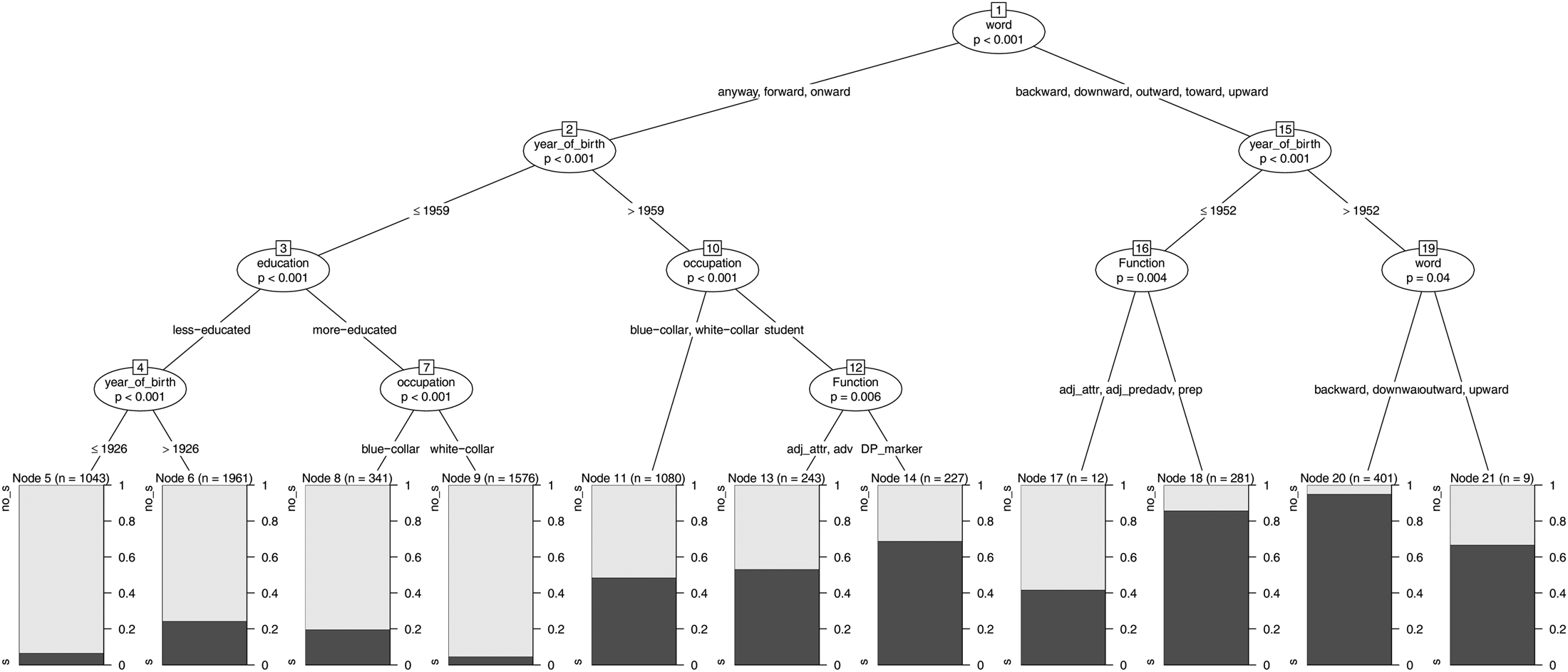
Figure 4 shows the conditional inference tree (with maximum depth set to four), which correctly predicts 80% of the tokens in the data.Footnote 6 The tree shows that there are dramatic differences between the words (node 1). On the right-hand side of the first split, most of the words in -ward(s) are shown. Interestingly, for older individuals (split off in node 15), functional differentiation is operative (node 16), with -s less frequent for adjectives (14) than for adverbs (15) or prepositional uses (16).
14. They lost all forward gears (T. Krieg, M, 50, Christie)
15. This whole big industrial thing went downwards (M. Pounding, M, 17, North Bay)
16. Heading towards the barn (A. Auer, M, 40, Temiskaming Shores)
Conditional inference tree.
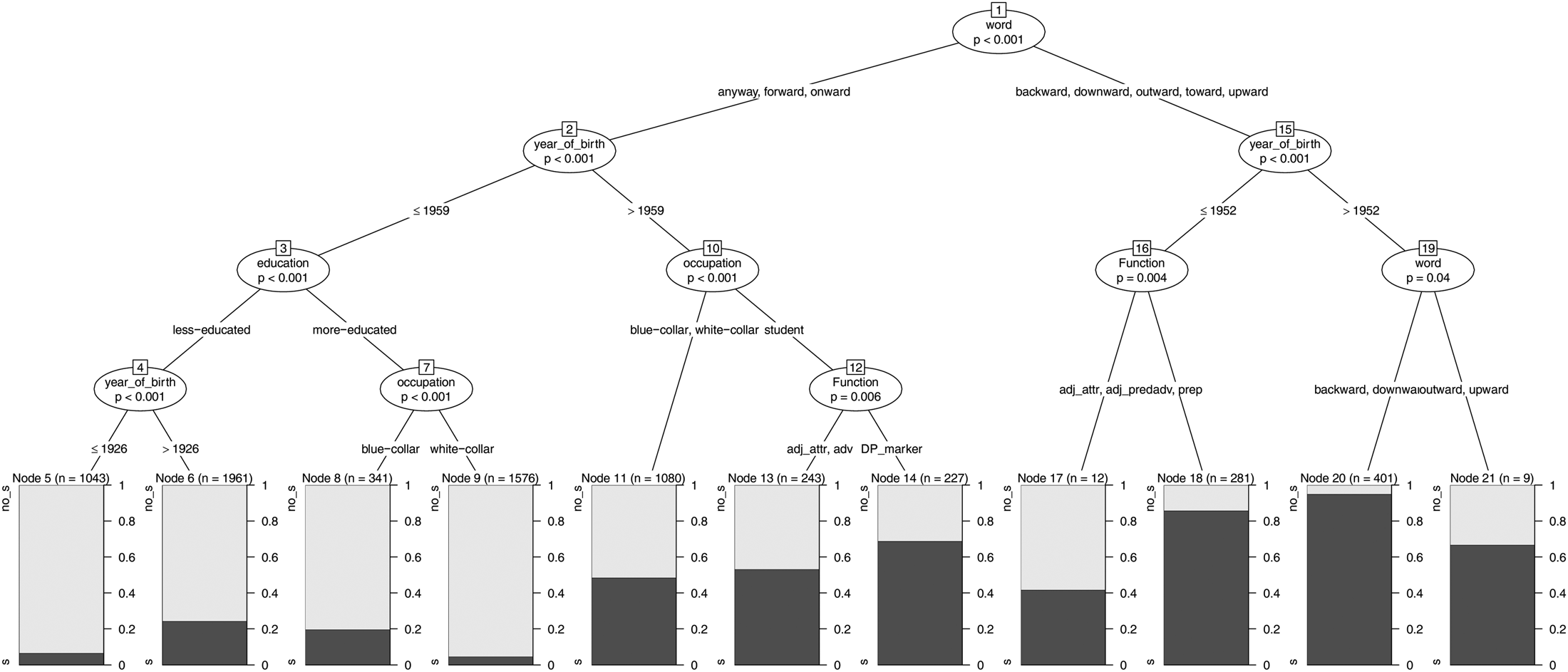
For younger individuals, this functional split disappears and the proportion of -s is mostly word-dependent. Node 19 indicates that the degree to which this process is complete depends on the word: backward(s), downward(s), and toward(s) nearly categorically take -s, whereas upward(s) and outward(s) still exhibit variation. In addition, toward(s), regardless of its unitary function as a preposition, does not behave differently from the other -ward(s) words. Overall, the splits on the right-hand side of the tree indicate that, while functional differentiation may have played a role in the past, for younger individuals it cannot be considered an important explanation for variation between -s and -Ø for the words in -ward(s). Instead, the words appear to be specializing by lexical item to one variant or the other in all their functions.
On the left side of the tree in node 1, anyway(s) is split off from most of the -ward(s) words together with forward(s) and onward(s). Overall, for these words, the -s variant occurs less frequently. However, here too a change in progress is visible with -s increasing in frequency in apparent time (node 2). Importantly, social factors are highly relevant (node 3: speaker education level, node 10: speaker occupation level). It is notable that only two of the -ward(s) words do not occur with -s frequently enough to be included in the right side of the tree. However, this distribution can probably be explained by two things. For onward(s), data sparseness probably plays a role: there are only four tokens (and 50% of these are with -s). Forward(s) likely occurs less with -s than the other -ward(s) words because of its high frequency as well as its occurrence without -s in phrasal verb constructions such as to look forward, to move forward (in the sense of ‘to move on’), and to pay it forward (see fn. 4 above). These phrasal verbs occur relatively frequently in the Ontario corpus (n = 179), but they were excluded from the analysis as forward is categorically used in these contexts without -s.
In sum, the conditional inference tree demonstrates that words in -ward(s) that do not occur in grammaticalized constructions are undergoing a change towards use of -s. The degree to which this change has advanced differs per word. Furthermore, while the frequency of -s is also increasing for anyway(s), this word shows more variation, in the sense that both -s and -Ø occur across the board, rather than in certain contexts, and is influenced by sociolinguistic factors. To examine the variation in anyway(s) in more detail, we conduct a generalized linear regression analysis in the next section.
Anyway(s)
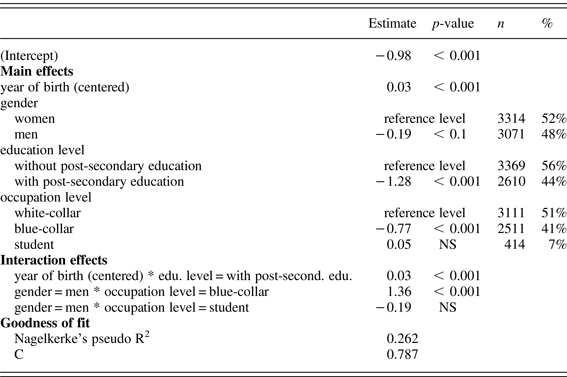
Table 5 shows the output of the generalized linear regression model for anyway(s) (excluding the interaction effects not supported after the bootstrapping procedure) together with some indications of its goodness of fit. Variables that were not selected as significant by our modeling procedure are function (discourse marker or adverb), first following character and number of following characters. Both Nagelkerke's pseudo R2 value (0.262) and the index of concordance C (0.787) indicate that the model has acceptable classificatory quality, although there is room for improvement, as C values of 0.8 or higher are generally interpreted as indicating adequate predictive power (Speelman, Reference Speelman, Glynn and Robinson2014:515).
Output of the generalized linear regression model predicting -s presence in anyway(s) (n = 6385)
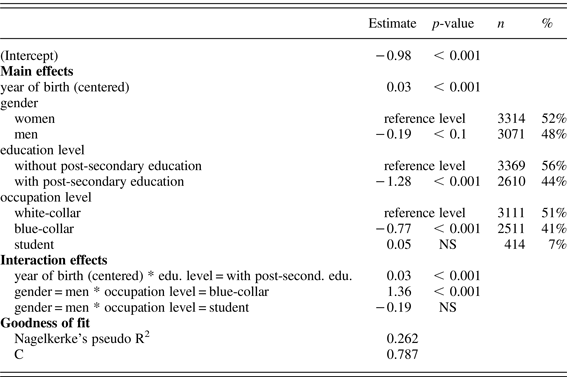
The model shown in Table 5 predicts -s, which means that significant p-values and a positive estimate indicate that a higher proportion of -s (and a lower proportion of -Ø) is predicted for a given category. For the numeric variable ‘year of birth,’ significant p-values and positive estimates indicate that the proportion of -s increases as individuals get younger, while significant p-values and negative estimates would predict the opposite effect. To interpret the results of the model, we will rely on visual inspection of the interaction effects below, as all the predictors are involved in interactions. Crucially, none of the language-internal features reach significance in the model, in contrast with previous observations in the literature.
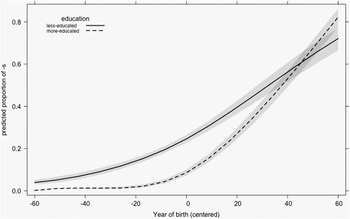
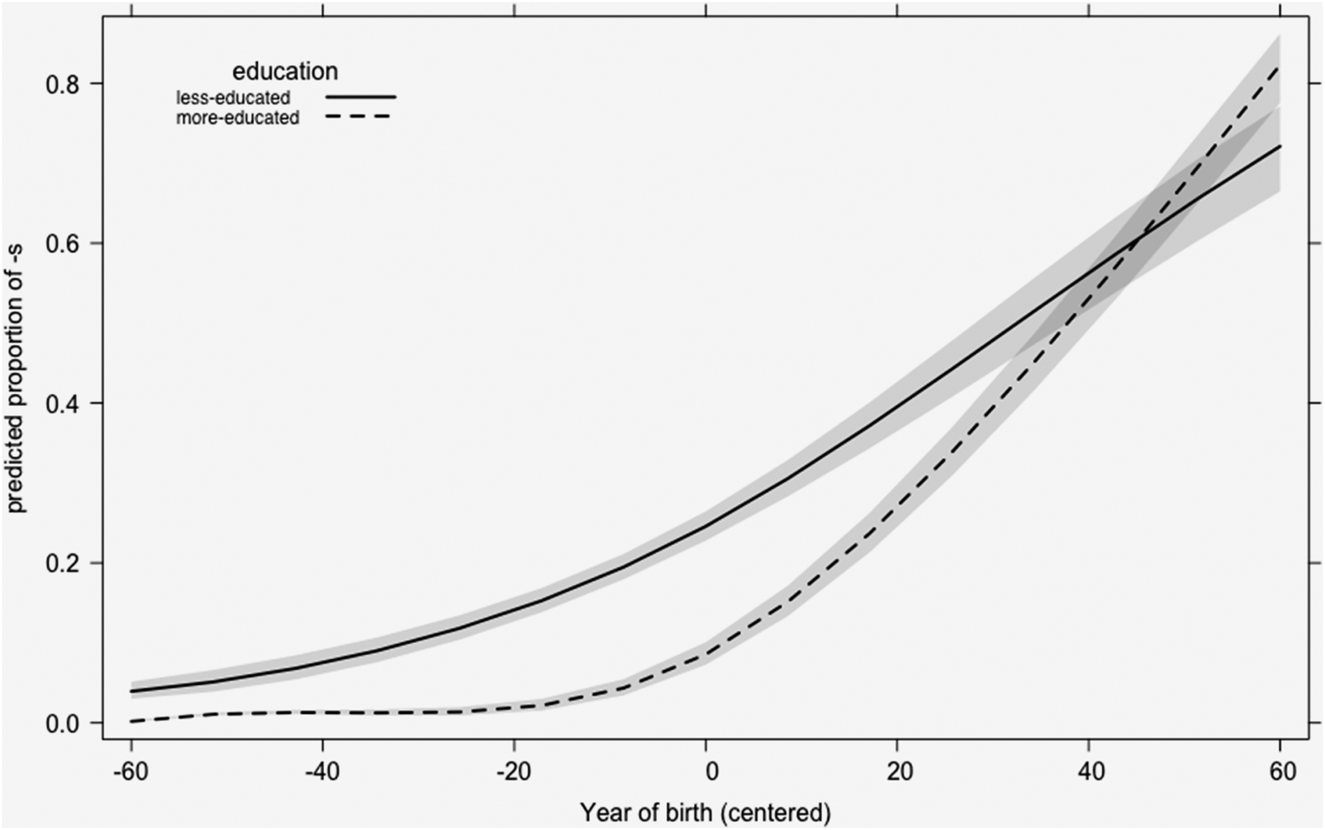
The first interaction effect in the model is between year of birth and education level. Figure 5 shows the predicted proportion of -s on the y-axis for people with or without post-secondary education. The figure indicates that there is a distinct contrast for older individuals with or without higher education: the people with a lower education level already use the variant with -s more, while the predicted proportion of this variant for older people with a higher education level is nearly zero. However, the difference between these two groups changes increasingly across the twentieth century as more educated individuals begin to use the variants with -s more. For the youngest individuals in the data, the education contrast reverses, with individuals with a higher education level using the variant with -s the most.
Interaction effect between year of birth (centered around the mean) and education level for use of -s in anyway(s).
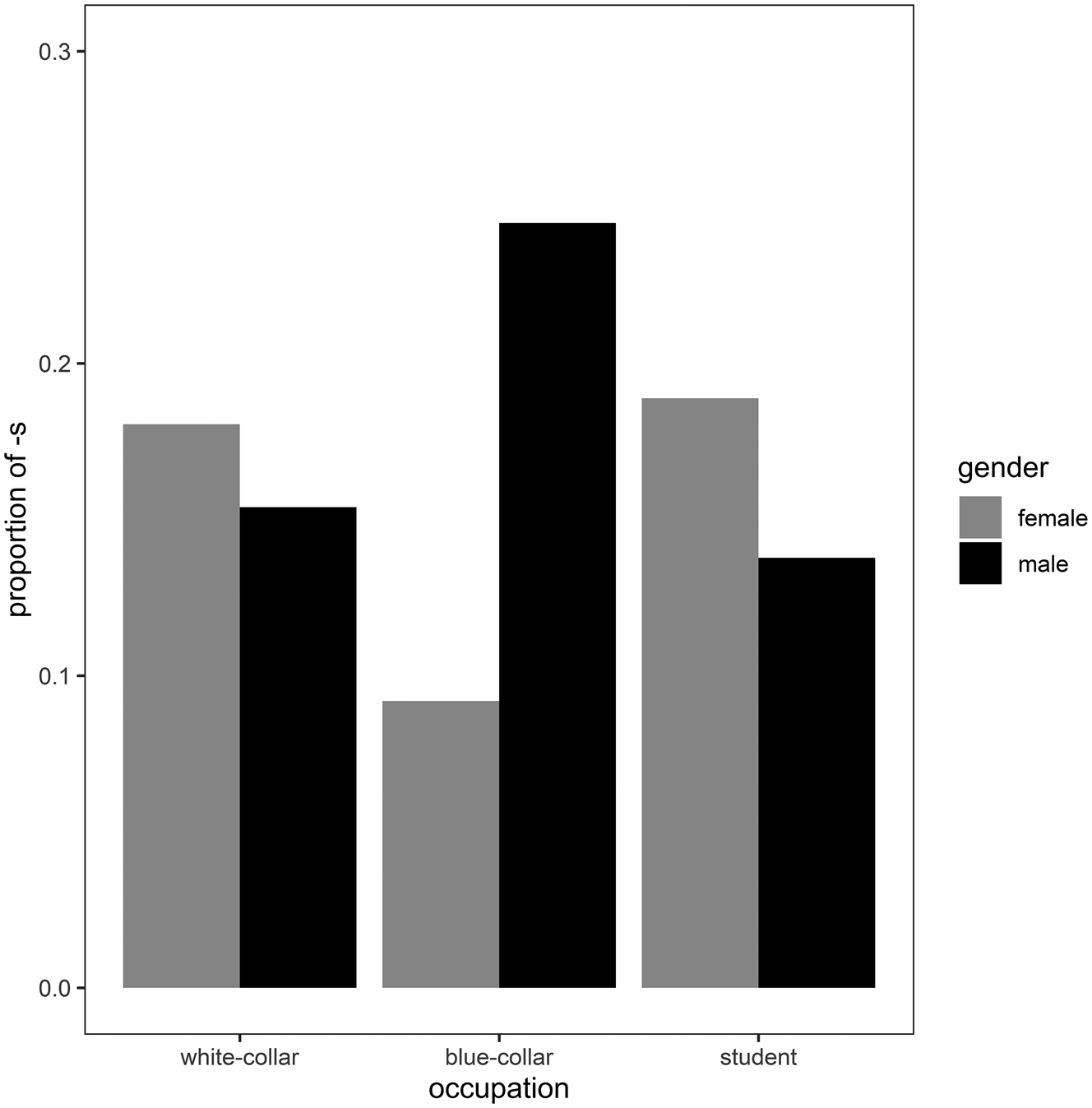
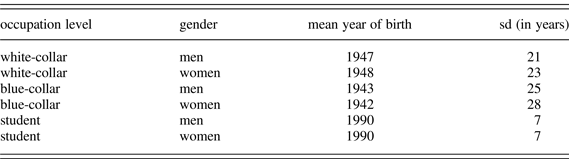
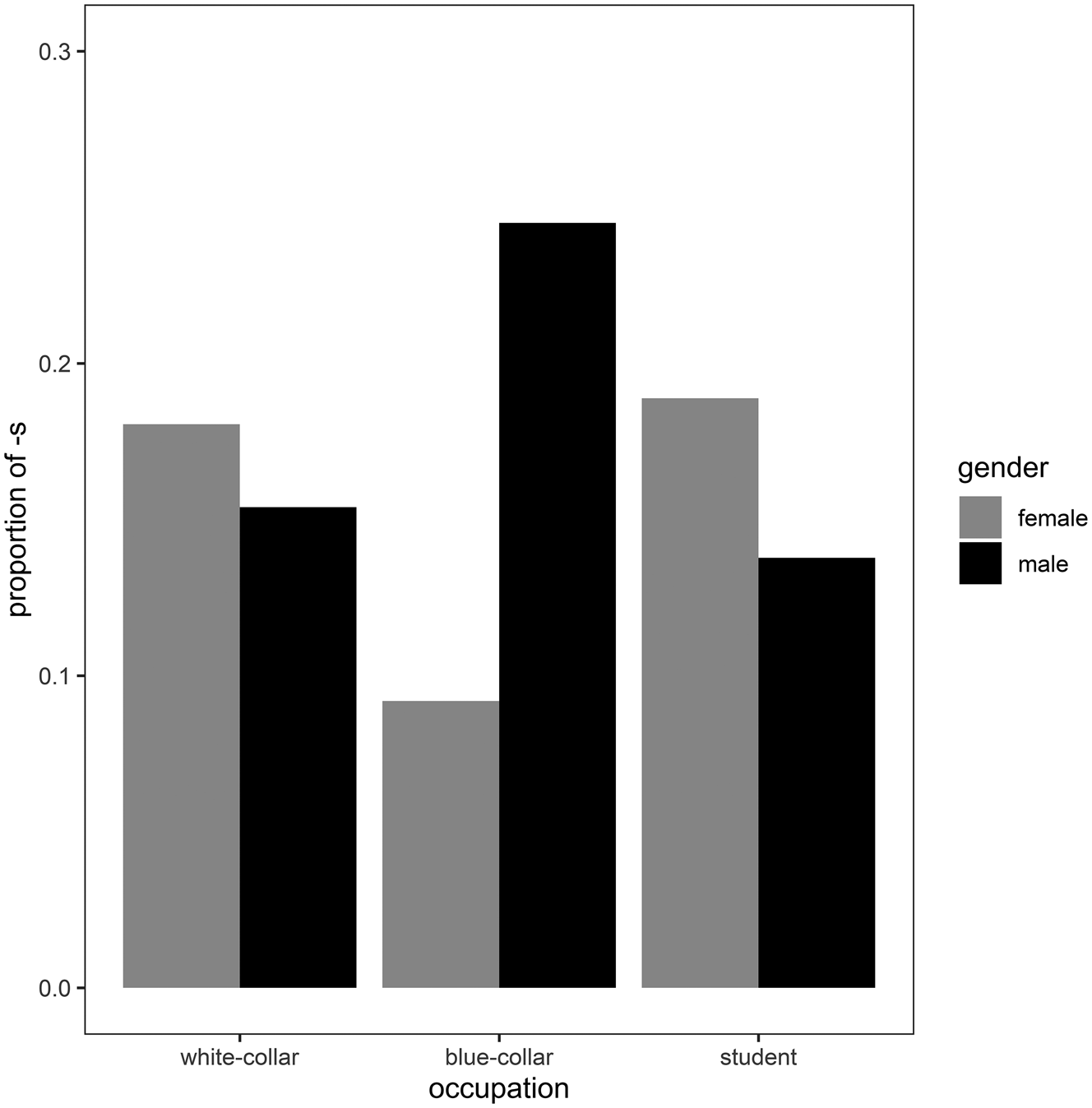
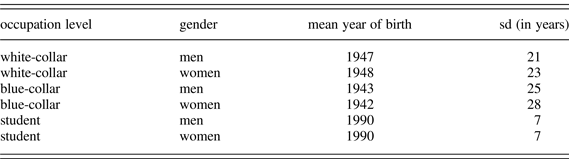
The second interaction effect in the model, between occupation level and speaker gender, is presented visually in Figure 6. This figure shows that blue-collar men use the -s variant more than blue-collar women, while there is no significant difference between white-collar men and women and between male and female students. This finding may be interpreted against the social meaning of the -s variant. While there is no gender-difference for white-collar workers, female blue-collar workers use it surprisingly infrequently in comparison to their male counterparts. This may be explained by the age differences between the groups, which is shown in Table 6 in terms of the mean and standard deviation for each group. Blue-collar workers are, on average, about five years older than white-collar workers. Thus, the gender pattern is a change from below with blue-collar men originally in the lead but white-collar women taking it forward. The students are on average much younger. This may explain why there is no gender difference between the students: the gender effect has disappeared, and the women have caught up to the men.
Interaction between occupation level and gender for use of -s in anyway(s).
Mean age and standard deviation by occupation level and gender
This general pattern of interaction and reversal of social factors is reminiscent of the situation described by Milroy, Milroy, Hartley, and Walshaw (Reference Milroy, Milroy, Hartley and Walshaw1994:351–2) for the rise of glottal stops in the UK. Glottalization is originally associated with blue-collar men, but middle-class women are instrumental in the innovation and spread of the glottal stop. Milroy et al. (Reference Milroy, Milroy, Hartley and Walshaw1994) suggested that one interpretation of this pattern is that, only when variants become established in the speech of women, their traditional stigmatized evaluation shifts to a prestigious one. Consistent with these results, our study shows that the leveling of the adverbial suffix variants for young people (students) and white-collar workers has led to a reversal of the low evaluation of the -s ending (anyways). While we cannot disentangle whether gaining prestige is contingent on women using the word with -s or whether the word gains prestige, and, therefore, women start using it, the parallel development of these two distinct changes in two different varieties of English is notable, suggesting an underlying regularity.
DISCUSSION
This paper analyzed the use of -s versus -Ø for words in -ward(s) and -way(s) in spoken vernacular Ontario English. Using a large database of spoken materials and taking an apparent-time perspective, we have demonstrated that, in Ontario English, the -s variant is increasing in frequency; however, there are significant differences between the words in which it is used and between the suffixes -ward(s) and -way(s).
First, by examining all possible forms in the data compared to the historical record, we discovered that some have become fixed in the contemporary language while others are still variable between -s and -Ø. For afterward(s), the -s variant occurs in 97% of the cases (n = 312). For inward(s) and frontward(s), the frequency of -s also surpasses 95%, although these words are not frequent enough to draw general conclusions. Additionally, most words in -way(s) nearly categorically occur with -Ø (one exception to this pattern is sideway(s), but this word only occurs 35 times in the data). Other than anyway(s), only two words were found in the corpus that still occasionally take -s (viz. away(s) and halfway(s)) although the -s variant is not frequent enough for these words to be considered variable, and, thus, to be included in the analysis.
Second, by delimiting the analysis to variable words and taking an apparent-time perspective, we found striking evidence for a trend for words in -ward(s) to specialize towards the -s variant. Because the corpus contains materials from people born as early as 1884 and as late as 2001, we can situate this process in the twentieth century. This general trend was confirmed by a conditional inference tree, treating each of the variable words separately. This analysis demonstrated a contrast between most -ward(s) words compared to anyway(s), with a general movement towards -s for -ward(s) and sociolinguistic correlates significantly predicting the variation in anyway(s). The conditional inference tree confirmed that this is a change in progress. In the early twentieth century, functional differentiation was key: for the older individuals, there is significantly less -s for adjectival uses. However, by the late twentieth century, among younger individuals, by-word differences are the only explanatory factor. We therefore conclude that the effect of functional differentiation mentioned in some of the reference works must have played a role in the past, but that it has lost any relevance in the contemporary language. Instead, among youth, the proportion of the -s variant depends on the word, with hardly any -Ø morphemes for backward(s), downward(s), and toward(s). Forward(s) forms an exception to this change toward -s with -wards words, probably because this latter word occurs frequently in grammaticalized constructions, such as to look forward, to move forward, and to pay it forward.
The pattern of variation and change in this system is thus not monolithic. The words used within constructions can be explained by a process of lexicalization (e.g., Brinton & Traugott, Reference Brinton and Traugott2005), whereby the meaning of the parts of a complex item becomes opaque and the unit is processed as a whole. However, in the case of the -ward(s) and -way(s) words, there are at least two possible explanations for the patterns in evidence: either the adverbial suffix -ward(s) or -way(s) is reanalyzed and stored as either ending in -s or -Ø, or the compositionality of a word in -ward(s) and -way(s) as a whole is lost. The analysis indicates that we find both patterns in the data. On the one hand, we find a general trend to -s for all the -ward(s) words that are frequent enough and to -Ø for most of the -way(s) words, which implies that these suffixes are becoming more fixed as -wards and -way. On the other hand, however, the extent to which this process is completed differs per word, and there are exceptions for both suffixes, which implies that this system is still in flux.
The sociolinguistic patterns for anyway(s) indicate that the use of -s can be considered a change from below that is solely governed by social features, as none of the language-internal features reach significance in the multifactorial model. Instead, the interaction effect between year of birth and speaker education level, on the one hand, indicates that the -s variant is increasing over time and that it has gained prestige recently. Its rate of increase in frequency is at first higher for individuals without post-secondary education than for people of a higher education level but shifts to the point where all individuals are increasingly using the -s variant more. Additionally, the interaction effect between occupation level and gender indicates that there is a notable gender difference for blue-collar workers. Compared to white-collar women, blue-collar men use the -s variant significantly more, while blue-collar women (who are also older than white-collar women on average) use it significantly less frequently. For students (who are generally younger) and for white-collar workers, this gender difference disappears.
While we have just argued that the change towards the -s variant can be considered a change from below, what historical principle can explain it? We suggest that this system shows evidence of exaptation (see Lass, Reference Lass1990, Reference Lass1997; Van De Velde & Norde, Reference Van de Velde, Norde, Norde and Van de Velde2016). Exaptation is the mechanism whereby a form that was originally used for a grammatical function (here: case marking) became redundant and can be repurposed for a novel function (here: social meaning). While this change is evident in the social contrasts (occupation and gender) at the beginning of the twentieth century, it appears to have leveled out, and the social meaning has fallen away.
Our study has a few shortcomings that should be addressed in future research. First, due to the complex distribution of the data over the individuals in the dataset, the regression model diagnostics indicated that a random effect for speaker was not supported by the data, even though some of the reference works indicate that by-speaker variation exists. While we were able to confirm that individuals differ with regard to the frequency of their use of the -s or -Ø variant, a follow-up study could use experimental methods to confirm to what extent this variation depends on individuals or on the specific context of the linguistic variable. Nevertheless, we believe that our novel way of ensuring that by-speaker variation does not influence the p-values and estimates for the fixed effects has merit for this and other studies in variationist sociolinguistics and empirical approaches to linguistics at large, as these are often characterized by unequal data distributions (see, for instance, the discussion in Tagliamonte & Baayen [Reference Tagliamonte and Baayen2012:142–6, 165–7] on unequal token counts for individuals in sociolinguistic data and Bauer [Reference Bauer, Chambers, Trudgill and Schilling-Estes2002:102–4] and Szmrecsanyi & Anderwald [Reference Szmrecsanyi, Anderwald, Boberg, Nerbonne and Watt2018:308–9] on the issues in using corpora of naturalistic language for sociolinguistic research).
Third, one of the features cited by many reference works as an explanation for variation between -Ø and -s, is that the -s variant occurs more in British English, while -Ø is more frequent in American English. However, we did a preliminary check of British English using our holdings for York English (Tagliamonte, Reference Tagliamonte1998) and the Roots Corpus (Tagliamonte, Smith, & Lawrence, Reference Tagliamonte, Smith, Lawrence, Filppula, Klemola, Palander and Penttilä2004) and discovered that, in both data sets, the -s variant is frequent for words in -ward(s).Footnote 7 This suggests that the trend towards -s is a general one; however, the other contrasts within the Ontario system require further investigation. Examining these patterns in other varieties of English will provide further insight into the degree to which the results that we obtained are also valid for other Englishes. We might wonder, for example, whether the change towards -s also occurs in US English, a variety geographically close to Canadian English, but with differing social history and population mixes.
Another question that remains is why anyway(s) and some of the -ward(s) words still show variation at all. We suggest that the interaction between by-suffix and by-word differentiation affects variation for some of the words in -ward(s). Perhaps we may even assume that a broader process of analogical extension plays a role as the -s has previously lost productivity, undergone exaptation, and developed new functions in other grammatical categories, such as third person singular verbs (see Childs & Van Herk, Reference Childs and Van Herk2014; Godfrey & Tagliamonte, Reference Godfrey and Tagliamonte1999; Lass, Reference Lass1990; Rupp & Britain, Reference Rupp and Britain2019). The fact that the change under investigation is characterized by particularly notable differential take-up across grammatical categories and lexical items, is likely due to the fact that this change is still in progress.
CONCLUSION
This paper uncovered a contemporary language change in an underresearched linguistic variable, viz. variation between -Ø and -s for the adverbial suffixes -ward(s) and -way(s). Why is it the case that there is so much variation? Taking all the findings into account, we suggest that, over the course of the twentieth century, a number of intersecting linguistic changes have occurred. First, certain constructions have lexicalized to a single form in phrasal verbs, for example, move forward. Second, the word anyway(s) has split off from the general trend, rising in frequency propelled by social correlates (exaptation) and likely developing a separate discourse-pragmatic function (cf., Tabor & Traugott, Reference Tabor, Traugott, Ramat and Hopper1998). Third, a group of adverbs that were once involved in a systemic process of word formation via -s suffixation that marked grammatical function(s), has lost this regularity to develop a new orderliness: most words in -ward(s) are being marked with -s, consistent with a general process of analogical extension. Thus, three intersecting processes are involved in this variable: lexicalization of phrasal verbs, splitting of a class of adverbial suffixes, each to its own form, and, more recently, a novel development of one word to a discourse-pragmatic function. Further, these developments can be pinpointed to the latter half of the twentieth century in Ontario. Taken together, this ‘system’ seems to be a particularly good example of what Lass (Reference Lass1997:317) meant when he said that “languages are not fully coherent systems.” Instead, they are:
“historically evolved systems … based at least partly on bricolage, cobbling, jerry-building, … pieces of such systems are always falling off and if not lost are recycled, often in amazingly original and clever ways.” (Lass, Reference Lass1997:316)
In sum, this study has provided a bird's eye view on how one linguistic system is evolving, in this case, not staying static, but reorganizing across time, not entirely systematic, but splitting off into new networks as the language evolves into its new design.
SUPPLEMENTARY MATERIAL
To view supplementary material for this article, please visit https://doi.org/10.1017/S0954394520000083.