Introduction
Over the last few decades, the way older people spend their retirement and their responses to the extension of working life have become frequently discussed topics in both academia and politics. Most theoretical and empirical evidence emphasises how consumption drops dramatically after people retire (referred to as ‘the retirement consumption puzzle’), which is not consistent with lifetime optimising behaviour (Banks et al. Reference Banks, Blundell and Tanner1998; Battistin et al. Reference Battistin, Brugiavini, Rettore and Weber2009; Schwerdt Reference Schwerdt2005; Smith Reference Smith2006; Wakabayash Reference Wakabayashi2008). These studies suggest that the retirement consumption decline may be related to unexpectedly low pensions, little accumulated wealth, involuntary retirement and uncertainty surrounding health shocks (Bernheim et al. Reference Bernheim, Skinner and Weinberg2001; Hamermesh Reference Hamermesh1982; Hurst Reference Hurst2008). These findings have been evidenced in different countries, both developed and developing (Li et al. Reference Li, Shi and Wu2015). Declines in expenditure at the time of retirement result in reduced life quality levels for elderly persons, placing pressure on them in regard to healthy and active ageing.
Acceleration of the ageing process also poses a challenge to different countries’ sustainable development. Specifically, an ageing population leads to a shortage of working-age populations and rising labour costs, which reduces the competitiveness of labour-intensive industries in international markets (especially for developing countries). In addition, the growing population life expectancy causes a serious shortfall in pension funds during the transition from a pay-as-you-go system to an investment-based system, which places pressure on national financial systems. One possible option to alleviate the pressures of ageing is to extend the length of older people’s working lives (Börsch-Supan et al. Reference Börsch-Supan, Härtl and Ludwig2014). For instance, the USA has raised the retirement age for full pensions from 65 to 67, and Japan has postponed the retirement system for three periods at the ages of 60, 65 and 70. Postponing retirement policies have also been advocated for by some in countries such as France, Italy, Korea and Germany, which are suffering from a serious ageing problem and poor birth rates (Galasso Reference Galasso2008). To deal with the negative effects of an ageing population, China has officially put postponing retirement reform on the policy agenda of government departments. Despite this measure, which is currently maintaining the social pension security system in a sustainable manner, the appropriate retirement age and the pace of policy implementation still need to be deliberated (Caliendo et al. Reference Caliendo, Casanova, Gorry and Slavov2023; Fisher et al. Reference Fisher, Chaffee and Sonnega2016).
As mentioned, there has been a considerable amount of research on the issues of retirement consumption and the work participation of older people. However, little is known about the relationship between post-retirement work and older people’s consumption expenditure. Does post-retirement employment increase older people’s spending? Is there any difference between groups at different consumption levels or genders? What driving mechanism underlies this phenomenon? This article aims to find answers to these questions by investigating the influencing mechanism of post-retirement employment on older people’s consumption.
Using data from the 2018 China Health and Retirement Longitudinal Study (CHARLS 2018) – a set of high-quality microdata representing households and individuals aged 45 and over in urban China – we explore how post-retirement employment can influence older people’s consumption expenditure. The expenditure of the urban older people who do not work after retirement is used as the control group, with a propensity score matching model. The benefit of this measure is that it prevents endogeneity problems due to sample selection bias, as post-retirement employment is often driven by individual choices. Specifically, urban older people who are less well-off may be more willing to work in retirement, or there may be older people in better health who are more willing and able to do so, thus creating the problem of adverse selection. The propensity score matching model solves this issue by aligning other factors outside of whether to work after retirement. Thus, we employ the propensity score matching model to robustly examine the impact of post-retirement employment on older people’s expenditures and the channels through which it operates. Additionally, we employed the kinky least squares (KLS) method as a supplementary approach to further reduce the effect of endogeneity.
In order to test how post-retirement work affects older people’s expenditure, we focus on the coefficients across different consumption levels and genders, based on a baseline estimation. The baseline estimation results suggest that, rather than promoting retirees’ spending, post-retirement employment reduces their consumption expenditure, a situation that diminishes as older people’s consumption levels rise. Moreover, compared to women, the consumption of male retirees is more negatively affected.
This study investigates the influencing mechanisms that may account for why post-retirement employment leads to older people’s consumption expenditure declines. Three possible channels are examined, including income, social activity participation and self-rated health status, which explain the findings of this paper. Results of the mechanism analysis suggest that post-retirement employment enhances retirees’ income, participation in social activities and self-rated health. Notably, the improvements in self-rated health can reduce medical care expenditure for older people, which accounts for 43.66 per cent of their household consumption expenditure. However, the three channels of influence show differential effects at the levels of consumption and gender. For example, post-retirement employment only promotes participation in social activities among the high consumption group. Re-entry into employment has a negative impact on the subjective health outcomes of the low consumption group and no significant impact on female retirees’ self-rated health status. In addition, the use of social media and electronic payments moderates this negative effect on elderly persons’ spending.
This article makes three main contributions to existing research. First, it broadens the literature regarding retirement consumption by considering post-retirement work. The traditional life cycle theory assumes that rational individuals organise their consumption over time according to their lifetime income, rather than their current income (Friedman Reference Friedman1957; Modigliani and Brumberg Reference Modigliani and Brumberg1954). However, the emergence of ‘the retirement consumption puzzle’ has shaken this theoretical assumption. For instance, post-retirement consumption expenditure declines may be due to work-related expenditure (e.g., transport, clothing, etc.) and food expenditure – a notion that is supported by a number of studies (Hurd and Rohwedder Reference Hurd and Rohwedder2006; Hurst Reference Hurst2008). Other research confirms the existence of ‘China’s retirement consumption puzzle’, suggesting that the decline in post-retirement consumption is reflected in different categories of spending (Chen et al. Reference Chen, Deng, Bai and He2017; Deng et al. Reference Deng, Zhao and Hu2022; Li et al. Reference Li, Shi and Wu2015, Reference Li, Shi and Wu2016; Zou and Yu Reference Zou and Yu2015). While a reduction in work-related expenditure after retirement has been proven, whether post-retirement employment can change this situation for the better remains unknown. This study contributes to this strand of research by providing new evidence of how post-retirement work affects retirees’ spending, verifying possible influencing channels.
Second, the possibility of extending the working lives of older people is explored from a consumer welfare perspective. Since extending the retirement age has become a commonly used measure to tackle ageing, there is growing interest in the employment behaviour of older populations. In most societies, post-retirement work is regarded as a major component of active ageing (Deeming Reference Deeming2009). However, research on the post-retirement labour force participation of older people is limited, especially in sociological fields. Maestas (Reference Maestas2010) suggests that one reason for the relative lack of research on retirement employment is that it has long been assumed to be a relatively rare phenomenon. Early theoretical studies of retirement behaviour have focused on demonstrating the existence of and trends in post-retirement employment behaviour (Blau Reference Blau1994; Hayward et al. Reference Hayward, Hardy and Liu1994; Herz Reference Herz1995; Pleau and Shauman Reference Pleau and Shauman2013; Rust and Phelan Reference Rust and Phelan1997). As retirees increasingly return to work, there is concern about the causes and consequences of post-retirement employment. These research findings suggest that demographic factors (e.g., gender, health, education, psychological, etc.) and social contexts (e.g., work-related factors, pension, nationalities, etc.) might be related to retirees’ back-to-work behaviour (De Wind et al. Reference De Wind, Scharn, Geuskens, van der Beek and Boot2018; Madero-Cabib and Kaeser Reference Madero-Cabib and Kaeser2016; Schreurs et al. Reference Schreurs, Van Emmerik, De Cuyper, Notelaers and De Witte2011; Wöhrmann et al. Reference Wöhrmann, Fasbender and Deller2016).
These findings emphasise the complexity and diversity of factors influencing older people’s post-retirement work. In contrast to the factors affecting older people’s post-retirement work, less is known about the outcomes arising from post-retirement employment. So far, results regarding the impact of post-retirement employment have focused on health-related outcomes. Some results imply that post-retirement work has negative effects on health. For instance, high-strain jobs could lead to low levels of health and well-being, as well as low productivity, task performance and job satisfaction (Dingemans and Henkens Reference Dingemans and Henkens2020). In addition, working after retiring could threaten life satisfaction if retirees feel forced to work for financial reasons (Dingemans and Henkens Reference Dingemans and Henkens2014). On the other hand, several studies show a positive relationship between post-retirement work and health outcomes. There is a beneficial effect of post-retirement work on self-assessed health and depressive symptoms for both women and men (Silver et al. Reference Silver, Dass and Laporte2020). Specifically, older people who decide to work after retirement for recreational reasons experience higher levels of life satisfaction and well-being (Dingemans and Henkens Reference Dingemans and Henkens2019). Studies to date have typically focused on the effect of post-retirement work on health and have ignored the effect of going back to work on consumption. An individual’s consumer behaviour is closely linked to well-being and life satisfaction. By exploring the spending of older people after returning to work, it is possible to provide a more objective and realistic view of extending the working lives of older people.
Third, the contribution of the adoption of information and communication technologies (ICTs) is considered in this study, adding to the literature on post-retirement consumption with the consideration of internet use. The advent of information technology has had persistent influences on the lifestyles of people today (e.g., social behaviour, consumer behaviour, etc.). On the one hand, using ICTs can contribute to improving socio-emotional outcomes by supporting older adults to overcome time and distance in establishing or maintaining social relationships, thereby reducing social isolation and loneliness (Antoci et al. Reference Antoci, Sabatini and Sodini2014; Cotten et al. Reference Cotten, Anderson and McCullough2013; Shi et al. Reference Shi, Liu, Fu and Dai2023). On the other hand, the rise of e-commerce platforms, the popularity of internet use and the convenience of electronic payments may change traditional consumer behaviour (Fowler et al. Reference Fowler, Gentry and Reisenwitz2015; Niu Reference Niu2013; Zhang and Guo Reference Zhang and Guo2020), which holds true for older people as well (He et al. Reference He, Li and Wang2022). In this study, ICT applications, such as social media and electronic payments, are employed as moderators in the analysis of the impact of post-retirement employment on consumption.
The remainder of this article is organised as follows: the next section describes the background and hypotheses, while the third section introduces the methodology, the model design, the measurement of the variables and the descriptive statistics of the study. Then come two sections that present the results and explanations, and a discussion of the proposed models, before the final section provides conclusions for and limitations of the study.
Background and hypotheses
Retirement system in China
Since the 1950s, the retirement system in China has operated under a mandatory scheme that regulates the official retirement age (according to the Labour Insurance Regulations 1953 and the Provisional Provisions on the Retirement of Workers and Staff (Draft) 1958). The system sets different retirement ages for different occupational positions – generally 60 for men and 55 for women for ‘cadres’, and 60 for men and 50 for women for ‘workers’. In addition, the retirement age is suitably early for those who are engaged in special types of work such as high-risk (e.g., underground, high-altitude, high-temperature), hazardous work or those who have lost the ability to work due to a work-related illness. Regular administrative retirement (i.e., retirement procedures) includes regular retirement, early retirement and internal retirement. The 1990s and early 2000s can also be seen as a transitional period of massive growth in China, during which small businesses proliferated, migrants surged and unstable government policies became pervasive in urban areas. In this market environment, the mandatory retirement age for workers was not strictly enforced (Che and Li Reference Che and Li2018). Furthermore, a significant proportion of the rural population exhibits employment flexibility, as they engage in both agricultural activities in their own households and temporary urban work (e.g., as migrant workers). This implies that their duration of work is determined by individual choices and is not influenced by China’s retirement policies. Therefore, it is possible for older people to continue working, despite the law stipulating the retirement age.
Post-retirement employment behaviour
Post-retirement employment (i.e., bridge employment) is generally defined as any kind of paid employment that elder people engage in after retiring from a career (Mitchell Reference Mitchell1992) or it may represent transitional work before full retirement (Shultz Reference Shultz, Adams and Beehr2003; Zhan and Wang Reference Zhan, Wang, Bal, Kooij and Rousseau2014). That is, older people can choose to take up paid work on a full-time, part-time or self-employment basis when approaching or after retirement (Beehr and Bennett Reference Beehr and Bennett2015). The emergence of this type of employment has changed the common perception that older people’s retirement is a permanent withdrawal from the labour force (Wang et al. Reference Wang, Zhan, Liu and Shultz2008), which presents possibilities for older people to extend their working lives. Some studies indicate that, while the proportion of older people opting for post-retirement employment remains low, the trend is increasing. Maestas (Reference Maestas2010) points out that the average length of employment after retirement tends to be around four years. Gilleard and Higgs (Reference Gilleard and Higgs2014) suggest that post-retirement employment behaviour is linked to a change in the culture of ageing, with older people choosing to work not only for greater financial resources but also for the social appreciation they desire. Changes in perceptions and attitudes towards age, affected by positive age ideologies, have resulted in older people having different expectations of their own personal achievements and consequent changes in behaviour (Moulaert and Biggs Reference Moulaert and Biggs2013). Specifically, post-retirement employment for older people provides work-related satisfaction and the intrinsic benefits associated with success, as well as financial security (Alcover Reference Alcover, Parry and McCarthy2017).
As China has a mandatory retirement system, in our opinion, post-retirement employment for urban elderly persons in China refers to choosing to return to work for pay after formal retirement (having received a pension).
Hypotheses
According to the life cycle hypothesis (LCH), rational consumers’ marginal utility will smooth out over their lifetime, and expected declines in income (e.g., due to retirement) will not affect the consumer’s consumption path. However, ‘the retirement consumption puzzle’ confirms that, if older people do not prepare sufficient savings for retirement consumption, it may lead to a reduction in their spending levels. Moreover, work-related expenses also decline when older people retire. Thus, according to the rational person assumption, if older people engage in paid work after retirement, the rise in income and work-related activities may increase their spending levels. Re-entering the workforce after retirement also enhances the self-rated health of older people, which may reduce medical care-related expenditure. Thus, in this study, we examine three channels of influence – income, activity participation and self-rated health status – in order to conduct an influence mechanism analysis of the relationship between post-retirement employment and elder people’s expenditure.
We focus on these three channels because each has a strong relationship with work and consumption. First, income enhancement is a direct benefit stemming from post-retirement employment (Alcover Reference Alcover, Parry and McCarthy2017). According to a range of consumption theories (e.g., the absolute income hypothesis, the relative income hypothesis, the life cycle hypothesis, etc.), income is the most important factor influencing consumption. Theoretically, as more income is earnt from paid work, the willingness of older people to consume increases. As a result, the possibility for retirees to reduce their spending due to the uncertainty of risk is reduced.
Second, post-retirement employment may affect the social participation of older people, with an indirect impact on their living expenses. Specifically, social participation directly enhances the work-related spending of older people, such as spending on food, clothing and transport. In addition, the consumption of older people in China is more likely to be influenced by the country’s ‘collectivist culture’ than by individual consumption decisions (Tian Reference Tian2020). Consumption in countries with a strong collective mindset has more cultural connotations, such as strengthening friendships, gaining affirmation, improving communication and releasing stress (De Mooij Reference De Mooij2019). Post-retirement employment allows older people to reintegrate themselves into the work community, and those who have worked in a group for a long time tend to emulate the consumption behaviour of others, which increases their willingness to consume. However, in contrast, more time spent at work reduces the frequency with which older people socialise with friends and participate in recreational activities, which in turn reduces their spending on leisure activities to some extent.
Third, previous studies have confirmed that health shocks have a significant impact on consumption decisions (Islam and Maitra Reference Islam and Maitra2012; Mitra et al. Reference Mitra, Palmer, Mont and Groce2016). According to the consumption capital asset pricing model (CCAPM), when health is treated as a risky asset for individuals, it generates a shock in regard to consumption (Edwards Reference Edwards2010). Health risks depend on the current and expected states of health, which are related to the judgement of health risk information embedded in the subjective perception of health. Older people’s subjective perceptions of health can contain more information about health risks than those of younger generations (Atella et al. Reference Atella, Brunetti and Maestas2012). Uncertain risks regarding health status could prompt retirees to engage in precautionary savings in order to ensure that they can afford future out-of-pocket health-related expenditures (Yogo Reference Yogo2016).
Through this discussion, it is evident that there is no consensus regarding whether post-retirement employment has a positive or negative impact on older people’s subjective health perceptions (i.e., self-rated health status). Although self-rated health status is one of the main channels through which retirement employment acts in relation to consumption, the direction of its impact remains unknown. Therefore, with three different channels at work, it is difficult to determine whether post-retirement employment can increase expenditure in old age. We thus propose the following hypotheses.
Hypothesis 1: Post-retirement employment has an impact on older people’s expenditure, which may be realised through changes in income, social engagement and health levels.
With the advent of the information age, the adoption of ICTs (represented here by internet use) is constantly changing people’s consumption patterns and behaviours. On the one hand, the internet broadens consumers’ access to information and satisfies their information needs for consumer decisions. On the other hand, the convenience of transactions through online electronic payments plays a positive role in consumers’ purchase intentions (Niu Reference Niu2013). As older people use information technology such as the internet with increasing regularity, the internet as a new social medium also provides an effective means of interaction between older people and the external world (Hunsaker and Hargittai Reference Hunsaker and Hargittai2018). In terms of the impact of the internet on the lives of older people, first, online social media allows older people to cross the limits of time and space, enhancing the frequency of their social interactions and access to rich information (Schehl et al. Reference Schehl, Leukel and Sugumaran2019). Second, use of the internet can reduce the cost and difficulty of activities for older people when purchasing goods, which stimulates their willingness to spend (Van Deursen and Helsper Reference Van Deursen and Helsper2015). Therefore, we propose the following hypothesis.
Hypothesis 2: The internet plays a moderating role in the relationship between post-retirement employment and older people’s expenditure.
Methodology
Model design
Our empirical work estimates the impacts of post-retirement employment on older people’s expenditure, which is expressed as
 \begin{equation}lnex{p_{ij}} = \alpha + \beta PR{E_{ij}} + \gamma {X_{ij}} + \lambda {Z_{ij}} + {\delta _{ij}} + {\varepsilon _{ij}}\end{equation}
where  $lnex{p_{ij}}$ refers to the logarithm of the per capital household expenditure of retiree i of household j. The key variable is ‘whether the retiree has retired in the previous survey period but still has a working status in this survey’, which is represented by
 $PR{E_{ij}}$;
 $PR{E_{ij}}$ is a dummy variable equal to one if the retiree is employed after retirement, and zero otherwise, while
 $\beta $ measures the influence of post-retirement employment on older people’s expenditure. A vector of the control variables
 ${X_{ij}}$ measures the retirees’ demographic characteristics, including age, gender, schooling years, the logarithm of pension, insurance, the presence of common diseases and activities of daily living (ADL) disability. A vector of the control variables
 ${Z_{ij}}$ refers to family characteristics, including marital status, number of children, the logarithm of the family’s assets, whether taking care of grandchildren or not and the average time spent taking care of grandchildren last year (in hours). We also control for the province fixed effects,
 ${\delta _{ij}}$. The error term is denoted as
 ${\varepsilon _{ij}}$.
Using the specification model outlined in Equation (1), two comparisons can be made. First, to explore cohort differences in the impact of post-retirement employment on consumption, we extend this model to different consumption levels. Specifically, we compare retirees at different spending levels. Second, we compare retirees by gender. The purpose of this approach is to allow for improved sensitivity analyses, as well as to further check the robustness of the baseline results.
Due to the presence of endogeneity issues, including potential measurement errors, omitted variables and reverse causality, the utilisation of ordinary least squares (OLS) estimation alone is insufficient to establish a causal relationship between post-retirement employment and older people’s expenditure. To overcome and mitigate these endogeneity concerns, we employ robust methodologies, as follows. First, since sample self-selection is present, we adopt the propensity score matching (PSM) method to mitigate this issue. Specifically, less wealthy older people may be more likely to need to work after retirement, or there may be healthier older people who are more able to do so, which may bias the results of the impact of post-retirement employment on consumption. The PSM model is used to test the impact of post-retirement employment on consumption by matching people working and people not working after retirement with similar characteristics. The advantage of using the PSM model is that it controls for individual-level and household-level factors other than the behaviour of post-retirement employment, which can reduce endogeneity bias. Second, to address any potential concerns regarding the weak instrument, we employ the KLS method. The KLS method constructs a regression model without the need for instrumental variables by utilising non-orthogonal conditions in the form of boundary acceptance of endogeneity. This approach offers the advantage of avoiding reliability and accuracy issues that may arise from potential weaknesses or invalidity of instrumental variables (Kiviet Reference Kiviet2020).
Data sources
We use the CHARLS 2018 dataset to empirically examine the hypotheses. The CHARLS dataset was launched in 2011 by the Institute of Social Science Survey of Peking University in China, with the latest survey conducted in 2018. The CHARLS respondents are mainly individuals aged over 45 and their families. The sample covers a total of 12,400 households and 19,000 individuals across 28 provincial administrative regions by using a multi-stage probability sampling procedure. The CHARLS dataset provides a wealth of information on the demographic and economic characteristics of the respondents, including household expenditure and detailed information on retirement and work. In addition, other expenditure-related information, such as family ties, individual financial situation and health status, are available.
As the Chinese retirement system is only for urban residents, urban respondents’ survey data from 2018 are used in this article. We focus on male respondents aged over 60 and female respondents aged over 50 or 55 (depending on their type of occupation) in the urban sample. Further, we restrict the sample to individuals who have already retired and are under 80 years old. The sample was chosen in this way for three reasons. First, due to differences in economic development and the labour market in each province, employees may not retire in full compliance with the mandatory retirement age. We ensure that the study participants have already retired and received their pensions, which meets the prerequisites for choosing employment after retirement. Second, the age of the sample was restricted to under 80 because respondents in that age range are often physically capable of performing work. Third, respondents in this age range are moving into old age and experiencing a significant change in mentality, which leads to a significant impact on their consumer behaviour.
Measurements
Dependent variable
Individual consumption is generally measured on a household basis. It includes spending on clothing, food, housing, durable goods, medical care, transportation, recreation, education and communication, among other factors. Certain studies on ‘the retirement consumption puzzle’ suggest that the reduction in post-retirement consumption is mainly caused by a decrease in work-related clothing and transport expenditure (Cho Reference Cho2012) and that changes in retirement also lead to a decline in spending on items such as food (Bai et al. Reference Bai, Wahl, Lohmar and Huang2010). We hypothesise that post-retirement employment behaviour affects older people’s expenditure through income, social participation and self-rated health, with all three channels of action associated with different consumer expenditures. Thus, we have chosen the logarithm of retirees’ household expenditure per capita as the dependent variable, rather than concentrating on a particular consumption item. Due to the presence of outliers in the questionnaire, a 1 per cent two-tailed winsorisation is applied to the data to avoid the effect of extreme values.
Independent variable
Post-retirement employment refers to the behaviour of older people who have not withdrawn from the labour market after formal retirement (Alcover Reference Alcover, Parry and McCarthy2017). Although studies have suggested that post-retirement employment could be considered a form of incomplete retirement (Shultz Reference Shultz, Adams and Beehr2003), this notion is less appropriate in the Chinese context. The compulsory retirement system implemented in China specifies the statutory retirement age and imposes restrictions on voluntary retirement; while there is a possibility of not retiring in full compliance with the statutory age, the chances of such a situation are low. To ensure the accuracy of the post-retirement employment behaviour variable in this study, we targeted respondents who have already begun formal retirement (including regular retirement, early retirement and internal retirement) and received a pension, but who are now working again. The independent variable is denoted by PRE.
For comparison purposes, we redefine post-retirement employment using information regarding whether an individual is working after reaching the statutory retirement age, based on the mandatory retirement system implemented in China. This variable is denoted by PRE_2, with the value of one assigned to those still working after reaching the statutory retirement age, and zero otherwise.
Moderating factor and control variables
Internet use has a significant effect on older people’s consumption (Bui Reference Bui2022). We chose online social media use (six social media applications in total) and e-payments (e-payment use = 1; no e-payment use = 0) as moderating variables. Online social media broadens the range of information channels and social activities of older people, while e-payments facilitate consumption behaviour, as discussed in the previous analysis. In addition, another concern with the selection of moderating variables is the correlation between internet use and other control variables, such as age or educational attainment. The social media software included in the sample (e.g., WeChat, Weibo) includes communication methods such as voice calls, short videos and photos, which are relatively simple to operate and avoid barriers to adoption caused by low education levels. This also applies to e-payments. Thus, another benefit of using social media applications and e-payments as proxy variables for internet use is that it excludes the correlation of moderating variables with control variables.
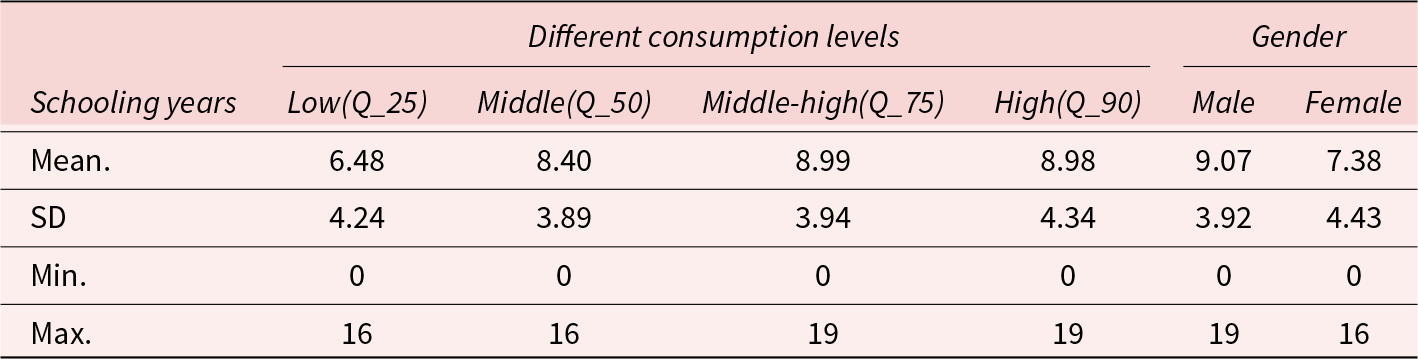
Among the control variables, factors that may influence consumption at both the individual and the household levels are selected. Respondent demographic information includes age (age range 50–80 years), gender (male = 1; female = 0), years of schooling years (range 0–19), insurance (insured = 1; uninsured = 0), common diseases (13 types in total), ADL disability (cannot work = 1; can work = 0) and the logarithm of pension. (The education levels of retirees in different consumption groups and by gender are shown in Table A2 in the Appendix. The low consumption group has the fewest years of schooling, with an average of about six to six and a half years. Men have, on average, two more years of schooling than women.) Specifically, common diseases and ADL disability are utilised as proxy variables to measure the health status of older people. Respondents’ household information includes marital status (with a spouse = 1; without a spouse = 0), number of children, the log of household assets, whether taking care of grandchildren or not (yes = 1; no = 0) and the average time spent taking care of grandchildren last year (in hours). Unlike Western family cultures, which are more often independent of each other, Chinese culture establishes strong ties between family members of different generations. Due to the cultural concepts of ‘three generations living together’ (‘san dai tong tang,’ ‘三代同堂’) and ‘children and grandchildren around’ (‘zi sun rao xi,’ ‘子孙绕膝’), it is common for Chinese grandparents to provide intergenerational care for their families (Ko and Hank Reference Ko and Hank2014). The opportunity cost of household time paid for by intergenerational caregiving (Bai et al. Reference Bai, Wahl, Lohmar and Huang2010) and the gift motive have impacts on retiree household consumption. Therefore, we incorporate the variables ‘whether taking care of grandchildren or not’ and ‘the average time spent taking care of grandchildren last year (in hours)’ into the set of household information variables. Due to the differences in economic level, industrial structure, employment and social environment across the provinces of China, we also control for provincial variables.
Empirical results
Descriptive statistics
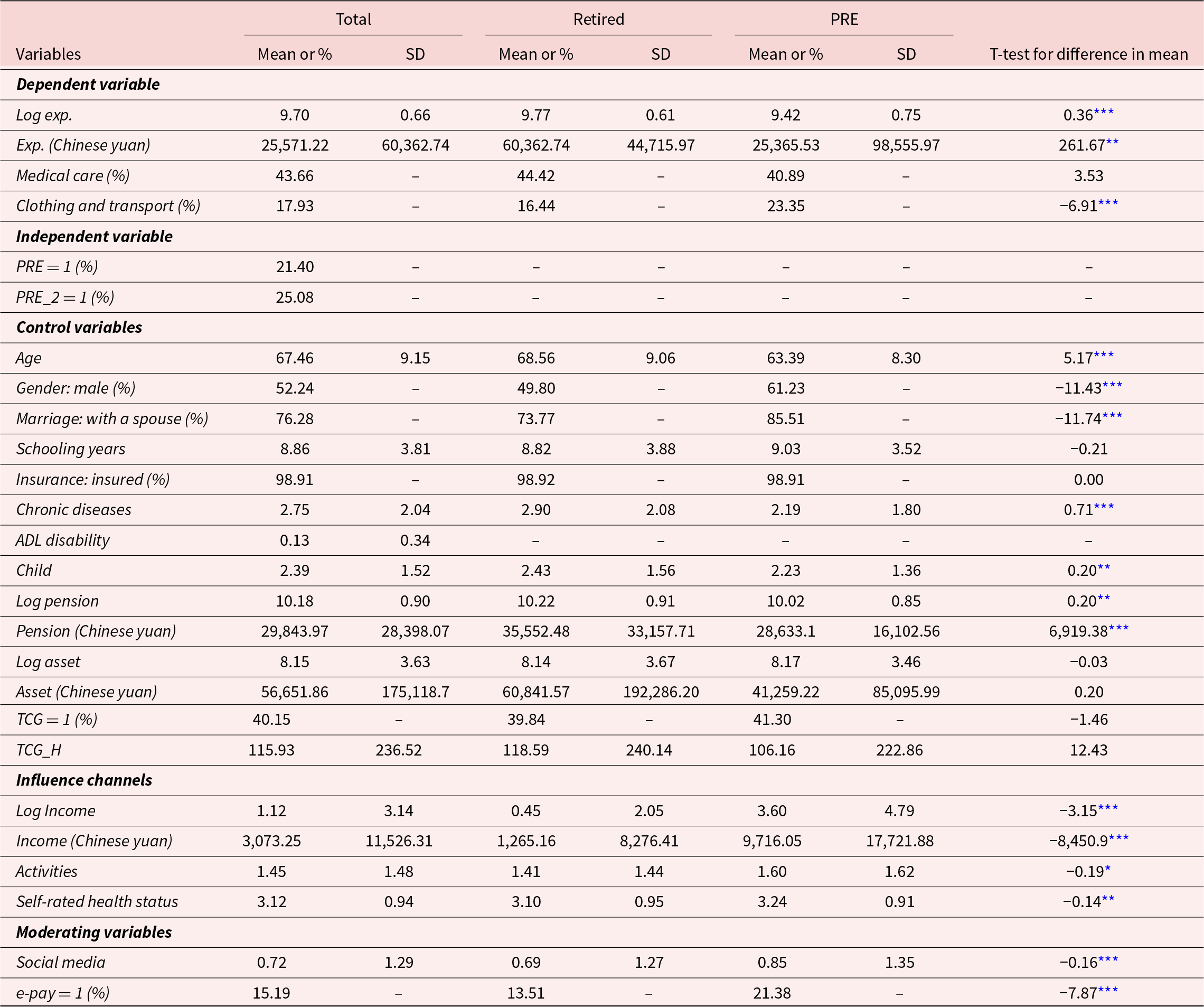
Table 1 presents the descriptive statistics of the research sample. In our sample, around 21.40 per cent of retirees are involved in post-retirement employment, while the proportion of those who remain in the labour market after reaching the statutory retirement age is about 25.08 per cent. These figures are consistent with the findings of Song et al. (Reference Song, Zhang and Zhang2023), which demonstrate a trend of diversification in the retirement trajectories of older people in urban China. The ‘active ageing’ policy and more flexible informal employment opportunities enable retirees to re-enter the labour market.
Descriptive statistics

Note: Obs. = 1,290; SD: standard deviation; TCG: whether taking care of grandchildren or not; TCG_H: the average time spent taking care of grandchildren last year (in hours).
*** p < 0.01, **p < 0.05, *p < 0.1.
In this sample, around 52.24 per cent of retirees were male and 47.76 per cent were female, with an average of two to three adult children. Around 76.28 per cent were married or cohabiting. The average age of retirees was around 65 years and their average years of schooling was more than eight years. The mean number of chronic diseases among respondents was around two to three. About 98.91 per cent of retirees had one or more insurance policies. Approximately 40.15 per cent of the survey respondents reported taking care of their grandchildren last year. Additionally, 15.19 per cent of the survey respondents reported being able to use e-payment methods.
On average, respondents spent about 43.66 per cent of their annual household expenditure on medical care, while only about 17.93 per cent was spent on clothing and transport. As the dataset does not contain information on annual household food expenditure, no specific descriptions of this are included.
Furthermore, when examining the differences in sample means between retirees who choose to work after retirement and those who do not, we find a significant reduction in consumption growth among elderly individuals who opt for re-employment, while there is no significant change in the proportion of healthcare expenditure to total expenses. Retirees who are male, younger, married, have higher levels of education and enjoy better health tend to be more likely to engage in post-retirement employment. Additionally, post-retirement employment leads to evident improvements in income, social participation, self-rated health status and digital literacy.
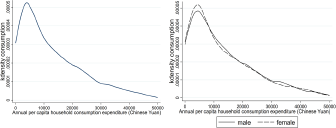
Figure 1 shows the distribution of retirees’ household expenditure and the results of the distribution of consumption expenditure by gender. The peak of the distribution curve is to the left, proving that the annual per capita household expenditure of retirees is mainly up to CNY10,000, with a lower density of low and high consumption groups. After annual per capita household expenditure reaches CNY10,000, the cluster density gradually decreases as the level of consumer spending continues to rise. The distribution curve of male household expenditure is flatter than that among women, with male household spending per capita mostly concentrated in the range of CNY10,000 to CNY40,000 per annum. The cohort density of female retirees spending below CNY10,000 and above CNY40,000 is higher than that of men, with clear polarisation.
Distributions of the kernel estimated density of retirees’ household expenditure.

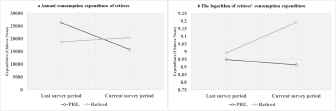
Figure 2 presents the data on consumption expenditure for individuals who transitioned from retirement to post-retirement employment, compared to those who remained retired, in both the current survey wave and the previous survey wave. The black line represents the changes in consumption expenditure for individuals who engaged in post-retirement employment. In comparison to the previous survey period when they were in a retired state and had not yet chosen to re-enter the labour market, their consumption has declined.
Consumer spending by retirees compared to the previous survey wave.a

Baseline regression
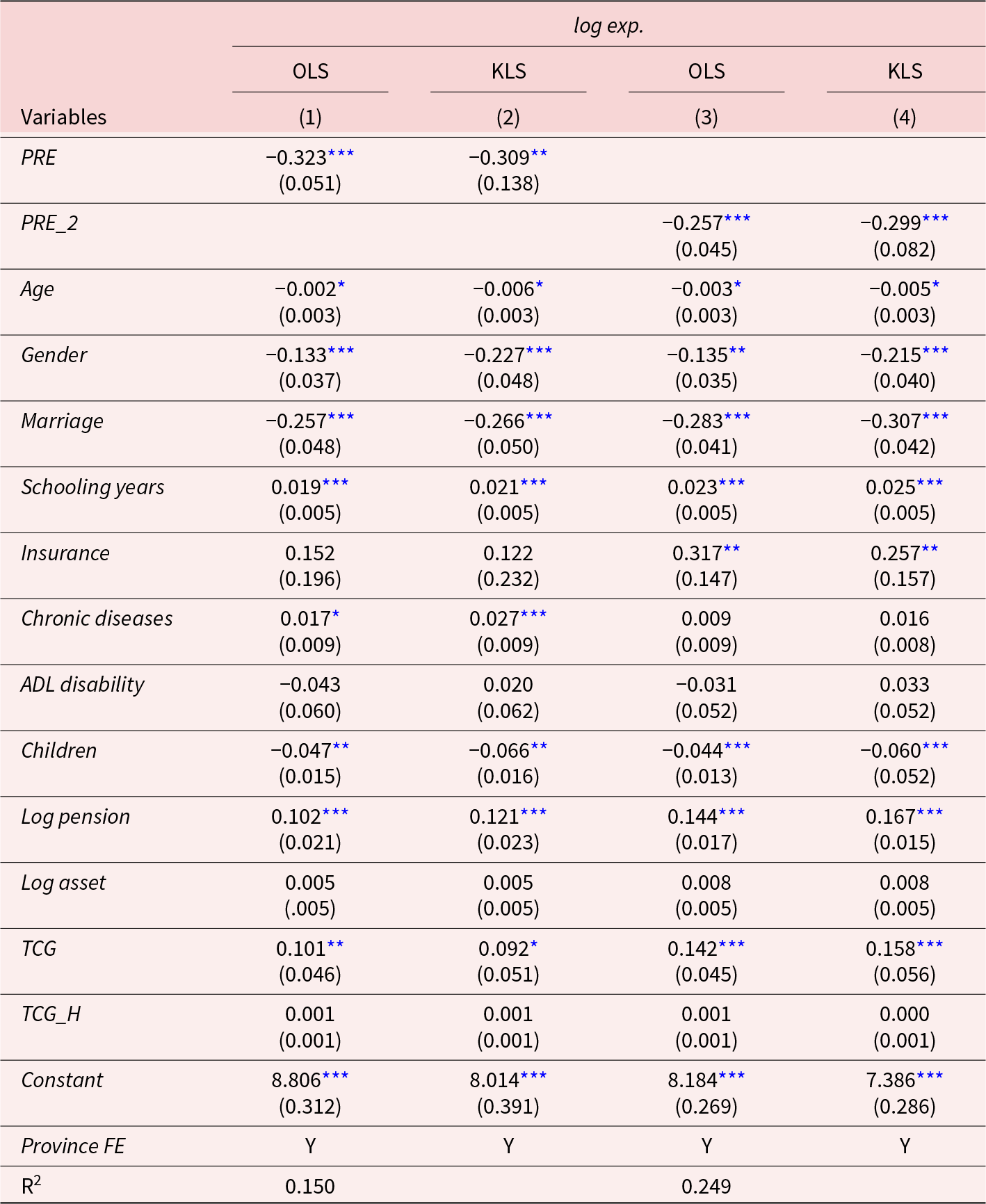
Table 2 shows the baseline results for the relationship between post-retirement employment and retirees’ household expenditure, which are reported in Columns (1) and (2). The results for the relationship between the behaviour of participants still working after the official retirement age and expenditure are shown in Columns (3) and (4). All the regressions control for province-fixed effects.
Baseline regression

Note: Obs. = 1,290. Robust standard errors are presented in parentheses,
*** p < 0.01, **p < 0.05, *p < 0.1.
Table 2, column (1), presents the OLS baseline regression results, indicating a significant negative correlation between post-retirement employment and retirees’ household expenditure. The estimates suggest that retirees who re-enter the labour market exhibit lower expenditures compared to those who do not engage in post-retirement employment. Column (2) of Table 2 displays the effects of post-retirement employment on retirees’ household expenditure using KLS regression. The KLS estimation result indicates a negative impact of post-retirement employment on retirees’ household expenditure, with statistical significance at the 5 per cent level. This confirms that post-retirement employment reduces old people’s expenditure. Hypothesis 1 is thus partially validated.
Columns (3) and (4) of Table 2 present the results of the OLS and KLS regressions, respectively, examining the relationship between individuals who continue working after reaching the statutory retirement age and retirees’ household expenditure. We observed that individuals who continue working after reaching the statutory retirement age exhibit lower expenditures compared to those who exit the labour market upon reaching the retirement age. The result from KLS regression confirms the negative effect of continuing work behaviour after the statutory retirement age on retirees’ household expenditure.
The estimated coefficients for the control variables are consistent with the literature on retirees’ household expenditure. For instance, elderly people who are getting older and have spouses and children prefer to save more and spend less due to considerations of future risks and legacies. Older people who have been educated for longer, have a pension and have multiple chronic conditions show higher levels of spending, such as on recreational leisure or healthcare items.
Robustness check
In this subsection, we address some potential concerns regarding endogeneity and heterogeneity, and then check the robustness of the empirical results.
The results of the impact of post-retirement employment on their expenditures could be biased due to differences in the economic status or gender of the retirees. In order to better comprehend the effect of post-retirement employment on retirees’ household expenditure, we analyse the differential impact of post-retirement employment by distinguishing between respondents according to their level of consumption and gender. We estimate the differential effects using KLS regressions.
Robustness check: propensity score matching analysis
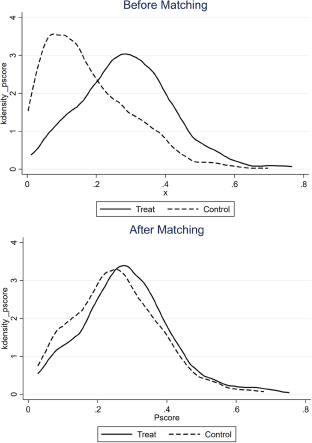
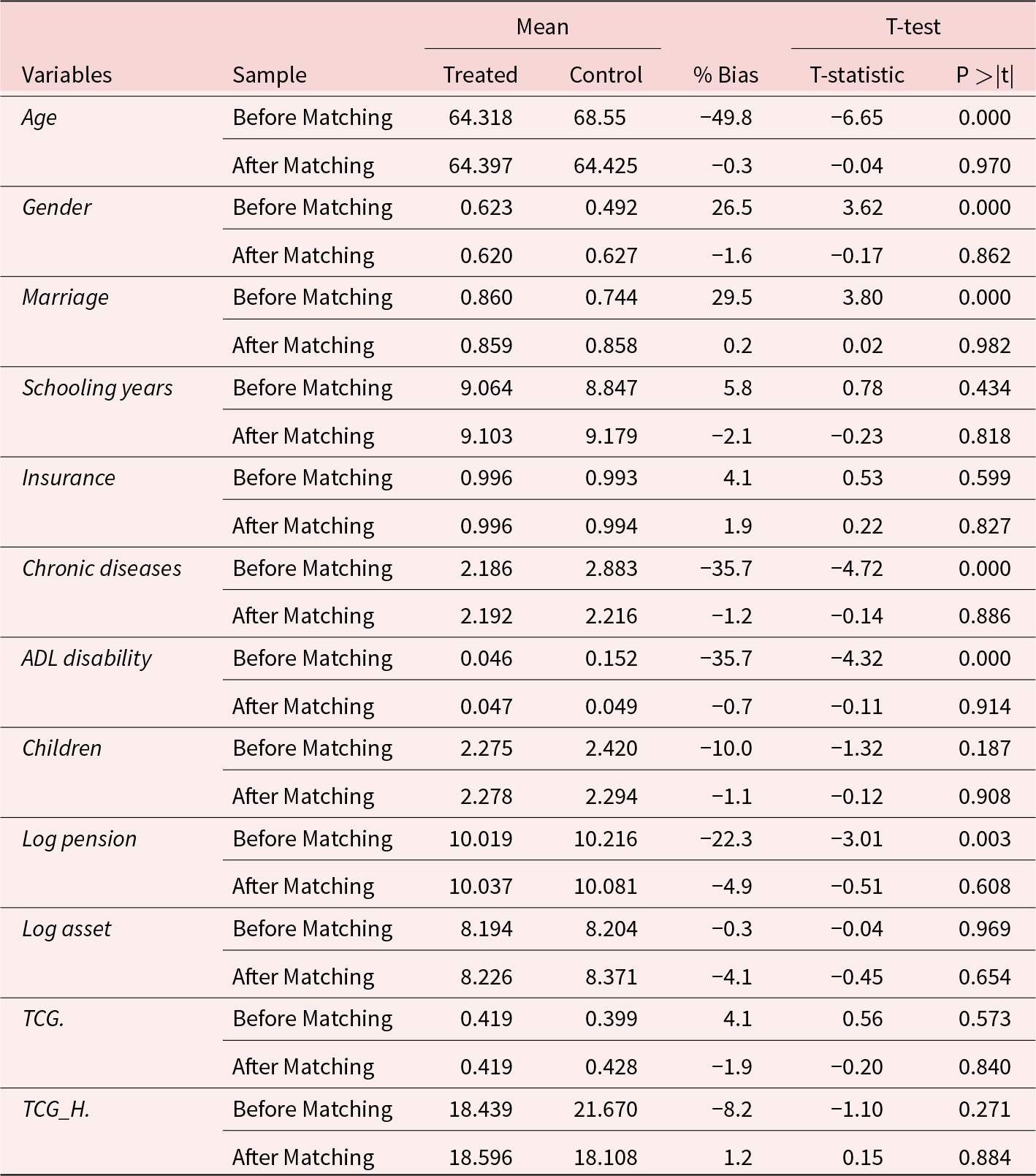
We employed retirees’ demographic characteristics (age, gender, years of schooling, logarithm of pension, insurance coverage, presence of common diseases and ADL disability) and family characteristics (marital status, number of children, logarithm of family assets, whether taking care of grandchildren or not and hours spent taking care of grandchildren last year) as matching variables based on the PSM method (K nearest-neighbor matching) to create a 1:1 matched sample of treatment and control group data. The PSM-matched samples satisfy the common trend assumption, thereby mitigating estimation errors arising from observable variables. The before and after matching kernel density distribution plots and balance test results are presented in Figure A1 and Table A1, respectively. Following matching, the differences between the control and the treatment groups reduced, indicating the effectiveness of the matching procedure.
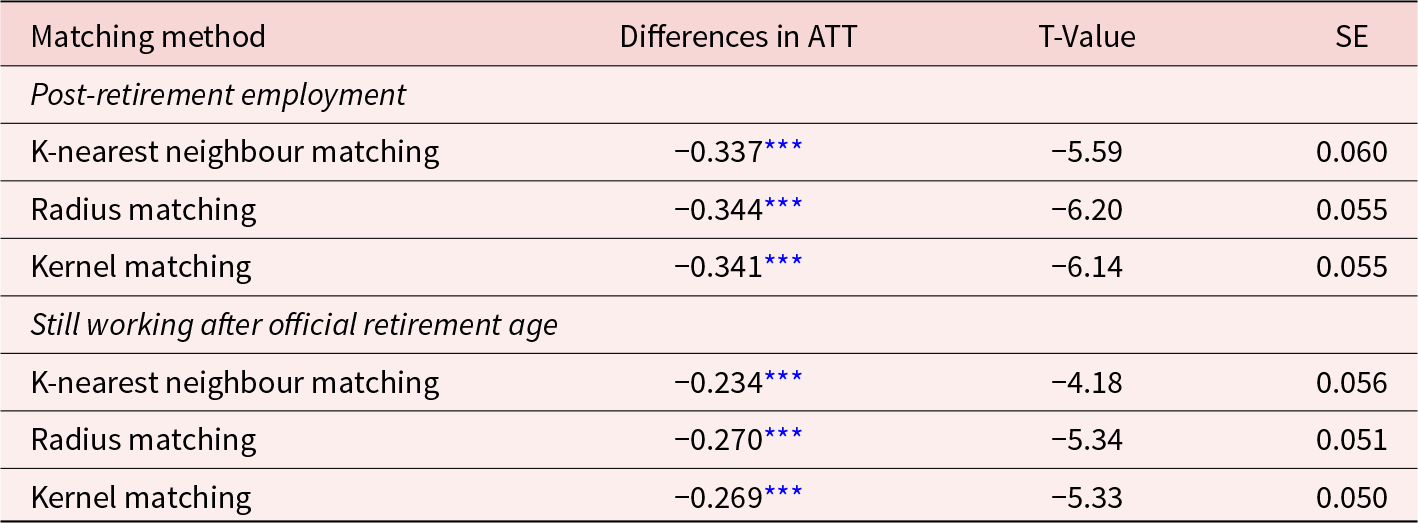
Table 3 presents the PSM matching results, where, in addition to k-nearest neighbour matching, we also utilised radius matching and kernel matching, yielding consistent results. As expected, the average expenditure difference between post-retirement employed and non-employed individuals is statistically significant at the 1 per cent level, indicating that post-retirement employed individuals have lower expenditures. For comparative purposes, individuals who continue working after reaching the statutory retirement age were also matched with those who do not work. The difference in average treatment effect on the treated (ATT) suggests that, under similar individual and family characteristics, retirees who fully retire after reaching the statutory retirement age have higher expenditures compared to those who continue working. The PSM results support the rationality of the baseline regression results.
Average estimated treatment effect

Note:
*** p < 0.01, **p < 0.05, *p < 0.1.
Regression results: different consumption levels
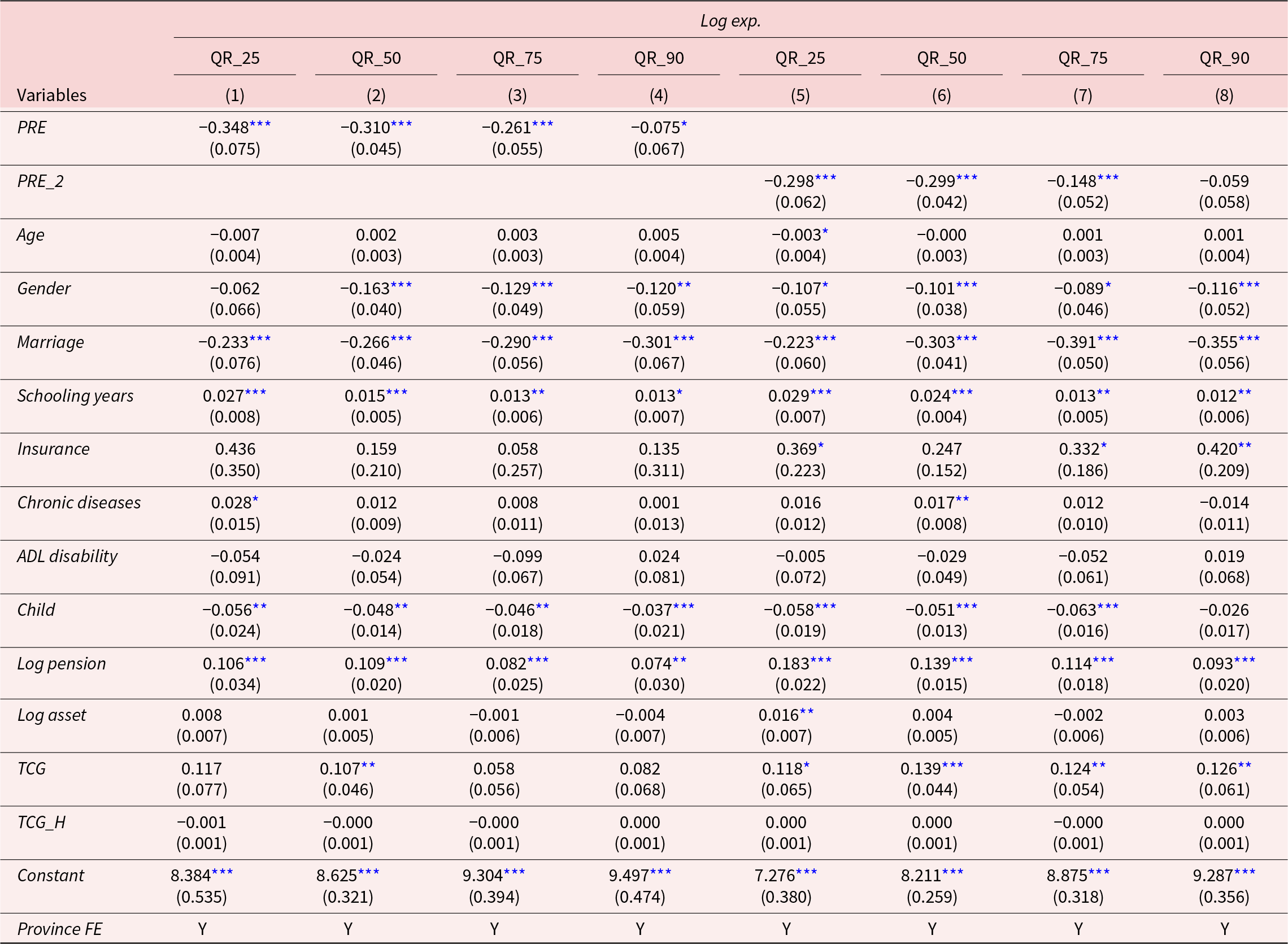
Table 4 reports the estimation results of the impact of post-retirement employment on retirees’ household expenditure by different consumption levels. We classify the household consumption of retirees into four groups according to the quantile scale – specifically, a low level (QR_25), a middle level (QR_50), a medium-high level (QR_75) and a high level (QR_90). The quantile regressions are performed following Equation (1).
Robustness check: different consumption levels

Note: Obs. = 1,290. Robust standard errors are presented in parentheses,
*** p < 0.01, **p < 0.05, *p < 0.1.
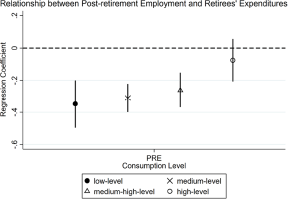
Columns (1) to (4) present the estimated effects of post-retirement employment on retirees’ household expenditure by these four groups’ consumption levels. The estimated coefficients are −0.348, −0.310, −0.261 and −0.075, respectively, and are statistically significant at the 1 per cent or 10 per cent level, suggesting that returning to work after retirement has a significant negative impact on retirees’ household expenditure by different levels of consumption. This disincentive gradually weakens as consumption levels increase. This finding implies that post-retirement employment reduces, to various degrees, the household consumption of retirees at different levels. The comparison of estimated coefficients is presented in Figure 3.
Coefficients of different consumption levels.

Columns (5) to (8) show the estimated effects of the behaviour of those still working after the official retirement age on retirees’ household expenditure by these four groups’ consumption. In Columns (5) to (7), the estimated coefficients of the core independent variable are all negative and statistically significant at the 1 per cent level. In Column (8), however, the estimated coefficients of the behaviour of those still working after the official retirement age is not significant. This finding is likely to be related to the sample, which may include those who are not fully retired after reaching the statutory age. The high consumption group is mostly concentrated in occupational categories with higher income and social status, which may delay their retirement, and this group cannot be considered as retirees.
Regression results: men and women
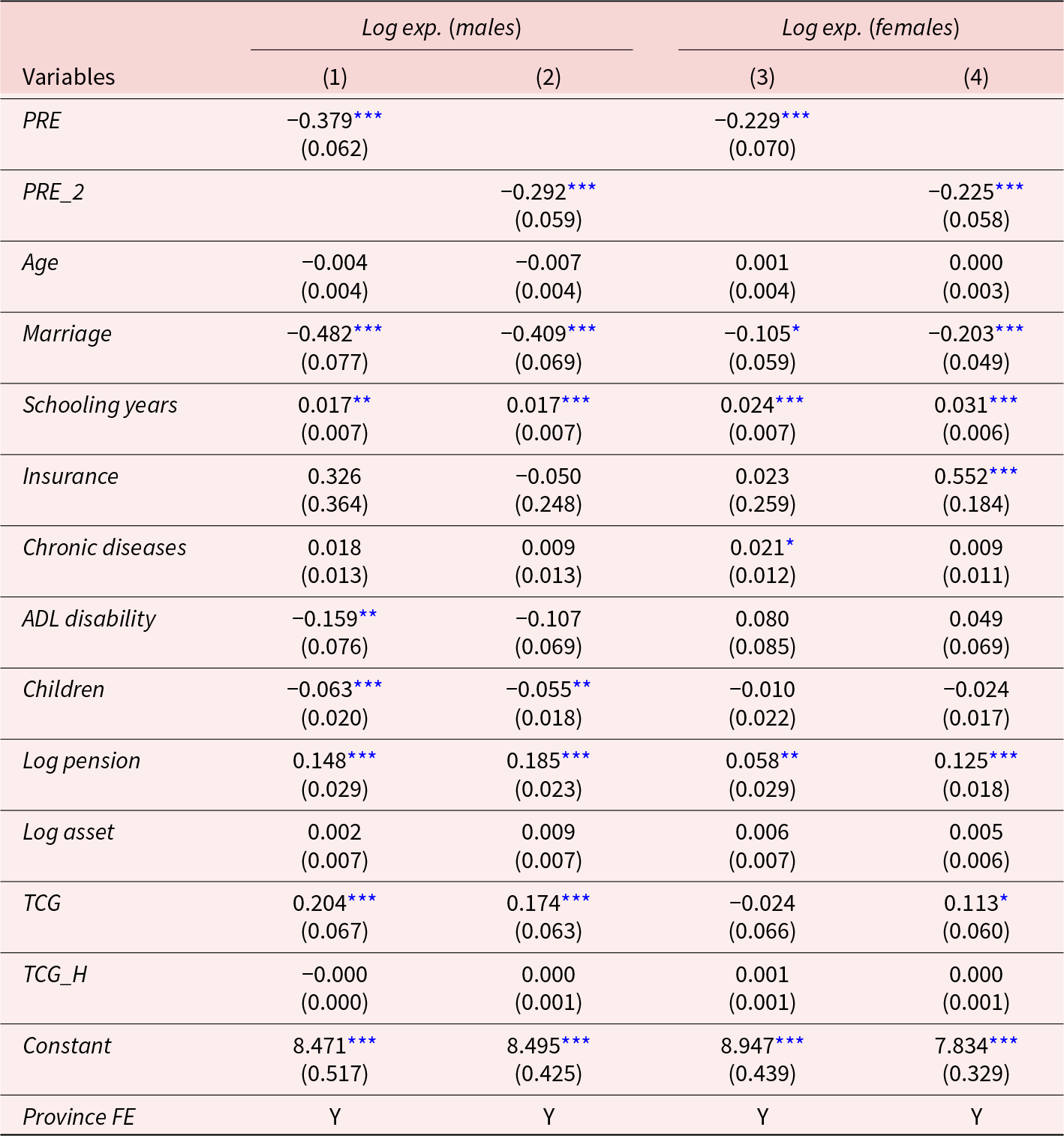
Studies suggest that the work needs and goals of male and female retirees are different. According to social gender role theory (Eagly et al. Reference Eagly, Wood and Diekman2000), people’s expectations and beliefs stemming from gender differences foster some of the differences in individuals’ cognition and behaviour (Eddleston et al. Reference Eddleston, Veiga and Powell2006; Zhan et al. Reference Zhan, Wang and Shi2015). Thus, the sensitivity of consumption to the effects of post-retirement employment behaviour may differ between men and women, and, consequently, the results of this study may also differ on this basis. We therefore examine the impact of post-retirement employment on retirees’ consumption by gender, with the results shown in Table 5.
Robustness check: by gender

Note: Obs. of male = 671, obs. of female = 619. Robust standard errors are presented in parentheses,
*** p < 0.01, **p < 0.05, *p < 0.1.
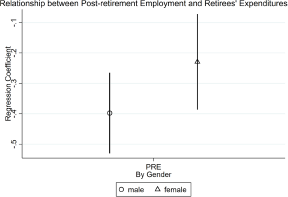
Columns (1) and (3) depict the estimated effects of post-retirement employment on the expenditure of male and female retirees, respectively. Controlling individual and family influencing factors, the coefficients of post-retirement employment remain statistically significant. Compared to women, men’s consumption is more likely to be influenced by post-retirement employment, which reduces spending by 37.9 per cent for male retirees. The comparison of estimated coefficients is shown in Figure 4.
Coefficients of male and female retirees.

We estimate the effects of working after the official retirement age by gender. The results are reported in Columns (2) and (4) for men and women, respectively. The corresponding results are consistent with the baseline results; the behaviour of those still working after the official retirement age decreases retirees’ household expenditure, regardless of gender.
The results of the effects of the control variables show that age has a significant effect on men’s consumption only, while education level has a stronger effect on women’s consumption. Men may be more likely to spend money on outings and activities, which decreases as they get older. The higher the educational level of women in China, the more financially independent they are, which has a positive effect on their consumption.
Discussion
Mechanism analysis
This subsection explores potential mechanisms through which post-retirement employment leads to retirees’ lower levels of expenditure. As summarised in the previous analysis, post-retirement employment affects consumption through a series of factors, including objective circumstances and subjective behaviour. Due to the availability of data, we focus on the three channels of transmission and provide exploratory evidence regarding these three aspects: income, social participation and self-rated health status.
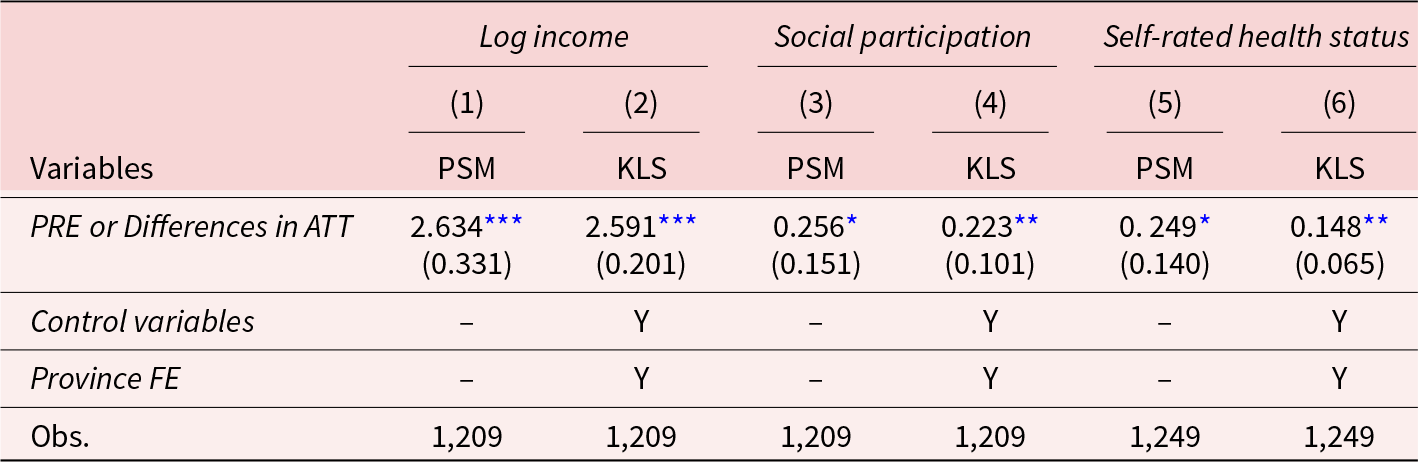
First, we explore the results of the average effect of post-retirement employment behaviour on the three channels that influence consumption. As shown in Table 6, Columns (1) to (6), respectively, present the effects of post-retirement employment behaviour on retirees’ income, social participation and self-rated health status. For social participation, we select data on participation in activities among older people (13 events in total) from the CHARLS data as a proxy variable. With regard to self-rated health status, the CHARLS data classify the self-rated health status into five levels, from ‘very good’ (denoted by Level 1) to ‘very poor’ (denoted by Level 5). For analysis purposes, we reverse the ranking of the self-rated health levels, from ‘very poor’ (denoted by Level 1) to ‘very good’ (denoted by Level 5). The results in Table 6 indicate that post-retirement employment behaviour enhances retirees’ income, promotes social participation and improves self-rated health status. As anticipated, the PSM results reveal that individuals engaged in post-retirement employment exhibit higher incomes, greater social participation and better self-rated health status. According to the previous theoretical analysis, higher incomes and increased social participation contribute to higher consumption expenditure among older people, but improved self-rated health status reduces older people’s medical care spending, which accounts for 43.66 per cent of older people’s total expenditure. Thus, the average impact of post-retirement employment on older people’s consumption in the presence of this cross-effect is negative, mainly due to the loss of spending on healthcare. Hypotheses 1 is thus confirmed. In the following subsection, we specifically explore whether changes in income, social participation and self-rated health all have consistent effects across different levels of consumption and across gender using the KLS method, as shown in Tables 7 and 8.
Different mechanism channels

Note: PSM: T-statistics of (1), (3) and (5) are 7.96, 1.70 and 1.78, respectively. Standard errors are presented in parentheses,
*** p < 0.01, **p < 0.05, *p < 0.1.
By consumption levels: different mechanism channels

Note: Robust standard errors are presented in parentheses,
*** p < 0.01, **p < 0.05, *p < 0.1.
By gender: different mechanism channels

Note: Robust standard errors are presented in parentheses,
*** p < 0.01, **p < 0.05, *p < 0.1.
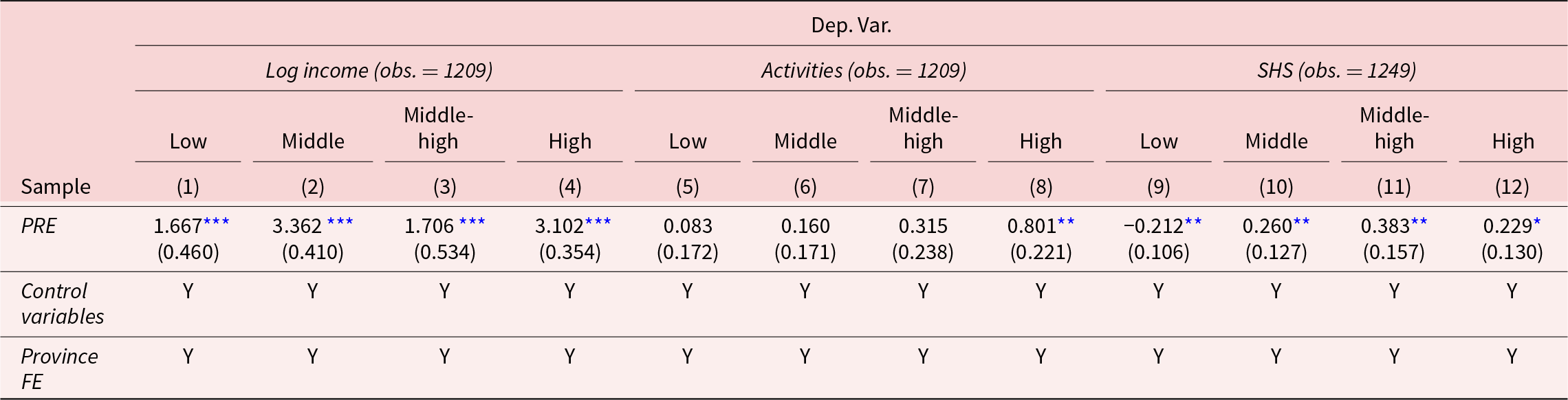
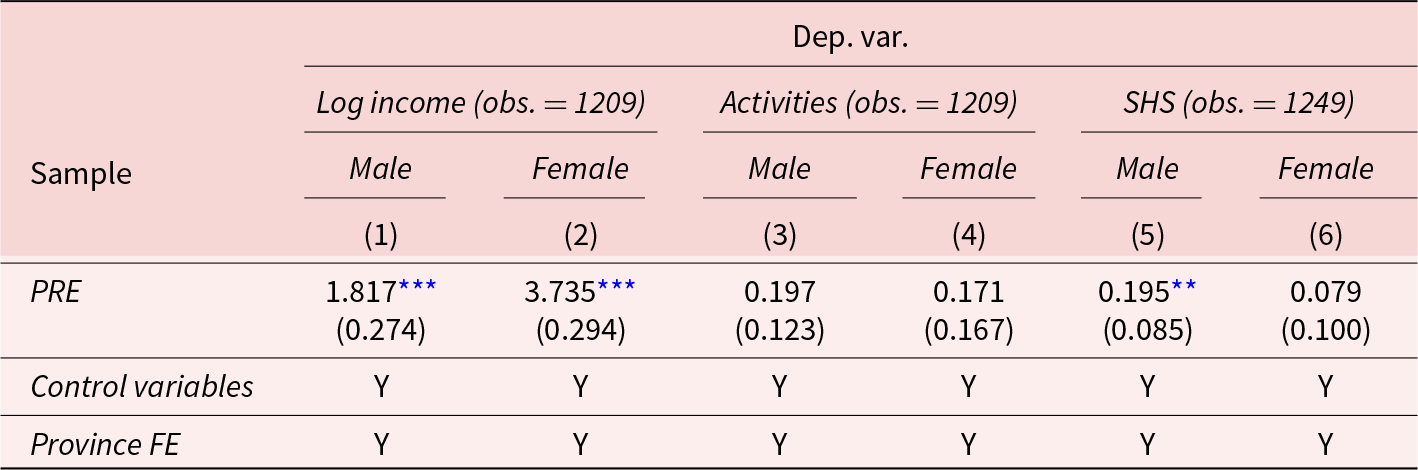
Second, post-retirement employment significantly raises the incomes of retirees at different consumption levels and by gender. The extent of the effects is stronger on the income of the middle-consumption-level group, on that of the high-consumption-level group and on women. This partly explains why the negative impact of post-retirement employment on the consumption of female retirees is weaker than that for male retirees.
Third, post-retirement employment enhances the social participation of only the high-consumption-level group. High-consumption retirees are concentrated in groups with high educational attainment and higher social status. The types of post-retirement employment occupied by the more educated population and populations with higher social status tend to be in managerial and high-end technical positions, such as professors, doctors and corporate executives (Ameriks et al. Reference Ameriks, Briggs, Caplin, Lee, Shapiro and Tonetti2020; Dingemans et al. Reference Dingemans, Henkens and Solinge2016). These types of work are more sensitive to social engagement – specifically, the interchange of resources, social relationships and wider social activities involved in the work to improve the social participation of retirees (Manski Reference Manski2000). In contrast, the less educated population and populations with lower social status represent a more homogeneous type of post-retirement employment in China, including security guards, construction workers, housekeepers and domestic workers, for example. These types of work instead take up the retirees’ time available to communicate with others and thus do not enhance their social participation. This finding suggests that the effect of increased social participation due to post-retirement employment on consumption does not exist for all retirees, explaining why post-retirement employment reduces the spending of retirees instead.
Fourth, we explore the effects of post-retirement employment on self-rated health status for different consumption levels and genders. Post-retirement employment behaviour significantly enhances the self-rated health of retirees at middle, medium-high and high consumption levels, but has a significant negative effect on self-rated health at low consumption levels. Across genders, post-retirement employment increases the self-rated health only of male retirees. Low-consumption retirees are concentrated in low-education and low-social-status groups, who tend to work in jobs that are more sensitive to health conditions. The high physical intensity and relatively isolated working environment reduce the self-rated health status of this group. In addition, post-retirement employment can bring about health benefits and emotional satisfaction (Silver et al. Reference Silver, Dass and Laporte2020). Compared to female retirees, male retirees are more likely to derive a sense of fulfilment from their work and find it rewarding, which enhances their self-rated health. There are two reasons why post-retirement employment does not enhance the self-rated health status of female retirees: First, the labour market discriminates against the older female workforce, making it more difficult for older women to secure employment after retirement (Neumark et al. Reference Neumark, Burn and Button2019). Even when post-retirement employment is achieved, the discrimination in the labour market does not enhance the sense of achievement of female retirees. Second, for female retirees, the emotional satisfaction of family care and work is largely equal (Griffin and Hesketh Reference Griffin and Hesketh2008), so the act of post-retirement employment does not significantly enhance their self-rated health.
To summarise, the exploratory evidence discussed indicates that, in the context of this study, changes in income, social participation and self-rated health status are channels through which post-retirement employment influences older people’s expenditure. However, these channels have different effects on different consumption levels and gender groups. While increased social participation from post-retirement employment stimulates spending intentions, rising incomes and self-rated health levels do not lead to an increase in spending. Positive changes in self-rated health instead reduce both healthcare spending and total expenditure among older people.
Estimating the moderating effects of internet use in post-retirement employment
In this subsection, we further employ the KLS method to investigate the role that the use of the internet, represented by social media and electronic payments, plays in the relationship between post-retirement employment and older people’s expenditure.
In the current digital economy, the adoption of ICTs such as the internet is gradually changing the way older people live and work. The intensity of the impact of post-retirement employment on consumption can vary depending on the digital literacy of older people. We select the number of social media uses (six in total) and whether electronic payments are applied (use = 1; no use = 0) as moderating variables with which to determine whether the moderating effect of internet use holds. Specifically, social media use broadens older people’s access to information about products and services, while electronic payments simplify the payment process. These two variables represent both the perception process and the application process involved in internet use.
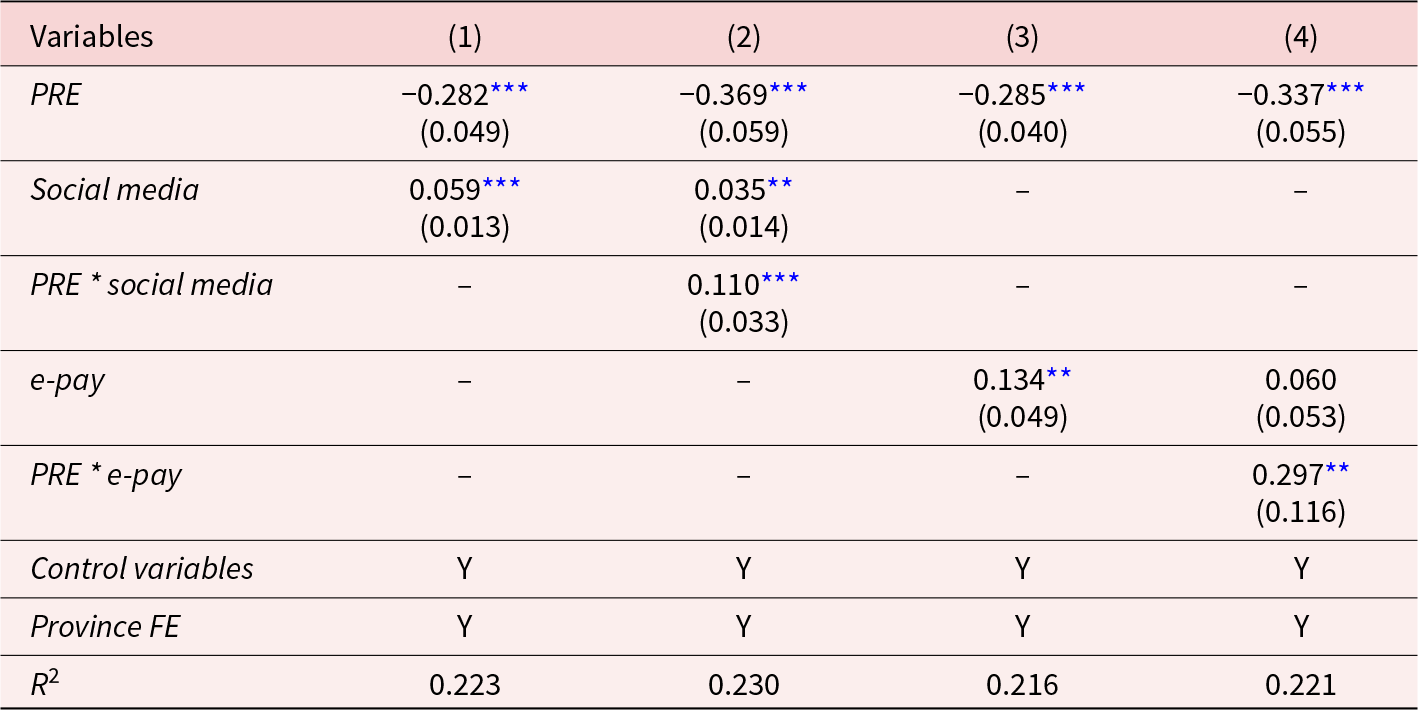
The results of the moderating effect are presented in Table 9. In Column (2), the coefficient of the impact of social media on retirees’ household expenditure and the coefficient of the interaction term between social media and post-retirement employment on retirees’ household expenditure are both statistically and positively significant. In Column (4), the interaction term between e-payment and post-retirement employment has a significant positive effect on expenditure. Internet use thus plays a moderating role in the effect of post-retirement employment on older people’s expenditure, which holds for Hypothesis 2. Additionally, the coefficient on the interaction term is positive, acting in the opposite direction to the main effect (i.e., post-retirement employment negatively affects consumption), suggesting a mutually suppressive relationship. This proves that social media and e-payment use diminish the negative impact of post-retirement employment on older people’s spending. Columns (1) and (3), respectively, present the results for the effects of social media and e-payment use without the interaction term, both showing positive and significant influences. All results control for individual and household characteristics and province-fixed effects.
Results of moderating effects

Note: Obs. = 1,290. Robust standard errors are presented in parentheses,
*** p < 0.01, **p < 0.05, *p < 0.1.
Conclusion
Using the CHARLS 2018 dataset, our study proposes and empirically investigates the hypothesis that, through income, social participation and self-rated health status, the behaviour of post-retirement employment affects elderly people’s spending, which is closely associated with both retirement consumption and the consequences of additional work for the older labour force.
Extending the working lives of older people is an important issue for ageing societies. Our findings specify how extending one’s working life affects the economic behaviour and well-being of older people through the impact of post-retirement employment behaviour on consumption. We find that post-retirement employment behaviour reduces retirees’ consumption expenditure and this effect diminishes as the level of consumption increases. In addition, the spending of male retirees is more likely to be influenced by post-retirement employment than that of female retirees. The evidence from the mechanism analysis suggests that post-retirement employment significantly increases older people’s income, promotes social participation and improves their self-rated health, while reducing older people’s expenditure despite this positive effect. While the income of older people has increased, the improvement in self-rated health reduces their spending on healthcare, which accounts for an average of 43.66 per cent of their total expenditure. The effects of post-retirement employment on social participation and self-rated health do not exist for all consumption levels and genders; for example, post-retirement work promotes social participation only among older people with high consumption levels, while this behaviour reduces the self-rated health status of those with low consumption levels. Social isolation and a decline in self-rated health levels also lead to a tendency for older people to increase their savings to combat future health risks, while reducing current consumption expenditure. Use of the internet in post-retirement employment, such as through the use of multiple social media software and electronic payments, could attenuate the negative impact of post-retirement employment on consumption.
Our findings provide insights into the ongoing debate on ‘delayed retirement’ policies, as well as ‘the retirement consumption puzzle’. First, while our results find that post-retirement employment behaviour reduces older people’s expenditure, this reduction is brought about by a decline in spending on healthcare. One positive aspect of the post-retirement employment impact is that it promotes both financial rewards and subjective health outcomes for most retirees, which is advocated for by active ageing. Hence, the impact of post-retirement employment behaviour on older people’s well-being is positive. The measures needed to promote the spending of older people must increase their level of social security and change the consumption structure of elderly persons, rather than increasing their financial income through post-retirement employment. Second, while it is confirmed that older people have an additional capacity to work, the education and gender discrimination in the labour market is detrimental to the health and well-being of lower consumption groups and female retirees. The high physical intensity and the limited type of work available do not allow for the economic rewards and emotional entitlements that retirees should receive. This situation similarly reduces their current expenditure as they attempt to prevent unknown risks. Hence, in exploring the implementation path for elderly employment and delayed retirement ages, there is a need to consider not only the supply but also the demand in the labour market for older people. Finally, internet use in the employment of older people has a moderating effect on consumption. It has also been documented that appropriate use of the internet enhances the mental health and well-being of older people (Shi et al. Reference Shi, Liu, Fu and Dai2023). Improving the digital literacy of older people and narrowing the digital divide between elderly populations and younger adults may be helpful in changing ‘the retirement consumption puzzle’.
There are several limitations in this study. First, post-retirement employment behaviour is also determined by individual personalities, which we could not obtain from the sample. Personalities also influence the spending preferences of older people. For example, older people with cheerful dispositions spend more on travel. Alternatively, preferences or needs regarding money may lead individuals in urgent need of funds to re-engage in work while reducing expenses. Second, although the CHARLS database is one of the most comprehensive surveys of the elderly population, the available data obtained through data cleaning and processing are limited to approximately 1,290 individuals or fewer. Due to a limited number of traceable observations and a substantial amount of missing values in the variables, conducting a longitudinal analysis of post-retirement employment over multiple periods was not feasible. As a result, this study employs only a comparative analysis within the same survey period to examine the differences between individuals who choose post-retirement employment and those who do not. With a larger and more substantial sample, studies could obtain more supportive evidence. Third, this study did not employ instrumental variable (IV) methods for endogeneity testing but instead utilised PSM and KLS methods to address endogeneity issues, although it is recommended that the KLS method be used in conjunction with IV methods (Kiviet Reference Kiviet2020). Among the existing studies on post-retirement employment, only the study by Silver et al. (Reference Silver, Dass and Laporte2020) employed eligibility for early retirement social security benefits and the full social security benefit eligibility of the respondent’s spouse as IVs, while excluding information on individuals without a spouse. However, these IVs are not feasible for our research question. We attempted to identify suitable IVs from the perspectives of policy, time opportunity cost and macroeconomics. Nonetheless, due to limitations in data availability, we were unable to obtain appropriate and exogenous IVs. Fourth, the sample is mainly drawn from older Chinese ‘baby boomers’, whose similar life trajectories (e.g., experiences of the send-down movement and unified work assignment) and educational experiences make them more consistent in their behaviour and accustomed to working and living in groups. The emotional rewards of hard work and dedication are important to them. In future studies on post-retirement employment behaviour and consumption related to older people, samples may exhibit individualised and differentiated behaviour, which warrants further consideration.
Financial support
This work was supported by the National Social Science Foundation of China (No. 21CTJ021).
Ethical standards
Approval was not required.
Appendix
Distribution of propensity score matching between before matching and after matching samples.

Balance test of PSM

Note: The biases for all variables are less than 10 per cent after sample matching and have passed the balance tests.
Educational attainment of retirees by consumption level and gender