I. INTRODUCTION
A wide variety of biomedical devices involve the long-term integration of metallic or semiconducting components with living tissue. Examples include pacemakers, Reference Norlin, Pan and Leygraf1 deep brain stimulators, Reference Kringelbach, Jenkinson, Owen and Aziz2 cochlear implants, Reference Eisen3 retinal prosthetics, Reference Weiland, Liu and Humayun4 and microfabricated cortical electrodes. Reference Mercanzini and Renaud5 Conjugated polymers are of interest for these devices because they transmit charge by both electron and ionic transport. Reference Kim, Richardson-Burns, Povlich, Abidian, Spanninga, Hendricks and Martin6 They also provide an intermediate level of mechanical compliance between the rigid inorganic device substrate and the soft biological tissue. However, to optimize the performance of these devices, there remains an unmet need for developing functionalized conducting polymers that can be modified with biomolecules to improve the interface between the hard electrode and soft tissue. Reference Groenendaal, Zotti, Aubert, Waybright and Reynolds7
Conjugated polymers are also of interest for a wide variety of devices, including electrochromic displays, photovoltaics, and chemical sensors. Reference Forrest8 A materials system that has been of particular scientific commercial interest is substituted polythiophenes, with particular focus on poly(3,4-ethylenedioxythiophene) (PEDOT). PEDOT is of particular interest because of its low oxidation potentials, high conductivity, superior environmental stability, and good chemical and electrochemical properties. Reference Groenendaal, Zotti, Aubert, Waybright and Reynolds7,Reference Groenendaal, Jonas, Freitag, Pielartzik and Reynolds9–Reference Hohnholz, MacDiarmid, Sarno and Jones12 However, the EDOT side groups are not chemically reactive, making it difficult to create materials with more specific functionality for particular applications.
To generate polymer films with more tailorable surface chemistries, it is possible to modify the chemical structure of the monomer Reference Lee, Serna, Nickels and Schmidt13,Reference Xiao, Cui and Martin14 and to copolymerize two or more suitably functionalized monomers to obtain conducting polymers with properties intermediate to those of the individual homopolymers. Reference Zhang, Tao, Xu, Zhou, Cheng and Zheng15,Reference Zhang, Xu, Wang, Xu, Xiang, Ouyang and Ma16 Substituting the side groups on the backbone of a conducting polymer can change the optical and electrochemical properties of the material and can also be used as a means to introduce functional groups. A wide variety of functional EDOT monomers have been synthesized to date; most of these have been tailored toward applications in electronic and electrochromic devices. Functional groups such as alcohols, Reference Akoudad and Roncali17 carboxylic acids, Reference Ali, Kantchev, Yu and Ying18 cyanobiphenyl, Reference Krishnamoorthy, Kanungo, Contractor and Kumar19 and sulfonate Reference Xiao, Cui and Martin14 have all been incorporated to synthesize functional EDOT molecules. Copolymerization strategies have also been employed to manipulate the properties of the conducting polymers. Copolymers of EDOT with pyrroles, Reference Zhang, Tao, Xu, Zhou, Cheng and Zheng15,Reference Sarac, Sonmez and Cebeci20 indole, Reference Xu, Nie, Zhang, Han, Hou and Pu21 3-methylthiophene, Reference Yohannes, Carlberg, Inganãs and Solomon22 and pyrenes Reference Zhang, Xu, Wang, Xu, Xiang, Ouyang and Ma16 are examples of few such copolymers. Copolymers of EDOT with functional EDOT molecules provide a means of creating PEDOT coatings with functionalized components and tunable properties, without changing the polymer backbone. Reference Xiao, Cui and Martin14,Reference Povlich, Cho, Leach, Corey, Kim and Martin23
Among these functional groups, carboxylic acids provide a particularly facile means of functionalizing monomers, especially with biological molecules. Biofunctionalization of conducting polymer coatings has proven to be an attractive method to provide superior interface for polymer-coated neural prosthetic implants. Monomers of EDOT and pyrroles with carboxylic acid functionality have been previously reported. Reference Lee, Serna, Nickels and Schmidt13,Reference Luo, Ali, Tansil, Yu, Gao, Kantchev and Ying24 Lee et al. recently reported the synthesis of carboxylic acid functional terthiophene monomers and demonstrated their use as bioactive conductive scaffolds. Reference Lee, Jeong, Ahn and Lee25 Luo et al. developed carboxylic acid functional EDOT molecules, linked with ether and ester groups on the ethylene dioxy ring, although the functional group reduced polymerization of the monomer versus rates for unmodified PEDOT, which was attributed to the steric hindrance of the functional group. Reference Luo, Ali, Tansil, Yu, Gao, Kantchev and Ying24 Povlich et al. thus developed and synthesized an EDOT monomer with the simplest possible COOH modification, as a direct substituent on the ethylene dioxy ring. Reference Povlich, Cho, Leach, Corey, Kim and Martin23
In this contribution, we have used this molecule, EDOTacid, to deposit copolymer films of EDOT and EDOTacid, with systematic variations in the monomer feed ratio. Use of this EDOT derivative permits maintenance of the backbone of the conducting polymer but inclusion of a carboxylic acid functional group to generate films with specific properties. Thus, we are able to generate PEDOT coatings with varying number of functional groups on the surface, thereby manipulating the surface concentration of the COOH groups and in turn controlling the hydrophilicity and morphology of the films. EDOT and EDOTacid were successfully copolymerized by electrochemical oxidation of the monomer mixtures from propylene carbonate solutions. The effects of the monomer feed ratio on the resulting copolymer films were characterized via chemical, electrochemical, and spectroscopic methods. The changing morphology of the films was characterized using scanning electron microscopy. These functional films can be modified with various biomolecules such as peptides and proteins.
II. EXPERIMENTAL SECTION
A. Materials
All chemicals were used as received from Sigma Aldrich without further purification. The working electrodes used were sputtered gold-palladium barbell-shaped electrodes (6 mm in diameter) on plastic slides. Indium tin oxide (ITO)-coated glass slides (0.7 × 5 cm; R, ∼4–8 ohms) were used for spectroscopic measurements.
B. Electropolymerization and characterization
Electropolymerization was carried out in a two-electrode cell using an AutoLab potentiostat/galvanostat (Utrecht, The Netherlands) with a platinum wire counter electrode. The copolymer films were electrochemically polymerized from a 0.01 M monomer solution in propylene carbonate with 0.1 M lithium perchlorate as the counter ion. All films were polymerized galvanostatically with a current density of ∼0.2 mA/cm2 for 10 min and were rinsed with DI water after polymerization.
Chemical analysis of the copolymer films was conducted using Fourier transform infrared (FTIR) spectroscopy (Bruker Tensor 27, Billerica, MA) in the attenuated total reflection (ATR) mode, and x-ray photoelectron spectroscopy (XPS; Omicron EA125, Taunusstein, Germany). To obtain FTIR spectra, each copolymer film was placed on the ATR crystal and scanned for 128 scans from 4000 to 400 cm−1. For XPS, non-monochromatic aluminum (1486.5 eV) x-ray source was employed. Corrections were made by using adventitious carbon peak located at 284.6 eV in C 1s region. 50 and 25 eV pass energies were used for survey scans and high-resolution scans, respectively. To quantify the concentration of carboxylic acid groups on the surface of the copolymer films, a toluidene blue O (TBO) assay was performed. Positively charged TBO has been shown to bind to negatively charged moieties on polymeric surfaces and shows an absorption peak at 630 nm. Reference Tiraferri and Elimelech26,Reference Djordjevic, Choudhury, Dutta, Kumar, Szili and Steele27 To construct calibration curves, TBO solutions at various concentrations were prepared by dissolving dry TBO powder in 50% acetic acid solutions, and their light absorbance at 630 nm was measured using an Agilent 8453 spectrophotometer (Agilent Technologies Inc, Santa Clara, CA). For the evaluation of the surface charge concentration of carboxylic acid groups on copolymer films, the films were soaked in an alkaline solution (0.1 mM NaOH) of TBO (0.5 mM) for 2.5 h. After TBO adsorption, the samples were rinsed with 0.1 mM NaOH to ensure removal of any noncomplexed dye. Samples were then soaked in 2 mL of 50% acetic acid solution for 4 h to desorb the complexed dye; a separate set of experiments indicated that this length of time was sufficient for complete desorption. The absorbance of the residual TBO solution was measured at 632 nm. The recorded spectroscopic data were converted into surface concentration (nanomoles per square millimeter) using the calibration curve. Three samples of each copolymer film were used to perform the assay.
Water contact angles were measured using the drop shape analysis plug-in and DropSnake method using ImageJ software (National Institute of Health). To do so, 1 μL of deionized water was pipetted onto the surface of the copolymer films, and images were captured using a Canon S5 IS camera attached to a tripod. Three different samples of each copolymer film were measured, and the final value was expressed as mean ± SD.
To analyze the electrical activity of the copolymer films, cyclic voltammetry (CV) and electrochemical impedance spectroscopy (EIS) were performed using the Autolab potentiostat/galvanostat (Utrecht, The Netherlands) described above with a platinum counter electrode, a saturated calomel reference electrode, and phosphate-buffered saline electrolyte. For the CV measurements, cycling was performed between +0.8 and −0.6 V with a scan rate of 0.12 V/s. The first stable curve was considered as cycle 1 and used to determine the electroactivity of the film. The charge storage capacity (CSC) was calculated by taking the integral, over time, of the area under the oxidation–reduction curve. For impedance measurements, an alternative current sinusoidal input of 5 mV in amplitude was used as the input signal with the direct current potential set to 0. The magnitude and phase angle for the impedance measurements were determined over six discrete frequencies over the range of 1–105 Hz.
Optical absorption measurements of the films were obtained on a Shimadzu ultraviolet (UV)–visible–near infrared spectrophotometer (Columbia, MD), with scanning from 300 to 800 nm and with an ITO electrode as the reference. Morphological studies were conducted using a JEOL JSM-7400F field emission scanning electron microscope (Tokyo, Japan) at a 3-kV operating voltage. All the films were sputtered with a thin layer of gold-palladium (45 s) to provide a more conductive surface. The profiles of the copolymer films were imaged via focused ion beam–scanning electron microscopy (FIB-SEM; Zeiss Auriga 60, Oberkochen, Germany). Three separate trenches (of 5 × 5 μM and 5 μM depth on each sample) were milled using an OmniProbe 200 system to determine the thickness of the films. A current of 600 pA was used to do the milling. The thickness of the films was determined by measuring the height at 6 different points for each milled trench for 3 samples (18 measurements for each copolymer film) and reporting the average.
III. RESULTS AND DISCUSSION
A. Synthesis of copolymer films
The films of PEDOT, PEDOTacid, and copolymers of PEDOT-PEDOTacid, deposited galvanostatically, with a current density of ∼0.2 mA/cm2, exhibited a blue color characteristic of PEDOT films. Various galvanostatic conditions were tested for PEDOTacid by varying current densities to obtain films that adhered to the Au/Pd electrodes and remained intact after washing with DI water. The pure PEDOTacid films deposited with current densities more than 0.3 mA/cm2 were extremely fragile and hence all the copolymer films were deposited with current densities of 0.2 mA/cm2. Copolymer films were obtained from mixtures of the two monomer solutions (in propylene carbonate) at different mole fractions. The total concentration of the monomer solution was maintained at 0.01 M for all depositions. The mole fraction X was calculated as n EDOTacid/(n EDOT + n EDOTacid) and films with mole fractions 0, 0.25, 0.5, 0.75, and 1 were deposited; these films are denoted as EA0, EA25, EA50, EA75, and EA100, respectively. The copolymer structure is presented in Scheme 1.
Polymerization of PEDOT-PEDOTacid copolymer.

B. Surface analysis of films
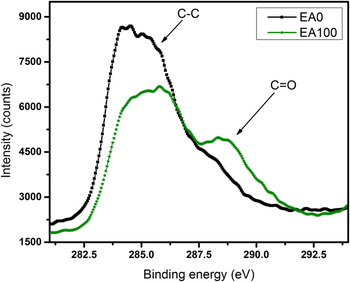
The chemical composition of films was determined via two surface analysis techniques; XPS and FTIR (ATR mode). The XPS data presented in Fig. 1 show the C 1s spectra for EA0 and EA100. The peak at 285 eV corresponds to the C–C bond and that at 289 eV corresponds to the C=O bond, consistent with binding energy values reported in literature. Reference Jonsson, Birgerson, Crispin, Greczynski, Osikowicz, Denier van der Gon, Salaneck and Fahlman28 Spectra were analyzed using the peak fitting functions to determine the relative contribution of the two peaks in each spectrum. The slight high-energy shoulder that appears in the EA0 spectra (287.9 eV) contributed 11.6% of the total area under the curve and is likely attributable to oxidation of organic matter on the film. In the EA100 spectrum, the peak at 289 eV (characteristic of the carboxylic acid group) represented 36.5% of the area under the curve, which is consistent with the presence of the carboxylic acid group (approximately 24%) in the EDOTacid monomer. The characteristic C=O peak at 289 eV was also observed in films EA50 and EA75 (data not shown) confirming the presence of EDOTacid in all copolymer films. The O 1s and S 2p spectra, with binding energies at 532 and 164 eV, respectively, were identical in the various copolymer films, as expected (Fig. S1 and Fig. S2).
XPS C 1s spectra for films EA0 and EA100.

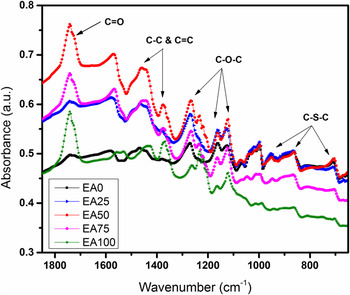
The presence of the carboxylic acid group, indicative of the incorporation of the EDOTacid into the copolymer film, was also confirmed via FTIR spectroscopy using the ATR mode. Infrared (IR) spectra for the copolymer films are presented in Fig. 2 and are similar to the spectra that have been reported previously for PEDOT polymers. Reference Sarac, Sonmez and Cebeci20,Reference Sriprachuabwong, Karuwan, Wisitsorrat, Phokharatkul, Lomas, Sritongkham and Tuantranont29 The peak at 1700–1740 cm−1 is characteristic of carbonyl stretching. For the EA0 films, this peak was absent, as expected. However, this peak was also missing from the spectra of EA25, suggesting there was little to no incorporation of EDOTacid in films with lower mole fractions of EDOTacid in the monomer feed solution, in agreement with the XPS observations. There was a distinct peak at 1740 cm−1 for films EA50, EA75, and EA100, as expected for copolymer films of PEDOT and PEDOTacid. The following peaks were observed in all of the copolymer films: the peaks at 707, 862, 966, and 997 cm−1 originate from the stretching modes of C–S–C in the thiophene rings; the peaks at 1120, 1160, and 1267 cm−1 originate from the stretching of the C–O–C group; and the peaks at 1365, 1463, and 1523 cm−1 originate from the C–C and C=C stretching in the thiophene ring. Reference Sarac, Sonmez and Cebeci20,Reference Sriprachuabwong, Karuwan, Wisitsorrat, Phokharatkul, Lomas, Sritongkham and Tuantranont29
FTIR spectra for the PEDOT-PEDOTacid copolymer films.

To quantify the amounts of surface-available PEDOTacid incorporated in the copolymer film with increasing mole fractions of EDOTacid in the monomer feed solutions, a spectrophotometric assay was employed. Toluidine blue O dye assay is a straightforward method used to analyze the chemical activity of surface moieties. Reference Tiraferri and Elimelech26,Reference Djordjevic, Choudhury, Dutta, Kumar, Szili and Steele27 TBO is a salt consisting of an aromatic cation and an associated chloride anion that can bind electrostatically to negatively charged species and that can easily be detected, after desorption, by light absorption in the blue region. The absorbance of the solution of the desorbed TBO can thus be used to calculate the surface concentration of the COOH groups.
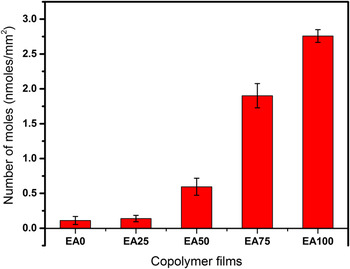
The surface concentrations of the COOH groups present in the copolymer films, as determined by the TBO assay, are presented in Fig. 3. The number of moles of carboxylic acid for EA0, EA25, EA50, EA75, and EA100 were 0.11 ± 0.06, 0.14 ± 0.05, 0.59 ± 0.12, 1.90 ± 0.17, and 2.76 ± 0.09 nmoles/mm2 respectively. The film EA0 showed a small absorbance for the desorbed TBO solution, which may be due to physical adsorption of the dye to the substrate/film. Consistent with the XPS (Fig. 1) and FTIR (Fig. 2) data, the film with 25% EDOTacid in the monomer feed ratio, EA25, showed only a small concentration of carboxylic acid groups on its surface. The remaining films (EA50, EA75, and EA100) exhibited an increasing surface concentration of carboxylic acid groups with the increasing mole fraction of EDOTacid. A possible explanation for the lack of carboxylic acid groups on the EA25 films could be that at low concentrations of EDOTacid, the monomer remains inside the bulk of the film and does not migrate to the surface. Alternatively, given that the increase in surface concentration of the acid groups from 25 to 100% was not linear, it is possible that EDOT acid was not incorporated in the copolymer linearly with increasing mole fraction of EDOTacid. This result is consistent with the IR spectra (Fig. 2) for the copolymer films where the C=O stretch appears only for films EA50, EA75, and EA100 and is almost absent for EA25. The data suggest that for lower mole fractions of EDOTacid, the polymer film was mainly comprised of EDOT. At higher concentrations of 75 and 100% of EDOTacid, the films were mainly comprised of EDOTacid.
Surface concentration of the carboxylic acid groups on the PEDOT-PEDOTacid copolymer films (n = 3).

C. Hydrophobicity of the films
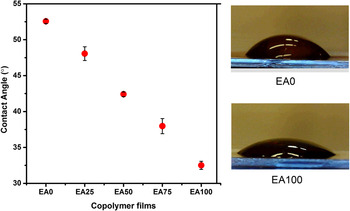
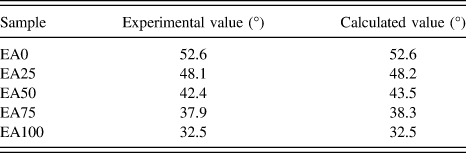
Static water contact angle measurements were conducted to assess the wettability of the PEDOT-PEDOTacid films. Figure 4 shows the water contact angles for the copolymer films, with increasing monomer feed ratio of EDOTacid (EA0 to EA100). The water contact angle for EA0, purely PEDOT films, was measured to be 52.6° ± 0.3°. The contact angle for EA25 was 48.1° ± 1.0°, for EA50 was 42.4° ± 0.3°, for EA75 was 37.9° ± 1.1°, and for EA100 was 32.5° ± 0.6°. The contact angle for PEDOT films (EA0) was consistent with previously reported values for PEDOT. Reference Povlich, Cho, Leach, Corey, Kim and Martin23,Reference Dobbelin, Marcilla, Tollan, Pomposo, Sarasua and Mecerreyes30 Figure 4 demonstrates the decrease in water contact angle with increase in PEDOTacid content in the copolymer films. Consistent with the increasing concentration of polar COOH groups on the surface of the films from EA0 to EA100, the films become increasingly hydrophilic in nature, resulting in increased wettability. The water contact angles for most of the COOH-functionalized films reported here were lower than those reported for COOH-functional PEDOT films synthesized by Luo et al. (in which the COOH was linked with an ether or an ester linkage); Reference Luo, Ali, Tansil, Yu, Gao, Kantchev and Ying24 the contact angles reported for the films with ether and ester linkers were 40.2° and 44.6°, respectively. The higher contact angles of the films reported by Luo et al. could be attributed to the alkyl linkers adding to the hydrophobicity of the films. Reference Luo, Ali, Tansil, Yu, Gao, Kantchev and Ying24 Thus, by manipulating the surface concentration of polar groups, films with varying hydrophilicities were achieved.
Water contact angles for copolymer films demonstrating increasing hydrophilicity with increasing PEDOTacid content (n = 3).

To determine the water contact angle of the PEDOT-PEDOTacid copolymer films theoretically, the Cassie equation was used. Reference Drelich, Wilbur, Miller and Whitesides31 Cassie's law is used to determine the effective contact angle for a liquid on a composite surface. For a two-component system, the Cassie equation is given by:
 $$\cos \left( {{\theta _{\rm{c}}}} \right) = {f_1}\cos \left( {{\theta _1}} \right) + {f_2}\cos \left( {{\theta _2}} \right)\quad {\rm{,}}$$
where f 1 and f 2 are the mole fractions and θ1 and θ2 are the contact angles for component 1 and component 2, respectively. Reference Drelich, Wilbur, Miller and Whitesides31 Using this equation, contact angles for the copolymer films EA25, EA50, and EA75 were calculated. As is illustrated in Table I, the experimental and calculated values are in excellent agreement within 1° of each other.
Experimental and calculated values of water contact angles for copolymer films.

D. Electrical properties of copolymer films
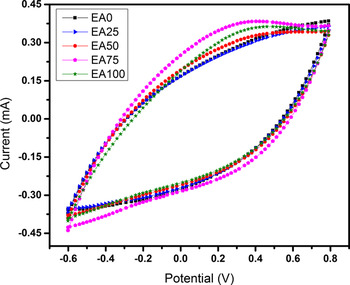
Electrical properties of the PEDOT-PEDOTacid copolymer films were determined via CV and EIS. The electrode sites were swept from +0.8 to −0.6 V at a scan rate of 0.12 V/s versus Ag/AgCl reference electrode. Figure 5 shows the first stable CV curve for the copolymer films EA0–EA100. The CSC of the film can be calculated by integration of I(t) within the cycled region; the CSC values for the copolymer films are provided in Table II. As shown in Table II, the CSC values for the films EA0, EA25, EA50, EA75, and EA100 are 3.74, 3.68, 3.81, 3.95, and 3.76 mC/cm2, respectively, indicating that there is no significant difference in the charge storage capacities of the various copolymer films. All the CSC values for the copolymer films were significantly greater than the CSC for Au/Pd electrodes (0.2 mC/cm2). However, the CSC values reported here are lower than previously published results for PEDOT films, where the deposition current density was ∼1 mA/cm2 and thus resulted in thicker films. Reference Green, Lovell and Poole-Warren32 The films in this work were polymerized with lower current density, resulting in thinner films and lower charge storage capacities. Nevertheless, our data suggest that differences in the amounts of PEDOT or PEDOTacid in the film do not appear to affect the manner in which charge is transferred from the film. This suggests that charge transfer must mainly happen along the backbone of the film, and that the carboxylic acid groups, which could generate ions that could contribute to an ionic component of charge transfer, do not seem to participate in the overall CSC of these copolymer films.
CV curves for 1st stable cycle for PEDOT-PEDOTacid copolymer films.

CSC values for copolymer films.

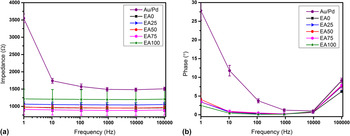
EIS was conducted to determine how the various amounts of PEDOT and PEDOTacid influenced charge transport in the copolymer films. The magnitude and phase of the impedance are shown in Figs. 6(a) and 6 (b), respectively. The results for the bare electrode are also included in the same spectrum. The characteristic drop in magnitude of impedance for the polymer-coated electrodes is evident when compared with bare electrodes in the frequency range 1–105 Hz. However, due to the comparably larger electrode diameter (6 mm) for the films reported here, the bare electrode impedance was lower than other micrometer-sized electrodes investigated elsewhere. Reference Kim, Richardson-Burns, Hendricks, Sequera and Martin33 The impedance magnitude was monitored in detail at 1 kHz, the frequency most relevant to neural recording and stimulating. The impedance values at 1 kHz for the copolymer films EA0, EA25, EA50, EA75, and EA100 were 952 ± 101, 1042 ± 65, 953 ± 42, 883 ± 145, and 1199 ± 277 Ω, respectively. The magnitude of impedance for all the copolymer films were similar to those of pure PEDOT (EA0) and were consistent with previously reported values for PEDOT. Reference Green, Lovell and Poole-Warren32,Reference Green, Lovell and Poole-Warren34,Reference Abidian, Kim and Martin35 The reduced impedance values were a result of the increase in the effective surface area of the electrode, consistent with previous reports. Reference Richardson-Burns, Hendricks, Foster, Povlich, Kim and Martin36,Reference Luo, Sekine, Zhu, Zhao, Nakao and Yu37 The phase lag for all the copolymer films in the entire frequency range was less than 10°, indicating that the polymer-coated electrodes function primarily as resistors. For lower frequencies of 1–100 Hz, the phase lag for the Au/Pd electrodes was around 30°. The low phase lag of <10° can also be attributed to the rough morphology of the films which makes them resistive in nature (as illustrated in the phase lag diagram [Fig. 6(b)]). Even though the phase lag was higher than that of the conducting polymer-coated electrodes, it was not high enough for the bare electrodes to behave as capacitors. The slightly higher magnitude of impedance in case of EA100, when compared with the rest of the films (around 1 kΩ), could be because of the different morphology of the film compared with PEDOT-containing films (see below).
Bode plot of impedance spectroscopy for the PEDOT-PEDOTacid copolymer films. Impedance magnitude is plotted in the left graph (a) and the phase lag is in the right graph (b). Error bars are marked with one standard deviation (n = 4). The impedance values at 1 kHz for the copolymer films EA0, EA25, EA50, EA75, and EA100 were 952 ± 101, 1042 ± 65, 953 ± 42, 883 ± 145, and 1199 ± 277 Ω, respectively.

E. Spectroscopic properties of the copolymer films
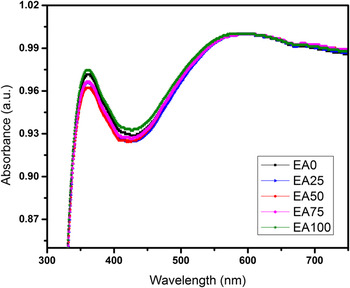
Optical absorption spectra of the PEDOT-PEDOTacid copolymer films coated on ITO electrodes at different monomer feed ratios in the polymerization solution are shown in Fig. 7. Normalized spectra of the copolymer films are presented in Fig. 7 for ease of comparison between the spectroscopic properties of the different PEDOT-PEDOTacid copolymer films. All the copolymer films exhibit a similar spectra consisting of 2 peaks in the UV–visible range. A narrow peak was observed at 360 nm and a broad peak from ∼500 to ∼675 nm with maxima at 590 nm. EDOT oligomers (dimers, trimers, and tetramers) have been shown to absorb between 300 and 400 nm, indicating that EDOT oligomers are present in the film. Reference Bolognesi, DiGianvincenzo, Giovanella, Mendichi and Schieroni38 PEDOT in its neutral state has a characteristic absorption spectra at 590 nm, Reference Lapkowski and Pron39,Reference Hwang, Tanner, Schwendeman and Reynolds40 attributable to the π-π* transition and consistent with the peak observed for the PEDOT-PEDOTacid copolymer films. The spectroscopic properties of the copolymer films appear unaltered with increasing amounts of PEDOTacid in the copolymer film, indicating that the incorporation of the acid group in the monomer does not influence the absorbance behavior of the conjugated polymer.
Ultraviolet–visible spectra for PEDOT-PEDOTacid copolymer films.

F. Morphology of the copolymer films
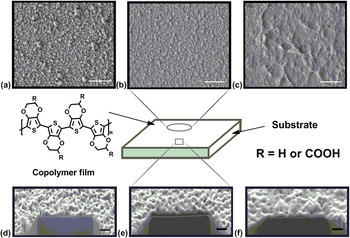
The structures of the deposited copolymers were studied using SEM and representative images are shown in Fig. 8. The surface morphology of films EA0, EA50, and EA100 is portrayed in Figs. 8(a)–8(c), respectively. It is clear from these images that the morphology of the films significantly changes with increasing mole fraction of EDOTacid in the monomer feed solution. The morphology of pure PEDOT films (EA0) was extremely rough in nature; similar to the morphology of PEDOT films deposited from propylene carbonate previously reported. Reference Blanchard, Carre, Bonhomme, Biensan, Pages and Lemordant41,Reference Kiefer, Bowmaker, Cooney, Kilmartin and Travas-Sejdic42 EA0 films were granular in nature with visible aggregation of the grains into clusters. These clusters, which were approximately 1 μm in diameter, were present uniformly over the film surface and were connected by smaller nanofibers (50–100 nm). The granular nature of the film disappeared with increasing PEDOTacid content in the copolymer films. The EA25 copolymer films had a fewer number of the clusters connected by nanofibers (50–100 nm), and they were smaller in size, ∼0.65 μm, when compared with those of the EA0 films. The micrometer-sized clusters disappeared completely for the EA50 films. The rough, granular morphology was almost entirely absent for the EA100 film (pure PEDOTacid), which exhibited a smoother surface decorated with “pleated” features. The EA100 film also lacked a porous morphology, which is consistent with previously reported porous morphologies of PEDOT deposited from organic solvents. Reference Groenendaal, Zotti, Aubert, Waybright and Reynolds7 The changing morphology of the films with increasing PEDOTacid content further supports the conclusion that the films deposited were indeed copolymers of EDOT and EDOTacid.
SEM images of the copolymer films containing different ratios of EDOT to EDOT acid. The top row of SEM images portray the surface morphology of the films containing 0, 50, and 100% EDOTacid; (a), (b), and (c), respectively (the scale bar represents 5 μm). The bottom images depict the films in profile, presenting the thickness of the deposited polymer. (d), (e), and (f) illustrate the profile of films composed of 0, 50, and 100% EDOTacid, respectively (the scale bar represents 1 μm).

Along with characterization of the morphology of the films, FIB-SEM [Figs. 8(d)–8(f)] was conducted on the films to determine the thickness and view the profile of the copolymer films. The film thickness and the maximum peak height varied with the copolymer composition as is shown in Figs. 8(d)–8(f). EA0, with a rough, porous and granulated morphology comprising aggregated clusters, had a film thickness of 535 ± 230 nm. The rough nature of the film resulted in a large standard deviation within the film thickness for EA0. The film thickness reduced for EA50 and EA100 films and was measured to be 355 ± 96 and 282 ± 46 nm, respectively. Owing to the absence of clusters on EA50 and EA100 surfaces, the average film thickness reduced with smaller standard deviations suggesting the films became smoother with increasing PEDOTacid content.
EA0 films, which were comprised of only PEDOT, were the most hydrophobic in nature and had a rough and porous morphology, similar to previously reported PEDOT films. Reference Blanchard, Carre, Bonhomme, Biensan, Pages and Lemordant41–Reference Chang, Her and Hong43 Related previous reports suggest pure PEDOT films were rougher and more hydrophobic with a high water contact angle compared with functionalized PEDOT films (with polar side groups), which were smoother and hydrophilic with a low water contact angle. Reference Luo, Ali, Tansil, Yu, Gao, Kantchev and Ying24,Reference Luo, Sekine, Zhu, Zhao, Nakao and Yu37,Reference Lima, Schottland, Sadki and Chevrot44 In particular, Luo et al. have also reported similar observations for the morphologies of PEDOT films with a hydroxyl and a carboxylic acid functionality. Reference Luo, Sekine, Zhu, Zhao, Nakao and Yu37 Pure PEDOT films were rough and porous, with nanofiber-like structures, whereas PEDOT with polar functional groups (–OH and –COOH) formed smoother films with “nanodots”. Reference Luo, Sekine, Zhu, Zhao, Nakao and Yu37 The changes in morphology of the reported films with changes in the hydrophilicity of the monomers are also in agreement with other reports in the literature that have shown that hydrophobic surfaces in polymer films are associated with rougher morphologies. Reference Hameed, Thomas, Abraham and Thomas45–Reference Lafuma and Quere47 The smoother surfaces of hydrophilic films have been attributed to high surface free energies and high work of adhesion. Reference Hameed, Thomas, Abraham and Thomas45
The precise copolymer composition of the various PEDOT-PEDOTacid films is difficult to establish unambiguously because of their limited solubility. However, when considering that the measured contact angles show outstanding agreement with theoretical predictions and that clear and nonorganized morphology changes uniformly and systematically with increasing PEDOTacid content, the data suggest that EDOTacid is incorporated randomly in the copolymer chains rather than in an organized or blocky manner. This is also in agreement with conclusions presented by Doherty et al. for a copolymer system of EDOT and EDOT-methanol. Reference Doherty, Wysocki, Armstrong and Saavedra48 Interestingly, from the TBO assay data for EA50 films, it is apparent that equimolar feed concentrations results in a film rich in PEDOT. This is also consistent with Doherty et al. in which calculated reactivity ratios for the EDOT and EDOT-methanol system indicated that r > 1 for EDOT and r < 1 for EDOT-methanol. Reference Doherty, Wysocki, Armstrong and Saavedra48 Given the similarity in chemical compositions of the polymers here and in the Doherty report, coupled with the results of the contact angle and SEM experiments, it is likely that a similar conclusion applies to the polymers reported here.
IV. CONCLUSIONS
Functional copolymer films with various compositions of PEDOT and PEDOTacid were successfully synthesized via electrochemical deposition. FTIR, XPS, and TBO assays confirmed the formation of copolymer films with increasing PEDOTacid content with increasing monomer feed ratios of EDOTacid. The contact angle measurements clearly demonstrate the increasing hydrophilicity of the film as the surface concentration of the carboxylic acid groups increased. Electrical properties of the films were not compromised by the addition of PEDOTacid in copolymer films and were similar to pure PEDOT films. The morphology of the films, however, significantly changed with increasing PEDOTacid content, transitioning from a rough to a smoother morphology. These approaches thus represent a facile method for the synthesis of functional PEDOT films with comparable electrical properties, tunable surface morphologies, and selected hydrophilicities. Myriad opportunities exist for functionalizing these copolymer films to provide an enhanced neural interface.
Supplementary Material
To view the supplementary material for this article, please visit http://dx.doi.org/jmr.2014.314.
ACKNOWLEDGMENTS
This research was supported in part by the National Science Foundation (DMR-1103027) and the University of Delaware. We would like to thank Inci Ruzybayev and Dr. Ismat Shah for help with XPS measurements on the copolymer film samples. DCM is a co-founder and the Chief Scientific Officer for Biotectix LLC, a University of Michigan spin-off company that is actively investigating the use of conjugated polymers for interfacing biomedical devices with living tissue.