Pinning any great hopes on international organizations has, since the failure of the League of Nations, generally been thought to be the province of dewy-eyed idealists. Hard-headed realists know that international organizations are simply the products of deals struck by nation states for their own purposes. They are creatures of states, at the service of states; states can enter reservations and derogations upon joining them and, by and large, states can leave them whenever they want with due notice. Realists have trouble seeing how such organizations could ever transcend the narrow purposes of the states that created them. It is hard for them to see how such organizations can get states to do anything they seriously do not want to do.
Organizational sociologists, however, know all is not quite as it seems to the self-styled realists. International organizations ‘bring people together’. They ‘convene’; they ‘orchestrate’.Footnote 1 Once created, international organizations – like all organizations – take on a life of their own. They acquire purposes and missions, proud histories and follow-on aspirations, all of which infuse the lives of those working in them and with them.Footnote 2 Maybe they make only soft, unenforceable law in the first instance.Footnote 3 But that takes on increasingly hard forms over time, as actors in and around the organizations increasingly invest their outputs with normative force.Footnote 4
Realists may scoff, saying that demands that are ultimately unenforceable are practically irrelevant.Footnote 5 But norms developed within and around international organizations can increasingly come to constrain even powerful players. Note Gunnar Myrdal’s description of what happened in the ‘talking shop’ that was the Economic Commission for Europe, of which he was the founding executive secretary:
[Once an] organization […] settles down to a tradition of work, […] the same state officials come together at regular intervals […]. Certain substitutes for real political sanctions can then gradually be built up. They are all informal and frail. They assume a commonly shared appreciation of the general usefulness of earlier results reached, the similarly shared pride of, and solidarity towards, the ‘club’ of participants at the meetings […]. Not upholding an agreement is something like a breach of etiquette in a club.Footnote 6
It is well documented that international institutions, rules and norms can get a grip on even the most powerful states in just that way.Footnote 7 A principal instrument of international governance is diplomacy, which is largely ‘government by talk’,Footnote 8 a mechanism extensively explored by deliberative theorists in other domains. This article aims to further those deliberative theorists’ project in relation to international politics.Footnote 9 We explore the role that international organizations – here, the Human Rights Council’s (HRC) Universal Periodic Review (UPR) – can play in instigating and orchestrating co-operative deliberation across the international system, with substantial consequences.
Operating under the auspices of the HRC, the UPR is designed as a co-operative rather than confrontational exercise that examines the human rights records of all member states of the United Nations (UN) on a four-and-a-half-year rolling cycle.Footnote 10 Our evidence suggests that the UPR effectively sets in motion a deliberative process to promote human rights around the world. In that respect, the UPR serves as a model of what international organizations can do to enhance the deliberative capacity of the international system.
CONCEPTUALIZING A SYSTEM’S DELIBERATIVE CAPACITY
In international politics, talk takes many forms. Everyone concedes an important role for certain sorts of talk, such as negotiation and bargaining, threats and offers. Much of that is bluff and bluster, of course, but even seemingly inconsequential ‘cheap talk’ can nonetheless lead to equilibrium outcomes, as game theorists have shown.Footnote 11 Those forms of talk are undeniably important, too. Like deliberative theorists, however, we focus here on talk in a more co-operative, problem-solving mode.
Deliberative theory emphasizes how, by talking together, we can learn more about one another’s position and perspectives, desires and constraints. In explicating our own points of view in order to help others understand them, we also come to a richer understanding of our own desires and constraints, principles and purposes. The ‘free give and take of discussion’ encourages the discovery of creative, novel solutions to shared problems.
When men who are serving a common purpose meet to pool their experience, to air their difficulties and even their discontents, there comes about a real process of collective thinking. The narrowness and one-sidedness of each person’s point of view are corrected, and something emerges which each can recognize as embodying the truth of what he stood for, and yet (or rather therefore) is seen to serve the purpose […] better than what any one conceived for himself.Footnote 12
For all these reasons, we should regard government by discussion ‘not [as] a makeshift or a compromise or a means of keeping people quiet by the production of a sham unanimity, or a process of counting heads to save the trouble of breaking them, but [as] the ideal form of government’.Footnote 13 So say the large raft of today’s theorists of deliberative democracy.Footnote 14 In international relations, too, scholars have come to appreciate the virtues of deliberation in this more co-operative, problem-solving mode.Footnote 15
In assessing the deliberative capacities of a political system, international or domestic, we need to consider two separate elements. The first relates to inputs – the capacity for ‘high-quality deliberation’ to occur. The second relates to outputs – the capacity for that deliberation to have effects outside of itself. Fully meeting these criteria requires a deliberative system with all of the following elements:Footnote 16
For high-quality deliberation:
Inclusiveness: Deliberation is open to (and inclusive of) all interested parties.
Authenticity: Deliberation evokes authentic expressions of the points of view of interested parties, or their authentic representatives.
Public space: There is an open arena in which civil society can come together (physically or virtually) to discuss matters of common concern, to identify problems and/or find solutions.
Discursive discipline: Within that forum, there are mechanisms to ensure that participants engage in non-coercive, sustained, considered, mutually responsive communicative engagement with one another’s views.
For deliberation with effect:
Empowered space: There is an arena in which decisions are made that may be formally binding or have practical effects in more informal ways.
Transmission: There is some mechanism by which public space can formally or informally influence empowered space.
Feedback loop: There is some mechanism by which empowered space reports back to, and is (formally or informally) held accountable by, the deliberating parties in the original public space. This is instrumental in ensuring that the effects of the process are indeed those intended.
We expand on all of these elements more fully in relation to the UPR below. Throughout, we emphasize that deliberative capacity is an attribute of a system as a whole, with different parts of that system contributing in different ways.Footnote 17 A high-profile discursive moment at the heart of the UPR process (in the form of the Interactive Dialogue between states in Geneva) catalyzes even more extensive deliberation across the system as a whole; this occurs both in the run-up to and backwash of the UPR process, and also within and between states around the world.
Deliberative theorists have identified a great many functions that deliberation can serve. At its best, deliberation promotes the pooling and probing of one another’s information and perspectives in a co-operative, collaborative context that is conducive to developing and furthering shared purposes and goals. These attributes of deliberative engagement have been well documented in domestic settings.Footnote 18 As our discussion will show, the same attributes are found in the deliberations in and around the UPR, globally. The function of deliberation there is to improve the implementation of human rights norms by providing an occasion for information sharing in a highly visible way while engaging a wide range of stakeholders, both nationally and internationally.
DELIBERATING OVER HUMAN RIGHTS: THE UPR
To explore how international organizations can contribute to the deliberative capacity of the international system, we examine the case of the recently created UPR that operates under the auspices of the UN’s HRC. We begin by describing the UPR process, explaining the respects in which it is a genuinely deliberative process, and assessing the quality of the deliberation involved. Then we explore its effects.
The Universal Periodic Review Process
The UPR process was established at the same time as the new HRC by a 2006 resolution of the United Nations General Assembly.Footnote 19 That resolution charged the HRC, inter alia, to ‘undertake a universal periodic review, based on objective and reliable information, of the fulfillment by each State of its human rights obligations and commitments’.Footnote 20 The resolution further enjoins the council to work in a transparent, fair and impartial manner that enables genuine, results-oriented dialogue (including follow-up discussions on recommendations and their implementation).Footnote 21
The UPR established under article 5(e) of that resolution is explicitly in the spirit of the larger dialogic mandate governing the HRC as a whole. The UN High Commissioner for Human Rights tellingly characterizes the UPR as ‘one of the key elements of the new Council which reminds States of their responsibility to fully respect and implement all human rights and fundamental freedoms’.Footnote 22 The founding resolution specifies that ‘the review shall be a cooperative mechanism, based on an interactive dialogue, with the full involvement of the country concerned’.Footnote 23 This point is re-emphasized in the HRC’s Statement of Principles and Objectives for the UPR.Footnote 24 Not only is the UPR supposed to ensure the full participation of the country under review, it is also supposed to engage all relevant stakeholders, including non-governmental organizations (NGOs) and national human rights institutions.Footnote 25
In the UPR, each of the 193 UN member states comes under scrutiny on a rolling basis, every four-and-a-half years.Footnote 26 Universality of coverage is key to the UPR, and distinguishes it from the previous, discredited practices of the UN Commission on Human Rights.Footnote 27 Two states volunteered to be reviewed in early sessions. Beyond that, the order in which states were initially reviewed was determined by lot, after stratifying to ensure regional balance within each session. The composition of the regionally diverse troika of member states that serves as the facilitator and rapporteur for each state’s review is also determined by lot.Footnote 28
The centerpiece of the UPR is a three-and-a-half hourFootnote 29 open session – the Interactive Dialogue – in which the State under Review (SuR) is subjected to comments and recommendations concerning its human rights record. This is state-to-state accountability. While other stakeholders are welcome to attend, only UN member states (together with two observers, Palestine and the Holy See) are allowed to speak.Footnote 30 Their interventions are required to be short – initially as short as two minutes,Footnote 31 reduced to fifty-one seconds in Cuba’s 2013 UPR.Footnote 32 In the Interactive Dialogue itself, the SuR’s responses must also be brief – the spokesperson for the SuR cannot speak for more than seventy minutes in total, including his or her opening presentation.Footnote 33
Each UPR is based on documentation of various sorts: some is supplied by the SuR, some by the UN’s Office of the High Commissioner for Human Rights (UNOHCHR) and some by other relevant stakeholders. The SuR submits a national report of up to twenty pages that is supposed to be prepared in consultation with all relevant national stakeholders. The UNOHCHR submits a compilation of information of up to ten pages, based on reports and official documents from relevant treaty bodies, special procedures and other UN agencies. It also supplies up to another ten pages summarizing information provided by the relevant stakeholders,Footnote 34 which include NGOs, national human rights institutions, academic and research institutes, regional organizations and civil society representatives.Footnote 35
Throughout the first two cycles of the UPR, this information from other stakeholders has been essential for assessing SuRs’ human rights practices. Stakeholders’ summaries have proven particularly useful in detecting discrepancies between the different reports, and enabled critical judgements about SuRs’ actual human rights achievements.Footnote 36
At the end of a UPR exercise, a troika of rapporteurs, with the assistance of the UNOHCHR, compiles an outcome report consolidating and organizing comments, questions and verbatim recommendations made during the Interactive Dialogue.Footnote 37 That report is then open for comments from other member states as well as relevant non-state stakeholders, and it is adopted (invariably without change) after discussion involving the SuR, other member states and NGOs at the next plenary session of the HRC a few months after the Interactive Dialogue.
The SuR may respond to any given recommendation by accepting it, rejecting (‘noting’) it or giving a more equivocal response.Footnote 38 Accepting a recommendation constitutes a voluntary commitment and pledge on a given issue.Footnote 39 The SuR is expected to say what it intends to do in that respect, referencing its key national priorities, initiatives and commitments.Footnote 40
At the next review, the SuR will then be expected to report on the implementation status of recommendations it accepted in the previous cycle, as well as report on achievements made and outstanding challenges and difficulties in advancing the human rights situation in that country.Footnote 41 Other relevant stakeholders are also specifically ‘encouraged to include in their contributions information on the follow-up to the preceding review’.Footnote 42
Thus the UPR is a co-operative process in which SuRs are invited to enter into voluntary commitments regarding their human rights practices. The UPR is an evolving process; further decisions have yet to be made by the council concerning follow-up modalities and how to handle ‘cases of persistent non-cooperation with the mechanism’.Footnote 43
Assessing the UPR’s Contribution to the Deliberative System
We now assess the ways in which the UPR process contributes to the deliberative capacity of the international system.
A threshold question is whether the UPR process really involves much deliberation. Its centerpiece is a highly public moment of state-to-state discursive accountability, during the Interactive Dialogue in the grand Salle XX of the Palais des Nations in Geneva. That is a hugely important event, at which national governments are questioned on their human rights performance by other states, with NGOs in the room and many of their citizens back home watching the live or archived webcast. The live webcasts of their countries’ Interactive Dialogues was watched by some 5,000 people in China, 6,000 in Malaysia and an astonishing 7,000 in tiny Vanuatu (almost 3 per cent of its population). In some cases, citizens were seeing their rulers publicly account for their human rights practices for the first time; the Saudi delegation seems to have felt this particularly, coming to its first UPR with an exceptionally large, senior and well-prepared delegation.
Nevertheless, the Interactive Dialogue lasts only three-and-a-half hours. States intervening during that session are allowed to speak only very briefly; they typically read out prepared texts that consist of comments and ‘recommendations’ rather than questions. The SuR is also strictly limited in the time available to respond to those interventions on the day itself – its representative may speak for no more than one-third of the 210 minutes, including opening remarks. In consequence, the SuR does not respond on the spot to each intervention, and even when it does the other state making that intervention is permitted no further follow-up. Thus the UPR’s Interactive Dialogue itself is not very dialogic at all.
While the proceedings on the day itself may fall short of the highest deliberative ideal, the requirement that states present themselves for questioning induces a great deal of high-quality deliberation in the run-up to (and the backwash of) the open session. There are protracted discussions within the government of the SuR – and with and among stakeholdersFootnote 44 – about formulating the national report to be submitted to the UPR and anticipating challenges that might arise during it. There are protracted discussions within the UNOHCHR, and between them and stakeholders, in preparing the stakeholder report,Footnote 45 and within the UNOHCHR in preparing its own submission to the UPR. The troika passes questions from other states to the SuR in anticipation of the Interactive Dialogue, and facilitates discussion among states over their recommendations afterwards.Footnote 46 While the SuR does not have time to respond to all the interventions and recommendations on the day, it is expected to give a written response to each recommendation within a few months of its Interactive Dialogue. Furthermore – crucially – each country will be subject to another Interactive Dialogue in four-and-a-half years. So responding to the last Interactive Dialogue blends into preparing for the next, as part of an ongoing dialogic process.
In short, the UPR as a whole is a protracted deliberative process, with a moment of highly public state-to-state accountability at its heart. The Interactive Dialogue of the UPR itself may be only minimally deliberative – although that highly public moment of peer-to-peer accountability is arguably the key to its evoking commitments from states regarding their human rights performance. The prospect of being held to account in that way generates intense and ongoing deliberation before and afterwards that, as the next section shows, seems to have made a positive difference to states’ human rights performance.Footnote 47
We now assess the quality of the deliberation involved in terms of the elements introduced above. The first element of a high-quality deliberative system is inclusiveness. The UPR is insistently open and inclusive, certainly with respect to all UN member states and to all internationally recognized human rights organizations. It is specifically designed to ‘ensure universal coverage and equal treatment of all States’ and to ‘promote the universality, interdependence, indivisibility and interrelatedness of all human rights’.Footnote 48
Universality is not merely UPR’s aspiration: it is its hallmark. Every state took part in its first UPR and, so far, every state has taken part in its second. They have done so even when it was costly or inconvenient, as it was for Pacific Island and African states in particular.Footnote 49 They have done so even when it was politically awkward: Israel threatened not to take part in its Wave 2, but eventually did so in Session 17.Footnote 50 Confronted with the prospect of being the only state in the world not to take part, no state ultimately seems prepared to stay away.
Looking beyond member states, the UPR also mandates the participation of all relevant stakeholders, ‘guided by the principles of universality, impartiality, objectivity and non-selectivity’.Footnote 51 This de-monopolizes states as suppliers of information. NGOs provide independent information and transparency, especially where the states fail to report fully or reliably.Footnote 52 Taken as a whole, NGOs introduce a diversity and range of views that would be missing under standard practices of monitoring and reporting. They also play a leading role on the ground, gathering together different segments of their society in UPR-related events prior to the review, disseminating information and providing training to less experienced NGOs.
High-quality deliberation also requires authenticity – that the views expressed are genuinely those of the agent concerned. International politics is rife with strategic behavior, and the UPR process is hardly exempt from that. The comments and recommendations that states make to their political friends under review sometimes veer between polite fictions and barefaced lies.Footnote 53 Nevertheless, we still find plenty of apparently genuine, non-strategic comments and recommendations being made during the course of a UPR. SuRs insistently (and we think not entirely disingenuously) echo the remarks of Malaysia:
In order for the UPR to be effective and meaningful, we believe that countries participating in the process must approach this important exercise in a spirit of sincerity, openness and transparency. We are of the view that observations and recommendations, raised during the session, no matter how difficult should be addressed and dealt with in a constructive manner. If we choose to be defensive, in denial, cynical and not wanting to engage with others in good faith, we will render the whole process meaningless.Footnote 54
Issues of authenticity sometimes also surround NGOs. Are they truly representative of civil society, or are they in effect agents of the national government? In the modalities specified for its second cycle of UPRs, the HRC attempts to help assuage these concerns by stipulating:
The summary of the information provided by other relevant stakeholders should contain, where appropriate, a separate section for contributions by the national human rights institution of the State under Review that is accredited in full compliance with the Paris Principles. Information provided by other accredited national human rights institutions will be reflected accordingly, as well as information provided by other stakeholders.Footnote 55
The Paris Principles for accreditation specifically require a pluralist representation of civil society.Footnote 56 It is true that there have been some egregious cases of ‘government-supported NGOs’ swamping the UNOHCHR with submissions – 326 in the case of Cuba and 579 in the case of Venezuela – many of which were virtually identical and contained almost no criticisms of the government.Footnote 57 Yet the fact that such biased reporting can be detected and discounted inspires confidence in the UPR process.
Another essential element of high-quality deliberation is discursive discipline. Participants must engage in the deliberation in a free and open manner, without coercion or intimidation. The UPR is represented as an insistently co-operative enterprise. In the course of a UPR, an SuR may make commitments, and its progress toward honoring those commitments will be a focus of discussion in its subsequent UPRs. But it is all insistently voluntary. The mechanism at work may be more the ‘civilizing force of hypocrisy’Footnote 58 than just ‘the forceless force of the better argument’.Footnote 59 But ‘forceless’ both are.
The UPR encourages ‘deliberation with effect’ by drawing human rights discourse in the public space of civil society into the empowered space of the Palais des Nations in Geneva, where states hold other states to account at the Interactive Dialogue for their human rights performance. As we have seen, mechanisms are in place to input the views of those relevant stakeholders into that process. And even if there are no formal mechanisms to assure the accountability of that empowered space to global/national civil society, more informal ways of reporting back to the original public space seem to emerge with NGOs as the main transmitters. Back home, NGOs often engage their governments in constructive (rather than confrontational) dialogue over solutions to problems identified in the last UPR in preparation for the next. Thus the UPR is equipped with all the procedural elements required to ensure effectiveness.
But does the UPR actually affect states’ behavior? That is the larger worry. How can a procedure that is so insistently co-operative really alter the human rights performance of any underperforming state? Next we present evidence suggesting that it does, concluding with some observations as to how and why.
EFFECTS OF THE UPR PROCESS
In assessing the effects of the UPR’s deliberative process, three questions arise:
1. To what extent do SuRs agree, in the course of their UPR, to undertake specific human rights promoting actions that they had not previously undertaken?
2. To what extent have SuRs progressed in improving their human rights practices from one UPR to the next?
3. To what extent can that progress be plausibly attributed to the UPR process itself (as opposed to all the other things that might have happened in the intervening period)?
We confine our analysis almost entirely to evidence internal to the UPR process.Footnote 60 Although limited in that way, our analysis exhausts what can be gleaned from that source. Our findings will thus be suggestive rather than conclusive. Still, on that basis we can make a strong circumstantial case that the UPR process has indeed been a deliberative force for good. Even if it is too early to determine the ultimate effects of the process on states’ overall human rights performance, as measured by the familiar cross-national indicators, our evidence identifies the UPR as a credible mechanism for such improvement.Footnote 61
We base our analysis on the full sample of fifty-five states that had an initial UPR in one of the twelve sessions of Wave 1 and their second review in one of the first four sessions of Wave 2 of UPRs (thirteenth to sixteenth sessions). We examine the recommendations that other states made to the SuR in each of those sessions, and the SuR’s response.
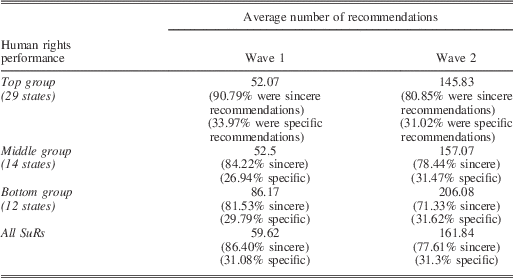
On average, SuRs received around sixty recommendations in Wave 1 and around 162 in Wave 2. Some of those recommendations were vague or general. Approximately 30 per cent in each wave, however, required specific new actions on the part of the SuR.Footnote 62
Some recommendations contain terms like ‘conduct’, ‘develop’, ‘eliminate’, ‘abolish’, ‘enforce’ and ‘ratify’. These terms point to actions – sometimes specific, sometimes general – that the SuR should undertake. Other recommendations contain words such as ‘continue’, ‘intensify’, ‘maintain’ and ‘strengthen’. These terms imply that the SuR is already taking action and is simply being encouraged to do more along the same lines. They therefore imply that the SuR is at the ‘post-action’ stage.Footnote 63
Based on such phrasing, we might infer at what ‘stage of implementation’ of human rights the SuR is (or is perceived to be by other states making recommendations to it at its UPR). That would, however, be a naïve way of reading those recommendations. Sometimes ‘post-action’ recommendations like ‘continue’ mean just what they seem to mean (‘You have made a good start, now continue along that path’). But sometimes they are more disingenuous and strategic, and amount to UN-speak meaning, roughly: ‘You are my friend and I’m not going to embarrass you by pointing out that you’ve not even started doing what you should; so I am going to phrase my recommendation as “continue”, pretending you have already started something which both of us know that you haven’t and should.’
We operationalize that distinction by treating State A’s ‘post-action’ recommendations to state B as sincere if and only if State A also made at least one explicitly ‘action’ recommendation to State B. By that standard, some 86 per cent of all recommendations in Wave 1 and 78 per cent in Wave 2 counted as sincere.Footnote 64 All of our subsequent discussion will be confined to sincere recommendations alone.
States can be distinguished according to their pre-UPR human rights performance using the Cingranelli-Richards (CIRI) Empowerment Rights Index.Footnote 65 Table 1 demonstrates that, as expected, the twelve poorest human rights performers received the most recommendations in each wave of the UPR – about 50 per cent more than the top group of twenty-nine SuRs.
Average Number of Recommendations, by States’ Human Rights Performance Level

Do SuRs Agree to Specific Recommendations?
In assessing the effects of the UPR process, we first investigate the extent to which SuRs agree to undertake new human rights promoting actions in response to their UPR. To do so, we focus on SuRs’ decisions to ‘accept’ recommendations that require specific actions departing from previous practice (for example, to ratify a particular human rights treaty).Footnote 66 Accepting a recommendation is a very public signal of the SuR’s willingness, and indeed intention, to take the indicated action with respect to human rights.
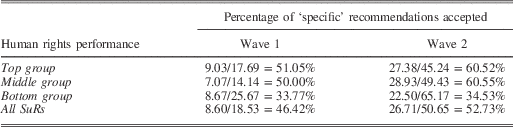
A few countries rejected or equivocated on all recommendations made during Wave 1. A few accepted all recommendations. The great majority lies somewhere in between.Footnote 67 On average, SuRs accept about half of the specific recommendations made to them during their UPR (see Table 2).
Proportion of Specific Recommendations Accepted, by States’ Human Rights Performance Level

Although top and middling human rights performers accept a much higher proportion of specific recommendations, even weak performers on average accepted over a third of the specific recommendations in each wave of the UPR. Thus even poor human rights performers accept a considerable proportion of specific recommendations.Footnote 68
The fact that, over the course of their UPR, states agree to do something they could have previously done (but had not) suggests that the UPR process is indeed effective in inducing states to agree to comply with human rights standards.
Is There Progress From One UPR to the Next?
Agreeing to do something is one thing; doing it is another. How can we tell whether a given SuR made progress with regard to their human rights practices between reviews? To answer this question, indirect evidence can be gleaned from two sources. One is internal to the UPR process, while the other employs our only form of external cross-check.
For the internal test, we compare the contents of all sincere recommendations the SuR received in each wave. From those, we infer which implementation stage (action or post action) the SuR is perceived to be at in each of those waves. If the SuR is seen to be at a substantially higher implementation stage in Wave 2 than in Wave 1 (based on sincere recommendations), we infer that the SuR made progress toward implementing human rights – at least in the eyes of the states making the recommendations.
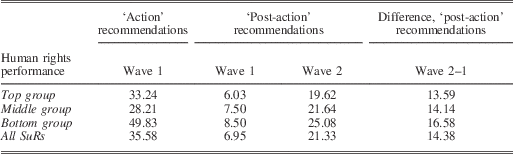
Examining evidence of this sort suggests that states generally do progress, in many cases substantially, between Waves 1 and 2. We determine this by looking at: (a) the average number of action-stage recommendations SuRs received in their Wave 1 UPR; (b) the average number of sincere post-action-stage recommendations states received in their first and second waves and (c) the difference between these numbers. SuRs that received many action recommendations in Wave 1, and then received many more sincere post-action recommendations in Wave 2 than in Wave 1, can be interpreted as having taken appropriate actions between the two waves (at least from the perspective of states making recommendations to them).
That was clearly the case for virtually all SuRs.Footnote 69 In general, SuRs received a substantial number of action-stage recommendations (35.58, on average) in Wave 1, and markedly more post-action recommendations in Wave 2 than in Wave 1 (14.38 more, on average). The bottom group of human rights performers received the most recommendations for actions in Wave 1, as one would naturally expect. But interestingly, that group also showed the greatest progress between Waves 1 and 2 (on average, they had 16.58 more post-action recommendations in Wave 2 than in Wave 1) (see Table 3).
Average Numbers of ‘Action’ and ‘Post-action’ Recommendations, by States’ Human Rights Performance Level

That is pleasing, but at first blush surprising. Other things being equal, we would expect better human rights performers to be more responsive to UPR recommendations than poorer ones. But presumably, states take the easier steps first (for example, basic civil rights) and the harder steps later (for example, rights of migrant workers). If so, then it should come as no surprise that good-performing states that have already taken many steps to implement human rights will find the next steps harder than will poor-performing states that have yet to take those easier first steps.
For our second test of whether there is progress between the two waves of UPRs, we consider evidence external to the UPR process. Here we look to the most specific, and checkable, recommendation that states make to one another during the UPR: to ratify a particular treaty.Footnote 70
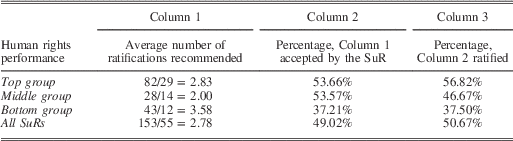
First, we note the average number of recommendations to ratify treaties that states received.Footnote 71 Then we record the proportion of those recommendations that each group of SuRs said they ‘accept’. Finally, we calculate the proportion of accepted recommendations to ratify treaties that SuRs acted upon (see Table 4).Footnote 72
Ratification of Human Rights Treaties

States in the bottom group of human rights performers receive the most recommendations to ratify additional treaties. That is unsurprising, because poor performers typically have more treaties left to ratify (in addition to attracting particular attention because they are seen as problem cases). The top and middle groups accept recommendations to ratify treaties about half the time, and they go on to ratify the treaty in about half of those cases (slightly more so in the top than in the middle group). But, significantly, even the bottom group accepts a substantial proportion (about 37 per cent) of recommendations to ratify specific treaties – and then acts on a substantial proportion (38 per cent) of those promises.
Of course, this does not constitute ironclad proof that receiving the recommendation, and accepting it, is what made those poor human rights performers ratify the treaties.Footnote 73 Still, most of those treaties had been open for ratification for quite some time before the first UPR. That such a substantial portion of UPR recommendations to ratify ended in ratification, even among the least human rights respecting states, strongly suggests that the UPR played an important role.
Is the Progress Plausibly Attributable to the UPR?
The third issue we investigate is whether the progress in human rights between Waves 1 and 2 of the UPR can be attributed to the UPR process. One way to assess that is to look at the timing of the implementation of UPR recommendations. If most of the progress came during the immediate run-up to Wave 2, it is not unreasonable to suspect that – at least in many cases – their implementation of action recommendations from Wave 1 is attributable to the prospect of having to give a public account to other states during the UPR process.
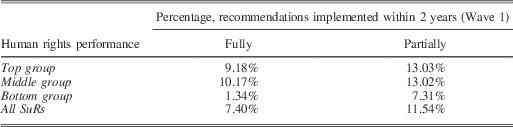
We investigate the timing of implementation of UPR recommendations in two ways. The first relies on Mid-term Implementation Assessment reports, which have been compiled by UPR Info for some (but not all) SuRs.Footnote 74 These documents assess whether recommendations made to the SuR during Wave 1 were implemented (and if so, whether fully or partially) after two years (see Table 5).Footnote 75
Timing of Implementation, by States’ Human Rights Performance Level

On average, SuRs implemented only around 7 per cent of Wave 1 recommendations fully (and another 12 per cent partially) by the time of the Mid-term Implementation Assessment. Of the twenty-seven SuRs in question, nineteen implemented fewer than 20 per cent of their UPR’s recommendations either partially or fully during the first two years after their Wave 1 UPR. Thus in most countries – but especially in the bottom group of human rights performersFootnote 76 – few implementation activities happened immediately after Wave 1. Recommendations were typically implemented nearer the time of the next review, when the prospect of giving public account to other states was looming.
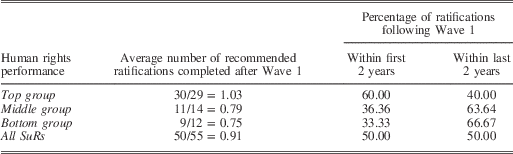
These findings are confirmed by looking once again at Wave 1 recommendations to ratify treaties, this time paying special attention to the timing of ratifications in relation to the SuR’s next UPR (see Table 6). Top human rights performing states ratified treaties recommended to them reasonably promptly after their first UPR – 60 per cent were ratified within the first two years of the SuR’s Wave 1 UPR. Middle and bottom human rights performing states, in contrast, tended to ratify treaties recommended to them in the more immediate run-up to their next UPR.Footnote 77 For those two groups of states, around two-thirds of recommended ratifications were accomplished in the last two years before the next UPR.
Timing of Treaty Ratification, by States’ Human Rights Performance Level

Therefore, a substantial proportion of recommendations was only implemented in the run-up to the next UPR, especially among poor human rights performing states. This finding suggests (but does not prove) that the prospect of the upcoming UPR led the state to take action.
WHY IT WORKS: DELIBERATIVE CAPACITY IN ACTION
The case of the HRC’s UPR reveals ‘what it takes’ for deliberation to ‘have effect’ in the international setting. Three features of the deliberation seem highly useful in that connection.
One crucial source of the UPR’s deliberative capacity is the fact that it is a repeated game among the same players. Repeat play can evoke more co-operative behavior, simply because players will have an opportunity to reward or punish one another in subsequent rounds of the game, depending on how they behave in this round; as a consequence, the shadow of the future makes players better behaved in the current round.Footnote 78 This is one plausible interpretation of how international law constrains states’ behavior in general.Footnote 79
This is an important part of the UPR story. The prospect of another Interactive Dialogue in just four-and-a-half years’ time is plausibly what induces many states to make (and keep) credible commitments. The timing of implementation of Wave 1 recommendations, particularly by states without good human rights records, clearly suggests this mechanism at work.
Note, importantly, that the UPR does not happen ‘under the radar’ of foreign ministries, where cozy cabals of diplomats can do as they please. It is a high-profile, high-level event: approximately 80 per cent of Wave 1 delegations are led by someone at the ministerial level.Footnote 80 Thus a SuR’s response to UPR recommendations is driven less by fear of personal embarrassment at a ‘breach of etiquette in a club’Footnote 81 than by fear of the consequences of damaging the reputation of the state as a whole at the next UPR.
A second, related source of the UPR’s deliberative success is peer-to-peer accountability.Footnote 82 It matters greatly that the UPR is a system of peers reviewing one another’s performance, because peers care about each others’ opinions. As observers of the UPR process repeatedly say, ‘States are proud in front of other states.’ States can dismiss experts and NGOs, but not other states.
Among some states, particularly of the Global South, it is a point of pride to boast of the large percentage of UPR recommendations that they accepted. The Moroccan delegation is famous for this. Uruguay, likewise, proudly accepted all eighty-eight recommendations made to it in its 2009 Interactive Dialogue.Footnote 83
But the peer pressure is felt equally keenly by the most powerful states in the world. Members of the G20, and especially the P5, are under special scrutiny in the UPR precisely because they are ordinarily immune.Footnote 84 They particularly feel the obligation to ‘look good’ – or as good as they can – at their UPR in order to vindicate their position of international leadership.
The third crucial element of the UPR process is discursive entrapment. This is a particular instance of a more general process by which recalcitrant states are socialized into international norms, including human rights norms: ‘Norm-violating governments accepted the norms rhetorically in order to decrease the international and domestic pressures against them.’Footnote 85 But after making what started as a purely tactical rhetorical concession, states are increasingly held responsible (by themselves as well as others) for acting on it. This leads to increasingly co-operative joint action toward increasingly convergent goals.Footnote 86 Parties have simply ‘talked themselves into a corner’,Footnote 87 as a result of ‘rhetorical coercion’, ‘persuasion’ or ‘socialization’.Footnote 88
An analogous cycle of self-entrapment seems to be at work in the UPR. In one cycle, the SuR receives a raft of recommendations. As a tactical concession to placate critics (at least in the short term), an SuR that is under heavy pressure over its human rights record might ‘accept’ some of the recommendations. But at its next UPR, it will have to account for its follow-through on the recommendations it accepted.
Some seriously recalcitrant states may of course simply brazen it out at that point, waiting to see what ‘further measures’ (as yet unspecified) the HRC finds to deploy. But for the same reason they felt it necessary to make the tactical concession in the first place, most states would presumably prefer to be able to report at least some progress in the next review.
The combination of these three mechanisms helps make the UPR process a relatively successful instrument for promoting human rights around the world. Early fears that it would simply collapse have proven unfounded. While there is naturally a certain amount of ‘gaming the system’ and some disingenuous testimony and even sheer bullying, overall the UPR process has been at least a qualified success. The deliberative capacity of other international organizations might be enhanced if they mimicked these mechanisms.
CONCLUSION
The UPR of human rights is, at face value, a toothless mechanism. Realists would scoff at its absence of any serious sanctions. But under some conditions, seemingly toothless mechanisms can have a real impact. Peer-to-peer accountability – universal in scope and repeated in form – engages states in co-operative dialogue that leads, for example, to their ratifying human rights treaties that they had failed to ratify before. Furthermore, the deliberative engagement is not only with other states but also with civil society, and the dialogue is continuous in form – occurring not only in anticipation of moments of peer-to-peer accountability but also because of it. In this way, the UPR mechanism induces a much more co-operative, deliberative culture across the system as a whole.
Peer-to-peer accountability and the requirements to consult civil society more generally are not unique to the UPR. Similar measures are found in the OECD peer-review proceduresFootnote 89 and in the Paris Principles governing the civil society consultative practices of UN bodies.Footnote 90 Other human rights bodies charged with implementing international treaties are using the UPR’s techniques for engagement and publicity (especially the webcasting of country review meetings).Footnote 91 In short, contrary to the expectations of hard-bitten realists, the UPR’s ‘soft’ way of inducing system-wide deliberation is both increasingly common and consequential in world politics.
SUPPLEMENTARY MATERIAL
To view supplementary material for this article, please visit http://dx.doi.org/10.1017/S0007123415000708