Despite global efforts to diagnose and treat patients, tuberculosis (TB) remains a major public health problem worldwide. Brazil is 1 of the 30 countries that account for ~87% of the total TB cases in the world, with 87,000 reported cases in 2017.1 The hospital environment presents a complex situation in which patients with suspected TB require airborne isolation beds to prevent nosocomial infection. In addition to the low availability of these beds in low-income settings and the high cost of hospitalization, respiratory isolation is also associated with higher likelihood of adverse events to the patients.Reference Jensen, Lambert and Iademarco2
Usually, 3 negative smear microscopies are required to remove a patient from an airborne isolation room.3 However, subsequent samples may be requested according to clinical suspicion, which is often necessary for paucibacillary cases, due to the lower sensitivity of smear microscopy.Reference Bates4 Thus, the time to discharge for a patient in an isolation room is usually long, which may lead to a delay in providing these rooms to other patients who require airborne isolation.
In 2015, the US Food and Drug Administration (FDA) recommended the use of a molecular Mycobacterium tuberculosis (MTB) DNA and resistance to rifampicin (RIF) test, GeneXpert MTB/RIF (Cepheid, Sunnyvale, CA), as a strategy to remove patients from respiratory isolation beds. It has high diagnostic accuracy, demonstrated mainly by high negative predictive values (NPVs). In addition, the short execution time (2 hours) has favored its adoption as a test of choice to exclude infectious tuberculosis. This practice leads to an earlier release of isolation beds compared with the 3 acid-fast bacilli (AFB) smears included in international and national protocols.5-Reference Lippincott, Miller and Popowitch9
In this study, we evaluated the role of a single GeneXpert MTB/RIF molecular test for deciding to remove patients with suspected pulmonary tuberculosis from respiratory isolation in the emergency room and wards of a tertiary-care public hospital in Brazil.
Methods
Study design
This retrospective, observational, pragmatic, real-world study was designed to evaluate the potential impact of a single molecular GeneXpert MTB/RIF test on the decision-making process for removing patients from respiratory isolation over a 12-month period from May 2017 to April 2018.
Study setting
The Clinics Hospital of Ribeirão Preto Medical School, University of São Paulo (FMRP-USP) in Sothern Brazil is a 900-bed university hospital, which is a referral center for 4.5 million people who need high-complexity health care. The hospital complex, including the emergency unit and satellite hospitals, has 35 airborne isolation rooms with a daily admission cost of ~US$1,440.
Study population
Patients older than 10 years suspected of pulmonary TB in the emergency room or hospital wards were enrolled in this study. All patients had at least 1 respiratory sample (ie, sputum, induced sputum, gastric washing, or bronchoalveolar lavage) tested with AFB smear, culture, and GeneXpert MTB/RIF. Demographic and clinical data related to suspected TB symptoms and patient outcomes were obtained from medical records. We excluded patients under TB treatment.
Laboratory methods
Clinical samples were collected during the routine diagnostic investigation of TB and were tested with GeneXpert MTB/RIF and direct smear microscopy with Ziehl-Neelsen staining, followed by the decontamination of the sample (using the Petroff technique) and subsequent incubation in liquid culture medium in the MGIT 960 automated system (MGIT 960; Becton Dickinson Diagnostic Systems, Sparks, MD). Mycobacterium tuberculosis complex identification was based on a rapid immunochromatographic test, SD Bioline TB Ag MPT64 TEST BIOEASY (Standard Diagnostics, Suwon, South Korea), directly from the liquid culture medium according to the manufacturer’s instructions.
After decontamination and concentration, GeneXpert MTB/RIF (Cepheid, Sunny, CA) was performed according to the manufacturer’s instructions. In Brazil, the National Tuberculosis Program provides GeneXpert MTB/RIF tests with a recommendation to perform only 1 test per specimen per patient. In the hospital, the first clinical specimen is always tested for AFB smear, GeneXpert MTB/RIF, and liquid media culture. If other clinical specimens are submitted to the laboratory, only AFB smear and culture are performed.
Study design
Patients were individually assessed according to the number of AFB smears and cultures available (1, 2, and 3). The molecular test (GeneXpert MTB/RIF) was performed in the first clinical specimen. The hospital policy to exclude TB follows the national guidelines, which require at least 3 respiratory samples collected on sequential days. However, we sometimes face complex cases that require >3 days to collect all the samples or that require >3 samples to confirm or exclude TB diagnosis.
We defined 3 groups. The first group included patients who had a single respiratory sample tested by AFB smear, culture, and GeneXpert MTB/RIF (group 1); the second group had 2 AFB smears, 2 the second group had 2 AFB smears 2 cultures, and 1 GeneXpert MTB/RIF (group 2); and the third group included patients with 3 or more respiratory specimens with at least 3 AFB smears, 3 cultures and 1 GeneXpert MTB/RIF (group 3).
In patients who had sequential AFB smears, the time to perform tests was calculated to estimate the average period to rule out TB. The time to discharge the patient from the isolation beds using the hospital protocol was then compared to what that time could be if a single GeneXpert MTB/RIF was considered for decision making. Using data on hospital daily costs, we also calculated the possible impact of the single GeneXpert MTB/RIF strategy in reducing the costs of hospitalization in airborne isolation rooms.
Statistical analysis
We used standard descriptive statistics to describe the data. The mean time to perform the sequential required AFB smear was calculated. The sensitivity and specificity of smear microscopy for a single GeneXpert MTB/RIF for TB diagnosis as well as its NPV and positive predictive value (PPV) were evaluated using positive liquid culture results as the reference standard.
Ethics
The project was submitted and approved by the Research Ethics Committee (protocol no. HCRP 15833-2015).
Results
Of the 725 patients initially selected for this study, we excluded 81 due to actual TB treatment or missing information regarding 1 or more required tests. Thus, 644 patients who had at least 1 AFB smear, culture, and GeneXpert MTB/RIF were enrolled and were divided into the 3 groups as follows: group 1, 324 patients (50%); group 2, 96 patients (15%); and group 3, 224 patients (35%).
Group 1 analysis
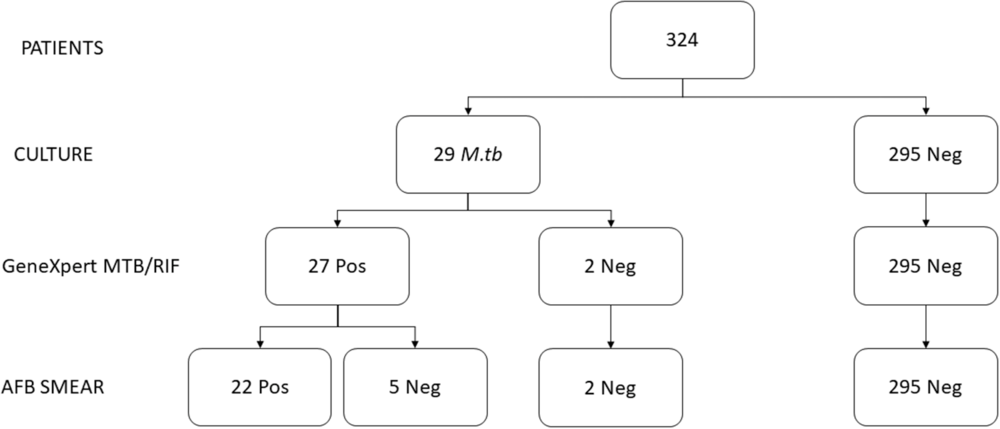
Group 1 included 324 patients, of whom 295 had a negative AFB smear, culture, and GeneXpert MTB/RIF. Among the 29 TB confirmed cases (ie, positive culture), 27 had a positive GeneXpert MTB/RIF, and 22 also had a positive AFB smear (Fig. 1).
Group 1 results comparing 1 GeneXpert MTB/RIF, 1 AFB smear and 1 culture. Note: AFB, acid-fast bacilli; M.tb, identification of Mycobacterium tuberculosis; Neg, negative; Pos, positive.

Group 2 analysis
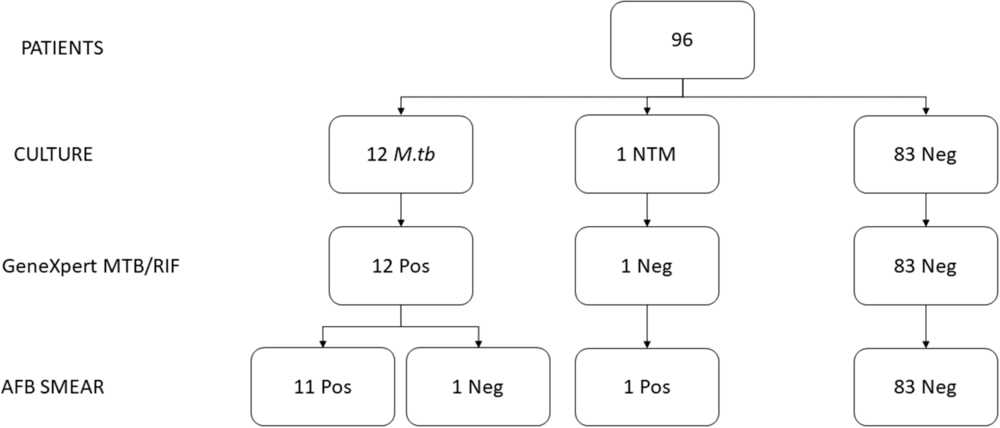
Group 2 had 96 patients, of whom 83 had the 3 negative tests. All 12 TB confirmed cases by positive culture had a positive GeneXpert MTB/RIF. Of these patients, 11 also had positive AFB smears. One patient with a positive AFB smear and a negative GeneXpert MTB/RIF had a positive culture for nontuberculous mycobacteria (NTM) (Fig. 2).
Group 2 results comparing 1 GeneXpert MTB/RIF, 2 AFB smears and 2 cultures. Note: AFB, acid-fast bacilli; M.tb, identification of Mycobacterium tuberculosis; NTM, nontuberculous mycobacteria; Neg, negative; Pos, positive.

Group 3 analysis
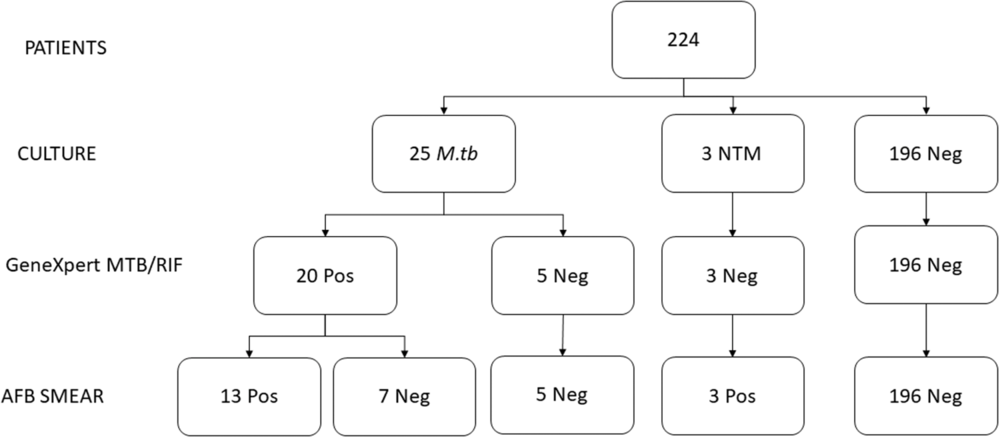
Group 3 is the model for discharging patients from airborne isolation beds. It included 224 patients with 3 AFB smears, 3 cultures, and 1 GeneXpert MTB/RIF for the first specimen tested. Overall, 196 patients tested negative for all the tests, while 25 cases of TB were confirmed by at least 1 culture. Among the confirmed cases, 20 had positive GeneXpert MTB/RIF, and of these, 13 also had a positive AFB smear. Also, 3 patients with a positive AFB smear and a negative GeneXpert MTB/RIF had a positive culture for NTM (Fig. 3).
Group 3 results comparing 1 GeneXpert MTB/RIF, 3 AFB smears and 3 cultures. Note: AFB, acid-fast bacilli; M.tb, identification of Mycobacterium tuberculosis; NTM, nontuberculous mycobacteria; Neg, negative; Pos, positive.

Table 1 shows the values of sensitivity, specificity, PPV, and NPV of AFB smear and GeneXpert MTB/RIF compared to culture of the 3 groups.
Performance of the GeneXpert MTB/RIF Versus Acid-Fast Bacilli Smear Microscopy

Note. AFB, acid-fast bacilli; PPV, predictive positive value; NPV, negative predictive value; CI, confidence interval.
In our study, the mean time to performing the 3 AFB smears required to remove the patients from the isolation beds was 84 hours versus 24 hours for GeneXpert MTB/RIF. Considering only group 3, a reduction of 560 patient-days (224 patients × 2.5 days reduction/patient) in the isolation room stay was estimated with the use of 1 GeneXpert MTB/RIF in a period of 1 year. Regarding the real costs for these facilities (isolation rooms) in our setting, the implementation of a protocol with a single GeneXpert MTB/RIF would represent a reduction of ~US$806,000.
Discussion
The guidelines recommend the use of 2 or more GeneXpert MTB/RIF to investigate and diagnose TB in low-burden countries, especially when there is a strong clinical TB suspicion.Reference Lippincott, Miller and Popowitch9-Reference Sulis, Agliati and Pinsi11 Brazil is a high-burden country, and considering its high cost (US$10 per cartridge), national guidelines have limited GeneXpert MTB/RIF use to a single test per patient.12,Reference Cowan, Chandler and Kracen13
Recent studies have demonstrated the possibility of using only 1 GeneXpert MTB/RIF to determine the continuation of respiratory isolation because performing >1 molecular test did not produce a superior result.Reference Chaisson, Roemer and Cantu8,Reference Poonawala, Leekha and Medina-Moreno14,Reference Al-Darraji, AbdRazak and Ng15
The economic importance of early patient removal from isolation beds has also been emphasized.Reference Chaisson, Duong and Cattamanchi16 Cowan et alReference Cowan, Chandler and Kracen13 estimated a shorter median of hospitalization in airborne isolation with the single GeneXpert MTB/RIF strategy, which would result in a cost savings of up to US$11,466 per patient compared to AFB smear. Thus, using a single GeneXpert MTB/RIF to replace 3 AFB smears to determine the need for isolation in hospitals could reduce costs.Reference Chaisson, Roemer and Cantu8
In countries with limited financial resources, adopting a single GeneXpert MTB/RIF would lead to additional benefits. Discontinuation of respiratory isolation based on the molecular test would reduce hospital expenditures and facilitate the reallocation of resources in deficient areas without compromising occupational risk.Reference Chaisson, Duong and Cattamanchi16
Although theoretical, our model represents real scenarios of clinical practice and demonstrates, as have other studies such as Chaisson et alReference Chaisson, Roemer and Cantu8 and Poonwala et al,Reference Poonawala, Leekha and Medina-Moreno14 a high single GeneXpert MTB/RIF NPV (ie, 99% in both studies) that is even higher than the NPV of sequential AFB smears. In our study, in group 3, a single GeneXpert MTB/RIF showed performance similar to that of 3 AFB smears, but in a shorter period. As far as we know, no other Brazilian study has evaluated GeneXpert MTB/RIF NPV in the airborne isolation room management. In cases in which clinical or radiological suspicion of tuberculosis is strong, even in the presence of a negative GeneXpert MTB/RIF, each service should define more conservative decisions.
Regarding the mean time to remove patients from isolation beds, Chaisson et alReference Chaisson, Roemer and Cantu8 reported a mean of 66 hours and, after the use of GeneXpert MTB/RIF, this time was reduced to 26 hours on average. In a study by Lippincott et al,Reference Lippincott, Miller and Popowitch9 this mean was 68 hours, which decreased to 20.8 hours with the implementation of the molecular test. The same improvement was described by Millman et al,Reference Millman, Dowdy and Miller17 whose results demonstrated a mean of 65 hours using AFB and 33.6 hours in the GeneXpert MTB/RIF scenario.
Poonwala et alReference Poonawala, Leekha and Medina-Moreno14 applied an active model of improvement in communication and logistics from hospital admission to the release of the molecular test results, and they obtained a time of only 12 hours for patient removal from airborne isolation. In the traditional model, these researchers also obtained values of ~65 hours. This study highlights a relevant point associated with the introduction of new technology: improvements in hospital process and logistics management must be undertaken to achieve a significant reduction in the time required to discharge a patient from an airborne isolation room.
In this study, the detection of positive AFB smear and negative GeneXpert MTB/RIF strongly suggests NTM infection. No official data of NTM prevalence in Brazil are available because it is not a reportable disease. The main limitation of the GeneXpert MTB/RIF compared with the AFB smears is that it allows only the diagnosis of TB, whereas AFB smears can also indicate NTM infection.Reference Aubry and Veziris18
Our study has several limitations. It was performed in a tertiary-care, university hospital, and other studies on this topic have been conducted in different settings. Only 35% of the patients in our study had had the 3 AFB smears usually requested in the respiratory isolation model. Although interesting, analyzing the causes of this low number of samples goes beyond the scope of this study. However, our data analysis suggests that most of these cases might have <3 AFB smears due to low suspicion of TB (acute disease or other confirmed pulmonary diseases) or due to the positivity of an AFB smear in the first collected sputum, which reinforces TB probability and formally indicates respiratory isolation for the patient. Finally, patient records were not systematically analyzed, and they were used only if there was any question about TB diagnostic confirmation.
On the other hand, some strengths of our study should be mentioned. The hospital’s mycobacterial laboratory is staffed by specialized technicians in all stages of the process, with 1 professional performing AFB smears, which demonstrates higher sensitivity values than other studies, such as Lee et al,Reference Lee, Kee and Shin19 who demonstrated AFB smear sensitivity of 38%. Also, the clinical-laboratory relationship in our hospital favors the implementation of protocols and process improvements.
In conclusion, a single GeneXpert MTB/RIF is a fast and strong predictor for TB absence in a high-complexity hospital, and these results are quite similar to those obtained in recent studies in low-burden settings. The use of a single GeneXpert MTB/RIF may also increase patient rotation through isolation rooms, with a potential positive impact in the emergency room and infectious diseases wards.
Acknowledgments
The authors thank the mycobacteria lab team; Diego Marques Moroço; Instituto Adolfo Lutz; and the Brazilian Ministry of Health—Tuberculosis Control Program for providing GeneXpert MTB/RIF resources to the hospital.
Financial support
Fundação de Apoio ao Ensino, Pesquisa e Assistência (FAEPA), Hospital das Clínicas da Faculdade de Medicina de Ribeirão Preto, provided financial support for this study.
Conflicts of interest
All authors report no conflicts of interest relevant to this article.