A core challenge in the field of developmental psychopathology is the identification of risk factors and competencies that explain not only concurrent difficulties but also underlying developmental issues linked to long-term risk and resilience. The present study seeks to distinguish short- versus long-term predictors of substance use and abuse. Although a large body of developmentally focused research has examined predictors of alcohol and substance use in adolescence, the challenge of determining which teens will versus will not develop substance abuse problems in the longer term, beyond the early 20s transitional period, has received far less attention. Identifying unique predictors of adolescent use versus adult substance abuse problems from within early and middle adolescence has immense potential value in focusing prevention and intervention efforts.
With only a few exceptions noted below, much of the research that exists on adolescent-era predictors of substance use beyond adolescence extends to predictions only up through the early 20s. Yet, in the early 20s substance use levels remain notably high and still may be significantly driven by transient developmental and cultural factors (e.g., peer pressure, college drinking, etc.; Masten, Faden, Zucker, & Spear, Reference Masten, Faden, Zucker and Spear2008; Nelson, Van Ryzin, & Dishion, Reference Nelson, Van Ryzin and Dishion2014; Schulenberg & Maggs, Reference Schulenberg and Maggs2002). In contrast, it is longer term use that accounts for the most problems, with those abusing in their late 20s considered to be at a very high risk for lifelong patterns of substance abuse (Brook, Brook, Zhang, Cohen, & Whiteman, Reference Brook, Brook, Zhang, Cohen and Whiteman2002).
Moffitt's recognition that adolescence-limited criminal behavior is in large part driven by social and developmental pressures unique to adolescence seems particularly relevant to distinguishing long- versus short-term substance use and abuse (Moffitt, Reference Moffitt and Walsh2017). Although Moffitt's analysis was applied to criminal behavior, factors she identifies, such as peer approval of illicit behavior, desire to seek out new experiences, and desire to establish autonomy by taking on “adultlike” behavior, all seem likely to also drive substance use during the adolescent/early adult period. If at least some adolescent criminal activity can arguably be considered as a partially adaptive response to normative social-developmental pressures (Moffitt, Reference Moffitt and Walsh2017), then this argument likely also applies to substance use as well; some adolescent substance use has even been linked to otherwise positive traits such as popularity (Allen, Porter, McFarland, Marsh, & McElhaney, Reference Allen, Porter, McFarland, Marsh and McElhaney2005; Mayeux, Sandstrom, & Cillessen, Reference Mayeux, Sandstrom and Cillessen2008). Even beyond normative pressures in adolescence, some teens are likely to be exposed to specific stressors (e.g., high levels of parent–adolescent conflict) that, although non-normative, are unlikely to continue with the same intensity in adulthood. Taken together, these factors make it likely that adolescent substance users will differ in significant ways from adults with substance abuse problems.
This study employed a social-developmental perspective to distinguish factors associated with adolescent-era substance use from those that have long-term predictive import with regard to adult substance abuse difficulties (Masten et al., Reference Masten, Faden, Zucker and Spear2008; Zucker, Reference Zucker2008). This perspective is based upon distinguishing transient, age-specific risk factors in adolescence from those likely to reflect underlying difficulty in meeting key social developmental tasks. Several factors are proposed as likely to be important in explaining adolescent substance use, and yet be likely to be relatively transient both in duration and in impact and thus much less likely to explain adult-era substance abuse difficulties. Among these potentially transient factors, peer influences supporting substance use are particularly prominent (Nash, McQueen, & Bray, Reference Nash, McQueen and Bray2005; Patrick & Schulenberg, Reference Patrick and Schulenberg2014). Teen substance use has been linked to close friend use, overall popularity, and broader patterns of social contagion (Allen et al., Reference Allen, Porter, McFarland, Marsh and McElhaney2005; Ennett et al., Reference Ennett, Bauman, Hussong, Faris, Foshee, Cai and DuRant2006; Li, Barrera, Hops, & Fisher, Reference Li, Barrera, Hops and Fisher2002; Mayeux et al., Reference Mayeux, Sandstrom and Cillessen2008; Patrick & Schulenberg, Reference Patrick and Schulenberg2010). All of these links are likely to be especially salient in adolescence given the intense adolescent focus upon establishing status within the peer group (Dijkstra, Cillessen, Lindenberg, & Veenstra, Reference Dijkstra, Cillessen, Lindenberg and Veenstra2010).
Similarly, criminal activity within adolescence has long been linked to adolescent substance use (Donovan & Jessor, Reference Donovan and Jessor1985; Donovan, Jessor, & Costa, Reference Donovan, Jessor and Costa1988); yet, in early and middle adolescence, many of the same transient factors noted above from Moffitt's framework are likely to be driving both behaviors, and early and middle adolescent criminal behavior may be more likely to be normative than to be an indicator of dysfunction (Moffitt, Reference Moffitt1993). Although late adolescent criminal behavior may have more significant implications (D'Amico, Ellickson, Collins, Martino, & Klein, Reference D'Amico, Ellickson, Collins, Martino and Klein2005; Merline, Jager, & Schulenberg, Reference Merline, Jager and Schulenberg2008), criminal behavior across the bulk of the adolescent era, which is to some degree normative (Moffitt, Reference Moffitt and Walsh2017), appears relatively less likely to reliably mark a long-term risk for substance abuse.
Finally, normative adolescent autonomy struggles may lead in some cases to high levels of parent–adolescent harsh conflict, creating substantial distress—a known driver of substance use (Nash et al., Reference Nash, McQueen and Bray2005; Ryan, Jorm, & Lubman, Reference Ryan, Jorm and Lubman2010). Family conflict has also been related to early initiation of substance use (King & Chassin, Reference King and Chassin2007). Whether such conflict is a transient versus enduring predictor is less clear, however, with some research suggesting that it is unrelated to late adolescent outcomes when other factors are taken into account (King & Chassin, Reference King and Chassin2007), while other research suggests a more enduring relationship (Van Ryzin, Fosco, & Dishion, Reference Van Ryzin, Fosco and Dishion2012). From a developmental perspective, when levels of exposure to family conflict decline as the adolescent moves into adulthood, we might expect corresponding levels of substance use to decline as well. In contrast, one of the few studies following individuals from early adolescence up through age 27 (Herrenkohl, Lee, Kosterman, & Hawkins, Reference Herrenkohl, Lee, Kosterman and Hawkins2012) found that adolescent-era family conflict was a strong predictor of age 27 substance use disorder symptoms, although the study was somewhat limited by reliance upon self-report data at both ages.
Each of the factors above is likely to be salient primarily within the adolescent and early adult era, which may explain why many adolescents ultimately “mature out” of patterns of elevated substance use (Masten et al., Reference Masten, Faden, Zucker and Spear2008; Sher & Gotham, Reference Sher and Gotham1999). Yet, a developmental perspective suggests that the import of some or all of these factors is likely to change as development progresses (Zucker, Reference Zucker2008). As social and developmental contingencies change, normal, healthy youth are likely to respond adaptively and reduce levels of deviant behavior (Moffitt, Reference Moffitt and Walsh2017). A developmental perspective would suggest a gradual shift from late adolescence into adulthood in both patterns and predictors of use. In the early 20s, levels of use are still likely to be largely socially driven, though perhaps not as much as in early adolescence. The effects of family factors (e.g., family conflict), however, might be expected to fade by this point. In the longer term, a different pattern is likely to emerge. Substance use is unlikely to cease completely later in adulthood, given the degree to which it is socially normative. However, the factors that predict adolescent substance use (and which are often targets of intervention) seem likely to be less useful in predicting non-normative patterns of substance abuse as individuals transition through the early 20s and into adulthood.
In contrast to the transient and developmentally driven factors noted above, indices of poor underlying overall adaptation within adolescence are likely to be far better predictors of long-term abuse. Substance abuse is distinguished from substance use by the presence not only of uncontrolled levels of use but also of significant deleterious external consequences of use, including legal difficulties, interpersonal problems, career problems, and risky behaviors (American Psychiatric Association, 2013; Presley, Meilman, & Lyerla, Reference Presley, Meilman and Lyerla1994). This study examined two such indicators: poor social skills and poor self-concept. Unlike the more transient factors described above, a lack of underlying social skills, as seen in the capacity to assert oneself successfully with peers in a way that still maintains relationships, is known to have long-term import across a variety of functional domains (Allen, Narr, Kansky, & Szwedo, Reference Allen, Narr, Kansky and Szwedoin press; Roisman, Masten, Coatsworth, & Tellegen, Reference Roisman, Masten, Coatsworth and Tellegen2004). Social skills in this domain are distinct from short-term popularity, which can be driven by factors ranging from physical attractiveness and athletic skill to a tendency toward aggressive behavior, and which does not necessarily predict longer term adaptation (Narr, Allen, Tan, & Loeb, Reference Narr, Allen, Tan and Loeb2019). In the short term, poor social skills might even buffer teens from substance use by reducing their access to a peer culture supporting this use. In the longer term, however, poor social skills, which often result from difficulties with undercontrol and impulsivity (Zucker, Reference Zucker2008), are likely to lead to a host of risk factors for later substance abuse, from heightened levels of ongoing conflict to a lack of self-efficacy in social situations, both of which have long been linked to substance abuse (Allen, Leadbeater, & Aber, Reference Allen, Leadbeater and Aber1990; Herrenkohl et al., Reference Herrenkohl, Lee, Kosterman and Hawkins2012).
Similarly, adolescence is a period during which cognitions surrounding identity and a sense of self-esteem consolidate. If this process goes poorly, leaving the adolescent with a negative self-concept, features of adolescent neurological development appear to create a sensitive period that would make such cognitions particularly likely to endure (Dahl & Hariri, Reference Dahl and Hariri2005; Nelson, Jarcho, & Guyer, Reference Nelson, Jarcho and Guyer2016). Longitudinal research has now identified links between poor adolescent self-esteem and a range of adult problems (Trzesniewski et al., Reference Trzesniewski, Donnellan, Moffitt, Robins, Poulton and Caspi2006). Within adolescence, the links between self-esteem and substance use are mixed, suggesting that adolescents across the full range of levels of self-esteem are at risk for substance use. For example, low self-esteem may create distress leading to substance use, yet high self-esteem can lead to greater contact with peers and their influences and (over)confidence in taking risks, thus also leading to substance use. This is one potential example of what Zucker (Reference Zucker2008) has referred to as the changing developmental saliency of factors related to alcohol and substance abuse.
By early adulthood, the chronic distress created by a poor self-concept has been directly linked to alcohol-related problems (Tomaka, Morales-Monks, & Shamaley, Reference Tomaka, Morales-Monks and Shamaley2013). Further, a poor self-concept appears to limit ability to cope with external stressors (i.e., negative relationships with parents in early adulthood) in a way that has also been linked to alcohol-related problems (Backer-Fulghum, Patock-Peckham, King, Roufa, & Hagen, Reference Backer-Fulghum, Patock-Peckham, King, Roufa and Hagen2012). Finally, links from a poor self-concept to poor overall mental health also increase the likelihood that low self-esteem will create an enduring risk for substance abuse (D'Amico et al., Reference D'Amico, Ellickson, Collins, Martino and Klein2005; Jackson & Sher, Reference Jackson and Sher2003). Together, factors such as poor social skills and poor self-concept in adolescence appear likely to reflect enduring developmental deficits that will be more likely to be linked to long-term problems with substance abuse than the transient factors that are viewed as more likely to drive adolescent-era use. To date, however, no research has examined this proposition.
This prospective, multimethod study, utilizing a diverse community sample followed over a 17-year period, assessed a developmental model to distinguish predictors of adolescent substance use that has limited long-term implications from those that predict long-term patterns of substance abuse. The following specific hypotheses were tested.
First, primary predictors of adolescent-era substance use were expected to include peer factors, including those that reflect adaptation to adolescent norms (e.g., popularity and peer substance use), as well as contemporaneous social stressors (e.g., exposure to parent–adolescent conflict). Given the socially driven nature of adolescent substance use, underlying risk factors that would be likely to lead to lower levels of peer interaction in adolescence (i.e., lack of social skill and poor self-concept) were not hypothesized to be linked to substance use during the adolescent era.
Second, problems associated with substance use by ages 27–30 were expected to be predicted, not by transient stressors and peer influence factors in adolescence, but rather by adolescent-era markers of enduring social and emotional difficulty (i.e., poor self-concept and poor social skills) that can nevertheless be identified within adolescence. This pattern was expected to begin emerging by the early 20s (ages 20–22).
Third, given the societally approved nature of alcohol and marijuana use within adulthood, predictions from enduring markers of difficulty are hypothesized to be stronger for problems linked to substance use in adulthood than for simple levels of use.
Method
Participants
This report is drawn from a larger longitudinal investigation of adolescent social development in familial and peer contexts. Participants included 184 seventh and eighth graders (86 male and 98 female) followed over an 18-year period from ages 13 to 30, along with collateral data collected from close friends, classmates, and parents of these adolescents. The sample was racially/ethnically and socioeconomically diverse: 107 adolescents (58%) identified themselves as Caucasian, 53 (29%) as African American, 15 (8%) as of mixed race/ethnicity, and 9 (5%) as being from other minority groups. Adolescents’ parents reported a median family income in the $40,000–$59,999 range at the initial assessment. During this period data were also obtained from participants’ parents and close friends.
Adolescents were initially recruited from the seventh and eighth grades of a public middle school drawing from suburban and urban populations in the Southeastern United States. Students were recruited via an initial mailing to all parents of students in the school along with follow-up contact efforts at school lunches. Families of adolescents who indicated they were interested in the study were contacted by telephone. Of all students eligible for participation, 63% agreed to participate, either as target participants or as peers providing collateral information. All participants provided informed assent before each interview session, and parents provided informed consent. Initial interviews took place in private offices within a university academic building. Follow-up assessments were conducted in the same setting, or for participants’ living at a distance, were conducted either in local settings (e.g., hotel conference rooms) or via mail.
Participants were first assessed annually over a 5-year period across adolescence (at ages 13.35 (SD = 0.64); 14.27 (SD = 0.77); 15.21 (SD = 0.81); 16.35 (SD = 0.87); and 17.32 (SD = 0.88). At each age, adolescents also nominated their closest friend to be included in the study as well as an additional two peers from within their extended circle of friends and acquaintances. Close friends came in during a visit along with the target adolescent participant. Additional friends came in in separate visits. Friends were close in age to participants (i.e., their ages differed on average by less than a month from target adolescents’ ages). Close friends were specified to be same-gender friends, but the same friend need not be specified across different waves. Close friends reported that they had known the target adolescents on average for periods ranging from a low of 4.01 years (SD = 2.90) at the age 13 assessment to a high of 5.91 years (SD = 3.86) at the age 17 assessment. Data were also obtained at two points from the adolescents’ parents (at adolescent ages 13 and 16).
For the adult follow-up assessments, data were obtained from participants in the early 20s (ages 20.83, SD = 0.98; 21.68, SD = 0.95; and 22.79, SD = 0.96) and in adulthood (ages 26.63, SD = 1.01; 27.67, SD = 0.99; 28.59, SD = 1.01; and 30.07, SD = 0.90).
Attrition analyses
Adult follow-up data were obtained from 91.3% of the original sample (N = 168). Attrition analyses comparing those participants with versus without follow-up data at ages 27–30 revealed no significant differences on any baseline variables, nor on any variables at ages 20–22, with the exception of participant gender (2% attrition among females vs. 16% among males, p < .001).
To best address any potential biases due to attrition in longitudinal analyses, full information maximum likelihood methods were used with analyses including all variables that were linked to future missing data (i.e., where data were not missing completely at random). Because these procedures have been found to yield the least biased estimates when all available data are used for longitudinal analyses (vs. listwise deletion of missing data; Arbuckle, Reference Arbuckle, Marcoulides and Schumaker1996), the entire original sample of 184 was utilized for these analyses. This full sample thus provides the best possible estimates of variances and covariances in measures of interest and was least likely to be biased by missing data.
Procedure
In the initial introduction and throughout all sessions, confidentiality was assured to all study participants, and adolescents were told that their parents and friends would not be informed of any of the answers they provided. Participants’ data were protected by a Confidentiality Certificate issued by the US Department of Health and Human Services, which protected information from subpoena by federal, state, and local courts. Transportation and childcare were provided if necessary. Adolescent/adult participants, their parents, and their peers were all paid for participation.
Measures
Popularity (age 13)
Adolescents’ capacity to establish themselves as preferred social companions with a range of their peers was assessed using a limited nomination procedure. Each adolescent, his or her closest friend, and two other target peers were asked to nominate up to 10 peers in their grade with whom they would “most like to spend time on a Saturday night.” The raw number of “like” nominations each teen received was standardized within grade level as a measure of desirability as a social companion in the broader peer group following the procedure described in Coie, Dodge, and Coppotelli (Reference Coie, Dodge and Coppotelli1982). This approach to assessing social acceptance has been previously found to be relatively stable over time and related to adolescent attachment security, qualities of positive parental and peer interactions, and short-term changes in levels of deviant behavior (Allen et al., Reference Allen, Porter, McFarland, Marsh and McElhaney2005; Allen, Porter, McFarland, McElhaney, & Marsh, Reference Allen, Porter, McFarland, McElhaney and Marsh2007; McElhaney, Antonishak, & Allen, Reference McElhaney, Antonishak and Allen2008).
Participant and close peer alcohol and marijuana use frequency (ages 13–17) and participant alcohol and marijuana use amount (ages 20–22 and 27–30)
The frequency and amount of substance use were assessed with the alcohol and drug use questionnaire from the Monitoring the Future surveys (Johnston, O'Malley, & Bachman, Reference Johnston, O'Malley and Bachman1987). This self-report measure was separately administered to participants and to their closest friend each year during adolescence and included items assessing the frequency of participant use of alcohol and/or marijuana in the past 30 days (1 = no use, 2 = 1–2 times, 3 = 3–5 times, 4 = 6–9 times, 5 = more than 10 times). Johnston et al. (Reference Johnston, O'Malley and Bachman1987) found high reliability from year to year and consistency between related measures within the same questionnaire administration. Scores for alcohol and marijuana use were averaged together each year. Data from each year from ages 13 to 17 was then summed and averaged to produce a measure of frequency of alcohol and marijuana use across adolescence. In the early 20s and in adulthood the same approach was used, but for alcohol use, a second item asked how many drinks on average participants had on each occasion of drinking. This was combined with the measure of number of days drinking to yield a measure of total amount (i.e., frequency and volume) of alcohol use. This measure and the “times per 30 days” measure for marijuana use were both standardized and summed to yield a measure for amount of adult alcohol and marijuana use.
Problems due to alcohol and substance use (ages 27–30)
The Core Alcohol and Drug Survey (Presley et al., Reference Presley, Meilman and Lyerla1994) was used to assess problems due to alcohol and substance use. This survey asks respondents to note whether they have experienced any of 20 different problems due to drinking or drug use during the past year, ranging from having a hangover to being hurt or injured, to being arrested for driving under the influence. A total problems score is created as the sum of responses to these 20 dichotomous items. It has previously been administered nationally to more than 50,000 college-age students each year (Presley et al., Reference Presley, Meilman and Lyerla1994). The number of problems reported in each year from age 27 to 30 was summed and averaged to produce a total problems score, and this summation was itself quite reliable (Cronbach α = .85).
Age of first alcohol use
Beginning with the age 13 assessment, participants who acknowledged having drunk alcohol (outside of family events) were asked the age at which they first drank. For participants who had not begun drinking at age 13, this question was repeated at each succeeding age up through age 18. Participants who had not begun drinking by age 18 were assigned the maximum possible score (age 18).
Participant criminal behavior (ages 13–17)
Adolescent criminal behavior was measured as the total number of times youths reported engaging in each of 37 non-overlapping classes of illegal behavior (designed to assess all significant classes of criminal behavior, except for drug use) during the previous 6 months, using the Self-Report of Delinquency measure (Elliott, Huizinga, & Menard, Reference Elliott, Huizinga and Menard1989; Huizinga & Elliott, Reference Huizinga and Elliott1986). When obtained by sensitive interviewers who have first established rapport with interviewees, self-reports of problem behaviors have long been found (a) to correlate significantly with reports obtained from independent observers and official records; (b) to be adequately reliable; and (c) to eliminate systemic biases present in official records of deviant behavior (Elliott et al., Reference Elliott, Huizinga and Menard1989; Huizinga & Elliott, Reference Huizinga and Elliott1986). Cronbach α across years ranged from .66 to .91 (M = .77).
Perceived self-worth (ages 13–17)
Participants completed the 4-item global self-worth scale from the Adolescent Self-Perception Profile each year from 13 to 17 (Harter, Reference Harter1988). Scores for ages 13–17 were averaged to yield a measure of self-worth across adolescence, and this sum displayed good reliability (Cronbach α = .77).
Parent–adolescent conflict (ages 13, 16)
Use of harsh conflict tactics in parent–adolescent interactions were reported by each parent using the Conflict Tactics Scale (Straus, Reference Straus1979). This study used the 6-item verbal aggression scale (e.g., insults, threats, etc.) and the 11-item physical aggression scale (e.g., slap, push, etc.) of the Conflict Tactics Scale as indicators of harsh conflict. Each parent reported on both his or her own behavior toward the adolescent and on the adolescent's behavior toward them. At the first assessment, parents were asked to report how often each behavior had occurred over their child's lifetime. The second assessment covered behavior across the past year. A 4-point scale (1 = never, 2 = once or twice, 3 = several times, 4 = many times) was used for each item. Scores were summed across the two scales for each parent and then averaged across all of these assessments (reliability for the final measure combining these scales across the two time points and two raters was good (Cronbach α = .85).
Social skills (ages 13–17)
The test-based Adolescent Problem Inventory (Freedman, Rosenthal, Donahoe, Schlundt, & McFall, Reference Freedman, Rosenthal, Donahoe, Schlundt and McFall1978; Gaffney & McFall, Reference Gaffney and McFall1981) was used to assess adolescents' social problem-solving skill. Adolescents were asked to describe their most likely response to a series of five problematic hypothetical situations. These responses were then rated by coders who were unaware of the hypotheses of the study using a 0 to 10 scale, rating competence in resolving the situation at hand in a way that also makes future problematic situations less likely. Situations included conflicts with peers, romantic partners, and teachers, and situations in which adolescents might be tempted to engage in delinquent behaviors. For example, one situation asks how the participant might deal with a situation in which a gym teacher unfairly calls the student out and tells him/her to do extra push-ups in front of the class. Another asks how the participant might deal with being harshly confronted by a parent about clothing choices just before heading out to a party. This measure was obtained repeatedly at each of the first five waves of data collection using different prompt situations at each wave. Interrater reliabilities calculated using the intraclass correlation coefficient, ranged from r = .86 to .96, all of which are considered in the “excellent” range for this statistic (Cicchetti & Sparrow, Reference Cicchetti and Sparrow1981). The mean of scores across these five waves was used in analyses, and this mean demonstrated good internal consistency (Cronbach α = .75).
Analytic plan
Initial analyses examined the role of gender and early adolescent family income on the primary measures examined in the study. Several variables of substantive interest in the study were related to both adolescent gender and income in the adolescent's family of origin, and hence these factors were considered as covariates in analyses below. No moderating effects of gender and income on any of the primary analyses below were found.
Primary analyses were conducted via hierarchical regressions using full information maximum likelihood handling of missing data. Sociodemographic factors (gender and baseline family income) were entered first, followed by adolescent age at first alcohol use, followed by hypothesized transient adolescent-era risks (adolescent deviant behavior, peer factors, and family conflict), followed by hypothesized developmental risk factors likely to have enduring effects (poor social skills and self-concept). All analyses were performed using SAS Proc CALIS, Version 9.4 (Sas Institute, 2015). Tabled primary results include simple correlations with the outcome of interest, for descriptive purposes, as well as results of regression analyses.
Results
Preliminary analyses
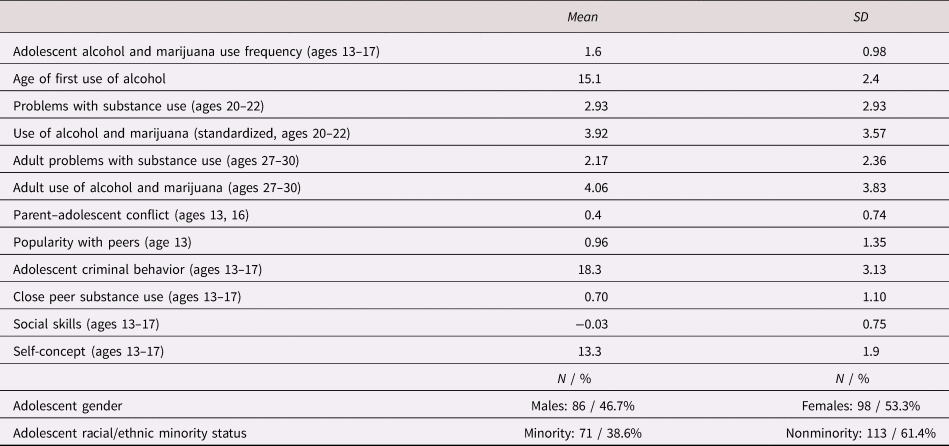
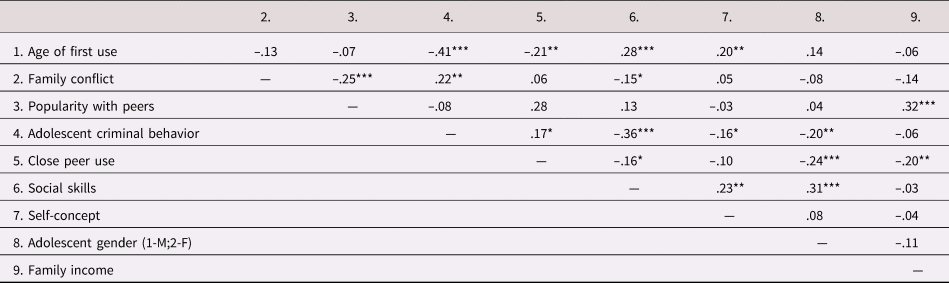
Means and standard deviations for all substantive variables and intercorrelations among predictor variables are presented in Tables 1 and 2, respectively. Means reflect growth in usage primarily from adolescence to the early 20s, with the average adolescent reporting use of alcohol or marijuana between 0 and 1–2 times in the past month across all of adolescence. By the early 20s, participants reported drinking an average of 7 drinks per week and using marijuana between 0 and 1–2 times per week. In adulthood, participants reported drinking an average of 6 drinks per week and using marijuana between 0 and 1–2 times per week.
Means and standard deviations of primary measures and demographic variables
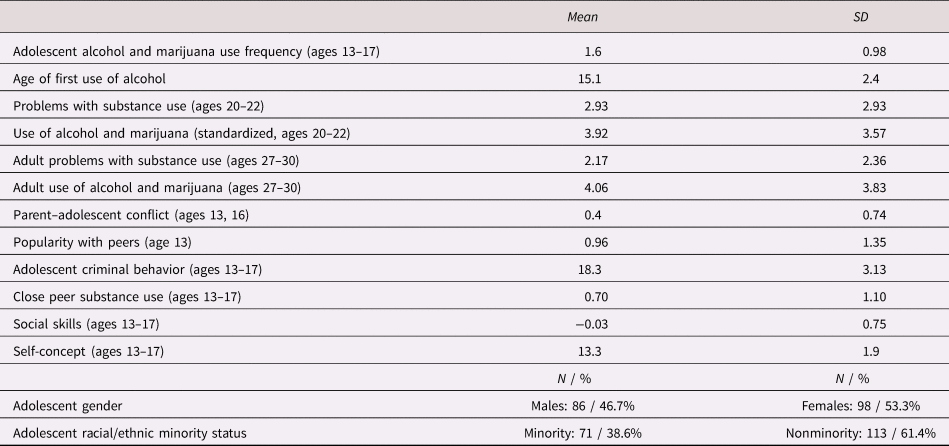
Note: Untransformed mean is reported for adolescent use of alcohol and marijuana.
Intercorrelations among predictor variables
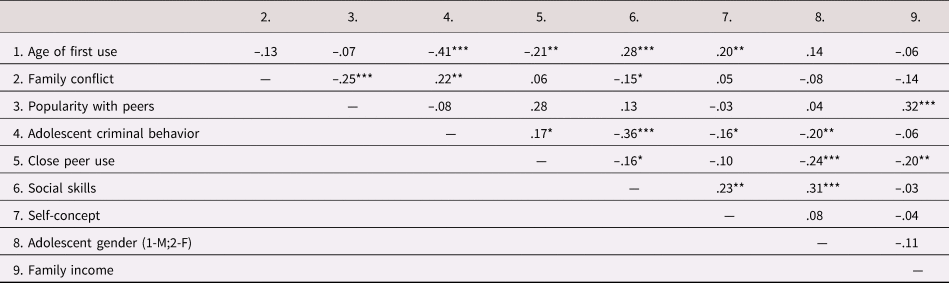
***p < .001. **p < .01. *p < .05.
Primary analyses
Hypothesis 1: Predictors of adolescent-era substance use will include peer factors, including those that reflect adaptation to adolescent norms, as well as contemporaneous social stressors. Lack of social skill is not expected to be a predictor.
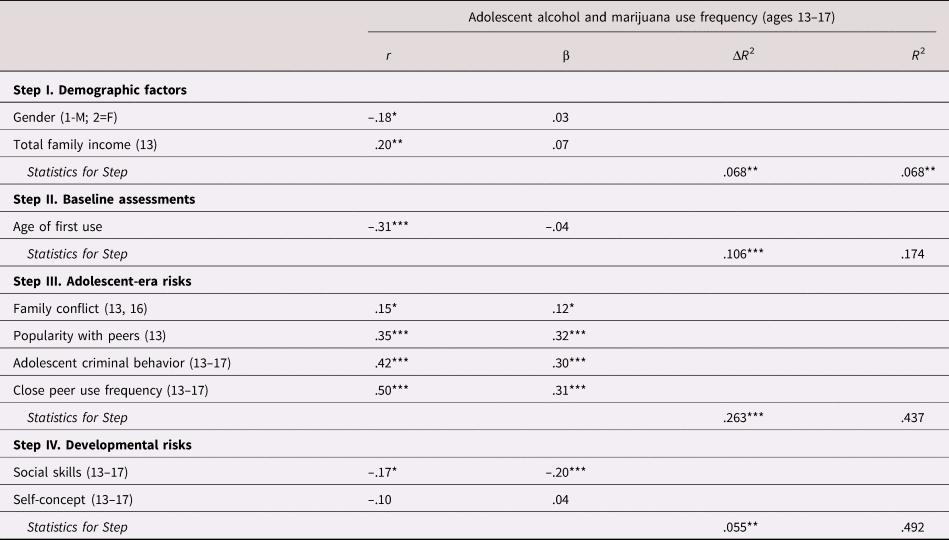
As hypothesized, an array of adolescent-era factors was linked to adolescent substance use, including peers’ reports of their own use levels, adolescents’ greater popularity with peers, high levels of parent–adolescent conflict, and adolescent criminal behavior. Of note, each of these factors contributed unique variance to explaining total levels of use across adolescence (see Table 3). Age at first alcohol use was correlated with total levels of use across adolescence, but it did not add to prediction in final models. Of the two developmental risks with potentially enduring effects, a lower level of social problem-solving skills was also predictive of higher frequency of use over and above all of the other factors examined, though self-worth was not. Effects of gender and family income observed in simple correlations became nonsignificant in regression models that also accounted for psychosocial factors.
Hypothesis 2: Problems associated with substance use by ages 27–30 were expected to be predicted, not by transient stressors and peer-influence factors in adolescence, but by adolescent-era markers of potentially enduring social and emotional difficulty (i.e., poor self-concept and poor social skills). This pattern was expected to begin emerging by the early 20s.
Adolescent alcohol and marijuana use frequency (ages 13–17)
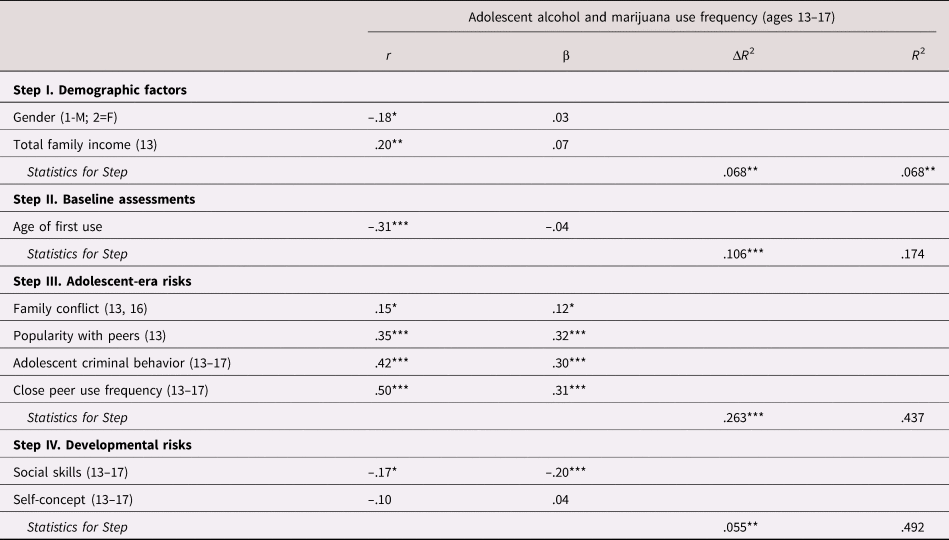
Note: β weights are from final model. Age of assessments are included in parentheses. ***p < .001. **p < .01. *p < .05.
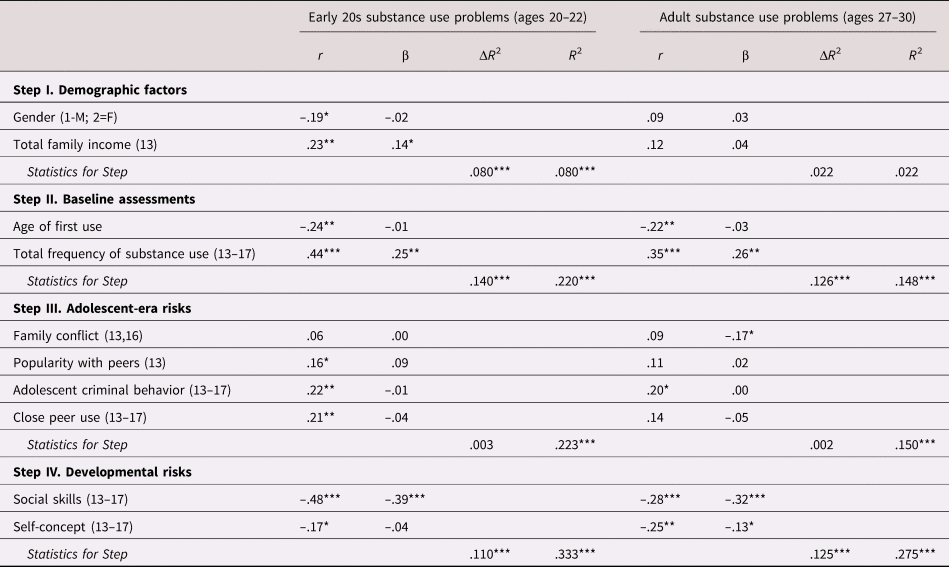
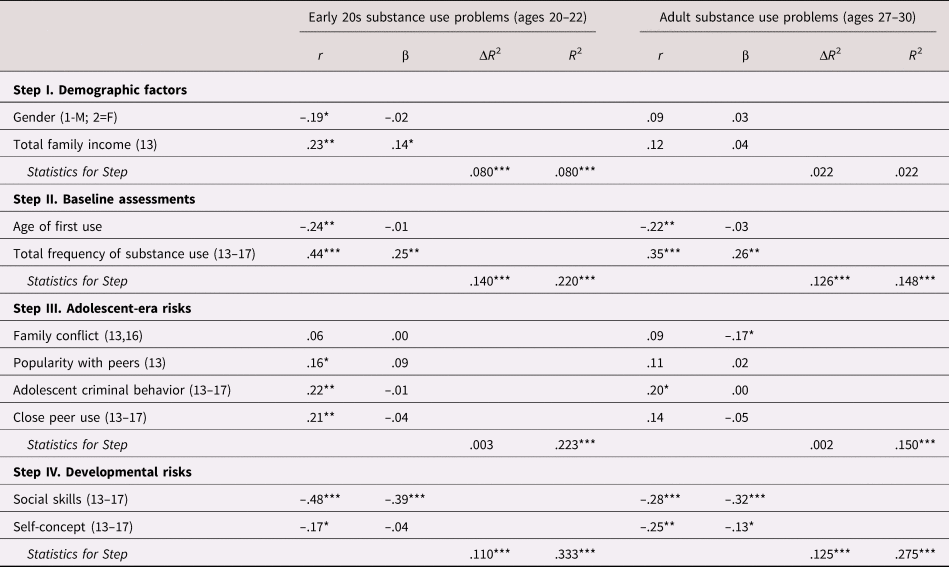
For these analyses, we considered all of the same predictors examined previously, but we also added in the baseline measure of adolescent alcohol and marijuana use. As shown in Table 4 and as hypothesized, a quite different picture from the adolescent-era predictions described above emerges in predictions to early 20s and adult substance use problems. Continuity from adolescent levels of use was observed as expected. However, in predictions to early 20s (ages 20–22) substance use problems, the block of adolescent-era risk factors was no longer significant, and social skills became a highly significant inverse predictor.
Early 20s (ages 20–22) and adult (ages 27–30) substance use problems
Note: β weights are from final model. ***p < .001. **p < .01. *p < .05.
In predictions to adult (ages 27–30) substance use problems, after accounting for continuity from adolescent use levels, none of the adolescent peer, family, or behavioral factors predicted adult problems, with the exception of the prior presence of high levels of parent–adolescent conflict, which predicted relatively lower levels of substance use problems at ages 27–30. This latter finding indicates that adolescents whose adolescent-era use was linked to (presumably transient) conflict go on to have relatively fewer problems as adults than might have been expected from solely observing their levels of baseline substance use.
In contrast to the decreasing role of these family, peer, and behavioral factors, the two adolescent factors that were believed to reflect enduring developmental risks—poor social skills and low self-esteem—became strongly predictive of adult-era problems. Together they added 12.5% to the explained variance in adult problems over and above baseline levels of use and adolescent-era factors.
To assess whether the observed differences in prediction between adolescent and later assessments was significant, nested models were tested in which predictions were made simultaneously to both adolescent use and later substance use problems (separate models were examined for both early 20s problems and for adult problems). Estimated effects of predictors to the different time periods were first allowed to vary across time period (as in the models above), and then were fixed to be equal. The resulting difference between the two nested models is a test of whether predictions are significantly different. For each of the two models comparing effects of adolescent risk factors on early 20s problems or on adult problems, results indicated no significant difference in the magnitude of the estimates for the adolescent risk factors considered as a block (although predictions from parent–adolescent conflict did differ from adolescence to adulthood when examined individually, χ2 (1) = 8.2, p = .004. For both of the two models comparing effects of the developmental risk factors (to early 20s problems and to adult problems), significant differences from predictions to adolescent-era use were detected, χ2 (2) = 27.9, p < .001; and χ2 (2) = 19.8, p < .001, respectively.
Hypothesis 3: Predictions from markers of potentially enduring difficulty are hypothesized to be stronger when made to adult problems linked to substance use than when made to simple adult levels of use.
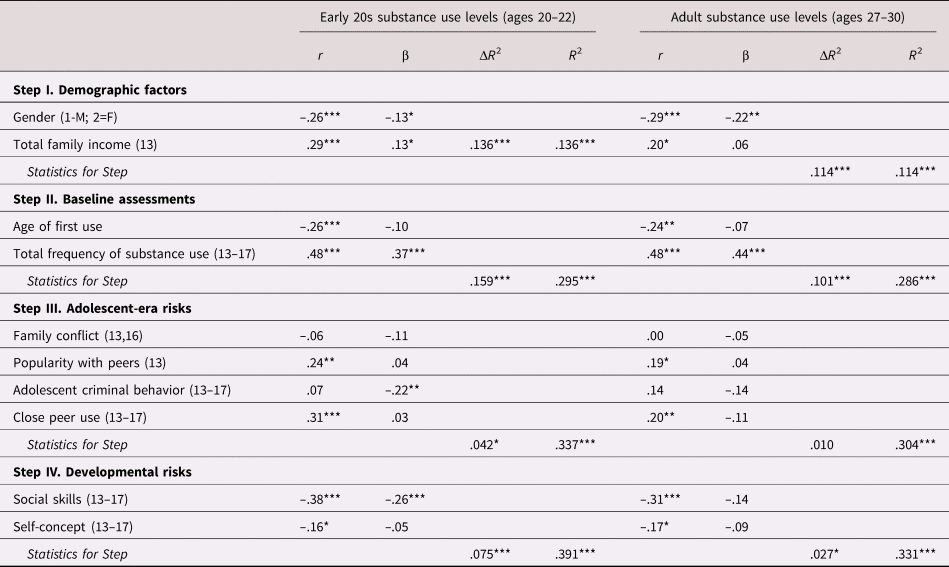
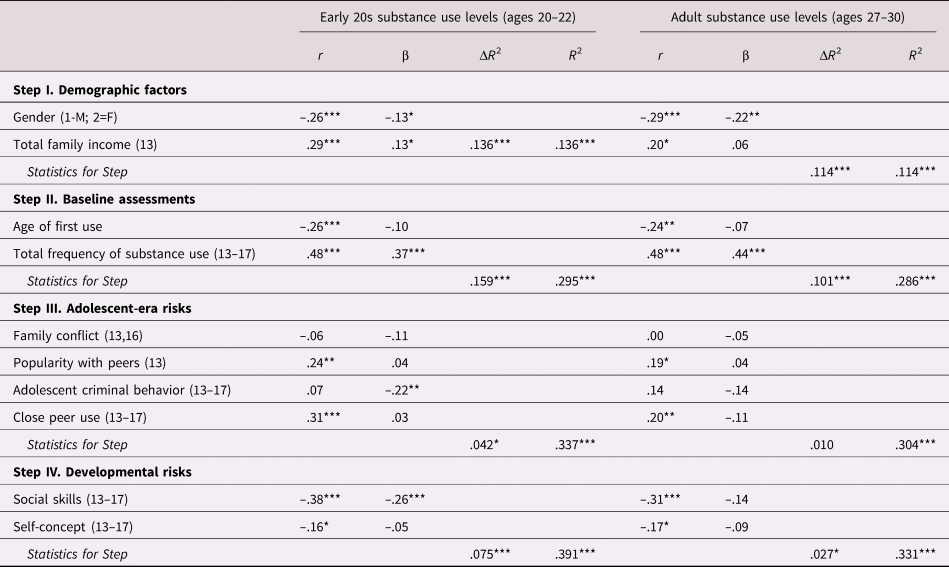
Predictions to overall frequency and amount of adult use of alcohol and marijuana displayed a somewhat mixed pattern of results, as hypothesized and as shown in Table 5. As with problems related to use, continuity from adolescent-era levels of use was observed in both the early 20s and adult eras. Only social skills emerged as a significant predictor of usage in the early 20s. In adulthood, the block of social skills and self-concept was significant, though the individual predictors within that block were not. To explore whether this reflected the effects of the covariation of these two factors, each of these two predictors was examined separately, in isolation, as the last step in the model in Table 5. These analyses (not shown) indicated that the covariation of the two was somewhat obscuring their effects, in that poor social skills was a significant predictor when examined in the absence of self-concept (β = –.16, p = .04), although the effect of self-concept was found only at a nonsignificant trend level (β = –.11, p = .09). In zero-order correlations at both eras, adolescent peer factors, both greater popularity with peers and greater peer use predicted adult use, suggesting that these social factors were linked to later substance use, just not to later problems with use. In these correlations, use at ages 20–22 was also predicted by adolescent gender (greater use among males) and family income. Use at ages 27–30 was also predicted by adolescent gender.
Early 20s (ages 20–22) and adult (ages 27–30) substance use levels
Note: β weights are from final model. ***p < .001. **p < .01. *p < .05.
To assess whether the observed differences in prediction to adolescent substance use versus later substance use as seen in Tables 3 and 5 were significant, nested models were tested in which predictions were made simultaneously to both adolescent and adult use, similar to those described regarding Hypothesis 2. With regard to differences in predictions to adolescent use versus early adult (ages 20–22) use, results indicated that the prediction estimates for adolescent family conflict and criminal behavior differed depending upon whether adolescent substance use or early adult substance use were the dependent variable, χ2 (1) = 9.79, p = .002; and χ2 (1) = 10.0, p = .002. With regard to differences in predictions to adolescent use versus later adult use (ages 27–30), results indicated that the prediction estimates for adolescent criminal behavior and peer substance use in adolescence differed depending upon whether adolescent substance use or early adult substance use were the dependent variable, χ2 (1) = 6.0, p = .014; and χ2 (1) = 19.0, p < .001.
Post hoc analyses
Models with adolescent use not covaried
To fully explore issues of continuity and discontinuity, we examined the possibility that including levels of adolescent substance use in multivariate models predicting adult problems was potentially obscuring the effects of adolescent-era predictors (i.e., if those effects were mediated via use that began in adolescence). To examine this, we assessed whether transient predictors of substance use in adolescence were related to future substance abuse problems in adulthood in multivariate models identical to those in Table 4, but without covarying adolescent levels of use. No relation was observed for any of the transient predictors (i.e., popularity, close friend use, criminal behavior, or family conflict; not tabled). This means that covarying adolescent substance use in the models above was not obscuring long-term effects of these adolescent-era predictors and that the adolescent-era factors did not have later effects that were mediated via adolescent levels of use.
Substance-specific processes
We also explored whether the primary results above would differ substantially if we examined alcohol and marijuana use separately. We focused on adulthood as our primary outcome period for these post hoc analyses. Only very minor differences were found in these analyses. Comparing the above model predicting adolescent substance use to models just predicting adolescent alcohol use, all four adolescent-era predictors remained significant; in addition, social skill was now also a significant predictor, whereas it was previously linked in zero-order correlations and as part of a significant block of predictors but not significant in final regression models. Comparing the above model predicting adolescent substance use to models only predicting adolescent marijuana use, all predictors remained significant except for age of first alcohol use and family conflict, which dropped out as predictors. When predicting adult substance use problems from either adolescent alcohol use or adolescent marijuana use, all predictions from the models presented above remained either significant or nonsignificant consistent with their status above, except for self-worth, which was predictive at the trend level (p = .06) in models predicting adult problems from adolescent alcohol use.
Discussion
Findings of this study supported the overarching hypothesis that factors that predict alcohol and marijuana use within adolescence can be distinguished from factors that predict the presence of longer term problems with substance use beyond the adolescent/early adult transition. As hypothesized, factors that were peer oriented and that were likely to exist primarily within the adolescent/early adult period were most closely associated with adolescent-era substance use, whereas adolescent-era markers of difficulties in underlying social–emotional adaptation were the primary predictors of long-term substance abuse problems.
Factors that were linked to substance use across adolescence were, as expected, largely consistent with those found in prior research on the social and emotional correlates of such use, and included age of first use, greater popularity with peers, close peer level of substance use, high levels of parent–adolescent conflict, and adolescent deviance proneness as reflected in criminal behavior. Perhaps most striking, however, was the finding that, after accounting for adolescents’ overall level of substance use, these risk factors were of relatively little utility in explaining adult substance use. This was true regardless of whether the outcome considered was adult levels of substance use or adult problems with use. It was also true regardless of whether baseline levels of substance use were entered into models, making it unlikely that predictions were being obscured by including this covariate.
In contrast to the apparently more transient effects of these adolescent environmental factors, two markers of underlying psychosocial adaptation in adolescence—poor social skills and poor self-concept—were predictive of longer term problems with substance use, with predictions spanning as much as 17 years and appearing even after accounting for predictions from robust measures of substance use obtained across a broad span of adolescence. These findings are fully consistent with findings in adult substance abuse research suggesting that the distress created by poor self-concept as well as levels of adult conflict that likely result from poor social skills can be significant drivers of substance abuse (Frone, Reference Frone1999; Jackson & Sher, Reference Jackson and Sher2003). This study suggests these factors can be identified in adolescence in a way that potentially allows us to distinguish them from transient factors that primarily explain adolescent and early adult use.
Examination of multivariate predictions to the intervening early 20s period (ages 20–22) revealed an almost identical pattern of results to predictions to the later adult period. The only exception being that self-concept only emerged as a significant predictor of fewer substance use problems by adulthood. When examining univariate correlations, several of the adolescent-era risk factors were linked to problems in the early 20s but not in adulthood, suggesting that the impact of these predictors fades across this period. Taken together, these findings are consistent with the idea that a developmental transition is occurring relatively rapidly across this period: for most youth, the early 20s are a waypoint between adolescence and adulthood in terms of substance use, but in terms of patterns of predictions from adolescence, this period more closely resembles later adulthood than it does the earlier adolescent era.
Taken together, these findings suggest that, similar to prior research on criminal behavior (Moffitt, Reference Moffitt1993, Reference Moffitt and Walsh2017), there appears to be a theoretical basis for distinguishing predictors of adolescent substance use from predictors of adult problems with substance use. With criminal behavior, however, it has thus far not been possible to distinguish among these two phenomena by looking solely within adolescence—it has only been by looking to whether behavior began prior to adolescence that distinguishing who is at risk for longer term criminal behavior has been possible (Moffitt, Reference Moffitt and Walsh2017). The results of this study are thus particularly promising in this regard in showing fairly distinct sets of predictors linked to each phenomenon that can be observed within adolescence.
Although not predicted a priori, findings regarding parent–adolescent conflict were particularly striking in this regard. Parent–adolescent conflict, as expected, predicted higher levels of substance use in adolescence. After accounting for this higher baseline use, however, parent–adolescent conflict predicted relatively lower levels of substance abuse problems by the late 20s. One explanation is that conflict within the family of origin seems likely to be the risk factor easiest for adolescents to ultimately escape. To be clear, the finding is not that conflict predicted lower absolute levels of substance abuse problems, but levels that were lower relative to what would be predicted from adolescent levels of use. This is important because without recognizing that this is a prediction of substance abuse that fully accounted for adolescent-era use, these findings appear to contradict prior research findings that parent–adolescent conflict predicted substance abuse to age 27 (Herrenkohl et al., Reference Herrenkohl, Lee, Kosterman and Hawkins2012). This prior research stopped at a slightly younger age than the present study (which may be relevant given the extent to which the 20s are a period during which individuals often move beyond family of origin conflicts (Arnett, Reference Arnett2001), used adolescent self-reports of conflict, and did not focus on harsh conflict as this study did. Perhaps the biggest difference between the two studies, however, is that the prior study only covaried a measure of substance use obtained at an early age (13 to 14) when a truly robust covariate might not yet exist. Further research is clearly needed with respect to the role of conflict, but findings point in the direction of suggesting the need to be highly sensitive to developmental issues in assessing both conflict and substance use.
Taken together, these findings highlight the unique social and developmental nature of substance use across this span. Several of the factors that predict adolescent use, such as popularity among peers and peers’ level of use, likely reflect natural socialization processes. Moffitt has argued that these socialization processes may even reflect adaptive socialization, even though some of the results of these socialization processes carry significant potential for real harm.
When examining total levels of adult alcohol and marijuana use (as opposed to problems associated with that use), a slightly different pattern was observed. Continuity was also observed with adolescent-era use and lower levels of adolescent social skills, though self-concept was unrelated to adult levels of substance use. Of course, in adulthood, some level of substance use is relatively normal and encouraged via many social rituals. Hence, the distinction between use and abuse appears critical to keep in mind. Relatedly, both male gender and higher baseline family income were positively correlated with adolescent use and found to be predictive of levels of adult use, with males and individuals from higher income families exhibiting higher usage levels. These demographic factors were not predictive of substance use problems in adulthood, however.
Several limitations to this study also warrant note. Because this study was nonexperimental in nature, causal conclusions cannot be drawn regarding predictors of substance use problems. Specifically, it was entirely possible that unmeasured “third variables” drove some of the relationships observed. For example, extensive work has been done on undercontrol/disinhibition as a predictor of substance problems (Zucker, Heitzeg, & Nigg, Reference Zucker, Heitzeg and Nigg2011), and, though not measured in this study, undercontrol may have partly driven the lack of social skills we observed. In addition, this study specifically focused on just one set of potential long-term predictors, social skills and self-concept, considered likely to be linked to substance use and abuse—yet a wide range of other factors from genetic propensities to internalizing symptoms to broader sociocultural factors would all be important for future research to consider. These factors might also differentially predict alcohol use versus marijuana use in ways that the current predictors did not. The current findings should thus not be interpreted as identifying the key predictors of long-term use, but rather as indicating that it is possible to distinguish predictors of adolescent use from predictors of long-term problems with abuse and as pointing toward some factors likely to aid in making such distinctions. Similarly, this study found that transient factors, such as concurrent peer use, in adolescence were not predictive of long-term outcomes. This does not mean, however, that these factors would be unimportant if examined concurrently in adulthood, but only that they are not predictive from adolescence into adulthood. Even this conclusion must be qualified by the possibility that predictions were simply not large enough to be detectable given the modest statistical power of the study.
It should further be noted that a failure to reject the null hypothesis regarding effects (i.e., from transient adolescent predictors to adult substance use problems) does not establish the null hypothesis as true. We can, however, at least say that with regard to the developmental risk factors, these were significantly stronger as predictors to adult problems than they were to adolescent substance use levels. Beyond that, regarding the transient adolescent predictors, we can say that they were not useful in understanding adult substance use problems in this study.
This study also focused on a community sample of adolescents, rather than a sample preidentified to be at high risk of substance abuse; hence, results cannot be generalized to riskier populations. This also limited consideration of variables, such as use of harder drugs, which occurred at such low rates as to make their inclusion statistically problematic within this sample. Nonetheless, it is precisely within more normative samples that making the distinction between adolescence-limited and life-course persistent issues with substance use and abuse is likely to be most relevant.
Finally, and perhaps most important, nothing about these results should in any way be taken as suggesting that substance use in adolescence is not a significant cause for concern. From its links to accidental death, violence, and other forms of criminal behavior, to its potential to start biologically vulnerable teens on a path toward lifelong problems with addiction, the reasons for concern are many and self-evident. In terms of longer term prevention efforts, however, the present findings suggest potential value in particularly targeting risk factors that are most likely to be enduring and to move with individuals as they traverse social-environmental contexts. Although adolescent substance use may remain highly problematic, to the extent that the factors that predict it are not the same as those that predict longer term difficulties, identifying those will be critical to longer term prevention efforts. Given the similarities in the developmental course between substance use and other problematic behaviors of adolescence (e.g., criminal behavior, risk-taking behavior, etc.), future research might do well to consider whether a developmental model as suggested in this study could apply more broadly to those problems as well.
Acknowledgments
This study was supported by grants from the National Institute of Child Health and Human Development and the National Institute of Mental Health (5R37HD058305-23, R01 HD058305-16A1, and R01-MH58066).