INTRODUCTION
The horse mussel Modiolus modiolus (L.) forms persistent dense beds that can build up as biogenic reefs or bioherms through the accumulation of shell and faecal deposits (Holt et al., Reference Holt, Rees, Hawkins and Seed1998; Wildish et al., Reference Wildish, Fader, Lawton and MacDonald1998). One such biogenic reef is located about 1–2 km offshore of Pen Llŷn, North Wales, in the southern Irish Sea at depths of 25–35 m (52°56′N 04°38′W). As an important feature of a Special Area of Conservation (SAC) under the EU Habitats Directive, this reef was the subject of several studies (reported in Sanderson et al., Reference Sanderson, Holt, Kay, Wyn and McMath2001). Geo-acoustic and visual methods showed that the reef had a pronounced wave like morphology (Lindenbaum et al., Reference Lindenbaum, Bennell, Rees, McClean, Cook, Wheeler and Sanderson2008). The associated sessile and vagile epifauna visible to SCUBA divers and on photographs or video was also reported by Sanderson et al. (Reference Sanderson, Holt, Kay, Ramsay, Perrins, McMath and Rees2008). Grab samples have also been taken in the same area as part of wider benthic investigations in the southern Irish Sea (Mackie et al., Reference Mackie, Oliver and Rees1995; Wilson et al., Reference Wilson, Mackie, O'Connor, Rees and Darbyshire2001; EU INTERREG HabMap project, in preparation, www.habmap.org) and ground truth sampling associated with earlier acoustic ground discrimination studies (Cook, Reference Cook and Sanderson2001).
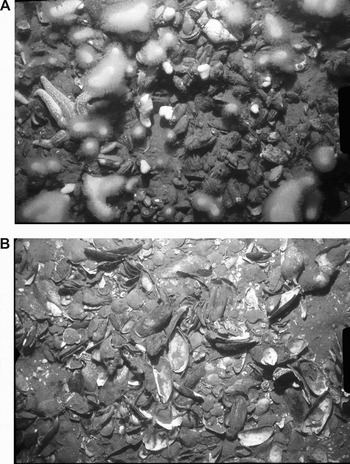
Modiolus modiolus bioherms often have a long axis aligned with the tidal currents (Wildish et al., Reference Wildish, Fader, Lawton and MacDonald1998), but within this they can develop a complex topography, sometimes with ribbons along the tidal axis at the extremities. Wave-like and quasi-regular lingulate undulations form across the tide where the reef is continuous. These bedforms were characteristic on side-scan sonar records from the Pen Llŷn reef and detectable by multibeam sonar, allowing the extent of the reef to be mapped (Lindenbaum et al., Reference Lindenbaum, Bennell, Rees, McClean, Cook, Wheeler and Sanderson2008). Typical amplitudes estimated from acoustic data were about 0.09–1.2 m, with wave lengths about 6–18 m between ridges. Such relief was at a scale visible to divers and the ridges were sharp enough for underwater television (UWTV) sledges crossing them to be seen to tip. Photographs and diver observations showed that the larger living mussels clumped together to form the ridges, with more dead shell lying in the troughs (Figure 1A & B). A further level of structural heterogeneity was due to the mussels binding together as clumps, so complex sub-habitat mosaics occurred at several spatial scales. This paper describes a trial to determine how much variation, particularly in the crevice and infauna associated with the mussels, could be attributed to the main ridge and trough sub-habitats.
Photographs of (A) typical ridge and (B) trough habitat on the Modiolus modiolus reef. View vertical downwards width of field 0.45 m. Taken with a remote sledge mounted camera.

MATERIALS AND METHODS
A substantial fixed benthic station marker, fitted with an acoustic transponder allowing relocation with a diver held instrument, was placed on the reef (Sanderson et al., Reference Sanderson, Holt, Kay, Wyn and McMath2001, Reference Sanderson, Holt, Kay, Ramsay, Perrins, McMath and Rees2008). Positions around the marker, representative of the ridge and trough features seen earlier on side-scan sonar records, were sampled on 5 June 1999. A diver operated air-lift suction sampler, similar to that described by Barnett & Hardy (Reference Barnett and Hardy1967) and fitted with a 0.5 mm mesh bag, was used. Three core samples (0.25 × 0.25 m) to depths of 20 cm were taken from positions on ridges and four were taken in the troughs. Clumps of Modiolus modiolus and associated epifauna too large for the sampler nozzle were carefully placed in 0.5 mm mesh draw-string bags. Samples were transferred to 4% formaldehyde in seawater within five hours then to 40% IMS within ten days. Subsequently the samples were sorted into major taxonomic groups, identified and enumerated using standard methods developed by the National Museum of Wales (Mackie et al., Reference Mackie, Oliver and Rees1995, Reference Mackie, James, Rees, Darbyshire, Philpott, Mortimer, Jenkins and Morando2006). The long axes of the larger M. modiolus and Chlamys spp. were measured with calipers to 0.1 mm and counts made of the numbers of individuals and colonies of epifauna attached to each.
All multivariate analyses employed the Bray–Curtis similarity coefficient and were carried out using PRIMER v.6 (Clarke & Gorley, Reference Clarke and Gorley2006). Numerical abundances in the cluster analysis of the core samples were scaled by a square root transformation in order to limit the influence of species exhibiting high numerical dominance (up to 362 individuals per core). The hierarchy of the dendrogram was determined by group average fusion. The SIMPROF permutation procedure was used to test the significance (at 5% level) of the clusters. The species contributing most to the dissimilarity between ridge and trough samples were examined using SIMPER analysis. Analysis of similarities (ANOSIM) was used to examine the effect of the location factor.
Non-metric multidimensional scaling (nMDS) ordination, using the default Kruskal fit scheme 1, was used to visualize the relationships of the fauna from the core locations (ridge and trough) and in relation to a wider study of 50 grab stations in the southern Irish Sea (Mackie et al., Reference Mackie, Oliver and Rees1995). In that study, the two Van Veen grabs from each station represented a combined sample area of 0.224 m2, hence four 0.0625 m2 Modiolus cores together covered an approximately equivalent area. Therefore the fauna from the four trough cores (T1–T4) were combined to represent a trough station, while one of the three ridge cores (R2) was randomly selected for duplication and inclusion with the others as a single ridge station. A stronger log10(x + 1) transformation was used due to the larger range of species abundance (0–1966) in the combined dataset.
Diving logistics prevented the collection of adequate sediment samples during the core sampling. However, particle size distributions, and organic and carbonate contents had previously been analysed from grab samples taken in and around the same reef in summer 1995 and 1997 (Nic Aonghusa, Reference Nic Aonghua, Wilson, Mackie and Wilson2001).
The photographs in Figure 1 were taken in July 1994 using a Photosea 1000 still camera system mounted on a towed seabed sledge with the camera lens 0.7 m above the bed, the strobe at 60° to it and operated by electronic timer at 42 s intervals.
RESULTS
A total of 213 taxa, not including the colonial epifauna attached to the mussels and Chlamys spp., were recorded from the seven cores. The colonial epifauna attached to the living mussels and Chlamys spp. included at least another 17 taxa, but not all were identified to species. Of the non-colonial taxa, approximately 50% could be classified as mainly infaunal, 25% were crevice living, 22% were epifaunal and 2% were either commensals or parasites. Categorization was based partly on literature and partly on observation while sorting samples from the locality. In a complex habitat, bound together by a mass of byssal threads, precise distinction between living within the sediment or inhabiting crevices is not absolute. Nor was it easy to distinguish between those living on, amongst, or embedded in the larger epifauna, as distinct from those in crevices amongst the mussel clumps.
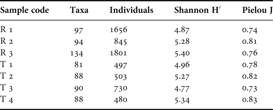
The numbers of taxa recovered from each of the 0.0625 m2 core samples are shown in Table 1, with numbers of individuals, and Shannon diversity (H′) and Pielou evenness (J) index values (calculated using log2). Species richness was higher in the ridge samples with up to 134 taxa present in core R3. Collectively, the three ridge cores yielded 166 taxa, against 152 taxa for the four trough cores. The ridge samples, which had the equivalent of 619 mussels larger than 40 mm per m2, contained nearly three times the total numbers of animals as the troughs, where there was predominantly dead shell. Converting the numbers of individuals into total N/m2 gives averages of 22.9 × 10³ m–2 for the dense mussel clumps on the ridges, and 8.8 × 10³ m–2 for the trough samples. Shannon diversity and Pielou evenness values were very similar: ridge cores H′mean = 5.18, J′mean = 0.77 and trough cores H′mean = 5.09, J′mean = 0.79. Similar patterns were found for other diversity measures (e.g. Fisher's alpha, Simpson's 1-λ index).
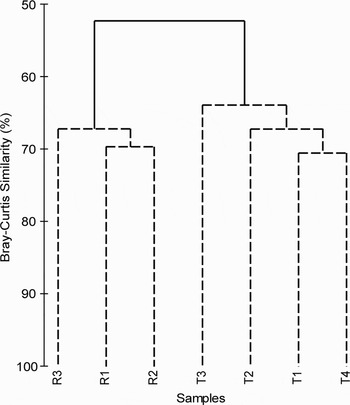
Quantitative Bray–Curtis classification of the Modiolus core samples (square root transformed data). Dashed lines indicate non-significantly differing samples (SIMPROF P > 0.05). R, ridge; T, trough.

Gross measures of the fauna from 0.0625 m2 core samples taken on ridge and trough positions on the Modiolus modiolus reef.

Code R, ‘ridge’; code T, ‘trough’.
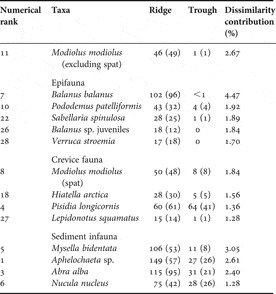
Clustering and ordination methods using Bray–Curtis similarity and MDS indicated clear separation between the ridge and trough samples. Clustering within both the ridge and trough samples was tight and the SIMPROF test showed no statistical evidence for any sub-structure within each group (Figure 2). Analysis of similarities showed that the location factor, ‘ridge’ or ‘trough’, was significant at the 5% level (P = 0.029, sample statistic R = 1 using all 35 possible permutations). Ordinations run separately on the infauna and the crevice species showed similar separation between the ridge and trough samples. In the SIMPER analysis of species contributions, the top 14 contributing taxa collectively accounted for almost 30% of the average dissimilarity (47.64%) between the ridge and trough samples (Table 2). Modiolus and 13 taxa from all three faunal components each contributed more than 1.27%, but Scalibregma inflatum and Exogone naidina, the second and ninth most abundant species in the survey, were more equally distributed between the sub-habitats and contributed only 0.90 and 0.41% respectively.
Mean and (median) numbers of Modiolus modiolus and of surface, crevice and sediment living fauna contributing most to the average dissimilarity (47.64%) between 0.0625 m2 ‘ridge’ and ‘trough’ core samples (SIMPER analysis).

A total of 104 taxa (48.6%) were present in both ridge and trough samples, and differences between their relative abundances together accounted for 78.9% of the average dissimilarity. The majority of taxa found in single sub-habitats were sporadic and occurred in low numbers (<10 per 3 or 4 cores). Balanus balanus, large Modiolus modiolus and Sabellaria spinulosus were almost entirely ridge species. Only 11 ‘unique’ ridge taxa were present in every ridge core. Of these, Balanus sp. juveniles and Verruca stroemia were the most prevalent. The others (Chlamys distorta, Tritaeta gibbosa, Aonides oxycephala, Anapagurus hyndmani, Pherusa plumosa, Capitella sp., Cumella pygmaea, Subadyte pellucida and Jasmineira elegans) were much less abundant (1–5 individuals per core). For the trough samples, no such ‘unique’ taxa were present. However, Tubificoides amplivasatus and Protodorvillea kefersteini with approximately four and five individuals in each trough core occurred only at lower abundances (1 and 2 individuals respectively) in single ridge cores.
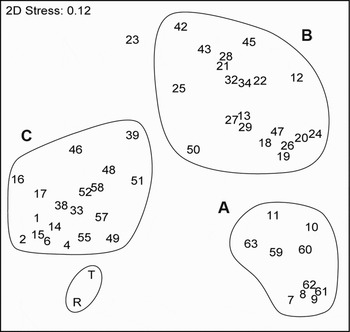
A cluster analysis (not shown) including the combined trough and scaled ridge samples together with 50 grab stations from the southern Irish Sea revealed four main groups at the 27% similarity level. These were the three assemblage groups (A–C) identified by Mackie et al. (Reference Mackie, Oliver and Rees1995) plus a group comprising the two Modiolus sub-habitats. The two sub-habitats clustered together at 64% similarity and subsequently grouped with assemblage C (clustered at 36%) at 29% similarity. The Modiolus and assemblage C clusters were significantly different (SIMPROF test; P = 0.001). A nMDS plot of the inter-station similarities revealed the relationship in 2-D space (Figure 3). The related 3-D plot (stress = 0.08) showed the Modiolus cluster in a separate plane to assemblage C, quite distinct, but closest to Stations 2, 6, 15, 38, 49 and 55. The inter-station similarities between the two Modiolus sub-habitats and these stations were between 30 and 39%.
Non-metric multidimensional scaling plot of Bray–Curtis similarity between faunal assemblages of the Pen Llŷn Modiolus ridge (R) and trough (T) samples, and 50 locations in the wider southern Irish Sea. Locations are grouped according to the four distinct clusters (27% similarity level) evident in the dendrogram produced from the same similarity matrix.

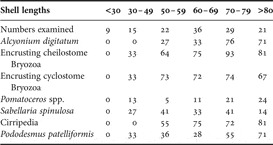
The larger size-classes of Modiolus modiolus had much more epifauna attached to them (Table 3). By putting the data into mussel size rank order, the sizes at which various epifaunal taxa began to colonize the living mussels was determined. For most of the attached epifaunal taxa the size-class at which more than 5% of the mussels had been colonized was 50–55 mm shell length, but for Alcyonium digitatum the mussels were over 60 mm before 5% of them were colonized and for Pomatoceros spp. the size was nearly 70 mm.
Living Modiolus modiolus by a series of shell size-classes (mm) with the percentage to which the most common epifaunal taxa were attached.

Particle size analyses by Nic Aonghusa et al. (Reference Nic Aonghua, Wilson, Mackie and Wilson2001) show the different grain size distributions that occur between grabs with dense populations of living Modiolus modiolus and nearby samples with only dead shell. With the living mussels there was much more fine sand, very fine sand and silt/clay, giving bimodal particle size distributions. Analyses for carbonate showed that shell and shell fragments made up just under a third of the bulk sediment within the reef, after the living material had been removed. Where there were patches with accumulations of dead shells, the carbonate content was up to 60%. On photographs the dead shells were sometimes seen to be packed together on edge (imbricated). The organic content of the fine sediment within the living part of the mussel reef was about four times that in the shelly areas.
DISCUSSION
The differences between targeted cores from the ridges and troughs of the Modiolus modiolus reef were clearly linked to the greater abundance of large mussels aggregated into dense clumps on the ridges. In the samples from the ridges the number of mussels, not including spat and others less than 40 mm long, was on average equivalent to over 600/m–2. The spat, which were mainly found amongst the mass of byssal threads of the larger mussels, were equivalent to another 805/m–2. In situ counts by divers of the larger mussels (Sanderson et al., Reference Sanderson, Holt, Kay, Ramsay, Perrins, McMath and Rees2008), recorded the equivalent of about 100/m–2 on the ridges and 6/m–2 in the troughs. The discrepancy probably occurred because the clumps of mussels were more than one layer thick and the luxuriant epifauna added to the difficulty of counting in situ.
The relative abundance of many of the crevice and infaunal taxa varied mainly in relation to the abundance of the larger mussels. This applied to Pisidia longicornis and spat Modiolus modiolus, which were the two most abundant crevice living taxa present. The two most abundant infaunal bivalves were Abra alba and Mysella bidentata. In other circumstances both bivalves are often most abundant in areas of muddy sand receiving substantial inputs of organic matter and they have been associated with enriched sediments (Pearson & Rosenberg, Reference Pearson and Rosenberg1978). During previous sampling of this Modiolus modiolus reef some A. alba had been found living in sediment deposited within the paired valves of dead M. modiolus (E.I.S. Rees, personal observation). Crevice or infaunal species found only in one of the sub-habitats were limited to those occurring so sparsely that absences were more likely chance. The mussel attached epifauna was nearly all confined to the ridge sub-habitat.
The Pen Llŷn Modiolus sub-habitats were found to be distinct from the species rich assemblage C of Mackie et al. (Reference Mackie, Oliver and Rees1995). This assemblage occurs in the shallow and offshore (27–170 m) gravelly sands and sandy gravels of the southern Irish Sea. It can be referred to the SS.SCS.CCS.MedLumVen biotope as defined in Connor et al. (Reference Connor, Allen, Golding, Howell, Lieberknecht, Northen and Reker2004), though more work is needed in characterizing benthic assemblages from coarse gravelly sediments (see Mackie et al., Reference Mackie, James, Rees, Darbyshire, Philpott, Mortimer, Jenkins and Morando2006). Modiolus modiolus occurred at a number of assemblage C stations, including most of those having the highest Bray–Curtis similarities with the Pen Llŷn location. However, most were juveniles and adults were embedded in the sediment, not forming clumps. Further studies of the Pen Llŷn Modiolus habitat are nearing completion as part of the EU INTERREG HabMap project (www.habmap.org). These investigations employing multibeam sonar, underwater photography and video, sediment profile imaging (SPI), sediment analyses and grab sampling will provide an increased insight into the relationship of the Modiolus beds to other habitats in Caernarfon Bay and the wider southern Irish Sea.
On superficial inspection, in areas where mussels are underlain by lag deposits, Modiolus modiolus biogenic reefs often appear to be oases of higher biomass and higher biodiversity, contrasting with the surrounding apparent deserts of tide-scoured cobbles or gravel. Our findings in this trial study support this in relation to species richness and numerical abundance, though interestingly not for the diversity measures such as the Shannon index. The richness of the reefs can be accounted for partly by the biogenic complexity of the habitat. Amongst the closely packed M. modiolus, the mass of byssal threads and the attached epifauna there are complex crevice niches. Filter feeding by the mussels also generates very large quantities of faecal and pseudo-faecal pellets. The pellets that become trapped amongst the mussels are often rich in organic matter, so the local deposits of mud or muddy sand can support a particularly abundant infauna. Navarro & Thompson (Reference Navarro and Thompson1997) estimated that up to 41 mg of dry weight per animal per day could be deposited by M. modiolus in the form of faeces and pseudo-faeces. Mussels in substantial undulating ribbons will alter bed roughness with consequences for patterns of sedimentation and the retention of the pellets as well as aggregated floc from suspension and grains of fine sand. On photographs and towed video images, especially those that had been taken in calm summer weather and on neap tides, the faecal mud could be seen on the Pen Llŷn M. modiolus reef (E.I.S. Rees & CCW unpublished data). Samples from this reef have always been retrieved with substantial amounts of mud amongst the mussel clumps (Mackie et al., Reference Mackie, Oliver and Rees1995; E.I.S. Rees, personal observation). Much of the sediment infauna would not exist at this fairly tide-swept location without the depositional and stabilizing influence of the mussels.
A total of 230 invertebrate taxa were noted in just seven small cores from the Pen Llŷn Modiolus modiolus reef, even though not all the sponges, bryozoa and other colonial epifauna were identified to species. Holt & Shalla (unpublished data reported in Holt et al., Reference Holt, Rees, Hawkins and Seed1998) recorded 270 invertebrate taxa associated with a horse mussel reef off the Isle of Man and also suggested that this number was likely to be an underestimate, particularly for sponges. Brown & Seed (Reference Brown, Seed and Keegan1977) recorded 90 taxa in horse mussel clumps in Strangford Lough (Northern Ireland), while Roberts et al. (Reference Roberts2004) recorded 119, 79 and 84 taxa in horse mussel beds from different various parts of the same locality. Mair et al. (Reference Mair, Moore, Kingston and Harries2000) studied Modiolus clumps and their associated fauna at three different study sites in Scotland. Species richness at Busta Voe (Shetland), Loch Creran (western Scotland) and Loch Alsh (north-west Scotland) ranged from 48 to 74, 80 to 88 and 90 to 116 taxa per clump respectively. Correponding Shannon diversity values were 3.25–4.08, 4.80–5.08 and 3.46–5.40. Pielou evenness values were 0.57–0.72, 0.76–0.81 and 0.57–0.86. Therefore, the Pen Llŷn Modiolus ridge samples compare well with the richest data available. In the Gulf of Maine the diversity of benthic species was found to increase as M. modiolus clump size increased (Ojeda & Dearborn, Reference Ojeda and Dearborn1989). The high biodiversity seems due in part to the physical complexity of the biogenic habitat and in part to the trophic richness deriving from enhanced biodeposition.
Several types of Modiolus modiolus biotopes have been recognized in UK waters differing mainly according to the assemblages of associated epifauna (Connor et al., Reference Connor, Allen, Golding, Howell, Lieberknecht, Northen and Reker2004). Holt et al. (Reference Holt, Rees, Hawkins and Seed1998) noted two reef types with obvious wave form morphologies. In the more common type the faecal pellets are substantially retained along with other trapped fine sediment and with the living mussels capping the ridge crests. Unlike Mytilus edulis, which Meadows & Shand (Reference Meadows and Shand1989) classified as epibyssate, Modiolus modiolus was described as endobyssate, having relatively more byssal threads for attaching to sediment particles and being adapted to live semi-infaunally. The other biotope type noted by Holt et al. (Reference Holt, Rees, Hawkins and Seed1998) occurred in a few very strong tidal current locations where the horse mussels were binding together cobbles and gravel to form waves within which they lived almost infaunally. In this situation the faecal pellets mainly wash away so the coarse sediment retains an open matrix particularly suited to crevice living species.
Although it may be possible to classify a horse mussel bed and to gauge the general condition by non-intrusive means, understanding ecosystem functioning requires that the crevice fauna and sediment infauna should be sampled as well. In trophic terms, the crevice living fauna and the locally enriched sediment infauna may be of equal or greater importance than the more easily observed superficial epifauna. Sub-habitat sampling precision is difficult, when using remotely operated grabs, especially where the scale of the mosaic is measured in only a few metres. Where the M. modiolus bioherms are within the depth range for routine scientific diving, detailed sampling by diver placed equipment may be suitable for monitoring studies. Sampling of bioherms lying deeper might be improved by using UWTV cameras attached to the grabs. On the Pen Llŷn bed the large attached epifauna such as the white colonies of Alcyonium digitatum were more easily seen on video than the mussels and so might be used to help target the parts of the habitat mosaic with dense M. modiolus. Camera assisted remote sampling has been successfully applied to sampling habitat mosaics in aggregate dredging studies (Boyd et al., Reference Boyd2004). Fewer destructive samples would be needed than post-sampling stratification of quasi-random samples discriminated by using the numbers of large mussels.
ACKNOWLEDGEMENTS
The targeted sampling study was a contribution to the UK Marine SACs Project funded from the EC ‘LIFE’ programme. The authors also appreciate the diving contributions made by James Perrins, Paul Turkentine and Kirsten Ramsay, and the provision of important background information by J. Bennell (Bangor Unversity) and Bill Cook (North Western & North Wales Sea Fisheries Committee). Thanks also to Teresa Darbyshire (National Museum of Wales) for preparing final versions of the line figures and the referees whose comments were much appreciated.