Sensory properties of food products are important factors in the evaluation of consumer preferences (Harker et al. Reference Harker, Gunson and Jaeger2003; Lesschaeve & Noble, Reference Lesschaeve and Noble2005; Drake, Reference Drake2007). According to a multidimensional concept of food quality, when consumers choose a food product they are influenced by credence attributes, such as links to the territory of origin, identity, sustainability of the production system, ethical attributes, safety, health and nutritional value of food (Deliza & MacFie, Reference Deliza and Macfie1996; Caporale & Monteleone, Reference Caporale and Monteleone2004; Siegrist, Reference Siegrist2008; Napolitano et al. Reference Napolitano, Girolami and Braghieri2010a; Branciari et al. Reference Branciari, Valiani, Trabalza-Marinucci, Miraglia, Ranucci, Acuti, Esposito and Mughetti2012; Hersleth et al. Reference Hersleth, Naes, Rodbotten, Lind and Monteleone2012).
In Europe, the food information is conveyed through quality labels i.e. Protected Denomination of Origin (PDO), Protected Geographical Indication (PGI), Traditional Speciality Guaranteed (TSG) (Reg. EU 1151/2012), and Organic (Reg. EU 834/2007).
One of the methods used in the studies about the drivers of consumer behaviour, involves the evaluation of the role of information which comprises several stages: a liking judgment of the product tasted without any kind of information (perceived liking), an assessment of the expectations linked exclusively to product information (expected liking), and finally an informed tasting (actual liking). Some studies have investigated the effect of information on consumer's evaluation or on willingness to pay for labelled cheeses. For example, in Italy, Napolitano et al. (Reference Napolitano, Braghieri, Piasentier, Favotto, Naspetti and Zanoli2010b) found similar perceived liking scores given for organic and conventional Pecorino cheeses. Garavaglia & Marcoz (Reference Garavaglia and Marcoz2012) in a study that considered Fontina PDO, a cheese produced in Valle d'Aosta (a mountain region) only with the local cattle breed (Valdostana breed), showed the positive influence of the PDO label on consumer preference, which also guaranteed a premium price to the product.
Many actions have been proposed in Italy to increase the value of mountain PDO cheeses by strengthening the link to the territory and the production chain, but the potentialities are not exploited enough. If the production area and processing techniques are always well defined, animal characteristics and farming practices are often not considered (Bovolenta et al. Reference Bovolenta, Dovier and Parente2011).
The aim of the paper was to assess whether the information about production process and in particular the cows' breed and the rearing system, may modify the consumer liking of a PDO cheese made in small-scale traditional farms, where the use of local breeds and grasslands is widespread.
For this purpose, Montasio cheese, one of the most important PDO and traditional product in North-East Italy, has been chosen. Although it takes its name from a mountain plateau, the Montasio PDO cheese is produced largely in lowlands where different cow breeds are reared indoor. Recently, in order to increase the value of the mountain cheese and to link it to the breed more present in this area, the production of Montasio PDO was combined with two additional labels: ‘Only Italian Simmental breed’ and ‘Mountain Product’. A previous study of Romanzin et al. (Reference Romanzin, Corazzin, Piasentier and Bovolenta2013) showed that consumers express a similar liking in blind condition for Montasio cheeses obtained from pure milk of Simmental cow kept indoor or grazing on mountain pasture. The present study gives an insight on the perceived liking of the Montasio cheeses and investigates its role on consumer behaviour.
Materials and methods
Cheeses
Cheeses under evaluation were obtained following the Montasio PDO (MC) specification, in summer period, from the milk of Italian Simmental (IS) cows maintained indoor with hay-based diet, (ISMC) or grazing on mountain pasture (ALP-ISMC).
Milk from the evening milking pooled with milk from morning milking was processed for three consecutive days (three cheese makings per type). The pooled milk collected in the vat milk was heated to 32 °C, and then was added 10 g natural starter/kg (microflora naturally present in raw milk and cultured in appropriate conditions for a day). The rennet was added after 25 min incubation. The curd was cut to obtain pellets of size comparable to grains of rice and it was heated at 45 °C for 30 min. The curd was then blended for 20 min and left to stand. After whey draining, it was placed in moulds and pressed. Fresh cheeses were then placed in brine (18% salt) for 24 h. Cheese shape was cylindrical, about 6 kg weight and 70 mm height. Cheeses were ripened for 60 d in a ripening cellar with controlled temperature (12 °C) and humidity (85%) until analysed.
Consumer test
Sensory analysis was performed at the University of Udine, in a laboratory built according to the UNI-ISO 8589:1990 standard. The potential respondents were asked to describe their attitudes towards cheese. One hundred twenty-four habitual consumers of Montasio PDO cheese were then selected, equally distributed by sex. The recruited subjects had a mean age of 39, from 23 to 71 years old, and 83% reported eating cheese more than once a week.
The consumers were asked to record their overall liking on LAM scale (Labelled Affective Magnitude bi-directional scale; from −100 to +100; Cardello & Schutz, Reference Cardello and Schutz2004). Consumers tasted cheeses presented at room temperature (20 °C±2) as small fingers, wrapped in aluminium foil, measuring 15×15 mm in thickness and 50 mm long. Samples were identified using a three digit number code and the presentation followed a balanced randomisation scheme in all phases.
Participants, scheduled in groups of eight, evaluated cheeses in two sessions. In the first, both cheeses were tasted by consumers in blind condition, without any information on the products (Perceived liking). After that, participants evaluated the expectations for cheese liking, on a LAM scale, based on information provided. ISMC was labelled as: Montasio PDO cheese ‘obtained from Italian Simmental cows’ and ‘indoor rearing system’; while ALP-ISMC was labelled as: Montasio PDO cheese ‘obtained from Italian Simmental cows’ and ‘mountain pasture rearing system’ (Expected liking). The second session of the consumer test was performed after 15 d: the same consumers evaluated cheeses only after they had read the information (breed, rearing system and cheese production) linked to each sample (Actual liking).
Physico-chemical analysis
Cheeses were analysed for dry matter (DM), fat content, total nitrogen (TN) and soluble nitrogen at pH 4·6 (SN) according to AOAC (2000). Protein content was obtained as TN×6·38. The ripening index (RI) was calculated as ratio (×100) between SN and TN.
The cheese colour was evaluated, according to the CIE L*, a*, b* colour system, by a spectrophotometer Minolta CM-2600d (Minolta Camera, Osaka, Japan) with D65 as light source, with a measured area diameter of 8 mm and 10° of observer angle.
The number and the per cent area of the holes were evaluated on a slice of cheese cut from the middle part of the form with the exception of the sub-crust area. Digital images of the slices of cheeses were examined using the Image-Pro Plus software (Media Cybernetics Inc., Silver Spring, MD, USA).
The rheological properties of cheeses were evaluated with a Texture Analyser (TA Plus, Lloyd Instruments, UK) using the procedure described by Bourne (Reference Bourne1978) and modified by Gunasekaran & Ak (Reference Gunasekaran and Ak2003). Texture Profile Analysis (TPA) was applied to the cylinders of cheese (20 mm in diameter and 20 mm height) compressed axially in two consecutive cycles, with a deformation of 50% of the original height and applying a force of 100 mm/min. The rheological parameters analysed were: hardness, cohesiveness, adhesiveness, springiness, gumminess and chewiness.
Statistical analysis
The statistical analysis was performed using the software R version 2.14.1. Normality of data distribution was tested by the Shapiro-Wilk test.
Cheese chemical composition, colorimetric parameters and texture were subjected to one way ANOVA with rearing system treated as fixed factor.
Assessors’ responses were recorded using FIZZ software (Biosystemes, Couternon, F). The Student's paired t-tests were used to evaluate differences between mean scores either obtained for the two products (ISMC and ALP-ISMC), or obtained for the same product evaluated under different information conditions. Moreover, the same test was used for evaluating the differences between expected liking and perceived liking and between expected liking and actual liking within consumers who have expressed different perceived liking for experimental cheeses.
Results and discussion
Perceived liking
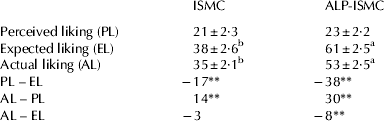
Sensory analysis results are given in Table 1. Consumers’ scores in blind condition (Perceived liking) were 21 and 23 points for ISMC and ALP-ISMC respectively. These values are not statistically different and reveals that Montasio cheese from Italian Simmental milk is characterised by a slight to moderate good eating quality along the bi-directional LAM scale (Cardello & Schutz, Reference Cardello and Schutz2004), independently of rearing system. These results confirm those obtained in the previous study (Romanzin et al. Reference Romanzin, Corazzin, Piasentier and Bovolenta2013).
Consumer liking results
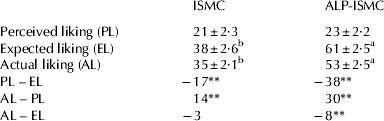
ISMC, Italian Simmental Montasio cheese; ALP-ISMC, Italian Simmental Montasio cheese at pasture
a,bP⩽0·05, **P⩽0·01
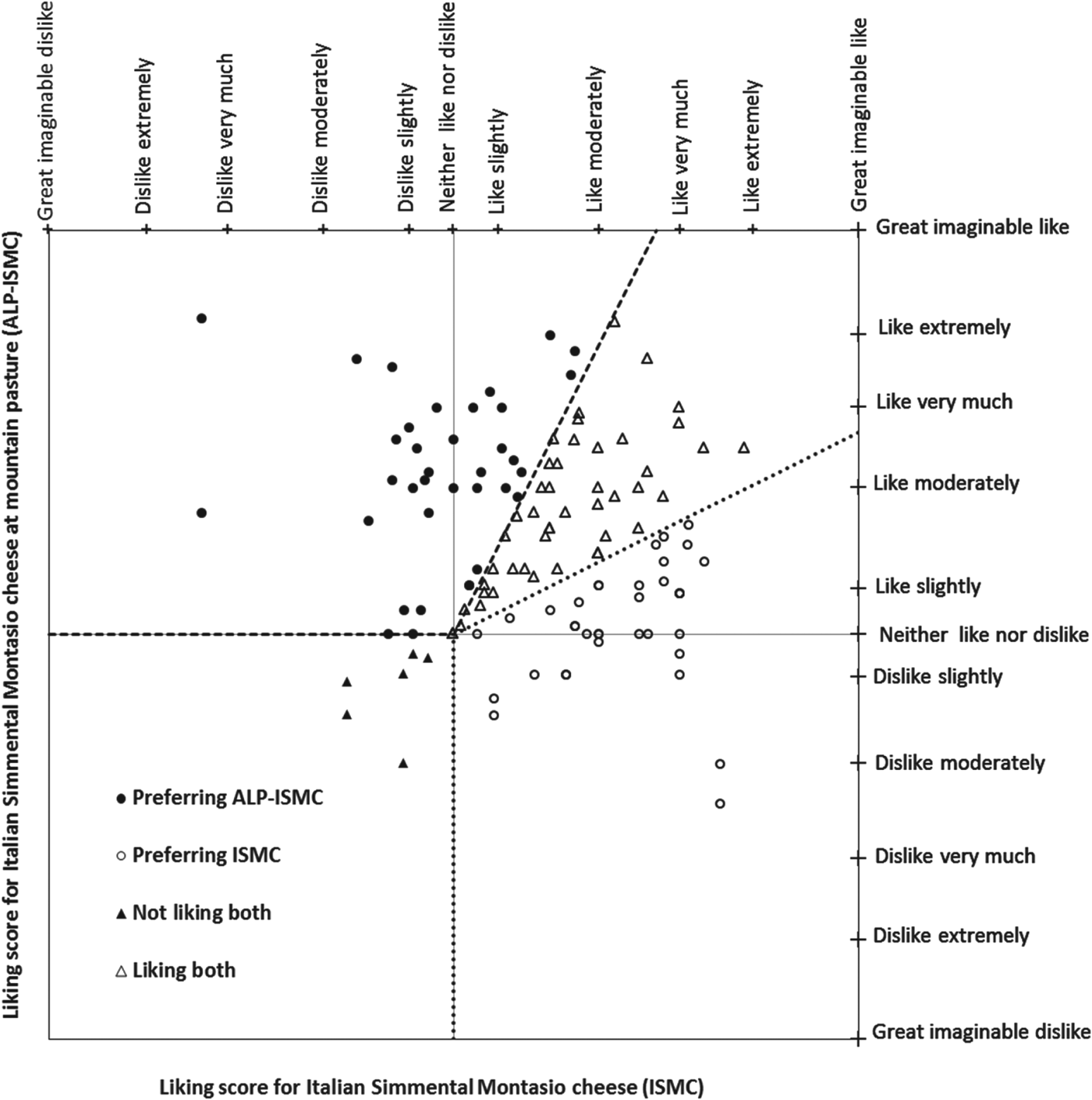
However, the average evaluation does not allow identification of clusters of consumers with different attitudes towards the two types of cheese. For a better understanding of product preference, the liking scores of individual consumers for ISMC and ALP-ISMC were plotted in Fig. 1. The consumers were widely scatter on the preference space, showing differentiated liking combinations for the two Montasio types. Indeed, four groups of consumers can be identified based on their preferences. A first group is made by consumers (29% of respondents) who scored ALP-ISMC positively, at least twice as much than ISMC: they can by regarded as consumers preferring ALP-ISMC. This group is placed in the top, left part of the bi-dimensional liking space, defined by the dotted line in Fig. 1. Conversely, a second group consists of consumers (29%) who prefer the second cheese, and it is located in the bottom, right side of the scatter-plot, demarcated by the spotted line. A third cluster of consumers did not seem to prefer the intrinsic characteristics of one particular Montasio type; indeed they perceived both of them positively, giving comparable liking scores (i.e. two scores, the difference between which is lesser than the minimum value of them). Eventually, only few consumers (5%) belong to the fourth group, who scored negatively both cheeses.
Perceived liking of consumers for the two types of Italian Simmental Montasio cheese (ISMC). Preferring ALP-ISMC: consumers who have expressed a positive Perceived Liking for ALP-ISMC, at least twice as much than ISMC; preferring ISMC: consumers who have expressed a positive Perceived Liking for ISMC, at least twice as much than ALP-ISMC.

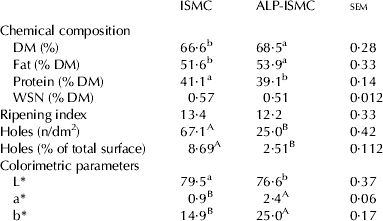
In order to clarify the nature of this diverse perception, some chemical and colorimetric parameters of the experimental Montasio types were assessed and reported in Table 2. The ALP-ISMC had more DM (68·5 vs. 66·6%) and fat content (53·9 vs. 51·6% DM) than ISMC, while protein content was lower (39·1 vs. 41·1% DM). In fact, the higher energy level of indoor diet reduces the milk fat concentration by decreasing the synthesis of acetic acid in the rumen (Walker et al. Reference Walker, Dunshea and Doyle2004). Moreover the lower protein concentration in ALP-ISMC could be due to the low energy supply and hypoxia, which characterise the dairy cows grazing on high mountain pasture (Dovier et al. Reference Dovier, Valusso, Morgante, Sepulcri and Bovolenta2005; Leiber et al. Reference Leiber, Kreuzer, Leuenberger and Wettstein2006; Bovolenta et al. Reference Bovolenta, Corazzin, Saccà, Gasperi, Biasioli and Ventura2009). The values of ripening index were not statistically different between cheeses (12·8) and fall within the range reported for PDO Montasio by Innocente et al. (Reference Innocente, Pittia, Stefanuto and Corradini2002).
Chemical composition, ripening index and colorimetric parameters of Montasio cheese after 60 d ripening

ISMC, Italian Simmental Montasio cheese; ALP-ISMC, Italian Simmental Montasio cheese at pasture; DM, dry matter; WSN, water soluble nitrogen; Ripening index, WSN/TN (×100); TN, total nitrogen
a,bP⩽0·05, A,BP⩽0·01
The number of holes and the total percentage area occupied by holes were significantly lower in ALP-ISMC than ISMC (25·0 vs. 67·1 holes/dm2 and 2·51 vs. 8·69% respectively). The values obtained with ISMC cheeses fall within the normal range for a Montasio cheese made from raw milk and natural starter (Innocente & Corradini, Reference Innocente and Corradini1998), while the values of ALP-ISMC are below this range. Colorimetric parameters show that cheeses from mountain pastures were more yellow and red and less shiny than those from indoor rearing, probably as a consequence of a high carotenoid content from fresh grass (Noziere et al. Reference Noziere, Graulet, Lucas, Martin, Grolier and Doreau2006).
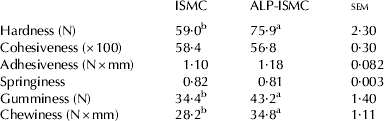
The rheological properties of experimental cheeses are shown Table 3. Hardness, gumminess and chewiness were higher in ALP-ISMC than ISMC (75·9 vs. 59·0 N, 43·2 vs. 34·4 N, and 34·8 vs. 28·2 N×mm respectively). Texture of cheeses is related to a complex interaction between chemical composition and ripening parameters. The differences in water content and percentage holes may have caused differences in the mechanical properties, hardness in particular (Innocente et al. Reference Innocente, Pittia, Stefanuto and Corradini2002; Gunasekaran & Ak, Reference Gunasekaran and Ak2003). Bovolenta et al. (Reference Bovolenta, Saccà, Corazzin, Gasperi, Biasioli and Ventura2008) in a trial on grazing cows have shown that a higher supplement level induces a higher degradation of the protein matrix in cheese that, consequently, causes lower hardness and gumminess.
Textural properties of Montasio cheese after 60 d ripening
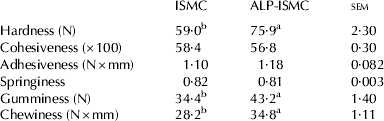
ISMC, Italian Simmental Montasio cheese; ALP-ISMC, Italian Simmental Montasio cheese at pasture
a,bP⩽0·05
Expected liking
In the second phase of the sensory test (Table 1), the respondents did not taste the cheeses and they judged them only on the basis of provided information. When there is a difference between expected and perceived liking, consumer expectations are not met and therefore there is a ‘disconfirmation’ (Cardello & Sawyer, Reference Cardello and Sawyer1992), which is positive if the perceived liking is higher than the expected and negative when the product is below expectations. The Expected liking was significantly higher than the Perceived liking for both types of Montasio cheese (P<0·01), thus indicating that a negative disconfirmation occurred. The reason for which consumers found the cheeses worse than expected is not due to a poor eating quality of them. Indeed, both cheeses were scored, on average, in the positive half of the LAM scale after testing in blind condition, and only 5% of respondents gave negative scores for both types of cheeses (Fig. 1). The disconfirmation rather reveals that information about the use of milk from the Italian Simmental breed, historically originated and still widespread in the region, had a positive impact on consumer expectancy about Montasio PDO cheese. The interest in pure-breed products comes from the fact that the consumer is aware that, buying them, contributes to the preservation of breed, with a significant impact on the rural economy and on the conservation of biodiversity (Gandini & Villa, Reference Gandini and Villa2003). For example, recovery of the Reggiana breed has depended upon the production and promotion of ‘Parmigiano Reggiano delle Vacche Rosse’ cheese, obtained exclusively from this breed, which is generally sold at double the price compared with undifferentiated Parmigiano Reggiano cheese (Russo et al. Reference Russo, Fontanesi, Scotti, Tazzoli, Dall'Olio and Davoli2007; Fontanesi, Reference Fontanesi2009).
Moreover, the Expected liking was higher for pasture (61±2·5; between ‘like very much’ and ‘like extremely’) with respect to indoor (38±2·6; next to ‘like moderately’) rearing system of Italian Simmental cows. Consumers have high expectations for cheeses made with milk from mountain pasture, probably due to their link with naturalness, authenticity, animal welfare, healthiness and more (Corazzin et al. Reference Corazzin, Piasentier, Dovier and Bovolenta2010; EEA, 2010; Parente & Bovolenta, Reference Parente and Bovolenta2012).
Actual liking
In the third phase of their liking evaluation, consumers scored the cheeses while tasting them after having received full information about breed and farming practices (Table 1). The Actual liking of ISMC (35±2·1 points) was similar and statistically not different from the Expected linking (i.e. ‘like moderately’) of a monobreed product made in the common indoor system. Thus, Actual liking of the cheese moved in the direction of the expectations and reached them, demonstrating the important effect of the information about breed.
The ALP-ISMC received a score significantly higher than that of ISMC, equal to 53±2·5 points. The information had strongly improved the position on the LAM scale bringing near ‘like very much’ for PDO Montasio obtained from Simmental cows grazing on mountain pasture. According to the theory of assimilation (Anderson, Reference Anderson1973), when the actual liking of the products moves in the direction of expectations an assimilation of information occurs, which is complete or incomplete if the actual liking reaches or does not reach expectation, respectively. Therefore, for both cheeses a negative disconfirmation and an assimilation occurred. However, for ALP-ISMC consumers assimilated 87% of expectations, which correspond to an incompletely assimilation. Also Napolitano et al. (Reference Napolitano, Braghieri, Piasentier, Favotto, Naspetti and Zanoli2010b) considering organic Pecorino cheese observed an incomplete assimilation of the information due to the high expectation linked to agricultural practices favourable for environment, animal welfare, and human health.
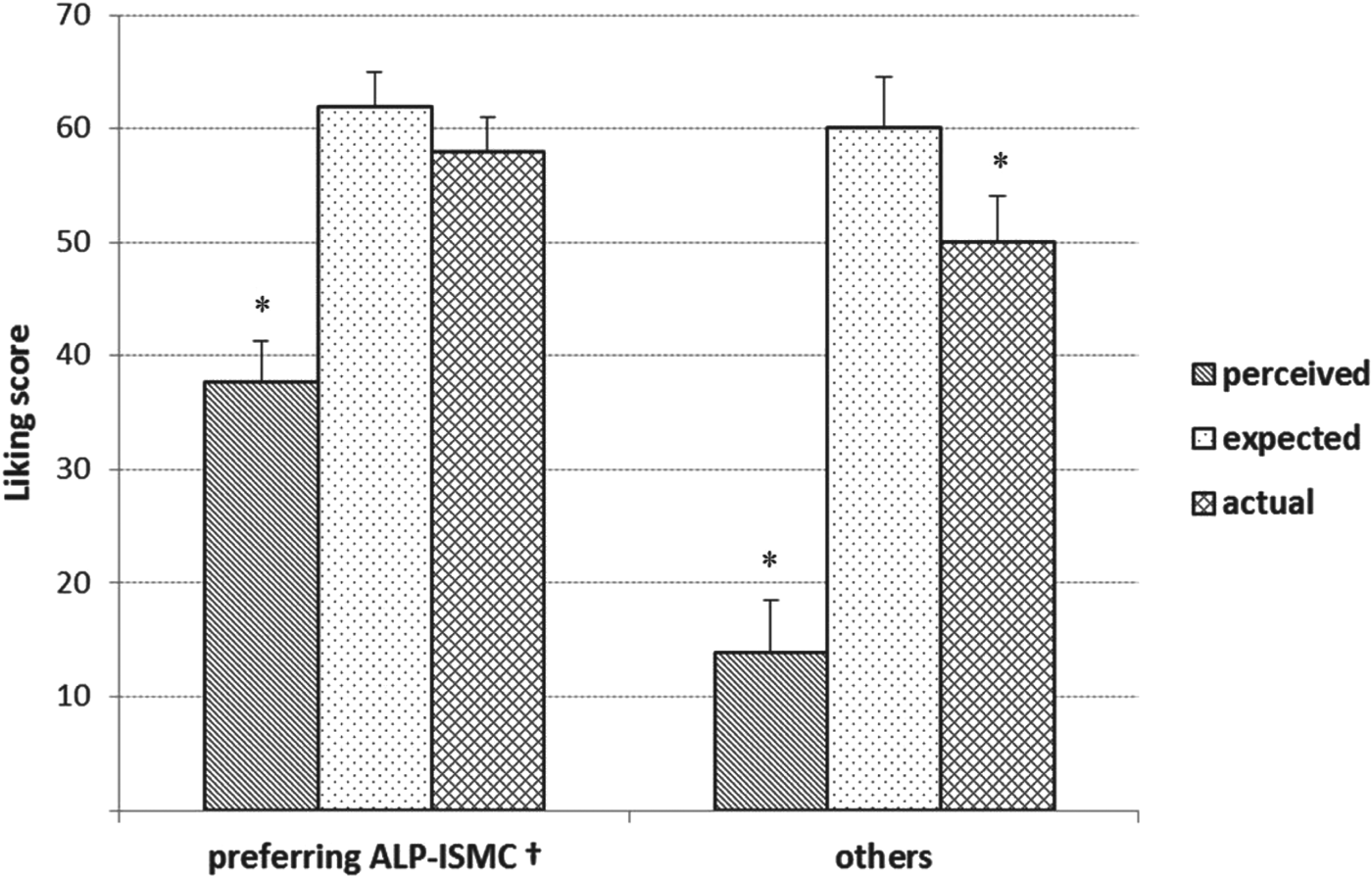
However, as shown in Fig. 2, the assimilation of product information has not been consistent among consumers. Those who have shown a preference for the sensory properties of ALP-ISMC completely assimilated the information on the grazing rearing system. On the other hand, for consumers who do not prefer ALP-ISMC (the set of consumers who prefer ISMC and the neutral ones) the assimilation was not complete, revealing that for them both information and intrinsic properties play a significant role in the actual liking of the pasture-derived cheese.
Liking scores for Italian Simmental Montasio cheese at pasture (ALP-ISMC), in different condition regarding product information. †: consumers who have expressed a positive Perceived Liking for ALP-ISMC, at least twice as much than ISMC; *: within each consumer group, difference from the expected liking P⩽0·05.
The study provide useful insights in order to increase the added value of dairy products of small-scale traditional farms, where husbandry is often based on local breeds, use of grasslands, and where production costs tend to be higher.
The authors would like to thank the ‘Centro di Ricerca e Innovazione Tecnologica in Agricoltura’ (CRITA) for financial support (funds of Friuli Venezia Giulia Region, L.R. n. 26/2005, art. 18) and the Breeders Association of Friuli Venezia Giulia Region (AAFVG) for technical collaboration.