Introduction
The genus Neodiplostomum Railliet, 1919 (Diplostomidae Poirier, Reference Niewiadomska, Gibson, Jones and Bray1886) comprises trematode species that parasitize birds and mammals, including humans. Of the six Neodiplostomum species known in the Russian southern Far East, three — Neodiplostomum cohleare (Kause, 1914), Neodiplostomum spathoides Dubois, 1937, and Neodiplostomum spathula (Creplin, 1960) — were recorded from various regions of the Western and Eastern Hemispheres. The other three species —Neodiplostomum lanocolum Oschmarin, 1963, Neodiplostomum oriolinum Oschmarin, Reference Oshmarin1963, and Neodiplostomum paraoriolinum Oschmarin, Reference Oshmarin1963 — were found in birds only in the Russian southern Far East (Skrjabin Reference Skrjabin1960; Oshmarin Reference Oshmarin1963). For N. oriolinum, data on the life cycle and morphology of developmental stages were obtained by Besprozvannykh (Reference Besprozvannykh2009). In addition, based on the morphological characteristics of mature trematodes, Besprozvannykh suggested N. oriolinum and N. paraoriolinum belong to the same species. Until recently, molecular data for trematodes of the genus Neodiplostomum, discovered in the Russian southern Far East, have not been obtained.
From 2017–2021, we conducted studies to identify cercariae that emerged from pulmonate aquatic snails in the Russian southern Far East. As a result we found snails Helicorbis sujfunensis Starobogatov, 1957 infected by furcocercariae morphologically identical to representatives of Neodiplostomum in three localities of the study region. In order to identify the species of the found trematode, we collected data on the life cycle, developmental stage morphology, and molecular genetic characteristics from each locality.
Material and Methods
Life cycle and morphology of worms
The materials for this study were the naturally infected freshwater snails H. sujfunensis (Planorbidae Rafinesque, 1815) collected in the Russian southern Far East: from the drainage basins of the Komissarovka and Arsenyevka Rivers and also from a reservoir in Russky Island (city of Vladivostok).
The infected snails, one from each locality, were placed in Petri dishes with water to obtain cercariae. Then the water containing cercariae from each Petri dish was transferred into three separate 1.5 L containers, where we had preliminarily placed snails H. sujfunensis, Polypylis semiglobosa Moskvicheva, 1980, and Anisus centrifugops Prozorova & Starobogatov, 1997 (five individuals of each species), juvenile fish Phoxinus percnurus (Pallas, 1814) (four individuals), and tadpoles Rana dybowskii Gunther, 1876 (seven individuals). All animals were caught in water bodies where no source of any trematodosis invasion was found. The control group consisted of 100% of the animals used in the experiment. The experimental animals were exposed to furcocercariae in the containers for 2 d. Upon completion of the exposure, the animals were kept in separate aquaria.
Subsequent necropsies showed that, of all the animals used in the experiment, only tadpoles were infected. Cercariae actively invaded the tadpole intermediate host, where they developed into metacercariae without cyst formation.
The tadpoles parasitized by 22 d old metacercariae were fed to incubated chickens and laboratory rats. We used two chickens and two rats to be infected by metacercaria from each locality. On day 8 post-infection, adult trematodes were found in the intestines of all rats. The intensity of invasion was from 3–12 mature trematodes. The chickens were not infected.
The morphology of sporocysts, cercariae, and metacercariae was examined on live specimens. The sporocyst and metacercariae were measured live, while cercariae were fixed in a hot 4% formalin solution before measurements. Adult trematodes were fixed in 70% ethanol and then transferred to 96% ethanol for storage. Whole mounts of adult specimens were prepared by staining with alum carmine, dehydration in a graded ethanol series, clearing in clove oil, and mounting in Canada balsam. All measurements were in micrometers (μm).
Euthanasia of laboratory animals was carried out in accordance with the Committee on the Ethics of Animal Experiments, Federal Scientific Center of the East Asia Terrestrial Biodiversity, Far Eastern Branch, Russian Academy of Sciences, Russia (Permit Number: 1 of 25.04.2022).
Molecular data
DNA extraction, amplification and sequencing
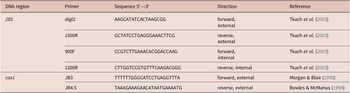
To obtain molecular data, two mature trematodes from each locality were used. Genomic DNA was extracted from these individual parasites using the HotSHOT technique (Truett et al. Reference Truett, Heeger, Mynatt, Truett, Walker and Warman2000). Partial sequences of the 28S rRNA gene (28S) nuclear DNA and partial sequences of the cox1 gene of mitochondrial DNA were amplified by polymerase chain reaction (PCR) using specific primers (Table 1). The annealing temperature was 55°C for the 28S marker and 50°C for the cox1 marker. The efficiency and contamination of PCR were tested by setting positive and negative controls, respectively. The PCR products were sequenced by the Sanger method, using a BigDye Terminator Cycle Sequencing kit (Applied Biosystems, CA USA) (Sanger et al. Reference Sanger, Nicklen and Coulson1977). Nucleotide sequences were determined on an ABI 3500 genetic analyzer (Applied Biosystems, USA) at the Federal Scientific Center of the East Asia Terrestrial Biodiversity, Far Eastern Branch, Russian Academy of Sciences, Russia. Both external and internal primers were used for sequencing (Table 1).
List of primers for amplification and sequencing

Analysis of genetic data
Processing and alignment of consensus sequences were carried out using the FinchTV 1.4 and MEGA 5.0 programs (Tamura et al. Reference Tamura, Peterson, Peterson, Stecher, Nei and Kumar2011). The p-distances between and within species were analyzed in the MEGA software without including indels. To construct a phylogenetic reconstruction based on the 28S marker, only sequences longer than 1000 bp were taken at the National Center for Biotechnology Information (NCBI).
Phylogenetic relationships within the family Diplostomidae were assessed independently for both markers using newly obtained sequences and data for all species deposited in GenBank. Members of the trematode families located left (basal) of the Diplostomidae in the phylogenetic tree constructed by Olson et al. (Reference Olson, Cribb, Tkach, Bray and DTJ2003) using nucleotide sequences of the 28S and 18S rRNA genes were selected as the outgroup in our study (Postharmostomum commutatum (Diesing, 1858) (Brachylaimoidea (Joyeux & Foley, 1930)) was used for reconstruction based on 28S marker and cox1).
Phylogenetic relationships were reconstructed using the Bayesian algorithm in the MrBayes 3.1.2. program (Ronquist & Huelsenbeck Reference Ronquist and Huelsenbeck2003) by applying a model selected as optimal on the basis of the Akaike information criterion (AIC) in the jМodeltest 2.1.7 program (Darriba et al. Reference Darriba, Taboada, Doallo and Posada2012): TVM+I+G for 28S and GTR+I+G for cox1. The method of posterior probabilities was used for the trees constructed by the Bayesian algorithm. In the Bayesian analysis, 4,700,000 and 6,000,000 generations of the Markov chain Monte Carlo posterior third (MCMC) were simulated for 28S and cox1, respectively. The number of generations was determined to be sufficient, since the SD value calculated was ˂ 0.01. The chain was sampled every 100 generations. Of the samples assessed, 25% were excluded to permit construction of consensus trees.
For the reconstruction of phylogenetic trees, aligned sequences of 1,133 bp and 318 bp were used for 28S and cox1, respectively.
Results
Morphology data
Neodiplostomum cf. seoulense (Seo, Rim, Lee, 1964) sensu Pyo et al., Reference Pyo, Lee, Lee, Park, Shin and Chai2014.
Definitive host: Rattus norvegicus Berkenhout, 1769 (experimentally).
Site: small intestine.
First intermediate host: Helicorbis sujfunensis.
Second intermediate host: Rana dybowskii (experimentally).
Site: visceral muscle tissue.
Locality: backwater in basin of the Komissarovka River, 44°49′N, 131°33′E, Arsenyevka River, 44°38′N, 133°46′E and lake on the territory of the Russian Island (Vladivostok city), 43°01′N, 131°90′E, Primorsky Region, the Russian southern Far East.
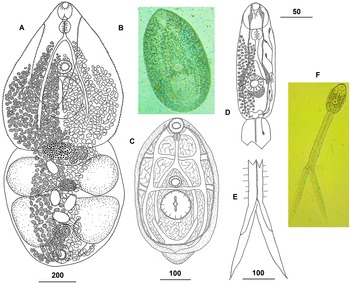
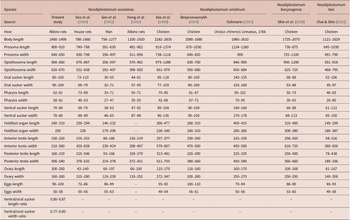
Adult worm (6 experimentally-derived specimens) (Figure 1A, Table 2). Body distinctly bipartite. Prosoma spatulate, with well-developed ventral concavity, covered with numerous spines. Opisthosoma cylindrical. Pseudosuckers absent. Oral sucker subterminal, round. Prepharynx short. Pharynx well-developed, round. Oesophagus extremely short. Intestinal bifurcation in middle between oral sucker and ventral sucker. Caeca extend to near posterior end of body. Ventral sucker round, equal to the oral sucker, located just anterior to holdfast organ or partially covered by its front edge, or in front of it at short distance. Holdfast organ large, circular, with median longitudinal slit. Testes of similar size, dumbbell-shaped, tandem lay in opisthosoma. Seminal vesicle curved, lay posterior testis. Ovary oval, pretesticular, median, situated close to borderline between prosoma and opisthosoma. Mehlis’ gland lay at level of middle of anterior testis. Seminal receptacle located to left of ovary. Uterus occupying middle field of posterior segment. Eggs oval, with a thin transparent shell. Vitelline fields contain small irregular follicles, begin at level of intestinal bifurcation, or at middle of distance between ventral sucker and intestinal bifurcation, or at level of anterior edge of ventral sucker. In opisthosoma vitelline follicles are aggregated in six longitudinal ribbon fields (three on each side of median line). In prosoma vitellarium formed by two merged median fields. Copulatory bursa opened dorsally, located near posterior end of body.
Neodiplostomum cf. seoulense (Seo, Rim, Lee, Reference Seo, Rim and Lee1964) sensu Pyo et al., Reference Pyo, Lee, Lee, Park, Shin and Chai2014: A, adult worm; B–C, metacercaria; D, F, cercaria (body); E, F, cercaria (tail). Scale-bars: μm.

Measurements of adult Neodiplostomum flukes (μm)

Sporocyst. Body threadlike. Genital pore terminal. Sporocysts contain cercariae of different stages of development.
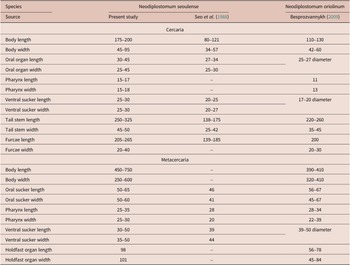
Cercaria (based on 30 specimens) (Figure 1D–F, Table 3). Body in shape of an elongated oval, covered with small spines, filled with numerous granular formations. Oral organ round. Prepharynx short. Pharynx round. Oesophagus long, reaches border anterior and middle thirds body. Intestinal bifurcation anterior to ventral sucker. Intestinal branches short, end at a short distance from posterior edge of the ventral sucker. Glands present by two pairs of cells located at level of ventral sucker. Ducts glands open at anterior end of body. Excretory system includes small excretory bladder, first-order ducts connected by transverse commissure at level ventral sucker, second-order ducts and caudal duct. Сaudal duct splits up in front of furcae into two canals reaching middle of furcae, where it opens with pores. Tail stem with sensitive hair. Furcae equal to tail stem. Excretory formula 2[(1 + 1 + 1) + (1 + 1 + [1])] = 12.
Measurements of larval stages of Neodiplostomum (μm)

Metacercaria (based on 30 specimens) (Figure 1B–C, Table 3). Body consists of large prosoma and small opisthosoma. Opisthosoma is not expressed in all individuals. Prosoma is leaf-shaped, gray due to pigmentation. Oral sucker round. Prepharynx absent. Pharynx small round or oval. Oesophagus long, reaches border anterior and middle thirds body. Intestinal bifurcation on the border of the anterior and middle thirds of the body. Intestinal branches reach anterior edge of excretory bladder. From excretory bladder, four ducts diverge, two of them blind and reach holdfast organ, and the other two form longitudinal channels connected transverse commissures form network of channels.
Molecular data
For all the trematodes obtained in this study, the lengths of the obtained nucleotide sequences were as follows: 1,187 bp for 28S and 446 bp for cox1. The nucleotide sequences of the 28S marker for the samples from Russky Island and the Arsenyevka River basin had a double peak (C and T) at position 176 bp. The nucleotide sequences of the 28S marker for the sample from the Komissarovka River basin had a bp indel of one base pair at a position of 560 bp, and p-distances between these sequences were 0%.
The nucleotide sequences of the mtDNA cox1 gene for four samples from the Komissarovka and Arsenyevka rivers were 100% identical, while both samples from Russky Island differed from them by one G/T nucleotide substitution at position 115 bp (0.3%). The samples from the latter locality were identical to each other.
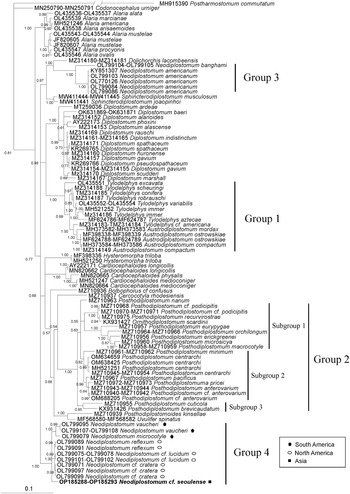
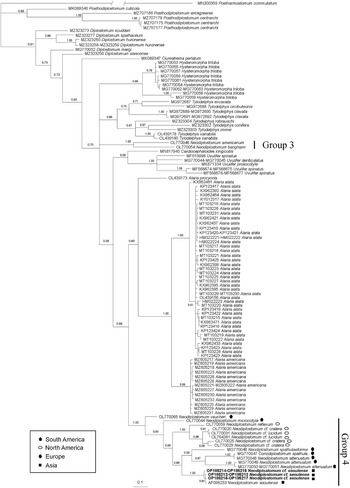
In the phylogenetic reconstruction based on the nuclear marker 28S, representatives of the family Diplostomidae are divided into 16 genera (Figure 2). As for the phylogenetic reconstruction of Diplostomidae relationships using the mitochondrial marker cox1, the distribution of species over genera is consistent to that based on the 28S marker (Figure 2, 3).
The phylogeny reconstruction based on 28S sequences using the Bayesian algorithm. The outgroup is Postharmostomum commutatum.

The phylogeny reconstruction based on cox1 sequences using the Bayesian algorithm. The outgroup is Postharmostomum commutatum.

The genus Neodiplostomum in the reconstructions based both on the 28S marker and on the cox1 marker is represented by two groups with high statistical support (Group 3 and Group 4) (Figure 2, 3). The genetic distances between these groups in the reconstructions correspond to the intergeneric level (5.56% for 28S; 16.38% for cox1).
Discussion
Life cycles, morphology and taxonomy
Based on the morphological features of mature trematodes, cercariae, and metacercariae, and also data on the life cycle, the trematodes that we found correspond to representatives of the genus Neodiplostomum. For six species from this genus, the type localities are in the East Asia region: N. lanocolum, N. oriolinum, N. paraoriolinum (discovered in the Russian southern Far East), N. seoulense (Seo, Rim, Lee, 1964), N. leei Chai & Shin, Reference Chai and Shin2002, and N. boryongense Shin et al., Reference Shin, Kim and Chai2008 (discovered in South Korea) (Skrjabin Reference Skrjabin1960; Oshmarin Reference Oshmarin1963; Seo et al. Reference Seo, Rim and Lee1964; Chai et al. 2002; Shin et al. Reference Shin, Kim and Chai2008).
The adult trematodes that we analyzed were morphologically similar both to the N. oriolinum and to N. seoulense, N. boryongense, and N. leei. The worms of the first three species listed above differ from N. leei in the extension of the vitelline fields in the prosoma of the body: the fields reach the level of the pharynx (N. leei) vs. may reach the level of intestinal bifurcation (N. oriolinum, N. seoulense, and N. boryongense). At the same time, the trematodes in our material were similar in most metric parameters to N. seoulense described by Seo et al. (Reference Seo, Rim and Lee1964), Seo et al. (Reference Seo, Lee, Hong, Hong, Kim and Lee1982), Hong et al. (Reference Hong, Hong, Lee, Seo and Chi1982), N. oriolinum by Besprozvannykh (Reference Besprozvannykh2009), and N. leei by Chai & Shin (Reference Chai and Shin2002), but differ from Neodiplostomum oriolinum specimens described by Oshmarin (Reference Oshmarin1963) N. seoulense by Seo et al. (Reference Seo, Lee, Chai, Hong and Hong1988), and Neodiplostomum boryongense by Shin et al. (Reference Shin, Kim and Chai2008) (Table 2, 3). For N. oriolinum and N. seoulense, in addition to data on the morphology of mature individuals, information was obtained on the morphometry of cercariae and metacercariae (Table 3) and the life cycle of these species. The first intermediate host for these trematode species is snails of the family Planorbidae, in particular snails of the genera Helicorbis Benson, 1855 and Polypylis Pilsbry, 1906 for N. oriolinum (Helicorbis for trematodes that we found) and Hippeutis Charpentier, 1837, Segmentina Fleming, 1818 for N. seoulense. The second intermediate host of N. oriolinum it is frogs (as the trematodes that we found); for the three Neodiplostomum species from South Korea the second intermediate hosts are frogs and snakes. Birds and mammals are the definitive hosts for N. oriolinum, mammals for N. seoulense (as the trematodes that we found), and birds for N. leei and N. boryongense (Seo et al. Reference Seo, Lee, Chai, Hong and Hong1988; Chai et al. 2002; Shin et al. Reference Shin, Kim and Chai2008; Besprozvannykh Reference Besprozvannykh2009). When studying the life cycle of N. oriolinum in one experiment, we identified the stages of trematode development from cercaria to the sexually mature stage and obtained morphometric data for cercariae, metacercariae, and mature individuals (Besprozvannykh Reference Besprozvannykh2009). Information about the life cycle of N. seoulense is based on summarized data from studies that provided descriptions of certain life cycle stages of this species. (Seo et al. Reference Seo, Rim and Lee1964; Seo et al. Reference Seo, Lee, Hong, Hong, Kim and Lee1982; Lee et al. Reference Lee, Shin, Hong, Sohn, Chai and Seo1986; Seo et al. Reference Seo, Lee, Chai, Hong and Hong1988; Seo et al. Reference Seo1989; Seo Reference Seo1990; Chung et al. Reference Chung, Jung and Kim1996; Chung et al. Reference Chung, Jung, Park and Hwang2002; Chai et al. 2002; Chai et al. Reference Chai, Park, Guk and Kim2007; Shin et al. Reference Shin, Kim and Chai2008; Pyo et al. Reference Pyo, Lee, Lee, Park, Shin and Chai2014). In all of these studies, metacercariae from naturally infected snakes were the initial source for life cycle reconstruction. As the authors point out, a mixed invasion of metacercariae by neodiplostomula was revealed in snakes. Among the found metacercariae, small ones were selected and fed to rats, mice, and chickens. Based on the results of these experiments, it was concluded that the sexually mature individuals in the intestines of rats and mice belonged to N. seoulense. The experimentally obtained trematodes showed morphological similarity to N. seoulense discovered Seo et al. (Reference Seo, Rim and Lee1964) in naturally infected rats. Other trematodes in these experiments penetrated into the liver of rats or localized in the intestines of mice, where both in the former and latter cases they remained juvenile and reached sexual maturity only after being fed to chickens. These worms, morphologically similar to N. seoulense, were referred to as N. leei. Mature trematodes that grew in the intestines of chickens from metacercariae extracted from snakes and did not have significant morphological differences from N. seoulense were referred to as N. boryongense. The main morphological criterion used by Pyo et al. (Reference Pyo, Lee, Lee, Park, Shin and Chai2014) for distinguishing South Korean Neodiplostomum is the level of extent of vitelline fields in the prosoma of the body and the structure of the testes. However, Seo et al. (Reference Seo, Lee, Chai, Hong and Hong1988) and Besprozvannykh (Reference Besprozvannykh2009) showed significant variability in these characters for N. seoulense and N. oriolinum, respectively. Thus, the main criterion for identifying Korean neodiplostomula species is the feature of their development from metacercaria to the mature stage in infected mammals and birds. During the experimental growing of mature worms from metacercariae from naturally infected intermediate hosts, it is impossible to simultaneously infect a rat and a chicken with the same metacercariae and, therefore, it is not legitimate to claim that trematodes that reached sexual maturity in rats could not have developed before this stage in chickens. For example, it was reported for N. oriolinum that metacercariae obtained from cercariae from a single snail were able to develop to the sexually mature stage both in chickens and in rats (Besprozvannykh Reference Besprozvannykh2009). There is also information on mature N. seoulense grown in chickens that had been fed metacercariae from naturally infected snakes (Seo еt al. 1988).
The work of Seo et al. (Reference Seo, Lee, Chai, Hong and Hong1988) is the only study available to date that has attempted a complete description of the life history of N. seoulense. However, this study, as well as other life cycle data obtained in South Korea for neodiplostomula, do not answer the question of accurate species identification of Neodiplostomum individuals. The authors divided the study of the cycle into two stages. At one of the stages, eggs were obtained from sexually mature individuals grown in rats from metacercariae from naturally infected snakes. Snails were infected with miracidia from these eggs, and cercariae were obtained. At the other stage, second intermediate hosts, the amphibians, were infected with cercariae from naturally infected snails, after which metacercariae from amphibians were fed to rats, and mature trematodes were obtained. With this approach to studying the life cycle, there is no link between the first and second stages of the study, which, as a consequence, does not exclude the probability that the trematodes obtained at each stage belong to different species. Along with this, Seo et al. (Reference Seo, Lee, Chai, Hong and Hong1988) point out that the emission of cercariae from snails began on the 13th day after the infection of the latter with miracidia, which is impossible and may indicate errors in the experiment set-up. In view of the above, one can state that there is no objective information that would allow species identification of South Korean neodiplostomulas obtained through experimental studies, in particular, individuals classified as N. seoulense. Thus, based on the results of the studies, not only N. seoulense but also other species capable of infecting mammals such as N. oriolinum may be present in the fauna of neodiplostomula of South Korea. This may also be evidenced by a number of differences in metrics of the body, oral and ventral suckers, pharynx, and eggs between trematode samples indicated as N. seoulense (Table 2). As mentioned above, the marites in our material that were morphologically similar to N. seoulense reached sexual maturity in rats and did not infect chickens. At the same time, there were significant differences in the size of cercariae between our samples and N. seoulense. The cercariae that we used to obtain sexually mature trematodes differed in size of tail, furcae, and body length, and were also distinguished by large maximum sizes of oral and ventral suckers and body width compared to both Korean N. seoulense cercariae and Far Eastern N. oriolinum. Such significant metric differences may indicate that either, based on the above-mentioned method of life cycle reproduction, the cercariae of Korean neodiplostomula do not belong to N. seoulense, or the trematodes in our material belong to another Neodiplostomum species.
Nucleotide sequences for the cox1 marker of the samples from the localities of the Kommisarovka and Arsenievka rivers were identical to those of the specimen indicated as N. seoulense (AF096233) in the NCBI. At the same time, there is no publication for AF096233 that confirms the species identification of this specimen. A publication by Pyo et al. (Reference Pyo, Lee, Lee, Park, Shin and Chai2014) provides the nucleotide sequence of the cox1 region for three Korean mature individuals identified as N. seoulense, N. leei, and N. boryongense (absent in the NCBI). However, the data published by Pyo et al. (Reference Pyo, Lee, Lee, Park, Shin and Chai2014) are questionable. Since the mitochondrial genome is homozygous, the presence of polymorphic sites in the sequence for the N. boryongense specimen may be associated with the presence of heteroplasmy in it, which could be detected by cloning. However, in this case, it is not correct to combine them into a consensus sequence. All variants of the nucleotide sequences should be presented at cloning. Regardless, it is impossible to interpret the presented data unambiguously. In addition, in the sequences of the samples designated as N. leei and N. seoulense, there are indels that are not multiples of three, and, since these are protein-coding sequences, such insertions also indicate the incorrectness of the presented results. Thus, the data described in this study, in our opinion, cannot be reliable evidence of genetic differences between the three indicated species, and additional molecular data are required to finally resolve this issue. Nevertheless, due to the fact that partial sequences of the cox1 that we obtained have a 249-bp region identical to the sample designated in the study by Pyo et al. (Reference Pyo, Lee, Lee, Park, Shin and Chai2014) as N. seoulense, and the adult worms are similar morphologically, we suggest that the trematodes found in the south of the Russian Far East should be considered as Neodiplostomum cf. seoulense (Seo, Rim, Lee, 1964) sensu Pyo et al., Reference Pyo, Lee, Lee, Park, Shin and Chai2014.
However, in our opinion, to objectively validate the species identification of the representatives of Neodiplostomum circulating in the East Asian region, additional studies are needed, including data about morphology and experiments growing metacercariae from cercariae and sexually mature trematodes from metacercariae in the same experiment. In this case, all morphological characteristics should be supported by nuclear and mitochondrial DNA markers of these trematodes.
Phylogenetic relationships
In constructing the phylogenetic reconstruction based on the nuclear marker 28S, a number of groups of trematodes uniting worms belonging to different genera are distinguished (Figure 2). One of these groups (Group 1) includes Tylodelphys spp. and Austrodiplostomum spp. At the same time, samples MZ314183–MZ314184 designated as Tylodelphys cf. americana (Dubois, 1936) are clustered separately from other Tylodelphys Diesing, 1850 sequences and occupy a basal position relative to Austrodiplostomum Szidat & Nani, 1951. Genetic distances constitute 1.32% between Tylodelphys cf. americana and Austrodiplostomum spp. and 1.36% between Tylodelphys cf. americana and Tylodelphys spp., corresponding to interspecific distances in the reconstruction. Differentiation between the species included in this group is not greater than 2.8%, whereas the smallest intergeneric distance among other representatives of Diplostomidae reaches 3.35% between Alaria spp. and Neodiplostomum spp., which are well distinguished at the morphological level (Group 4). The presence of specimens belonging to Tylodelphys spp. and Austrodiplostomum spp. in a single group agrees with the results obtained by Achatz et al. (Reference Achatz, Martens, Kostadinova, Pulis, Orlofske, Bell, Fecchio, Oyarzún-Ruiz, Syrota and Tkach2022а). Based on the reconstruction using the cox1 marker, the authors also found an intrageneric level of differences between Austrodiplostomum spp. and Tylodelphys spp. However, in view of the existing morphological differences between members of these genera (Niewiadomska Reference Niewiadomska, Gibson, Jones and Bray2002)—reduced ventral sucker or no ventral sucker at all and the lack of a genital cone vs. small, but well developed ventral sucker and a small genital cone respectively—Achatz et al. (Reference Achatz, Martens, Kostadinova, Pulis, Orlofske, Bell, Fecchio, Oyarzún-Ruiz, Syrota and Tkach2022а) left the question of the level of relationship to Austrodiplostomum and Tylodelphys pending additional data on the life cycles, developmental stage morphology, and molecular characteristics of these trematodes. Furthermore, it is necessary to take into account the known discrepancies between morphological and molecular characteristics in trematodes. For example, among Haplosplanchninae Poche, 1926, Pseudohaplosplanchnus catbaensis Atopkin et al., Reference Atopkin, Besprozvannykh, Ha, Nguyen and Nguyen2020 are similar to Haplosplanchnus Looss, 1902 in morphological characteristics, but by molecular characteristics this trematode is a representative of a different genera (Atopkin et al. Reference Atopkin, Besprozvannykh, Ha, Nguyen and Nguyen2020). The situation with Unisaccus Martin, 1973 (Haploporinae Nicoll, 1914) representatives is opposite (Atopkin et al. Reference Atopkin, Besprozvannykh, Beloded, Ha, Nguyen and Nguyen2022). Based on the above, we suggest that, in resolving the issue of relationships of between Austrodiplostomum spp. and Tylodelphys spp., priority should be given to molecular indicators that confirm belonging of these trematodes to the same genus rather than to morphological differences.
In another group (Group 2) with representatives of Posthodiplostomum Dubois, 1936, specimen KX931427 indicated as Ornithodiplostomum scardinii (Shulman, 1952) is clustered. This specimen is differentiated from Posthodiplostomum spp. at an interspecific level (Figure 2). Considering that the molecular data for KX931427 were obtained from metacercariae, the species identification of this specimen, due to the morphological similarity of closely related trematodes at this stage, may be incorrect. Therefore, we assume that the trematodes indicated as O. scardinii belong to the genus Posthodiplostomum. Achatz et al. (Reference Achatz, Chermak, Martens, Pulis, Fecchio, Bell, Greiman, Cromwell, Brant, Kent and Tkach2021) discussed this earlier in their work. Thus, our data confirm the results published by Achatz et al. (Reference Achatz, Chermak, Martens, Pulis, Fecchio, Bell, Greiman, Cromwell, Brant, Kent and Tkach2021). In general, Group 2, which includes worms attributed to the genus Posthodiplostomum, can be considered a group with complex phylogenetic relationships. In Group 2, several subgroups are distinguished (Subgroup 1, Subgroup 2, Subgroup 3) (Figure 2). Genetic distances between subgroups vary within 3.10–3.52%, comparable to the above-indicated minimum intergeneric distance for the 28S marker (3.35%). In addition, if we consider the mitochondrial marker (cox1), then the variability among the Posthodiplostomum specimens reaches 13.43%. Furthermore, intergeneric distances within Diplostomidae for this marker range from 13.13 (Alaria Schrank, 1788 vs. Neodiplostomum (Group 4) to 23.3% (Posthodiplostomum vs Hysteromorpha Lutz, 1931). Thus, based on the presented molecular data, we assume that the trematodes from Subgroups 1, 2, and 3 may be representatives of different genera within the Diplostomidae.
In the phylogenetic reconstruction of Diplostomidae relationships using the mitochondrial marker cox1, the distribution of species over genera is consistent to that based on the 28S marker (Figure 2, 3). In our opinion, this may indicate the objectivity of molecular data on 28S to determine the level of relationship between representatives of Diplostomidae, despite some unresolved taxonomic issues.
As for the division of the genus Neodiplostomum two groups (Group 3 and Group 4) on both reconstructions (Figure 2, 3), this separation was previously noted by Achatz et al. (Reference Achatz, Pulis, Woodyard, Rosser, Martens, Weinstein, Fecchio, McAllister, Bonilla and Tkach2022b). Since the type species of Neodiplostomum (Neodiplostomum spathulaeforme (Brandes, 1888)) is included in Group 4 in the cox1-based reconstruction, we consider specimens from this group as true Neodiplostomum, while Neodiplostomum americanum Chandler and Rausch, 1947 and Neodiplostomum banghami Penrod, 1947 should be attributed to a different genus. In this case, as mentioned above, there is a discrepancy between morphological and molecular characteristics. Mature N. americanum, as well as N. banghami, are morphologically similar to Neodiplostomum, but molecular data indicate that they belong to a separate genus, which, according to the currently available data, is differentiated from Group 4 Neodiplostomum only at the molecular level. It is possible that some non-molecular criteria for differentiating the specimens indicated as N. americanum and N. banghami from the true Neodiplostomum can also be identified based on the morphology of their cercariae or the characteristics of their life cycles. The belonging of N. americanum and N. banghami to a separate genus is also evidenced by the indicators of genetic distances (4.5–7.89% for 28S; 15.4–21.5% for cox1) between them and representatives that are not included in Neodiplostomum.
Along with this, an analysis of the phylogenetic relationships of Neodiplostomum (Group 4) based on data on the 28S and cox1 markers has shown that both reconstructions combine into separate subgroups the Neodiplostomum species circulating in geographically remote regions: South America (Neodiplostomum vaucheri Dubois, 1983 and microcotyle Dubois, 1937), North America (Neodiplostomum cf. cratera (Barker & Noll, 1915), Neodiplostomum reflexum Chandler and Rausch, 1947, and Neodiplostomum cf. lucidum (La Rue & Bosma, 1927)), Europe (Neodiplostomum spathulaeforme, Neodiplostomum attenuatum (Linstow, 1906)), and Conodiplostomum spathula (Neodiplostomum spathula according to Heneberg et al. (Reference Heneberg, Sitko and Těšínský2020) (Creplin, 1829)), and the East Asian region (N. seoulense and Neodiplostomum cf. seoulense sensu Pyo et al. Reference Pyo, Lee, Lee, Park, Shin and Chai2014). Taking into account the external position of South American neodiplostomula relative to North American, European, and East Asian species in the reconstruction based on a mitochondrial marker and relying on the less conserved cox1 gene compared to 28S, it can be assumed that the speciation center of Neodiplostomum was in South America. However, to finally resolve this issue, more molecular data for neodiplostomula from different regions are required.
Data availability
The data supporting the findings of this study are available within the article. All newly generated sequences were deposited in the GenBank database under the following accession numbers: OP185288–OP185293, OP185212–OP185217.
Financial support
The research was carried out within the state assignment of Ministry of Science and Higher Education of the Russian Federation (theme No. 121031000154-4). This work was supported by the Russian Federal Academic Leadership Program Priority 2030 (No. 22-01-3.04-0001).
Competing interest
The authors declare no conflict of interest.
Ethical standard
The authors assert that all procedures contributing to this work comply with the ethical standards of the relevant national and institutional guides on the care and use of laboratory animals including birds and mammals.