In my first address I argued that democracy, not meritocracy, was the driving force behind the provision of universal secondary education in Britain in the second half of the twentieth century. Before the Second World War, when state secondary education was only on offer to a portion of the population, thus by definition selective, meritocracy (though not yet so-called) had a powerful appeal, as it promised fair access to selective schools. After the Second World War, however, when universal secondary education was promised, the terms of the debate changed radically. Education was now viewed within a universal welfare-state context, like health, and just as most people wanted the best health-care they also wanted the best education for all. By the end of the 1950s, a cross-party consensus was emerging for ‘grammar schools for all’, and in the 1960s this materialised as cross-party support for comprehensivisation. This democratic consensus on secondary education was not confined to the ‘consensus’ era; post-consensus politicians of the Thatcher stripe have maintained it to the present day, with the focus shifting away from selection for some towards raising standards for all.Footnote 1
Not quite the same argument can be made for higher education. Unlike secondary education, higher education has never been offered as a universal service. Only some people are deemed eligible for it. The governing principle since the 1960s has been the Robbins principle – ‘that courses of higher education should be available for all those who are qualified by ability and attainment to pursue them and who wish to do so’ – clearly a meritocratic principle.Footnote 2 Nevertheless, here I will argue that Robbins embedded this principle in a democratic context that assumed that not only the numbers of those ‘qualified by ability and attainment’ but also the numbers of those ‘who wish to do so’ would and should increase consistently for the foreseeable future. This was at least in part because access to higher education was umbilically connected to rising aspirations and attainments in secondary education, and thus implicated in the democratic discourse that governed secondary education. As with secondary education, this quasi-democratic approach to higher education, while born in the classic ‘consensus’ period, can be shown to have persisted and indeed intensified in allegedly post-consensus circumstances; though unlike secondary education its course did not run smooth. This makes, I think, for a more textured and a more interesting narrative, which I will trace from the 1960s to the present day.
I
Higher education did not figure prominently in the consciousness either of the nation or even of politicians at the end of the Second World War. Less than 3 per cent of the age-group entered full-time higher education and even at elite levels participation was patchy; Stanley Baldwin was the sole interwar prime minister with a university education. The only point at which the universities came regularly into the national consciousness was the Boat Race, which involved only two universities that enrolled few students.Footnote 3 There was a widespread assumption that the potential constituency for university was limited by innate ability to perhaps 5 per cent of the population, and as late as 1956 only 5 per cent of working-class parents with primary school children expected them to go to university.Footnote 4 There was, however, a new strain of political discourse about higher education in the immediate post-war years that was neither meritocratic nor democratic, but technocratic. Higher education was increasingly turned to by politicians for help with economic growth; thus the Percy Report of 1945 which called for a quadrupling of trained engineers, the Barlow Report of 1946 which called for a doubling of trained scientists and the Scientific Manpower Committee Report of 1956 which called for a further doubling. The context was not so much education as ‘manpower planning’, and the emphasis was not on quantity but on quality – the right kind of graduates rather than the right numbers. ‘The prizes will not go to the countries with the largest population’, said Anthony Eden at a speech in Bradford in January 1956. ‘Those with the best systems of education will win. Science and technical skills give a dozen men the power to do as much as thousands did fifty years ago.’ This speech formed part of a Conservative campaign to beef up technical education, which included upgrading of technical colleges, the creation of new Colleges of Advanced Technology (the CATs) and gentle prods of the University Grants Committee (the UGC) to shift the balance of university students from arts to sciences (which was, gently, achieved: the proportion of arts students in universities fell from 45 per cent in 1939 to 43 per cent in 1956).Footnote 5
However, by the late 1950s, the focus on quality began to be eclipsed by issues of quantity, as a newly democratic tone had begun to enter the public discussion of higher education.Footnote 6 Even scientific manpower planning had required an expansion of the system, as it proved easier to create new institutions such as the CATs than to get the universities to swing to the sciences. The real driver by the end of the 1950s, however, was not the supply-side concern for manpower planning but the growing evidence of unsatisfied demand for higher education, as a direct result of the advent of universal secondary education and growing aspiration for the ‘best’ education for all. As I argued in my first address, these aspirations were widely doubted or even stifled within the political elite until the early 1960s, but they were evident to local authorities and to MPs with their ears to the ground as early as the mid-1950s. The same can be said of the knock-on effects for higher education. Social research monitored the demand for higher education closely in this period, developing a set of measures of demand which became the benchmarks for policymaking for the rest of the century. The most basic measure was the age-participation rate – the proportion of the 18- and 19-year-old cohort that actually took up places in higher education. This was the measure that had stood at 3 per cent before the war and by 1957 had pushed up to 7 per cent, thanks to steady expansion of both the university and other higher-education sectors – teacher-training colleges, art colleges, technical colleges and the CATs. It continued to rise to about 8 per cent in 1959, but then stuck at that level for the next few years. However, participation in higher education is not itself a pure expression of demand; it reflects also supply, how many places are available. To assess potential demand, researchers also tracked other measures – the staying-on rate (what proportion of the age-cohort stayed on at school after the school-leaving age of 15), and the qualified leaver rate (what proportion of the age-cohort achieved two A-Levels, then the minimum qualification for entry to university). Here lay the evidence of unsatisfied demand, a political problem. Widening access to O-Levels and therefore to A-Levels and qualified-leaver status led to a sudden jump in the qualified leaver rate from 7.5 per cent to 15 per cent between 1955 and 1959.Footnote 7 This spurt in demand pressure could not be easily (and certainly not quickly) accommodated by university expansion, and while the UGC did lay plans for expansion – fifteen new universities were opened or planned before Robbins – politicians were keenly aware that both short- and long-term demand pressures were creating a new political problem for them, much as the clamour for ‘grammar schools for all’ was at secondary level.Footnote 8 Just as there were many ‘frustrated’ parents failing to get grammar school places for their children, so there were smaller but increasing (and influential) numbers of 18-year-olds failing to get university places; whereas nearly 80 per cent of qualified leavers gained university places in 1956, by 1962 fewer than 60 per cent got them.Footnote 9 Accordingly, just as Conservative education ministers looked to expert committees to help them pave the road to comprehensivisation (the Crowther and Newsom Committees, which reported in 1959 and 1963), so they appointed in 1961 an expert committee chaired by Lionel Robbins to pave the road to the expansion of higher education that all parties knew would inevitably ensue from widening access to O- and A-Levels in all-ability schools.Footnote 10
The seriousness with which the Robbins Committee was taken by the politicians (and by itself) speaks volumes both about the growing political significance attached to demand for higher education and to the greater care then taken about what is now called ‘evidence-based policy-making’ (as if there were any other kind). Robbins sat for two years, accumulated twelve volumes of evidence (and many more unpublished submissions), undertook seven study visits abroad and commissioned six national social surveys on various aspects of supply and demand. With so much evidence accumulated, and a cannily written report, it has been possible for subsequent commentators to label Robbins technocratic, meritocratic and democratic, indeed, even aristocratic.Footnote 11 Here, I make the case that both its language and especially its legacy were primarily democratic.
The central principle enshrined in the Report – ‘that courses of higher education should be available for all those who are qualified by ability and attainment to pursue them and who wish to do so’ – was avowedly a meritocratic principle. But it was embedded in the same democratic premises as the contemporaneous reform of secondary education. Robbins embraced the same critique of the ‘pool of ability’ – the meritocratic idea that there was a fixed stock of ability from which educational institutions had to select – and he drew on the same sources, notably the work of the sociologist Jean Floud.Footnote 12 ‘It is highly misleading’, his report asserted, ‘to suppose that one can determine an upper limit to the number of people who could benefit from higher education, given favourable circumstances’, and a free and democratic society should create the favourable circumstances in which ‘ability’ would be ever more widely distributed. ‘If there is to be talk of a pool of ability’, the report continued, ‘it must be of a pool which surpasses the widow's cruse in the Old Testament, in that when more is taken for higher education in one generation more will tend to be available in the next.’Footnote 13 Here, Robbins took recent rapid increases in the staying-on and qualified-leaver rates and extrapolated them forward. Extrapolations were made to 2020 based on ‘sober’ calculations of steadily growing staying-on and qualified-leaver rates, plus a return to growth in the proportion of qualified leavers successfully finding higher-education places, as a result of the continuous process of university expansion that Robbins recommended. ‘These figures involve what to many will seem a startling increase in numbers’, the Report conceded, but indicated (correctly) that they were probably an underestimate, given the difficulty of projecting the effects of the new norm of progression, especially for women. There was no going back to mere ‘manpower planning’, based on the alleged needs of the economy – consumer demand was to be the prime mover of higher-education planning, and it was assumed that demand would grow steadily (or perhaps more than steadily) for at least twenty and probably sixty years. The Robbins escalator had begun to roll.Footnote 14
Because the Robbins Committee had been appointed to justify a policy already more-or-less agreed on, the Conservative government accepted its recommendations immediately, and placed their democratic premises at centre stage. The Robbins principle was presented as the ‘basic assumption’ of the Report.Footnote 15 The Labour government that succeeded soon after went further. From 1965, it created an entirely new layer of higher-education institutions – the polytechnics, assembled from existing technical, art and education colleges – in order to speed up the pace of expansion being led painstakingly by the UGC. Robbins had explicitly advised against this, on the grounds (similar to the critique of the bipartite system in secondary education) that a binary system would never achieve parity of esteem. But Labour had both technocratic and democratic reasons for doing so. On the technocratic side, the expansion of the so-called public-sector institutions – polytechnics and colleges, then under the control of local authorities and subject to much more direct patronage from central government than the autonomous universities – permitted Labour to smuggle manpower planning in through the back door. On the democratic side, the public-sector institutions gave Labour more tools to speed up the expansion of places. Polytechnics and colleges could be run up quickly and cheaply, situated in city centres near to the target population, affording easier access by means of part-time study and sandwich courses (combining work and study). And indeed the public sector did expand more quickly than the university sector, such that it was providing half of all higher-education places by the early 1970s.Footnote 16 The catchphrase that Labour used to justify its expansion policy – ‘social demand’ – was nicely ambiguous: was demand to be defined by the government's estimate of ‘national needs’, a technocratic response, or by the countless individual choices of the mass of the people, the democratic response that Robbins had intended?
However, it would be a mistake to confine the impact of Robbins to questions of government policy: its true impact lay in the encouragement it gave to social demand at the grassroots. Contemporaries were well aware of the ‘euphoria’ that Robbins unleashed.Footnote 17 The demand pressures that had been building up before 1963 were now relieved by improved supply, and this improved supply itself incited further demand, in a positive feedback loop. Aspirational parents could be confident that if their children were able to stay on after 15, they could reasonably expect a higher-education place; as the prime minister, Alec Douglas-Home, himself said in parliament, embracing the Robbins principle, ‘every father and mother in the country should know that if they have in the family a child who wishes to pursue a course of higher education, there should be a place at technical college or university for that boy or girl to fill’.Footnote 18 Teenagers and their teachers could see the glittering new institutions all around them – not only the plateglass universities on green-field sites but colleges and polytechnics in their midst. The supply bottleneck was clearing.
At the same time, as the feedback loop closed, the growth of demand was accelerating. Pressures were now building up from earlier in the life-cycle. Comprehensive education was beginning to expose more children to O-Levels. A survey in 1968 found parents were paying considerably more attention to their children's progress through school than they had done in a survey just a few years earlier, in 1964. By 1968, two-thirds of all parents of primary children wished those children to stay in education not only past 15 but past 18, and, even more tellingly, three-quarters of parents of children in the last year of compulsory education wished for further education.Footnote 19 As a result of these aspirations, by 1967 the qualified-leaver rate had increased to a level 25 per cent higher than Robbins had predicted for that date.Footnote 20 And because the supply constraints had been relaxed, especially in the public sector, the actual participation rate for higher education surged as well: having been stagnant between 1959 and 1962 at around 8 per cent, it grew rapidly to about 12 per cent by 1967, having by then already reached Robbins's target for 1970.Footnote 21 Indeed, the doors to higher education had not only been opened, but a welcome sign had been posted on them, in the form of a new student-grant regime which had become virtually universal (for qualified entrants) by 1969.Footnote 22
In this euphoric period of the late 1960s, higher education became something aspired to by larger and larger segments of the population, regardless of whether they had prior experience of it. Demand had become the driving force that government was now committed to meeting regardless of its own manpower-planning or other agendas. Awareness of this new grassroots political force was keenly registered by experts and in government. There were different but congruent economic and sociological versions of this new understanding of demand. Among the economists, human-capital arguments saw education as an ‘investment good’, which accrued value to both individuals and society from the benefits it conveyed in terms of lifetime income and GDP growth.Footnote 23 A more sociological argument considered that the loosening class structure of modern societies meant that higher education for personal development could now be a goal for more if not all families, not just those with a past track-record in higher education.Footnote 24 In between lay another economic argument, which viewed education as a ‘consumption good’, which was valued for itself and thus more sought after naturally with growing affluence, regardless of its future payoff. Higher education had become, in the words of the American expert Martin Trow, ‘one of the decencies of life rather than an extraordinary privilege reserved for people of high status or extraordinary ability’.Footnote 25 All of these arguments shifted attention away from the technocratic towards the democratic case for widening participation. That case was further fortified by a series of reports from the Organisation for Economic Co-operation and Development (OECD) showing that growing demand for higher education was evident across the developed world.Footnote 26 As a result of this new valuation placed on the demand side, supply-side planning went into decline, on the Left as much as on the Right. Robbins – a liberal economist after all – had already deprecated manpower planning as imprecise and probably futile. The consumer was king. Even at the time of his report, for example, it was clear that the technocratic ‘swing to science’ had gone into reverse; the new demand for higher education was in the arts and especially in the social sciences (either as better for personal development or better for the modern labour market, or both).Footnote 27 Despite further efforts by the Labour government to reverse what was now recognised as the ‘swing away from science’, by the end of the 1960s ‘social demand’ no longer meant what the Labour government demanded, but what millions of ordinary citizens demanded.Footnote 28 Bureaucratically, it was easier to use Robbins-style projections to plan for demand than highly suppositious manpower targets, and even the Treasury liked the predictability of public-expenditure targets that could be projected years ahead.Footnote 29 Thus, experts, bureaucrats and politicians alike had been nudged into accepting that the agenda for higher education was being set by teenagers and their parents. That agenda was a democratic one – higher education was achieving in ever widening circles the status of a new social norm. The Robbins escalator looked to be climbing a stairway to heaven.Footnote 30
II
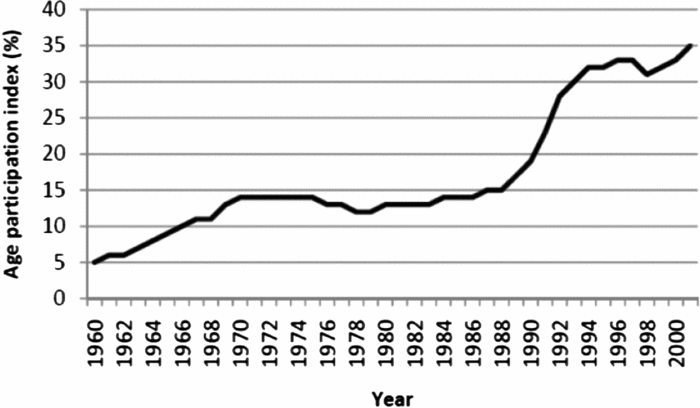
And then the Robbins escalator just stopped dead (Figure 1). Why exactly this happened has been one of the two great mysteries that I seek to plumb in this address. (The other is why it started back up again, equally suddenly, almost two decades later.) There is no shortage of explanations – each academic constituency has its own: the economists think the labour market was overstocked with graduates; the sociologists cite the unchanging social order; the political scientists blame ‘the cuts’; historians (on those few occasions when they deign to notice the deep freeze of higher education in the 1970s and 1980s) gesture vaguely at ‘the end of consensus’ or ‘declining confidence in public institutions’ or at best at a loose amalgam of all these explanations. I cannot pretend to improve greatly on the loose amalgam, but I can try at least to tighten it up chronologically and analytically, so that we can share to some extent in the series of confusions and discouragements that beset young people around school-leaving age in the 1970s and 1980s and that for such a long period put an effective damper on their ‘social demand’ for higher education.Footnote 31
HE participation, 1960–2001.
Source: Reproduced from Walker and Zhu, ‘Impact of University Degrees’, 14.

We should start with the economists, because they detect the change of weather earlier than anyone else – before any contemporaries were aware of it (and certainly before any policy shifts can be blamed) – and that change was a sudden slackening in the growth of the staying-on rate. After rapid growth in the 1960s, the growth rate at least among boys slowed to 1 per cent in 1969 and remained low for a decade.Footnote 32 Within a few years, this had knock-on effects on the qualified leaver rate – those leaving with two A-Levels – and on the all-important age participation rate, which peaked at 14.2 per cent in 1972 and did not reach that level again until 1986. The economists’ explanation is that what we now call the ‘graduate premium’ – the salary advantage for graduates – dropped suddenly, in part due to the over-exuberant growth of the late 1960s (leading to an over-supply of graduates), though mostly due to the resurgence of demand for manual labour.Footnote 33 In the period 1969–74, ‘the ratio of new-graduate earnings to juvenile earnings declined by over 30 per cent’.Footnote 34 Once they became aware of this flatlining in participation rates, contemporaries developed a variety of explanations for it that did not rely on young people's super-sensitivity to wage rates. Perhaps it was a temporary course-correction after a burst of Robbins euphoria in the late 1960s, following the pattern of epidemic disease. Class barriers to educational mobility in Britain may have been higher than elsewhere, putting a lid on the feasible rate of expansion. There may even have been a hardening of class barriers at just this sensitive juncture, as aspirational working-class boys found too many middle-class girls ahead of them in the educational queue, and they turned against education altogether, embracing instead a lubricious, masculinist working-class ‘counter-school culture’ of hard play and hard manual labour.Footnote 35
We must also consider the possibility of reinforcements to the ‘counter-school culture’ provided by the reorganisation of secondary education from the late 1960s, which might either have temporarily disrupted the progress of schooling and/or put a cap on attainment and ambition. There are two factors to consider: the raising of the school-leaving age to 16 in 1973, and the replacement of selection by comprehensive education in most local authorities over the course of the 1970s. Some contemporaries did think that raising the school-leaving age to 16, combined with the advent of a terminal school certificate (the CSE) which did not give access to higher education, may have encouraged school-leaving at 16.Footnote 36 But raising the school-leaving age to 16 also gave many more children access to O-Levels, the prerequisite for staying on to 18.Footnote 37 Much the same can be said of comprehensivisation. There may well have been temporary disruptions due to school reorganisation, and there is some evidence for the 1958 birth cohort (that is, 16-year-olds in 1974), that while lower-achieving children did better from reorganisation the highest-achieving did slightly worse. But once passed reorganisation again gave more rather than less access to O-Levels and A-Levels and thus potentially to higher education.Footnote 38
Each of these explanations – declining economic incentives, a temporary correction to over-rapid growth, the development of a ‘counter-school’ culture, the immediate effect of reorganisation – has its merits, and they do seem to capture something about the peculiar brash philistinism of the early 1970s.Footnote 39 But even together they do not begin to explain the breadth and depth of the turn against higher education, which affected girls as much as boys, and middle-class girls especially (the group that Robbins had correctly identified as the prime new audience for higher education), and which long outlasted the temporary decline in the graduate premium.Footnote 40 In addition to factors encouraging early school-leaving, we must consider factors discouraging entry to higher education: that is, choices made at 18 as well as at 16. And here we must, I think, take into account a factor that the economists cannot see because they cannot measure it, which is the changing image of higher education among the general public. Precisely from around 1969, the presentation of universities in the mass media shifted sharply from golden places of uplift, aspiration and modernity to very tarnished places of conflict, rebellion and, above all, difference – a space apart from society rather than integrated into it. There is some evidence that ‘student behaviour’ came under more intense scrutiny in Britain than in other countries where student protest was actually more widespread and disruptive.Footnote 41 If I am allowed a personal anecdote, I remember being very surprised and indeed shocked when, coming from California to study as an undergraduate in this country in 1975, I found that the genus ‘student’ was portrayed even in the mainstream media as a class apart: scruffy, lazy, pampered and troublesome – a devastating combination. Though I cannot demonstrate this statistically, it seems highly likely that this repelling force was just as important in deterring the marginal entrant (especially a middle-class girl) from contemplating staying on at 16 to qualify for higher education as was the fluctuating graduate premium. Even amongst those who did stay on, those who achieved university entrance qualifications were now less likely to apply for or take up a university place.Footnote 42 And this repelling force applied to the public-sector institutions as well as the universities – the cause célèbres of the 1970s centred not only on places like Essex University (which as late as 1985 the Sun still hoped might crumble and fall into the North Sea) but also places like North-East London Polytechnic, alleged to have witnessed the ‘rape of reason’ in the student ructions of summer 1975.Footnote 43 This changing image of higher education was also an international phenomenon, which may help to explain declining uptake of higher education even in places where the graduate premium was not in decline, but where there was as in Britain an apparent mismatch (as the OECD put it) between ‘the outlook and system of values in the teaching environment’ on the one hand, and career aspirations, a search for income and security, and ‘the pursuit of knowledge and the desire for self-fulfilment’ amongst young people on the other.Footnote 44
In sum, a series of hammer-blows hit the image of higher education across the 1970s: an Indian Summer of industrial employment (this part unique to Britain), a crisis of confidence in the graduate labour market, reorganisation of secondary education and, perhaps above all, a crisis of confidence in the ability of higher education to deliver aspirations for either social mobility or self-fulfilment. As a number of OECD reports in this decade concluded, higher education across the Western world seemed stranded between the decline of industrial employment and uncertainty about a post-industrial future, which left it unclear whether higher education could deliver on material or personal aspirations.Footnote 45 On the other hand, there was not the same stagnation in general educational attainment during this period. As mentioned, secondary school reorganisation did not affect overall attainment levels. While it might have (in combination with the other factors cited) reduced aspiration to higher education, it increased attainment at 16, so that the relative number of CSE and O-Level passes continued to rise.Footnote 46 In other words, school attainment continued to improve, and since prior attainment is normally the best predictor of progress to higher education, the longer-term prospects for getting the Robbins escalator moving again were good, so long as faith in higher education itself could be restored.Footnote 47
So far I have not mentioned ‘the cuts’. This is not because they are unimportant, but I have wanted first to put them in proper context. They did not start to figure until 1974. As late as 1972 Thatcher's White Paper was repeating the established mantra – the Robbins principle was sacrosanct, higher education was not only for jobs but also for ‘personal and social action’ – and uprating Robbins's prediction of a 17 per cent age-participation rate by the end of the decade to 22 per cent, predicting 5 per cent per annum growth in higher-education expenditure throughout the 1970s.Footnote 48 The financial crisis of 1974 then hit at the same time as the realisation that participation was in decline anyway.Footnote 49 This allowed the cash-strapped Labour government to slash the 1972 projections while defending the Robbins principle – cuts in supply were only responding to cuts in demand.Footnote 50 Thus, Labour accepted (though it did not necessarily trigger) stagnant participation rates throughout its 1974–9 term of government, upholding the Robbins principle at least in theory. There was one conspicuous exception to this rule. Even before Labour came to power in February 1974, the Conservative government was planning a huge cut in teacher training as a demographic downturn in the school-age population was imminent, seeking in its own way to turn declining demand to the service of public-expenditure cuts. Labour continued this policy, closing a third of all teacher-training colleges and merging most of the rest into the polytechnics.Footnote 51 Since teaching was still the ideal-type graduate profession for new entrants, these cuts made a further direct hit on participation rates, especially for women.Footnote 52 But otherwise, Labour relied successfully on naturally stagnant demand to keep a lid on public expenditure and to maintain the fig-leaf of the Robbins principle.
It is striking nonetheless how vigorously even an enfeebled Labour government clung to the Robbins principle. Both in public and in private ministers and civil servants insisted they were still catering to demand. The government was now negotiating annually with both universities and the public-sector institutions on the number of places needed. There was deep concern inside the Department of Education and Science (DES) that keeping too tight a lid on student numbers would be seen as rationing, and thus a violation of the Robbins principle. Worse, there was a keen awareness that the control of student numbers was itself sending market signals – that demand and supply were intertwined. Civil servants began to speak not only of the staying-on rate or the age-participation rate but also of the ‘opportunity/willingness’ rate – that is, the effect that constricted opportunity to enter higher education might have on young people's willingness even to attempt it. Since Robbins, it had been unthinkable to posit any limitations on supply. To avoid this imputation, Shirley Williams as education secretary insisted that short-term projections incorporated a tiny annual uptick of the participation rate, in the hopes that this would keep the Robbins escalator moving upwards (at a crawl), until a demographic downturn in the 1980s might again permit more rapid expansion without paying the price in public spending.Footnote 53 But this was desperate stuff. After a decade of stagnant participation rates and five years of severe public-expenditure pressures, few people in government – or in higher education – had any real hopes that the expansionary days of Robbins would return.
Any lingering hopes of this type were then firmly dashed by the advent of a Conservative government that was determined on deep cuts in public expenditure and was willing (if at first only sotto voce) to question the Robbins principle itself. Higher education became a deliberate target for deep cuts in the first Thatcher government. Thatcher herself had bad memories of her time as education secretary and she did not feel that investment in higher education was a good use of public money; nor, with some justice, did she feel that her core lower-middle-class constituency (still poorly represented in higher education) was particularly attached to it. There was also an ideological element in her circle that was divided or agnostic about what the right level of participation was, but was determined to apply more realistic market tests than the Robbins principle allowed, by shifting the cost burden towards the consumer and then seeing what happened to participation rates. This was the position of both Keith Joseph, her education secretary from 1980, who in his heart wanted lower participation rates, and also of his junior minister William Waldegrave, who wanted to boost the polytechnic sector and other low-cost forms of higher education that might attract greater participation and also prove good investments in human capital and economic growth.Footnote 54 The result was a two-pronged approach: an immediate cut in higher education (HE) provision, expected to induce a drop in the age-participation rate to 11 per cent, and market reforms (a new student loan scheme, offers of more places to polytechnics at cut-rate prices), expected to be neutral in their effects on demand. Although inside government the assumption was that ministers were quietly retracting from the Robbins principle, in public they still upheld it, relying in part (as had Labour) on declining demand and in part on cutting costs rather than places.Footnote 55
But something odd was happening in the depths of the recession of the early 1980s – demand was increasing. This forms part of the second great mystery I have sought to plumb – why after a long period of stagnation in demand did it begin to recover during an economic downturn, precisely the conditions that the economists had used to explain the fall-off in demand in the first place? What was different about the conditions and the decision-making processes of young people in the 1970s versus the 1980s?
A number of unexpected things were happening in the recession of the early 1980s. First, in conditions of high unemployment, staying-on rates rose sharply to 32 per cent by 1983. Contemporaries were unsure why – this could have been what was called ‘parking’, staying in further education until the labour market recovered. Nevertheless, unlike in the 1970s, it indicated that parents (also being exposed to high unemployment) were willing to invest in their children's acquisition of more education.Footnote 56 Then, those already staying on past 16 were showing more interest in higher education: qualified leavers’ participation grew from 83 to 88 per cent between 1979 and 1982. This might have been a form of parking, too, but it led to higher participation rates than the Conservative government had anticipated.Footnote 57 Most markedly, and encouraging to the more technocratic Tories like Waldegrave, these higher participation rates registered in the polytechnics, not the universities. New entrants after 1979 had little choice – the universities’ numbers were being cut, but the polytechnics’ were only cash-limited, so they could offer cut-rate places. What surprised everyone is that these new entrants, still mostly middle-class, seemed now willing to go to public-sector institutions when they might previously have held out for university.Footnote 58
In short, although these new levels of demand might at first have indicated only temporary ‘parking’, they were transmuting – certainly transmutable – into more sustained demand, if only supply constraints could be lifted. As we move through the 1980s, we can certainly detect changing public attitudes to higher education, running ahead of government. High levels of blue-collar unemployment and a new glamour attaching to white-collar jobs, especially in financial services, reversed the values of the early 1970s, and made higher education for social mobility look more attractive. Graduate employment opportunities were more varied and despite later waves of expansion the graduate premium began to rise jerkily from 1980, practically to the present day.Footnote 59 The association of higher education with a separate class of student began to wear off and the psychic conditions, at least, were in place for the Robbins escalator to begin rolling again.
Although ministers were aware of all these tendencies, it was far from clear that they wanted to go with them. This is the latter part of the mystery of the 1980s – why did the government change its mind about contraction of the higher-education system? Soberingly, even one of the top civil servants in the DES, looking back just a few years later at this about-turn which he had witnessed as closely as anyone, concluded that ‘I am not sure I can identify all the influences, let alone rate their relative importance. . .Regretfully, I must class the necessary analysis as “too difficult” and leave it to someone else.’Footnote 60 A challenge to the historian.
Although government was aware of growing demand, it did not show at first any immediate urgency to respond to it. Thatcher and Joseph had no attachment to the Robbins principle. Evidence of demand for low-cost higher education might have swayed some of the free-market ideologues away from contraction to expansion, but they had no influential champion in government. Joseph's 1985 Green Paper projected student numbers to 2000 assuming no increase at all in the participation rate, and still below 1972 levels. It explicitly applied a cost-benefit calculation to the Robbins principle, and for the first time in public admitted that it was revising it, adding ‘the application to admissions of the criterion of “ability to benefit” from higher education, having regard to the intellectual competence, motivation and maturity of the candidate’, undoubtedly a dig at the alleged immaturity displayed by so many students in the 1970s.Footnote 61 Tabloids still in full 1970s mode celebrated what the Daily Express called ‘a crackdown on left-wing student bully boys’; this was the occasion when the Sun expressed the view that Essex might safely crumble into the North Sea, though it regretted the resultant risk of coastal pollution.Footnote 62
However, by this point a fundamental change was already stirring in the heart of Conservative government, a few years behind public opinion. In part, this was due to the shift from austerity to growth, as unemployment rates began at last to come down, white-collar employment prospects improved and pressure on public expenditure eased. Even ministers who did not care about education might be willing to give it a piece of a slowly growing pie. But education benefited from an additional, demographic gift at just this time, as the ‘hump’ which had so bedevilled Labour at last fell away and the number of first 16-year-olds and then 18-year-olds began to drop from 1983. With this demographic slump, steadily rising participation rates need not require more public expenditure. However, just as important, I would argue, was Keith Joseph's failure to pass his key market reforms and Thatcher's turn to a very different alternative in the person of Kenneth Baker. Joseph's bid to replace student grants with loans met with unexpectedly ferocious hostility from the Tory backbenches, and this gave the prime minister pause – perhaps her constituents did care about higher education after all?Footnote 63 As the cohort that had benefited from the Robbins-era boom now had children of post-compulsory education age, and as parental attainment is a good predictor of children's attainment, the truth was that parents in the mid-1980s were more likely to favour higher education, even without the changes in the labour market and popular attitudes already mentioned.Footnote 64
Baker was a market reformer who believed in education, for personal and economic growth, and who was pragmatic about combining market reforms with a touch of technocracy if the combination would serve those ends.Footnote 65 Thatcher liked his ebullience and optimism, and she was probably a little shamed by his hints that she should have more confidence in the efficacy of her own government's efforts to raise standards in schools, which were always going to lift demand for higher education.Footnote 66 He was lucky, too, in inheriting one policy from his predecessors that could easily be turned to growth, the merging of the two school examination systems (CSE and GCE) into a single exam at 16, the GCSE. Although Joseph had meant the GCSE to reestablish a firm hierarchy of merit, criterion- rather than norm-referenced (that is, setting fixed standards of attainment), in fact, by vastly extending the number of 16-year-olds taking an exam that could facilitate staying on, the GCSE proved the sine qua non of rapid expansion in higher education.Footnote 67 Then all Baker had to do was to turn on the supply tap of places in higher education. First, he adopted as a policy what Joseph had stumbled on by accident, expansion via low-cost polytechnic places. On this basis, he was already prepared in his 1987 White Paper to predict not further stagnation but steady growth in the participation rate – past the 14.2 per cent peak of 1972 to 18.5 per cent by 2000. Then he offered the universities the same deal he was offering the polytechnics: more places if they would accept lower prices. Seeing their market advantage slipping, the vice-chancellors snapped at the chance. By January 1989, Baker was ready to announce, in a famous speech at Lancaster University (actually not as famous as it should be), not just steady growth but a sudden transition to mass higher education. The goal was to reach for American levels of participation, as befitted a country aspiring to American levels of affluence. His new target for 2000 was 30 per cent. From 1989, therefore, the course was set for the revolution in higher-education participation that we experienced in the 1990s and the noughties.Footnote 68
The after-effects of the Lancaster speech were much like the after-effects of Robbins, creating a kind of euphoria, compounded of pent-up demand, the entirely novel boost provided by GCSE, and the market signals sent by the unleashing of supply. The euphoria was in fact much greater amongst potential applicants than it was in the media, which on the whole remained sceptical about expansion on the grand scale, even in its leftish incarnations, because of the cuts in the unit of resource that made it possible. (If I may be allowed one more personal anecdote – I was hired by a polytechnic in 1991 to set up a new history degree in anticipation of rapid expansion in traditional ‘university’ subjects like history, and admitted dozens of students in the first few years who were frankly dazed to find themselves suddenly placed in higher education – though, and this is the point, also very keen to be there.) Baker fuelled this euphoria by sharply shifting government's own rhetoric away from utilitarian criteria. Thatcher and Joseph had been surprisingly attracted to ‘manpower planning’ of the 1960s variety, using higher education strictly to stoke economic growth. Baker instead spoke a new language of ‘widening participation’ – reaching out to under-represented groups, who deserved higher education for their own purposes – and in this he had some unlikely allies in high-tech industry, which disapproved of manpower planning. ‘We must change our higher education system from one geared to a small minority to a more open system which brings many more people to a generally higher level of education than they attain now’, insisted one key industry group in 1988, and the chairman of Shell chimed in, in quintessentially Robbins-esque terms,
The wonders of classics and the mysteries of physics are as good a preparation for management as the disciplines of economics or the increasingly popular business studies. The enhancement and enrichment of the mind confer a perspective on the individual which will be called on in their future direction of human affairs.Footnote 69
With these encouragements, the 30 per cent target was hit not in 2000 but as early as 1991 – in other words, the proportion of the cohort in higher education had more than doubled in a few years from its plateau level of 14 per cent held since the early 1970s. By then, the Treasury had begun to squeal loudly. The cuts in unit costs had been overwhelmed by the rise in numbers; over the whole period to 1997, unit costs fell 40 per cent but even so the higher-education budget increased in real terms by 45 per cent.Footnote 70 The Treasury sought – and thought it received – an agreement to hold participation rates at 30 per cent, but at this point New Labour began campaigning on education – ‘education, education, education’ was about HE as well as schools – and after 1997 the Treasury was bought off with the prospect of a growing student contribution, as recommended by the Dearing Review. Participation began to rise again, approaching 40 per cent by 2003. It was at this point that Labour set its notorious 50 per cent target, though at the same time changing the way it calculated participation rates, taking into account participation amongst older groups than 18- to 19-year-olds, which boosted the existing rate to 41 per cent. Though the 50 per cent target attracted much ridicule at the time, no party has been willing to move against it, and we have now nearly reached it. Only the huge tuition-fee hike of 2010 stands in the way. It was undoubtedly designed not to deter widening participation but early indications are that it may have done, at least temporarily freezing participation at 46 per cent.Footnote 71 It would take a bold historian to predict the course even of the immediate future – not me. Instead, let me move to some conclusions based on this last phase of rapid expansion we have experienced since the late 1980s.
While the name of Robbins has been on many lips recently in the 50th anniversary year of the famous report, there is a case to be made that the reforms of the late 1980s were vastly more important, not only for the rate and extent of expansion, but for my main focus in these lectures, the democratic discourse of education. The Robbins principle, as I suggested at the beginning, was an explicitly meritocratic principle with a democratic promise. That promise was only gradually redeemed over the first twenty-five years, as participation grew rapidly, then stagnated, before it reached much beyond the upper-middle parts of the social spectrum. Only after GCSE put staying on within the reach of a majority of the population could substantial numbers from other groups have a reasonable expectation of achieving higher education. In the first ten years of GCSE, staying on increased among the lowest income group from 21 per cent to 61 per cent.Footnote 72 Although this did not yet put higher education immediately within the reach of this group, it undoubtedly established a platform and encouraged a new set of expectations.Footnote 73 The economists speak of a ‘role-model effect’, in which the breakthrough of some members of unrepresented groups has knock-on effects for others, particularly among women.Footnote 74 Perhaps the most thought-provoking statistic I have come across in this research addresses aspiration of young mothers in the lowest income group for their children. Even at the height of the Robbins euphoria of the 1960s perhaps only a quarter of parents in the lowest income group expressed a desire for higher education for their primary-age children.Footnote 75 But in a survey of the millennium birth-cohort in 2008, no fewer than 96 per cent of mothers in the lowest-qualification group wanted their 8-year-olds to go to university.Footnote 76
Though only a portion of those children will realise their mothers’ aspirations, the aspirations themselves clearly indicate that higher education is today a nearly universal social norm in a way it had not been in the late 1960s. Student life is no longer seen as a peculiar sub-culture but rather as a widely shared life-cycle experience. As the economists would point out, there are practical as well as cultural reasons for this. The old school-to-job transitions, based on fathers’ contacts passed on to their sons, have been disrupted by deindustrialisation and the feminisation of the labour market. There is now a huge, relatively undifferentiated white-collar labour market to which higher education provides the best access. This has helped to restore the graduate premium as employers use HE qualifications as gatekeepers to a wider range of jobs.Footnote 77 At the same time, higher education is now also again a consumption good; as Dolton and Vignoles have put it, ‘people want to go to university because they enjoy the education process, irrespective of the financial return to a degree’.Footnote 78 It has become a normal part of the maturation process, bridging school and work. This is not to say that everyone can, should or will seek higher education. Even 50 per cent participation rates, which we have not yet reached, leave 50 per cent not participating. Indeed, a strong case is now made that the flight of so many people into higher education has left beached everyone else who mostly leave school at 16. In the OECD, Britain now has above-average rates of participation in higher education but also above-average rates of early school-leaving. This is why government has recently required that all young people must remain in education or job training to 18.
Nevertheless, it would be a mistake to underestimate the propulsive force of aspiration behind the Robbins escalator. It has been a central argument in my first two addresses that democratic aspirations to ever-higher levels of educational provision have been a driving force behind policy, even when they do not appear to be. There does not in fact need to be an organised education lobby to galvanise politicians, who are plenty aware of public opinion without it. In secondary education, councillors and MPs encountered the pressure of public opinion on every doorstep. In higher education, the establishment of a demand-led presumption by Robbins – itself a by-product of universal secondary education – set up a host of indicators (staying-on rates, qualified-leaver rates, age-participation rates and so on) as well as a climate of opinion which made it difficult for politicians, even when cash-strapped, and even when demand seemed to be flagging, to come out in public against limits. Thus, the touching insistence by Shirley Williams on a 0.1 per cent annual increase in participation even at a time when she was desperately reliant upon the stagnation of demand to keep public expenditure in check. The one government willing to retract from the Robbins principle – that is, Thatcher's of the early 1980s – found itself overtaken by a resurgence of demand and eventually became its willing servant.Footnote 79
The worst forebodings of the education lobby proved unfounded. Throughout the period of stagnation, educationalists had argued that the ‘natural’ level of demand was too low and would have to be stimulated artificially by providing more sub-degree courses or shorter degree courses – anything to make staying on a little more attractive. If only, they mourned, they had more political clout.Footnote 80 But in fact they had political clout in demand that they never fully appreciated. As soon as all children were given a chance to take a staying-on exam, the GCSE, demand for university-level higher education soared again. Since then, there has been no more talk of abandoning the Robbins principle. The opportunity to qualify for and enter higher education is now widely seen not as a meritocratic opportunity but as a democratic right. Higher education now, like secondary education since the 1950s, benefits from a strong universalist presumption that all young people deserve an equal – that is, the best – start in life. Where the money comes from to achieve this goal bedevils us all, but the goal itself seems more consensual than it has ever been.