INTRODUCTION
The carpet shell clam Venerupis decussata (Linnaeus, 1758), is a commercially valuable bivalve mollusc. It is widely distributed in the Mediterranean and its adjacent Atlantic waters from the North Sea to the coast of Senegal (Breber, Reference Breber1985). In Tunisia, V. decussata is widely distributed along the southern coasts. It represents an important economic endpoint being mostly exported to Europe, and is exclusively collected in the Gulf of Gabes. Natural populations of V. decussata can be found in sandy and muddy-sand sediments in bays, estuaries coastal lagoons and other sheltered environments, living on tidal flats and below tidal marks. The target species also has an important role in ecosystems. They are filter-feeders pumping water through their siphons at sediment level, and they can bury in the sediment to a depth of 10–12 cm (Vilela, Reference Vilela1950).
In Tunisia, extensive studies have been conducted on V. decussata occurrence (Medhioub, Reference Medhioub1983, Reference Medhioub1993; Trigui, Reference Trigui1995; Trigui-El Menif et al., Reference Trigui-El Menif, Le Pennec and Maamouri1995), ecotoxicological studies (Smaoui-Damak et al., Reference Sobral and Widdows2003; Gharbi et al., Reference Gharbi, Chatti, Said and Van Wormhoudt2010), reproductive biology (Zamouri-Langar, Reference Zamouri-Langar1991; Trigui-El Menif et al., Reference Trigui-El Menif, Le Pennec and Maamouri1995; Zamouri-Langar & Tritar, Reference Zamouri-Langar and Tritar1995; Hamida, Reference Hamida2004; Medhioub et al., Reference Medhioub, Lymayem, Fathallah, Abed and Medhioub2006) and ecotoxicology (Trigui-El Menif, Reference Trigui-El Menif, Le Pennec and Maamouri1995; Dellali et al., Reference Dellali, Gnassia-Barelli, Romeo and Aissa2001; Hamza-Chaffai et al., Reference Hamza-Chaffai, Pellerin and Amiard2003; Dellali et al., Reference Dellali, Romeo, Gnassia-Barelli and Aissa2004; Banni et al., Reference Banni, Bouraoui, Ghedira, Clearandeau, Jebali and Boussetta2009; Fathallah et al., Reference Fathallah, Medhioub, Medhioub and Kraiem2010). Nevertheless, available information on stock size assessment and spatial distribution of this target species is insufficient. What is known about this species is limited to the contributions of Haouas-Gharsallah et al. (Reference Haouas-Gharsallah, Zammouri, Jarboui, Mrabet and Missaoui2008) and Charef et al. (Reference Charef, Zamouri-Langar and Houas-Gharsallah2011) who conducted research in coastal areas of northern Tunisia. The literature review clearly indicates the lack of studies aimed at characterizing the target species stocks size and its spatial distribution in the Gulf of Gabes.
Venerupis decussata is one of the most important components of benthic fauna. Studies concerning its stock distribution and densities underpin basic knowledge in different fields of environmental research. These studies constitute the first step for any future work and can be useful as a reference for studies in marine invertebrates and cultivation. Accordingly, the aim of this study was to assess the current status of V. decussata along the Sfax coasts depending upon the species distribution, abundance and for the first time the sex ratio and size at first sexual maturity. The purpose was to give an outline of the status of this target clam along the coastal areas as a background of southern Tunisia waters poorly known from this point of view.
MATERIALS AND METHODS
Study area
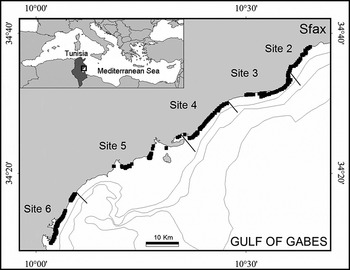
The study area, located in southern Tunisia and in the northern part of the Gulf of Gabes, extends along 235 km (Figure 1). Both wide and shallow continental shelves are topographically regular. The bottom slightly declines towards the sea and 60 m depth occurs at 110 km from the coast (Ben Othman, Reference Ben Othman1973). The main characteristic of substrates in the inshore area is muddy sand, being covered in same area by the seagrass Cymodocea nodosa (Ucria) Ascherson and Zostera noltii Hornemann.
Geographic position of sampling transects in the littoral zone of Sfax (Gulf of Gabes).

Sampling protocol and operations
In the present study, systematic surveys were carried out from May 2012 to August 2014 within the 100 km Sfax coastal part located in south Tunisia. Venerupis decussata was well known in five sites of production: Site 2 (Gargour), Site 3 (Nakta-El Gtifa), Site 4 (Sidi Hmed-Oued Maltine), Site 5 (Maouma-Zabboussa) and Site 6 (Skhira-Bousaid) (Figure 1). Transects were systematically performed along the Sfax coast during low tides. Clams were collected every 50 m along transect lines from extreme high water tide to the extreme low water tide. Along transects, 4–10 stations were sampled. In each one, two replicates were taken from quadrats (0.25 m2) using a shovel. Large specimens were collected by hand and small ones were taken using a 2 mm mesh size sieve. During each sampling period, seawater temperature and salinity were recorded at the same time as the clam collections.
The materials were put in labelled plastic bags, subsequently preserved in a 7% formaldehyde solution and then transported to the laboratory. In the laboratory, samples were sorted and washed to remove all adhering organisms and other debris. Specimens were identified, counted and measured for shell length (SL) with a digital caliper to the nearest 0.01 mm and weighed for total weight (TW) on a toploading digital balance (precision of 0.001 g). The obtained data set was registered and maps of population distribution were drawn.
After identification to species level, data were pooled within each station to obtain a mean density (inds m−2) and mean biomass (g m−2) per site, and subsequently pooled across stations to assess stocks. Obtained data were exploited also for the cartography based on the method of kriging using Arc View v. 3.2 software and to evaluate the population densities and biomass according to the following equation (Gulland, Reference Gulland1969): B i = N i × A i/a i × 1/X i, where Bi – represents the total biomass of cockles; Ni – the mean abundance in the sample; Ai – the whole study area; ai – the swept area and Xi – is the proportion retained.
For statistical analysis, data were tested for homogeneity of variance and normality using Leven's and Kolmorogov–Smirnov tests, respectively. The Kruskal–Wallis median test was used to compare densities and sizes in all depth ranges.The effect of site on SL and on abundance was investigated using one-way ANOVA. Similarities between sites in terms of abundances and biomasses were investigated using Cluster analysis (group average). In addition, the harmonic Spearman correlation coefficient was also applied to identify any significant correlation between density and biomass in each site. The results are presented as a mean ± 95% CI and the significance level used for the tests was P < 0.05. The relationship between SL and TW was described using the exponential regression (TW = aSL b).
For biological study, in order to study the first sexual maturity and sexuality of the clam V. decussata in the Gulf of Gabes, a monthly sampling was carried out during its first period of reproduction (from May to July 2009). A total of 862 clams with sizes ranging from 19 to 40 mm were collected and analysed. Initially, V. decussata specimens were measured for shell length (SL, mm) and weighed for total weight (TW, g). The sexuality of V. decussata was determined by examination of (1) macroscopic appearance of the gonad and (2) microscopic examination of gametes. The visceral mass was then teased apart and smears of the visceral wall with attached gonad were examined at 100× magnification and sex of specimens was determined.
For both sexes, the shell length at first maturity, defined as the length at which 50% of clams mature, was estimated by means of a logistic function fitted to the proportion of the mature specimens pooled in 1 mm shell length classes (L). The quasi-Newton algorithm for non-linear least square estimation of function parameters was applied to data according to the following equation: P = 1/(1 + e –a (L–L 50)), where P is– proportion of mature individuals; a is estimated parameter (slope of the curve); L is shell length corresponding to the proportion (P); L 50 is total length of 50% mature clams. The sex ratio (expressed as number of females per males; F:M) was determined. Statistically significant deviations from a balanced sexual proportion of 1:1 were assessed by the χ2 test, with statistical significance considered at P < 0.05 (Zar, Reference Zar1996). Statistical package used was STATISTICA v. 6.0.
RESULTS
Occurrence and abundance
Venerupis decussata was encountered throughout the areas surveyed and was found in various substrates. This includes muddy-sand substrate covered in some areas by the marine seagrass C. nodosa or Z. noltii or by mixed vegetation consisting of these two seagrasses. In some localities, samples of V. decussata were also encountered loose on the sandy bottom. Overall, a total of 143 transects were made from extreme high water tide to the extreme low water tide, corresponding to 966 samples in total (Table 1).
Surface of sites, number of transects and replicates, and stock assessment of Venerupis decussata in littoral zone of Sfax.

Changes in water temperature in the study area ranged from 12 to 13.9°C in winter and from 21.7 to 27°C in summer. Highest values were recorded in July (27°C), whereas the lowest values were recorded in February (12°C). Salinity measurements showed an annual fluctuation between 36 in winter and 48 in summer.
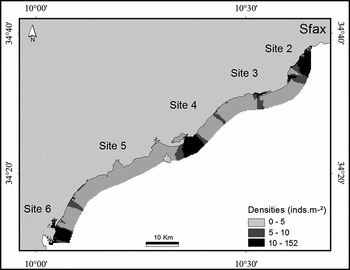
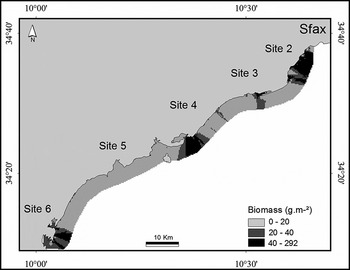
Data on clam densities were not normally distributed (Kolmorogov–Smirnov test, P < 0.05) and were not homogeneous (Leven's test, P < 0.05). Therefore, the Kruskal–Wallis median test was adapted to compare densities in all depth ranges because it is suitable when many cases in the data are at either extreme of the scale. The overall clam densities in the study areas were significantly different (χ2 = 14.08, P < 0.05). The results showed a scattered distribution pattern of the target species according to location ranging between 0 and 152 ind m−2 for densities and from 0 to 292 g m−2 for biomass (Figures 2 & 3). Pairwise comparisons of densities showed that overall data in the five sites were significantly different (P < 0.05).
Spatial distribution of Venerupis decussata densities in the littoral zone of Sfax (Gulf of Gabes).

Spatial distribution of Venerupis decussata biomass in the littoral zone of Sfax (Gulf of Gabes).

The total stock was estimated to be 891 tons (total fresh weight), with a mean biomass around 25.9 g m−2 and a total abundance reaching over 261.7 million individuals. The population was limited to mean densities of 7.6 ind m−2 (Table 1).
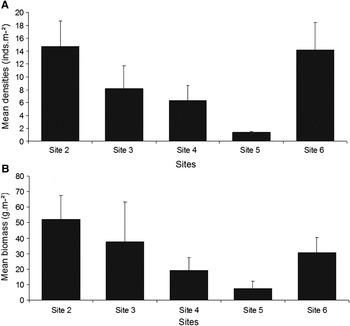
Overall, 1290 specimens were harvested from the six aforementioned sites (4182 hectares). Significant variations in abundance and biomass values were recorded among sites (Figure 4). In term of abundance, there is a significant difference between all prospecting sites (P < 0.05) except site 3 with respect to sites 4 and 6 and among site 2 with respect to site 6 (P > 0.05). As for abundance, mean biomass showed significant variations among sampling sites (P < 0.05) except ones among site 3 with respect to sites 4 and 6 (P > 0.05). A Spearman correlation coefficient was performed to compare between densities and biomass values in each site. Obtained values exceed 0.95 so there is a strong positive correlation between densities and biomass. Moreover, by means of cluster analysis of sites applied to sampling period two groups were defined; the first composed of site 2 whereas the second grouped the remaining sites.
Venerupis decussata densities (A) and biomass (B) levels, expressed as ind m−2 and g m−2, in the littoral zone of Sfax (Gulf of Gabes). Values are means ± CI.

Population structure
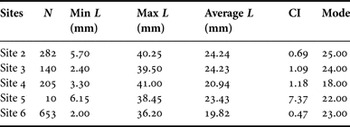
The size frequency distribution of V. decussata was determined in all sites (Table 2). The broad size range of specimens varied between 2 and 41 mm SL. The mean size of the length distribution was 21.47 ± 0.38 mm SL. The majority of species populations were attributed to size classes (15–31 mm) which represented 79.15% of total samples collected in the present study. Large-size individuals (>30 mm) represent only 6.2%. The populations of clams are not distributed in an even manner: larger individuals are distributed in a relatively heterogeneous way over the whole study area, however smaller specimens were more geographically restricted to the southern part (sites 4, 5 and 6).
Variability of minimum (Min), maximum (Max), average, Confidence Interval (CI) and mode values of shell length (L) of Venerupis decussata in littoral zone of Sfax (N, number of harvested specimens).

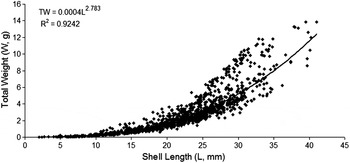
The mean sizes ranged from 19.82 ± 0.47 mm in site 6 to 24.24 ± 0.69 mm in site 2. The coefficient of variation of the size data in the current study area was relatively higher in sites 4 and 5. In addition, individuals’ sizes appeared greatly influenced by location. Significant variations were recorded among sites 2 and 3 when compared with sites 4 and 6 (P < 0.001) (Table 2). However, no significant differences were detected between sites 4, 5 and 6. On other hand, the shell length-weight relationship for overall data (1290 individuals) is shown in Figure 5. The calculated R 2 was positively correlated to total weight (0.924; P < 0.001). The slope b and condition factor were 2.783 and 0.0004 respectively. The relationship was: W = 0.0004L 2.783 (R 2 = 0.9242, N = 1290).
Relationship between shell length and total weight of Venerupis decussata in the littoral zone of Sfax (Gulf of Gabes).

Size at first maturity
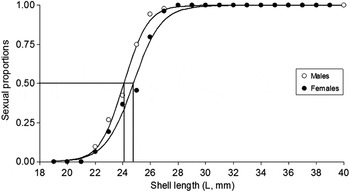
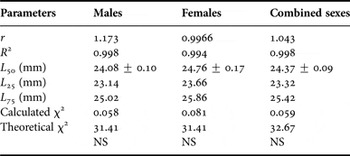
The changes in the proportion of the mature individuals showed that at a size (SL) < 22 mm, no individual was mature and that in a size (SL) > 27 mm, all observed individuals were mature. The results obtained by the application of the logistical function showed that size at first maturity (L 50) was 24.08 mm for males, 24.76 mm for females and 24.37 mm for the two sexes combined (Figure 6). The χ2-test did not show any significant difference between the theoretical proportions and the observed ones of mature individuals (Table 3).
Relationship between the proportion of mature individuals and total shell length (L) for Venerupis decussata males (○) and females (●) in the Gulf of Gabes.

Size at first maturity corresponding to 25, 50 and 75% mature Venerupis decussata (L 25, L 50 and L 75) in the Gulf of Gabes (NS = no significant, S = significant for P < 0.05).

Sexuality
From all samples examined during the study period, we counted 459 males (53.2%), 392 females (45.5%) and 11 indeterminate sex (1.3%). For both sexes, specimens presented a broad size range, both in term of shell length (19–39.8 mm) and total weight (1.26–11.65 g). The overall sex ratio (F:M = 1:1.17) was significantly divergent from parity (F:M = 1:1; χ2 test, P < 0.05).
DISCUSSION
The present paper describes for the first time the stocks assessment, spatial distribution and first maturity of the clam Venerupis decussata in the Gulf of Gabes, an important bivalve habitat. Findings of recent research indicate an extraordinary stock of this species. The consequence was a remarkable biomass which represented 891 tonnes of total fresh weight and high abundance levels reaching over 261 million individuals. This stock was smaller than that reported from the Gabes coastline area (2405 tonnes of fresh weight and high abundance levels reaching over 908 million individuals) and higher than that recorded from the Medenine littoral zone located in the southern Tunisian part (730 tonnes; unpublished data).
Mapping stocks revealed the fluctuation of V. decussata habitat in the prospected area. It seems that stocks varied substantially from one locality to another. Elsewhere, obtained densities was considered much higher than that recorded in the Arcachon Basin (128 g m−2; Bertignac et al., Reference Bertignac, Auby, Foucard, Martin, De Montaudouin and Sauriau2001) and that focused in later works in the same area (0.4 ind m−2; Caill-Milly et al., Reference Caill-Milly, Duclerq and Morandeau2006) but much smaller than that signalled for other populations for Mellah lagoon in Algeria (528 inds m−2; Draredja & Beldi, Reference Draredja and Beldi2004). The same authors indicated also that densities varied substantially according to strata.
It appears that clam populations has been influenced by strong impacts of various levels (e.g. physicochemical, edaphic and hydrological factors of the study area). Due to high water temperature levels (12–27°C) and shallow waters, the salinity remains fairly stable throughout the year. It was recorded with high concentrations in summer (48) and often in winter (36) (Derbali, Reference Derbali2011). The temperature and the food potentials are the most important factors affecting phenotypic differences in growth patterns and maximum sizes in a variety of marine organisms (Stergiou et al., Reference Smaoui-Damak, Hamza-Chaffai, Berthet and Amiard1997; Derbali et al., Reference Derbali, Jarboui and Ghorbel2011). Elevated water temperatures and phytoplankton levels may promote rapid growth rates in many local bivalve species. On the opposite side, high temperatures (above 27°C) can be stressful to V. decussata as shown by Sobral & Widdows (Reference Stergiou, Christou, Georgopoulos, Zenetos and Souvermezoglou2014) for clam populations in southern Portugal.
Other factors structuring the clam populations include soft bottoms and organic matter content. The high diversity of shellfish species is particularly interesting when the depth of the organic matter layer (<1 m) and the muddy-sand bottom are considered. In fact, these factors can provide ecological conditions that are able to maintain highly diverse reef communities in southern Tunisian waters. Indeed, the prospected areas maintain high diversity if compared with other areas in southern Tunisian waters where only a few species (Hexaplex trunculus (Linnaeus, 1758), Conus mediterranneus (Bruguière, 1792), Gibbula ardens (Von Salis, 1793), Cerithium vulgatum (Bruguière, 1792), Cerithium scabridum (Philippi, 1848) and Bittium reticulatum (Da Costa, 1778)) were found on rock and hard substrates. It seems that this low diversity is primarily attributed to bottom characteristics. This hypothesis can be supported by the relationship between the sedentary nature of some shellfish species such as V. decussata and substrates.
With respect to faunal diversity and substrate types, this species was harvested from areas sheltered by seagrasses C. nodosa and Z. noltii, covering more than 50% of the muddy-sand bottoms. It seems that the heterogeneity of geographic distribution of V. decussata was not significantly correlated to the distribution of the two seagrasses. Venerupis decussata prefers feeding on planktonic and benthic microalgae, especially diatoms. The same conclusion was pointed out by Vilela (Reference Vilela1950) from natural populations of clams in Portugal. Several studies have confirmed the correlation between patterns of community structure with the primary production. In particular, the local abundance and biomass of filter-feeders was correlated with both intertidal productivity and nearshore primary productivity (Menge & Olson, Reference Menge and Olson1990; Bustamante et al., Reference Bustamante, Branch, Eekhout, Robertson, Zoutendyk, Schleyer, Dye, Hanekom, Keats, Jurd and McQuaid1995).
These assumptions of spatial distribution patterns may explain the prevalence of the clam species in these particular grounds. In the same order, it shows the importance of environmental factors in controlling the density and then the biomass of shellfish aggregations. The broad size range of specimens varied between 2 and 41 mm SL. The mean size of the length distribution was 21.47 mm SL. The majority of specimens belonged to size classes (15–31 mm) which represented 79.15% of total samples collected in the study area. The size range of populations varied subsequently between localities. Variability in V. decussata size could be related to environmental factors that vary from one habitat to another. In fact, the growth, development and survival of bivalves are generally under the control of physical and chemical parameters, in particular temperature. This conclusion was the same as that given by Laing et al. (Reference Laing, Utting and Kilada1987) and Jara-Jara et al. (Reference Jara-Jara, Pazos, Abad, Garcia-Martin and Sànchez1997) in R. decussatus (recently V. decussata) from Conwy (UK) and Galicia (NW Spain), respectively.
On the other hand, our investigations showed that V. decussata populations exhibited characteristics that were similar to those described for other bivalve species. The condition factor estimated from length-weight relationship can provide an indication of the ‘well being’ of a given species, and it can be an indicator of the food abundance for the given species in a given area or time (Mzighani, Reference Mzighani2005).
Sexual maturity of bivalves is classified according to microscopic properties, such as the presence of gametes in gonads and the degree of their development, though sometimes it can be determined from macroscopic properties, i.e. from the appearance and colour of foot tissue (Lucas, Reference Lucas1965). Similar trends were found in other bivalve families, such as in Pectenidae, Mytilidae, Limidae and Cardiidae, both the sex and degree of gonad development can be determined from the colour of gonads (Lubet, Reference Lubet1959; Derbali et al., Reference Derbali, Jarboui and Ghorbel2009a, Reference Derbali, Jarboui, Ghorbel and Dhiebb, Reference Derbali, Elhasni, Jarboui and Ghorbel2012, Reference Derbali, Hadj Taieb, Kammoun, Jarboui and Ghorbel2014). Accordingly, investigations on the size at sexual maturity revealed that males and females matured at 24.08 and 24.76 mm respectively, and at 24.37 mm for combined sexes. In comparison, present outcomes were not in agreement with those of findings made in other geographic areas differing by their bottom characteristics, vegetation cover and physicochemical factors. Indeed, for French coasts, the first maturity recorded was at about 20 mm (Conti et al., Reference Conti, Muller and Lamare2014) which is slightly smaller than in our data.
Finally, the present paper revealed the localization of the main concentrations of the clam V. decussata with potential commercial value along the Sfax coastal areas. Furthermore, this contribution was the first attempt to estimate its stock. It gives more information about its stocks in the colonization area, but it was not possible to reveal the influence of physical processes (tide), intraspecific interactions and spatio-temporal change of the target species. Future studies could be done in two ways: firstly, stock assessments should be carried out each year in order to show the variations of V. decussata stocks and to check changes in population size structure. Secondly, the relationship between the spatial distribution of populations and hydrodynamic surveys, combined with topography could allow the assessment and quantification of the effect of transport processes in the regulation of the population.
ACKNOWLEDGEMENTS
This work was undertaken within the framework of research activities in the Laboratory of Fisheries Sciences of the National Institute of Marine Sciences and Technologies (INSTM). The authors thank all the people who contributed to V. decussata sampling. We are grateful to the reviewers for helpful comments on the manuscript.