INTRODUCTION
Myxosporean research in Australia has made a significant contribution to the discovery of bivalvulidan species, with a total of 72 new species descriptions, 26 new host records (Delvinquier, Reference Delvinquier1986; Hill et al. Reference Hill, Green and Lucke1997; Rothwell et al. Reference Rothwell, Virgona, Callinan, Nicholls and Langdon1997), and reports of a further 58 undescribed species (O'Donoghue and Adlard, Reference O'Donoghue and Adlard2000; Roubal, Reference Roubal1994a, Reference Roubalb). These records include 44 species of Ceratomyxa (Johnston and Bancroft, Reference Johnston and Bancroft1918; Moser et al. Reference Moser, Kent and Dennis1989; Su and White, Reference Su and White1994; Heiniger et al. Reference Heiniger, Gunter and Adlard2008; Gunter and Adlard, Reference Gunter and Adlard2008, Reference Gunter and Adlard2009; Gunter et al. Reference Gunter, Whipps and Adlard2009, Reference Gunter, Burger and Adlard2010), 10 Myxobolus species (Johnston and Bancroft, Reference Johnston and Bancroft1918; Langdon, Reference Langdon1990; Lom and Dykova, Reference Lom and Dykova1994; Su and White, Reference Su and White1994) and several species of Sphaeromyxa (Su and White, Reference Su and White1994; Lom, Reference Lom2004), Myxidium (see Johnston and Bancroft, Reference Johnston and Bancroft1918; Gunter and Adlard, Reference Gunter and Adlard2008), Zschokkella (Moser et al. Reference Moser, Kent and Dennis1989; Su and White, Reference Su and White1994, Reference Su and White1995), Ortholinea (Kent and Moser, Reference Kent and Moser1990; Lom et al. Reference Lom, Rohde and Dykova1992; Su and White, Reference Su and White1994), Triangula (Langdon, Reference Langdon1987), Coccomyxa (Lom et al. Reference Lom, Rohde and Dykova1992), Sinuolinea (Moser et al. Reference Moser, Kent and Dennis1989), Sphaerospora (Moser et al. Reference Moser, Kent and Dennis1989; Su and White, Reference Su and White1994), Chloromyxum (Woolcock, Reference Woolcock1936) and Henneguya (Hallet and Diamant, Reference Hallet and Diamant2001; Johnston and Bancroft, Reference Johnston and Bancroft1918). The rate of description of new species from Australian waters has not slowed in recent years. This study reports 2 new Coccomyxa and 3 new Auerbachia species representing the first descriptions from the latter genus in Australian waters.
Since the establishment of Coccomyxa Léger & Hesse Reference Lèger and Hesse1907 and Auerbachia Meglitsch Reference Meglitsch1968 few species have been recorded and described and thus little is known beyond descriptions derived from light microscope observations. To date, there are 7 species assigned to the genus Auerbachia, all united in having club-like spores with a broad anterior end, narrow caudal extension and a single elongated polar capsule opening at the anterior end of the spore (Lom and Dykova, Reference Lom and Dykova2006). Genus Coccomyxa has 9 species assigned, all with spores that are ellipsoidal with a single elongated polar capsule opening in the sutural plane (Lom and Dykova, Reference Lom and Dykova2006) with the exception of Coccomyxa leognathi which is club shaped (Wu, Reference Wu1991). Species of Auerbachia and Coccomyxa are mainly coelozoic in marine teleosts with the exception of 2 species reported as histozoic in their hosts, Auerbachia hepatica infecting the liver of Carangoides praeustus (Sarkar, Reference Sarkar2006) and Coccomyxa hoffmani infecting the gill cartilage of Plotosus anguillaris (Cheung and Nigrelli, Reference Cheung and Nigrelli1990). Pathological changes have been reported for only one species, Coccomyxa jirilomi, which caused cholestasis, periductular fibrosis and pericholangitis in Bathygobius cyclopterus (Diamant et al. Reference Diamant, Lipshitz and Ucko2007). Three species have been genetically characterized using SSU rDNA: Auerbachia pulchra in Coryphaenoides rupestris from the Atlantic Ocean (Fiala, Reference Fiala2006), C. jirilomi in Bathygobius cyclopterus from the Red Sea and Coccomyxa sp. IE200903 in Istiblennius edentulous also from the Red Sea (Diamant et al. Reference Diamant, Lipshitz and Ucko2007). Herein we propose 3 novel species of Auerbachia and 2 novel species of Coccomyxa. We further propose to re-establish the Coccomyxidae and to transfer all Coccomyxa spp. and the genera and species currently within the Auerbachiidae into the Coccomyxidae.
MATERIALS AND METHODS
Host and parasite collection
Teleost fish were collected by line and spear fishing from Heron Island (23°26′S, 151°54′E) at the southern end of the Great Barrier Reef (GBR) and Lizard Island at the northern end of the GBR (14°40′S, 145°27′E), Queensland, Australia and at Point Cloates on Ningaloo Reef (22°40′S, 113°41′E), off Western Australia. Fish were euthanized by neural pithing. The gall bladder was removed from the abdominal cavity and ruptured in an excavated glass block. A small drop of bile was placed on a glass microscope slide, covered with a glass cover-slip and examined with a light microscope at 400x magnification. Infected gall bladders were preserved in 100% ethanol for DNA analysis and frozen in saline for morphological characterization.
Morphological analysis of spores
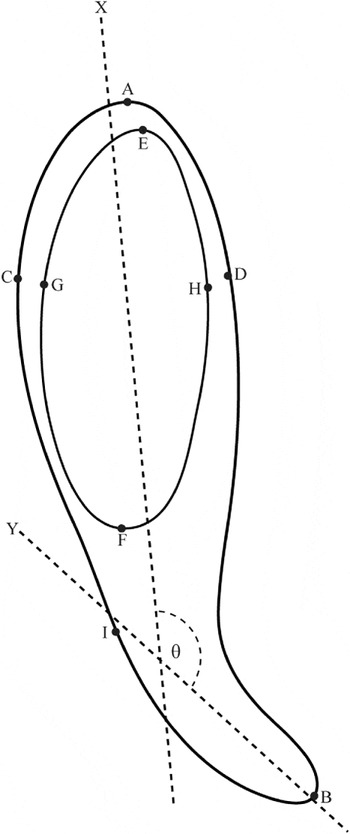
Measurements of spores followed those described for the type species of each genus (Lèger and Hesse, Reference Lèger and Hesse1907; Meglitsch, Reference Meglitsch1968) with the additional measurement of caudal extension angle for Auerbachia isolates (Fig. 1). The caudal extension angle was made from images where the spore presented a maximum caudal flexion. Two axes were then constructed, one bisecting the main body of the spore and another bisecting the posterior caudal extension, which when extended, meet at the position where the posterior angle is measured (see Fig. 1). Images of 30 spores were taken with an Olympus BH2 microscope at 400x or 1000x magnification using a Nikon Digital Sight DS-LI digital camera (Nikon Corporation, Japan). Measurements were taken from microphotographs using the measuring tool in the Nikon NIS Elements software (Nikon Corporation, Japan) calibrated against a stage micrometer. Mean measurements and their standard deviation were calculated for each spore dimension, allowing characterization of each isolate. All measurements are given in micrometers (μm).
Schematic diagram showing spore measurements for Auerbachia. A-B, Spore length; C-D, spore width; E-F, polar capsule length; G-H, polar capsule width; I-B, caudal extension length; X, axis bisecting the body of the spore; Y, axis bisecting the posterior caudal extension; θ, caudal extension angle.

Principal component analysis of the morphometric data was conducted using PAST v 1.97 (Hammer et al. Reference Hammer, Harper and Ryan2001) and 95% ellipses from individual scatter plots of components 1 and 2 were obtained of variant-covariant matrices from Auerbachia and Coccomyxa measurements. Discriminant analysis was also conducted on morphometric data of Auerbachia and Coccomyxa species in order to determine which morphological character contributed the most to observed variation between groups or species using Systat 11 software (Systat Software Inc. Chicago, IL, USA).
Small subunit rDNA analysis
DNA was extracted from 600 μl of infected bile preserved in ethanol. The sample was first pelleted at 15 700 g for 10 min and the ethanol supernatant removed. DNA was extracted from the pellet as per the recommended protocol accompanying the QIAgen DNeasy Kit (QIAGEN Inc., Valencia, CA, USA). Small subunit ribosomal DNA (SSU rDNA) was amplified by PCR using the primers MyxospecF 5′ TTC TGC CGT ATC AAC TWG TTG (Fiala, Reference Fiala2006) and 18R 5′ CTA CGG AAA CCT TGT TAC G (Whipps et al. Reference Whipps, Adlard, Bryant, Lester, Findlay and Kent2003). PCR reactions and purification were performed as described by Heiniger et al. (Reference Heiniger, Gunter and Adlard2008). Purified DNA was sent to the Australian Genome Research Facility, The University of Queensland, Australia, for sequence determination using the same primers as used for the initial amplification.
Phylogenetic analysis
The SSU rDNA regions from the taxa sequenced in this study were edited using BioEdit version 7.0.9 (Hall, Reference Hall1999). Selected SSU rDNA sequences were downloaded from GenBank and included all described Auerbachia and Coccomyxa sequences available together with all sequences from a recent myxosporean phylogeny (Diamant et al. Reference Diamant, Lipshitz and Ucko2007) and some Australian myxosporean species that were returned in BLAST results. All new sequences generated in this study were lodged in GenBank. An alignment of all the taxa included here was produced using Muscle version 3.7 (Edgar, Reference Edgar2004) using the Clustal W algorithm (Thompson et al. Reference Thompson, Higgins and Gibson1994) with UPGMB parameters for all iterations on the CIPRES portal (Miller et al. Reference Miller, Holder, Vos, Midford, Liebowitz and Chan2009). The resulting alignment was exported as fasta and nexus files, edited by eye and trimmed using MacClade version 4.08 (Maddison and Maddison, Reference Maddison and Maddison2005). This produced a 1935 base alignment that was used to conduct all phylogenetic analyses. A second alignment including the species described here and other species of Auerbachia and Coccomyxa was created in BioEdit version 7.0.9 (Hall, Reference Hall1999) using sequence alignment parameters as recommended by Hall (Reference Hall2001). The resulting 1252 base alignment was used to produce a distance matrix to view nucleotide base differences.
Neighbour-joining and parsimony analyses were conducted using PAUP* 4.0b 10 (Swofford, Reference Swofford2002) and Bayesian analysis using MrBayes version 3.1.2 (Ronquist & Huelsenbeck, Reference Ronquist and Huelsenbeck2003). Neighbour-joining and parsimony analyses were performed using default parameters to construct the trees. The strength of resultant relationships was tested by bootstrap analyses with 10 000 replicates. Parsimony analysis employed a heuristic search with 50 repetitions of random sequence addition and tree bisection and re-connection branch swapping. The software jModelTest version 0.1.1 (Posada, Reference Posada2008) was used to estimate the best substitution model for the SSU rDNA dataset. Bayesian analysis was conducted using the GTR+I+G model predicted as the best estimator by the Akaike Information Criterion (AIC) in jModelTest. Bayesian inference analysis was run over 10 000 000 generations (ngen=10 000 000) with 2 runs each containing 4 simultaneous Markov Chain Monte Carlo (MCMC) chains (nchains=4) and every 1000th tree saved (samplefreq=1000). Bayesian analyses used the following parameters: nst=6, rates=invgamma, ngammacat=4, the MCMC parameters were left at the default settings, and the priors parameters of the combined dataset were set to ratepr=fixed as per the model selected by jModelTest for AIC. Samples of substitution model parameters, and tree and branch lengths were summarized using the parameters ‘sump burnin=3000’ and ‘sumt burnin= 3000’. These ‘burnin’ parameters were chosen because the log likelihood scores ‘plateaued’ well before 3 000 000 replicates in the Bayesian inference analyses.
RESULTS
Since 2005, over 2200 individual teleosts and elasmobranchs from 70 families have been examined for the presence of myxosporean infections at 10 different localities off the Great Barrier Reef, southern coast of Queensland and Ningaloo Reef in Western Australia (Adlard, unpublished data). Fish sampling has been both opportunistic and targeted. However, despite this extensive survey only 7 isolates (6 possible host/parasite combinations) of Auerbachia (including the 3 species reported here) from 2 locations in Queensland and from 3 host families (Carangidae, Chaetodontidae and Polynemidae) and only the 2 species of Coccomyxa reported here, have been discovered.
Phylum Myxozoa
Order Myxosporea
Class Bivalvulida
Family Coccomyxidae Léger & Hesse,Reference Lèger and Hesse1907
Syn: Auerbachiidae Evdokimova, 1973
Genus Auerbachia Meglitsch, 1968
Auerbachia scomberoidi n. sp.
(Figs 2 and 3, Tables 1 and 3)
Description: Spores typical of Genus Auerbachia. Mature spores club-like with broad anterior section and narrow caudal extension, 21·4±1·91 (17·5–25·2) in total length and 7·5±0·76 (6·3–10) in width. Caudal extension 6·6±1·47 (4·4–9·6) in length and at an angle of 143·7°±14·86 (98–176) to the spore. Shell valves smooth and suture indistinct. Single elongate pyriform polar capsule situated at the anterior end of the spore, 10·6±0·69 (9·3–12) in length and 3·8±0·39 (3–4·5) in width. Polar filament with 2 longitudinal coils.
Material: Syntypes – air-dried slide stained with Giemsa, number G465434 and DNA voucher, number G465435 deposited in the collections of the Queensland Museum, Brisbane, Australia. GenBank Accession number HM037787.
Host: Scomberoides lysan (Forsskål, 1775) (Doublespotted Queenfish), Family Carangidae.
Prevalence: 1 of 2 (50%)
Locality: Lizard Island, Great Barrier Reef, Queensland (14°40′S, 145°27′E).
Site: Gall bladder
Etymology: Named after the host genus, Scomberoides, used as a substantive in the genitive case.
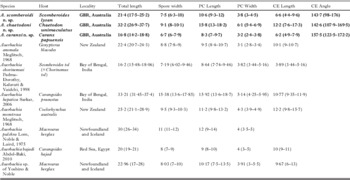
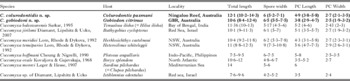
Taxonomic affinities: Auerbachia scomberoidi n. sp. is superficially similar in size to A. anomala, A. monstrosa and Auerbachia sp. of Yoshino and Noble (Reference Yoshino and Noble1973) (see Table 1). Auerbachia scomberoidi n. sp. can be distinguished from these 3 species by having a smaller caudal extension length and narrower spore width. Measurements of Auerbachia sp. were taken from ethanol preserved material and are therefore compromised for comparative purposes since preservation has been shown to cause spores to shrink (Parker and Warner, Reference Parker and Warner1970).
Mean spore dimensions including range in μm and caudal extension angle in degrees, for all available Auerbachia spp.

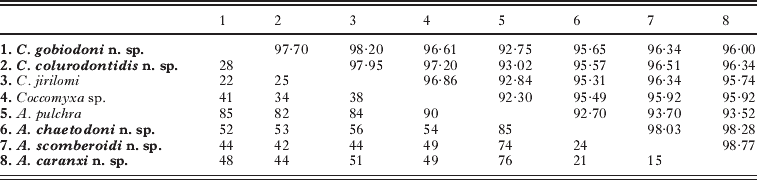
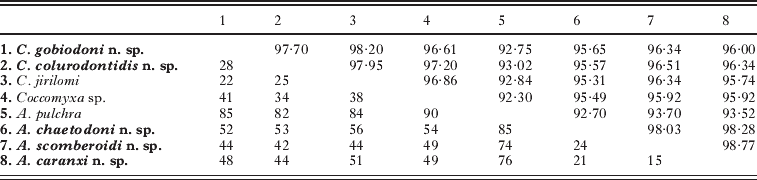
Remarks: A total of 1321 bases of SSU rDNA were generated from A. scomberoidi n. sp. (GenBank Accession number HM037787). The sequence differs from the aligned sequences of Auerbachia spp. and Coccomyxa spp. at 15–74 of 1252 nucleotides and has a maximum genetic similarity of 98·77% with A. caranxi n. sp. (Table 3).
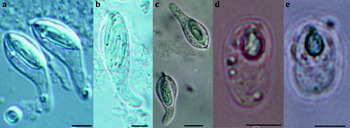
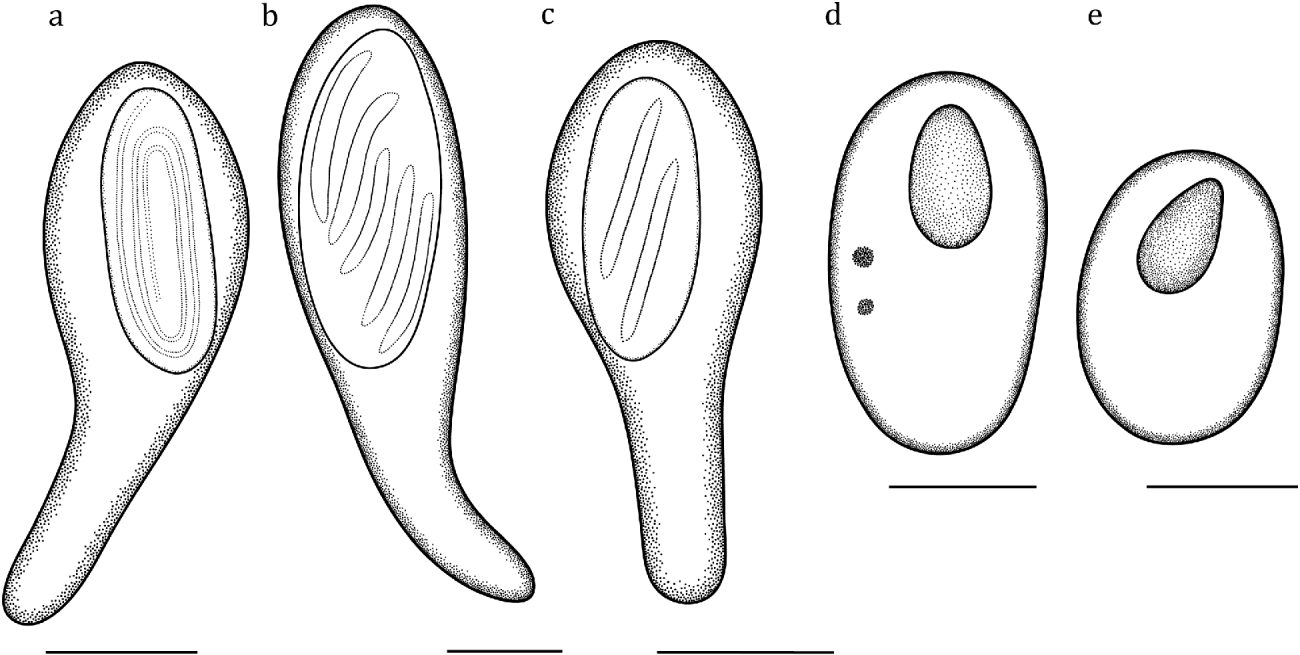
Photomicrographs of spores of new Auerbachia and Coccomyxa species. (a) A. scomberoidi n. sp.; (b) A. chaetodoni n. sp.; (c) A. caranxi n. sp.; (d) C. colurodontidis n. sp.; (e) C. gobiodoni n. sp. Scale bar=5 μm.

Auerbachia chaetodoni n. sp.
(Figs 2 and 3, Tables 1 and 3)
Description: Spores typical of Genus Auerbachia. Mature spores club-like with broad anterior section and narrow caudal extension, 32·2±2·36 (26·9–37·7) in total length and 9·1±0·57 (8–10·1) in width. Caudal extension is 12·2±2·16 (7·6–17·3) in length and at an angle of 142·6°±18·36 (107·9–169·5) to the spore. Shell valves smooth and suture indistinct. Single elongate pyriform polar capsule situated at the anterior end of the spore, 15·8±1·09 (13–18·2) in length and 6·1±0·44 (5·4–6·9) in width. Polar filament with 5 coils.
Material: Syntypes – air-dried slides stained with Giemsa, numbers G465436 and G465437. Voucher specimens, air-dried slide stained with Giemsa, number G465438 and DNA voucher, number G465439 deposited in the collections of the Queensland Museum, Brisbane, Australia. GenBank Accession number HM037788.
Host: Chaetodon unimaculatus, Bloch, 1787 (Teardrop Butterflyfish), Family Chaetodontidae.
Prevalence: 1 of 6 (16·67%)
Locality: Lizard Island, Great Barrier Reef, Queensland (14°40′S, 145°27′E).
Site: Gall bladder
Etymology: Named after the host genus, Chaetodon, used as a substantive in the genitive case.
Taxonomic affinities: Auerbachia chaetodoni n. sp. is superficially similar in size to A. hepatica and A. pulchra (see Table 1). Auerbachia chaetodoni n. sp. differs from these two species by having a narrower spore. Auerbachia hepatica has a larger polar capsule and a longer caudal extension and A. pulchra has a smaller polar capsule. Auerbachia hepatica also differs from all other described Auerbachia species in its host tissue location (histozoic in the liver). Furthermore, measurements of A. hepatica are unreliable for comparative purposes as they were derived from formalin-preserved material that has been shown to cause spores to shrink (Parker and Warner, Reference Parker and Warner1970).
Remarks: A total of 1305 bases of SSU rDNA were generated from A. chaetodoni n. sp. (GenBank Accession number HM037788). The sequence differs from the aligned sequences of Auerbachia spp. and Coccomyxa spp. at 21–85 of 1252 nucleotides and has a maximum genetic similarity of 98·28% with A. caranxi n. sp. (Table 3).
Auerbachia caranxi n. sp.
(Figs 2 and 3, Tables 1 and 3)
Description: Spores typical of Genus Auerbachia. Mature spores club-like with broad anterior section and narrow caudal extension, 16·8±1·01 (14·2–18·8) in total length and 6·7±0·4 (6–7·9) in width. Caudal extension is 6·2±0·84 (4·9–7·9) in length and at an angle of 157·5°±9·44 (123·5–172·2) to the spore. Shell valves smooth and suture indistinct. Single elongate pyriform polar capsule situated at the anterior end of the spore, 8·3±0·8 (7–9·7) in length and 3·2± 0·34 (2·4–3·8) in width. Polar filament with 4 coils.
Material: Syntypes – air-dried slides stained with Giemsa, numbers G465440 and G465441. Voucher specimens, air-dried slide stained with Giemsa, number G465442 and DNA voucher, number G465443 deposited in the collections of the Queensland Museum, Brisbane, Australia. GenBank Accession number HM037789.
Host: Caranx papuensis, Alleyne & MacLeay, 1877 (Brassy Trevally), Family Carangidae
Prevalence: 2 of 6 (33·33%)
Locality: Lizard Island, Great Barrier Reef, Queensland (14°40′S, 145°27′E).
Site: Gall bladder
Etymology: Named after the host genus, Caranx, used as a substantive in the genitive case.
Taxonomic affinities: Auerbachia caranxi n. sp. is superficially similar in size to Auerbachia chorinemusi (see Table 1). Auerbachia caranxi n. sp. has a slightly narrower spore, shorter polar capsule and longer caudal extension than A. chorinemusi.
Remarks: A total of 1312 bases of SSU rDNA was generated from A. caranxi n. sp. (GenBank Accession number HM037789). The sequence differs from the aligned sequences of Auerbachia spp. and Coccomyxa spp. at 15–76 of 1252 nucleotides and has a maximum genetic similarity of 98·77% with A. scomberoidi n. sp. (Table 3).
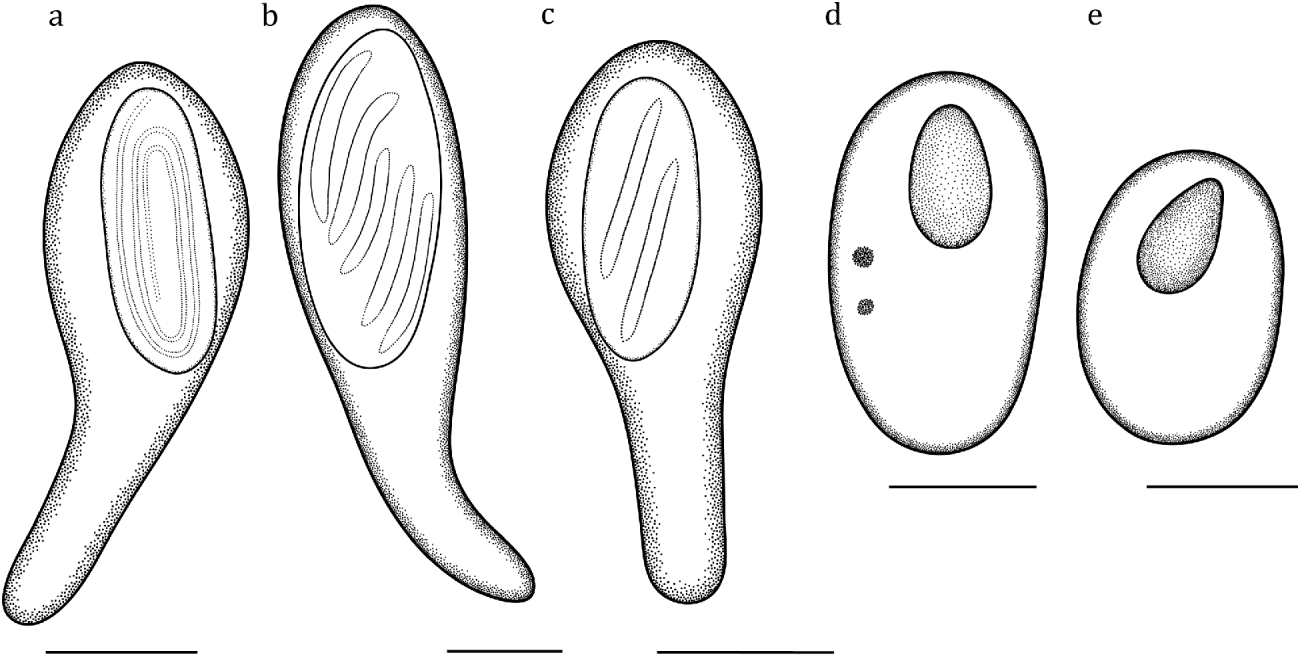
Diagrammatic illustrations of spores of the new Auerbachia spp. and Coccomyxa spp. (a) A. scomberoidi n. sp.; (b) A. chaetodoni n. sp.; (c) A. caranxi n. sp.; (d) C. colurodontidis n. sp.; (e) C. gobiodoni n. sp. Scale bar=5 μm.
Genus Coccomyxa Léger and Hesse,Reference Lèger and Hesse1907
Coccomyxa colurodontidis n. sp.
(Figs 2 and 3, Tables 2 and 3)
Description: Spores typical of the Genus Coccomyxa. Mature spores ellipsoidal, 12·1±0·9 (10·2–14·2) in length and 6±0·5 (5·2–7·1) in width. Shell valves smooth and suture indistinct. Single pyriform polar capsule situated at one pole of the spore, 4·9±0·5 (3·8–5·8) in length and 2·7±0·33 (2·1–3·5) in width. Polar filament indistinct.
Material: Syntypes – air-dried slide stained with Giemsa, number Z27552 deposited in the collections of the Western Australian Museum, Perth, Australia. Voucher specimens, air-dried slides stained with Giemsa, numbers G465444–G465445 and DNA Voucher, number G465446 in the collections of the Queensland Museum, Brisbane, Australia. GenBank Accession number HM037790.
Host: Colurodontis paxmani, Hutchins, 1977 (Paxman's Leatherjacket), Family Monacanthidae
Prevalence: 3 of 4 (75%)
Locality: Point Cloates, Ningaloo Reef, Western Australia (22°40′S, 113°41′E).
Site: Gall bladder
Etymology: Named after the host genus, Colurodontis, used as a substantive in the genitive case.
Taxonomic affinities: Coccomyxa colurodontidis n. sp. is superficially similar in size to C. baleswarensis, C. jirilomi, C. meridiei, C. tenuiparies, C. hoffmani, C. ovale and C. morovi (see Table 2). Coccomyxa colurodontidis n. sp. can be distinguished from C. baleswarensis by its larger spore and smaller polar capsule. Coccomyxa colurodontidis n. sp. has a longer spore than C. jirilomi and C. meridiei, C. tenuiparies has a wider spore and longer polar capsule. Coccomyxa hoffmani is distinguished from C. colurodontidis n. sp. by its site of infection (gill cartilage), shorter spore and longer polar capsule. Coccomyxa ovale also has a shorter spore than C. colurodontidis n. sp., while C. morovi has a longer polar capsule.
Mean spore dimensions including range in μm for species of Coccomyxa with superficial morphological similarity to Coccomyxa colurodontidis n. sp. and Coccomyxa gobiodoni n. sp.

Remarks: Two identical sequences were generated from individual hosts and aligned to create a total of 1350 bases of SSU rDNA from C. colurodontidis n. sp. (GenBank Accession number HM037790). This sequence differs from the aligned sequences of all other Coccomyxa spp. and Auerbachia spp. at 25–82 of 1252 nucleotides and has a maximum genetic similarity of 97·95% with C. jirilomi (Table 3).
Similarity in rDNA sequences of all Auerbachia and Coccomyxa species
Coccomyxa gobiodoni n. sp.
(Figs 2 and 3, Tables 2 and 3)
Description: Spores typical of the Genus Coccomyxa. Mature spores ellipsoidal, 10·6±1·03 (8·4–12·4) in length and 6·5±0·57 (5·5–7·5) in width. Shell valves smooth and suture indistinct. Single pyriform polar capsule situated at one pole of the spore, 3·8±0·41 (2·9–4·7) in length and 2·5±0·25 (1·9–3·2) in width. Polar filament indistinct.
Material: Syntypes – air-dried slides stained with Giemsa, number G465447 and DNA Voucher number G465448 deposited in the collections of the Queensland Museum, Brisbane, Australia. GenBank Accession number HM037791.
Host: Gobiodon citrinus, (Rüppell, 1838) (Poison Goby), Family Gobiidae
Prevalence: 1 of 3 (33·3%)
Locality: Heron Island, Great Barrier Reef, Queensland (23°26′S, 151°54′E).
Site: Gall bladder
Etymology: Named after the host genus, Gobiodon, used as a substantive in the genitive case.
Taxonomic affinities: Coccomyxa gobiodoni n. sp. is superficially similar in size to C. baleswarensis, C. jirilomi, C. meridiei, C. tenuiparies, C. hoffmani, C. ovale and C. morovi (see Table 2). Coccomyxa gobiodoni n. sp. can be distinguished from C. baleswarensis, C. jirilomi, C. meridiei, C. tenuiparies, C. hoffmani and C. morovi by its shorter polar capsule. Coccomyxa gobiodoni n. sp. can be further distinguished from C. baleswarensis and C. tenuiparies by its difference in spore width. Coccomyxa hoffmani has a shorter spore than C. gobiodoni n. sp., while C. morovi has a longer spore. Coccomyxa ovale is able to be distinguished from C. gobiodoni n. sp. by its narrower spore.
Remarks: A total of 1337 bases of SSU rDNA was generated from C. gobiodoni n. sp. (GenBank Accession number HM037791). The sequence differs from the aligned sequences of all other species of Coccomyxa spp. and Auerbachia spp. at 22–85 of 1252 nucleotides and has a maximum genetic similarity of 98·20% with C. jirilomi (Table 3).
General Remarks
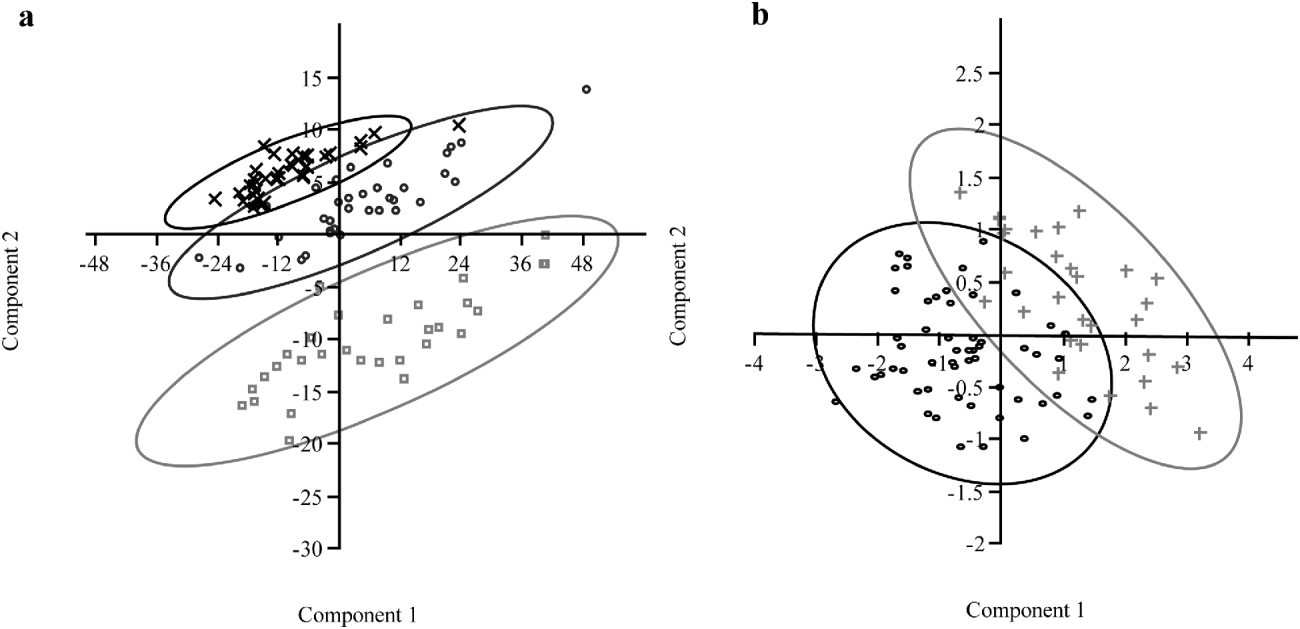
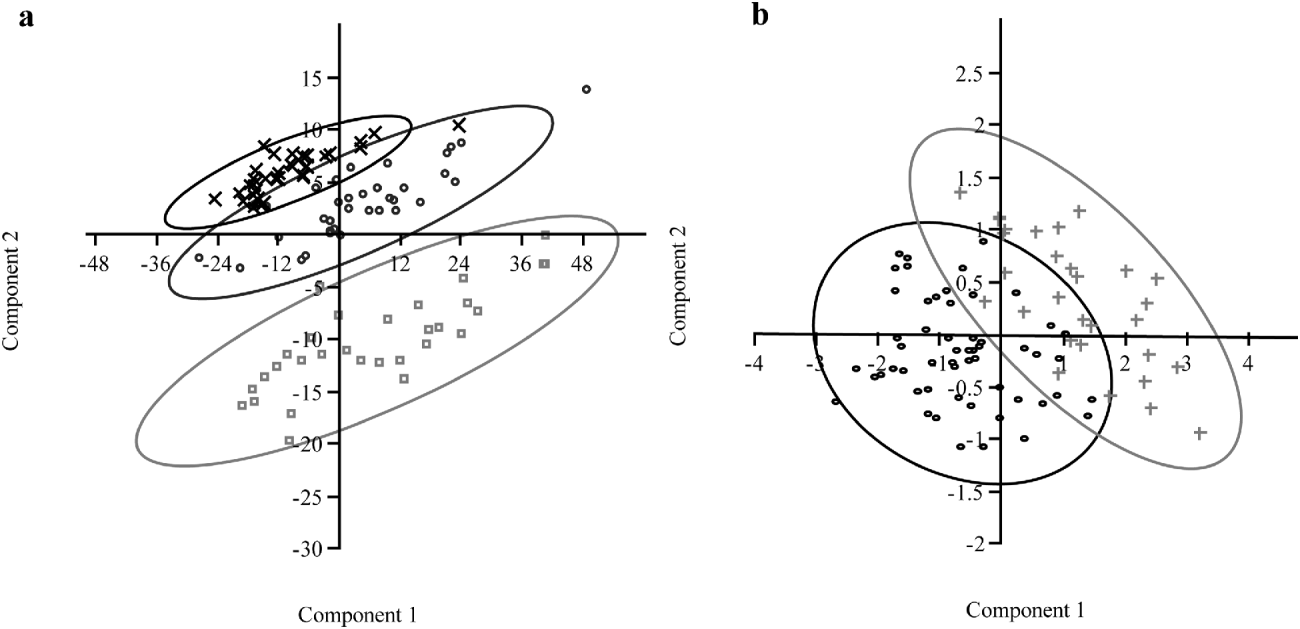
The 5 new species characterized in this paper are morphologically, genetically, and biologically distinct from all other Auerbachia and Coccomyxa species described to date. Principal component analysis supports the morphological separation of the species described here (Fig. 4). Discriminant analysis conducted on the morphometric data of the novel Coccomyxa spp. indicated that polar capsule length was the character that most contributed to the statistically significant variation observed between these taxa. Total spore length was the character that most contributed to the variation observed between the novel Auerbachia spp. To further support the separation of Coccomyxa spp. described in this study from those already characterized (shown in Table 2) principal component analysis was also conducted using the minima and maxima as well as average (mean) measurements. This limited analysis (not shown in figures) aided in establishing boundaries between species from confamilial hosts (i.e. C. gobiodoni n. sp. and C. jirilomi both from hosts within the family Gobiidae).
Principal component analysis (PCA) of morphometric data for (A) Auerbachia scomberoidi n. sp. (grey circles), A. chaetodoni n. sp. (dark grey crosses) and A. caranxi n. sp. (light grey squares); (B) Coccomyxa colurodontidis n. sp. (light grey crosses) and C. gobiodoni n. sp. (dark grey dots).
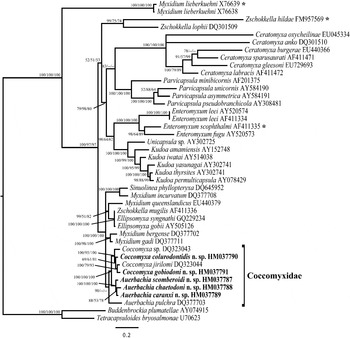
Molecular analysis included 39 myxosporean sequences, including 1 Auerbachia sequence and 2 Coccomyxa sequences available from GenBank together with the sequences generated in this study (shown in bold in Fig. 5). Neighbour-joining, Maximum Parsimony and Bayesian analysis (Fig. 5) all produced trees of similar topology characterized by the presence of 6 clades. These clades can broadly be described as a Ceratomyxa clade, Enteromyxum clade, Kudoa clade, Parvicapsula clade, Auerbachia and Coccomyxa clade and a mixed clade containing species of Myxidium, Zschokkella, Sinuolinea and Ellipsomyxa. All species described in this paper showed high levels of statistical support for close relatedness to other species within the genera Auerbachia and Coccomyxa.
Phylogenetic tree resulting from Bayesian analysis inferred from the SSUrDNA dataset. Support values at branching points are listed as: Posterior Probabilities (PP) from Bayesian analysis/Bootstrap values from parsimony analysis/Bootstrap values from Neighbour-joining analysis. Any values below 50% are indicated by dashes. GenBank Accession number follows each taxon. Species from this study are shown in bold. Type species for genera currently within the Myxidiidae are indicated with *.

Re-establishment of the family Coccomyxidae Léger & Hesse,Reference Lèger and Hesse1907
The genus Auerbachia was originally established by Meglitsch (Reference Meglitsch1968) who designated A. anomala as type species and described A. montrosa as a second novel species in the same publication. He did not assign it to any higher taxon at that time. After a short time dwelling in the, now defunct, Myxosomatidae (see Shul'man, Reference Shul'man1966), Evdokimova (Reference Evdokimova1973) proposed the new family Auerbachiidae to house her new species, Auerbachia sphaerica, and those of Meglitsch (Reference Meglitsch1968). Two years later, Lom et al. (Reference Lom, Noble and Laird1975) re-described Auerbachia sphaerica as Globospora sphaerica, establishing a new genus. Since then the Auerbachiidae has been recognized in major taxonomic publications (Lom and Noble, Reference Lom and Noble1984; Lom and Dykova, Reference Lom and Dykova2006) as a valid family in the Suborder Variisporina containing 2 genera, Auerbachia with type species A. anomala Meglitsch, Reference Meglitsch1968 and Globospora with type, and only, species G. sphaerica (Evdokimova, Reference Evdokimova1973).
At its proposal (Lèger and Hesse, Reference Lèger and Hesse1907), the genus Coccomyxa was placed in the family Coccomyxidae Léger & Hesse, Reference Lèger and Hesse1907 which was erected on the basis that their type species, Coccomyxa morovi, could not be accepted into the diagnosis of the Myxobolidae, which, at that time, was one of the few myxosporean families in existence. Later, Lom and Noble (Reference Lom and Noble1984) placed Coccomyxa into the Myxidiidae and amended the family diagnosis to accept a spore with a single polar capsule.
It is clear from our inferred phylogenetic relationship (Fig. 5) that, based on SSU rDNA sequence data, Coccomyxa spp. are more closely related to Auerbachia spp. than they are to other members of the Myxidiidae (i.e. Myxidium, Zschokkella and Enteromyxum spp.). These data are unambiguous in demonstrating the paraphyletic nature of the Myxidiidae. Furthermore, we feel it would be incongruous for us to propose new species that show convincing evidence, from both morphological and molecular studies, of their relatedness but then refer them to different families. Currently, the family Auerbachiidae Evdokimova, 1973 is considered valid (see Lom and Dykova, Reference Lom and Dykova2006) and includes species in the genera Auerbachia and Globospora.
Based on priority and on the new data provided in this study, we re-establish Coccomyxidae (Lèger & Hesse, Reference Lèger and Hesse1907) to house species of the Coccomyxa and additionally, we transfer all species of Auerbachia and Globospora into the Coccomyxidae. We provide a new familial diagnosis for the Coccomyxidae and a list of its genera and species below:
Class Myxosporea Bütschli, 1881
Order Bivalvulida Shulman, 1959
Suborder Variisporina Lom & Noble,Reference Lom and Noble1984
Family Coccomyxidae (Léger & Hesse,Reference Lèger and Hesse1907)
Diagnosis: Spores with symmetrical or asymmetrical equal or unequal smooth shell valves and a single elongated polar capsule with polar filament making a few longitudinal turns. Coelozoic or histozoic, mono- or polysporic plasmodia of marine fishes.
Coccomyxa Léger & Hesse, Reference Lèger and Hesse1907
C. morovi Léger & Hesse, Reference Lèger and Hesse1907 type species.
C. baleswarensis Sarkar, 1995
C. claviforme Cunha & Fonseca, 1919
C. jirilomi Diamant, Lipshitz & Ucko, 2007
C. leognathi Wu, Reference Wu1991
C. meridiei Lom, Rohde & Dykova, 1992
C. tenuiparies Lom, Rohde & Dykova, 1992
C. hoffmani Cheung & Nigrelli, Reference Cheung and Nigrelli1990
C. ovale Kovaljova & Gajevskaja, 1968
C. colurodontidis n. sp. (this study)
C. gobiodoni n. sp. (this study)
Auerbachia Meglitsch, 1968
A. anomala Meglitsch, Reference Meglitsch1968 type species
A. bajadi Abdel-Baki, 2010
A. chakravartyi Narasimhamurti, Kalavarti, Anuradha & Padma, 1990
A. chorinemusi Padma-Dorothy, Kalavati & Vaidchi, 1998
A. hepatica Sarkar, Reference Sarkar2006
A. monstrosa Meglitsch, Reference Meglitsch1968
A. pulchra Lom, Noble & Laird, 1975
A. scomberoidi n. sp. (this study)
A. chaetodoni n. sp. (this study)
A. caranxi n. sp (this study)
Globospora Lom, Noble & Laird, 1975
G. sphaerica (Evdokimova, Reference Evdokimova1973)
DISCUSSION
The 5 new species described in this paper are distinct from all previously described species of Auerbachia and Coccomyxa and provide the first record of Auerbachia and the second record of Coccomyxa found in Australian waters. Nonetheless, the diversity and prevalence of both Auerbachia and Coccomyxa in Australian marine hosts appears to be relatively low.
Before the incorporation of molecular systematics in myxozoan taxonomy, host specificity was difficult to determine. Recent studies on myxozoan host specificity have shown different patterns for different genera. The bivalvulidan genera Ceratomyxa and Myxobolus tend to be highly host-specific and generally restricted to a single host species, while Myxidium and Kudoa species may have a broad host range even infecting fishes from different orders (Gunter and Adlard, Reference Gunter and Adlard2008; Burger and Adlard, Reference Burger and Adlard2009; Gunter et al. Reference Gunter, Whipps and Adlard2009; Molnár et al. Reference Molnár, Székely, Hallett and Atkinson2009). As a result no broad trends for host specificity can be adopted within the Myxozoa, but rather, it is important to assess host specificity for each genus independently.
The two new Coccomyxa species reported here have each been found only in single host species, similar to all other described species of Coccomyxa. However, there are 2 families of teleosts with multiple species of Coccomyxa reported. Coccomyxa baleswarensis, C. meridiei and C. morovi have all been reported to infect 3 different genera of Clupeidae. Nonetheless, all 3 of these species are distinct through morphological comparison of mature spores and plasmodia, as well as geographical location (reported from India, Australia and the Mediterranean Sea, respectively). Coccomyxa jirilomi and C. gobiodoni n. sp. have been recorded from 2 genera of Gobiidae. Although these species are superficially similar in morphology they are both genetically (22 bp differences, 98·2% similarity) and geographically (reported from Israel and Australia, respectively) distinct.
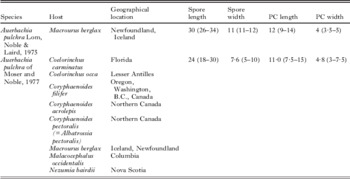
The 3 new species of Auerbachia reported here have, like most previously described species, each been found only in single host species. Two exceptions include A. pulchra (Moser and Noble, Reference Moser and Noble1977; Zubchenko, Reference Zubchenko1985; Khan et al. Reference Khan, Bowering, Burgeois, Lear and Pippy1986; Fiala, Reference Fiala2006) and A. monstrosa (see Moser and Noble, Reference Moser and Noble1977; Walter et al. Reference Walter, Palm, Piepiorka and Ruckert2002) that have been reported from several host species from several host families (Table 4). Equally, the occurrence of these two species within more than a single host species may be the result of insufficient morphological resolution to discriminate between the type species and closely related species. As such, they could represent the presence of a species complex rather than truly reflecting a broad host range.
Auerbachia monstrosa was originally described by Meglitsch (Reference Meglitsch1968) from Coelorinchus australis (Richardson, 1839) (reported as Coelorhynchus australis) from New Zealand waters. Moser and Noble (Reference Moser and Noble1977) detected the species in the type host and a second Coelorinchus species, C. innotabilis McCulloch, 1907 from the same region. The morphometrics from both hosts were combined (n=26 spores) and the means and ranges were superficially similar to Meglitsch's original description (Table 4). The ranges reported by Moser and Noble (Reference Moser and Noble1977) are larger, perhaps due to combining measurements from both hosts. Unfortunately, any data on slight morphometric differences occurring between isolates from these closely related hosts are not available. Walter et al. (Reference Walter, Palm, Piepiorka and Ruckert2002) also reported A. monstrosa in another macrourid fish, Macrourus whitsoni. No morphometrics were given and it appears that the diagnosis was based on host range. Walter et al. (Reference Walter, Palm, Piepiorka and Ruckert2002) stated “According to Moser and Noble (Reference Moser and Noble1977), Auerbachia spp. occur in several widely distributed fish species, such as Coelorhinchus caelorhincus (Risso, 1810) and Macrourus berglax Lacapède, 1810. The present finding of Auerbachia monstrosa in Macrourus whitsoni represents a new host record”. However, the hosts listed above represent hosts for A. pulchra not A. monstrosa. This example highlights the contentious nature of species diagnostics and its influence on our understanding of host specificity.
Spore measurements for host records of Auerbachia monstrosa

Spore measurements for all host records of Auerbachia pulchra

The reported host range of A. pulchra is just as contentious. This species was first described by Lom et al. (Reference Lom, Noble and Laird1975) in Macrourus berglax off Newfoundland and Iceland. Morphometric differences could differentiate this species from all other Auerbachia including A. monstrosa, which also infects fishes from the Macrouridae. The species boundary becomes harder to distinguish when the host range was extended to include a further 8 hosts all of which are macrourids (Moser and Noble, Reference Moser and Noble1977). Again the morphometrics of spores from these 8 hosts were combined for a total of 190 spores. However, the measurements given by Moser and Noble (Reference Moser and Noble1977) appear to be significantly different from the original report (Table 5). To add to the confusion, the morphometrics of A. monstrosa described by Moser and Noble (Reference Moser and Noble1977) overlap with these measurements. It appears that species diagnosis by Noble and Lom (Reference Lom, Noble and Laird1975) is based on locality and host range, with A. monstrosa being found only off New Zealand and restricted to fishes from the macrourid genus Coelorhinchus. Regardless, the species boundary between A. monstrosa and A. pulchra needs further investigation. Khan et al. (Reference Khan, Bowering, Burgeois, Lear and Pippy1986) carried out a comprehensive morphometric analysis using both fresh and preserved material of Auerbachia from Macrourus berglax caught in the eastern Weddel Sea. This isolate was diagnosed as A. pulchra because spore measurements were consistent with those previously recorded and the material was collected from the type host. Fiala (Reference Fiala2006) reported A. pulchra from a new host Coryphaenoides rupestris from the North Atlantic, no morphometrics are given for this species and it was possibly assigned to that species due to the reported broad host range which includes other fishes from the same genus. The isolate from Coryphaenoides rupestris has corresponding SSU rDNA sequence data and will be useful for investigating whether A. pulchra represents a species complex.
Two of the 3 Auerbachia species described here are from fishes from different genera of the family Carangidae both collected off Lizard Island, GBR. These 2 isolates are genetically distinct (15 bp differences, 98·8% similarity). While the level of genetic variation between species is not consistent across different taxonomic groups, intra-specific variation in other myxozoan genera has been reported at similar, relatively low levels (e.g. 1·3% for Ceratomyxa and 1% for Kudoa). On the basis of morphometric differences supported by principle component analysis together with the observed genetic differences, we are confident that these represent different species. Additionally, 3 other species of Auerbachia have been reported from carangids. Auerbachia hepatica was described from Carangoides praeustus in India (Sarkar, Reference Sarkar2006) and can be distinguished from both species on the basis of site of infection and on spore morphology. Auerbachia chorinemusi was described from Scomberoides tol (=Chorinemus tol) in India (Padma-Dorothy et al. Reference Padma-Dorothy, Kalavati and Vaidchi1998) but it can easily be distinguished from A. scomberoidi n. sp. on the basis of morphometric differences, as can A. bajadi from Carangoides bajad. Auerbachia chorinemusi and A. caranxi n. sp. are superficially similar except that the polar capsule of A. chorinemusi is wider and the caudal extension is shorter than that reported here for A. caranxi n. sp. Once SSU rDNA sequence data corresponding to A. chorinemusi are available we can be more certain of its identity. However, we feel it is more useful taxonomically to separate the species of Auerbachia that infect the gall bladders of carangid fishes on the basis of morphometric, geographical and host differences than to potentially create a species complex within A. chorinemusi.
Molecular information is becoming an invaluable tool for species discrimination, especially for bivalvulidan species of parasites which, like many other taxa, often have limited morphological characters that are taxonomically informative at the light microscope level and furthermore, many characters display plasticity (Sitja-Bobadilla and Alvarez-Pellitero, Reference Sitja-Bobadilla and Alvarez-Pellitero1993; Heiniger et al. Reference Heiniger, Gunter and Adlard2008). Molecular information was used in this study to separate the 3 superficially similar Auerbachia isolates and 2 Coccomyxa isolates to further support the proposal of these 5 new species.
The molecular analyses included 42 myxozoans (including 4 species of Auerbachia and 4 species of Coccomyxa) and were primarily aimed at species discrimination then secondarily at phylogenetic relatedness. The Auerbachia and Coccomyxa species formed a well-supported clade with Sinuolinea phyllopteryxa, Ellipsomyxa gobii, E. syngnathi, Zschokkella mugilis, Myxidium incurvatum, M. gadi, M. bergense, and M. queenslandicus. Of particular significance, the 3 Auerbachia species described here formed a well-supported clade with all species of Coccomyxa and did so to the exclusion of A. pulchra. This relationship is further supported by the pair-wise base differences between these species which showed A. pulchra was genetically the least similar, with 74–88 bases difference, to the 5 new species described herein, with species of Auerbachia being genetically more similar to Coccomyxa than to A. pulchra.
The genetic distance between Auerbachia pulchra and the remaining species of Auerbachia and Coccomyxa may correlate with host differences. Auerbachia pulchra is reported from the deep-sea fishes, Macrourus berglax and Coryphaenoides rupestris, while all other Auerbachia and Coccomyxa species analysed here are reported from coral reef-dwelling, shallow-water fish. Similarly, Ceratomyxa from deep sea fishes sequenced by Fiala (Reference Fiala2006) sit basally to the rest of the clade. Regardless of what drives these relationships, it is clear that our phylogenetic analyses support a close taxonomic relationship between Auerbachia and Coccomyxa, a relationship which is also reflected in the morphological similarities between these two genera. For example, Coccomyxa leiognatha, is morphologically very similar to Auerbachia with spores that are club-like in shape complete with a caudal extension (Wu, Reference Wu1991). Equally clearly, our phylogenetic analyses infer that Auerbachia may not be a monophyletic genus and the systematic placement of species in both Auerbachia and Coccomyxa may be contentious. However, bootstrap support is equivocal and until data are more comprehensive and the type species for both genera have been genetically characterized, we feel that any attempted revision would at this stage be premature.
Nonetheless, the obvious genetic and morphological affinity shown by species of Coccomyxa and Auerbachia has prompted us to re-establish the Coccomyxidae to house them and, by association, house the monotypic genus Globospora. Coccomyxa spp. have recently resided in the Myxidiidae which also includes species from the genera Myxidium, Enteromyxum and Zschokkella. Included in our analyses are the type species of these genera (M. lieberkueni, E. scophthalmi and Z. hildae) and their relative, and well-supported, positions in the phylogeny demonstrate unequivocally that the Myxidiidae is not a natural grouping. The Auerbachiidae was first proposed by Evdokimova Reference Evdokimova1973 but the Coccomyxidae Léger and Hesse, Reference Lèger and Hesse1907 clearly has priority as a familial concept.
We undertake this nomenclatural change as an attempt to stabilize the taxonomy of a small group of genera and species within the Bivalvulida and recognize that a considerable effort remains to clarify relationships within this myxozoan taxon.
ACKNOWLEDGMENTS
The authors would like to thank Dr Bruce Halliday for his advice and nomenclatural discussions, Dr Terrence Miller and Dr Kathryn Hall for technical advice. Dr Tom Cribb, Dr Mieke Burger and Ricky Gleeson who assisted in field collection, and the staff at Lizard Island and Heron Island Research Stations for logistical support in the field.
FINANCIAL SUPPORT
This study was funded by, and is a contribution from, the Australian node of the CReefs global research initiative, a project generously sponsored by BHP Billiton in partnership with The Great Barrier Reef Foundation, the Australian Institute of Marine Science, the Australian Biological Resources Study and the Alfred P. Sloan Foundation. CReefs is a field program of the Census of Marine Life.