INTRODUCTION
Agricultural development faces unprecedented challenges, in the form of changes in climate, market conditions and the demand for food. In the rain-fed agricultural systems of sub-Saharan Africa (SSA), climate variability threatens to exacerbate the damaging effects that recurrent droughts have historically had on agricultural harvests (Funk et al., Reference Funk, Dettinger, Michaelsen, Verdin, Brown, Barlow and Hoell2008). Climate change projections have highlighted SSA as the epicenter for increased incidence of drought (Li et al., Reference Li, Ye, Wang and Yan2009). Maize (Zea mays L.) is a crop at the center of efforts to assist farmers in adapting to climate variability and change (Kostandini et al., Reference Kostandini, Mills, Omamo and Wood2009). In addition to being a calorie source widely relied upon in SSA, and elsewhere, it is a crop that faces a convergence of escalating demand for animal feed, human consumption, and ethanol production, while being vulnerable to precipitation variation. To reduce household vulnerability to food insecurity in drought-prone areas, modern maize varieties have been bred for drought tolerance and early maturity. Drought-tolerant varieties are less sensitive to drought, providing an acceptable harvest under reduced rainfall, and under good rains they match or exceed the yields of popular commercial maize varieties. Early maturing varieties enable farmers to escape the effects of late-season moisture stress. By decreasing the vulnerability of farm households to drought-related harvest failure, these modern varieties also reduce the need to resort to harmful ex post coping strategies such as borrowing, reducing food consumption, distress sales of household assets, or taking children out of school.
Anecdotal evidence indicates considerable farmer demand for drought-tolerant and early-maturing varieties of maize, but there has been little empirical research to verify this. Adoption of modern crop varieties by smallholder farmers in SSA and Southeast Asia has an uneven record; incidents of widespread adoption (Evenson and Gollin, Reference Evenson and Gollin2003) are mixed with examples of low rates of adoption and lack of sustained use of seemingly advantageous farm technologies (Moser and Barrett, Reference Moser and Barrett2006; Suri, Reference Suri2011). Explanations for limited adoption of new agricultural technologies are that (a) farmers are not aware of existing technologies, or they are uncertain about their benefits and costs; (b) farmers face constraints in accessing the new technologies (e.g., imperfect markets for credit and agricultural inputs); (c) farmers are risk averse; (d) returns to agricultural technologies may be low for many farmers, even if they are high on average; and (e) the technologies do not meet farmer criteria for variety characteristics (Croppenstedt et al., Reference Croppenstedt, Demeke and Meschi2003; Doss, Reference Doss2006; Feder et al., Reference Feder, Just and Zilberman1985; Foster and Rosenzweig, Reference Foster and Rosenzweig2010; Lunduka et al., Reference Lunduka, Fisher and Snapp2012; Moser and Barrett, Reference Moser and Barrett2006; Suri, Reference Suri2011).
Of these explanations, the last one – that modern crop varieties do not meet farmer criteria for adoption – is the basis for interest in approaches, such as participatory plant breeding, that systematically involve farmers in assessing varieties, with the explicit goal of developing varieties that more closely match the myriad goals of smallholder farmers (Kitch et al., Reference Kitch, Boukar, Endondo and Murdock1998; Sperling and Scheidegger, Reference Sperling and Scheidegger1995). Crops that remain outside the commercial seed sector, such as subsistence cereals and legumes, have been successfully developed through this approach, and are said to be more suited to local requirements. Notable examples of participatory plant breeding efforts include new varieties developed for West African sorghum (Sorghum bicolor L.) and millet (Panicum miliaceum L.) farmers and Ethiopian bean (Phaseolus vulgaris L.) farmers (Asfaw et al., Reference Asfaw, Almekinders, Blair and Struik2012; Haussmann et al., Reference Haussmann, Rattunde, Weltzien-Rattunde, Traore, vom Brocke and Parzies2012). Maize variety development (mostly by the private sector), combined with public sector efforts, has led to the release of a tremendous range of modern varieties in SSA. It is not known to what extent local farmer requirements – beyond the key criterion of yield potential – have been addressed in the development of these varieties.
This study evaluates the prospects for widespread adoption of drought-tolerant and early-maturing varieties of maize in SSA. We use a unique dataset from Southern Malawi to examine how smallholder farmers’ perceptions of drought risk, and their desire to manage such risk, influence adoption and sustained cultivation of modern maize. The study also investigates the degree to which variety attributes beyond drought tolerance and early maturity (e.g., processing and storage characteristics) influence farmers’ decisions on the adoption and sustained use of modern maize varieties, to gain insights on the merits of participatory breeding efforts and local adaptation in the development of modern maize varieties.
Malawi is an ideal setting for studying smallholder farmer demand for modern maize varieties. Food security in the country is generally defined in terms of adequate production of and access to maize, the country's staple crop. Malawi has in recent years achieved dramatic maize productivity gains, fostered largely by the widely administered Farm Input Subsidy Program (FISP), in which the government has since 2006 provided over a million farmers with annual subsidized vouchers for modern maize seed and nitrogen fertilizer. Further, Malawi is representative of the mixed maize systems that dominate smallholder agriculture across Eastern and Southern Africa (http://www.fao.org/docrep/003/Y1860E/y1860e07.jpg). These maize-based production systems are rain-fed, and highly vulnerable to variable precipitation. Major drought incidences in Malawi occurred in 1992, 1994, 1995, 2002 and 2005, leading to chronic food shortages, greater poverty and deterioration in health conditions (Syroka and Nucifora, Reference Syroka and Nucifora2010).
The study first uses data from a household survey in Southern Malawi to document farmers’ perceptions of rainfall variability and change, and the ways farmers have tried to adapt to such changes. A regression model then investigates the factors associated with adoption of modern maize varieties (hybrid and open pollinated varieties [OPVs]), with particular focus on the influence of farmers’ perceptions of drought risk and their demand for variety traits that enable avoidance or escape from the effects of drought (i.e., drought tolerance and early maturity). Empirical work that includes variety characteristics has documented that production, consumption, processing, and risk management traits influence adoption (Adesina and Baidu-Forson, Reference Adesina and Baidu-Forson1995; Hintze et al., Reference Hintze, Renkow and Sain2003; Lunduka et al., Reference Lunduka, Fisher and Snapp2012). However, the role of farmers’ preferences for variety attributes has received relatively limited attention in adoption studies.
The current study also contributes to extant research by distinguishing in the empirical analysis among the factors that explain adoption in general, initial adoption, and sustained adoption of modern maize. The analysis, similar to Moser and Barrett (Reference Moser and Barrett2006), uses cross-sectional data with recall questions to provide insights on adoption dynamics. Although there is a vast literature on agricultural technology adoption, most studies are based on the classic comparison between adopters and nonadopters, mostly because of a paucity of panel datasets (Doss, Reference Doss2006). Recent longitudinal analyses have advanced our understanding of how farmers learn about new technologies, differences between early and late adopters and why farmers sustain or abandon their use of technologies (Barham et al., Reference Barham, Foltz, Jackson-Smith and Moon2004; Foster and Rosenzweig, Reference Foster and Rosenzweig1995). While a cross-sectional approach to studying adoption dynamics is inherently inferior to a longitudinal approach, it is a practical solution when time or money is limited, and is preferable to static analysis.
The remainder of the paper is organized as follows. The next section describes the study sites, the household survey and the study data. We then present the empirical model and establish the set of explanatory variables. The presentation of empirical results follows. The paper concludes with a discussion of the main findings, and implications for policy and future research.
MATERIALS AND METHODS
Field sites and study context
Data for the study come from a household survey completed in four rural villages in Mulanje District, Malawi, between May and July 2010. The sample villages were chosen in an earlier survey in 2008 to represent a range of household livelihoods and of access to markets. Mulanje District, where the study sites are located, is in Southern Malawi, about 90 km southeast of Blantyre. The four study villages are located on the northwestern side of the Mulanje Mountain Forest Reserve (MMFR). Average elevation is about 800 m above sea level, and there is a single rainy season (November–April) when agricultural production occurs. The Mulanje site represents a range of access to markets/services and household livelihoods. The village with best access to markets and services is located about 2 km from Chitakale, a main market town, and 4 km from the Mulanje boma (district administrative center). The most remote of the study villages is about 15 km from Chitakale. In Chitakale and Mulanje there are hospitals, a number of private health facilities, a supermarket, a thriving weekly and daily market, a post office, several schools and several government offices.
The household survey
In 2008, a simple random sample of 50 households in each of the four study villages was selected for interviews, providing an overall sample size of 200 households. In 2010, the research team returned to re-interview the original 200 households, asking a few of the same but mostly different questions than were asked in the earlier survey. As a result of attrition, the sample size was reduced to 179 for the 2010 interviews.
The 2010 household survey used structured interviews with household members to collect information on demographics, wealth holdings, agricultural production, access to agricultural information, perceptions of maize variety attributes, perceptions of climate variability and change, and adaptation strategies. The collection of high-quality data was assured by close supervision of enumerators by the lead author; interviews with both the household head and wife present and groups of household residents, where possible, to obtain complete information; and separate interviews with wives and husbands, when this was judged to be conducive to disclosure of sensitive data or when we were interested in learning their unique perceptions.
Annual household income in the four study villages was about US$850 in 2008. The bulk of income was derived from agriculture and livestock activities (38%), followed by forest activities (30%) and wage work (16%). Income from business activities and from transfers (e.g., pensions and remittances) each made up 7% of total household income for the year. The 2010 survey measured farm sizes with GPS devices and found landholdings in the study area to be small, averaging 1.10 acres per household. The main crops grown in 2010 were maize, pigeonpea, sorghum, cassava, sweet potato and pumpkin. Livestock ownership was minimal, with percentages of sample households owning cattle, goats, pigs and chickens recorded at 1%, 31%, 6% and 80%, respectively.
Soil sampling
Ten soil samples were collected from randomly selected locations across a field site, to a 0–20 cm depth, using a straight edge probe. Samples were composited per field, mixed until homogeneous, air dried and sieved to 2 mm. Particle size analysis to determine texture was conducted following gravimetric sedimentation, after removal of the organic fraction with H202 (30%), after Gee and Bauder (Reference Gee, Bauder and Klute1986).
Definition of modern maize used in the study
Modern maize is here defined as hybrid, recycled hybrid, or OPVs, and is contrasted with local maize varieties. While modern maize varieties are the result of crop science breeding, local varieties are the product of centuries of selection by farmers and the natural environment. To determine the type of maize grown by farm households, we used survey information provided by the household head regarding the name of the maize variety, the maize type (local, hybrid, recycled hybrid, OPV), and the reported source of seed. A total of 12 different maize varieties (8 modern and 4 local) were mentioned by farmers. For most households, the maize variety name was in agreement with the type of maize, but where there was a discrepancy we looked to the source of maize for clarification. At the study sites, maize seed was obtained from farmers’ own fields (25%); neighbours, relatives, or friends (15%); local markets (10%); private traders (3%); shops in Chitakale town (30%); and the Agricultural Development and Marketing Corporation, ADMARC, a government parastatal (17%). ADMARC and the Chitakale shops only sell modern varieties; thus if one of these sources was reported, the maize type was considered to be modern. Using the procedures outlined above, we determined that modern maize and local maize were planted in 57% and 43%, respectively, of the 280 fields cultivated by the sample households.
Modelling approach and research hypotheses
To examine the degree to which smallholder farmers in Malawi grow modern maize as a means to manage drought risk, a regression model is developed and estimated using data from the 2010 household survey described earlier. The dependent variable A in the regression model developed below is categorical, with one category for nonadoption (87 households had never grown modern maize varieties) and three categories for the duration of growing a modern maize variety among adopters: this year only (n = 46), 2 to 5 years (n = 84), and 6 years or more (n = 30). (We exclude from the analysis 33 households that were not currently growing modern maize but had grown modern maize in the past.) The household survey asked respondents to list the maize varieties currently grown and the number of years each of these currently grown varieties had been cultivated. Enumerators asked and recorded responses on the duration of maize variety cultivation in terms of categories, because respondents often had difficulty recalling duration for longer time periods, for example 8 vs. 9 years or 10 vs. 13 years. An ordered logit model is the appropriate empirical model, given that the dependent variable has a clear ordering to the categories from low to high, but the spacing between categories is not uniform (Long and Freese, Reference Long and Freese2001). If the dependent variable categories did not have a clear ordering from low to high, a multinomial logit or conditional logit model would be appropriate (Cameron and Trivedi, Reference Cameron and Trivedi2009).
The empirical model takes the form
 \begin{equation}
A = \alpha _0 + \alpha _1 D + \sum\limits_j {\beta _j RT_j } + \sum\limits_k {\lambda _k C_k } + \varepsilon\end{equation}
The primary explanatory variables in the ordered logit regression model are a variable for the number of droughts D the farmer reported having occurred in the past decade (taken as a measure of the farmer's subjective perception of drought risk), and a set of dummy variables measuring maize variety traits related to risk management RT: early maturity and drought tolerance. For the maize variety risk traits RT, each dummy variable had a value of 1 if the respondent stated that the given characteristic was a main positive attribute influencing choice of that variety, and 0 otherwise.
We expect that a farmer's subjective perception of drought risk D is positively associated with adoption of technologies that reduce drought risk, but whether modern maize varieties are risk reducing or perceived as such is an empirical question. Most of the modern maize varieties grown at the study sites were bred with early maturity traits for escaping drought, but they were not bred for drought tolerance. Inclusion of maize variety risk traits RT allows investigation of whether demand for risk management traits influences the choice to grow modern or local maize varieties. We hypothesize that farmers who value early maturity are more likely to grow modern maize. How demand for drought tolerance influences adoption probability is indeterminate ex ante, as it is not known how modern and local maize varieties compare in terms of this trait.
Variety choice is influenced by many factors beyond risk management objectives, and these are controlled for in the regression model. Vector C includes production and postproduction variety attributes, access to agricultural information, age and education of the household head, household labour availability, soil conditions, farm size, capital constraints and market access.
To assess the characteristics that are most influential to farmers’ varietal choice decisions, the model includes dummy variables for production and postproduction traits, alongside the risk management trait variables mentioned above. Yield potential has been the traditional orientation of crop breeders, and empirical evidence indicates it is a primary driver of farmers’ variety choice decisions (Adesina and Baidu-Forson, Reference Adesina and Baidu-Forson1995; Hintze et al., Reference Hintze, Renkow and Sain2003). We thereby include a variable for yield, specifically a farmer's subjective assessment of the maize variety's yield performance. Research also indicates that postproduction characteristics like storability, poundability, flour-to-grain ratio, and taste are important (Adesina and Baidu-Forson, Reference Adesina and Baidu-Forson1995; Lunduka et al., Reference Lunduka, Fisher and Snapp2012), and these are incorporated into the model.
Learning about crop varieties, and agricultural technologies in general, takes a variety of forms. A farmer may learn by experimenting with the technology in her garden, through the advice or technical information provided by agricultural extension, and by observing the experiences of other farmers experimenting with the technology (Foster and Rosenzweig, Reference Foster and Rosenzweig2010). We include variables for two sources of information about modern maize varieties: agricultural extension officers and other farmers. Parameter estimates for variety traits variables provide indirect evidence on learning by doing, as is discussed at the end of section 4.
The household head's age and education are common predictor variables in adoption studies. Householder age should have a negative association with technology adoption if older farmers are more resistant to change and younger farmers are more accepting of risk. As for education, empirical evidence suggests that educated individuals are more likely to adopt new technologies. Analysts posit that the education-adoption link reflects that educated individuals have better access to information about new technologies and are better able to quickly and effectively process such information (Foster and Rosenzweig, Reference Foster and Rosenzweig2010).
The model controls for household labour availability, which is posited to be positively associated with the growing of modern maize varieties. Cultivation of modern maize increases farm labour demand during the peak agricultural season, since modern maize is typically associated with a more intensive plant arrangement and fertilizer application, whereas local maize is commonly grown without fertilizer application in Malawi. As a result, adoption may be difficult for those with limited household labour, given that Malawi's labour markets fail or function poorly. We also include a variable for soil clay (%), which closely relates to organic matter and is thereby an indicator of soil quality. The soil clay variable was calculated from soil samples taken from one field of each sample household.
A GPS-based measure of the household's landholding is included to account for possible scale effects on maize variety choice. Large and small farmers exert the same amount of effort to acquire and process information about a new technology, learn how to use it and make the purchase. Thus, if there is a fixed return per acre, the effort may not be worth it for a small farmer. Furthermore, adoption of new technologies involves the risk of the unknown, and small farmers may be less able to undertake production risks. Farmers with small landholdings are less likely to be food secure, and adoption presents a higher proportional change in their farming operation. Farm size may also indicate access to cash and credit, the lack of which constrains farmers from using purchased inputs such as modern maize seed and fertilizer (Croppenstedt et al., Reference Croppenstedt, Demeke and Meschi2003). Farm size is a key indicator of the capacity to earn agricultural income and is thus a useful proxy for access to cash. Credit transactions often require that borrowers present some form of collateral, and land is commonly used for this purpose. As another indicator of modern seed access, the model includes a binary variable for receipt of a maize seed voucher in recent years under the Malawi FISP.
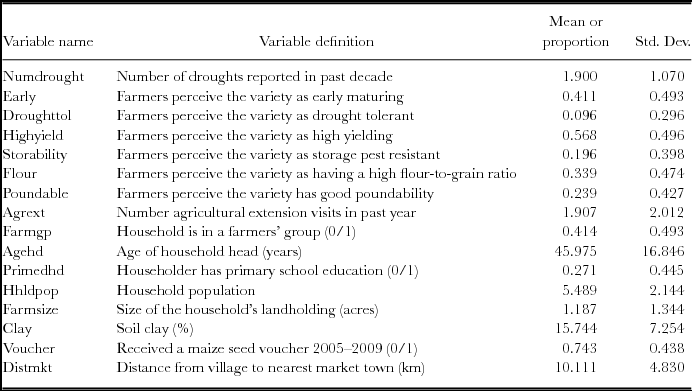
Market access is here proxied by the distance to the nearest market town. We expect access to markets for purchasing inputs and selling outputs has a positive influence on the growing of modern maize varieties, because compared to local maize, modern maize is cultivated with greater levels of chemical fertilizer and is more likely to be sold. Table 1 provides descriptive statistics for all explanatory variables.
Descriptive statistics of the explanatory variables included in the regression analysis, sample households’ plots 2010.

Before turning to the study's empirical results, it is important to point out a limitation of the regression analysis, one that is common to studies employing cross-sectional, observational data. We have aimed to include in the empirical model the key factors that influence adoption of modern maize, however the modelling exercise is restricted to variables available in the survey dataset. The current dataset does not include information on some variables that have been found to influence technology adoption, such as access to credit, tenure security and rainfall parameters. The analysis is also unable to control for unmeasured farmer heterogeneity, for example motivation, farm management ability, etc. As a result, the regression coefficient estimates may be biased where there is correlation between included and omitted modern maize adoption determinants. This study limitation should be kept in mind when interpreting empirical findings in the next section of the paper.
RESULTS
Farmer perceptions of modern and local varieties of maize
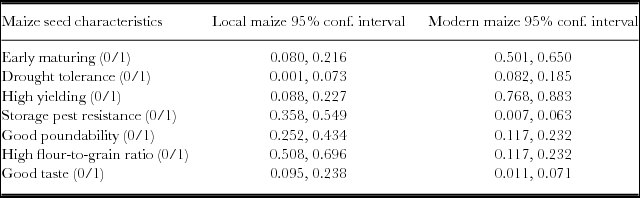
The household survey asked household heads to report the two main positive attributes of the planted maize varieties that led them to grow the varieties. The most common attributes mentioned were high yield, early maturity, drought tolerance, good storability (not susceptible to weevil damage), good poundability, high flour-to-grain ratio and good taste for nsima (a stiff porridge made of maize flour). Table 2 presents 95% confidence intervals for the responses provided. As shown, farmers characterized modern and local maize varieties as having different positive attributes. The data suggest that modern maize varieties are perceived as advantageous in terms of duration, drought tolerance and yield. Local maize varieties appear to perform better than modern maize varieties in terms of storability, poundability, flour-to-grain ratio and taste.
Farmers’ responses on the positive characteristics of local and modern maize varieties planted in 2009/2010.

Farmer perceptions of rainfall variability and change
As in the study of (Osbahr et al. Reference Osbahr, Dorward, Stern and Cooper2011), our survey instrument included questions on farmer perceptions of extreme weather events and changes in climate over the years. Interviews were conducted with both household heads and their spouses (n = 293) and below we report their responses related to rainfall parameters only. Farmers nearly unanimously (98%) stated they have noticed a change in the average volume of rainfall during the rainy season in recent years, with 87% of these farmers reporting observed decreases in rainfall levels and 13% believing that rainfall levels had increased over the years. Furthermore, 86% of respondents perceived that the rainy season now starts later than it did in the past. A large proportion of respondents (68%) also reported that they believe the rainy season now ends earlier than in the past. Thus many farmers perceived a shorter agricultural growing period. The data indicate that while farmers need to plant as soon as the rainy season begins (because of the shorter duration of the rainy season), predicting the onset of the rains has become harder in recent years. Farmers in the area have long relied on the chizimalupya or early rains as a signal that the rainy season is about to begin, but 41% of respondents said these rains no longer come. As for droughts, 92% of respondents claimed their village experienced a drought in the last 10 years; on average, these respondents reported four droughts during that period. By comparison, 13% of interviewees said there was flooding in the area over the same period. Similarly, in the 2008 household survey 78% of respondents said they worried more about drought than about floods in terms of the deleterious effects on agriculture. This is as expected. In Malawi, as in many other African countries, droughts have had devastating effects on the assets and food security situation of smallholder farmers. Floods, by contrast, can have both damaging (e.g., loss of property) and beneficial consequences (e.g., farmers often rely on floods as an important source of residual moisture for their crops) for farm households.
Farmer reported adaptations to drought risk
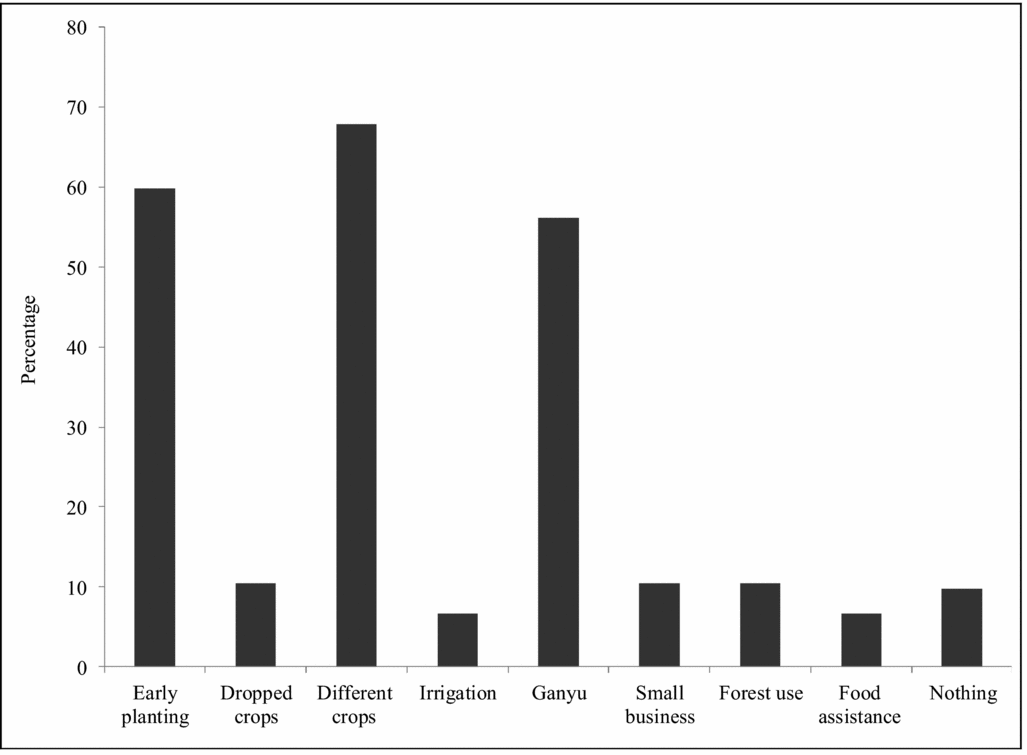
As described above, sample farmers perceived that drought is a major risk. Following the questions about whether drought had occurred in recent years, respondents were asked ‘What, if anything, have you done to try and reduce the negative consequences that a drought can have?’ Figure 1 shows the adaptations reported for households by either the husband or wife. Note that the sum of percentages exceeds 100% because most respondents provided more than one adaptation strategy. The data indicate that household behaviour had been influenced by subjective drought risk; only 10% of households reported that nothing had been done to reduce the impacts of drought. The most common adaptations reported are planting different crops (68%); planting as soon as the rains start (60%); and engaging in ganyu (56%), which is piecework labour, usually of an agricultural nature, for which payment is often in the form of food (e.g., a bag of maize), but sometimes in cash.
Farmers’ reported adaptations to drought risk, sampled husbands and wives (n = 293).
Respondents who had observed drought in the past decade reported trying to adapt to drought risk by growing cassava (48%), sweet potatoes (34%) and legumes (32%). These are all crops that are relatively tolerant to drought. The growing of modern maize was mentioned as an adaptation to drought risk by 14% of survey respondents who had observed drought in the last 10 years. None of the modern maize varieties grown at the study sites was bred for drought tolerance, but some farmers consider hybrid maize an option for adapting to rainfall variability and change, because it is generally early maturing relative to local maize and can help farmers avoid crop loss when drought occurs late in the growing season.
Regression model results
Above we presented evidence that farmers perceived drought as a major risk, and a key adaptation to such risk has been the growing of crops that are less sensitive to drought, particularly cassava, sweet potato and legumes. Among respondents who reported a recent drought, 14% said they grow modern maize varieties as an adaptation to drought risk. It was also shown that modern maize varieties are perceived by sample farmers as advantageous in terms of yield, early maturity and drought tolerance, while local varieties are considered better in terms of postproduction characteristics such as storage pest resistance and flour-to-grain ratio. In this section, we use multivariate regression analysis to examine if farmers’ decisions to grow modern maize varieties are influenced by their perceptions of drought risk and their demand for risk management traits (early maturity and drought tolerance).
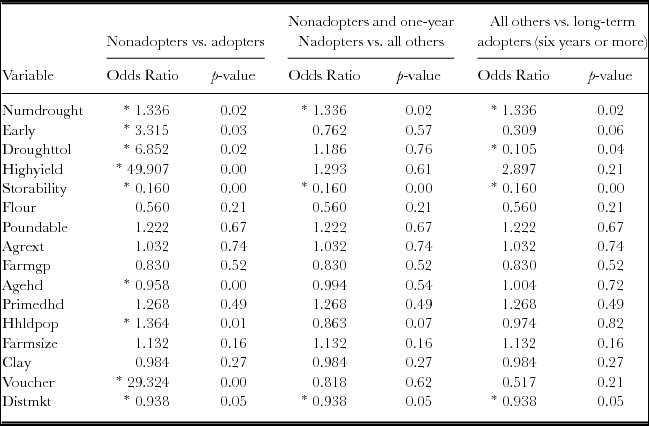
The appropriate model to understand factors associated with adoption duration is a generalized ordered logit model (see Table 3). A Brant test for the parallel lines assumption – that the effect of the regressors is the same across adoption categories – indicates violation for several explanatory variables; thus a generalized ordered logit model is estimated. The generalized ordered logit model relaxes the parallel lines assumption of the ordered logit model and allows the coefficients of the explanatory variables to have differential effects across the dependent variable categories if the parallel lines assumption is violated (Maddala, Reference Maddala1983). Goodness-of-fit measures are presented at the bottom of the table: the p-value for a likelihood ratio chi-square test that our model as a whole is statistically significant, and the pseudo-R-squared.
Generalized ordered logit results.
Number of observations = 247.
p- value of Wald Chi-squared = 0.000.
Pseudo R-squared = 0.262.
Interpretation of the generalized ordered logit results requires comparison across the adoption categories. There are three panels for the results in Table 3, a reflection of there being four categories for the dependent variable, and the fourth category (grew modern maize varieties 6 years or more) being the excluded category. Odds ratios and p-values for the explanatory variables are reported. It should be noted that because the unit of analysis is the maize field, standard errors are adjusted for within-cluster (household) correlation with use of the household identifier variable. For parameter estimates that are statistically significant (p < 0.05) and have the same odds ratio across the three panels, odds ratios exceeding one indicate greater chances of being in a higher adoption category, and odds ratios less than one indicate greater chances of being in a lower category. When the odds ratio differs across panels for a given variable, the comparisons are as follows. Panel 1 results are a comparison between nonadopters and adopters of modern maize. The second panel contrasts nonadopters and one-year adopters with those who have grown modern maize at least 2 years. The third panel contrasts farmers who have grown maize 6 years or more with everyone else. Our discussion of the results begins with the control variables and then turns to interpretation of the key variables, those related to drought risk management.
Consistent with other research (Hintze et al., Reference Hintze, Renkow and Sain2003; Lunduka et al., Reference Lunduka, Fisher and Snapp2012; Salasya et al., Reference Salasya, Mwangi, Mwabu and Diallo2007), we find that adopters of modern maize prioritize yield as shown by the large odds ratio for yield in panel 1 of Table 3. As for postproduction traits, results indicate that compared to local maize, modern maize is perceived as unsatisfactory in terms of storability. A study of modern maize adoption in Kenya similarly found that poor storability was a key factor limiting adoption (Salasya et al., Reference Salasya, Mwangi, Mwabu and Diallo2007). Relative to local varieties of maize, modern varieties are susceptible to storage pests such as weevils (Smale and Heisey, Reference Smale and Heisey1994). Storability is particularly important in Malawi where only 20% of maize farmers produce surplus and sell their product (Denning et al., Reference Denning, Kabambe, Sanchez, Malik, Flor, Harawa, Nkhoma, Zamba, Banda, Magombo, Keating, Wangila and Sachs2009), and farmers who market maize prefer to store for several months until the maize price is high. In the Kenyan study mentioned above, farmers ranked storability as the third most important attribute that they generally look for in a maize variety (Salasya et al., Reference Salasya, Mwangi, Mwabu and Diallo2007). Other evidence from our household survey confirms the importance of storability. The data show that 26% of respondents reported having dropped a particular modern maize variety in recent years. The dominant explanation was poor storability (61%), followed by low yield (24%). In short, these two important traits, yield and storability, explain both adoption and disadoption of modern maize.
Neither of the two learning/information variables is statistically significant in Table 3, consistent with results reported in Lunduka et al. (Reference Lunduka, Fisher and Snapp2012). This finding may be indicative of a saturation of opportunities to learn about modern maize varieties, given the technology is not new and Malawian farmers have had good access to the technology through multiple years of agricultural input subsidy programs (Lunduka et al., Reference Lunduka, Ricker-Gilbert and Fisher2013). Results show that households headed by older individuals were less likely to grow modern maize. Age has often been found to have a negative association with agricultural technology adoption, which may reflect reduced willingness among older farmers to give up familiar production technologies (Kafle, Reference Kafle2010). Household size is found to correlate positively with adoption of modern maize. This may suggest that, at the study sites, the added labour requirements associated with modern maize adoption are fulfilled mainly by family members. The farm size odds ratio is greater than one, but is not statistically significant at standard test levels.
Results indicate a very strong, positive association between receipt of a maize seed voucher at least once in the last 5 years and the growing of modern maize (panel 1 of Table 3), suggesting that the FISP has been successful in ensuring widespread access to modern maize seed. Smale and Mason (Reference Smale and Mason2012) similarly found that agricultural input subsidies had a strong and positive influence on adoption of modern maize in Zambia. As anticipated, geographic proximity to a market town is positively associated with adoption and sustained use of modern maize varieties, consistent with results of other agricultural technology adoption studies (Staal et al. Reference Staal, Baltenkweck, Waithaka, de Wolff and Njoroge2002; for a review of studies, see Kafle, Reference Kafle2010).
We turn now to the results of primary interest in Table 3, those that can shed light on whether farmer interest in managing drought risk is associated with the growing of modern maize varieties. The odds ratio for the drought risk variable shows a positive relationship between farmers’ observations of drought frequency (a proxy for their perception of drought risk) and the growing of modern maize. This finding is consistent with the hypothesis that smallholder farm households grow modern maize in part out of a desire to reduce drought risk. The result supports other evidence from our survey: 14% of sampled farmers who observed drought in recent years stated that they grow modern maize as an adaptation to drought risk.
Farmers’ subjective assessments of the traits of modern varieties related to drought risk management are found to influence adoption behaviour. The odds ratio for early maturity, a drought escape trait, indicates that farmers who value this trait are more likely to adopt modern varieties of maize (panel 1 of Table 3). The modern maize varieties available at the study sites were generally early maturing relative to local varieties. Early maturity is a beneficial attribute allowing farmers to have both an early (modern maize) and a late (local maize) harvest. Furthermore, farmers at the study sites perceived a shorter duration of the rainy season in recent years, and therefore early maturing varieties have clear value. Research in Zimbabwe and Kenya (Mhike et al., Reference Mhike, Okori, Kassie, Magorokoshu and Chikobvu2012; Salasya et al., Reference Salasya, Mwangi, Mwabu and Diallo2007) similarly found early maturity to be a highly valued trait of smallholder maize farmers.
Interestingly, the odds ratio for drought tolerance is greater than one in panel 1 and is below one in panel 3 of Table 3. It appears that farmers initially experimented with modern maize varieties with the belief that the varieties would provide a measure of drought tolerance; however, as farmers gained experience with modern maize varieties, confidence in this trait was lost. It is plausible the growing dissatisfaction with the drought tolerance of modern maize reflects learning about the new technology over time. Further evidence is provided by the reasons farmers gave for dropping a particular maize variety. Among the 26% of respondents that dropped a modern maize variety in recent years, 11% said they did so because the variety was not drought tolerant. The above results together suggest that the discovery that modern maize varieties did not in fact express adequate drought tolerance under Malawi conditions influenced farmers’ decisions on whether to continue growing modern maize varieties.
DISCUSSION AND CONCLUSIONS
The future of climate change adaptation among smallholder farmers of SSA has been largely considered to be dependent on development of modern crop varieties and investment in irrigation (Funk et al., Reference Funk, Dettinger, Michaelsen, Verdin, Brown, Barlow and Hoell2008). New releases of maize varieties have been promoted as having improved traits for early maturity and yielding well under drought conditions in Southern Africa. The households surveyed in this study were indeed interested in growing modern maize as a means to reduce vulnerability to drought. The empirical findings show a positive association between a farmer's perception of drought risk and the adoption and continued use of modern maize. Regression results also indicate that farmers for whom the variety traits of early maturity and drought tolerance are important are more likely to adopt modern maize, relative to farmers who do not highly value these traits. In summary, results are consistent with demand for modern varieties as a means to help farmers mitigate the effects of drought.
Importantly, the ordered logit model results highlight drivers of adoption as a fluid process, and illustrate how farmers’ perceptions of variety characteristics can evolve over time. Farmers who had only recently started growing a modern maize variety were interested in their high yield potential, early maturity and drought tolerance traits. Experience proved to the sampled farmers that the modern varieties were indeed high yielding and early maturing, but the varieties that had been disseminated at the time of the survey were not in fact tolerant to drought. Since this time several varieties specifically bred to be drought tolerant have been made available to farmers in Malawi. Some of the sample farmers reported dropping modern maize varieties when they discovered them to be sensitive to drought conditions. Taken together these results are consistent with farmer learning by doing (Foster and Rosenzweig, Reference Foster and Rosenzweig1995). Drought tolerance appears an essential trait influencing adoption, disadoption and sustained use of modern varieties in Southern Malawi.
Another important study result is that postproduction traits, notably storability, are highly influential to farmer variety choice. Whereas yield, early maturity and drought tolerance are priorities of crop breeding programs, storability has been overlooked. This is a central finding of this study – that poor storability was the primary reason cited by sample farmers for dropping modern maize varieties. Storability is an important trait for many reasons, including risk management; farmers in sub-Saharan Africa have long used grain storage as a means to reduce food shortages in times of drought. Compared to local maize, hybrid varieties are generally more susceptible to weevils (Smale and Heisey, Reference Smale and Heisey1994). Storage pests such as weevils cause both dry weight loss and price discounts for damaged grain. Reliable national estimates of the magnitude of losses caused by storage pests are not available for Malawi. Studies have reported household-level losses of 40 to 100%, without chemical treatment (Denning et al., Reference Denning, Kabambe, Sanchez, Malik, Flor, Harawa, Nkhoma, Zamba, Banda, Magombo, Keating, Wangila and Sachs2009). Although pesticides can be added to maize grain storage to improve storability, these are often inaccessible to local farmers. Poor storability of modern crop varieties has been documented previously, particularly for pest-susceptible legumes such as bean and pigeonpea (Cajanus cajan L.) (Mhango et al., Reference Mhango, Snapp and Kanyama-Phiri2012). The storability problem remains today for the chief staple cereal for Southern and Eastern Africa, as illustrated by our study. This highlights the importance of connecting clients (farmers) and those developing and marketing improved crop genetics to ensure that crop breeding efforts adequately address farmers’ demands for variety characteristics.
Overall, our study clearly demonstrates the urgent need to simultaneously address storability traits along with yield, early maturity and drought tolerance if widespread adoption and sustained use of drought-tolerant maize varieties is to occur in Southern Malawi. But farmers’ preferences for maize variety traits undoubtedly are highly context specific, which underscores the importance of participatory plant breeding and local adaptation in the development of drought tolerant maize varieties. For example, an appraisal of farmer maize variety selection in Zimbabwe found that farmers’ preferences for variety traits differed across the two drought-prone districts that were part of the study. In one district, farmers said that yield, early maturity and drought tolerance were the main traits they looked for in choosing a maize variety to grow. In the other sampled district, farmers considered these traits as important but not sufficient: taste and quality of the staple sadza were also crucial traits (Mhike et al., Reference Mhike, Okori, Kassie, Magorokoshu and Chikobvu2012).
Crop improvement has increased drought tolerance and yield and reduced the time to maturity in staple cereals, essential first steps to provide options for SSA farmers in the face of global climate change (Funk et al., Reference Funk, Dettinger, Michaelsen, Verdin, Brown, Barlow and Hoell2008; Kostandini et al., Reference Kostandini, Mills, Omamo and Wood2009). Our study from Southern Malawi highlights that these modern variety traits are necessary but not sufficient. Importantly, there is a need for a rich understanding of the cultural and economic context in which smallholders farmers exist and cope with climate risk, to be integrated with agroecological knowledge generation, support for adaptive learning and plant breeding efforts.