Introduction
The natural history of schizophrenia is believed to include premorbid, prodromal, and syndromal stages of illness. Prior research has demonstrated the therapeutic benefits of early detection and intervention in psychotic disorders (Wyatt, Reference Wyatt1991; Lieberman et al., Reference Lieberman, Alvir, Koreen, Geisler, Chakos, Sheitman and Woerner1996; Perkins et al., Reference Perkins, Gu, Boteva and Lieberman2005). Consequently, first-episode psychosis (FEP) programs have sought to curtail the duration of untreated illness through proactive community outreach and provision of coordinated multispecialty care.
The success of such specialty programs has spurred efforts to develop a similar model of care for persons at clinical high-risk (CHR) for developing psychotic disorders who are in putatively prodromal or attenuated stages. However, whereas the diagnostic and treatment methodologies necessary to establish FEP programs were well-developed and validated, there are gaps in the methodologies for applying similar approaches in the CHR field. Specifically, case identification criteria proposed by the various research groups lack sufficient diagnostic specificity for prediction of conversion to syndromal psychosis.
Current approaches (Yung et al., Reference Yung, Phillips, Yuen, Francey, McFarlane, Hallgren and McGorry2003; Addington et al., Reference Addington, Liu, Buchy, Cadenhead, Cannon, Cornblatt, Perkins, Seidman, Tsuang, Walker, Woods, Bearden, Mathalon and McGlashan2015; Perkins et al., Reference Perkins, Jeffries, Cornblatt, Woods, Addington, Bearden, Cadenhead, Cannon, Heinssen, Mathalon, Seidman, Tsuang, Walker and McGlashan2015; Cannon et al., Reference Cannon, Yu, Addington, Bearden, Cadenhead, Cornblatt, Heinssen, Jeffries, Mathalon, McGlashan, Perkins, Seidman, Tsuang, Walker, Woods and Kattan2016; Brucato et al., Reference Brucato, Masucci, Arndt, Ben-David, Colibazzi, Corcoran, Crumbley, Crump, Gill, Kimhy, Lister, Schobel, Yang, Lieberman and Girgis2017; Fusar-Poli et al., Reference Fusar-Poli, Rutigliano, Stahl, Davies, Bonoldi, Reilly and McGuire2017; Lehembre-Shiah et al., Reference Lehembre-Shiah, Leong, Brucato, Abi-Dargham, Lieberman, Horga and Girgis2017; Ciarleglio et al., Reference Ciarleglio, Brucato, Masucci, Altschuler, Colibazzi, Corcoran, Crump, Horga, Lehembre-Shiah, Leong, Schobel, Wall, Yang, Lieberman and Girgis2019) focus on the number of positive symptoms (e.g. delusions, hallucinations, and disorganized communication) in their attenuated forms and their severity in terms of the level of conviction, frequency, intensity, and behavioral impact (Correll et al., Reference Correll, Hauser, Auther and Cornblatt2010; Fusar-Poli et al., Reference Fusar-Poli, Borgwardt, Bechdolf, Addington, Richer-Rossler, Schultze-Lutter, Keshavan, Wood, Ruhrmann, Seidman, Valmaggia, Cannon, Velthorst, De Haan, Cornblatt, Bonoldi, Birchwood, McGlashan, Carpenter, McGorry, Klosterkotter, McGuire and Yung2013) using semi-structured interviews such as the Structured Interview for Psychosis-Risk Syndromes (SIPS) (Miller et al., Reference Miller, McGlashan, Rosen, Cadenhead, Cannon, Ventura, McFarlane, Perkins, Pearlson and Woods2003), widely used throughout North America. The SIPS delineates an Attenuated Positive Symptom Psychosis-Risk Syndrome (APSS), a construct for CHR case identification. While nearly all of the five positive symptom categories assessed by the SIPS predict, to varying degrees, syndromal psychosis (Addington et al., Reference Addington, Liu, Buchy, Cadenhead, Cannon, Cornblatt, Perkins, Seidman, Tsuang, Walker, Woods, Bearden, Mathalon and McGlashan2015; Perkins et al., Reference Perkins, Jeffries, Cornblatt, Woods, Addington, Bearden, Cadenhead, Cannon, Heinssen, Mathalon, Seidman, Tsuang, Walker and McGlashan2015; Cannon et al., Reference Cannon, Yu, Addington, Bearden, Cadenhead, Cornblatt, Heinssen, Jeffries, Mathalon, McGlashan, Perkins, Seidman, Tsuang, Walker, Woods and Kattan2016; Brucato et al., Reference Brucato, Masucci, Arndt, Ben-David, Colibazzi, Corcoran, Crumbley, Crump, Gill, Kimhy, Lister, Schobel, Yang, Lieberman and Girgis2017; Fusar-Poli et al., Reference Fusar-Poli, Rutigliano, Stahl, Davies, Bonoldi, Reilly and McGuire2017; Lehembre-Shiah et al., Reference Lehembre-Shiah, Leong, Brucato, Abi-Dargham, Lieberman, Horga and Girgis2017; Ciarleglio et al., Reference Ciarleglio, Brucato, Masucci, Altschuler, Colibazzi, Corcoran, Crump, Horga, Lehembre-Shiah, Leong, Schobel, Wall, Yang, Lieberman and Girgis2019), no single symptom or combination of symptoms achieves adequate specificity. Consequently, there is an urgent need to improve the risk criteria used to predict syndromal psychotic disorders, with the aim of facilitating clinical application of early detection and intervention in the pre-syndromal stages of psychotic disorders.
The timing (i.e. recency of onset) and intensification (i.e. change in severity) of symptoms is an important component of the progression subtype of the SIPS, requiring that one or more positive symptoms that scored 3–5 on the measure be new or worsening (NOW) in the past year (Miller et al., Reference Miller, McGlashan, Rosen, Cadenhead, Cannon, Ventura, McFarlane, Perkins, Pearlson and Woods2003; McGlashan et al., Reference McGlashan, Walsh and Woods2014). One study suggested altogether removing consideration of a symptom's recency of onset or intensification due to the rarity of attenuated positive symptoms which meet NOW criteria, relative to longerstanding attenuated psychotic symptoms, in the general population (Schultze-Lutter et al., Reference Schultze-Lutter, Michel, Ruhrmann and Schimmelmann2014). However, the investigators did not specifically report the relationship between NOW symptoms and conversion to syndromal psychosis.
We evaluated the predictive capacity of the recency of symptom onset or intensification of symptoms (i.e. NOW symptoms), in addition to the severity and quantity of positive symptoms, in an effort to enhance the predictive validity of symptom-based criteria in CHR patients. We hypothesized that, among CHR patients, those with NOW symptoms, as opposed to those with symptoms that were present, but unchanging or just worsening in the year preceding baseline, would be more likely to convert to psychosis over the follow-up period, and that this would be independent of symptom severity. Importantly, since all subjects in our cohort had NOW symptoms, our goal in this paper was to examine the degree to which recency of symptoms was associated with higher probability of conversion, within the context of a syndrome that contains several other criteria for the APSS, including severity.
Method
Study sample
We recruited 109 help-seeking individuals whose symptoms met criteria for the SIPS APSS progression subtype, which requires NOW criteria, at the New York State Psychiatric Institute and Columbia University Irving Medical Center's Center of Prevention and Evaluation (COPE) (McGlashan et al., Reference McGlashan, Miller, Woods, Hoffman, Davidson, Miller, Mednick, McGlashan, Liberger and Johannessen2001, Reference McGlashan, Walsh and Woods2014; Miller et al., Reference Miller, McGlashan, Rosen, Somjee, Markovich, Stein and Woods2002, Reference Miller, McGlashan, Rosen, Cadenhead, Cannon, Ventura, McFarlane, Perkins, Pearlson and Woods2003; Rosen et al., Reference Rosen, Woods, Miller and McGlashan2002). Participants came from a network of clinical and academic sites, or were self-referred after viewing COPE's website. Following telephone screening, potential participants underwent in-person evaluations. Written informed consent was provided by those aged ⩾18. Minors gave written assent, with written informed consent provided by parents/legal guardians. There were separate consents and assents for screening and enrollment. The authors assert that all procedures contributing to this work comply with the ethical standards of the relevant national and institutional committees on human experimentation and with the Helsinki Declaration of 1975, as revised in 2008. All procedures involving human subjects/patients were approved by the NYSPI Institutional Review Board. Exclusion criteria included age <14 or >30; non-proficiency in English; any lifetime psychotic disorder; a DSM disorder better explaining symptoms; I.Q. < 70; medical conditions involving the central nervous system; imminent danger to self or others; unwillingness to participate in research; geographic distance; or current substance/alcohol abuse or dependence. Antipsychotic medication use was not exclusionary, provided evidence that attenuated, never fully psychotic-level positive symptoms preceded use. We exclusively included participants from our wider COPE cohort who were enrolled after we implemented systematic recording of the temporal course of symptoms (Brucato et al., Reference Brucato, Masucci, Arndt, Ben-David, Colibazzi, Corcoran, Crumbley, Crump, Gill, Kimhy, Lister, Schobel, Yang, Lieberman and Girgis2017).
Clinical characterization
The SIPS contains 19 subscales within positive, negative, disorganization, and general symptom subsections (Miller et al., Reference Miller, McGlashan, Woods, Stein, Driesen, Corcoran, Hoffman and Davidson1999; McGlashan et al., Reference McGlashan, Miller, Woods, Hoffman, Davidson, Miller, Mednick, McGlashan, Liberger and Johannessen2001; Hawkins et al., Reference Hawkins, Quinlan, Miller, Woods, Zipursky, Perkins, Addington and McGlashan2004). The definitions of specific symptoms, as well as their timing of worsening and onset, are delineated by the SIPS. Both APSS status and lifetime syndromal psychosis are defined by positive symptoms (P.1. unusual thought content/delusional ideas, P.2. suspiciousness/persecutory ideas, P.3. grandiose ideas, P.4. perceptual abnormalities/hallucinations, and P.5. disorganized communication), scored 0–6, as follows, using symptom-specific anchors for degrees of frequency, conviction, insight, and behavioral impact: 0, absent; 1, questionably present; 2, mild; 3, moderate; 4, moderately severe; 5, severe, but not psychotic; and 6, psychotic, delusional conviction, at least intermittently.
The SIPS APSS syndrome criteria require at least one positive symptom occurring at least once weekly in the past month and scored between 3 and 5. Symptoms must not be better explained by another psychiatric or medical condition. The syndrome is ruled out by past or present syndromal psychosis (i.e. at least one positive symptom scored 6, occurring for at least one hour daily for four days weekly throughout one month, or causing severe disorganization, or endangering self or others). All patients in this cohort also met criteria for the progression subtype of the SIPS APSS syndrome, which additionally requires that at least one positive symptom is new or has worsened by one or more points in the past year. A ‘new’ positive symptom has scored 3–5 for the first time in the past year. A ‘worsening’ positive symptom has scored 3 or 4 sometime before the year preceding the baseline evaluation, and progressed to 4 or 5 within the past 12 months. Consensus of individuals SIPS scores and diagnostic categories was established by certified administrators.
Participants were seen for follow-up SIPS evaluations every 3 months for up to 2 years, or whenever conversion was suspected (e.g. when a patient's treating clinician, family member, or other source providing collateral became concerned about possible progression of positive symptoms). Note that NOW criteria are, by definition, used to establish criteria for the APSS at baseline and are, therefore, not reassessed at follow-up evaluations. Consequently, in this study, we only utilized baseline SIPS scores when determining NOW criteria and in our analyses. Syndromal psychosis during the follow-up period was assessed in the manner used to delineate lifetime psychosis, described above. Participants who did not develop syndromal psychosis by 2 years were considered non-converters. Post-conversion DSM psychotic disorder diagnoses were established by COPE clinicians using the fifth edition of the Diagnostic and Statistical Manual of Mental Disorders (First et al., Reference First, Williams, Karg and Spitzer2015).
Participants' birth sex, race, age, and medications (antipsychotics, antidepressants, both) were self-reported at baseline. Baseline DSM Axis I diagnoses were established using either the Diagnostic Interview for Genetic Studies (Nurnberger et al., Reference Nurnberger, Blehar, Kaufmann, York-Cooler, Simpson, Harkavy-Friedman, Severe, Malaspina and Reich1994) or Structured Clinical Interview for DSM-IV Axis-I Disorders (First et al., Reference First, Spitzer, Gibbon and Williams1996). The Global Functioning Scale: Social and Global Functioning Scale: role were also assessed at baseline (Cornblatt et al., Reference Cornblatt, Auther, Niendam, Smith, Zinberg, Bearden and Cannon2007). The social scale evaluates interpersonal relationships, while the functioning scale measures academic, occupational or homemaking performance. Each is scored from 1 (extreme dysfunction) to 10 (superior functioning).
Statistical analyses
Descriptive statistics, and mean differences in baseline demographic and clinical features between converters and non-converters, were derived using SPSS version 22 (IBM Corporation, 2013). Group differences were evaluated using one-way ANOVAs for continuous variables (e.g. SIPS scores) and, for categorical variables (e.g. diagnosis), Pearson χ2 test or Fisher's exact test was employed, where warranted by low-cell counts. We used as predictor variables the following symptom variables: type of symptoms as reflected by SIPS ratings, severity of symptoms, number of symptoms above clinical severity thresholds (i.e. between 3–5 on the SIPS), and timing of worsening and onset of symptoms (i.e. recency). Tallies of new, worsening, and new or worsening symptoms were also calculated and stratified by conversion status. Using logistic regression, we evaluated the association of NOW symptoms with conversion, controlling for total symptom scores, and demographic variables. We also examined the relationship between NOW symptoms and time to conversion using Kaplan–Meier and the log-rank test and separately the Cox proportional hazards models controlling for total symptom scores and demographic variables. Non-converters were considered censored at two-years or at their last known follow-up time less than 2 years.
Results
Baseline demographics and clinical variables
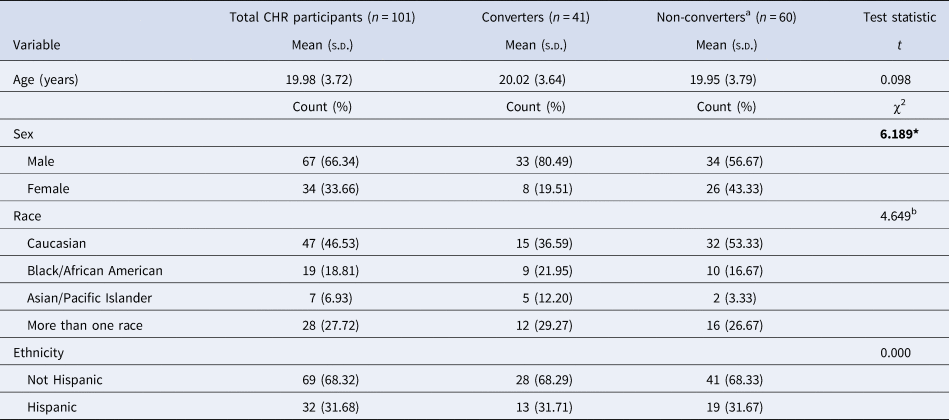
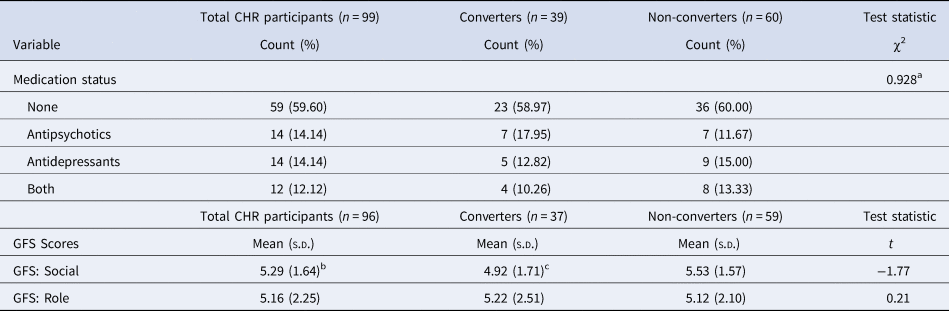
We ascertained, assessed, and followed 109 patients. Eight (7.34%) were excluded as they were lost to follow-up immediately after their baseline visits and their conversion status was unable to be determined (see Tables 1–2 for demographics). Of the 101 participants, 41 (40.6%) progressed to meet criteria for a syndromal psychotic disorder with half converting within 142 days (interquartile range: 69–410 days), or about 4.7 months (Supplementary Table S1). It was found that 80.5% of patients who converted met DMS criteria for schizophrenia. Converters were more often male (χ2 = 6.19; p = 0.01) (Table 1). There were otherwise no significant differences between converters and non-converters among the 11 baseline demographics, diagnoses (including substance use disorders), medication status, or social/role performance (Tables 1–2, Supplementary Table S2).
Baseline demographic characteristics of the COPE sample

a 28 of the non-converters were followed the full 2 years, and the average censoring time was 573 days s.d. = 255 days, see Kaplan–Meier
b 2 cells have expected count of less than 5. The minimum expected count is 2.84.
*p < 0.05, **p < 0.01, comparisons between converters and non-converters.
Additional baseline clinical characteristics: Medication status and GFS scores for the COPE sample

a 1 cell has expected count less than 5. The minimum expected count is 4.73.
b n = 95.
c n = 36.
Association of type and severity of symptoms in CHR to syndromal psychosis
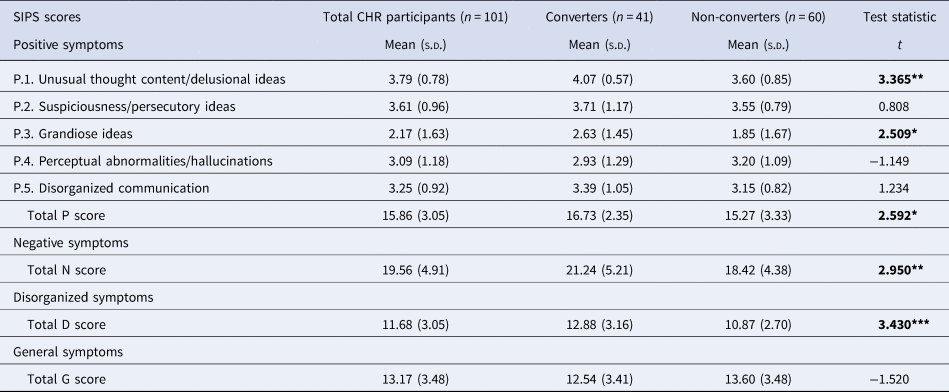
We first examined which individual SIPS symptoms were associated with conversion to syndromal psychosis (Table 3). The differences in severity of positive symptoms at baseline were: SIPS P.1. unusual thought content/delusional ideas [converters: 4.07 (0.57); non-converters 3.60 (0.85); t = 3.37; p = 0.001], P.3. grandiose ideas [converters: 2.63 (1.45); non-converters: 1.85 (1.68); t = 2.51; p = 0.01], total positive symptoms [converters: 16.73 (2.35); non-converters: 15.27 (3.33); t = 2.592; p = 0.01], total negative symptoms [converters: 21.24 (5.21); non-converters: 18.42 (4.38); t = 2.95; p < 0.01], and total disorganization symptoms [converters: 12.88 (3.16); non-converters: 10.87 (2.70); t = 3.43; p < 0.01], all of which were higher at baseline among converters than non-converters. Baseline P.2. suspiciousness/persecutory ideas, P.4. perceptual abnormalities/hallucinations, and P.5. disorganized communication and total general symptoms were not different between converters and nonconverters.
SIPS scores and clinical data

*p < 0.05, **p < 0.01, ***p < 0.001, comparisons between converters and non-converters.
Number of positive symptoms and conversion to syndromal psychosis
We next examined the number of SIPS positive symptoms scored between 3–5 and conversion. We found no significant differences in the mean number of positive symptoms scored between 3–5 between converters (4.02 ± 0.79) and non-converters (3.92 ± 0.98; p = 0.56). We then examined relationships between the number of positive symptoms scored between 3–5 and conversion (see Supplementary Table S3) using χ2 analyses, again finding no relationship (χ2 = 2.93; p = 0.57).
Recency of onset or intensification of positive symptoms and conversion to syndromal psychosis
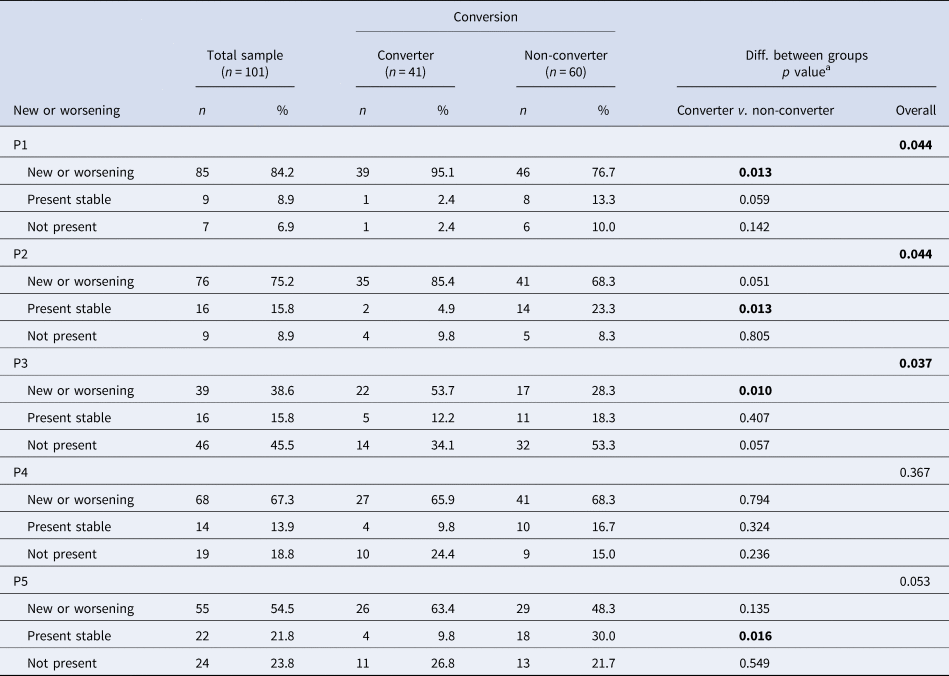
We next examined whether there are relationships between the recency of onset or intensification of positive symptoms and conversion to syndromal psychosis. Table 4 shows NOW symptoms for SIPS P.1.–P.5. symptoms separately as they relate to conversion status. Non-converters were more likely to have all P symptoms scored 3–5 in severity and unchanging in the past year. However, this was only statistically significant for P.2. suspiciousness/persecutory ideas (4.9% v. 23.3%, p = 0.013) and P.5. (9.8% v. 30.0%, p = 0.016) and trending for P.1. unusual thought content/delusional ideas (2.4% v. 13.3%, p = 0.059). Converters were significantly more likely than non-converters to have new or worsening P.1. unusual thought content/delusional ideas (95.1% v. 76.7%, p = 0.013) and P.3. grandiose ideas (53.7% v. 28.3%, p = 0.010) symptoms, and trending for P.2. suspiciousness/persecutory ideas (85.4% v. 68.3%, p = 0.051), but not P.4. perceptual abnormalities/hallucinations or P.5. disorganized communication symptoms.
Examining 3-levels of each P symptom by conversion status

a χ2 tests; present stable (3–5) but unchanging; not present (score 0–2).
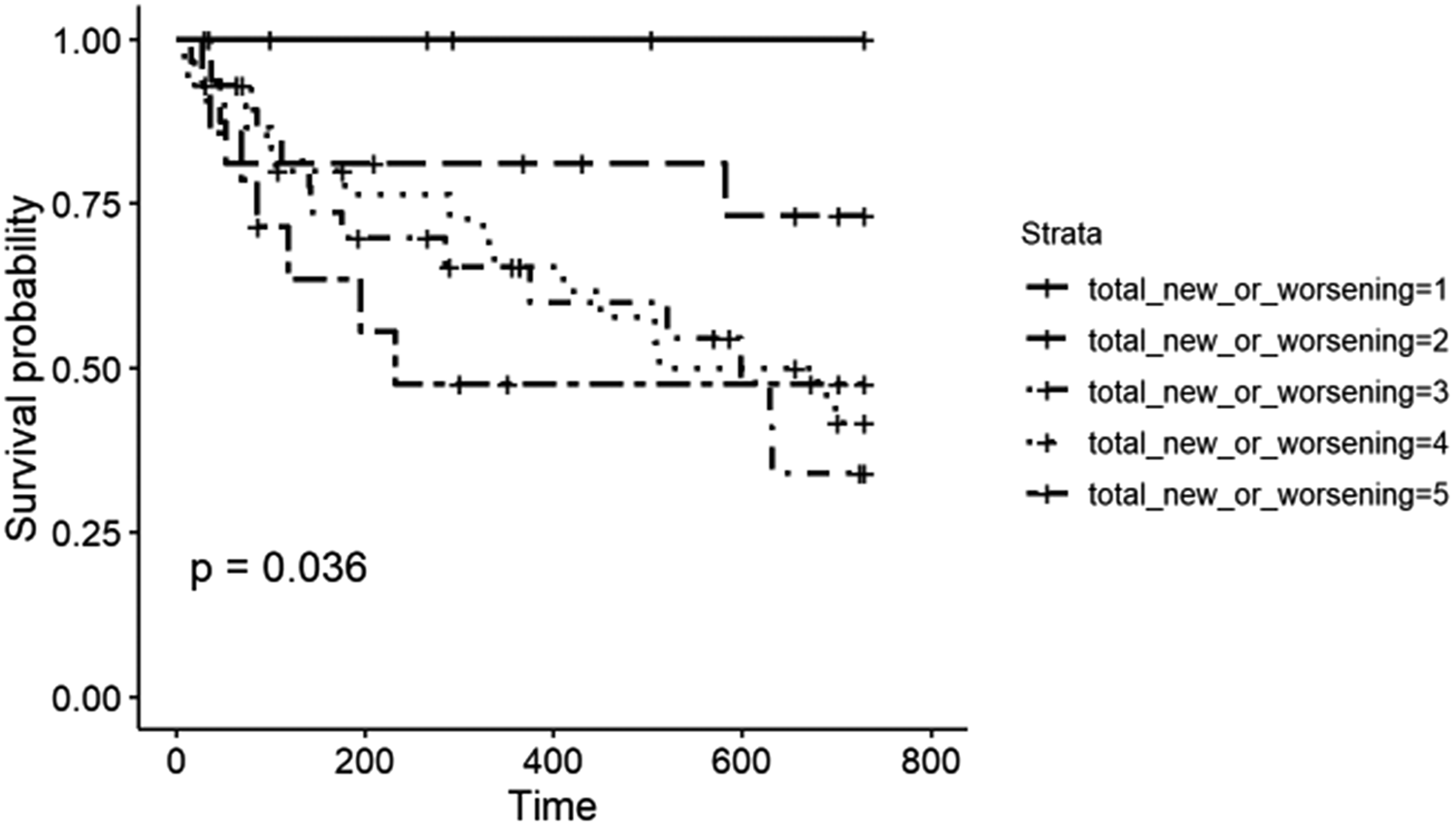
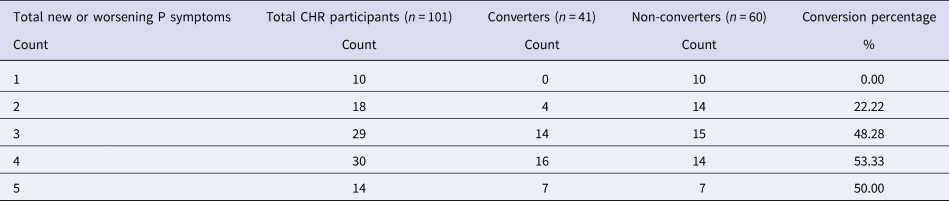
Converters had significantly more NOW symptoms at baseline (3.63 ± 0.89) than non-converters (2.90 ± 1.27; p = 0.001). We then separately examined differences between groups with regard to the mean numbers of new symptoms [converters: 2.46 (1.45); non-converters: 1.82 (1.26); p = 0.02; see Supplementary Table S4] and worsening symptoms [converters: 1.17 (1.00); non-converters: 1.08 (1.15); p = 0.69; see Supplementary Table S5]. We also examined the relationships between the number of NOW symptoms and conversion by χ2 analyses (Table 5) and found that conversion was significantly related to increased numbers of NOW symptoms (χ2 = 12.60; p = 0.01). Survival analysis found the same association with increasing count of NOW symptom being associated with increased hazard of conversion (log-rank test p = 0.036) (Fig. 1). Importantly, none of 10 participants with only one NOW symptom converted to syndromal psychosis.
Kaplan–Meier survival plot of total NOW symptoms (N = 101).

Total new or worsening positive symptoms by conversion status

Finally, to determine the effect of each variable reflecting positive symptoms as measured on the SIPS on risk of conversion to syndromal psychosis, we examined the relationships between NOW symptoms and conversion while controlling for differences in demographics (birth sex in this sample) and baseline severity of symptoms (total positive, negative, and disorganization scores). Increasing NOW symptoms were found to be associated with increased risk of conversion when controlling for these variables using logistic regression (OR 1.89; p = 0.03). Survival analysis using a Cox proportional hazard model showed an association between NOW symptoms and time to conversion at a trend level (hazard ratio = 1.45, p = 0.057). We further performed a logistic regression considering the two different NOW positive symptom variables individually, one for new and one for worsening symptoms, controlling for sex, total Positive score, total Negative score, and total Disorganization score and found that new (β = 0.66; p = 0.02) but not worsening symptoms (β = 0.37; p = 0.31) were positively associated with conversion.
Discussion
Efforts to define the prodromal or attenuated phase of schizophrenia and related psychotic disorders and develop reliable, sensitive, and specific predictors of progression to syndromal psychosis have chiefly been based on phenomenological criteria measured by instruments like the SIPS and nosological criteria for diagnostic categories, such as APSS and CHR. Studies relying on these methods and constructs have provided useful, yet limited results due to the poor specificity of the case criteria, and hampered, in part, by low-sample sizes and declining conversion rates (Fusar-Poli et al., Reference Fusar-Poli, Borgwardt, Bechdolf, Addington, Richer-Rossler, Schultze-Lutter, Keshavan, Wood, Ruhrmann, Seidman, Valmaggia, Cannon, Velthorst, De Haan, Cornblatt, Bonoldi, Birchwood, McGlashan, Carpenter, McGorry, Klosterkotter, McGuire and Yung2013).
Our results suggest that emphasis upon criteria that reflect the temporal characteristics of attenuated positive symptoms – i.e. the timing of their emergence and intensification – alongside the presence, severity, and quantity of attenuated positive symptoms, enhances their predictive validity. Specifically, conversion from the CHR phase to a syndromal psychotic disorder (predominantly schizophrenia in our cohort) was driven by the presence of at least two NOW symptoms in the year preceding baseline assessment. Conversion risk increased with a greater number of NOW symptoms at baseline, and this was true beyond the effect of overall positive symptom scores (which was correlated r = 0.64, p < 0.001 with NOW symptoms). Furthermore, while conversion was most strongly associated with NOW symptoms, it appeared to also be related to new, but not worsening, symptoms in the previous year, when considered in isolation. This suggests an interactive effect of new and worsening symptoms, and conversion to syndromal psychosis.
These findings are important for several reasons. First, they improve the predictive validity of current symptom-based models of risk prediction and reduce the false-positive rate of cases, and the associated distress, stigmatization, and possible unwarranted treatment faced by inaccurately labeled individuals (Yang et al., Reference Yang, Link, Ben-David, E, Girgis, Brucato, Wonpat-Borja and Corcoran2015). In addition, they suggest that the pathogenesis of schizophrenia and other psychotic disorders is a rapid, dynamic process, with qualitative, quantitative, and temporal dimensions that may distinguish between ‘state-’ and ‘trait-’ related features of the natural history of psychotic disorders. The inclusion of temporal measures to the CHR criteria does not simply identify patients who are ‘on the verge’ of syndromal psychosis and caught in an inexorable and imminent process. The period of recency was one year and the time to conversion was a mean of eight months, with a median of five months. The fact that our conversion rate was higher than other recent studies and more similar to early cohorts that did tend to include temporal measures (Yung et al., Reference Yung, Phillips, Yuen, Francey, McFarlane, Hallgren and McGorry2003, Reference Yung, Yuen, Berger, Francey, Hung, Nelson, Phillips and McGorry2007; Cannon et al., Reference Cannon, Yu, Addington, Bearden, Cadenhead, Cornblatt, Heinssen, Jeffries, Mathalon, McGlashan, Perkins, Seidman, Tsuang, Walker, Woods and Kattan2016; Fusar-Poli et al., Reference Fusar-Poli, Borgwardt, Bechdolf, Addington, Richer-Rossler, Schultze-Lutter, Keshavan, Wood, Ruhrmann, Seidman, Valmaggia, Cannon, Velthorst, De Haan, Cornblatt, Bonoldi, Birchwood, McGlashan, Carpenter, McGorry, Klosterkotter, McGuire and Yung2013) Yung et al. (Reference Yung, Phillips, Yuen, Francey, McFarlane, Hallgren and McGorry2003, Reference Yung, Yuen, Berger, Francey, Hung, Nelson, Phillips and McGorry2007) also bears consideration, and further supports the current findings. It is additionally plausible that our cohort's relatively higher conversion rate is attributable to the fact that, while only one NOW positive symptom scored 3–5 on the SIPS is required by APSS criteria, over 90% of our CHR participants display more than one NOW symptom at baseline, and over 99% of our sample has more than one positive symptom scored between 3–5 at baseline.
Our findings, if replicated, would suggest that the prodromal phase of psychotic disorders involves the emergence of multiple NOW, increasingly interwoven, positive symptoms, signaling that psychosis may be imminent within one year. We postulate that this may constitute the juncture at which the critical duration of untreated psychosis period, traditionally temporally associated with the first-episode of psychosis (Perkins et al., Reference Perkins, Gu, Boteva and Lieberman2005), may actually begin. If confirmed, this construct may fundamentally affect the way attenuated psychosis is conceptualized, studied, and treated.
The findings of the current article strongly support emphasizing recency of onset or intensification of symptoms as a required and fundamental element in prodromal/CHR criteria. For instance, in research employing the SIPS measure, only progression criteria should be employed if a study's aim is to optimally predict conversion to psychosis. Further, these results may help to explain why published conversion rates have been decreasing over the last 15 years (Yung et al., Reference Yung, Yuen, Berger, Francey, Hung, Nelson, Phillips and McGorry2007), and suggest that limiting the NOW requirement to only one subtype of the SIPS APSS may have been disadvantageous.
Our conclusion regarding the multiplicity of positive symptoms in emergent psychosis is also supported by research on which positive symptoms best predict conversion on an individual basis, from the perspective of symptom severity. Namely, large single- and multi-site cohorts have reported at least two or more positive symptoms from the SIPS to be associated with transition to syndromal psychosis (Addington et al., Reference Addington, Liu, Buchy, Cadenhead, Cannon, Cornblatt, Perkins, Seidman, Tsuang, Walker, Woods, Bearden, Mathalon and McGlashan2015; Cannon et al., Reference Cannon, Yu, Addington, Bearden, Cadenhead, Cornblatt, Heinssen, Jeffries, Mathalon, McGlashan, Perkins, Seidman, Tsuang, Walker, Woods and Kattan2016; Brucato et al., Reference Brucato, Masucci, Arndt, Ben-David, Colibazzi, Corcoran, Crumbley, Crump, Gill, Kimhy, Lister, Schobel, Yang, Lieberman and Girgis2017; Ciarleglio et al., Reference Ciarleglio, Brucato, Masucci, Altschuler, Colibazzi, Corcoran, Crump, Horga, Lehembre-Shiah, Leong, Schobel, Wall, Yang, Lieberman and Girgis2019). Furthermore, among 200 CHR individuals in a previously-cited study, 60% of 60 conversions were to schizophrenia, implying that they endorsed multiple positive symptoms across multiple SIPS categories (Brucato et al., Reference Brucato, Masucci, Arndt, Ben-David, Colibazzi, Corcoran, Crumbley, Crump, Gill, Kimhy, Lister, Schobel, Yang, Lieberman and Girgis2017). These studies and others (Addington et al., Reference Addington, Liu, Buchy, Cadenhead, Cannon, Cornblatt, Perkins, Seidman, Tsuang, Walker, Woods, Bearden, Mathalon and McGlashan2015; Cornblatt et al., Reference Cornblatt, Carrion, Auther, McLaughlin, Olsen, John and Correll2015; Perkins et al., Reference Perkins, Jeffries, Cornblatt, Woods, Addington, Bearden, Cadenhead, Cannon, Heinssen, Mathalon, Seidman, Tsuang, Walker and McGlashan2015; Brucato et al., Reference Brucato, Masucci, Arndt, Ben-David, Colibazzi, Corcoran, Crumbley, Crump, Gill, Kimhy, Lister, Schobel, Yang, Lieberman and Girgis2017), on balance, suggest that, while a given cohort may demonstrate a significantly stronger relationship between a specific SIPS positive symptom and eventual conversion, it is likely a multiplicity of positive symptoms which characterizes emergent psychosis. The present research further implies that this multiplicity and recent onset or intensification are interwoven, essential ingredients for the development of syndromal psychotic illness.
This is also supported by our observation that P.3. grandiose ideas predicted conversion to syndromal psychosis in this sample, an association that has rarely, if ever, been reported. We suggest that this may be related to the multiplicity of symptoms, such that it is not any particular SIPS positive symptom, but rather, the SIPS positive symptoms taken as a whole, that portend later transition to syndromal psychotic illness. Thus, across various studies, disparate SIPS positive symptoms have emerged as the one most strongly associated with future conversion; indeed, all five from P.1. through P.5. (Addington et al., Reference Addington, Liu, Buchy, Cadenhead, Cannon, Cornblatt, Perkins, Seidman, Tsuang, Walker, Woods, Bearden, Mathalon and McGlashan2015; Cannon et al., Reference Cannon, Yu, Addington, Bearden, Cadenhead, Cornblatt, Heinssen, Jeffries, Mathalon, McGlashan, Perkins, Seidman, Tsuang, Walker, Woods and Kattan2016; Brucato et al., Reference Brucato, Masucci, Arndt, Ben-David, Colibazzi, Corcoran, Crumbley, Crump, Gill, Kimhy, Lister, Schobel, Yang, Lieberman and Girgis2017; Lehembre-Shiah et al., Reference Lehembre-Shiah, Leong, Brucato, Abi-Dargham, Lieberman, Horga and Girgis2017), in light of this further finding regarding P.3. Some data suggest, however, that P.1. unusual thought content/delusional ideas is among the most commonly endorsed group of positive symptoms on the SIPS, whereas P.3. grandiose ideas is the least endorsed (Addington et al., Reference Addington, Liu, Buchy, Cadenhead, Cannon, Cornblatt, Perkins, Seidman, Tsuang, Walker, Woods, Bearden, Mathalon and McGlashan2015; Cannon et al., Reference Cannon, Yu, Addington, Bearden, Cadenhead, Cornblatt, Heinssen, Jeffries, Mathalon, McGlashan, Perkins, Seidman, Tsuang, Walker, Woods and Kattan2016; Brucato et al., Reference Brucato, Masucci, Arndt, Ben-David, Colibazzi, Corcoran, Crumbley, Crump, Gill, Kimhy, Lister, Schobel, Yang, Lieberman and Girgis2017). One study (Crump et al., Reference Crump, Arndt, Grivel, Horga, Corcoran, Brucato and Girgis2018) examined P.1. unusual thought content/delusional ideas in order to better understand its strong association with conversion and found that it was, in fact, driven by the collective weight of numerous peculiar ideas assessed within the SIPS P.1. unusual thought content/delusional ideas section, rather than any individual component. This finding appears to further support our point regarding the importance of the multiplicity of positive symptoms.
Of note, the present study was conducted at a single site, limiting generalizability without replication. Furthermore, all raters were extensively trained in CHR assessment, whereas clinicians lacking specialized instruction may less adeptly identify attenuated psychosis. We also had a minor amount of missing data. Additionally, given the number of associations examined there is always a chance of spurious findings and the results should be replicated in other samples. Finally, we did not examine individuals with attenuated positive symptoms who did not have at least one NOW symptom, to determine the relative likelihood of conversion independent of the number of symptoms and their respective degrees of severity. Future research in this area would benefit from longitudinally examining and comparing two cohorts, one meeting criteria for APSS progression (i.e. NOW) and another meeting criterion for the APSS but not requiring NOW criteria.
In pragmatic terms, our findings, if replicated, may offer means of minimizing high-false-positive rates and stigma; help understand the current conceptualization of how psychosis develops; and suggest a window for developing time-sensitive, efficacious interventions (i.e. starting several months before syndromal psychosis at a time proximate to when a new symptom develops in a person with at least one worsening symptom). These findings also carry several research-related implications: First, that individuals with different NOW profiles should not be collectively examined. The fact that studies to date have done so may explain equivocal findings with regard to treatment trials, neuroimaging, and other work. Second, whether individuals with persistent attenuated positive symptoms, not NOW in the past year, will eventually have new symptoms, increasing conversion risk, is unclear without additional investigation. Third, the specific neurobiological profiles of individuals with different NOW presentations should be independently examined, as these may prove to be meaningfully correlated with clinical symptoms. Such profiles would help clarify the now key question of whether CHR individuals with and without new symptoms reflect different phases of the same spectral condition, or two similar, but distinct psychiatric conditions. Finally, this study has implications for the Attenuated Psychosis Syndrome in the appendix of the DSM-5 (American Psychiatric Association, 2013). This category evolved from the attempt to include in DSM-5 a psychotic risk syndrome, but became, because of the high-false positive rate of conversion to psychosis, a heterogeneous category to include both those at higher risk of conversion, and those who are more likely to become stable and chronic. This study suggests it might be possible to divide this group into two subtypes – those at higher risk of conversion and those not at higher risk but who still may benefit from clinical management.
Supplementary material
The supplementary material for this article can be found at https://doi.org/10.1017/S0033291719003040.
Acknowledgements
We thank Lisa Dixon, MD for her helpful comments on an earlier version of this manuscript.
Author contributions
All authors made substantial contributions to the conception or design of the work; or the acquisition, analysis, or interpretation of data for the work and either drafted the work or revised it critically for important intellectual content and approved the final version of the manuscript and agree to be accountable for all aspects of the work in ensuring that questions related to the accuracy or integrity of any part of the work are appropriately investigated and resolved. Drs. Brucato, Wall, and Girgis, and Ms. Samuel and Ms. Dishy and Mr. Masucci and Ms. Xu performed data analysis. Drs. Brucato and Girgis drafted the first version of the manuscript. Drs. Brucato and Girgis and Mr. Masucci and Ms. Dishy and Ms. Samuel were responsible for data collection.
Financial support
This work was supported by R01MH093398-01. R. Girgis acknowledges research support from Otsuka, Allergan/Forest, BioAvantex and Genentech. S. Small serves on the Scientific Advisory Board of MeiraGTx. J. Lieberman has received support administered through his institution in the form of funding or medication supplies for investigator-initiated research from Lilly, Denovo, Biomarin, Novartis, Taisho, Teva, Alkermes, and Boehringer Ingelheim, and is a member of the advisory board of Intracellular Therapies and Pierre Fabre. He neither accepts nor receives any personal financial remuneration for consulting, advisory board or research activities. He holds a patent from Repligen and receives royalty payments from SHRINKS: The Untold Story of Psychiatry. Dr First receives royalties from the American Psychiatric Association for DSM-related books. Dr Brucato receives royalties from The New Evil: Understanding the Emergence of Modern Violent Crime. No other authors have disclosures.