A majority of Neotropical rain-forest trees have fruits evolved for animal consumption suggesting that seed-dispersal mutualisms are fundamental interactions structuring these ecosystems (Howe Reference HOWE and Murray1986, Howe & Smallwood Reference HOWE and SMALLWOOD1982, van Roosmalen Reference VAN ROOSMALEN1985). However, whether frugivores act as seed dispersers or predators of particular plant species is unknown for most tropical trees. Trees of the family Lecythidaceae are widespread in Neotropical rain forests forming an important component of the plant community (Aparecida Lopes Reference APARECIDA LOPES2007, Mori Reference MORI1990, Mori et al. Reference MORI, BECKER, KINCAID, Bierregaard, Gascon, Lovejoy and Mesquita2001, Sabatier & Prevost Reference SABATIER and PREVOST1990), yet studies of plant–animal interactions are few (Jorge & Peres Reference JORGE and PERES2005, Silvius & Fragoso Reference SILVIUS and FRAGOSO2003, Trivedi et al. Reference TRIVEDI, CORNEJO and WATKINSON2004). Results suggest that Lecythidaceae trees with zoochoric fruits are principally dispersed by bats, birds, rodents and primates (Prance & Mori Reference PRANCE and MORI1983), although we know little about animal interactions with Eschweilera seeds.
Eschweilera ovata (Cambess.) Mart. ex Miers has a broad distribution in the south-eastern Amazon and the Atlantic forest between Pernambuco and Espírito Santo (Mori Reference MORI1990). Because it produces a considerable quantity of seeds with high starch reserves (Regis Reference REGIS2008), it is likely to provide a nutritious reward for large vertebrates. However, we still do not know which animals consume the seeds or the roles they may play in seed dispersal or predation. The objective of this study was to identify which vertebrate species interact with E. ovata seeds in order to increase our understanding of the recruitment ecology of the species.
The study site was the 550-ha Pacangê forest of the Michelin Ecological Reserve (13°50′S, 39°10′W) in Igrapiúna-Bahia, Brazil. The forest is a mosaic of fallows, selectively logged forest, and small patches of old-growth forest, and is bordered to the north and east by rubber (Hevea brasiliensis Muell.) monocultures, to the south by Bactris gasipaes Kunth plantations, and to the west by a 13 000-ha forest. The forest supports 28 mammal species ≥1 kg (Flesher Reference FLESHER2006), 20 small non-volant mammal species (G. Ximenes pers. comm.), at least 55 bat species (K. Herr pers. comm.), and 260 bird species (Lima Reference LIMA2005), so it is likely that most of the vertebrates that historically interacted with E. ovata seeds are present. Two possible exceptions are the white-lipped peccary (Tayassu pecari Link) and the tapir (Tapirus terrestris Linnaeus) both of which were extirpated from the region in the early 20th and mid-19th centuries, respectively (Flesher Reference FLESHER2006).
Eschweilera ovata is locally abundant with individuals as tall as 18 m in mature-forest patches and up to 5 m in large gaps. The green fruit is a dehiscent pyxidium measuring 5 cm in diameter consisting of an urn and operculum. The pericarp is hard, 2–3 mm thick, and holds 1–6 seeds attached to it by a funicle-aril (Prance & Mori Reference PRANCE and MORI1978). Seed length and width vary between 2–3 and 1–2 cm, respectively. The seeds weigh 2.8–3.3 g, with water content of 58–89%, and a significant energy reserve, principally of starch grains (Regis Reference REGIS2008). The fruits hang on the branches and when mature the operculum falls exposing the seeds which, if not removed by animals, eventually fall from the crown.
To observe animals at the fruiting trees we built platforms 3 m above the ground and 10 m from seven focal trees. We sat camouflaged for 3–4-h watches between 4h30–8h30 and 16h30–20h30, for a total of 120 diurnal and 80 nocturnal h. We used binoculars and at night used a headlamp. For each visit we recorded the animal species, the duration of the visit, the way in which the animal manipulated the seeds, and whether and how far the seeds were carried. To gather information on dispersal distance and seed fate, we pierced the coat of 70 seeds with a needle, attached 30-m threads, and placed 10 seeds around the base of each focal tree (Asquith et al. Reference ASQUITH, WRIGHT and CLAUSS1997, Forget & Milleron Reference FORGET and MILLERON1991). The threads were wound around a spindle placed in a plastic canister fixed to the ground with a stake. The threads allowed us to find the seeds after removal, measure the distance they were carried and the way they were deposited.
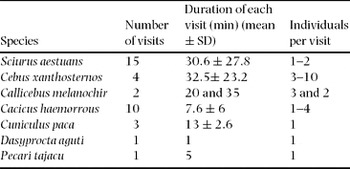
We observed the following animal species interacting with E. ovata seeds: Guianan squirrel (Sciurus aestuans, Linnaeus); yellow-breasted capuchin monkey (Cebus xanthosternos Wied-Neuwied); Bahian masked titi monkey (Callicebus melanochir Wied-Neuwied); red-rumped agouti (Dasyprocta aguti Linnaeus); paca (Cuniculus paca Linnaeus); collared peccary (Pecari tajacu Linnaeus); three-striped short-tailed opossum (Monodelphis americana, Müller); and red-rumped cacique (Cacicus haemorrhous Linnaeus) (Tables 1 and 2). None of these animals was a specialized consumer of E. ovata seeds as we saw them foraging for fruits of other species during the E. ovata fruiting season.
Animals that interact with Eschweilera ovata seeds: number of visits, duration of visits and number of individuals per visit at 10 trees in the Pacangê forest, Michelin Ecological Reserve (13°50′S, 39°10′W), Igrapiúna, Bahia, Brazil.

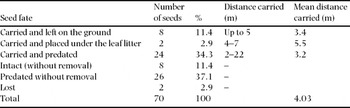
Fate of 70 thread-marked Eschweilera ovata seeds placed at the base of the focal trees. Crown radii varied between 5–7 m. Pacangê forest, Michelin Ecological Reserve (13°50′S, 39°10′W), Igrapiúna, Bahia, Brazil.

We recorded 15 visits by squirrels. They consumed 7–15 fruits per visit during seven of the visits, but on eight of the visits did not consume any seeds. Squirrels held the fruits in their front paws and removed the mature seeds with their mouth. They also gnawed at the pericarp, presumably testing for ripeness and dropping the immature fruits without consuming them. While we did not observe squirrels gathering seeds from the ground, we saw squirrels foraging for food on the forest floor on other occasions as have other authors (Galetti et al. Reference GALETTI, PASCOAL and PEDRONI2007), so it is possible that they will forage on fallen E. ovata seeds as well. We observed squirrels carrying seeds on four occasions, with a maximum distance carried of 15 m. Three of these seeds were carried and predated and one was cached in a tree-hole 10 m from where it was collected.
Capuchin monkey groups visited the focal trees on four occasions and titi monkeys visited twice. Both monkey species began visiting the trees when the seeds were immature and continued after the fruits matured, consuming seeds in both stages of maturity. They manipulated the immature fruits by biting the operculum to open the fruit but they dropped many fruits after partially consuming the seeds or not eating them at all. They also knocked many mature and immature fruits out of the trees while foraging. It was not possible to observe whether they swallowed intact seeds, but a large number of the fruits on the ground with monkey tooth marks suggest that they were responsible for many of the seeds predated. We did not observe monkeys carrying seeds.
We recorded only five visits by terrestrial animals that consume E. ovata seeds despite the fact that several of these animals are common in the forest (Laufer Reference LAUFER2009). On three occasions paca ate seeds under the crown and an agouti and a peccary spent 1 and 5 min, respectively, consuming seeds under the tree. None of these animals was observed carrying seeds.
Red-rumped caciques visited the trees on 10 occasions and several unidentified birds also visited the trees. The birds knocked seeds out of the trees while feeding on the arils. The seeds fell under the crown and we did not observe birds carrying any seeds. Several short-tailed opossums foraged on the forest floor beneath the focal trees, although it was not possible to verify if they ate the seeds.
Vertebrates interacted with 60 (85.6%) of the 70 thread-marked seeds (Table 2). Predation was the most significant interaction with 50 (71.4%) of the seeds consumed. Of the 18 (25.7%) seeds left intact, eight were carried and left on top of the leaf litter, two were carried and placed under the leaf litter and eight remained untouched. Two seeds were lost. Thirty-four (48.6%) of the seeds were carried, and although 70.6% of these were predated, the remaining 10 seeds were carried and left intact suggesting dispersal behaviour. Although some seeds were carried relatively far (22 m), most were not carried more than several metres and were deposited under the crowns of the parent trees (radii of 5–7 m).
The results from both the tree-hide observations and the thread-marked seeds show that vertebrates play an important role in the recruitment ecology of the species. Eschweilera ovata appears to depend on squirrels for seed dispersal and although we only observed them carrying seeds on four occasions, they were the only visitors observed to do so. Several of the threads of predated seeds showed that the seeds were carried up and down trees indicating foraging behaviour typical of squirrels (Galetti et al. Reference GALETTI, PASCOAL and PEDRONI2007). Of the 10 threaded seeds carried, two were placed under the leaf litter and not buried in the soil suggesting that squirrels or perhaps the spiny rat (Trinomys iheringi Thomas) and not the agouti was responsible for placing them there. It was not possible to determine which animals moved the other eight threaded seeds left intact on the forest floor.
The principal role of most visitors, however, was that of seed predators and other than the squirrels, none of the animals demonstrated behaviour indicative of seed dispersal. The role of monkeys, peccaries and paca as seed predators corroborates results from other studies (Beck-King & von Helversen Reference BECK-KING and VON HELVERSEN1999, Bodmer Reference BODMER1989, Heiduck Reference HEIDUCK1997, Peres Reference PERES1991), but we were surprised that agoutis were not observed dispersing seeds as other studies (Hallwachs Reference HALLWACHS, Estrada and Fleming1986, Peres & Baider Reference PERES and BAIDER1997) show that they are important dispersers of large seeds. This suggests that seed-dispersal mutualisms may be less predictable than believed. As hanging seeds eventually fall even when the arils are not consumed, birds appear to have a commensalist role in the recruitment ecology of the tree. The role of bats as E. ovata seed dispersers remains to be clarified because although Prance & Mori (Reference PRANCE and MORI1983) and local people claim that bats disperse the seeds, we did not witness these events.
The maximum distance we observed an animal carry a seed was 15 m and the majority of the threaded seeds were carried no further than 7 m, with a maximum distance of 22 m (Tables 1, 2). The short distance animals carried the seeds is consistent with other studies of the dispersal of large-seeded species (Forget Reference FORGET1990, Hallwachs Reference HALLWACHS, Estrada and Fleming1986, Peres & Baider Reference PERES and BAIDER1997) and indicates that the recruitment dynamics of the species occurs over small spatial scales. Measures of seedling density around parent trees show that there may be a selective advantage for seed escape from close proximity to the trunk (Connell Reference CONNELL, den Boer and Gradwell1971, Janzen Reference JANZEN1970), with seedlings increasing with distance from the parent tree, peaking at 15 m (8–10 m beyond the crown) and dropping off sharply thereafter (Vilela Reference VILELA2008). Squirrels and other visitors that carry seeds even short distances beyond the tree crown therefore appear capable of providing the dispersal services required for seedling recruitment and are likely effective dispersers (Schupp Reference SCHUPP1993).
Although we observed few animal interactions at the tree hides (considering the time invested), the arboreal mammals we observed fed for prolonged periods in the relatively small trees, consuming and knocking down large numbers of fruits, and the threaded-seed data show that vertebrates interact intensively with seeds on the ground. These data suggest that interactions affecting the recruitment of the species continue to occur in the study forest. Evidence from other forests in the region also indicates that despite decades of deforestation, logging, forest fragmentation and intensive hunting of most of the animals that interact with E. ovata seeds (Flesher Reference FLESHER2006, Gusson et al. Reference GUSSON, SEBBENN and KAGEYAMA2006), the tree's population in coastal Bahia is still large and the species conspicuously abundant in forests of most successional stages (Rocha Reference ROCHA2011, Vilela Reference VILELA2008). Recent findings of E. ovata trees colonizing abandoned agricultural lands in heavily hunted forests near our study area (Piotto et al. Reference PIOTTO, MONTAGNINNI, THOMAS, ASHTON and OLIVER2009) provide further evidence of the resilience of this tree.
ACKNOWLEDGEMENTS
FAPESB provided a grant for F. Vilela's graduate work and the Center for Biodiversity Studies of the Michelin Ecological Reserve helped with logistical support.