Classifiers are a common-place feature of Chinese, and proficiency in their usage and acquisition is the subject of much research (Loke & Harrison, Reference Loke, Harrison, Gao and Hoosain1986; Loke, Reference Loke and Kwan-Terry1991; Erbaugh, Reference Erbaugh and Slobin1992; Lee, Reference Lee, Huang and Li1996; Wei & Lee, Reference Wei and Lee2001). Cantonese, as with other variations of Chinese, calls for a classifier after the number when referring to amounts (Yip & Matthews, Reference Yip and Matthews2000). Nouns in Cantonese may have such words associated with them that are obligatory both syntactically and semantically, for example jat1 go3 jan4 ‘one (CL) person’,Footnote 1 loeng5 tiu4 jyu2 ‘two (CL) fish’, saam1 zek3 gau2 ‘three (CL) dogs’ and sei3 gaa3 ce1 ‘four (CL) cars’. The complex syntax and semantics of classifiers pose major problems for Cantonese learners, particularly the choice of which one to use with which noun and when and where to use particular classifiers. The actual acquisition of such proficiency by Cantonese speakers in early childhood is a fascinating research area per se and it also illuminates the mental processes of categorization in young learners. Although there is considerable research into the acquisition of Cantonese classifiers (Poon, Reference Poon1980; Loke & Harrison, Reference Loke, Harrison, Gao and Hoosain1986; Mak, Reference Mak1991; Szeto, Reference Szeto, Lee, Wong, Leung, Man, Cheung and Szeto1996; Wong, Reference Wong1998, Reference Wong and Clark2000; Wei & Lee, Reference Wei and Lee2001; Erbaugh, Reference Erbaugh2002), there is a dearth of large-scale studies using representative samples to permit the establishment of norms.
The typology of Cantonese classifiers
Allan (Reference Allan1977) defines classifiers as morphemes that denote salient perceived or imputed characteristics of the referents of associated nouns. He suggests four types of classifier languages: numeral, concordial, predicate and intra-locative. Aikhenvald (Reference Aikhenvald2000) uses the term ‘classifiers’ as an umbrella label for a wide range of noun categorization devices and suggests seven types of classifiers in the world: (1) noun classifiers that merely categorize the noun by itself (e.g. Yidiny, an Australian language); (2) numeral classifiers that categorize the referent of a noun in terms of its animacy, shape or other inherent properties (e.g. Chinese, Japanese); (3) possessed classifiers that are special morphemes characterizing a possessed noun in a possessive construction (e.g. Tariana, a South American language); (4) relational classifiers that are special morphemes in possessive constructions characterizing the way in which the referent of a possessed noun relates to that of the possessor (e.g. Fijian, an Austronesian language); (5) verbal classifiers that appear by the verb to categorize a noun which is typically in intransitive subject or direct object function in terms of its shape, consistency and animacy (e.g. Waris, a Papuan language); (6) locative classifiers that occur with locative adpositions (e.g. Palikur, an Arawak language); and (7) deictic classifiers that are associated with deictics and articles (e.g. Mandan, a Siouan language).
According to the proposed typologies of both Allan (Reference Allan1977) and Aikhenvald (Reference Aikhenvald2000), Cantonese is a numeral classifier language in which enumeration or quantification requires the use of a classifier as a bound form to designate semantic features or the quantum of whatever is being enumerated. Cantonese has a large set of classifiers and the classifier system is intricate (Erbaugh, Reference Erbaugh2002). It is widely accepted that noun classifiers and verb classifiers are differentiated according to whether they classify nouns or verbs (Mak, Reference Mak1991; Szeto, Reference Szeto1998; Wong, Reference Wong and Clark2000; Yamamoto, Reference Yamamoto2005). Verb classifiers enumerate the number of times an action has taken place, such as daa2 saam1 kyun4 ‘hit with the fist three (CL) times’.
The majority of Cantonese classifiers are noun classifiers (Szeto, Reference Szeto1998; Erbaugh, Reference Erbaugh2002), thus the subsequent review focuses on these ‘noun categorization devices’ (Aikhenvald, Reference Aikhenvald2000). Two main types of noun classifiers predominate: ‘sortal’ and ‘mensural’ (Lyons, Reference Lyons1977). A sortal classifier individuates whatever it refers to in terms of the kind of entity that it is, while a mensural classifier classifies noun referents according to quantity or general grouping. Mensural classifiers are comparable to words denoting measurement as well as to so-called ‘collective nouns’ in English, whereas the use of sortal classifiers is unique to classifier languages such as Cantonese (Killingley, Reference Killingley1983). The typology proposed by Lyons (Reference Lyons1977) has been employed to analyze Cantonese classifiers by Killingley (Reference Killingley1983) and Mak (Reference Mak1991) : (1) sortal classifiers: belong with nouns and classify them in terms of some intrinsic feature, e.g. zi1 (CL) denoting long, thin objects such as pens and guns; (2) mensural classifiers: denote quantities of an item, such as bui1 (CL) denoting a glass of uncountable substances, or the collective baan1 (CL) referring to a group of people. This dichotomy of noun classifiers by Killingley (Reference Killingley1983) and Mak (Reference Mak1991) has been widely accepted by other researchers, for instance Matthews & Yip (Reference Matthews and Yip1994), Szeto (Reference Szeto1998), Yip & Matthews (Reference Yip and Matthews2000), Wong (Reference Wong and Clark2000) and Wei & Lee (Reference Wei and Lee2001).
Killingley (Reference Killingley1983) classifies mensural classifiers into three subtypes: (1) collective classifiers that form the most important and most semantically interesting class, consisting of generic classifiers (referring to a type or kind of entity, not to be confused with the ‘general’ sortal classifier such as go3), and non-generic classifiers (denoting entities grouped in twos or units of more than two); (2) measurement classifiers involving the measurement of linearity (1D), surface (2D), volume (3D) weight and other features; and (3) containment classifiers denoting that which can be contained in a box, parcel or vessel of some kind.
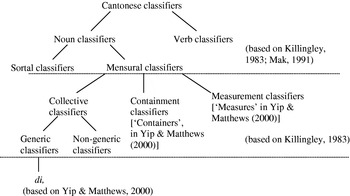
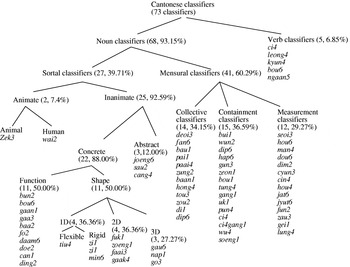
Yip & Matthews (Reference Yip and Matthews2000) suggests an easy-to-understand typology of Cantonese classifiers: (1) ‘measures’ that in the narrow sense words are used in counting quantities that are called ‘measurement classifiers’ by Killingley (Reference Killingley1983), for example jat1 gan1 coi3 ‘a catty of vegetables’; (2) ‘containers’ constituting an open-ended category since any container can serve as a measure, such as saam1 bui1 caa4 ‘three cups of tea’, called ‘containment classifiers’ by Killingley (Reference Killingley1983) ; (3) ‘collective’ classifiers refer to a grouping of items such as nei1 ban1 hok6 saang1 ‘this class of students’, go2 deoi1 laap6 saap3 ‘that pile of rubbish’, equivalent to Killingley's (Reference Killingley1983) ‘collective classifiers’; (4) ‘plurals’ and ‘quantities’ with di1, the word di1 being used for both countable and uncountable nouns. This can be seen as a special kind of collective classifier, for example di1 caang2 hou2 tim4 ‘(CL) the oranges are very sweet’ (referring to an unspecified number of countable items), di1 seoi2 ng4 gaau3 jit6 ‘(CL) the water is not hot enough’ (referring to quantities of uncountable substances). Wei & Lee (Reference Wei and Lee2001) assert that di1 is a classifier denoting plural and non-count nouns and is often overgeneralized to denote countable and singular nouns. After considering these widely received typologies of Cantonese classifiers, the writers have converted them into the systematic typology described in Figure 1, then investigated whether the productions of Cantonese-speaking preschoolers are in accord with the proposed typology.
A typology of Cantonese classifiers.

Figure 1 summarizes the subtypes of mensural classifiers. Yamamoto (Reference Yamamoto2005: 42) proposes ‘a semantic structure for Chinese classifiers’ that seems able to encompass most Chinese classifiers. It is a semantic typology of the sortal classifiers for Mandarin per se. Despite various grammatical differences between Mandarin and Cantonese, classifiers make similar semantic distinctions in the two varieties of Chinese. Accepting that Yamamoto's typology is almost wholly applicable to Cantonese, the writers employ this typology to classify sortal classifiers in Cantonese and propose a more complete typology of Cantonese classifiers for the present study (see Figure 3).
In Yamamoto's typology, go3 (CL) is placed at the top node as a default general classifier. General classifiers are supposed to be widely used with all nouns in many numeral classifier languages (Lyons, Reference Lyons1977). In Mandarin, go3 (CL) is the most frequently used classifier and classifies numerous nouns, so is widely regarded as the general classifier (Chao, Reference Chao1968; Li & Thompson, Reference Li and Thompson1981; Erbaugh, Reference Erbaugh and Craig1986). Cantonese has the same morpheme go3 (CL), making it the most likely candidate for the general classifier. However, Mak (Reference Mak1991) questions whether go3 (CL) can be qualified as the general classifier in Cantonese on semantic grounds, pointing out that go3 (CL) has its own semantic restrictions and cannot be used with some nouns. For instance, go3 (CL) is generally not used with substance-denoting nouns. Thus, the acceptability of phrases such as jat1 go3 seoi2 ‘one (CL) water’ is marginal. Mak (Reference Mak1991) therefore suggests that it seems more appropriate to group it under ‘mixed’ classifiers, as no single classifier in Cantonese can claim to behave comprehensively as a general classifier. The writers question the evidential base for this conclusion for, whilst it is important to examine children's actual use of go3 in Cantonese, it is just as important to explain why a general classifier in the acquisition process is welcome and helpful. One advantage of having a general classifier in the system is that it can predict/explain the direction of overgeneralization and why children overuse and generalize go3 (CL) to other specific classifiers.
In addition to the debate about the existence of a general classifier, there are arguments among linguists over the exact number of Cantonese classifiers. Although over 200 classifiers have been documented as being in everyday use by adult speakers of Cantonese in Hong Kong (Wong, Reference Wong1998, Reference Wong and Clark2000), some researchers propose that there are only some 60 classifiers or so in Cantonese (Wei & Lee, Reference Wei and Lee2001; Erbaugh, Reference Erbaugh2002). Uncertainty over the exact number of Cantonese classifiers is partly due to dialectal differences and the non-orthographic nature of some classifiers. It is also the case that container classifiers form an open-ended category and any container can serve as a classifier (Yip & Matthews, Reference Yip and Matthews2000). If it is a difficult task for psycholinguists to specify all the classifiers in Cantonese, the problems experienced by young children in mastering the system are understandable. In addition, the choice of classifier is often arbitrary and not predictable from the meaning or physical characteristics of the referent (Wei & Lee, Reference Wei and Lee2001). Sometimes there may be two or more alternative classifiers for the same noun, depending on the context and on the particular attribute of the referent the speaker wishes to emphasize. All these usages have to be learned individually. These unique features help to make the acquisition of Cantonese classifiers a fascinating research topic for Chinese psycholinguists.
The acquisition of Cantonese classifiers
A number of longitudinal and experimental studies have been conducted over recent decades into the acquisition of classifiers in languages such as Mandarin (Erbaugh, Reference Erbaugh and Craig1986; Loke & Harrison, Reference Loke, Harrison, Gao and Hoosain1986; Hsu, Reference Hsu1987; Loke, Reference Loke and Kwan-Terry1991; Tse, Tang, Shie & Li, Reference Tse, Tang, Shie and Li1991; Hu, Reference Hu1993a, Reference Hu and Clarkb), Cantonese (Poon, Reference Poon1980; Loke & Harrison, Reference Loke, Harrison, Gao and Hoosain1986; Mak, Reference Mak1991; Szeto, Reference Szeto, Lee, Wong, Leung, Man, Cheung and Szeto1996, Reference Szeto1998; Wong, Reference Wong1998, Reference Wong and Clark2000), Thai (Gandour, Petty, Dardarananda, Dechongkit & Mukngoen, Reference Gandour, Petty, Dardarananda, Dechongkit and Mukngoen1984; Carpenter, Reference Carpenter1991), Japanese (Sanches, Reference Sanches, Blount, Sanches and Gumperz1977; Matsumoto, Reference Matsumoto, Nelson and van Kleek1987; Uchida & Imai, Reference Uchida and Imai1999) and Hokkien (Ng, Reference Ng1991). For example, Fang (Reference Fang1985) conducted an elicited counting study on 12 classifiers (11 sortal, 1 mensural) by Mandarin- and Cantonese-speaking children and found that the ability to use appropriate classifiers was low for both Mandarin- and Cantonese-speaking four-year-olds, and that performance increased rapidly during the preschool period. The syntax of classifiers in noun phrases in the form of [Num-CL-N] NP was mastered much earlier than the classifier semantics. All of the four-year-olds had already acquired the correct classifier syntax in enumerating noun phrases. In addition, both Mandarin- and Cantonese-speaking children used ge/go3 to replace more appropriate classifiers.
Poon (Reference Poon1980) examined the acquisition of sortal classifiers by 27 Cantonese-speaking children aged between 2;7 and 6;10. Altogether, 27 sortal classifiers were anticipated to be prompted through the 89 different noun objects depicted on picture cards. In fact, the children produced 1–19 types of classifiers. Significant individual differences were found and the use of classifiers generally increased with age. The youngest children used only go3 and the oldest children (6;10) had not yet reached adult-level proficiency.
With 122 normal children aged between four and eight years and 63 children aged between nine and sixteen years who had mild learning disability, Mak (Reference Mak1991) tested children's knowledge of 6 shape classifiers and 4 function classifiers. The major findings were that on average the children's performance improved with age and, in the initial stage, children overwhelmingly preferred the general classifier go3 (CL). It is interesting to note that rules later also start emerging for tiu4 (CL), zi1 (CL) and lap1 (CL). The small number of test items (10 classifiers), however, is too small for pronouncing definitively on early classifier acquisition.
Szeto (Reference Szeto1998) explored the development of the entire classifier system in early child Cantonese via a one-year, in-depth longitudinal study of eight Cantonese-speaking children aged from 1;5 to 3;8. She found that: (1) the first set of Cantonese classifiers emerged around 1;7 to 1;8, although usage was sporadic; (2) the syntactic acquisition of classifiers was completed around 2;1 to 2;2; (3) children's classifier inventories varied from 23 to 39 different classifier types with examples of verb classifiers, sortal and mensural classifiers; (4) verb classifiers were rarely used, whereas the majority of classifiers used were sortal noun classifiers; (5) children were sensitive to the mandatory nature of classifiers and rarely omitted them; and (6) the inappropriate use of classifiers was infrequent and mostly occurred with mixed classifiers. The small sample size was freely acknowledged as a major limitation of the study.
Wong (Reference Wong and Clark2000) argues that the above studies focus solely on sortal classifiers, thus missing out a very revealing piece of the puzzle, that of mensural classifiers. Only by taking into consideration all three subtypes of classifiers (sortal, mensural and verbal) is it possible for a complete developmental trend to be validly identified. Hence, Wong conducted a longitudinal study of four monolingual Cantonese-speaking children in Hong Kong (three males and one female) aged between l;5 and 2;10. The major findings were that: (1) the children were sensitive from the onset of acquisition to all three subtypes of classifiers: numeral, verbal and mensural; (2) the general classifier go3 (CL) was highly overgeneralized by children, with a strong preference to extend it to animals and various other referents; and (3) the general classifier go3 (CL) and the verbal classifier indicating location, dou6, were the first two classifiers that all four children used. zek3 (CL), a numeral classifier for animals, and di1, a mensural classifier for plurality, were the next set of classifiers. However, the very small sample size (N=4) and few age variations (between l;5 and 2;10), weaken the generality of the findings of the study.
In brief, analyses of previous studies have elicited as many questions as answers. There is doubt about the exact number of the productive repertoire of classifiers by Cantonese-speaking children. A robust typology of Cantonese classifiers of the type made possible in the present study needs to be tested, and whether children use go3 as the general classifier needs to be ascertained. At the same time, the developmental trend that syntactic acquisition precedes semantic mastering and that the core set of first classifiers reflects a proto-system with the crucial elements in place needs to be examined in a large sample. In an attempt to resolve these issues and to shed light on the acquisition of Cantonese classifiers in early childhood, the writers raised the following questions to guide the design of the fieldwork:
(1) How many types of classifiers can be identified in the productive repertoire of classifiers of Cantonese-speaking preschoolers?
(2) Will a typology emanating from the present study be sufficiently robust to permit conclusions about Cantonese-speaking children's productive repertoire?
(3) Will any core set of first classifiers reflect the subtypes of classifiers listed in the typology?
(4) Are there differences in classifier acquisition between children at different age levels? Specifically, will one find stable age-related developments in the type of classifiers and repertoire size?
(5) Is there a general classifier in Cantonese-speaking preschoolers' daily production? How might this be overgeneralized in classifier usage in early childhood and why?
METHOD
Subjects
The subjects were randomly selected from the sample participating in the International Educational Achievement (IEA) Preprimary Project, which gathered data from Hong Kong children in order to establish a normative framework of developmental milestones for children aged 3;0 to 5;11. The sampling pool of the IEA Project consisted of all the Cantonese-speaking preschoolers in this age range in Hong Kong. The sample in the present study consisted of 492 children selected from 68 preschools (58 kindergartens and 10 nurseries) located in Hong Kong Island, Kowloon and the New Territories. The subjects were randomly selected from each class in the participating preschools, representing three age groups (3;0, 4;0 and 5;0), with 82 boys and 82 girls in each age group. In order to minimize the influence of variability of home background and teaching approach, the number of children in each preschool was limited to 10.
Communication task
A toy-play context was set up in the selected children's classroom and furnished with a set of toys, including cooking materials, food and fruit, furniture and electrical appliances, hospital materials and vehicles. Each randomly arranged pair of participants (boy/girl, boy/boy or girl/girl) was left in the play corner to play for 30 minutes. They were encouraged to talk while they were playing and the 30-minute conversations were recorded using an unobtrusive recorder. During the free-play sessions, researchers observed but did not intervene and there were no other children present.
Transcription
All conversations were audiotaped using high-fidelity equipment. Each conversation was first transcribed by one of two conversation researchers to a level of detail that captured all words and word fragments audible to the ear, as well as overlapping speech. Also transcribed were non-lexical fillers (such as ‘uh’) and other vocalizations (such as laughter). Transcriptions were made using a tape player that allowed automatic rewinding for repeated playing at slow and normal speeds. After each conversation was transcribed, other researchers independently checked transcripts while listening to the tape to guarantee that each transcript was accurate.
Coding of the lexical classes
Specially trained research assistants entered the transcribed utterances into a computer using Microsoft Chinese Windows 98 and Office 97. Next, the Chinese script of each child's oral language was segmented into utterances. Classifiers (including wrongly-used ones) were identified in the types of noun phrases below in Cantonese (Szeto, Reference Szeto1998) by two research assistants. Then the coding results were scrutinized by one author of this paper and all the writers carefully went through the listed classifiers to achieve a consensus of the Cantonese classifiers.

Reliability
The text transcript of the corpus, which consisted of 246 cases, was divided into halves and two trained coders coded each half (n=123). Before starting the formal coding, the two coders recoded 6 cases selected from each half. The percentage agreement on the 12 cases was a satisfactory 93·8%, indicating an excellent inter-rater reliability.
RESULTS
The final database consisted of a total of 90,908 words from the 492 children. The sample produced a mean of 48·65 (s.d.=17·35) utterances that yielded a mean of 184·77 (s.d.=52·38) vocabulary words per child. The percentages of each lexical class (including exclamations and onomatopoeia) across the three age groups were calculated. The majority of words produced by the sample were verbs, auxiliaries, pronouns, nouns and adverbs, accounting for 80% of the total number of words produced by the participants. By contrast, the proportion of classifier tokens was consistently lower than 8% (6·72% for age 3;0, 7·11% for age 4;0 and 7·5% for age 5;0). It is important to note that all of the language samples were of variable length; thus the absolute counts were not used directly in the analyses. In counting the number of classifier types produced by each child, for example, the researcher counted only whether the child had used the classifiers or not, not the number of times a classifier had been used. In this way, this study could count how many types of classifiers the children used and then the repertoire size of each age group. This calculation is therefore independent of utterance length.
The productive repertoire of Cantonese preschoolers
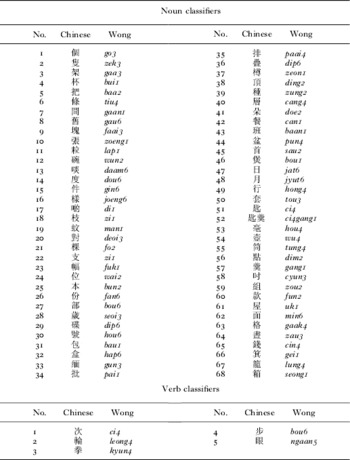
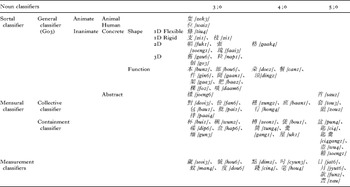
Altogether 73 classifier types were identified from the utterances produced by the 492 participants. As shown in Table 1 and Figure 3, all these classifiers were able to be placed appropriately within the typology proposed by the writers. The number and relative percentages of each subtype within the subcategories are shown in Figure 3. The results indicate that: (1) most (93·15%) of the Cantonese classifiers were noun classifiers; few (6·85%) were verb classifiers; (2) within noun classifiers, mensural classifiers exceeded sortal classifiers in terms of percentages (60·29% vs. 39·71%) and total numbers (41 vs. 27); (3) inanimate classifiers (25, 92·59%) predominated over animate classifiers (2, 7·4%) within the subcategory of sortal classifiers; (4) collective classifiers (14, 34·15%), containment classifiers (15, 36·59%) and measurement (12, 29·27%) had almost even levels in the subcategory of mensural classifiers; (5) concrete classifiers (22, 88%) prevailed over abstract classifiers (3, 12%) within the subcategory of inanimate classifiers; (6) there was only one classifier within the subtype of animal classifier and that of human classifier; (7) an even proportion between function classifiers (11, 50%) and shape classifiers (11, 50%) was found in the subcategory of concrete classifiers; and (8) there was no predominance of 1D (4, 36·36%), 2D (4, 36·36%) or 3D (3, 27·27%) classifiers within the subcategory of shape classifiers.
List of the classifiers produced by the Cantonese-speaking preschoolers (N=492)

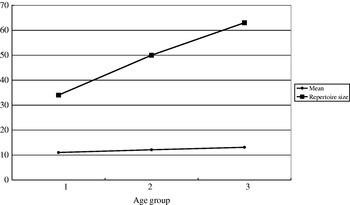
The noun classifiers produced by the three age groups were analyzed and placed within the typology to permit identification of developmental trends. As shown in Table 2 and Figure 2, the results indicate that: (1) the first set of classifiers produced by the three-year-old Cantonese speakers covered all the subtypes in the typology; (2) 54% of the noun classifiers were present in the three-year-olds’ utterances, 25% in those of the four-year-olds and 21% in those of the five-year-olds; and (3) the time of and before three years is possibly a critical period for the acquisition of Cantonese classifiers.
Mean number of classifier types and repertoire size produced by three age groups (N=492).

The list of noun classifiers manipulated by Cantonese-speaking preschoolers

ANOVAs of age and gender were applied to examine age and gender differences in the number of classifier types. The results shown in Table 3 indicate that there was a marginally significant effect for age (F(2, 489)=2·42, p=0·09), but not for gender (F(1, 489)=0·73, p=0·392) in the number of classifier types. Further, no significant age-by-gender effect was found from a two-way ANOVA of age by gender. There was a gradual but significant increase in the repertoire sizes among the three age groups, as shown in Figure 2, suggesting an apparent age-related growth trend in classifier variations.
Mean and s.d. of types of classifiers and repertoire size produced by age 3;0, 4;0 and 5;0

* p<0·05.
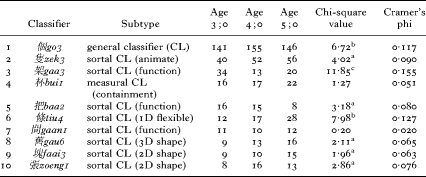
Two-way contingency tables were used to test for statistically significant age and gender differences in the first 10 classifiers with the highest frequency of occurrence. As shown in Table 4, significant age differences were found in most cases, the exceptions being bui1 (CL) (mensural classifier, containment) and gaan1 (CL) (sortal classifier, function). No gender differences were found. Dramatically, 9 of the top 10 classifiers are sortal classifiers, the only mensural classifier being bui1 ‘cup’, which is originally a name of a container. To partial out the effect of sample size, Cramer's phi was used to calculate the effect size. The biggest effect is gaa3 (CL), which is 0·155 and is considered a small effect. This is reasonable since the effect of a large sample size has been discounted. Hence, though there are significant effects of age on these top classifiers, the effects are not large.
Age differences in top 10 classifiers with the highest frequency of occurrence in Cantonese-speaking children

a p<0·05.
b p<0·005.
c p<0·001.
Overgeneralization and inappropriate use of classifiers
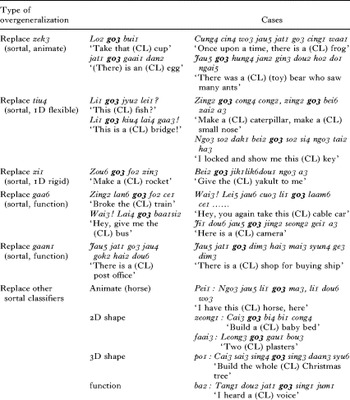
It was found that the percentages of use of the classifier go3 in children's conversations were 86% (141/164), 95% (155/164) and 89% (146/164) for age 3;0, 4;0 and 5;0, respectively. The overextended use of go3 (CL) occurred most frequently to refer to everyday objects which have their own specific classifiers, such as human beings nei1 go3 jan4 ‘this (CL) person’ and keoi5 go3 hok6 sang1 ‘his/her (CL) student’, and round objects such as jat1 go3 caang2 ‘one (CL) orange’ and loeng5 go3 bo1 ‘two (CL) balls’. As shown in Table 5, go3 (CL) was used by the Cantonese-speaking children to replace most of the subtypes of sortal classifiers such as zek3 (animate), tiu4 (1D flexible), zi1 (1D rigid), gaa6 (function), gaan1 (function), zoeng1 (2D shape), faai3 (2D shape), po1(3D shape) and baa2 (function). It's important to note that all of the overgeneralizations of go3 occurred in the cases where a specific sortal classifier is needed to classify the noun. No cases of replacing mensural classifiers with go3 were found in the present study. This indicates that, in terms of the syntactic awareness of these Cantonese preschoolers, the general classifier go3 was used to replace only sortal classifiers, not all kinds of classifiers.
Summary of the overgeneralizations of go3 by the Cantonese preschoolers (N=492)

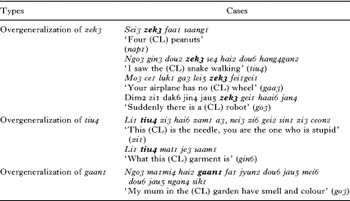
However, go3 was not the only overgeneralized classifier. Other classifiers, such as zek3 (CL), tiu4 (CL) and gaan1 (CL), were also ‘borrowed’ to replace other specific classifiers. A summary of these cases is presented in Table 6. As they are not general classifiers, the overgeneralization of these classifiers is regarded as ‘inappropriate’ usage. Other instances of the inappropriate use of a classifier out of place, for example using a classifier where one is not required, the omission of classifiers and so on were not found in the present study. The finding of no omission of classifiers seems to indicate that, by three years, Cantonese-speaking children understand that a classifier is obligatory when enumerating or quantifying nouns. However, one case of using redundant classifiers was found, as is evident in the following example:
utterance: Jau5 go3 jau5 go3 gaan1 maai5 tong4 gwo2 ge3 dim3 hai2 dou6.
corrected: Jau5 gaan1 maai5 tong4 gwo2 ge3 dim3 hai2 dou6.
english: ‘There is a (CL) shop selling candies, over there.’
Summary of the overgeneralizations of other classifiers by the Cantonese preschoolers (N=492)

This example with two classifiers could be a case of self-repair or correction: the child begins with the non-target jau5 go3 ‘there is a (CL)’ before repeating this sequence and eventually arriving at the target classifier, gaan1 (CL). If so, the apparent double classifier would be a performance error rather than a systematic one.
DISCUSSION
As the largest investigation ever made so far of classifier acquisition in Cantonese-speaking children, the research set out to examine a rich set of data in an attempt to ascertain the productive repertoire of classifiers and to outline developmental trends. Turning first to the productive repertoire of Cantonese classifiers by the preschool children, using a substantially sized sample there was abundant evidence to test the appropriateness and suitability of the typology proposed in Figure 3. It was found that the productive repertoire of Cantonese classifiers could be classified fully within the typology in Figure 3. The 492 children produced a total number of 73 classifier types, a figure very close to that (N=63) in Szeto's (Reference Szeto1998) study of 8 Cantonese-speaking Hong Kong children from 1;5 to 3;8. The tiny difference between two studies might be primarily due to the age difference, as the subjects in the present research were aged from 3;0 to 5;0. The writers believe that the total number of 73 seems reasonable, even though there is no absolute consensus on the exact number of Cantonese classifiers among linguists. In addition, both Szeto (Reference Szeto1998) and the present study found that the core set of first classifiers contained all three subtypes of classifiers: numeral, verbal and mensural. These consistent findings indicate that the young children had acquired the syntactic prototype of the three subtypes of classifiers by age 3;0.
The typology of the Cantonese classifiers produced by the sample (N=492).

It was also found that most of the first classifiers are noun classifiers, with few being verb classifiers. The significant predominance of noun classifiers would be well received by Cantonese linguists (Killingley, Reference Killingley1983; Yip & Matthews, Reference Yip and Matthews2000; Erbaugh, Reference Erbaugh2002). In addition to the predominance of noun classifiers, three other types of predominance were found within the noun classifiers. Mensural, inanimate and concrete classifiers significantly dominate their own subcategories, respectively. The prevalence of inanimate classifiers and that of concrete classifiers has been found in adult productions and accords with the theories of respected Cantonese linguists such as Killingley (Reference Killingley1983) and Yip & Matthews (Reference Yip and Matthews2000). The predominance of mensural classifiers, however, reflects not only the developmental trend of classifier acquisition but also the specific features of Cantonese classifiers. Linguistically, the relatively large percentage of mensural classifiers within the subcategory of noun classifiers may be attributed to the expanding subtype of containment classifiers. Understandably, this usage is open-ended, as any container could be used as a containment classifier. At the same time, most previous studies of Cantonese classifiers have focused on sortal classifiers (see Wong, Reference Wong and Clark2000).
It may be that, developmentally, this phenomenon is associated with the maturing language proficiency of young children. Types of mensural classifiers were found significantly more often than those of sortal classifiers. However, nearly all the top ten classifiers were sortal classifiers (except for one mensural classifier). The conflict in these findings is possibly attributable to developments in language proficiency and might be reflecting cognitive development. Sortal classifiers qualify the noun referent according to intrinsic characteristics, while mensural classifiers quantify the noun referent by a humanly determined unit (Szeto, Reference Szeto1998). Classification by a sortal classifier is intrinsic whereas a mensural classifier imposes an extrinsic measure on the noun referent. Hence, using sortal classifiers is more applicable than using mensural classifiers as different sortal classifiers suggest different intrinsic attributes of the noun referent. In addition, Szeto (Reference Szeto1998) speculates that the impact of a precise quantity on children is less important than the impact of the intrinsic qualities of the noun referent. Therefore, the younger children in her study (Szeto, Reference Szeto1998) used more sortal classifiers, and the young children in our study used sortal classifiers more frequently.
Three developmental trends in classifier acquisition, widely reported in the literature (Poon, Reference Poon1980; Hu, Reference Hu1993; Szeto, Reference Szeto1998; Mak, Reference Mak1991; Wong, Reference Wong and Clark2000), were also found in the present study. First, the children overwhelmingly favoured the ‘general classifier’ go3 in this early stage of their language acquisition. Hu (Reference Hu1993a, Reference Hu and Clarkb) asserts that children acquire the syntactic structure of the numeral classifier phrase by first acquiring the general classifier as a placeholder that is later replaced by more specific classifiers. The acquisition of a general classifier is syntactically motivated and that of specific classifiers is semantically instigated. This proposal is supported by the evidence in the present study. Second, the study also lends support to the notion that children's performance in classifier usage generally improves with age (Poon, Reference Poon1980; Hu, Reference Hu1993a; Szeto, Reference Szeto1998; Mak, Reference Mak1991; Wong, Reference Wong and Clark2000). Some 54% of the noun classifiers in the productive repertoire emerged in the three-year-olds' utterances, and the number substantially increased each year during the remaining preschool years. Wei & Lee (Reference Wei and Lee2001) found an age-related but relatively slow progression (the productive repertoire of Cantonese classifiers was fewer than nine items). Sample size and language context might have made the difference, as the subjects in Wei & Lee's (Reference Wei and Lee2001) study were 34 British-born Cantonese–English bilinguals aged between five and sixteen years. Third, the present study's finding is similar to that of Fang (Reference Fang1985), who asserts that four-year-olds are able to use the correct classifier syntax in enumerating noun phrases. In fact, the evidence is that the three-year-olds in the present study had to a large extent acquired the basic syntax of classifiers, as no omission of classifiers was observed and go3 was widely used as a syntactic placeholder. Coincidently, Erbaugh (Reference Erbaugh and Craig1986, Reference Erbaugh and Slobin2002) found repeatedly that Cantonese-speaking children overused the general classifier but almost never omitted a classifier where it was grammatically required.
The present study found no predominance for using 1D, 2D and 3D shape classifiers among the participants. It is important to note that the notion of dimensionality (1D, 2D and 3D) is not an objective classification of the objects classified. Rather, it suggests that certain dimensions are cognitively salient. For example, something classified with zoeng1 (e.g. a table) is not actually a two-dimensional object. It is classified as such because it has a flat 2D surface as one of its salient features. In addition, the present study found no cases to support Wong's (Reference Wong and Clark2000) conclusion that animacy plays a role in determining which classifiers emerge earlier among children aged 1;5 and 2;10. This might be due to the age differences between two cohorts, and research involving a larger sample of younger children is needed to clarify the inconsistencies. Studies of logical thinking and cognitive development are also pertinent for illuminating the processes involved, as cognitive psychologists maintain that language mirrors thought.
The finding that go3 was overused by the participants is pertinent to theorizing about the use of a general classifier by very young children. Chao (Reference Chao1968) and Erbaugh (Reference Erbaugh and Craig1986) observed that Chinese has the general classifier ge (ge in Man darin, go3 in Cantonese), which is applicable to any individual noun and can replace any classifier. This is in line with Lyons' (Reference Lyons1977) definition of a general classifier. Since then, ge has been widely accepted as the general classifier in Mandarin to classify numerous nouns (Chao Reference Chao1968; Lyons, Reference Lyons1977; Li & Thompson, Reference Li and Thompson1981; Erbaugh, Reference Erbaugh and Craig1986). But some researchers (e.g. Mak, Reference Mak1991) suggest that go3 (CL) in Cantonese should not be treated as a general classifier, even though it can be used with very many nouns. The data in the present study seem to indicate that go3 (CL) in Cantonese could be labelled ‘general classifier’. It was found that in 86–96% of the occasions when the children used a classifier, go3 (CL) was their first choice. And they tended to use go3 (CL) to replace only the sortal classifiers (not the mensural classifiers) including: (1) animal sortal classifiers; (2) 1D, 2D and 3D shape sortal classifiers; and (3) function sortal classifiers. These findings are consistent with analyses by Matthews & Yip (Reference Matthews and Yip1994) and the findings of Fang (Reference Fang1985), Stokes & So (Reference Stokes and So1997), Szeto (Reference Szeto1998) and Wong (Reference Wong and Clark2000). One may argue that the children have not yet securely acquired the exact semantics of the classifiers and do not yet know which classifier is appropriate in certain contexts, and therefore opt for the general classifier go3 (CL). Erbaugh (Reference Erbaugh2002) found that even highly educated people might use a general classifier where prescriptive grammar expects a sortal classifier, and the general classifier go3 (CL) is widely used with 44% of Cantonese nouns. Furthermore, the present study found that go3 (CL) was the most frequently used classifier, even at the age of 4;0 and 5;0 when the children were able to use a greater variety of classifiers, such as zoeng1 (CL), faai3 (CL) and bun2 (CL). In these circumstances, the writers suggest that go3 be regarded as the general classifier.
Why did the children overuse the general classifier? There are cognitive, linguistic and contextual influences that may be presumed to have shaped this overuse by the sample. First, using the general classifier is a cognitively accessible and economical strategy so that, when in the toy-play situation, the children eased the burden on their cognitive processing and shortened response time by using the widely accepted and ‘general’ classifier. Similarly, Fang (Reference Fang1985) noted that overuse of the general classifier might be an outcome of a cognitively accessible and economical strategy. Second, the general classifier is typically the only correct choice to refer to ‘human’ other than wai2 (CL), the human-only classifier in Cantonese which is widely used in the written language. Third, discourse factors are also important. It was noted in the present study that the first mention of an object often featured a specific classifier, but that later mention very often was simplified to the general classifier. This interpretation is given weight by the inappropriate use of other classifiers. Beside the wide use of the general classifier, zek3 (CL), tiu4 (CL) and gaan1 (CL) were also employed to replace specific classifiers by the participants in the present study.
Why did the young children overgeneralize these three high-frequency classifiers? First, overusing zek3 (CL) might be attributed to the fact that this classifier is highly salient for Cantonese speakers (Erbaugh, Reference Erbaugh2002) and that, accordingly, it was the most frequently used classifier (except for go3 in the present study. Mak (Reference Mak1991) suggests that children with higher language proficiency, or who are in a higher age group, tend to overgeneralize specific classifiers commonly used in daily life. In the present study, zek3 (CL) was the top sortal classifier with the highest frequency of occurrence (see Table 4) and the children tended to overuse it in their utterances. This finding is in line with that of Erbaugh (Reference Erbaugh2002). Second, the overuse of tiu4 (CL) might be a type of misusing behaviour when children tend to repeat the same classifier that has occurred in their previous phrases, such as nei5 jau5 jat1 tiu4 syun4, ngo3 jau5 jat1 tiu4 ce1 ‘You have a (CL) boat, I have a (CL) car’. In this case, they overgeneralize the classifier tiu4, as they are aware that a classifier is syntactically necessary but are unable or simply unwilling to produce a semantically more appropriate one. Third, the overuse of gaan1 is of special interest to the writers, as there have been no similar reports in other studies. In Cantonese, gaan1 refers to a whole flat or building (Erbaugh, Reference Erbaugh2002). In the case of ngo3 maa1mi4 hai2 gaan1 faa1 jyun2 dou6 jau5 mei6 dou6 jau5 ngaan4 sik1 ‘My mum in the (CL) garden have smell and colour’, the specific classifier for ‘garden’ is zo6, which is also a function sortal classifier like gaan1 (CL). However, gaan1 (CL) is easier than zo6 (CL) to grasp (e.g. gaan1 is a top seven classifier) and emerges earlier (around three years) than zo6 (CL), which is not yet in the repertoire of Cantonese-speaking preschoolers. Possibly, this case might reflect the fact that the child had not yet reached adult-level proficiency.
On the basis of using a large sample and gathering a large bank of linguistic data from an authentic ‘child’ context, evidence has been gathered that enable a number of conclusions to be drawn: an exact quantification of the productive repertoire of classifiers by Cantonese-speaking children has been proposed; a working typology of Cantonese classifiers has been advanced; and the general classifier go3 (CL) has been confirmed. The study has also uncovered developmental trends that are worth exploring further. However, the study has its limitations. First, it targeted a cross-sectional rather than a longitudinal sample and, second, the age range examined should, in hindsight, have been extended both downwards and upwards in order to permit comment on the validity of published research in the area.
As it stands, the study offers a descriptive but accurate account. Its design and scope did not permit the researchers to comment on how the children's language had developed, but the typology and repertoire found in the present study have set up a cornerstone for further theoretical building. Are the developmental trends a product of the nature of Cantonese or are they by-products of home and the linguistic environmental factors? It is likely, of course, that both possibilities apply. The discovery that young Cantonese-speaking children tend to overgeneralize several commonly used classifiers should be noted by early childhood educators. Such usage should be tolerated and children should be provided with structured learning to utilize and extend their linguistic repertoire. The researchers were struck by the considerable variability in the children's language and believe that there is clearly scope for further study of Cantonese classifiers.