INTRODUCTION
Expressive suppression (ES) is an emotion regulation strategy involving effortful control of behavioral and facial manifestations of emotions (Gross, Reference Gross1998). ES has been well-documented to interfere with performance on measures of executive functioning (EF). Such interference carries into the future, with test performance being sub-optimal even after ES has stopped. For example, research has demonstrated that experimentally manipulated ES is associated with subsequent performance decrements on tests of reasoning and generative fluency, initiation and inhibition, and working memory (Baumeister & Alquist, Reference Baumeister and Alquist2009; Franchow & Suchy, Reference Franchow and Suchy2017; Inzlicht & Gutsell, Reference Inzlicht and Gutsell2007; Schmeichel, Reference Schmeichel2007; Schmeichel, Vohs, & Baumeister, Reference Schmeichel, Vohs and Baumeister2003). Importantly, ES does not appear to have any impact on performance on measures of lower-order processes, such as visual scanning, motor speed, or simple sequencing (Franchow & Suchy, Reference Franchow and Suchy2015, Reference Franchow and Suchy2017; Niermeyer, Ziemnik, Franchow, Barron, & Suchy, Reference Niermeyer, Ziemnik, Franchow, Barron and Suchy2018); as such, ES appears to be a factor that differentially affects EF performance.
Regarding the timeframe within which ES exerts influence on EF performance, no research has thus far clearly addressed this question, and only indirect evidence exists. Based on experimental studies, it has been proposed that the interference lasts at least half an hour (since the assessment often goes on for some 30 min past ES exposure), and possibly even longer (Baumeister, Bratslavsky, Muraven, & Tice, Reference Baumeister, Bratslavsky, Muraven and Tice1998; Fischer, Kastenmüller, & Asal, Reference Fischer, Kastenmüller and Asal2012; Muraven, Tice, & Baumeister, Reference Muraven, Tice and Baumeister1998; Schmeichel, Reference Schmeichel2007).
In addition, in our recent work, we have shown that naturally occurring (as opposed to experimentally manipulated) ES in daily life is also associated with subsequent EF decrements, such that higher than usual self-reported engagement in ES before testing is associated with poorer performance on EF tests (Franchow & Suchy, Reference Franchow and Suchy2015; Niermeyer, Franchow, & Suchy, Reference Niermeyer, Franchow and Suchy2016). In these studies, “prior to testing” has been variably defined as occurring any time on the day of test administration, or even any time within the past 24 hr (up to and excluding the testing session). Given these findings, it is possible that the deleterious impact of ES may last for several hours, potentially representing an important and as-of-yet uncontrolled moderator of both daily functioning and performance during neuropsychological assessment.
In addition to the direct impact of ES on immediately subsequent test performance, there is also the possibility that ES could have an impact on EF performance much further in the future. Specifically, it is possible that ES may interfere with the subsequent encoding and/or consolidation of new information, thereby precluding individuals from benefitting from exposure to, or practice of, various tasks. Consequently, ES could have an impact on individuals’ ability to learn new tasks in daily life, or it could confound neuropsychological re-assessments due to interference with the expected practice effects.
There are good reasons to believe that ES may interfere with memory and learning. First, memory encoding is well recognized to be a process that either relies on EF, or, per some accounts, represents a component of EF (Suchy, Reference Suchy2015). Consequently, if ES interferes with EF, it should also interfere with memory and learning. Second, in a pilot study examining the impact of tic suppression (which we conceptualized as a form of ES) on cognition, we found that memory consolidation was disrupted, as evidenced by poor delayed recall on a list-learning task (Himle et al., Reference Himle, Hayes, Suchy, Thorgusen, Herbert, Zelaya and Chang2012). Lastly, there is evidence that certain other transient factors (e.g., pain, sleep disturbance) that appear to interfere with EF (Abeare et al., Reference Abeare, Cohen, Axelrod, Leisen, Mosley-Williams and Lumley2010; Karp et al., Reference Karp, Reynolds, Butters, Dew, Mazumdar, Begley and Weiner2006; Tinajero et al., Reference Tinajero, Williams, Cribbet, Rau, Bride and Suchy2018) also interfere with memory functions (Cavuoto et al., Reference Cavuoto, Ong, Pike, Nicholas, Bei and Kinsella2016; van der Leeuw et al., Reference van der Leeuw, Eggermont, Shi, Milberg, Gross, Hausdorff and Leveille2016), suggesting that EF and memory are similarly vulnerable to interference from transient factors.
Given that memory and learning have been shown to predict the magnitude of practice effects on at least some neuropsychological measures (Busch, Chelune, & Suchy, Reference Busch, Chelune and Suchy2005; Thorgusen, Suchy, Chelune, & Baucom, Reference Thorgusen, Suchy, Chelune and Baucom2016), the above findings suggest that ES may also result in a reduced ability to benefit from task exposure or task practice. While the indirect evidence supporting this idea is compelling, the current literature is limited in several ways.
First, most studies examining the relationships between these state-level factors and learning or memory have assessed cognition during a single testing visit and have purely focused on performance on memory measures. To our knowledge, no studies have investigated whether these taxing factors would interfere more generally with the ability to benefit from task exposure, thereby interfering with practice effects during a repeat test administration. Second, the studies that examined interference with memory and learning have only examined the taxing impact of pain, sleep disturbance, or tic suppression, not “classic” ES. The present study aimed to address these gaps in the literature.
Purpose of the Current Study
The principal aim of this study was to determine whether the deleterious effect of experimentally manipulated ES would carry forward such that test administration 1 year later would still be affected (presumably due to interference with memory/learning at the time of the initial test administration). As we have done in our prior research on ES (Franchow & Suchy, Reference Franchow and Suchy2015, Reference Franchow and Suchy2017; Niermeyer et al., Reference Niermeyer, Ziemnik, Franchow, Barron and Suchy2018), we also examined whether the impact of ES would be unique to EF or whether lower-order cognitive processes would also be affected. Based on past research, we hypothesized that participants who engaged in ES as part of experimental manipulation would exhibit the deleterious effects of ES on repeat test administration 1 year later, but only for EF measures.
To these ends, we conducted a baseline assessment of a sample of community-dwelling older adults using a battery of standard clinical tests of EF and lower-order cognitive processes. We then experimentally manipulated ES and immediately following the manipulation we re-administered the cognitive measures (including both EF tests and tests of lower-order processes)Footnote 1 . One year later, participants returned for a follow-up, during which all tests were re-administered again. To our knowledge, the present study is the first to examine the deleterious impact of ES on EF test performance 1 year later.
METHODS
Participants
Participants were drawn from a sample of 110 community-dwelling older adults from the Salt Lake City area who participated in a larger study on the impact of emotion regulation on cognition. Participants were recruited from a senior health fair and from a university program for older learners. Interested individuals provided contact information in person or by email and completed eligibility screening by phone. Individuals with a self-reported history of dementia or mild cognitive impairment, uncorrected vision or hearing impairments, color-blindness, left-handedness (due to evidence of differing cognitive profiles of left-handed individuals; Gunstad, Spitznagel, Luyster, Cohen, & Paul, Reference Gunstad, Spitznagel, Luyster, Cohen and Paul2007; Szaflarski et al., Reference Szaflarski, Binder, Possing, McKiernan, Ward and Hammeke2002) and motor dysfunction in the right hand/arm (precluding completion of speeded graphomotor tasks; see the Measures section) were excluded from participation.
To minimize prior exposure to our measures, individuals reporting recent participation in cognitive testing (in research or clinical contexts) were also excluded. Participants were pseudo-randomly assigned to either the Expressive Suppression or the Control conditions. Pseudo-random, as opposed to random, assignment was conducted to ensure group comparability on demographics.
From the total sample of 110 tested participants, three were excluded from analyses because they reported the following potentially confounding conditions in a comprehensive medical history interview conducted during the testing visit: a history of occipital stroke (n=1), hereditary motor neuropathy (n=1), and essential tremor (n=1). Five participants were removed because they had outlying low values on an IQ estimate and as such were responsible for causing group differences on IQ (once they were removed, the groups became comparable). Seven additional participants were excluded from analyses because they failed to follow instructions per their assigned experimental condition (see Validity Check in Preliminary Analyses).
Lastly, two were excluded because their 1-year follow-up evidenced a notable decline in general cognition during the intervening year (4 and 6 scaled score points lower on the follow-up DRS-2, suggesting that a failure to exhibit practice effects could be explained by abnormal cognitive decline, rather than experimental manipulation). This resulted in a final sample of 93 participants (49 in the Expressive Suppression condition and 44 in the Control condition). From among these, 69 participants returned for the 1-year follow-up (33 in the Expressive Suppression condition and 36 in the Control condition). One participant in the final sample was missing baseline EF score, and 31 participants were missing sleep information, as sleep question was included in the study only after data on 31 participants have been collected. There were no other missing data.
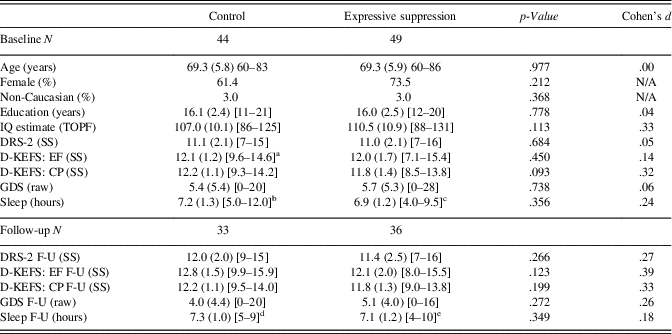
As seen in Table 1, groups did not differ at baseline or at follow-up (all p values>.160) on demographics or IQ estimate, general cognitive status, or factors thought to affect state cognition (depressive symptoms, self-reported total hours of sleep in the 24 hr before their laboratory visit). However, participants who failed to return for follow-up exhibited a lower baseline IQ (M=103.3; SD=9.8) than those who returned (M=110.8; SD=10.3), t=3.1, p=.003, Cohen’s d=.75.
Descriptive statistics for demographics and baseline and follow-up psychiatric and cognitive functioning

Note. a,b,c,d,e n=43,33,29,30,32, respectively.
SS=Scaled Score; F-U=Follow-up; TOPF=Test of Premorbid Functioning; DRS-2=Dementia Rating Scale 2nd edition; D-KEFS=Delis Kaplan Executive Function System battery; EF=Executive Function composite; CP=Component Process composite; GDS=Geriatric Depression Scale; Sleep=self-reported hours of sleep in the 24 hours before testing.
Procedures
The study was approved by the university Institutional Review Board and was conducted in compliance with APA ethical standards. Before testing, participants were assigned to either the Expressive Suppression or Control conditions. Initial group assignment was determined randomly (via online random order generator), with later participants assigned to groups pseudo-randomly to ensure comparability on age, sex, and educational attainment.
After providing informed consent, participants completed a structured interview developed in our laboratory, providing information about handedness, colorblindness, the number of hours they slept the night before, as well as their medical and psychiatric histories, including the following: impact to the head with loss of consciousness (including a description of the event, age, length of loss of consciousness, medical care including hospitalization, whether neuroimaging was conducted, post-traumatic amnesia, and additional accompanying symptoms), hospitalization for other reasons, brain surgery, carbon monoxide or other toxin exposure, any psychiatric disorder, learning disability, repeating a grade, attention deficit disorder, stroke/TIA, seizures or epilepsy, multiple sclerosis, hydrocephalus, brain tumor, chronic or severe headaches/migraines, high blood pressure, diabetes, heart disease, sleep apnea, and COPD. They then completed a baseline assessment, followed by experimental manipulation, followed by repeat administration of baseline measures.
This session lasted approximately 4 hours and took place in the Executive Laboratory in the Social and Behavioral Sciences building at the University of Utah. At the end of the visit, participants were given the option of receiving written and oral feedback on their cognitive status and were reimbursed $40 for participation. Eleven to 15 months later (M=12.62; SD=.95), participants returned for follow-up assessment, during which the baseline battery was re-administered. Participants were again given the option of receiving feedback on their cognitive performance and were reimbursed $30.
Measures
General cognitive status
The Dementia Rating Scale, 2nd edition (DRS-2) (Jurica, Leitten, & Mattis, Reference Jurica, Leitten and Mattis2001), is a well-validated battery of tests that measures abilities in the domains of attention, initiation/perseveration, visuospatial construction, concept formation, and memory in persons over age 60 (Brown et al., Reference Brown, Rahill, Gorell, McDonald, Brown, Sillanpaa and Shults1999; Kovner et al., Reference Kovner, Wayne Lazar, Lesser, Perecman, Kaplan, Hainline and Napolitano1992; McDaniel & McLaughlin, Reference McDaniel and McLaughlin2000). Lower scores indicate poorer cognitive status (Jurica et al., Reference Jurica, Leitten and Mattis2001). Previous research suggests that the total score is sensitive to individual differences in non-clinical samples (Suchy, Kraybill, & Franchow, Reference Suchy, Kraybill and Franchow2011). The DRS-2 total Scaled Score was used as an estimate of general cognitive status, to examine group comparability.
IQ estimate
The Test of Premorbid Functioning (TOPF; Pearson, 2009) is an untimed reading task of phonetically irregular words. It has high internal and test–retest reliability (Chu, Lai, Xu, & Zhou, Reference Chu, Lai, Xu and Zhou2009). The TOPF was administered to yield an estimate of IQ (standard scores by age group) to characterize the sample and determine group comparability.
Depression
The Geriatric Depression Scale (GDS) is a widely used self-report screening measure for depression in older adults (Yesavage, Reference Yesavage1988). Participants were asked to indicate whether they have experienced any of 30 depressive symptoms over the past week. The GDS was administered to characterize the sample and to determine group comparability.
Executive-functioning composite
The Delis-Kaplan Executive Function System battery (D-KEFS) is a well-validated, widely used battery of EF (Delis, Kaplan, & Kramer, Reference Delis, Kaplan and Kramer2001; Delis, Kramer, Kaplan, & Holdnack, Reference Delis, Kramer, Kaplan and Holdnack2004). Participants completed four subtests, yielding the following eight age-corrected scaled scores: Trail Making Test: Letter Number Sequencing (Time to Complete); Verbal Fluency: Letter Fluency (Total Correct), Category Switching (Total Correct); Design Fluency: Filled Dots (Total Correct), Empty Dots (Total Correct), Switching (Total Correct); Color-Word Interference: Inhibition (Time to Complete) and Inhibition/Switching (Time to Complete).
Consistent with previous research (Franchow & Suchy, Reference Franchow and Suchy2015; Kraybill & Suchy, Reference Kraybill and Suchy2011; Kraybill, Thorgusen, & Suchy, Reference Kraybill, Thorgusen and Suchy2013), the arithmetical mean of these score was used as a single EF composite for each individual. Importantly, a similar D-KEFS composite score was found to be sensitive to EF decrements associated with self-reported expressive suppression in young adults (Franchow & Suchy, Reference Franchow and Suchy2015). Baseline and post-manipulation executive composite scores demonstrated good internal consistency reliability in this sample (baseline Cronbach’s α=.711; post-manipulation Cronbach’s α=.797).
Component-process composite
The D-KEFS also includes conditions designed to measure lower-order component processes(i.e., basic perception, numeric sequencing, graphomotor speed, and visual scanning) known to contribute to EF performance yet being distinct from the EF construct. Age-corrected scaled scores were generated for six subtests, and their arithmetical mean was calculated to generate a single component-process composite score for each individual. These subtests consisted of Trail Making Test: Visual Scanning (Time to Complete), Number Sequencing (Time to Complete), Letter Sequencing (Time to Complete), and Motor Speed (Time to Complete); and Color-Word Interference: Color-Naming (Time to Complete) and Word-Reading (Time to Complete). Baseline and post-manipulation composites demonstrated adequate to good internal consistency in this sample (baseline Cronbach’s α=.661; post-manipulation Cronbach’s α=.751).
Experimental Manipulation
Based on previously published methods (Muraven et al., Reference Muraven, Tice and Baumeister1998; Schmeichel et al., Reference Schmeichel, Vohs and Baumeister2003), experimental manipulation was designed to tax EF for participants assigned to the Expressive Suppression group, but not for those assigned to the Control group. Specifically, all participants viewed affect-inducing video clips (without audio). Participants in the Expressive Suppression group were instructed to view the clips while avoiding to reveal any of their emotional reactions. In contrast, participants in the Control group were instructed to simply view the videos and react naturally, as they would if they were watching TV at home.
Stimuli
Clips consisted of amusing and disgust-inducing material readily available on the Internet, including material shown on popular television shows and news. Disgust-inducing material included people eating non-food items or people with various physical abnormalities and injuries. Such disgusting images are commonly used in experimental manipulations of expressive suppression and are associated with reliably high autonomic responses and subjective unpleasant emotional experience (Gross, Reference Gross1998). Amusing material consisted of people and animals in physically comedic situations. Amusing images were included to induce positively valenced responses with physiologic similarities to disgust (Demaree, Schmeichel, Robinson, & Everhart, Reference Demaree, Schmeichel, Robinson and Everhart2004; Hubert, Möller, & de Jong-Meyer, Reference Hubert, Möller and de Jong-Meyer1993). Clips were collated to form two videos: Video A was comprised of 2.5 min of disgusting content, and Video B was comprised of 2.5 min of amusing content. Videos were presented in counterbalanced order.
Manipulation check
To ensure that participants in each condition followed instructions, participants also answered the following question in a free-response format: “What was your approach to completing this [video viewing] task? Please describe how you went about watching the videos in the space below.” Furthermore, to ensure that the Expressive Suppression and Control conditions were differentially effortful (as designed), a manipulation check was conducted immediately following the task in the form of a Likert-style item querying the level of effort exerted across both videos (“How difficult was the video-viewing task?” 1- Not at all difficult, 2- Somewhat difficult, 3- Fairly difficult, 4- Very difficult, 5- Extremely difficult). As independent verification of participants’ self-report, participants’ reactivity (which was video-recorded) was coded by blinded raters using a Likert-type scale (1- No observable reaction to 5- Constant reactions that were poorly controlled). Due to technical difficulties and/or examiner error, video-recordings were unavailable for 4 participants (Control n=1; Expressive Suppression n=3).
RESULTS
Preliminary Analyses
Manipulation check
Regarding their self-reported approach to watching the videos, participants’ free responses were coded for indications of expressive suppression (e.g., “tried to keep a straight face,” “remained stoic,” “swallowed my laughter”). As noted above, seven participants failed the manipulation check and were eliminated from further analyses. Three of these participants were in the Control condition, but spontaneously reported suppressing their affect (against instructions); four were in the Expressive Suppression condition, but reported a lack of regulatory effort of any kind. The remaining participants in the Expressive Suppression condition all reported expending deliberate regulatory effort as compared to Control participants (Chi Square=22.89; df=1; p<.001). Among retained participants, suppressors also rated the video viewing task (across disgusting and amusing films) as significantly more difficult overall (t=2.04; p=.044; Cohen’s d=.43).
Confirming their self-report, per coding conducted by blinded raters, participants in the Expressive Suppression group exhibited fewer facial expressions to both the disgusting and amusing films compared with those in the Control group (all t values>7.5, all p values<.001, all Cohen’s d values>1.8). Taken together, participants’ self-reported strategies and level of effort expended as well as observations of blinded raters converge to demonstrate that retained participants in both groups followed task instructions, such that suppressors were expending greater and more deliberate effort to control their affect relative to controls.
Zero-order correlations
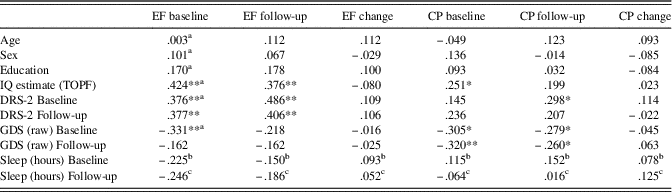
Zero-order correlations between demographics, cognitive status, mood, and sleep on the one hand and EF and component processes (CP) composite scores (baseline, follow-up, and change) on the other hand are presented in Table 2. As seen in the table, EF and CP at both baseline and follow-up were generally correlated with IQ, cognitive status (DRS-2), and depression (GDS); however, the size of the changes from baseline to follow-up was uncorrelated to potential demographic, cognitive, or psychiatric covariates, showing that these other factors did not have an impact on changes in scores. Additional, baseline to follow-up correlations for EF, CP, DRS-2, GDS, and hours of sleep were .815, .806, .622, .786, and .500, respectively (all p values<.001). Lastly, EF and CP correlated .519 at baseline and .600 at follow-up (all p values<.001).
Zero order correlations among demographics, psychiatric, and cognitive variables

Note. N=93 for Baseline * Baseline coefficients, N=69 for coefficient involving follow-up, except when otherwise indicated.
a n=92.
b n=46.
c n=62.
** p<.01 (two-tailed).
*p<.05 (two-tailed).
TOPF=Test of Premorbid Functioning; DRS-2=Dementia Rating Scale 2nd edition; D-KEFS=Delis Kaplan Executive Function System battery; EF=Executive Function composite; CP=Component Process composite; GDS=Geriatric Depression Scale; Sleep=self-reported hours of sleep in the 24 hours prior to testing.
Principal Analyses
Analyses used multilevel modeling methodology. Specifically, we examined (a) how the first administration of the D-KEFS during the baseline visit and the final administration of the D-KEFS approximately 1 year later varied as a function of time in years, and (b) how the effect of time differed as a function of group membership (Expressive Suppression vs. Control). In these analyses, time points were nested within persons. Available data included 162 time points for 93 persons. Multilevel modeling was justified for these analyses, because there were some participants who did not return for follow up and because participants differed slightly in the amount of time between the baseline and follow-up visits. The assumptions of multilevel modeling allow for all possible data to be used to improve the point estimates where applicable (participants who did not return for follow-up), and for there to be varying time intervals across participants.
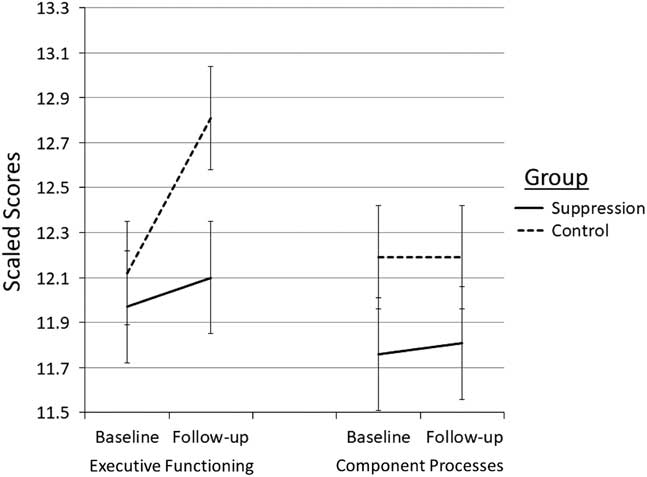
For the EF composite, results revealed that the average score at baseline collapsed across groups was 12.1. There was a significant effect of time for the EF analysis (coded in years), such that for every 1-year increase there was a .6 increase in the EF composite (B=.6; p=.001). This increase most likely represents the size of the practice effect for the EF composite over time, as there is no reason for participants’ EF capacity to improve over time, and since it is well accepted in clinical neuropsychology that test re-administration is frequently associated with such a practice phenomenon. There was also a significant effect of the ES manipulation for EF, such that participants in the Expressive Suppression condition showed a smaller practice effect relative to Controls (B=−.5; p=.047).
For the CP composite, the average score at baseline collapsed across groups was 12.2. However, unlike the EF composites, the CP composite did not evidence the effect of time in years (B=−.1; p=.47) or the effect of group membership (B=−.1; p=.79).
For both the EF and the CP composites, there were statistically significant random effects on the intercepts (both p values<.001), suggesting that, collapsed across groups, there were individual differences in older adults’ performances on the EF and CP composites at baseline. As would be expected, the ES manipulation did not have a statistically significantly effect on baseline performance for neither the EF composite (B=−.19; p=.568) nor the CP composite (B=−.47; p=.052). See Figure 1.
The figure illustrates the differential impact of group membership (Suppression vs. Control) on test performance 1 year after baseline assessment. As expected, for executive functioning, practice effect is evidenced for the Control Group only. Groups do not differ on their performance on measures of lower-order component processes. Error bars reflect±1 standard effort of measurement.

DISCUSSION
Prior research has shown that engagement in an emotion regulation strategy known as Expressive Suppression (ES) is associated with subsequent decrements in performance on measures of Executive Functioning (EF). The present study experimentally manipulated ES to determine whether EF would be impacted not only immediately post-manipulation (which has already been demonstrated in this sample previously, Franchow & Suchy, Reference Franchow and Suchy2017), but also at a 1-year follow-up. Such a long-term impact could be due to ES interfering with either (a) the consolidation of new learning from both the initial (i.e., pre-manipulation) and the second (post-manipulation) exposure to the tests, or (b) the encoding during the second (i.e., post-manipulation) exposure to the tests. The key finding of the present study is that participants who engaged in ES during experimental manipulation did in fact exhibit a decrement in performance relative to controls at a 1-year follow-up. This is the first study to examine the long-term impact of ES on cognitive performance. The implications of this finding for diagnostic and functional questions often addressed by clinical neuropsychologists are discussed below.
Repeat neuropsychological assessment is commonly used to clarify whether a neurodegenerative condition is present for patients with mild cognitive impairment, and/or to evaluate the cognitive outcomes related to changes in modifiable factors (e.g., interventions for mood, medication adjustments; Lezak, Howieson, Bigler, & Tranel, Reference Lezak, Howieson, Bigler and Tranel2012). The current finding illustrates how state-level factors (such as ES) present during or before a baseline assessment can have a lasting effect on performance as far out as 1 year later. Such interference with performance complicates the interpretation of repeat assessments (particularly for EF measures) as it may be unclear whether a reduced performance (evidenced by a smaller-than-expected practice effect relative to baseline) reflects underlying neuropathology, or whether it simply reflects a lack of learning during the initial assessment caused by the presence of a transient factor such as ES.
Indeed, EF measures have been shown to have lower test–retest reliabilities than measures of other cognitive domains (Calamia, Markon, & Tranel, Reference Calamia, Markon and Tranel2013), which may in part be explained by the vulnerability of EF to inference from state-level factors. To facilitate quantification of such factors for clinical use, we have developed a self-report measure of state ES (Burden of State Emotion Regulation Questionnaire; BSERQ) and have shown its association with performance on measures of EF in both younger and older adults (Franchow & Suchy, Reference Franchow and Suchy2015; Niermeyer et al., Reference Niermeyer, Franchow and Suchy2016). The present findings provide further evidence that the impact of ES on test performance can be far-reaching and as such justify further development and validation of instruments like the BSERQ.
Repeat neuropsychological assessment of older adults is also commonly used in research settings. Examples include evaluating cognitive trajectories as a function of education and bilingual status (Mungas, Early, Glymour, Zeki Al Hazzouri, & Haan, Reference Mungas, Early, Glymour, Zeki Al Hazzouri and Haan2017), amyloid burden (Machulda et al., Reference Machulda, Hagen, Wiste, Mielke, Knopman, Roberts and Petersen2017), and psychiatric conditions (Sarapas, Shankman, Harrow, & Goldberg, Reference Sarapas, Shankman, Harrow and Goldberg2012). The current findings suggest that group differences in state-level factors (e.g., ES) could result in continued group differences on subsequent longitudinal assessments even when state-level group differences are no longer present, and may help explain counter-intuitive findings such as a lack of an association between change in depressive symptom and change in EF performance (Sarapas et al., Reference Sarapas, Shankman, Harrow and Goldberg2012). Thus, using a self-report measure of state ES may help adjust EF tests scores to facilitate appropriate interpretation in findings.
As mentioned above, the development of methods to characterize and potentially correct for the presence of state-level factors that lead to reduced practice effects is an important topic for future research. For example, researchers could examine whether self-reported ES (as assessed via the BSERQ, or other similar instrument) in the period immediately before testing relates to the size of practice effects on EF measures during longitudinal assessment. It seems likely that such effects would be seen, as current research shows that higher self-reported ES before testing is linked to lower EF performance during a single study visit among both younger and older adults (Franchow & Suchy, Reference Franchow and Suchy2015; Niermeyer et al., Reference Niermeyer, Ziemnik, Franchow, Barron and Suchy2018). If similar relationships are seen between self-reported ES and EF practice effects, it may be possible to use ES self-report to statistically correct test performance.
Future research should also examine the mechanism by which ES interferes with EF both in the short term (by causing EF processing to be inefficient, depleted, or otherwise degraded), and in the long term. The most viable explanation for the long-term impact is that ES interferes either with the encoding of the new information, or with the subsequent consolidation of the new information, both of which are components of memory processing that contribute to practice effects seen on repeat test administration. Alternatively, the emotional state during the first exposure to the assessment environment may itself interfere with subsequent performance as the same emotional state is evoked during a repeat assessment. These presumed mechanisms need to be tested in future research.
Furthermore, the reason why the interference of ES with subsequent practice effect is limited to EF tests (and not non-executive tests that were also re-administered after suppressing) is less clear, but might potentially be explained by the fact that practice effects for CP tend to be smaller and may thus be less sensitive to interference.
Lastly, it is important to highlight the implications the current findings have for how ES (and other factors thought to tax EF) might affect functional outcomes. Specifically, it is well recognized that EF is among the strongest correlates of independent functioning (Bell-McGinty, Podell, Franzen, Baird, & Williams, Reference Bell-McGinty, Podell, Franzen, Baird and Williams2002; Boyle, Paul, Moser, & Cohen, Reference Boyle, Paul, Moser and Cohen2004; Cahn-Weiner, Boyle, & Malloy, Reference Cahn-Weiner, Boyle and Malloy2002; Cahn-weiner, Malloy, Boyle, Marran, & Salloway, Reference Cahn-weiner, Malloy, Boyle, Marran and Salloway2000; Carlson et al., Reference Carlson, Fried, Xue, Bandeen-Roche, Zeger and Brandt1999; Grigsby, Kaye, Baxter, Shetterly, & Hamman, Reference Grigsby, Kaye, Baxter, Shetterly and Hamman1998; Kraybill & Suchy, Reference Kraybill and Suchy2011; Kraybill et al., Reference Kraybill, Thorgusen and Suchy2013; Lau, Parikh, Harvey, Huang, & Farias, Reference Lau, Parikh, Harvey, Huang and Farias2015), suggesting that many instrumental activities of daily living (IADL) are executive in nature.
Thus, it is reasonable to assume that engagement in ES would interfere with a person’s ability to benefit from exposure to a new IADL in much the same way as it interferes with a person’s ability to benefit from exposure to EF assessment measure. For example, ES may interfere with an older person’s ability to learn to use new technology (e.g., a new cell phone) or relearn a skill after injury or illness. Reduced ability to learn from new situations following ES might also partially explain why older adult patients with depressive symptoms have poorer rehabilitation outcomes than their non-depressed peers (Ahn, Lee, Jeong, Kim, & Park, Reference Ahn, Lee, Jeong, Kim and Park2015; Allen, Agha, Duthie, & Layde, Reference Allen, Agha, Duthie and Layde2004), as such individuals may disproportionately engage in ES (D’Avanzato, Joormann, Siemer, & Gotlib, Reference D’Avanzato, Joormann, Siemer and Gotlib2013; Larsen et al., Reference Larsen, Vermulst, Geenen, van Middendorp, English, Gross and Engels2013). Providers invested in helping older individuals learn or relearn functional skills should be mindful of how state-level factors like ES could impede the rehabilitation process.
Limitations
The present study has some limitations. First, the study examined a relatively narrow range of cognitive abilities. Although the present findings are generally consistent with the notion that ES uniquely interferes with EF (to the exclusion of other cognitive domains, since lower-order component processes were not affected), future research should examine the impact of ES on a broader range of cognitive domains, most notably memory and procedural learning, as these processes play an important role in the ability to benefit from practice (Busch et al., Reference Busch, Chelune and Suchy2005).
Second, since the principal goal of the study was to examine the impact of ES on performance within a single session, EF tests were repeated three times (twice during the initial session, and once at the 1-year follow-up). It is not clear whether the impact on performance 1 year later would be notable had participants been exposed to the tests only once in the previous year. In fact, it is possible that no participants (regardless of group membership) would benefit from prior exposure after 1 year had they been exposed to the tests only once before. If that is the case, then the present findings may not be relevant in interpretation of repeat neuropsychological data; however, deleterious impact of ES on new IADL tasks or for rehabilitation outcomes would likely still hold, as such activities tend to be associated with multiple exposures.
Third, although CP evidenced a practice effect immediately post-manipulation (Franchow & Suchy, Reference Franchow and Suchy2017), there was no evidence of practice 1 year later. Consequently, it is not clear that the long-term impact of ES is unique to EF; alternatively, it may simply be the case that for some tests (e.g., CP) practice effects 1 year later are no longer relevant.
Fourth, we did not administer any performance validity tests (PVTs). Given that this is an experimental study, we assumed that non-cognitive contributions to performance (such as effort) would be equally distributed between groups. That said, effort may be a relevant factor when participants feel “depleted” by an emotionally demanding task, and thus future studies should include PVTs.
Fifth, participants in this study were overwhelmingly non-Latino white, with only two participants from other racial groups (i.e., Native Americans); thus, it is unclear whether present findings would generalize to other racial or ethnic groups. Additionally, participants in this study demonstrated high average IQ (TOPF Standard Score M=111) relative to general population, and it is unknown whether the results would generalize to individuals with lower intellectual capacity. Lastly, all participants in this study attained at least a high school diploma, with the majority holding a bachelor’s degree or higher; thus, it is unclear whether the present findings would generalize to individuals with lower educational attainment.
ACKNOWLEDGMENTS
The authors have no financial or any other kind of personal conflicts with this manuscript. This research received no specific grant from any funding agency, commercial or not-for-profit sectors.