INTRODUCTION
Cold-water corals may occur in isolated colonies, in patch reefs, or form large reef and mound structures which can be up to several kilometres in diameter (Roberts et al., Reference Roberts, Wheeler and Freiwald2006). Whilst cold-water corals have been recognized since the 18th Century it is only recently that improvements in survey techniques have resulted in an awareness of the abundance of reef structures: during the past decade carbonate mounds have been discovered in the Porcupine Seabight and the Rockall Trough, these form seabed elevations up to 300 m in height and are usually covered in coral reef patches, approximately 1 m thick, of Lophelia pertusa and Madrepora oculata (Freiwald et al., Reference Freiwald, Fosså, Grehan, Koslow and Roberts2004). Cold-water coral reefs are complex habitat structures in the deep ocean and are of high ecological importance, providing habitat, feeding ground and nursery functions for deep-water organisms including commercial fish species (Freiwald et al., Reference Freiwald, Fosså, Grehan, Koslow and Roberts2004). High biodiversity is associated with these reefs: over 1300 species have been found on Lophelia pertusa reefs in the north-east Atlantic (Roberts et al., Reference Roberts, Wheeler and Freiwald2006), primarily associated with dead coral framework and coral rubble as living coral appears to be successful in preventing fouling (Freiwald et al., Reference Freiwald, Fosså, Grehan, Koslow and Roberts2004).
A new area of cold-water coral reef, termed the Mingulay Reef Complex, was located during a multibeam survey in 2003, in relatively shallow water (Roberts et al., Reference Roberts, Brown, Long and Bates2005). This reef structure was investigated in July 2006 (Maier, Reference Maier2006; Roberts et al. Reference Roberts, Davies, Henry, Dodds, Duineveld, Lavaleye, Maier, van Soest, Bergman, Huehnerbach, Huvenne, Sinclair, Watmough, Long, Green and van Haren2009), continuing the work of the Dutch funded programme which investigated cold-water coral reefs off the west coast of Ireland (Mienis & De Haas, Reference Mienis and de Haas2004; Van Duyl & Duineveld, Reference Van Duyl and Duineveld2005). One of the aims of these surveys was to investigate the species composition of sponges occurring in or near these reefs (see Van Soest & Lavaleye, Reference Van Soest and Lavaleye2005; Van Soest et al., Reference Van Soest, Cleary, Kluijver, Lavaleye, Maier and van Duyl2007). Sponges have been recognized as important in cold water reef communities (Bruntse & Tendal, Reference Bruntse and Tendal2001; Mortensen & Fosså, Reference Mortensen and Fosså2006), however, only one other project has studied sponge diversity on cold water reefs (Longo et al., Reference Longo, Mastrototaro and Corriero2005).
The genus Hymedesmia Bowerbank 1864 is large with 118 species currently known from the north-east Atlantic and Mediterranean, and 169 worldwide (Van Soest et al., Reference Van Soest, Boury-Esnault, Hooper, Rützler, de Voogd, Alvarez, Hajdu, Pisera, Vacelet, Manconi, Schoenberg, Janussen, Tabachnick, Klautau and Picton2008). Many of the extant Hymedesmia species have been described associated with cold-water corals (Lundbeck, Reference Lundbeck1910; Stephens, Reference Stephens1916, Reference Stephens1921; Alander, Reference Alander1942). Recent work has suggested this genus is one of the dominant sponge groups in coral reef communities (Van Soest in Maier, Reference Maier2006). The sponges of Lophelia pertusa coral from deepwater off the west and south-west coast of Ireland were studied by Stephens (Reference Stephens1916, Reference Stephens1921) who described four new species of Hymedesmia from this area. The Hymedesmia fauna of Britain and Ireland is still comparatively poorly known although six new species were recently described (Goodwin & Picton, Reference Goodwin and Picton2009). Many Hymedesmia species are known from only one or two records from the type locality.
Preliminary identifications of some of the Hymedesmia material collected in these surveys had been undertaken (Van Soest et al., Reference Van Soest, Cleary, Kluijver, Lavaleye, Maier and van Duyl2007) but it was not possible to give definitive identifications within the time frame of the project and only tentative identifications were given. This work provides descriptions of the Hymedesmia species found in these areas.
The shallow Mingulay reef system (80–190 m depth) represents an area of intermediate depth-range between the bathyal cold-water coral reefs off the west coast of Ireland and the coastal infralittoral and shallow circalittoral sponge communities. Approximately 25% of the species occurring on the Mingulay reefs also occur in shallow water habitats on the coast of the British Isles. The Rockall Bank sponges are all truly bathyal species (Van Soest in Maier, Reference Maier2006).
We describe five new species and provide new information on the bathymetric distribution of Hymedesmia species.
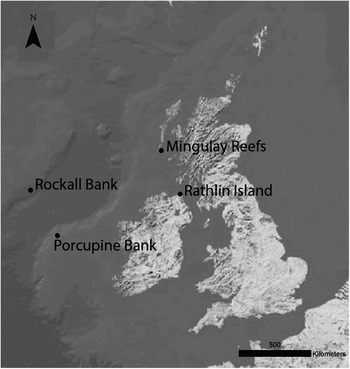
THE STUDY AREAS (FIGURE 1)
The sampling sites. Shading indicates the continental shelf.

Mingulay Reefs, Outer Hebrides, Scotland
These reef areas were investigated during the Royal Netherlands Institute for Sea Research BIOSYS 2006 cruise (Maier, Reference Maier2006; Roberts et al., Reference Roberts, Davies, Henry, Dodds, Duineveld, Lavaleye, Maier, van Soest, Bergman, Huehnerbach, Huvenne, Sinclair, Watmough, Long, Green and van Haren2009). The study site was confined to an area of 320 km2. This is a relatively shallow cold-water coral ecosystem; sites sampled ranged from 82–214 m. The study site is relatively sheltered from the open Atlantic Ocean by the island chains of the Hebrides.
Rockall Bank and Porcupine Bank
The Royal Netherlands Institute for Sea Research MOUNDFORCE Expedition 2004 (Mienis & de Haas, Reference Mienis and de Haas2004) sampled the south-east slope of Rockall Bank. Twenty stations in an area (55.25′–55.30′°N 15.37′–16.07′°W) at the south-east slope of Rockall Bank varying in depths from 557–1407 m were sampled.
The Royal Netherlands Institute for Sea Research BIOSYS-HERMES Expedition 2005 (Van Duyl & Duineveld, Reference Van Duyl and Duineveld2005) sampled the south-eastern part of the Rockall Bank (Logachev Mounds area) and the north-western side of the Porcupine Bank (Pelagia Mounds area), situated on either side of the Rockall Trough in the north-east Atlantic Ocean. The main study area was the Logachev Mound province on the south-east facing slope of the Rockall Bank in a depth-range of 550–900 m. Sites included two distinct areas with coral mounds approximately 10 nautical miles apart, designated as CLAN and Haas Mound Complex respectively. In addition sites on the north facing slope of the Porcupine Bank in a depth-range of 500–1000 m were investigated.
MATERIALS AND METHODS
Sampling
Samples were obtained by three methods (Maier, Reference Maier2006): video-grabbing; boxcoring using a 50 cm diameter cylinder; and trawling (10 minutes bottom time). From the Mingulay reefs a total of 228 sponge samples consisting of one or more specimens of a given species were secured from 20 boxcore attempts, 21 videograb and 2 dredge attempts (Maier, Reference Maier2006). From Rockall and Porcupine Banks 734 sponge samples were taken from 84 boxcores and 8 dredges/trawls in 2005 (Van Duyl & Duineveld, Reference Van Duyl and Duineveld2005), and 245 samples from 20 boxcores in 2004 (Mienis & de Haas, Reference Mienis and de Haas2004). Sponges were obtained from sub-samples of coral branches assigned for sponge research. Sponges detected on board were pre-identified using crude slide preparations (cf. Van Soest & Lavaleye, Reference Van Soest and Lavaleye2005) and preserved in 96% ethanol. Unsorted trawl sub-samples and boxcore subsamples were directly preserved in larger containers and analysed onshore in Amsterdam. All material is held in the Porifera collection of the Zoological Museum of Amsterdam (ZMA).
Identification
All material which had been identified as Hymedesmia was re-examined. Tissue slides were prepared by sectioning a very thin portion of tissue at a 90 degree angle through the sample, this was then dehydrated in absolute ethanol for four minutes and placed in clove oil for a further four minutes to clarify the tissue before being mounted on a microscope slide in Canada balsam. A coverslip was then placed on the slide and they were then kept at 50°C for at least 48 hours to allow the mountant to dry. Spicule preparations were prepared by placing a small piece of sponge tissue on a slide, adding a few drops of concentrated nitric acid and then heating over a spirit burner until tissue had dissolved. After rinsing with water and 95% alcohol the excess alcohol was burned off, leaving the dry spicules attached to the slide. Spicules were then either mounted in Canada balsam for light microscopy or sputter coated with gold-palladium for examination using a scanning electron microscope (Jeol 6500 FEG).
The tissue slide was used primarily for identification to genus level. Spicule measurements were taken from the spicule preparations; at least 20 spicules of each type were measured—taking care to include those that appeared near the ends of the size-range.
A list of the described Hymedesmia species was obtained from the online World Porifera Database (Van Soest et al., Reference Van Soest, Boury-Esnault, Hooper, Rützler, de Voogd, Alvarez, Hajdu, Pisera, Vacelet, Manconi, Schoenberg, Janussen, Tabachnick, Klautau and Picton2008). Original descriptions for all Hymedesmia species were examined; this was greatly facilitated by access to the collection of Hymedesmia descriptions at the Zoological Museum of the University of Copenhagen, compiled by Ole Tendal (ZMUC) and Shirley Stone (BMNH). Data on spicule sizes, presence/absence of microscleres and other distinguishing characters were entered into a spreadsheet to allow comparison of the material with the numerous described species.
Type specimens were examined from several collections, and are listed in the text. Institutional abbreviations used are as follows: ZMUC (The Zoological Museum of the University of Copenhagen (SNM)); NMI (The National Museum of Ireland, Dublin); BMNH (Natural History Museum, London); UM (The Ulster Museum, Belfast (National Museums Northern Ireland)).
RESULTS
Hymedesmia with microscleres:
TYPE MATERIAL
Holotype: specimen in industrial denatured alcohol (IDA), tissue section and spicule preparation on slides. (BIOSYS/HERMES 2005, Boxcore BX46/06; co-ordinates 55°29.964′N 15°47.899′W, south-east Rockall Bank–Haas Mounds; water depth 580 m) (ZMA 19537). Collected by R.W.M. Van Soest, 29 June 2005.
Paratypes: specimens in IDA, tissue sections and spicule preparations on slides. (1) (BIOSYS/HERMES 2005, Boxcore BX48/rest3; co-ordinates 55°29.943′N 15°47.941′W, south-east Rockall Bank–Haas Mounds; water depth 567 m) (ZMA 19545). Collected R.W.M. Van Soest, 29 June 2005. (2) (BIOSYS/HERMES 2005, Boxcore BX48/rest5; co-ordinates 55°29.943′N 15°47.941′W, south-east Rockall Bank–Haas Mounds; water depth 567 m) (ZMA 19547). Collected R.W.M. Van Soest, 29 June 2005. (3) (BIOSYS/HERMES 2005, Boxcore BX48/rest11; co-ordinates 55°29.943′N 15°47.941′W, south-east Rockall Bank–Haas Mounds; water depth 567 m) (ZMA 19553). Collected by R.W.M. Van Soest, 29 June 2005.
COMPARATIVE MATERIAL EXAMINED
Hymedesmia (Hymedesmia) poicilacantha Alander, Reference Alander1942. Cotype, spicule preparation on slide (Zoological Museum Copenhagen, slide 5.8.1937), 15 nautical miles south-east of Jomfruland Sweden. Collected on 5 August 1937, 400 m depth.
ETYMOLOGY
This species is named after Shirley Stone, former Curator of Porifera at the Natural History Museum London, in recognition of her work on the genus Hymedesmia.
DIAGNOSIS
External morphology
Appearance when living is not known. In spirit small, white, hispid patches on Lophelia pertusa coral (one piece on mollusc shell).
Skeleton
Basal layer of acanthostyles standing singly erect on the substrate, the small acanthostyles are much more abundant than the large ones. Short columns of tornotes arise from around the large acanthostyles. The large acanthostyles pierce the ectosome. A dense layer of large and small chelae is present in the ectosome with some chelae also scattered throughout the choanosome. Intermediate chelae with reduced alae and very thin shafts are present but only in the choanosome.
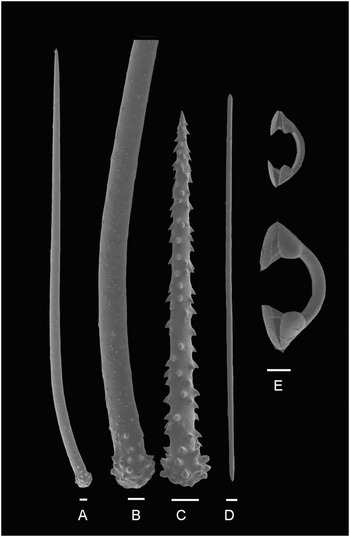
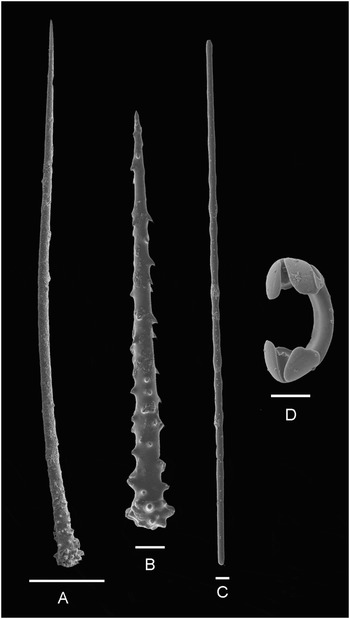
Spicules (Figure 2)
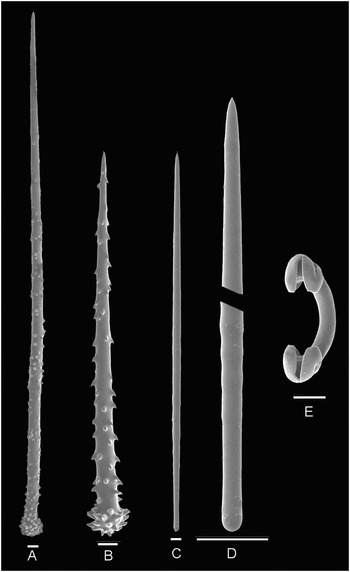
(1) Small acanthostyles 108(135)152 µm by 11(17)21 µm on the head and 7(11)14 µm on the shaft. Entirely spined with small recurved spines. The head is very slightly tylote and bears spines slightly larger than those on shaft. (2) Large acanthostyles 194(570)1175 µm by 16(27)32 µm. Some longer spicules may be present but the longest break on preparation and therefore may not have been measured. Shaft almost completely smooth but the head, and a very short piece of the shaft adjacent to it, bears small rounded spines. The shaft tapers evenly to a fine point. (3) Ectosomal spicules. Polytylote, fusiform, anisostrongyles. 362(399)427 µm by 6(8)13 µm. (4) Chelae: two size-categories of arcuate chelae with a bowed shaft: 51(56)60 µm and 25(32)39 µm. These are extremely abundant in the ectosome, forming a dense crust; a few are also present in the choanosome. There is an intermediate size-category of chelae with reduced alae and a very thin shaft 35(42)46 µm but these are very scarce and are present only in the choanosome.
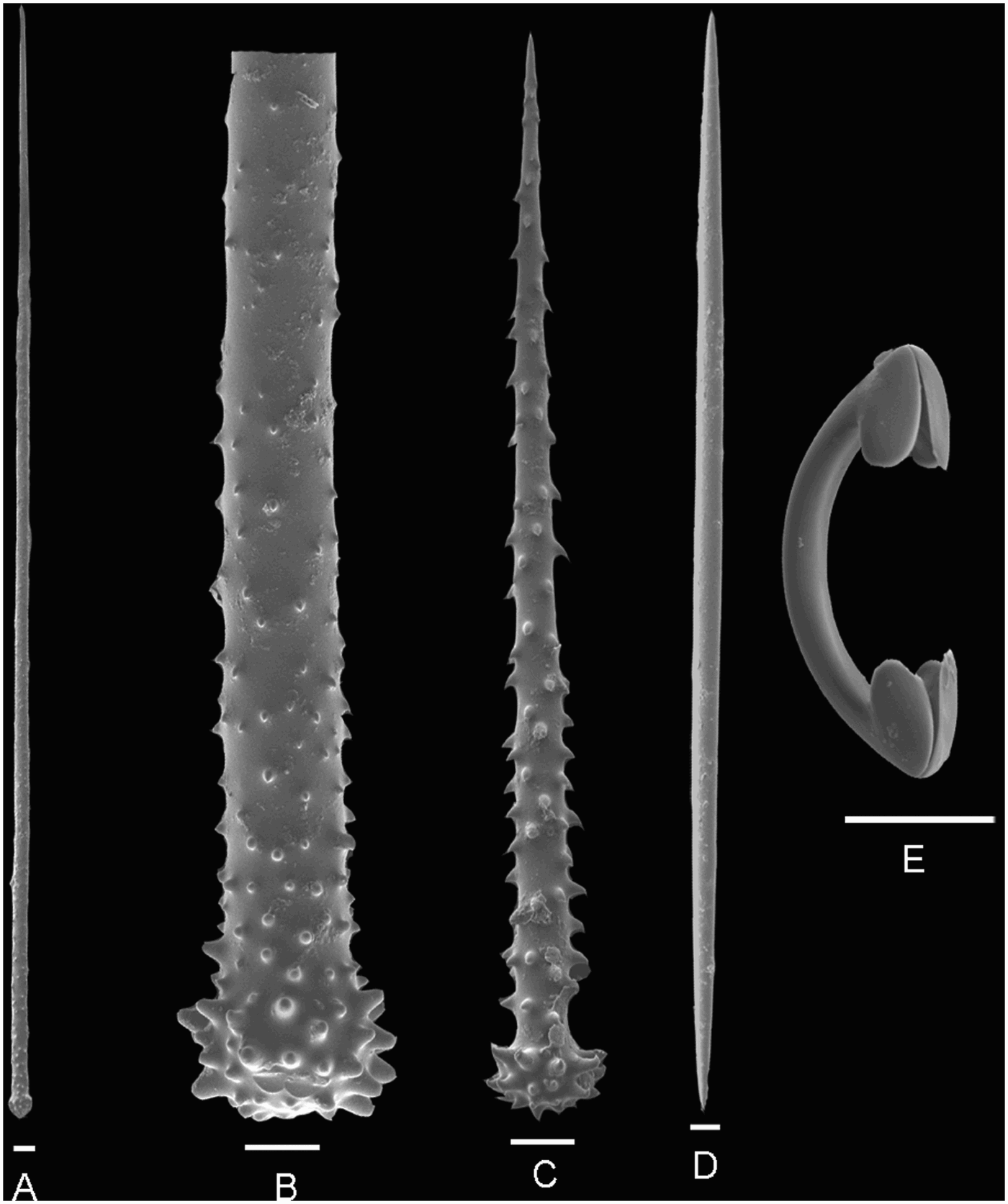
Hymedesmia (Hymedesmia) stoneae sp. nov. ZMA 19537. (A) Large acanthostyle; (B) base of large acanthostyle; (C) small acanthostyle; (D) ectosomal spicule; (E) large and small chelae. All scale bars 10 µm.

REMARKS
All six records are from south-east Rockall Bank, depth-range 567–767 m.
Large acanthostyles this long are rare in the genus. The only species with both large acanthostyles of a comparable size and polytylote strongyles is Hymedesmia poicilacantha Alander, Reference Alander1942. However, this has a smaller size-range of large acanthostyles (725–1250 µm) and small acanthostyles (130–160 µm) and only one category of chelae (30–50 µm). The cotype examined does not match the type description and is therefore likely to be a distinct species: although it possesses long acanthostyles (>1000 µm) the chelae have a wide, semi-circular shaft and small alae similar to those found in Hymedesmia (Hymedesmia) paupertas and Hymedesmia (Hymedesmia) bocki. Hymedesmia nummulus Lundbeck, Reference Lundbeck1910 also has large acanthostyles (510–950 µm) and possesses chelae of a similar form to our specimens. However, the size-range of the larger category of acanthostyles is smaller, the ectosomal spicules are not polytylote and it has only one size-category of chelae.
TYPE MATERIAL
Holotype: specimen in IDA, tissue section and spicule preparation on slides. (BIOSYS 2006, Videograb VG20-1/14; co-ordinates 56°49.401′N 007°23.864′W, Outer Hebrides, Mingulay Reef; water depth 139 m) (ZMA 20299). Collected by R.W.M. Van Soest, 11 July 2006.
Paratypes: specimens in IDA, tissue sections and spicule preparations on slides. (1) (BIOSYS 2006, Videograb VG28/02; co-ordinates 56°49.315′N 007°23.786′W, Outer Hebrides, Mingulay Reef; water depth 131 m) (ZMA 20317). Collected by R.W.M. Van Soest, 12 July 2006. (2) (BIOSYS 2006, Dredge DR182/rest; co-ordinates 56°49.456′N 007°22.118′W, Outer Hebrides, Mingulay Reef; water depth 128–137 m) (ZMA 20393). Collected by R.W.M. Van Soest, 22 July 2006. (3) (BIOSYS 2006, Dredge DR182/rest; co-ordinates 56°49.456′N 007°22.118′W, Outer Hebrides, Mingulay Reef; water depth 128–137 m) (ZMA 20409b). Collected by R.W.M. Van Soest, 22 July 2006.
COMPARATIVE MATERIAL EXAMINED
Hymedesmia (Hymedesmia) chlorosa Alander, Reference Alander1942. Type: specimen in alcohol (Swedish Museum of Natural History, specimen 2333, type sample 32). 15 nautical miles south-east of Jomfruland, Skagerrak, Sweden. Collected on 5 August 1937, 400 m depth. Spicule preparation and tissue section prepared from this material.
Hymedesmia (Hymedesmia) gustafsoni Alander, Reference Alander1942. Cotype: specimen in alcohol (Swedish Museum of Natural History, specimen 23120). Lophelia-bank of Säcken, Sweden. Collected on 27 May 1935, 85 m depth. Spicule preparation and tissue section prepared from this material.
ETYMOLOGY
This species is named after Ole Tendal, Associate Professor and Curator at the State Natural History Museum of Denmark in recognition for his work on the genus Hymedesmia and his assistance with this study.
DIAGNOSIS
External morphology
Appearance when living is not known. In spirit small, white, hispid patches on Lophelia pertusa coral.
Skeleton
Basal layer of large and small acanthostyles standing singly erect on the substrate, the longest piercing the sponge surface. Columns of ectosomal spicules (6–10 spicules thick) arise from around the acanthostyles. Chelae present throughout the tissue.
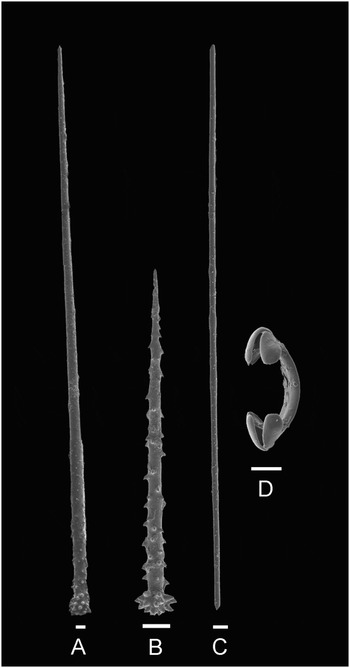
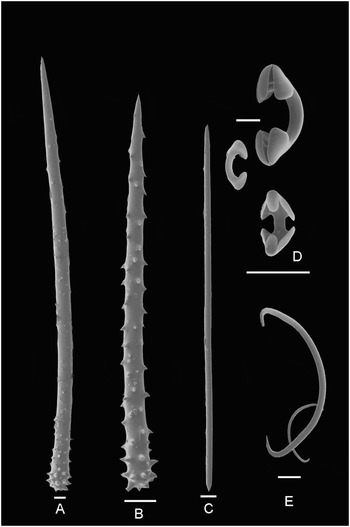
Spicules (Figure 3)
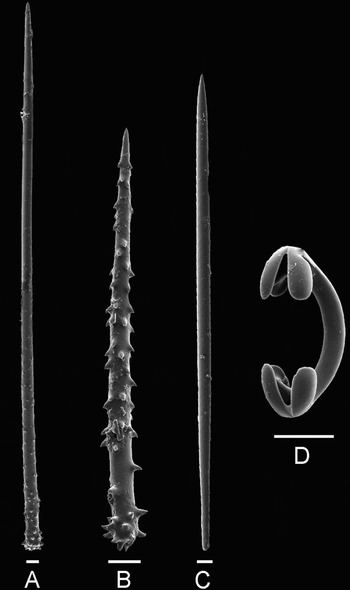
(1) Large acanthostyles. 269(337)415 µm by 15(23)29 µm on head and 8(14)19 µm on shaft. Spined for up to half their length; spines denser near to the head. Spines point out at 90° from shaft and are much larger on the head than on the shaft. Head is slightly tylote. Shaft comes to an abrupt point rather than smoothly tapering. (2) Small acanthostyles 90(113)139 µm by 11(15)21 µm on head and 6(9)13 µm on shaft. Entirely spined with small spines, these are recurved on shaft. Head marked with larger spines. (3) Ectosomal spicules 204(247)282 µm by 3(5)7 µm. Polytylote tylo-strongyles. (4) Chelae 41(47)53 µm. Large central alae, outer alae partially fused to the shaft. Shaft flattened.
Hymedesmia (Hymedesmia) tendali sp. nov. ZMA 20393. (A) Large acanthostyle; (B) small acanthostyle; (C) ectosomal spicule; (D) chelae. All scale bars 10 µm.

REMARKS
All five records from Mingulay Reef, Outer Hebrides depth-range 128–139 m.
There are two other Hymedesmia species with polytylote strongyles as ectosomal spicules and spicules in the same size-range: H. chlorosa Alander, Reference Alander1942 and H. gustafsoni Alander, Reference Alander1942. Hymedesmia chlorosa has fatter ectosomal spicules which are much more strongly polytylote; its chelae are smaller (27–34 µm) and have a bowed shaft and alae which are proportionally longer. Hymedesmia gustafsoni has distinctive chelae with a broad flattened shaft, more robust acanthostyles and ectosomal spicules which are not tylote at the ends.
Holotype: specimen in IDA, tissue section and spicule preparation on slides. (BIOSYS/HERMES 2005, boxcore BX48/rest10; co-ordinates 55°29.943′N 15°47.941′W, south-east Rockall Bank–Haas Mounds; water depth 567 m) (ZMA 19552). Collected by R.W.M. Van Soest, 29 June 2005.
Paratypes: specimens in IDA, tissue sections and spicule preparations on slides. (1) (BIOSYS/HERMES 2005, boxcore BX156/rest; co-ordinates 55°29.448′N 15°48.073′W, south-east Rockall Bank–Haas Mounds; water depth 573 m) (ZMA 20005). Collected by R.W.M. Van Soest, 11 July 2005. (2) (BIOSYS2006, dredge DR182/rest; co-ordinates 55°26.678′N 16°04.307′W, Outer Hebrides, Mingulay Reef; water depth 128–137 m) (ZMA 20410a). Collected by R.W.M. Van Soest, 22 July 2006. (3) (BIOSYS/HERMES 2005, boxcore BX48/rest11; co-ordinates 55°29.943′N 15°47.941′W, south-east Rockall Bank–Haas Mounds; water depth 567 m) (ZMA 19554). Collected by R.W.M. Van Soest, 29 June 2005. (4) BIOSYS/HERMES 2005, boxcore BX92/04; co-ordinates 55°30.062′N 15°47.274′W, south-east Rockall Bank–Haas Mounds; water depth 588 m) (ZMA 19675). Collected by R.W.M. Van Soest, 6 July 2005. (5) BIOSYS/HERMES 2005, boxcore BX173/rest; co-ordinates 55°26.678′N 16°04.307′W, south-east Rockall Bank–CLAN Mounds; water depth 629 m) (ZMA 20074). Collected by R.W.M. Van Soest, 12 July 2005.
ETYMOLOGY
This species is named after Joana Xavier, fellow Porifera researcher formerly of the Zoological Museum Amsterdam, in recognition of her assistance during the research in Amsterdam.
DIAGNOSIS
External morphology
Appearance when living is not known. In spirit small, white, hispid patches on substrate. In three specimens the substrate was mollusc shell, in three Lophelia pertusa coral.
Skeleton
Basal layer of closely packed acanthostyles standing singly erect on the substrate. Columns of ectosomal spicules 4–5 spicules thick surround acanthostyles and rise to the surface. Dense layer of chelae present in ectosome.
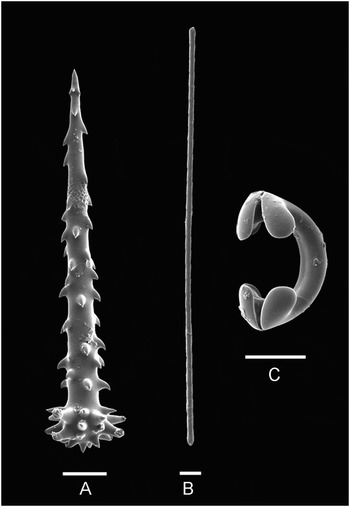
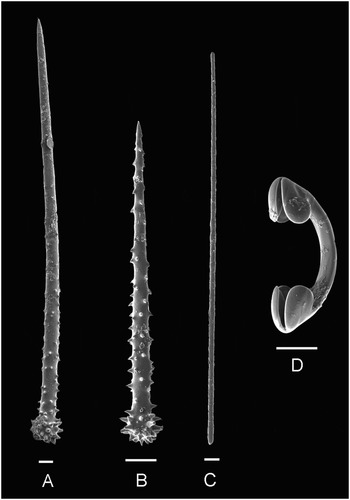
Spicules (Figure 4)
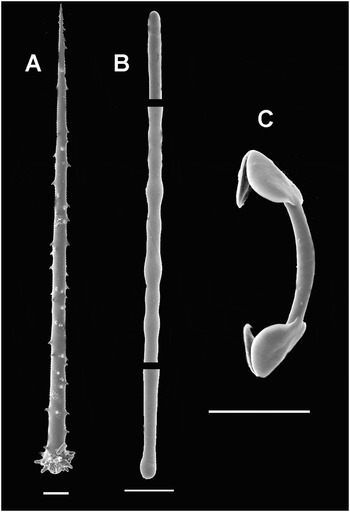
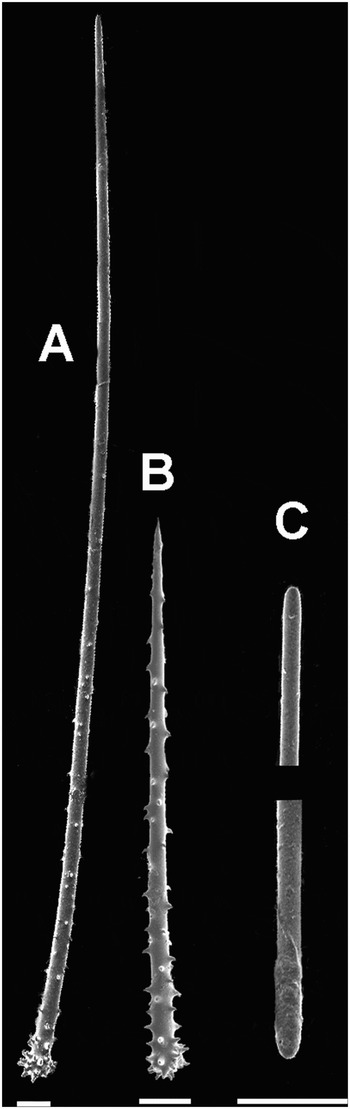
(1) Acanthostyles 80(115)155 µm by 10(15)19 µm on head. Entirely spined with small recurved spines. Head tylote and marked by slightly larger spines which curve up towards the shaft. (2) Ectosomal spicules 177(199)225 µm by 4(5)6 µm. Polytylote anisostrongyles. (3) Chelae. Curved, almost semicircular, shaft and small alae. Shaft is broad and appears slightly flattened when viewed from the front. Length 31(34)38 µm.
Hymedesmia (Hymedesmia) xavierae sp. nov. ZMA 20005. (A) Acanthostyle; (B) ectosomal spicule; (C) chelae. All scale bars 10 µm.

REMARKS
Only three species of Hymedesmia have acanthostyles of a similarly small size and ectosomal spicules which are polytylote strongyles. Of these Hymedesmia (Hymedesmia) truncata Lundbeck, Reference Lundbeck1910 has acanthostyles with a distinctive flattened tip and H. lantrunculoides Lundbeck, Reference Lundbeck1910 has much longer ectosomal spicules (300–400 µm). Hymedesmia bowerbanki Lundbeck, Reference Lundbeck1910 agrees most closely, having acanthostyles 90–130 µm, and ectosomal spicules 190–238 µm. However, it has thicker ectosomal spicules (7–9 µm) which are tylote at the ends and smaller chelae (20–34 µm) which do not have a strongly curved shaft.
Five specimens from Rockall Bank depth-range 567–629 m and one from Mingulay Reef, Outer Hebrides depth of site 128–137 m.
Holotype specimen in IDA, tissue section and spicule preparation on slides. (BIOSYS/HERMES 2005, boxcore BX68/07; co-ordinates 55°29.982′N 15°48.059′W, south-east Rockall Bank–Haas Mounds; water depth 562 m) (ZMA 19605). Collected by R.W.M. Van Soest, 1 July 2005.
COMPARATIVE MATERIAL EXAMINED
Hymedesmia proxima Lundbeck, Reference Lundbeck1910. Holotype. Spicule preparation 1. (Zoological Museum Copenhagen). Ingolf Expedition, Station 85, Denmark Strait, 155 m.
ETYMOLOGY
This species is named from the Latin for humpbacked.
DIAGNOSIS
External appearance
Appearance when living is not known. In spirit small, white; hispid patch on Lophelia pertusa coral.
Skeleton
Basal layer of large and small acanthostyles standing singly erect on the substrate, the longest protrude though the surface of the sponge. Ascending bundles of ectosomal spicules (6–10 spicules thick) surround the points of the acanthostyles and rise to the surface. Thre is a very dense layer of chelae in the ectosome.
Spicules (Figure 5)
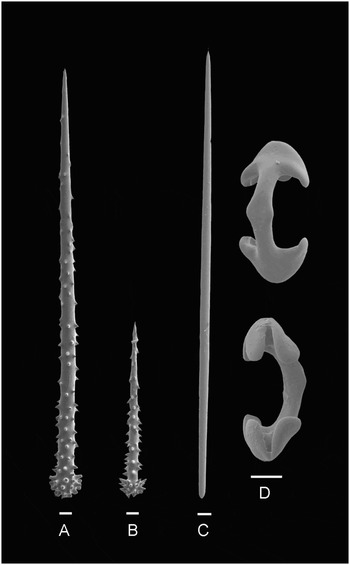
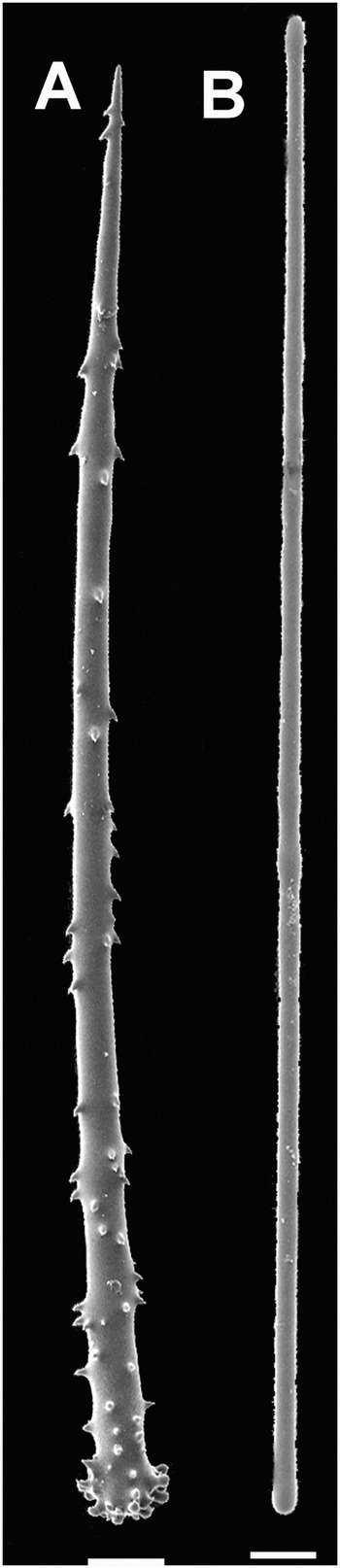
(1) Large acanthostyles 387(482)572 µm by 21(29)37 µm at head. Head slightly tylote. Spined for majority of length with small spines, these are sparser towards the tip and the longest may be smooth at the tip. (2) Small acanthostyles 109(168)240 µm by 14(22)30 µm on head. Head slightly tylote. Spined for all of their length. (3) Ectosomal spicules, 319(366)399 µm by 8(11)13 µm. Fusiform styles with a handle shaped rounded end and a fairly abrupt point. (4) Chelae 46(49)51 µm. There are large chelae with a hump in the middle of their shaft.
Hymedesmia (Hymedesmia) gibbosa sp. nov. ZMA 19605. (A) Large acanthostyle; (B) small acanthostyle; (C) ectosomal spicule; (D) chelae back and side view. All scale bars 10 µm.

REMARKS
Hymedesmia pennata Brøndsted, Reference Brøndsted, Jensen, Lundbeck and Ragnar Spärck1932 has chelae similar in form but may be distinguished by its thinner, polytylote, oxeote tornotes and the presence of only one category of acanthostyles which are entirely spined. Hymedesmia proxima Lundbeck, Reference Lundbeck1910 has similar sized acanthostyles and ectosomal spicules. However, its chelae are much smaller (23–35 µm) and do not have the hump which is characteristic of this species. There are no other Hymedesmia with styles as ectosomal spicules and acanthostyles of a similar size.
TYPE MATERIAL
Holotype: specimen in IDA, tissue section and spicule preparation on slides. BIOSYS/HERMES 2005, boxcore BX49/rest; co-ordinates 55°29.951′N 15°47.944′W, south-east Rockall Bank–Haas Mounds; water depth 568 m) (ZMA 19566c). Collected by R.W.M. Van Soest, 29 June 2005.
Paratypes: (1) (BIOSYS/HERMES 2005, boxcore BX156/rest; co-ordinates 55°29.448′N 15°48.073′W, south-east Rockall Bank–Haas Mounds; water depth 573 m) (ZMA 20003). Collected by R.W.M. Van Soest, 11 July 2005. (2) (BIOSYS/HERMES 2005, dredge DR209/02; co-ordinates 53°46.487′N 13°56.791′W, Porcupine Bank; water depth 659–747 m) (ZMA 20110). Collected by R.W.M. Van Soest, 16 July 2005. (3) (BIOSYS2006, boxcore BX77/04; co-ordinates 55°48.327′N 007°26.525′W, south-east Rockall Bank–CLAN Mounds; water depth 117 m) (ZMA 20183). Collected by R.W.M. Van Soest, 17 July 2006. (4) (BIOSYS2006, boxcore BX127/rest; co-ordinates 55°48.195′N 007°26.827′W, Outer Hebrides, Mingulay Reef; water depth 82 m) (ZMA 20273). Collected by R.W.M. Van Soest, 20 July 2006.
COMPARATIVE MATERIAL EXAMINED
Hymedesmia occulta Bowerbank in Norman, Reference Norman1869. Holotype. Tissue section. (Natural History Museum London, Bk472, 2328).
ETYMOLOGY
This species is named for Clare Valentine, Head of Collections and former Curator of Porifera at the Natural History Museum London, who has provided much assistance during this and other studies.
DIAGNOSIS
Skeleton
Basal layer of large and small acanthostyles standing singly erect on the substrate, the longest piercing the sponge surface. Columns of ectosomal spicules (4–8 spicules thick) arise from around the acanthostyles. Chelae present throughout the tissue.
Spicules (Figure 6)
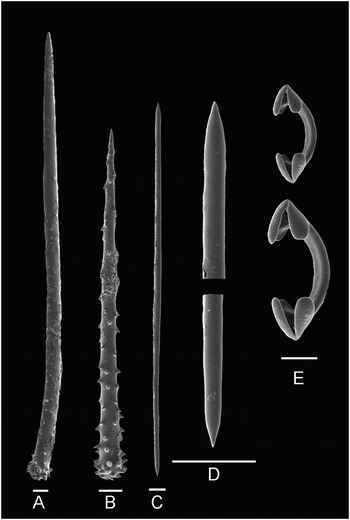
(1) Large acanthostyles. 370(676)945 µm by 12(24)32 µm on head. Head not tylote. Only head and very base of shaft spined (up to about 1/8 of shaft length). Taper to fine point. (2) Small acanthostyles. 88(110)149 µm by 7(12)17 µm. Head not tylote. Entirely spined with small spines. (3) Ectosomal spicules, 253(284)310 µm by 3(5)8 µm. Thin aniso-tornotes with abruptly pointed ends. One end usually slightly thinner and spicule tapers towards this. (4) Chelae. Two categories 21(26)28 µm and 34(43)50 µm.
Hymedesmia (Hymedesmia) valentinae sp. nov. ZMA 20183. (A) Large acanthostyle; (B) small acanthostyle; (C) ectosomal spicule; (D) ectosomal spicule ends; (E) chelae. All scale bars 10 µm.

REMARKS
The large size of the acanthostyles and the size-range of the chelae are unusual.
Hymedesmia (Hymedesmia) occulta Bowerbank in Norman Reference Norman1869 and Hymedesmia (Hymedesmia) nummulus Lundbeck Reference Lundbeck1910 have spicules of a similar range in size. However, H. nummulus has strongyles tending towards tornotes as ectosomal spicules. Hymedesmia occulta has much longer and thicker ectosomal oxeas (330(398)460 µm by 6.3(8.7)10.3 µm measured from type) and a larger size-range of chelae (33(45)78 µm. Hymedesmia (Hymedesmia) peachi had similar ectosomal spicules and two categories of chelae, however, its large acanthostyles attain only 379 µm.
Three records from south-east Rockall Bank (depth-range 117–573 m), one from Porcupine Bank (659–747 m) and one from Mingulay Reef (82 m)
Specimens: specimens in IDA, tissue sections and spicule preparations on slides. (1) (BIOSYS 2006, boxcore BX123/rest; co-ordinates 56°48.352′N 007°25.741′W, Outer Hebrides, Mingulay Reef; water depth 162 m) (ZMA 20200). Collected by R.W.M. Van Soest, 19 July 2006. (2) (BIOSYS 2006, Videograb VG20-1/rest; co-ordinates 56°49.393′N 007°23.686′W, Outer Hebrides Mingulay Reef; water depth 128 m) (ZMA 20343b). Collected by R.W.M. Van Soest, 11 July 2006.
COMPARATIVE MATERIAL EXAMINED
Hymedesmia (Hymedesmia) bocki Alander, Reference Alander1942.
Holotype: specimen in alcohol (Swedish Museum of Natural History, specimen 2200, type sample 43). Lophelia bank, Säcken, Sweden. Collected on 27 May 1935, 85 m depth. Spicule preparation and tissue section prepared from this material.
DIAGNOSIS
External morphology
Appearance when living is not known. In spirit small, white, hispid patches on Lophelia pertusa coral.
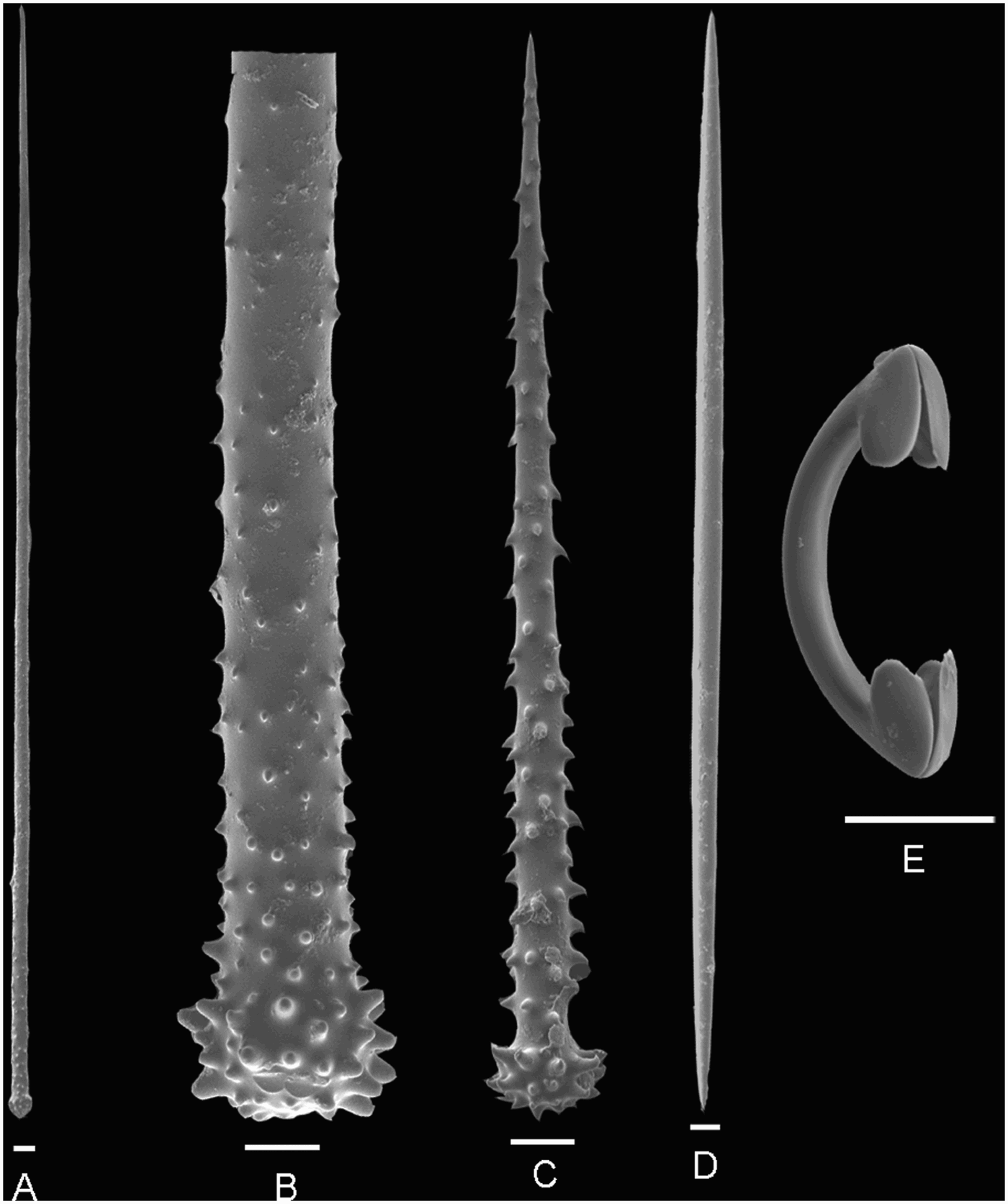
Spicules (Figure 7)
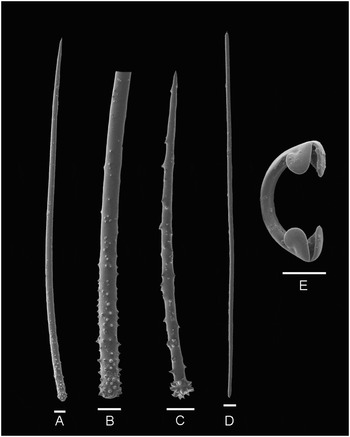
(1) Large acanthostyles. 285(352)471 µm by 9(13)17 µm on head and 8(10)14 µm on shaft. Head slightly tylote. Spined for up to 1/3 of their length. (2) Small acanthostyles. 80(136)153 µm by 6(11)16 µm. Head slightly tylote. Entirely spined with small spines. The majority are curved. (3) Ectosomal spicules. 272(294)324 µm by 5(7)9 µm. Anisostrongyles with one end thinner than the other. Some are faintly polytylote. (4) Chelae. 23(28)34 µm. Broad flattened, strongly curved shaft and small alae.
Hymedesmia (Hymedesmia) bocki Alander, Reference Alander1942. ZMA 20200. (A) Large acanthostyle; (B) large acanthostyle base; (C) small acanthostyle; (D) ectosomal spicule; (E) chelae. All scale bars 10 µm.

REMARKS
The form and size-range of the spicules is similar to those of the type specimen but all spicules are slightly less robust. Two specimens, both from Mingulay Reef, depth-range 128–162 m. Originally described from a Lophelia bank in 85 m at Sacken, Sweden. No other records.
SPECIMENS
(1) (BIOSYS 2006, boxcore BX123/08; co-ordinates 56°48.352′N 007°25.741′W, Mingulay Reef; water depth 162 m) (ZMA 20197). Collected by R.W.M. Van Soest, 19 July 2006. (2) (BIOSYS 2006, boxcore BX123/rest; co-ordinates 56°48.352′N 007°25.741′W, Mingulay Reef; water depth 162 m) (ZMA 20207b). Collected by R.W.M. Van Soest, 19 July 2006. (3) (BIOSYS 2006, boxcore BX179/03; co-ordinates 56°48.198′N 007°26.799′W, Outer Hebrides, Mingulay Reef; water depth 145 m) (ZMA 20241). Collected by R.W.M. Van Soest, 22 July 2006. (4) (BIOSYS 2006, boxcore BX119/03; co-ordinates 55°48.353′N 007°25.742′W, Mingulay Reef; water depth 129 m) (ZMA 20189a). Collected by R.W.M. Van Soest, 19 July 2006.
COMPARATIVE MATERIAL EXAMINED
Hymedesmia (Hymedesmia) cohesibacilla Goodwin & Picton Reference Goodwin and Picton2009. Holotype: spicule preparation and tissue section (Ulster Museum, National Museums Northern Ireland BELUM Mc2626). Rathlin Island sponge biodiversity project; Damicornis Bay (55°17.433′N 06°15.137′W); water depth 29.6–32.6 m.
DIAGNOSIS
External morphology
Appearance when living is not known. In spirit small, white, hispid patches on Lophelia pertusa coral.
Spicules (Figure 8)
Measurements from specimen ZMA20197.
Hymedesmia (Hymedesmia) cohesibacilla Goodwin & Picton Reference Goodwin and Picton2009. Type specimen (BELUM Mc2626). (A) Acanthostyle; (B) ectosomal spicule; (C) chelae. All scale bars 10 µm.

(1) Large acanthostyles. 125(147)168 µm by 9(13)17 µm at head entirely spined, head slightly tylote. (2) Small acanthostyles. 56(75)95 µm by 5(8)10 µm at head. Same form as the large acanthostyles: entirely spined, head slightly tylote. (3) Ectosomal spicules. 150(183)217 µm by 2(3)5 µm. Polytylote strongyles. (4) Chelae. 17(20)23 µm. Very thin shaft and alae fused to shaft for part of their length, giving a palmate appearance.
REMARKS
Good match for type specimen. Large acanthostyles slightly smaller range (140–220 µm in the type). The small size of the acanthostyles and the shape of the chelae are distinctive in the genus. Five specimens from Mingulay Reef, depth-range 129–162 m and one from Rockall Bank in 770 m. Originally described from Rathlin Island (30–40 m), since recorded from the Maidens and sites in the Firth of Lorn in Scotland (30–40 m) (authors' unpublished data).
SPECIMENS
(1) (BIOSYS/HERMES 2005, boxcore BX10/11; co-ordinates 55°29.987′N 15°47.889′W, south-east Rockall Bank–Haas Mounds; water depth 602 m) (ZMA 19408). Collected by R.W.M. Van Soest, 10 July 2005. (2) (BIOSYS/HERMES 2005, boxcore BX16/01; co-ordinates 55°30.016′N 15° 47.946′W, south-east Rockall Bank–Haas Mounds; water depth 584 m) (ZMA 19434). Collected by R.W.M. Van Soest, 26 June 2005. (3) (BIOSYS/HERMES 2005, boxcore BX10/11; co-ordinates 55°29.943′N 15° 47.941′W, south-east Rockall Bank–Haas Mounds; water depth 567 m) (ZMA 19546). Collected by R.W.M. Van Soest, 29 June 2005. (4) (BIOSYS/HERMES 2005, boxcore BX49/10; co-ordinates 55°29.951′N 15°47.944′W, south-east Rockall Bank–Haas Mounds; water depth 568 m) (ZMA 19564). Collected by R.W.M. Van Soest, 29 June 2005. (5) (BIOSYS/HERMES 2005, boxcore BX10/11; co-ordinates 55°26.644′N 16°04.531′W, south-east Rockall Bank–CLAN Mounds; water depth 780 m) (ZMA 19580). Collected by R.W.M. Van Soest, 30 June 2005. (6) (BIOSYS/HERMES 2005, boxcore BX153/02; co-ordinates 55°29.443′N 15°48.079′W, south-east Rockall Bank–Haas Mounds; water depth 573 m) (ZMA 19979). Collected by R.W.M. Van Soest, 11 July 2005. (7) (BIOSYS/HERMES 2005, dredge DR190/07; co-ordinates 53°46.200′N 13°56.832′W, Porcupine Bank; water depth 683–749 m) (ZMA 20102). Collected by R.W.M. Van Soest, 14 July 2005.
COMPARATIVE MATERIAL EXAMINED
Hymedesmia curvichela type preparation 1. Hymedesmia (Hymedesmia) curvichela Lundbeck, Reference Lundbeck1910. Holotype. Spicule preparation 1. (Zoological Museum Copenhagen). Ingolf Expedition (Station 1566°18′N 25°29′W, Denmark Strait, 604 m).
DIAGNOSIS
External morphology
Appearance when living is not known. In spirit small, white, hispid patches on Lophelia pertusa coral.
Spicules (Figure 9)
(1) Large acanthostyles. 408(543)736 µm, 20(24)27 µm on the head and 13(16)20 µm on the shaft, because of their scarcity in the spicule preparations it was only possible to measure 10 spicules. Spined for up to half their length with very small spines; these decrease in abundance with distance from the head. Head marked with larger spines. (2) Small acanthostyles. 159(170)191 µm by 10(20)26 µm on the head and 10(13)18 µm on the shaft. Entirely spined with small spines. Head marked by slightly larger spines. (3) Ectosomal spicules. 334(390)457 µm by 7(9)12 µm. fusiform anisostrongyles, one or both ends may be slightly tylote. The majority are polytylote. (4) Chelae. 36(41)46 µm. Strongly curved chelae with a flattened broad shaft and short rounded alae.
Hymedesmia (Hymedesmia) curvichela Lundbeck, Reference Lundbeck1910. ZMA 20102. (A) Large acanthostyle; (B) small acanthostyle; (C) ectosomal spicule; (D) chelae. All scale bars 10 µm.

REMARKS
The spicules are a good match for the type specimen. Lundbeck reports a slightly larger size-range for the small acanthostyles (107–300 µm). Six specimens from Rockall Bank, depth-range 567–780 m and one from Porcupine Bank (depth of site 683–749 m). Originally recorded by Lundbeck from the Denmark Strait (603 m and 567 m), East of the Faeröe Islands (457 m) and west of the Faeröe Islands (293 m). Additional records from Ramsö in the Koster Fjord, 100–200 m and in the Skagerrak from 200–400 m, Sweden (Alander, Reference Alander1942); 50°42′N 11°18′W, Porcupine Bank, Ireland 1147–1331 m (Stephens, Reference Stephens1921). Specimens from the Cape Verde Islands formerly attributed to this species (Van Soest, Reference Van Soest1993) are now believed to be a different species.
SPECIMEN
(BIOSYS/HERMES 2005, boxcore BX172/05; co-ordinates 55°26.688′N 16°4.321′W, south-east Rockall Bank–CLAN Mounds; water depth 650 m) (ZMA 20068b). Collected by R.W.M. Van Soest, 12 July 2005.
COMPARATIVE MATERIAL EXAMINED
Hymedesmia (Hymedesmia) ebria Alander, Reference Alander1937. Holotype. Spicule preparation. (Zoological Museum Copenhagen specimen Alander 17 June 1936). Off Trondheimsfjord, north of Storforsen, Norway, depth 180–210 m, 17 June 1936.
DIAGNOSIS
External appearance
Appearance when living is not known. In spirit small, white hispid patch on mollusc shell.
Spicules (Figure 10)
(1) Large acanthostyles 325(383)473 µm by 9(14)18 µm. Head not tylote. Spines densest and largest on head, becoming more sparse and smaller towards the tip. End of shaft usually smooth. (2) Small acanthostyles 78(124)140 µm by 6(9)11 µm. Head not tylote, entirely spined with small spines. (3) Ectosomal spicules anisotornotes 222(251)323 µm. One end abruptly pointed and the other more gradually tapered. Ends mucronate. (4) Sigmas in two size-categories: 21–37 µm and 47–74 µm. (5) Normal arcuate chelae in three size-categories: 9–16 µm, 23–30 µm and 40–65 µm.
Hymedesmia (Hymedesmia) ebria Alander, Reference Alander1937. ZMA 20068. (A) Large acanthostyle; (B) small acanthostyle; (C) ectosomal spicule; (D) chelae; (E) sigmas. All scale bars 10 µm.

REMARKS
The spiculation agrees well with that described by Alander, although size-ranges differ slightly (Alander gives large acanthostyles 350–425 µm, small acanthostyles 125–145 µm, tornotes 220–250 µm, chelae 55–75 µm, 20–30 µm, 9–15 µm and sigmas 55–75 µm and 20–30 µm). The large number of microsclere categories is unusual in this genus. One specimen from Rockall Bank. Originally described off Trondheimsfjord depth 180–210 m. No other records.
SPECIMEN
(BIOSYS/HERMES 2005, Videograb VG28/01; co-ordinates 56°49.315′N 007°23.786′W, south-east Rockall Bank–Haas Mounds; water depth 131 m) (ZMA 20316). Collected by R.W.M. Van Soest, 12 July 2005.
COMPARATIVE MATERIAL EXAMINED
Hymedesmia (Hymedesmia) gustafsoni Alander, Reference Alander1942. Cotype. Specimen in alcohol (Swedish Museum of Natural History, specimen 2312). Lophelia-bank of Säcken, Sweden. Collected on 27 May 1935, 85 m depth. Spicule preparation and tissue section prepared from this material.
DIAGNOSIS
External appearance
Apperance when living is not known. In spirit small, white; hispid patch on Lophelia pertusa coral.
Spicules (Figure 11)
(1) Large acanthostyles. 252(354)431 µm by 15(21)25 µm. Spined for up to 2/3 length. Spines denser near to head. Head slightly tylote. Come to an abrupt point. (2) Small acanthostyles. 106(108)129 µm by 12(17)19 µm. Head slightly tylote and marked with larger spines. Entirely spined with small spines. (3) Ectosomal spicules. 261(264)306 µm by 4(6)8 µm. Polytylote aniso-tylostrongyles. (4) Chelae. 37(41)45 µm. Arcuate chelae with a thin shaft and comparatively large alae.
Hymedesmia (Hymedesmia) gustafsoni Alander, Reference Alander1942. ZMA 20316. (A) Large acanthostyle; (B) small acanthostyle; (C) ectosomal spicule; (D) chelae. All scale bars 10 µm.

REMARKS
Good match for the type specimen. Ectosomal spicules are thinner than in the type. The large acanthostyles have a slightly larger size-range (335–425 µm in the type). The acanthostyles are described as having spines ‘hooked like an eagle's beak’ but neither the type nor this specimen obviously corresponded to this description. One specimen from Mingulay Reef (131 m). Previously only known from the type location.
SPECIMENS
(1) (Moundforce 2004, boxcore M2004/32/rest; co-ordinates 55°29.947′N 15°47.799′W, south-east Rockall Bank; water depth 626 m) (ZMA 18511). Collected by R.W.M. Van Soest, 2 September 2004. (2) (Moundforce 2004, boxcore M2004/32/rest; co-ordinates 55°26.375′N 16°06.152′W, south-east Rockall Bank–CLAN Mounds; water depth 777 m) (ZMA 18562b). Collected by R.W.M. Van Soest, 6 September 2004. (3) (BIOSYS/HERMES 2005, boxcore BX08/02; co-ordinates 55°30.010′N 15°47.946′W, south-east Rockall Bank–Haas Mounds; water depth 584 m) (ZMA 19398). Collected by R.W.M. Van Soest, 25 June 2005. (4) BIOSYS/HERMES 2005, boxcore BX68/03; co-ordinates 55°29.982′N 15°48.059′W south-east Rockall Bank–Haas Mounds; water depth 562 m) (ZMA 19601). Collected by R.W.M. Van Soest, 1 July 2005. (5) (BIOSYS/HERMES 2005, dredge 111/19; co-ordinates 55°29.614′N 15°48.053′W, south-east Rockall Bank–Haas Mounds; water depth 524 m) (ZMA 19731). Collected by R.W.M. Van Soest, 8 July 2005. (6) (BIOSYS/HERMES 2005, boxcore BX173/rest; co-ordinates 55°26.678′N 16°04.307′W, south-east Rockall Bank–CLAN Mounds; water depth 629 m) (ZMA 20085). Collected by R.W.M. Van Soest, 12 July 2005. (7) (BIOSYS/HERMES 2005, dredge DR190/01; co-ordinates 53°46.200′N 13°56.832′W, Porcupine Bank; water depth 683–749 m) (ZMA 20097). Collected by R.W.M. Van Soest, 14 July 2005. (8) (BIOSYS 2006, Dredge DR182/rest; co-ordinates 56°49.456′N 007°22.118′W, Outer Hebrides, Mingulay Reef; water depth 128–137 m) (ZMA 20412a). Collected by R.W.M. Van Soest, 22 July 2006. (9) (BIOSYS/HERMES 2005, boxcore BX48/rest11; co-ordinates 55°29.943′N 15°47.941′W, south-east Rockall Bank–Haas Mounds; water depth 567 m) (ZMA 19553a). Collected by R.W.M. Van Soest, 29 June 2005.
COMPARATIVE MATERIAL EXAMINED
Hymedesmia simillima Lundbeck, Reference Lundbeck1910. Holotype. Spicule preparation 1. (Zoological Museum Copenhagen, 81.9). Ingolf Expedition.
DIAGNOSIS
External appearance
Appearance when living is not known. In spirit small, white; hispid patch on Lophelia pertusa coral.
Spicules (Figure 12)
(1) Large acanthostyles. 416(537)768 µm by 21(26)29 µm. Head slightly tylote. Spined for up to two-thirds of their length with small spines. Head very densely spined, spines become progressively less dense along shaft. Majority slightly curved.
(2) Small acanthostyles. 148(190)239 µm by 12(16)20 µm. Head slightly tylote. Entirely spined with small spines. (3) Ectosomal spicules. 336(344)430 µm by 10(14)19 µm. Fusiform oxea. (4) Chelae. 32(34)36 µm. Normal arcuate chelae.
Hymedesmia (Hymedesmia) simillima Lundbeck, Reference Lundbeck1910. ZMA 20085. (A) Large acanthostyle; (B) large acanthostyle base; (C) small acanthostyle; (D) ectosomal spicule; (E) chelae. All scale bars 10 µm.
REMARKS
Good match in terms of size and spicule form to type specimen. In comparison with the type specimen the chelae have slightly less robust shafts but the heads of the acanthostyles and the dermal spicules are indistinguishable. The form of the ectosomal spicules (fusiform oxea) is unusual in this genus. Seven specimens from Rockall Bank (depth-range 524–777 m), also one from Porcupine Bank (683–749 m) and one from Mingulay Reef (128–137 m). Initially recorded from east Greenland, west and south of Iceland, and east of the Faeröe Islands at depths from 176–1264 m (Lundbeck, Reference Lundbeck1910). Recorded from the Aegean Sea at 80 m (Voultsiadou & Vafidis, Reference Voultsiadou and Vafidis2004). However, the measurements given for this specimen (large acanthostyles 270–425 µm, small acanthostyles 79–158 µm, ectosomal spicules 198—297 µm and chelae 16–32 µm) differ significantly from the type and therefore it is unlikely that this identification is correct.
SPECIMENS
(1) (BIOSYS/HERMES 2005, boxcore BX26/01; co-ordinates 55°30.215′N 15°47.181′W, south-east Rockall Bank–Haas Mounds; water depth 688 m) (ZMA 19466). Collected by R.W.M. Van Soest, 27 June 2005. (2) (BIOSYS/HERMES 2005, boxcore BX173/rest; co-ordinates 55°26.678′N 16°04.307′W, south-east Rockall Bank–CLAN Mounds; water depth 629 m) (ZMA 19466). Collected by R.W.M. Van Soest, 12 July 2005.
COMPARATIVE MATERIAL EXAMINED
Hymedesmia irregularis Lundbeck, Reference Lundbeck1910. Holotype. Spicule preparation 1. (Zoological Museum Copenhagen). Ingolf Expedition.
DIAGNOSIS
External morphology
Appearance when living is not known. In spirit small, white, hispid patches on Lophelia pertusa coral.
Spicules (Figure 13)
(1) Large acanthostyles. 403(499)661 µm by 19(27)31 µm at head. Spined for up to 2/3 length with small spines. These become progressively less dense up the shaft. Head slightly tylote and much more densely spined than shaft. Point quite abrupt. (2) Small acanthostyles. 146(182)232 µm by 12(20)26 µm. Slightly tylote head abrupt point, entirely spined with small spines. Spines slightly larger on head. (3) Ectosomal spicules. 343(381)413 µm by 10(14)17 µm. Fusiform styles with a very abrupt point and a reduced thickness handle shaped section at the opposite end. Faintly polytylote. (4) Chelae. 48(51)55 µm Large arcuate chelae.
Hymedesmia (Hymedesmia) irregularis Lundbeck, Reference Lundbeck1910. ZMA 19466. (A) Large acanthostyle; (B) small acanthostyle; (C) ectosomal spicule; (D) ectosomal spicule ends; (E) chelae. All scale bars 10 µm.

REMARKS
Spicules form a good match for the type specimen. Lundbeck describes the acanthostyles as being in one category 120–500 µm with the larger smooth in the end part. The form of the ectosomal spicules is unusual in this genus. Two records from south-east Rockall Bank (depth-range 629–688 m). Initially recorded from the Denmark Strait, between Iceland and Greenland, and the Faeröe Islands (depths 1441, 457, 311, 293 and 329 m).
SPECIMENS
(1) (Moundforce 2004, M2004/32-01B; co-ordinates 55°29.947′N 15°47.799′W, south-east Rockall Bank; water depth 626 m) (ZMA 18110). Collected by R.W.M. Van Soest, 1 September 2004. (2) (BIOSYS/HERMES 2005, boxcore BX161/02; co-ordinates 55°30.063′N 15°47.305′W, south-east Rockall Bank–Haas Mounds; water depth 585 m) (ZMA 20033). Collected by R.W.M. Van Soest, 11 July 2005. (3) (BIOSYS/HERMES 2005, boxcore BX161/02; co-ordinates 55°30.063′N 15°47.305′W, south-east Rockall Bank–Haas Mounds; water depth 585 m) (ZMA 20034). Collected by R.W.M. Van Soest, 11 July 2005.
COMPARATIVE MATERIAL EXAMINED
Hymedesmia proxima Lundbeck, Reference Lundbeck1910. Holotype. Spicule preparation 1. (Zoological Museum Copenhagen). Ingolf Expedition, Station 85, Denmark Strait, 155 m.
DIAGNOSIS
External morphology
Appearance when living is not known. In spirit small, white, hispid patches on Lophelia pertusa coral.
Spicules (Figure 14)
Measurements from ZMA 20034. (1) Large acanthostyles. 406(520)623 µm by 15(20)26 µm. Spined for up to a third of their length with small spines. Taper evenly to a fine point. Head not tylote. (2) Small acanthostyles. 121(135)151 µm by 12(14)20 µm. Entirely spined with small spines. Head not tylote but some have a small constriction at the neck. (3) Ectosomal spicules. 271(289)304 µm. Fusiform styles with an elongated handle-like end and an abrupt point. (4) Chelae. 23(32)39 µm. Curved shaft and small alae.
Hymedesmia (Hymedesmia) proxima Lundbeck, Reference Lundbeck1910. ZMA 20033. (A) Large acanthostyle; (B) small acanthostyle; (C) ectosomal spicule; (D) chelae. All scale bars 10 µm.

REMARKS
Spicule form and size-range good match for the type specimen. Size-range of smaller acanthostyles slightly less (140–180 µm in the type). Three records, all from south-east Rockall Bank, depth-range 585–626 m. Originally described from the Denmark Strait, between Iceland and Greenland in 155 m.
Hymedesmia without microscleres:
SPECIMENS
(1) (BIOSYS 2006, videograb VG20-4/01; co-ordinates 56°49.439′N 007°23.833′W, Mingulay Reef; water depth 150 m) (ZMA 20300). Collected by R.W.M. Van Soest, 11 July 2006. (2) (BIOSYS 2006, dredge DR182/rest; co-ordinates 56°49.456′N 007°22.118′W, Mingulay Reef; water depth 128–137 m) (ZMA 20399). Collected by R.W.M. Van Soest, 22 July 2006. (3) (BIOSYS 2006, dredge DR182/rest; co-ordinates 56°49.456′N 007°22.118′W, Mingulay Reef; water depth 128–137 m) (ZMA 20416b). Collected by R.W.M. Van Soest, 22 July 2006.
COMPARATIVE MATERIAL EXAMINED
(1) Hymedesmia (Stylopus) hibernica Stephens Reference Stephens1916. Holotype. Spicule preparation and tissue section (National Museum Ireland 14.1916). (2) Hymedesmia hibernica section and spicule preparation (Ulster Museum BELUM Mc 2766), Rathlin Island Sponge Biodiversity Project, west of Derginan Point (55°18.283′N 06°16.774′W); water depth 28.5–31.5 m. (2) Hymedesmia hibernica section and spicule preparation (Ulster Museum BELUM Mc 2950) White Cliffs (55°17.546′N 06°14.518′W); water depth 32–35 m.
DIAGNOSIS
External morphology
Appearance when living is not known. In spirit small, white, hispid patches on Lophelia pertusa coral.
Spicules (Figure 15)
(1) Large acanthostyles 199(223)245 µm by 7(9)10 µm. Spined for up to 1/3 length with very small spines. Head very slightly tylote. (2) Small acanthostyles 88(93)100 µm by 6(8)11 µm. Entirely spined with very small spines. Head very slightly tylote. (3) Ectosomal spicules 206(234)252 µm by 2(4)5 µm. Anisostrongyles, one end is noticeably thinner and the spicule tapers towards this. Ends of spicules sometimes tylote—small oval swellings.
Hymedesmia (Stylopus) hibernica Stephens, Reference Stephens1916. BELUM Mc2950. (A) Large acanthostyle; (B) small acanthostyle; (C) ends of ectosomal spicule. All scale bars 10 µm.

REMARKS
Form of spicules generally a good match for the type specimen. However, the acanthostyles are spined for slightly more of their length and some of the ectosomal spicules are polytylote. Polytylote and non polytylote ectosomal spicules can be present in the same species and this may not be a good character for classification. Size-categories differ slightly—Stephens gives large acanthostyles 250–325 µm, 110–130 µm small acanthostyles and 220–250 µm ectosomal spicules. The small size of spicules is unusual in this genus. Three records, all from Mingulay Reef, depth-range 128–150 m. Type location off Reenacry Head, County Kerry Ireland 67 m. Also recorded from Brittany, France in 80–85 and 60 m (Cabioch, Reference Cabioch1968), Rathlin Island, Northern Ireland 30–35 m (Goodwin & Picton, Reference Goodwin and Picton2009) and Firth of Lorn, Scotland 30–35 m (authors' unpublished data).
SPECIMENS
(1) (BIOSYS/HERMES 2005, dredge DR21/06; co-ordinates 55°30.208′N 15°48.243′W, south-east Rockall Bank–Haas Mounds; water depth 672–675 m) (ZMA 194390. Collected by R.W.M. Van Soest, 26 June 2005. (2) (BIOSYS 2006, boxcore BX123/rest; co-ordinates 56°48.352′N 007°25.741′W, Mingulay Reef; water depth 162 m) (ZMA 20206b). Collected by R.W.M. Van Soest, 19 July 2006. (3) (BIOSYS 2006, boxcore BX171/03; co-ordinates 55°48.199′N 007°26.804′W, Mingulay Reef, Outer Hebrides; water depth 144 m) (ZMA 20223). Collected by R.W.M. Van Soest, 21 July 2006. (4) (BIOSYS 2006, videograb VG20-1/06; co-ordinates 56°49.401′N 007°23.864′W, Mingulay Reef, Outer Hebrides; water depth 139 m) (ZMA 20292). Collected by R.W.M. Van Soest, 11 July 2006.
COMPARATIVE MATERIAL EXAMINED
Hymedesmia primitiva Lundbeck, Reference Lundbeck1910. Holotype and cotype. Spicule preparation (Zoological Museum Copenhagen). Ingolf Expedition, Station 6 (63°43′N 14°34′W, east Iceland, depth 165 m) and Station 89 (64°45′N 27°20′W, Denmark Strait, depth 567 m).
DIAGNOSIS
External morphology
Appearance when living is not known. In spirit small, white, hispid patches on Lophelia pertusa coral.
Spicules (Figure 16)
(1) Acanthostyles 80(156)226 µm by 8(13)22 µm at head. Most entirely spined with small spines but largest smooth at tip. Head slightly tylote. (2) Ectosomal spicules 156(220)246 µm by 3(4)5 µm. Slightly polytylote with pronounced tylote ends.
Hymedesmia (Stylopus) primitiva Lundbeck, Reference Lundbeck1910. BELUM Mc2981 (A) Acanthostyle; (B) ectosomal spicule. All scale bars 10 µm.

REMARKS
The size-range of acanthostyles smaller than that described for the type (119–350 µm), however, Lundbeck (Reference Lundbeck1910) notes that size-range is variable with a maximum length of only 270 µm in some individuals. Three records from Mingulay Reef (depth-range 139–162 m) and one from Rockall Bank (672 m). Known from the type localities in east Iceland 165 m and Denmark Strait 567 m, also recorded from Iceland 99 m, east of the Faeröe Islands 293 m (Lundbeck, Reference Lundbeck1910). Noted as rather common on Lophelia bank at Säcken, Sweden (85 m), present at Singlefjord, Sweden (100 m) and in the Skagerrak south-east of Jomfruland, Sweden (100–400 m) (Alander, Reference Alander1942). Also recorded from Drake's Island, Queen's Ground and Wembury Bay, Devon (Burton, Reference Burton and Wilson1957). Recently recorded from Rathlin Island, Northern Ireland 30–35 m (Goodwin & Picton, Reference Goodwin and Picton2009) and Firth of Lorn, Scotland 30–35 m (authors' unpublished data).
NOTES ON THE DISTRIBUTION OF OTHER HYMEDESMIA SPECIES OCCURRING IN BRITAIN AND IRELAND
Hymedesmia (Hymedesmia) aerolata Thiele, Reference Thiele1905
Kilkieran Bay, 15–45 m Galway (Konnecker, 1973) now classified as Phorbas areolatus (Thiele, Reference Thiele1905). This record is doubtful as the type locality is Chile.
Hymedesmia (Hymedesmia) baculifera (Topsent, Reference Topsent1901)
Recorded from Ireland 50 miles west–north-west of Eagle Island (710 m) and 50°37′N 11°32′W, 100 miles south-west of Cork (457–991 m) (Stephens, Reference Stephens1921). Type locality Mediterranean, north of Algiers, also recorded Azores 1250 m (Topsent, Reference Topsent1904); Denmark Strait and South of Iceland (241, 539, 1264, 139, 373, 252 and 494 m) and east of the Faeröe Islands (402 and 457 m) (Lundbeck, Reference Lundbeck1910). Brittany 7 m (Borojevic et al., Reference Borojevic, Cabioch and Lévi1968) and Banyuls-sur-Mer (no depth given but study area from 0–40 m) (Boury-Esnault, Reference Boury-Esnault1971).
Hymedesmia (Stylopus) brondstedi Burton, Reference Burton1930a
Common from the shore to the shallow circalittoral. However, the taxonomy of this Hymedesmia (Stylopus) species is confused and this species has currently, we suspect erroneously, been synonymized with Hymedesmia (Stylopus) coriacea (Alander Reference Alander1942; Van Soest, Reference Van Soest and Jones1987).
Hymedesmia (Stylopus) crami Goodwin & Picton, Reference Goodwin and Picton2009
Currently only known from the type locality, Rathlin Island, Northern Ireland (30–33 m).
Hymedesmia (Stylopus) coriacea (Fristedt, Reference Fristedt1885)
See comments for H. brondstedi; records of these species require revalidation.
Hymedesmia (Hymedesmia) cratera Goodwin & Picton, Reference Goodwin and Picton2009
Type locality, Rathlin Island, Northern Ireland (29–32 m). Also recorded from the Maidens, Northern Ireland (080617/03) and the Firth of Lorn, Scotland 080628/01 (authors' unpublished data).
Hymedesmia (Hymedesmia) crux (Schmidt Reference Schmidt1875)
50°37′N 11°32′W, 100 miles south-west of Cork (457–991 m), 50°42′N 11°18′W, Celtic Sea (1147–1331 m) (Stephens, Reference Stephens1921). Type locality Bukenfjord, Norway 194 m (Schmidt, Reference Schmidt1875) and Denmark Strait (539, 887, 311, 252 and 380 m) and west of the Faeröe Islands (293 and 329 m) (Lundbeck, Reference Lundbeck1910). Also recorded from Stavanger between 20 and 200 m (Burton, Reference Burton1930b).
Hymedesmia (Hymedesmia) digitata Lundbeck, Reference Lundbeck1910
Fifty miles west–north-west of Eagle Island 54°17′N 11°33′W at 710 m (Stephens, Reference Stephens1921). Type locality Denmark Strait, 567 m (Lundbeck, Reference Lundbeck1910). Also recorded from 15 miles south-east of Jomfruland, Sweden 400 m (Alander, Reference Alander1942).
Hymedesmia (Hymedesmia) helgae Stephens, Reference Stephens1921
Fifty miles west-north-west of Eagle Island 54°17′N 11°33′W 710 m and 51°23′N 11°38′W 856 m.
Hymedesmia (Hymedesmia) jecusculum (Bowerbank, 1866)
Type locality Loch Duich, Scotland. Relatively common and widespread around Britain and Ireland. Present in the lower infralittoral and shallow circalittoral: depth- range approximately 10–40 m. Recently recorded from Wales, Scotland, Ireland and Northern Ireland (authors' unpublished data).
Hymedesmia (Hymedesmia) koehleri (Topsent, Reference Topsent and Koehler1896)
Fifty miles west–north-west of Eagle Island, Mayo, Ireland, (710 m) and 51°23′11°38′, (856 m) (Stephens, Reference Stephens1921). Type locality Golfe de Gascogne (1220 m) (Topsent, Reference Topsent and Koehler1896), also Azores (845 and 1165 m) (Topsent, Reference Topsent and Koehler1896), Villafranca, Azores 1740 m (Topsent, Reference Topsent1928). Topsent notes that it is common in deep water in the Azores, recorded from 9 stations (599–2540 m, usually deeper than 1000 m) off Morocco, Mediterranean 35°25N 04°18W 170 m (Boury-Esnault et al., Reference Boury-Esnault, Pansini and Uriz1994) off Iceland and in the Denmark Strait (539, 457, 1264, 640 and 252 m), and east and west of the Faeröe Islands (329 and 457 m) (Lundbeck, Reference Lundbeck1910).
Hymedesmia lenta Descatoire, 1966—this is listed in the British species directory (Howson & Picton, Reference Howson and Picton1997) but we cannot find any UK records. Originally described from Glénan, Atlantic coast of France.
Hymedesmia (Hymedesmia) mucronata (Topsent, Reference Topsent1904)
50°37′N 11°32′W, depth 457–991 m; 50°42′N 11°18′W, depth 1147–1331 m (Stephens, Reference Stephens1921). Type locality Azores 880 m. Also recorded Davis Strait, west of Greenland 1064 m (Lundbeck, Reference Lundbeck1910).
Hymedesmia (Hymedesmia) mutabilis (Topsent Reference Topsent1904)
50°37′N 11°32′W, Porcupine Bank, 457–991 m; 51°23′N 11°38′W, Porcupine Bank, 856 m (Stephens, Reference Stephens1921). Type locality Azores, three sites: 523, 200 and 1360 m (Topsent, Reference Topsent1904). Also recorded from the Canyon de Cassidaigne, near Cassis, Southern France, 235–500 m (Vacelet, Reference Vacelet1969) and Southern Italy 631–809 m (Longo et al., Reference Longo, Mastrototaro and Corriero2005).
Hymedesmia (Hymedesmia) occulta Bowerbank in Norman, Reference Norman1869
Originally described 176 m off Shetland, Scotland (Norman, Reference Norman1869). Outside UK recorded from 50 miles off Mogador, Morocco 2165 m, north of the Azores 2460 m, and Gorringe Bank, 780 m (Topsent, Reference Topsent1928), south of Denmark Strait 2076 m, Iceland 311 m, 1904 m and between the Faeröe Islands and Iceland 1317 m (Lundbeck, Reference Lundbeck1910). Koltun (Reference Koltun1959) recorded specimens from Arctic Russia 10–550 m, however given the depth-distribution of other specimens the shallow water specimens should be verified.
Hymedesmia (Hymedesmia) pansa Bowerbank, Reference Bowerbank1882
Type localities Birterbuy Bay and Roundstone Bay, Galway (Bowerbank, Reference Bowerbank1882). Common species in the infralittoral and shallow circalittoral in Britain and Ireland. Recent records from Rathlin Island and Strangford Lough Northern Ireland and Pembrokeshire Wales. Depth-range approximately 10–40 m. Deeper water record from off Kerry, Ireland (51°26′N 11°20′W), 10 specimens in 183 m. Also recorded from Brittany, very common on gravel in more than 50 m (Borojevic et al., Reference Borojevic, Cabioch and Lévi1968), Naples (Topsent, Reference Topsent1925), Banyuls-sur-Mer 12–30 m (Boury-Esnault, Reference Boury-Esnault1971) and Monaco 20–50 m (Topsent, Reference Topsent1936).
Hymedesmia (Hymedesmia) paupertas (Bowerbank, 1866)
This species is relatively common in the infralittoral and sublittoral around Britain and Ireland. Type locality Shetland Island (depth). Ireland, off Reenacry Head, Kerry, Ireland 67 m, 1.5 miles south-east of the Bills, Mayo 69 m (Stephens, Reference Stephens1921). Galway, 10–30 m (Könnecker, Reference Könnecker1973). Also recorded from Greenland, Koster 85–200 m and Skagerrak 400 m Sweden Alander (Reference Alander1935, Reference Alander1942) and Galicia, Spain in 37.5–39 m (Cristobo et al., Reference Cristobo, Urgorri and Ríos1998). Red specimens from the Mediterranean which were formerly recorded as this species, in the genus Phorbas, have recently been described as Phorbas topsenti (Vacelet & Perez, Reference Vacelet and Perez2008).
Hymedesmia (Hymedesmia) peachi Bowerbank, Reference Bowerbank1882
Hymedesmia peachi was originally described by Bowerbank (Reference Bowerbank1882) from ‘deep water’ off Wick. It has also been reported from the Mediterranean (Naples), shallow water (Topsent, Reference Topsent1925); Italy (0–3 m) (Sarà, Reference Sarà1964); Banyuls-sur-Mer (5–17 m), (Topsent, Reference Topsent1936; Boury-Esnault, Reference Boury-Esnault1971); Marseille (Pouliquen, Reference Pouliquen1972), the Azores (599 and1022 m) (Topsent, Reference Topsent1904), Atlantic France, Roscoff (80, 100 and 50–60 m) (Borojevic et al., Reference Borojevic, Cabioch and Lévi1968); Northern Spain (Topsent, Reference Topsent1892), Gettysburg Seamount 31–38 m (Xavier & Van Soest, Reference Xavier and van Soest2007), western Atlantic, off Newfoundland 47°10′N 50°47′W 748–1262 m (Topsent, Reference Topsent1928), the North Sea (Arndt, Reference Arndt1935), Sweden (Fristedt, Reference Fristedt1885), Gullmarsfjord (Gislen, Reference Gislen1930). The reported depths vary from under 3 m (Sarà, Reference Sarà1964) to 1022 m (Topsent, Reference Topsent1904) and it is possible that this name is being used for several species.
Hymedesmia (Hymedesmia) pilata Bowerbank, Reference Bowerbank1882
Birterbuy Bay, Ireland.
Hymedesmia (Hymedesmia) rathlinia Goodwin & Picton, Reference Goodwin and Picton2009
Type locality Rathlin Island (30–35 m), additional records from the Maidens, Northern Ireland and Firth of Lorn Scotland (authors' unpublished data).
Hymedesmia (Hymedesmia) spinosa Stephens, Reference Stephens1916
Type locality 50°37′N 11°32′W, Porcupine Bank, 457–991 m; 50°42′N 11°1′ 8W, south-west Ireland, 1147–1331 m. No additional records.
Hymedesmia (Hymedesmia) stellifera Goodwin & Picton, Reference Goodwin and Picton2009
Type locality Rathlin Island 30–35 m. Also known from Firth of Lorn Scotland (paratype location) and the Maidens, Northern Ireland (authors' unpublished data).
Hymedesmia (Hymedesmia) tenuisigma Lundbeck, Reference Lundbeck1910
Fifty miles miles west–north-west of Eagle Island 54°17′N 11°33′W 710 m. Type locality Denmark Strait 539 m and 252 m. Also recorded 15 miles south-east of Jomfruland, Sweden in 400 m (Alander, Reference Alander1942).
Hymedesmia (Hymedesmia) truncata Lundbeck, Reference Lundbeck1910.
Fifty miles west–north-west of Eagle Island, County Mayo, 710 m (Stephens, Reference Stephens1921). Known elsewhere from the east coast of Greenland 91–135 m, Denmark Strait (between Iceland and Greenland) 311 and 567 m, north of Iceland 106 m and off the Faeröe Islands 329 m (Lundbeck, Reference Lundbeck1910).
Hymedesmia (Hymedesmia) zetlandica Bowerbank, 1864
Type locality Shetland. Also recorded from Mauritania (Van Soest, Reference Van Soest1993). Type species of the genus Hymedesmia.
Hymedesmia longistylus Lundbeck, Reference Lundbeck1910, Hymedesmia procumbens Lundbeck, Reference Lundbeck1910, Hymedesmia nummulus Lundbeck, Reference Lundbeck1910, Hymedesmia similis Lundbeck, Reference Lundbeck1910
Hymedesmia (Hymedesmia) veneta (Schmidt, 1862) and Hymedesmia versicolor (Topsent, 1893) were all reported from Lough Ine, Cork by Lilly et al. (Reference Lilly, Sloane, Bassindale, Ebling and Kitching1953). However, these are the only records for Britain and Ireland. The specimens were identified by Maurice Burton of the British Museum. However, no descriptions are given in this paper. Van Soest & Weinberg (Reference Van Soest and Weinberg1980) state that this work undoubtedly contains a number of synonyms and wrong identifications and stated that records of deep-water species (such as these Hymedesmia species) from the Lough were doubtful.
DEPTH-DISTRIBUTION OF HYMEDESMIA SPECIES
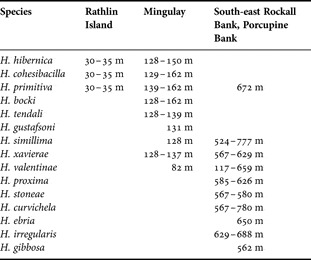
Presence of Hymedesmia species in the two coral reef areas is given in Table 1; data from Rathlin Island, Northern Ireland are provided for comparison. Whilst H. primitiva was present in all three areas and consequently showed a wide depth-range, all other species were present in only one or two areas.
Distribution of Hymedesmia species recorded in this study. Additional information for Rathlin Island is given from Goodwin & Picton (Reference Goodwin and Picton2009).

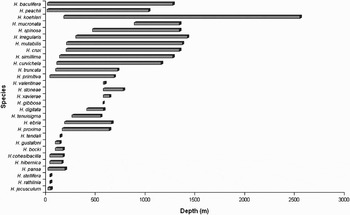
Depth-distributions of Hymedesmia species based on data from this study and the literature were plotted (Figure 17). Whilst for some species such as H. baculifera and H. peachi the reported depth-range was from shallow water to bathyal depths the majority of species have smaller depth-ranges. Hymedesmia jecusculum, H. rathlinia and H. stellifera are apparently restricted to the shallow circalittoral (<50 m). Hymedesmia pansa, H. hibernica, H. bocki, H. gustafsoni, H. tendali and H. cohesibacilla are restricted to depths under 200 m. The majority of species have only been recorded from deeper than 200 m. Few species have been reported from both the shallow circalittoral (<50 m) and bathyal depths; H. primitiva, H. baculifera and H. peachi being the exceptions.
Depth-distribution for Hymedesmia species which occur in Britain and Ireland. Species for which there is a single record were not included. Sources as in text.

DISCUSSION
Previous Hymedesmia records have spanned a wide geographical area and differences in species composition could be ascribed to biogeographical variation. This study, however, together with data from Rathlin Island (Goodwin & Picton, Reference Goodwin and Picton2009), investigated the Hymedesmia fauna of three relatively close areas which might have been expected to share a fauna. Other controlling factors can play a role. The substrate in Rathlin was bedrock; in this study branches of Lophelia. However, the majority of cold-water coral associated species are not obligate associates (Jensen & Frederiksen, 1992; Cordes et al., Reference Cordes, McGinley, Podowski, Becker, Lessard-Pilon, Viada and Fisher2008; Henry et al., Reference Henry, Nizinski and Ross2008; O'Hara et al., Reference O'Hara, Rowden and Williams2008) and could consequently be expected to be found in other areas; one species H. primitiva was present at all three sites. It seems probable that depth, or bathymetry-linked factors, are one of the factors controlling species distribution.
Longo et al. (Reference Longo, Mastrototaro and Corriero2005) demonstrated depth structuring of Mediterranean cold-water coral sponges with different species characterizing distinct shallower (600–800 m) and deeper-water groups (800–1100 m). Depth has also been shown to be one of two major factors affecting species composition within Irish bathyal coral reefs (Van Soest et al., Reference Van Soest, Cleary, Kluijver, Lavaleye, Maier and van Duyl2007). In the Mediterranean a clear distinction between the species composition of sponge communities in the sublittoral (0–40 m), circalittoral (40–120 m) and bathyal (>120 m) zones has been recorded (Voultsiadou, Reference Voultsiadou2005). Further work is needed before the depth-range of many species is understood, because many Hymedesmia species are currently known from only one or two records. The present study indicates that the majority of Hymedesmia species may be divided into three distinct groups: those occurring only in the infralittoral and shallow circalittoral (<50 m); those also extending into the deeper sublittoral (<200 m); and those occurring only in the bathyal zone (>200 m). Bathymetric depth zonation is recorded for many marine invertebrate groups with causal factors including both physical (temperature, salinity, pressure, hydrogeographical patterns and nutrient availability) and biological (larval dispersal, competition and predation) factors (see Carney et al. (Reference Carney, Haedrich, Rowe and Rowe1983); Carney (Reference Carney2005) for review). In the Porcupine Seabight hydrographic factors such as the permanent thermocline and water body structure have been indicated as important in determining depth zonation for echinoderms (Howell et al., Reference Howell, Billett and Tyler2002). The underlying cause of bathymetric zonation for sponges is not yet understood. Restricted depth distribution in keratose sponges has been shown experimentally to be linked to larval dispersal or settlement success for depths ~100 m, although at >300 m effects on adult sponge physiology were implicated (Maldonado &Young, Reference Maldonado and Young1998).
The genus Hymedesmia is very speciose. It has been suggested that these may in fact not be separate species but rather varieties of a few species (Vosmaer, Reference Vosmaer1935) although this has been disputed by others (Lundbeck, Reference Lundbeck1910; Alander, Reference Alander1942). Species are often separated by small differences in acanthostyle shape, chela shape and dermal spicule shape, and these have been shown to correlate with clear differences in external appearance and colour (Goodwin & Picton, Reference Goodwin and Picton2009). The small inter-specific differences do cause problems in identification with species frequently erroneously ascribed to the closest available name (e.g. Lilly et al., Reference Lilly, Sloane, Bassindale, Ebling and Kitching1953); a problem compounded by the fact that most species as described from deep water and many circalittoral species, at least in the British Isles, may be undescribed (Goodwin & Picton, Reference Goodwin and Picton2009). The wide depth-ranges of some of the Hymedesmia species covered here may be a result of misidentifications: notably the species with the widest depth-range H. peachi and H. baculifera have distinctive features which separate them from other species, in the case of the former two sizes of chelae and in the latter very short acanthostyles. The presence of these may have led other authors to dismiss, possibly incorrectly, smaller differences. It has not been possible to examine all these specimens and, as this work has shown, some Hymedesmia species do have large depth-ranges.
Several of the species recorded from this study were previously known only from the type locality (e.g. H. gustafsoni and H. bocki Säcken in Sweden, and H.ebria Trondheimsfjord, Norway). However, few studies have been conducted on the sponge fauna of cold-water coral reefs, and in general faunal studies Porifera have tended to be not fully investigated (e.g. Mortensen & Fossa, 2006; Cordes et al., Reference Cordes, McGinley, Podowski, Becker, Lessard-Pilon, Viada and Fisher2008); therefore it is likely that these species are present also in areas between these relatively distant locations. The connectivity of cold-water coral reefs is currently not well understood (Roberts et al., Reference Roberts, Wheeler and Freiwald2006). Jensen & Fredriksen (Reference Jensen and Fredriksen1992) found little species overlap between Lophelia pertusa associated fauna from the Faeröe Islands, Norway and the Bay of Biscay. However, differences in sampling methods and biases introduced by taxonomic preferences of the respective authors make any significant geographical effect on species composition hard to determine (Mortensen & Fossa, 2006). Future studies on cold-water coral associated sponge species will add to our knowledge on these habitats and contribute substantially to existing knowledge on the biogeography of sponge species.
ACKNOWLEDGEMENTS
The study utilized a collection of literature and information of occurrence of Hymedesmia species compiled by Shirley Stone and Ole Tendal and we would like to thank them for allowing access to this. Invaluable assistance was provided in Amsterdam by Elly Beglinger. Samples of other species for comparison were provided by the National Museum of Ireland, the Zoological Museum of the University of Copenhagen, the Swedish Museum of Natural History and the Natural History Museum, London. We would like to thank the curators of these collections Mark Holmes (NMI), Ole Tendal (ZMUC, SNM), Karin Sindemark Kronestedt (SMNH) and Clare Valentine (NHM) for facilitating access to the material. Comparison of species was greatly facilitated by the loan of a pair of microscopes and a comparison bridge by the Forensic Science Services Northern Ireland. Four anonymous referees commented on the manuscript and we would like to thank them for their input. This work was part of the ‘Sponge Biodiversity of the United Kingdom’ project funded by the Esmée Fairbairn Foundation, Scottish Natural Heritage and Countryside Council for Wales. Work in Amsterdam received support from the SYNTHESYS Project (http://www.synthesys.info) which is financed by European Community Research Infrastructure Action under the FP6 ‘Structuring the European Research Area’ Programme. Collecting of sponges in Rockall Bank and Mingulay Coral Reefs was facilitated by the following grants to the Royal NIOZ: MOUNDFORCE 2004, HERMES, and BIOSYS. Special thanks are due to Dr F.C. Van Duyl of the Royal NIOZ for invitations to participate in the cruises of RV ‘Pelagia’.