





Over the past years, the Italian Twin Registry (ITR) — held at the Istituto Superiore di Sanità (ISS) in Rome — has devoted significant efforts to building new networks and to joining existing consortiums for genetic-epidemiological research. These efforts have generated a number of national and international collaborations that have provided ITR with valuable opportunities for large-scale studies involving the sharing of data and tools. At the same time, these networking endeavors have required ITR to face complex challenges for cohorts’ harmonization and data integration, with a few related ethico-legal issues. This has also represented the occasion for ITR to address critical aspects in its own organization and activities, and to look for proper solutions to the various weaknesses, within the data sharing and security framework provided by the General Data Protection Regulation (GDPR) since May 2018.
This article aims to describe (1) the international collaborations carried out by ITR, involving data and tools sharing and cohorts harmonization, (2) ongoing national collaborations aimed to replicate findings obtained from non-twin population, (3) the integration of ITR datasets with national/regional administrative records information, and (4) the ethico-legal criticalities experienced by ITR in multicohort collaborations, data integration and reuse of data and biospecimens, and ITR initiatives to overcome the GDPR bottleneck.
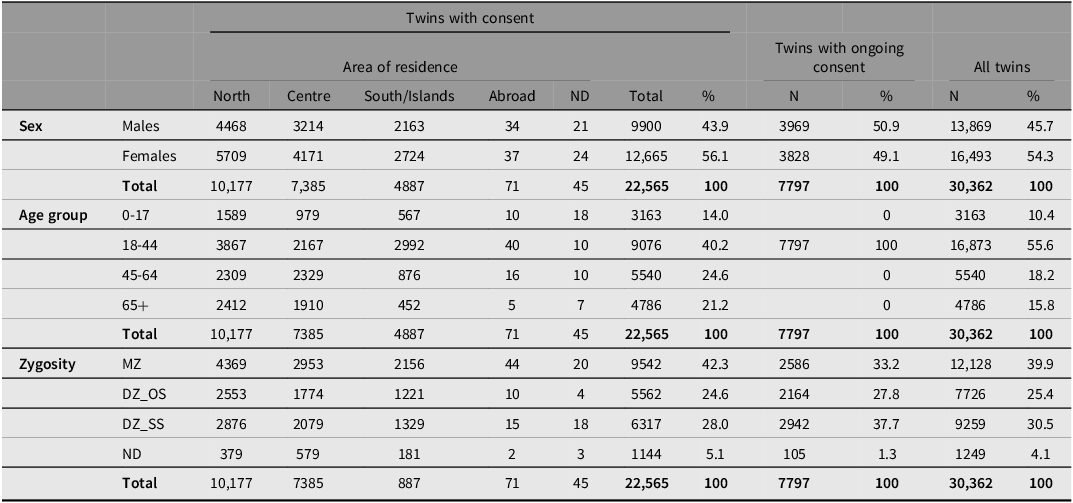
In terms of collected data, ITR currently contains information on 30,362 twins of various ages and from different geographical areas (Table 1). Of these twins, 7797 are in the phase of reconfirming their subscription upon recontact by ITR, having reached the majority age.
Distribution of twins enrolled in the Italian Twin Registry, according to sex, age, zygosity and area of residence

Table 1. Long description
The table presents the distribution of twins enrolled in the Italian Twin Registry, categorized by sex, age group, zygosity, and area of residence. It includes data on twins with consent and twins with ongoing consent. The table has 12 rows and 12 columns. Column headers are: Sex, Age group, Zygosity, North, Centre, South/Islands, Abroad, ND, Total, %, N, %, N, %. Row labels include categories such as Males, Females, Age groups (0-17, 18-44, 45-64, 65+), and Zygosity (MZ, DZ_OS, DZ_SS, ND). Each row provides specific values for each category. For example, Row 1: Sex, Males, 4468, 3214, 2163, 34, 21, 9900, 43.9, 3969, 50.9, 13869, 45.7. Row 2: Sex, Females, 5709, 4171, 2724, 37, 24, 12665, 56.1, 3828, 49.1, 16493, 54.3. Row 3: Total, 10177, 7385, 4887, 71, 45, 22565, 100, 7797, 100, 30362, 100. The table provides a comprehensive overview of the demographic distribution of twins in the registry.
Note: Numbers in cells are absolute counts of twins. MZ, monozygotic; DZ, dizygotic; OS, opposite sex; SS, same sex; ND, area of residence or zygosity not defined.
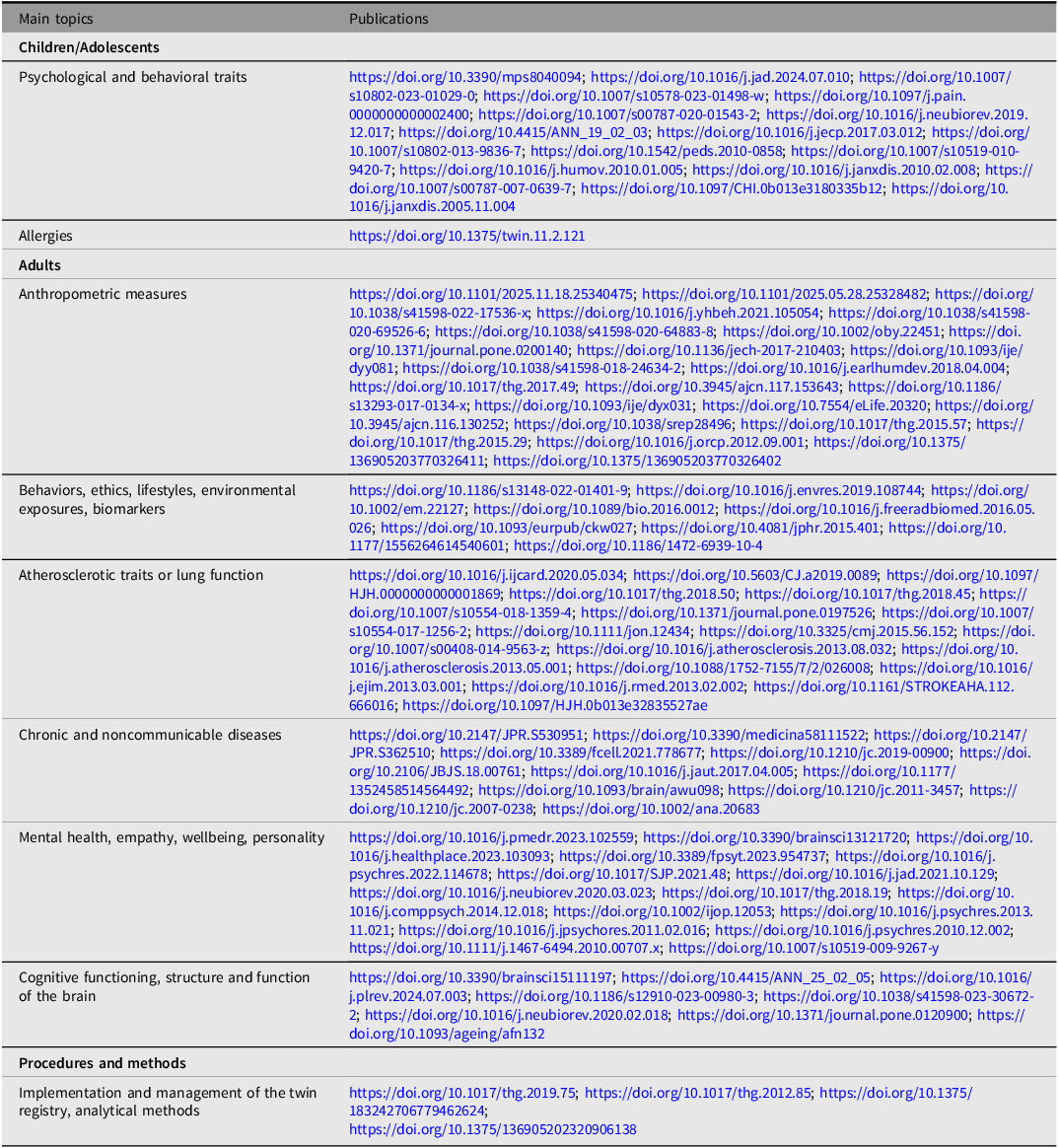
Many of these twins have been involved in genetic-epidemiological studies conducted by ITR in different periods and focusing on a large variety of complex traits (average response rate for study participation: 40%); these studies have made a substantial contribution to the scientific literature (Table 2).
Main topics addressed in Italian Twin Registry studies, along with related publications

Table 2. Long description
The table is organized into two main columns: Main topics and Publications. The Main topics column is further divided into subcategories for Children/Adolescents and Adults, each with specific traits or conditions listed. The Publications column contains URLs for various studies and articles related to these topics. The table has 8 rows and 2 columns. Row 1: Main topics, Publications. Row 2: Children/Adolescents, Psychological and behavioral traits. Row 3: Allergies. Row 4: Adults, Anthropometric measures. Row 5: Behaviors, ethics, lifestyles, environmental exposures, biomarkers. Row 6: Atherosclerotic traits or lung function. Row 7: Chronic and noncommunicable diseases. Row 8: Mental health, empathy, wellbeing, personality. Row 9: Cognitive functioning, structure and function of the brain. Row 10: Procedures and methods. Row 11: Implementation and management of the twin registry, analytical methods. The table lists multiple URLs under each subcategory, indicating various studies and publications related to the main topics.
Note: Additional collected information includes: sociodemographic characteristics (age, sex, marital status, educational level, residential address or area); anthropometric variables (weight, height, waist circumference, hip circumference); lifestyle-related factors (smoking status, alcohol consumption, physical activity); residential environmental exposures (green spaces, blue spaces, urban green areas, forests, air pollution indicators, including particulate matter); medical history (past and current medical conditions, family history of specific diseases, pharmacological treatments).
Biological material of various natures has so far been collected from a subsample of ITR-enrolled twins and in some cases also from their parents (Table 3). This material is stored in the ITR biobank and represents a valuable resource for future genetic and molecular studies.
Biological material collected from twins enrolled in the Italian Twin Registry and their parents

Table 3. Long description
The table compares the types of biological material collected from twins and their parents. It has two rows and six columns. The columns are labeled as follows: Blood, Serum, Plasma, Buffy coat, Lymphocytes, and DNA (from saliva or swab). The row labels are Twins and Parents. The values in the table are as follows: Row 1: Twins: Blood, 218; Serum, 804; Plasma, 816; Buffy coat, 236; Lymphocytes, 567; DNA (from saliva or swab), 1753. Row 2: Parents: Blood, -; Serum, -; Plasma, -; Buffy coat, -; Lymphocytes, -; DNA (from saliva or swab), 866.
Note: Numbers in cells are counts of twins/parents
In recent years, the enrollment of twins in ITR has been rather stable, with response rates generally around 25−30%, and some physiological variations due to changing resource availability or unique historical contingencies. For example, a slowdown in the enrollment rate has been inevitable during the COVID-19 pandemic (Figure 1). The numbers are well below those achieved in previous years, when a higher willingness to participate in epidemiological studies has generally been observed in Italy, and greater fund-raising opportunities were provided to ITR by international research networks (e.g., GenomEUtwin).
Twins newly enrolled in the Italian Twin Registry since 2012.

These numbers are expected to increase over the coming period in view of the ITR access to the Italian National Register of the Resident Population, for which at present ITR is being called to conform to the provisions of the Italian data protection law (d.lgs 196/2023) as modified by the GDPR (EU Reg 679/2016) (see corresponding section below).
ITR International Collaborations Involving Data/Tools Sharing and Cohorts’ Harmonization
The following section illustrates a series of international ITR collaborations from 2009 to the current day, which implied various procedures for data sharing and harmonization, as well as ethical and legal procedures provided by the law and the institutional regulations. In particular, all the collaborations were framed by an agreement between the Istituto Superiore di Sanità (ISS) and the external coordinating centre of the study/project. Since 2018, all the scientific collaborations, which imply use and/or sharing of personal (even pseudonymized) data, require an approval by the Data Protection Officer (DPO) at ISS; this approval is conditional on adherence to the provisions of both GDPR (EU Reg 679/2016) and the Italian Legislative Decree 196/2003, with the latter being the pre-existing italian law on personal data treatment as modified according to the GDPR. It is important to specify that all data are collected by ITR according to an informed consent procedure, because the ITR collection is currently not provided by a specific law as happens for many Italian health surveillance systems or disease-registries, which are based on routinely accessed hospital records. In the absence of a law, the juridical bases for ITR data collection are exclusively provided by an informed consent by the twins. The adopted model of consent has progressed since the early 2000s to incorporate not only the consent for the use of data (and biospecimens when required) for a specific study, but also the reuse of data and biospecimens for future use in studies with similar aims, provided that there will be, in this order: (1) a DPO’s approval for what concerns the privacy by design structure and the protection of personal data flows of the study/project; (2) an approval of the study/project by the National Review Board; and finally, (3) the signing of an official scientific collaboration agreement between ITR and the partner(s).
The sharing of data, as showed by the following collaborations, can be done after internal analysis on the individual records, sending outside the summary statistic results for meta-analyses (which is the most ‘comfortable’ data-sharing procedure for privacy issues concerns). Alternatively, data sharing can be accomplished by transferring individual records to the collaborating centers, provided that the records are previously pseudonimized following strict procedures supervised by the DPO experts at ISS. External direct access to individual ITR records is never allowed.
International Twin Study on Atherosclerotic Traits
In 2009, ITR and the Hungarian Twin Registry (Littvay et al., Reference Littvay, Métneki, Tarnoki and Tarnoki2013; see also https://ikrek.semmelweis.hu/content/about-us?language=en) conducted a collaborative study aimed at investigating the etiology of atherosclerosis. The research was carried out across 3 centers located in Central and Northern Italy, and in Hungary. A total of 760 adult twins were recruited, and a wide set of clinical and lifestyle parameters were collected using validated questionnaires and clinical assessments.
The primary aims focused on identifying clinical and subclinical markers of atherosclerosis, including the presence of carotid and femoral plaques, increased intima-media thickness, and arterial stiffness. These were assessed using validated, noninvasive diagnostic tools such as oscillometric devices and B-mode and color Doppler ultrasonography. An additional strength of the study was the inclusion of longitudinal follow-up data, collected five years later from a subsample of Italian twins. This allowed the evaluation of temporal changes in the same set of parameters.
The robustness of the study’s findings (Tarnoki et al., Reference Tarnoki, Baracchini, Tarnoki, Lucatelli, Boatta, Zini, Fanelli, Molnar, Meneghetti, Stazi, Medda, Cotichini, Nisticò, Fagnani, Osztovits, Jermendy, Preda, Kiss, Metneki and Schillaci2012; Tarnoki et al., Reference Tarnoki, Tarnoki, Bogl, Medda, Fagnani, Nisticò, Stazi, Brescianini, Lucatelli, Boatta, Zini, Fanelli, Baracchini, Meneghetti, Osztovits, Jermendy, Kiss, Preda, Karlinger, Lannert and Pietiläinen2013) is strongly supported by the high degree of standardization in data collection: all measurements were determined using the same equipment across all study places, and all measurements were performed by the same two physicians. Moreover, this rigorous approach not only minimized measurement variability but also created a unique opportunity to compare outcomes between two populations (Italy and Hungary) with distinct environmental, genetic, and cultural backgrounds. ITR perfomed in-house analyses on the Italian twins data and received pseudonimised individual records by the Hungarian collaborating group to perform joint analyses.
MUBICOS Study
MUBICOS (Multiple Births Cohort Study) is an Italian longitudinal twin cohort study launched in 2009 within the framework of the ITR activities. It involves around 350 families with twins (27% monozygotic [MZ] and 73% dizygotic [DZ]) recruited from eight hospitals across Italy. The study aims to follow participants from birth through adolescence and adulthood to investigate the interplay between genetics and environment in health and development (Larsen et al., Reference Larsen, Kamper-Jørgensen, Adamson, Barros, Bonde, Brescianini, Brophy, Casas, Charles, Devereux, Eggesbø, Fantini, Frey, Gehring, Grazuleviciene, Henriksen, Hertz-Picciotto, Heude, Hryhorczuk and Andersen2013). In particular, the main objectives of the study include: (1) monitoring early-life growth and respiratory health (e.g., wheezing and asthma); (2) assessing neurocognitive development, emotional regulation, and behavioral traits during childhood and adolescence; (3) studying gene–environment interactions in relation to growth, neurodevelopment, and respiratory conditions.
Biological samples (e.g., DNA from saliva and saliva swabs) have been collected from 171 complete families (i.e., twin pairs/triplets with both parents) and from further 88 incomplete families (i.e., with one or more missing parent or twin), and cryo-stored for future genetic and epigenetic analyses.The stored samples could not be linked to, or accessed by external biobanks or collections on a routine basis; however, the informed consent provided by participants (i.e., parents) covered the possibility of future reuse of the samples and data, but only within projects having similar purposes and approved by the competent Review Boards.
MUBICOS data are harmonized using different protocols developed by the coordinating centres wthin specific collaborations, such as the HEALS and ART projects outlined below.
Moreover, MUBICOS became part of the European Birth Cohort Inventory (see https://www.birthcohorts.net/birthcohorts/birthcohort/?id=47) and is going to participate in new collaborations on twin birth cohorts.
CODATwins
In 2013, an international collaborative effort (The COllaborative project of Development of Anthropometrical measures in Twins — CODATwins; Silventoinen et al., Reference Silventoinen, Jelenkovic, Sund, Honda, Aaltonen, Yokoyama, Tarnoki, Tarnoki, Ning, Ji, Pang, Ordoñana, Sánchez-Romera, Colodro-Conde, Burt, Klump, Medland, Montgomery, Kandler and Kaprio2015) has been put in place to study, with the twin design, those factors that modify genetic and environmental variation of height, body mass index and size at birth, with a special focus on education and smoking, and to address other research questions such as long-term consequences of birth size. The ITR group joined this initiative by contributing data on 17,361 twins from 8630 complete pairs (44% MZ), for a total of 18,834 measures of height and weight, 5651 of smoking status, 1904 of birth weight, and 5767 of maternal education (Silventoinen et al., Reference Silventoinen, Jelenkovic, Yokoyama, Sund, Sugawara, Tanaka, Matsumoto, Bogl, Freitas, Maia, Hjelmborg, Aaltonen, Piirtola, Latvala, Calais-Ferreira, Oliveira, Ferreira, Ji and Kaprio2019). Among the main findings, it has been found that: (1) genetic factors play a key role in adolescent BMI variation among populations of different ethnicities exposed to different obesity-related environmental factors; (2) heritability of adult height does not seem to depend on the population’s living standards; (3) individual-specific environmental factors significantly contribute to the positive association between birth weight and later BMI, at least until young adulthood; (4) both genetic and individual-specific environmental factors play a role in the association between birth size and later height from infancy to adulthood; (5) smoking is associated with lower BMI, while smoking cessation is associated with higher BMI.
In 2024, the second stage of the CODATwins study has been launched to investigate adult weight change and its risk factors. For this longitudinal study, ITR provided information on 1433 twins from 455 complete pairs (60% MZ) aged 18−78 years. Analyses performed so far have shown that environmental factors are the main drivers of adult BMI changes (Obeso et al., Reference Obeso, Drouard, Jelenkovic, Ordoñana, Sánchez-Romera, Colodro-Conde, Ollikainen, Aaltonen, Corley, Huibregtse, Medda, Fagnani, Toccaceli, Gatz, Butler, Bartels, Ligthart, de Geus, Christensen and Silventoinen2025).
For both CODATwins projects, data were harmonized according to the guidelines provided by the data coordination center at the University of Helsinki and were then analyzed centrally by the same coordination center.
HEALS Project
ITR participated in the international HEALS Project (Health and Environment-wide Associations Based on Large Population Surveys; https://www.heals-eu.eu/), funded by the European Union and focused on environmental risk factors. The project started in 2013 and was carried out over the course of five years. The participating countries shared previously collected data on respiratory, metabolic, and neurological health outcomes, as well as environmental exposure data. A large-scale harmonization of collected data enabled the project to produce robust scientific evidence and to identify environmental exposure profiles associated with the health conditions investigated.
ITR contributed data on about 4600 twins (age range 0–79; 43% MZ and 57% DZ) collected from earlier surveys on respiratory, metabolic, and neurological outcomes. The exposure data were provided by the University of Stuttgart (Stuttgart, Germany) and the VTT Technical Research Centre of Finland (Espoo, Finland), one of the leading R&D institutions in Europe. These data are based on participants’ residential addresses supplied by ITR. The addresses were geocoded, and the percentages of green space, blue space, grey space, agricultural land, and forest coverage were calculated according to the CORINE Land Cover (CLC’s Lambert Equal-Area projection). In addition, estimates of lifelong exposure to PM2.5, NO2, and multiple environmental stressors were derived. All data were harmonized by ITR according to the protocol that had been developed within HEALS activities to best exploit data from all cohorts. Cross-sectional data were drawn from multiple registry-based studies conducted by ITR, while longitudinal data originated from the Multiple Births Cohort Study (MUBICOS). The data were shared in full compliance with the Italian regulations on personal data protection in force since 2003 in the country (the Italian Legislative Decree 196/2003). This ensured that no identifying information — such as names, surnames, or dates of birth — was transferred, nor was any other shared data that could directly or indirectly lead to the identification of the participating twins.
Overall, the findings indicate that environmental exposures and related health outcomes are strongly influenced by socio-demographic factors such as age, gender, location, education, employment, and lifestyle. Both indoor and outdoor pollution contribute significantly, with notable geographic variability. Higher green space coverage, especially coniferous forests, is linked to increased probability of respiratory symptoms like asthma and wheezing, while no association is found with eczema (Li, Friedrich et al., Reference Li, Maesano, Friedrich, Medda, Brandstetter, Kabesch, Apfelbacher, Melter, Seelbach-Göbel, Annesi-Maesano and Sarigiannis2019; Li, Maesano et al., Reference Li, Friedrich, Maesano, Medda, Brescianini, Stazi, Sabel, Sarigiannis and Annesi-Maesano2019; Parmes et al., Reference Parmes, Pesce, Sabel, Baldacci, Bono, Brescianini, D’Ippolito, Hanke, Horvat, Liedes, Maio, Marchetti, Marcon, Medda, Molinier, Panunzi, Pärkkä, Polańska, Prud’homme and Annesi-Maesano2020).The studies conducted within the framework of the HEALS project contributed to the strengthening of ITR’s collaborative network and led to significant outcomes for public health.
A Chronic Pain Questionnaire Validation and Sharing for Heritability Comparisons
In 2019, ISS set up an interinstitutional Working Group (WG) for research on chronic pain (CP) and its psychosocial correlates. The WG activities involved various researcher groups from ISS and the Italian Institute of Statistics (ISTAT), together with pain clinicians from the ISAL Foundation (Institute for Pain Research, Rimini, Italy). In this framework, ITR contributed to the validation of the ‘Brief 5-item Chronic Pain questionnaire’ (Toccaceli et al., Reference Toccaceli, Tenti, Stazi, Fagnani, Medda, Gargiulo, Burgio, Sampaolo, Ferri and Raffaeli2022); this is a specific tool designed to survey the occurrence of CP and its main characteristics in large samples of the general population, while many available questionnaires are suitable to address CP only in clinical settings. For the ‘reliability’ assessment of the tool, a prototype questionnaire was tested through two distinct double-wave online surveys on two adult twin-samples (a first test−retest on a convenience sample of 70 adult twins, a second test−retest on a new version of the questionnaire on further 273 adult twins recruited by ITR). The results of the reliability tests paved the pathway to subsequent validation phases (criterion and construct validity assessment) on a representative sample of individuals (N = 38,775), drawn from the Italian general population who participated in the Italian section of the European Health Interview Survey in 2019, which adopted this CP measure. After validation, the final version of the ‘Brief 5-item CP Questionnaire’ was shared with the Murҫia Twin Registry in order to promote a comparison between the Italian and Spanish populations with respect to the heritability estimates of CP occurrence and intensity. For the Italian population, these estimates are available from a recent ITR study (Fagnani et al., Reference Fagnani, Toccaceli, Tenti, Medda, Ferri, Stazi and Raffaeli2022), while between-countries comparative analyses are still ongoing.
ART-Health Partnership
The aim of the Assisted Reproductive Technology and Health partnership (ART-Health; https://arthealth.bristol.ac.uk/), promoted by the University of Bristol (kick-off September 2022), is to provide robust evidence on the effects of pregnancy conception by assisted reproductive technology (ART), compared with natural conception, on mothers and offspring health from pregnancy through early adulthood. Twin data were exploited to examine two key developmental outcomes: (1) growth trajectories and adiposity patterns from infancy through early adulthood, and (2) the presence of behavioral and emotional difficulties in offspring from childhood through adolescence (ongoing analyses).
To address the objectives of the project, several cohorts’ data from both singleton and multiple births were used. ITR provided data on twins, while all other cohorts provided data on singletons. ITR contribution was made possible thanks to the data collected as part of several previous ITR studies (e.g., longitudinal COVID survey started in 2020, studies on Psycho-Physical Well-Being of adolescents started in 2003), as well as the MUBICOS study. First, data were subjected to an in-house harmonization following a protocol specifically designed by the coordinating centre at the University of Bristol (e.g., different ART techniques, weight, BMI, data collected through the Children Behavioural Checklist [CBCL] and the Strengths and Difficulties Questionnaire [SDQ]). As a second step, data were analyzed independently by each partner using consistent and standardized statistical methods, and the results are being pooled through a meta-analysis by the coordinating center. Overall, about 2000 Italian twins were included in the analyses. All contributing studies had received ethical approval from the Ethics Board at ISS in Rome, and informed consent was obtained from all participating offspring’ s parents.
This collaboration shows that twins datasets can be fruitfully exploited for joint international research efforts within general population frameworks, thanks to the systematic and timely collection of data on large and representative cohorts, which is allowed by the twin registries’ infrastructures (Elhakeem et al., Reference Elhakeem, Taylor, Inskip, Huang, Tafflet, Vinther, Asta, Erkamp, Gagliardi, Guerlich, Halliday, Harskamp-van Ginkel, He, Jaddoe, Lewis, Maher, Manios, Mansell and McCarthy2022).
ITR Ongoing National Collaborations to Replicate Findings from Nontwin Population
This section discusses two recent replication studies where ITR provided an important contribution to strengthening the health-related findings regarding the general population. Both studies respond effectively to the standards required by the ethical and legal procedures. The rights of the participants and donors are all well considered in the consent procedures (access, modification, and erasure of personal data, right to be forgotten), and specific formal procedures for communication between ITR and the twins are defined at institutional level.
A Replication Twin Study of Risk Factors for Cognitive Decline And Dementia
In 2022, a multicenter project has been funded by the European Union within the National Recovery and Resilience Plan (NRRP) – Health Section, entitled ‘From prevention to the etiopathogenetic and pathophysiological mechanisms of dementia: a paradigm shift in the biological continuum of cognitive decline. The PREV-ITA-DEM study’. ITR is part of the working groups and in charge of implementing a twin study with various objectives. The main one of these is to confirm in the twin population, by using individual-level and matched-pair analyses, the major risk factors previously reported by the Lancet Commission for dementia, that account for around 40% of cases worldwide (Livingston et al., Reference Livingston, Huntley, Liu, Costafreda, Selbæk, Alladi, Ames, Banerjee, Burns, Brayne, Fox, Ferri, Gitlin, Howard, Kales, Kivimäki, Larson, Nakasujja, Rockwood and Mukadam2024). To this end, a sample of around 520 twins aged 60−85 years was recruited, and questionnaires on risk factors for cognitive decline and on cognitive performance (Self-Administered Gerocognitive Evaluation [SAGE] questionnaire) were administered. Among these twins, 72 cognitively discordant pairs (i.e., pairs in which the two twin members showed different levels of cognitive abilities as assessed by the SAGE score) were identified, and are currently undergoing a clinical evaluation to confirm the discordance status and to collect a blood sample for biomarkers identification. The data collection and statistical analyses are still underway, but preliminary results on the twins recruited to date provide support for the representativeness of the Italian twin population with respect to the main risk factors for cognitive decline (Medda et al., Reference Medda, Vanacore, Canevelli, Sciancalepore, Fabrizi, Locuratolo, Nuti and Fagnani2025).
A Replication Twin Study for the Validation of a Chronic Pain Biomarker
During the years 2018−2024, the ISAL Foundation (Institute for Pain Research, Rimini, Italy) has conducted biomolecular research in collaboration with the Scientific Hospital and Care Institution S.Raffaele of Rome, which has notably increased the knowledge regarding a possible biomarker for chronic pain (CP). In 2024, ITR was involved in an official collaboration with the above-mentioned Institutions, offering a valuable pool of twins (N = 60 twins, 20 CP discordant pairs plus 20 control twins from unaffected pairs), previously surveyed in February 2020 with the Brief 5-item CP Questionnaire (see previous section). The aim of the collaboration is the implementation of a discordant-twin study to strengthen the hypothesis of a causal relationship between CP and the percentage of B and NK lymphocyte cells, expressing a possible biomarker named Mu-Opioid-Receptor (MOR). The designed twin study, starting in March 2026, will replicate the analyses conducted on two samples of singleton osteoarthritic and fibromyalgic patients enrolled at S. Raffaele (Malafoglia et al., Reference Malafoglia, Ilari, Gioia, Vitiello, Tenti, Iannuccelli, Cristiani, Garofalo, Passacatini, Viglietto, Scavalli, Tomino, Mollace, Raffaeli, Di Franco and Muscoli2023, Reference Malafoglia, Raffaeli, Ilari, Gioia, Iannuccelli, Tenti, Vitiello, Proietti, Lupacchini, Passacatini, Tomino, Vincenzo, Fini, Di Franco and Muscoli2025), and it will provide crucial support to the hypothesis of MOR as a biomarker. Thanks to the discordant-twin methodology, the study results will be able to drive the hypothesis towards an etiological interpretation of the biomarker significance, or to divert the same hypothesis towards the existence of a biomarker of predisposition. Moreover, this discordant-twin study will provide evidence of a possible role of selected mental health and social factors known to be associated with CP phenotypes in the etiological pathways. Last but not least, it will pave the way for future molecular studies on the same phenotypes, based on the biological samples that will be stored in the ITR biobank.
Integration of ITR Data With National Administrative Records
A furher important field where ITR has variously been involved since 2015 is that of data integration with official administrative records. The requests for data integration may come from different external institutions, as it was the case in the collaboration with the National Social Security Institute (INPS), or from other departments internal to ISS itself. These collaborations addressed relevant social and healthcare issues, and required particular attention to data access, sharing, and pseudonymization procedures.
A Twin Study on Labor Characteristics
The INPS (National Social Security Institute) dataset collects payroll taxes from all workers (private and public employees, self-employed, contract workers) in Italy, covering, therefore, almost all earning sources of the Italian population, including immigrants and temporary residents. The aim of the data integration effort involving the INPS dataset and the ITR dataset, undertaken by ITR in 2022, was to study the heritability of education attainment and of some labor-specific measures in Italy. To this purpose, the two databases were linked. The linkage was a deterministic one, and used the unique social security code — retained by both ITR and INPS — as the key identifier. ITR provided zygosity and years of education of the twin sample that was identified as the working sample according to age-based inclusion criteria, while INPS provided yearly earnings and years of employment. IT procedures were thoroughly applied, according to the privacy by design implant requested by the GDPR and supervised by the Data Protection Officers at both ISS and INPS, to make the linkage key uninformative and to produce a pseudonymized data set as output. Moreover, the analyses were conducted exclusively in house, at INPS, to guarantee that data on earnings and taxes were not released outside the data controller institution. Finally, at the end of the analyses, the resulting database was destroyed.
At the time of the linkage, ITR included around 29,000 twins spanning a wide age range across Italy (Medda et al., Reference Medda, Toccaceli, Fagnani, Nisticò, Brescianini, Salemi, Ferri, D’Ippolito, Alviti, Arnofi and Stazi2019). INPS provides near-universal coverage of earnings and employment histories in the country through its contributory archives, including detailed records of employment spells, unemployment, parental leave, and other labor-market events. To construct the working sample, ITR data were matched with INPS records for individuals born between 1964 and 1996, assuming that most had completed their education and were active in the labor force by 2021. This match yielded a final analytic sample of 13,600 individuals, but information on educational attainment was available for 10,068 individuals (47% MZ). The match rate varied by birth cohort, displaying an inverted U-shaped pattern: high among those in their 40s and lower among older or younger cohorts, likely reflecting retirement or late enrollment in the registry. Women and identical twins were overrepresented, likely due to higher participation rates of both groups in voluntary registries like ITR. The home leaving age was almost identical for MZ and DZ twins, thus supporting the Equal Environments Assumption. Regional differences could be detected, with underrepresentation from South Italy and a stronger presence from Central Italy.
Heritability in educational attainment reaches about 44–50%, while the shared family environment accounts for roughly 20–30% of the variance, depending on the birth cohort. For labor-market outcomes among younger cohorts, shared environment falls to essentially 0%, with inequality driven almost entirely by genetics (about 49%) and idiosyncratic factors (about 51%), whereas older cohorts show a larger idiosyncratic component and a smaller genetic one. In more detail, heritability was 47% for ‘years of education’, 49% for ‘life-cycle earning’ and 39% for ‘life-cycle employment’. Shared environment contribution was about 26% for ‘years of education’, while it was almost negligible for ‘life-cycle labor measures’ (4% for earning and 7% for employment).
The publication of these results is still ongoing, but a report is available for further details (see https://www.inps.it/it/it/dati-e-bilanci/attivit--di-ricerca/pubblicazioni/workinps-papers/2025.html).
A Comparison of Pharmaceutical Prescriptions Between Twins and the General Population
Using administrative data from an Italian regional drug prescription monitoring system, medication use patterns among approximately 6675 twins — identified through ITR — were analyzed and compared with a matched cohort of around 20,000 singletons from the Italian general population resident in the Umbria Region. This study represents the first effort in Italy to evaluate the comparability of twins and singletons in terms of pharmaceutical prescription use, a concrete and objective measure of healthcare need and utilization. For over 15 years, a scientific collaboration agreement has been in place between the ISS and the Umbria Region, governing the flow of pharmaceutical prescription data. In accordance with legal provisions on the processing of personal and sensitive data, the Region routinely transmits this data to ISS. The twin study was conducted within the framework of this agreement, with prior approval from the ISS National Ethics Committee and in compliance with current privacy regulations. Prescription data spanned from 2012 to 2017 and included all medications covered by the National Health Service and dispensed through pharmacies.
In 2017, 60.2% of singletons received at least one prescription, compared with 56.4% among twins. Our findings indicate a slightly higher medication use among singletons, with no substantial differences in usage trends over the six-year period. When the population was divided into minors and adults, this pattern remained consistent. Singletons showed only marginally higher prescription rates than twins across all age groups, with the greatest difference observed among minors — particularly those aged 14–17 years (44.8% in singletons vs. 36.4% in twins). Pharmaceutical prescriptions were also analyzed according to the Anatomical Therapeutic Chemical (ATC) classification system, and no significant differences were observed between twins and singletons. Overall, the observed variations were modest and not sufficient to indicate a systematic divergence between the two groups. The study’s results have not yet been published.
This study highlights how national and regional administrative health data can effectively complement information from twin registries, enhancing the validity of twin research. By integrating these Italian data sources, the study supports the assumption that findings from twin studies are generalizable to the broader population, aligning with international research and strengthening the relevance of twin-based investigations in public health.
Ethico-Legal Criticalities Experienced by ITR in Multicohort Collaborations and Data Acquisition: ITR Initiatives to Overcome the GDPR Bottleneck
This final section describes two further major ITR efforts. The first one regards the potential contribution by ITR to an international enterprise, which, at the moment of the collaboration proposal by the network coordinator, was hindered by outdated informed consents, collected many years before and not yet updated. The second effort, currently underway, is probably the most demanding and fundamental one since ITR inception: the attempt to access the Italian National Registry of the Resident Population; this access will allow ITR to significantly increase the numbers of contactable twins all over the country, and, thus, also the enrollment figures.
Consortium for GWAS on DZ Twinning
Recently, significant genetic-epidemiology research efforts have been devoted to understanding the genetic bases of spontaneous DZ twinning, and an international consortium (Twinning Genetics Consortium) has been established to meta-analyze genomewide association study (GWAS) evidence from different European ancestry cohorts. For details on this consortium, a webpage is available (see https://www.twinningconsortium.org/projects/genetics-of-dizygotic-twinning/).
In 2024, the ITR research group was offered the opportunity to join this consortium and to contribute valuable GWAS data from a southern European area. In particular, GWAS Italian data potentially available for this international endeavor referred to 100 DZ twins not conceived after fertility treatments, plus 102 controls (either MZ twins or parents of MZ twins).
However, at the time of the enrollment of these twins in ITR, namely the early 2000s, the informed consent they signed did not address collaborations involving the reuse of genetic information; therefore, ITR could not join the consortium. The reason for this lack of consent was basically that the first Italian personal data protection law was issued later in 2003. Prior to that time, the consent did not cover the sharing of data and did not have a legal value, as it is now required by the current national and international legislation. In the general framework of the GDPR (EU Reg 679/2016) provisions, ITR is now setting up new ethico-legal procedures to update these consents, providing a multilayer model suitable to favor future collaborations involving genetic data sharing.
Access to the National Register of the Resident Population
Since its inception in the early 2000s, ITR twins’ enrollment was accomplished by variously enquiring with single municipal registries in the country, with a specific algorithim that identified potential twins by matching individuals with the same date and place of birth, and identical parental names. This procedure is able to retrieve lists of contact information of potential twins (or parents, in the case of children) to be reached by mail or email, and start the informed consent procedures. After the entrance into law of the GDPR in May 2018 and a series of more recent IT development actions regarding administrative data management in Italy, the datasets of Italian municipalities registries have all been gathered in the National Register of the Resident Population (Anagrafe Nazionale Popolazione Residente, ANPR). This made the procedures to retrieve the lists of potential twins increasingly difficult and eventually impossible for ITR. It has clearly emerged, in fact, that the lists’ retrieval has become a process without a juridical basis, as the GDPR changed the pathway to frame such data request, while formerly, the Italian personal data protection law (d.lgs 196/2003) together with the Personal Data Regulation Act — issued by ISS in 2007 — provided the juridical bases for accessing these municipal registries. As a consequence, ITR has recently made an enquiry to the Italian National Personal Data Protection Authority to learn about the legal and administrative tools that would be needed to solve the problem. The Authority has detected two different possible mechanisms for the legal retrieval of the twins’ contact information by ITR. The first one would be a temporary bridging solution that would imply transmitting an official ‘communication’ to the same Authority for requesting these lists to the ANPR (according to art. 2- ter, par. 3 of the EU Reg 679/2016); however, this would be a ‘one-shot’ authorization, not suitable in the long run. The second one would imply including the potential twins’ demographic data flow from ANPR to ITR in a national law regarding the interconnection of health-related datasets, which is in the process of being updated in Italy. This second pathway would be much more difficult and time consuming for ITR, as it would involve the intervention of a Directorate General of the Health Ministry and the balance of various competing needs at national level in terms of human and financial resources. Although this scenario is inevitable to achieve the future consolidation of ITR, the first solution would temporarily allow an estimated 1.5 million potential twins to be contacted; this would enable the ITR group to start a time- and resource-demanding process to obtain the expected new enrollments and to update the consent for those twins who were enrolled in the registry as children but have now reached the majority age. The success of this legal and managerial endeavor will be fruitful for ITR, as it will also lay the basis for a possible epidemiological monitoring of the Italian population, through a ‘sentinel twin population’ to be followed up for several complex health outcomes.
Discussion and Conclusions
It appears quite clear that one of the most important events that had an impact on ITR activities has been the issue of the GDPR. The former Italian law regarding personal data treatment required only that certain measures and acts were adopted, such as prescribed data security measures or specific notification to the Authority. On the contrary, the GDPR has introduced the principle of accountability, which requires a far more proactive, demanding and time-consuming role of researchers to build up a data-protecting framework for their research and the related personal data flows. However, the advantage that the Italian law has maintained on the GDPR is that the informed consent sometimes can be waived if the scientific research pursues a significant major public interest, or if obtaining consent is impossibile or disproportionate, provided that there are adequate guarantees and the research is provided by law (Art. 110 Legislative decree 196/2003). This is exactly the exemption that ITR is aiming for in the long run. In the meantime, we hope that our detailed explanation of the ITR ethico-legal framework and related technical procedures could be of help to other twin registries in Europe to ease the pathway for collaborations and to speed up future multicohort studies involving data integration.
Currently, the main goal of ITR is the enrichment of its enrollments, to cover not only the main cities of the country but also minor towns and possibly rural areas, especially in the south and on islands of the country. Considering the difficulties in obtaining a specific legal norm in a short time, our efforts are concentrating to have an intermediate result: a one-shot communication by the National Register of the Resident Population, which will produce huge numbers of potential twins to be contacted all over Italy, and consequently, a long and busy period of enrollment procedures for the ITR research team.
Accessing the national demographic data will represent a historical landmark for ITR, able to open new horizons towards a systematic enrollment of large and representative twin cohorts, with novel opportunities not only for genetic-epidemiological research but also for the implementation of a powerful health-related monitoring of the Italian general population.
Finally, making the most of the problems ITR enconuntered, we are confident that new research collaborations might be more smoothly achieved, thanks also to the informed consent model for study participation we have adopted during the last few years, that allows for the reuse of data and biospecimens for several future research endpoints on a stable basis. However, we are well aware that such a model of informed consent has to be recognized by the Data Protection Officers, according to the GDPR provisions, for each single future collaboration.
Acknowledgments
The Italian Twin Registry (ITR) group expresses its gratitude to all the twins and their families for the continuing interest and participation. The financial and organizational support by the Centre for Behavioural Sciences and Mental Health of the Istituto Superiore di Sanità (Responsible: Dr. Gemma Calamandrei) to all ITR initiatives is also acknowledged. Furthermore, a special thank is due to the following scientific ITR partners for their valuable collaboration: (1) Developmental Psychopathology Unit, ‘Vita-Salute’ San Raffaele University, Milan, Italy; (2) Faculty of Psychology, Sigmund Freud University, Milan, Italy; (3) Department of Neurosciences and Mental Health, Fondazione IRCCS Ca’ Granda Ospedale Maggiore Policlinico, Milan, Italy; (4) Child and Adolescent Psychiatry Unit, IRCCS Eugenio Medea, Bosisio Parini, Italy; (5) Department of Psychology, Sapienza University of Rome, Rome, Italy; (6) Centro Cardiologico Monzino, IRCCS, Milan, Italy; (7) ISAL Foundation, Institute for Research on Pain, Rimini, Italy.
Competing interests
None.



 Open access

