

1. Introduction
Taxes create burdens on economic agents as purchasing power is transferred from households and firms to the public sector. Taxes may also change the behaviour of households and firms. Agents might move from high tax activities to low tax activities, from taxed activities to untaxed activities. It is an important empirical task to provide evidence on how large the behavioural effects of taxation are. Episodes with major changes in taxes that induce considerable changes in the behaviour of economic agents provide one possible empirical approach.
There is a discussion in the economics literature on whether parents choose to give assets to their children while alive instead of bequeathing as a way of reducing tax payments. Poterba (Reference Poterba2001) finds that this is not the case in the United States.Footnote 1 This might be explained by the fact that parents fear the risk of medical costs in the future, fear that the children will not make appropriate use of the funds etc. Schmalbeck (Reference Schmalbeck, Gale, Hines and Slemrod2001, p. 156), however, concludes that: ‘people simply do not like to give away their property while they are alive’. Thurow (Reference Thurow1976) argues that parents want to keep economic power as long as they can. But it can be argued that tax changes may change behaviour, in this case result in inter vivos giving, provided that the potential tax gains are expected to be large enough.
There was a gift and inheritance tax in Sweden until 2004. The inheritance tax was introduced in 1895, replacing an estate tax, while the tax on gifts was added in 1915.Footnote 2 There was also an estate tax during the period 1948–58.Footnote 3 These taxes were always controversial. One might say that they have generated more controversy than tax revenue.Footnote 4 They became symbols for the ideological tension between the political left and the political right. Arguments about equity and equality of opportunity stood against property rights arguments. But these taxes also provided integrity for other tax bases, for example, the wealth tax. The existence of a gift tax made it, in other words, more difficult to avoid the wealth tax by giving wealth to others.
I have access to aggregate tax revenue data since 1884. Even though there are fluctuations in the tax revenue series, one episode seems more difficult to explain than the others. Sweden was struck by an epidemic of sudden generosity during the second half of the 1940s. Gift tax revenue in 1947 was 20 times higher than the annual averages before and after. It was, however, not the first peak in tax revenue; similar epidemics had already struck in 1933 and 1919/20, but the outbreak was bigger. The 1947 gift tax revenue was, however, exceptional as this was the only year during the studied period when gift tax revenue exceeded inheritance tax revenue.
In the mid 1940s the Social Democrat finance minister Ernst Wigforss made his third attempt to introduce an estate tax in Sweden.Footnote 5 The estate tax was an element in a comprehensive tax reform. The tax reform created a heated discussion in the political sphere, but the design of economic policy in general was very much on the political agenda during the years immediately after World War II. There was a strong polarisation between the political left and the political right on issues such as economic planning. The discussion at the political level intersected with a discussion about legal principles. The focus on law was not paralleled by an interest in the economic actions of individuals at the micro-level.
The estate tax was introduced from 1948 by the Estate Tax Law of 1947. To my knowledge, this is the first time that this gift episode has been discussed in the research literature. It has been a completely neglected episode.Footnote 6
The 1947 gift explosion is a clear example of the behavioural effects of taxes. It illustrates that behaviour is affected not only by actual tax rates but also by expectations about future tax increases. The episode is also a fascinating part of Sweden's economic history.Footnote 7
One might ask why people had not previously given inter vivos more regularly to their children up to the gift tax exemption level to avoid taxes. A possible interpretation of the events in Sweden during the 1940s is that the expected tax changes were so large that this outweighed the perceived disadvantages of giving inter vivos.
I also have a rich micro-data set of all gifts reported during the period 1942–9 in Dalarna, a county in the geographical middle of the country. The main type of asset used, in value, during the gift explosion 1945–7 was promissory notes. The choice of promissory notes, instead of giving financial or real assets, was a way of still keeping as much economic power as possible. Minors got higher amounts than others and parents gave higher amounts than others. When a parent gave to a minor child, the parent lost less control over the resources than if a gift had been made to someone else.Footnote 8
So, what is the legacy of the Swedish gift and inheritance tax 1884–2004? My three main conclusions from the discussion in the article are:
• A first main result is that gifts, inheritances and estates were never important sources of tax revenue. Revenue, as a share of GDP and as a share of total tax revenue, had already reached a peak in the 1930s. The roles of these taxes have instead primarily been equity and to provide integrity for other tax bases.
• Expectations were important. Gift tax revenue during the 1940s started to increase long before a new estate tax and increased wealth taxation were decided and implemented, starting even before the legislative process began.
• Economic power and economic control were important. Parents gave to their children in order to avoid taxes, but only when the expected gain became large enough and in ways that left them with as much economic power as possible.
The article is structured as follows: in Section 2, I discuss the revenue from taxes on gifts, inheritances and estates since 1884. Section 3 presents the episode in the mid 1940s when the revenue from the gift tax increased twentyfold. The evidence from the Dalarna micro-data set is presented in Section 4. Section 5 reports the results from estimating econometric models using the Dalarna micro-data. Section 6 concludes. There are three appendices. Appendix 1 presents the data sources and some descriptive statistics. Appendix 2 accounts for the most important changes affecting taxes on inheritances, estates and inter vivos gifts in Sweden. The gift tax rates in the mid 1940s are reported in Appendix 3.
2. Tax revenue since 1884
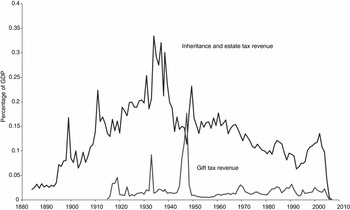
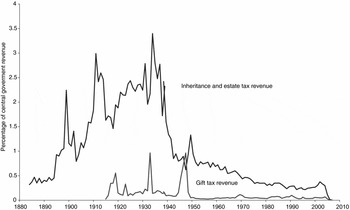
Figures 1 and 2 report the revenue from taxes on estates, inheritances and inter vivos gifts during the period 1884–2008.Footnote 9 When studying the long-run evolution of tax revenue it is necessary to relate nominal tax revenue to some other macro-aggregate. I have chosen, first, to focus on nominal tax revenue as a share of nominal GDP at basic prices; see Figure 1. This means that I deflate revenue not only with the increase in prices but also with the increase in real production. Second, I relate nominal tax revenue to total central government revenue; see Figure 2.
Revenue from taxes on inheritance, estates and inter vivos gifts, 1884–2008, percentage of GDP

Revenue from taxes on inheritance, estates and inter vivos gifts, 1884–2008, percentage of central government revenue

The main trends in tax revenue are very clear. Tax revenue from inheritance and estate taxes increased from 1884, when my data start.Footnote 10 The increase continued until the mid 1930s. Annual tax revenue as a share of GDP peaked at about 0.3 per cent; see Figure 1. Inheritance tax revenue as a share of total central government revenue peaked at 3.5 per cent. There is a trend decrease thereafter. Gift tax revenue, on the other hand, was stable in the long run since its introduction in 1915, with three distinct peaks in 1919, 1933 and, in particular, 1947. Gift tax revenue exceeded inheritance tax revenue in 1947. This is exceptional and only happened once during the decade I have gift tax revenue data for.
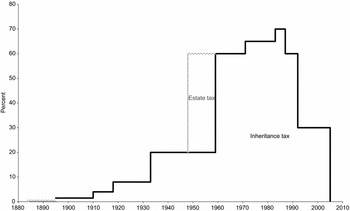
But in addition to the long-run trends, tax revenue shows a lot of variation in the short run. These developments can, of course, be related to the main changes in the tax design. Figure 3 reports the top marginal tax rates on inheritances received by legal heirs during the period 1884–2004.Footnote 11 It should be stressed that I here report the nominal tax rates. The effective tax rates have been lower than the nominal rates. The reasons for this have varied over time.
Top marginal tax rates on inheritances received by legal heirs, 1884–2004 (percentage)

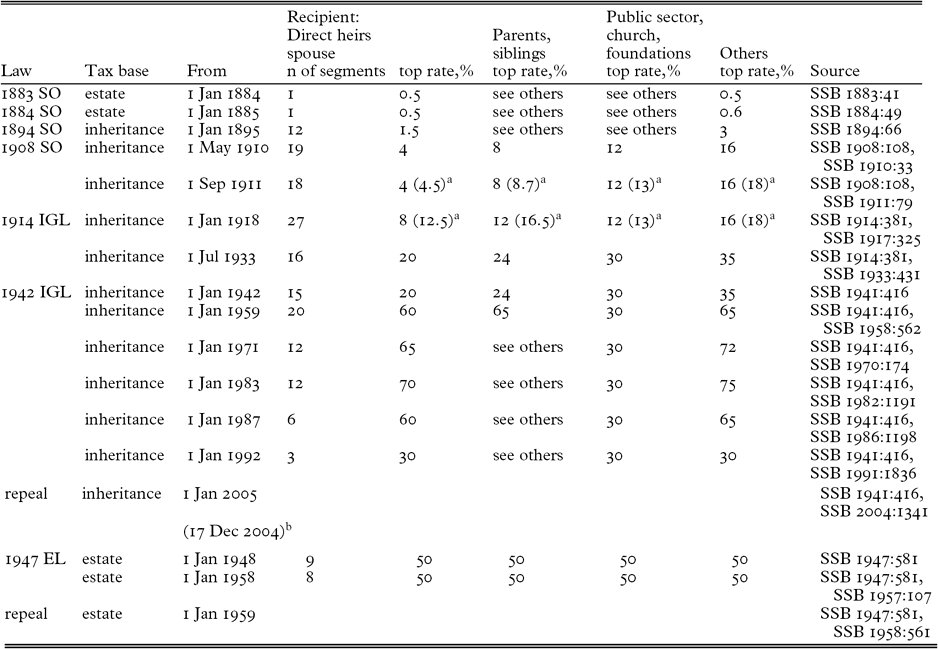
The estate report was the basis for the estate tax in the 1883 Stamp Ordinance, which was the basis for the tax revenue in 1884, the first year of the revenue series. The tax rate was 0.5 per cent. The 1884 Stamp Ordinance started to make the estate tax dependent on the type of heir. The rate was 0.5 per cent of the estate if there were direct heirs, 0.6 per cent otherwise.
A true inheritance tax was introduced in the 1894 Stamp Ordinance. There were 12 tax brackets for direct heirs and spouses, and the maximum rate was 1.5 per cent. The maximum rate for others was 3 per cent. Tax revenue increased. The revenue peak in 1899 coincided with a peak in mortality that year.Footnote 12
The tax rates were increased in 1910/11, when the maximum rate for direct heirs and spouses became 4 per cent. This created a tax revenue peak. The stamp ordinances were replaced by an Inheritance and Gift Tax Law in 1914, which came into effect in 1915. The two taxes were now integrated with each other. The tax rates were further increased in 1918, and the maximum rate for direct heirs and spouses now became 8 per cent.
In 1928, finance minister Wigforss put forward a private bill in Parliament to introduce an estate tax. This became an extremely hot topic in the 1928 parliamentary election campaign, which was very tense between the left and the right. The election was won by the Conservatives.
The Social Democrats gained power in the next parliamentary election in 1932. The new minority government suggested the introduction of an estate tax in 1933. This was, however, rejected by Parliament. Instead, the inheritance and gift taxes were increased in 1933. The maximum rate for direct heirs and spouses was increased to 20 per cent, and a special wealth tax was introduced the following year. These tax changes are well correlated with the peak in gift tax revenue before the tax increases and the peak in inheritance tax revenue afterwards. This provides additional evidence on the role played by expectations of future tax changes in the decision to give.
A new Inheritance and Gift Tax Law was introduced in 1942, but there were no major changes to the tax schedules. More importantly, an estate tax was introduced from 1948 by the Estate Tax Law of 1947. In addition, an estate tax on gifts was combined with the estate tax to provide integrity to the tax base. The political process leading to this tax is discussed in the next section. In this case gift tax revenue also increased before the tax increase but to a much larger extent, and revenue from taxes on estates and inheritances increased afterwards.
Now there were four different taxes on transfers. The gift tax was integrated with the inheritance tax, while the estate tax on gifts was integrated with the estate tax. The combined effects of the transfer taxes implied that the marginal tax on a bequest or an inter vivos gift to a direct heir could be as high as 60 per cent.
The estate tax was repealed from 1959. As the tax on inheritances was increased at the same time, however, revenue remained approximately the same. The maximum rate for direct heirs and spouses was increased to 60 per cent.
The tax rates were increased further in 1971. Now the maximum rate for direct heirs and spouses was increased to 65 per cent. Nominal tax rates reached their all-time highs in 1983 when, for example, the maximum rate for direct heirs and spouses now reached 70 per cent.
The reduction of tax rates and the final repeal of the inheritance tax were done in three steps. The first step was taken in 1987 when tax rates were decreased. The maximum rate for direct heirs and spouses, for example, was reduced to 60 per cent. In 1992, tax rates were further reduced. The maximum rate for direct heirs and spouses was halved to 30 per cent. Finally, the gift and inheritance tax was repealed on 17 December 2004. There is, however, still revenue from these taxes as there are lags before estate reports are filed and taxes paid.
Gift tax revenue has three distinct peaks – 1919, 1933 and 1947 – but the 1947 peak is certainly the most important. In 1947, gift tax revenue was 20 times higher than the annual averages before and after. Gift tax revenue was higher than revenue from the inheritance tax. The revenue effect was, in other words, as if mortality had doubled in 1947.Footnote 13
3. Gift taxes during the 1940s
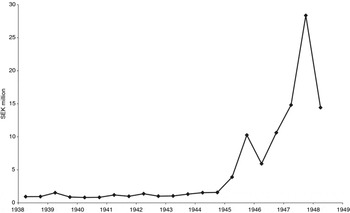
This section discusses the events leading to the gift explosion during the 1940s. It is possible to obtain semi-annual data on gift tax revenue during the period 1938–48. This is fortunate as it makes it possible to study the increase in gifts during the 1940s more closely.
Revenue was low and stable from 1938 until 1944; see Figure 4. During the first half of 1945 revenue began to increase. This increase accelerated during the second half of 1945. Then tax revenue decreased somewhat during the first half of 1946. But after this breathing space there was a rebound to the level of the year before during the second half of 1946. This increase continued during the first half of 1947 and accelerated (doubled) during the second half of that year. During the first half of 1948 revenue decreased by 50 per cent.
Gift tax revenue, biannual data, 1938:1–1948:1 (SEK million)

The tax rates did not change during this period until 1948 nor did the design of the tax system.Footnote 14 Revenue changes had to do with the number of gifts and the amounts given.
How can we understand and explain this development? There were, of course, uncertain and turbulent times at the end of World War II and immediately after. The transformation of societies from war to peace affected all areas. Tax policy was one of these. Elvander (Reference Elvander1972), chapter II, is a detailed account of the political process of Swedish tax policy after the war.Footnote 15 It is interesting to compare the development at the political level with that of the private economic sphere:
1944. The Social Democrats and the Trade Union Confederation presented a joint Post-War Programme in spring 1944, which was supported by the Communists. One of the objectives was to equalise income and wealth by, among other things, taxation. But there were no concrete tax reforms suggested.
In the private sphere gifts did not increase.
The first half of 1945. The Communists, who had gained increased support in the 1944 parliamentary election, suggested a one-time tax on wealth in Parliament during the spring sessions 1945. One argument was that this was a way of reducing public debt generated during the war. In 1940, all political parties had agreed in principle on a one-time tax on wealth to be implemented later.
Now gifts started to increase.
The second half of 1945. Sweden had a grand coalition government during the war and until July 1945, when a Social Democrat government took office. The Trade Union Confederation made a statement in August about tax policy. The unions argued for increased taxes on bequests, wealth and businesses and also for more progressive personal income taxes. An official central government tax committee was appointed in October.
In the private sphere gifts began to accelerate.
The counties were responsible for administrating the gift tax reports. The governor of Stockholm wrote to the Ministry of Finance in November 1945 to point out that there was a strong increase in gifts. He argued that not only the increase in the number of gifts and the amounts but also other circumstances suggested intent to reduce the effects of a possible progressive one-time wealth tax. The Ministry, therefore, asked all county governors to report the number of gifts and the amounts during 1944 and 1945.Footnote 16
The first half of 1946. In June, the Social Democrats suggested the introduction of an estate tax instead of a one-time wealth tax.
Gifts decreased during this period.
The central government tax committee was well aware of the increase in gifts during 1945. I have found notes from a committee meeting of 31 January 1946 in the National Archives.Footnote 17 A conservative member of the committee remarked that the gift increase was of no major concern. He argued that if anything it meant that future tax revenue was received earlier. A liberal member, on the other hand, said that the gift increase could be regarded as a kind of disloyalty and that the gift tax rates maybe should be increased.
The second half of 1946. There were nationwide local elections in September. The Social Democrats had a tax policy programme that included the introduction of an estate tax. But this did not play a major role in the election campaign.
The official central government tax committee finished its report in November. The committee suggested an estate tax and a separate wealth tax instead of a one-time wealth tax. It was also suggested that it would be possible to pay the estate tax in stocks.
In the private sphere gifts started to increase again.
The final report from the central government committee included an enclosure that reported the analysis of the gift increase done by the Ministry of Finance in 1945. The enclosure also included a more thorough analysis by the committee of gift reports in the City and the County of Stockholm during July–October 1945.
The Board of Post Offices was responsible for collecting the gift tax. In one of the very few other comments I have found about these events, the Board wrote in November 1946:Footnote 18
The collection of gift tax shows a marked increase already from the month of December 1944. During the fiscal year 1944/45 2.5 million kronor more than during the previous fiscal year in gift tax thus flowed in. As the Board of Post Offices has previously put forward in its letters to the National Accounting Board 13 November 1945 and 17 April 1946 concerning the calculation of stamp duty collection during the fiscal years 1945/46 and 1946/47, the increase in gift tax collection has probably been brought about by fears of increased wealth taxation.
The first half of 1947. This was the main period of political controversy. The deadline for submitting comments on the suggestions of the official central government was in February. There was a heated discussion in the daily papers and other places where politicians, economists and law scholars were active.Footnote 19 The Swedish Economic Association had a debate, with a very critical introduction given by Heckscher, commented on by Wigforss; see Nationalekonomiska Föreningen (1948). In April, Swedish Public Radio broadcast a two-hour debate about the tax proposal.Footnote 20
The tax discussion was, however, only one of many issues in a polarised political environment at this time. The more general discussion about economic planning was very much on the political agenda.
Private gifts continued to increase.
The second half of 1947. Parliament decided in July, following the recommendations of the official government committee. The estate tax and increased wealth taxation were to be introduced from 1948. The estate tax was integrated with an estate tax on gifts to reduce tax avoidance, but this only applied to gifts made from 1948, so the estate tax on gifts was not immediate. A district judge pointed out the risk of tax avoidance before the estate tax was introduced and suggested that gifts should be integrated from the day the government submitted the estate tax bill to Parliament. Finance minister Wigforss, however, affirmed that integration should take place from the time the estate tax was introduced and not before,Footnote 21 so he did not instigate this.
In the private sphere gifts doubled compared to the first half of the year.
There is to my knowledge no previous analysis of this gift episode in the research literature. Nor have I been able to find any discussion about the episode in the memoirs of leading politicians at the time, such as the finance minister Wigforss (Reference Wigforss1954), the prime minister Erlander (Reference Erlander1973) and the opposition leader Ohlin (Reference Ohlin1975).Footnote 22 I have also checked the Uppsala press archives, covering 50 daily papers since 1945, for anything about the episode without any success.Footnote 23
The only later reference to the 1947 gift episode I have found is in the report of the 1957 official government committee on inheritance taxation. The committee writes:Footnote 24
Finally it should be mentioned that the exceptionally big return of the gift tax during the fiscal years 1945/46–1947/48 should be seen against the background of the increase in primarily estate taxation first expected then decided, but not coming into force until 1 January 1948.
It is obvious that there was a clear correlation between gifts and politics. But what was the causality between the events in the political and the private sphere? On the one hand, was the giving a reaction to policy based on private economic considerations? Or were there political motives for the giving? I regard it as less likely that the giving had direct political motives; this was in any case not reflected in the political discussion. Instead, it is more likely that private concerns were more important.
On the other hand, did the opinions among those giving form the political basis for the opposition to the estate tax? This seems more likely to me. But the question of causality in this case is an important topic for future research about Sweden's economic history.
4. IOU: Micro-data evidence from the county of Dalarna
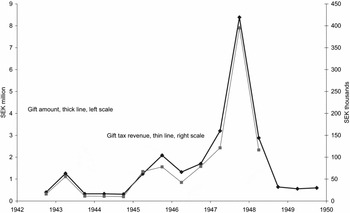
The micro-data studied in this section come from the county of Dalarna, in the geographical middle of Sweden.Footnote 25 There were slightly more than 250,000 inhabitants in the county during the second half of the 1940s. As far as I have been able to find, there are no corresponding data available for any other county.Footnote 26Figure 5 shows the development of gift tax revenue and the underlying gift amounts during the period 1942–9.
Gift amount and gift tax revenue in Dalarna, biannual data, 1942:2–1949:2

If we compare this with tax revenue at the national level, shown in Figure 4, it is clear that the evolution of tax revenue in Dalarna is highly correlated with the total in the country.Footnote 27 The figure also shows that tax revenue follows the total gift amount very closely. Tax revenue as a share of the total gift amount is mostly very close to 5 per cent.
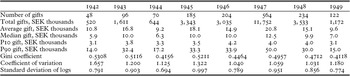
The total gift amount in Dalarna during 1947 was almost SEK 12 million; see Table 1. This was about 20 times more than the annual average during the period 1942–5. The increase in the total amount came about because both the number of gifts and their average amount increased. The 2009 value of the total gift amount corresponds to SEK 215 million, EUR 20 million, USD 28 million and GBP 18 million.
Gifts in Dalarna

Note: P10 and P90 refer to percentiles in the gift distribution.
The table also reports different measures of the spread in gift amounts. There is no evidence that the spread increased during the gift explosion in 1947.
Statistics Sweden provided an estimate of total wealth in each county in 1947. This is one of the few years when such an estimate is available. Estimated wealth in Dalarna in 1947 was SEK 864.1 million.Footnote 28 It is, therefore, possible to relate the total gift amount in 1947 to total wealth in the same year. Total gifts as a share of county wealth is 1.40 per cent. Some might regard this share as small, but the share is in the neighbourhood of the annual transfer of wealth by bequests.
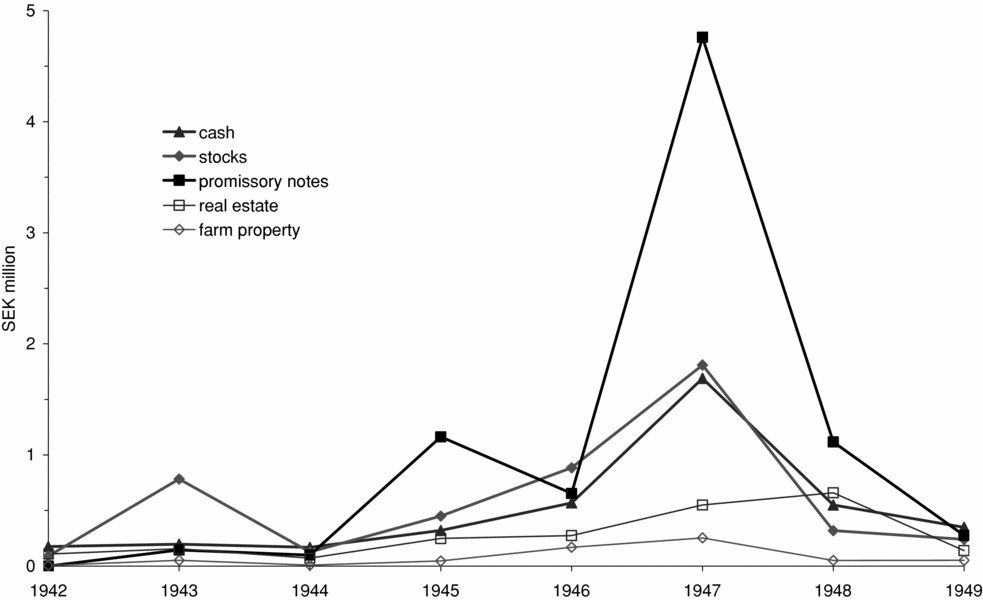
The data set has information on the type of asset that was transferred as a gift. Figure 6 shows the total values given of the five main asset types used during the period 1942–9. The main type of asset used, in value, during the gift explosion in 1945–7 was promissory notes. Cash and stocks also increased but much less. The amounts of real estate and farm property were never considerable. There was a long tradition in Sweden of using promissory notes. Lindgren (Reference Lindgren2002) shows how promissory notes played an important role in providing credit in the nineteenth century.
Gift amounts in Dalarna, annual data, 1942–9
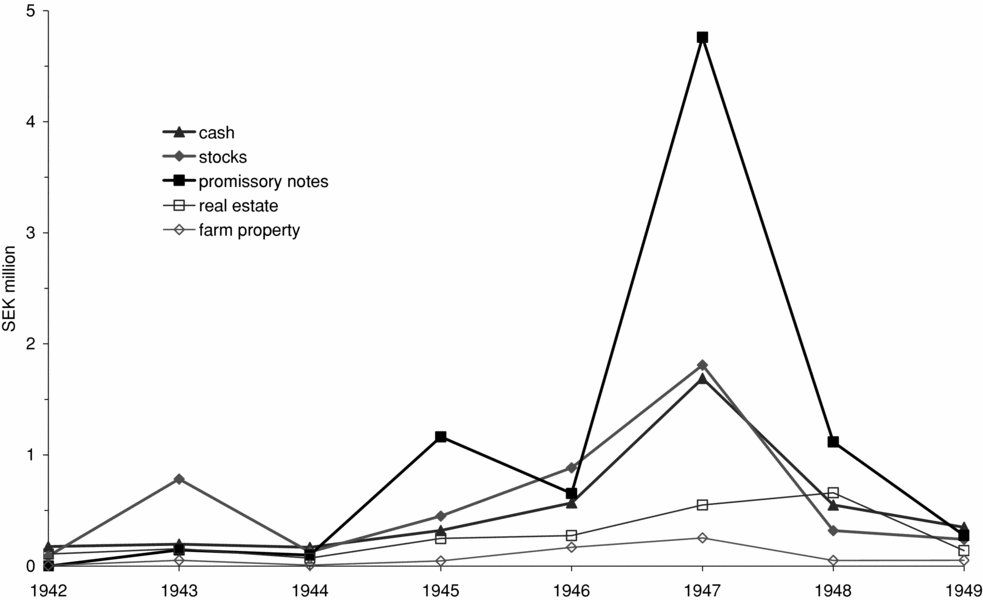
The analysis done by the central government tax committee, reported in SOU (1946), showed that promissory notes were also the most important asset given in Stockholm during July–October 1945. About 43 per cent of the gift amount was in promissory notes, 40 per cent in stocks and bonds, while 10 per cent was in cash.
About 80 per cent of the total annual gift amounts in Dalarna was from parents. An additional 10 per cent was from relatives on the father's and the mother's sides. Women received as much as men during most years, but men received more than women in 1943 and 1947. About 35 per cent of the amount given in 1947 went to minors. This was a higher share than in other years.
5. Econometric evidence
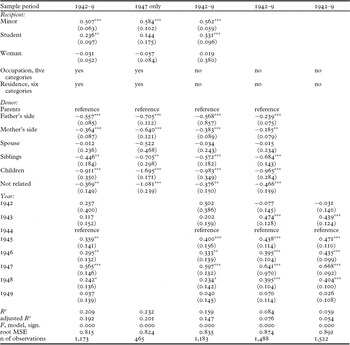
I have collected the evidence from econometric analyses in this section. First, I study total amounts. Table 2 reports the results from estimations of models of the gift amounts received. It should be stressed that these models are conditional on there being a gift. I cannot estimate models for the likelihood of making and receiving inter vivos gifts using the present data set.
Gift amounts received, logarithm, OLS

Notes:*** indicates statistical significance at 1%, ** at 5%, * at 10%.
Robust standard errors within parentheses.
Minors received significantly more than other recipients. The difference is 50 per cent (see column 1 in Table 2); it is statistically significant at the 1 per cent level. Adult students also received more than other recipients; the difference of almost 25 per cent is significant at the 5 per cent level. There were no significant differences in the gift amounts received by women and men, on the other hand. In the estimation reported in column 1, I control for the most common occupations and the most common places of residence.
I have less information about the donor but I know the family relationship between the donor and the recipient. Gifts from relatives on the father's side and the mother's side were significantly smaller in value than gifts from parents. The same was true for the gift amounts from siblings and from children. Gifts during 1945, 1946 and – in particular – 1947 were significantly higher than the gifts during other years. The estimated effect suggests that the gift amounts in 1947 were almost 60 per cent higher than during the reference year. For the previous two years the estimated effects are 30–35 per cent higher gift amounts compared to those during the reference years. This further strengthens the conclusion that not only did the number of gifts increase during this episode, but so too did the amounts given.
The second column in Table 2 reports the estimation results when only the gifts made and received during 1947 are included in the sample. The idea is to check whether the estimated coefficients remain the same when the sample is limited to the single year with most gifts. This also seems to be the case as there are no major differences between columns 1 and 2. It should be noted, however, that the estimated effect for minors increases to almost 60 per cent.
Table 2, third column, reports an estimation for the whole period but where the controls for occupation and place of residence are dropped. The differences compared to the first two columns are small. The estimated effect for adult students is, however, here significant at the 1 per cent level.
There are, however, many missing observations for the variable ‘title’ (see Appendix 1), which is used to classify minors and adult students (and occupations). These variables are dropped in column 4 of Table 2. The number of observations increases from slightly fewer than 1,200 to slightly fewer than 1,500. This does not, however, change the estimated coefficients substantially.
Finally, I drop the donor variables and estimate the ‘raw’ year effects. The gift amount received in 1947 was almost 70 per cent higher than in the reference year according to this specification; see column 5.
Second, I estimate probability models for receiving particular assets. The five main assets in the sample are:
• promissory notes
• cash
• stocks
• real estate
• farm property
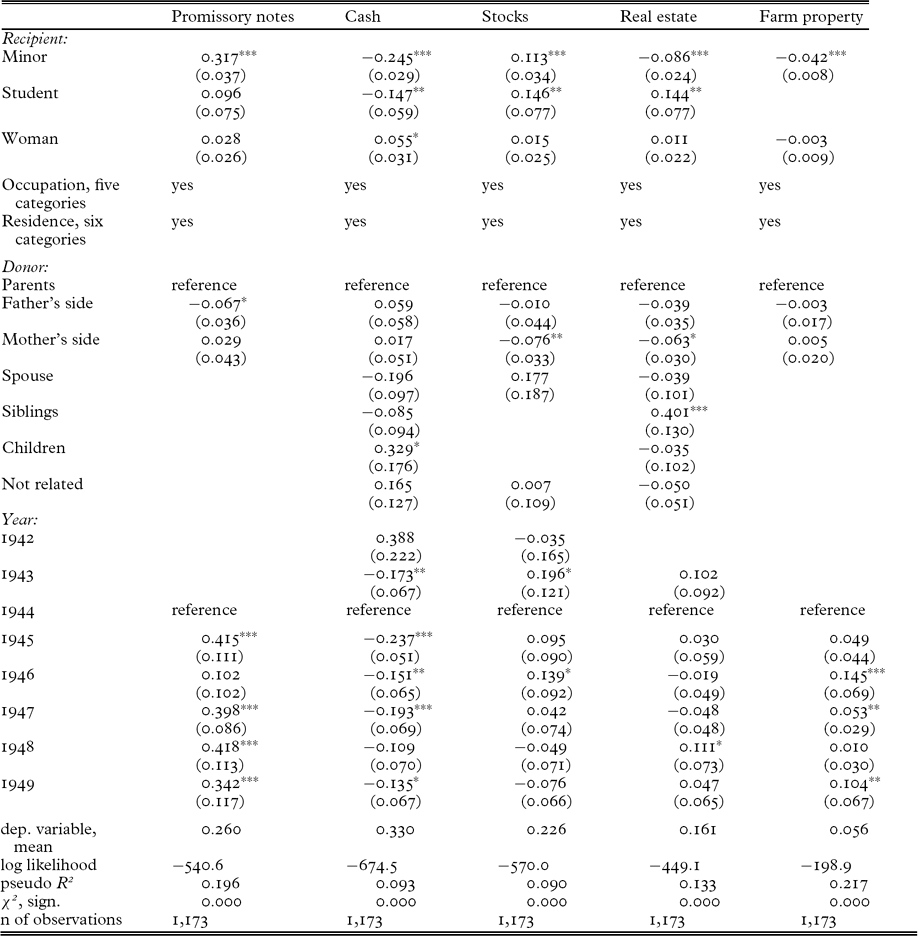
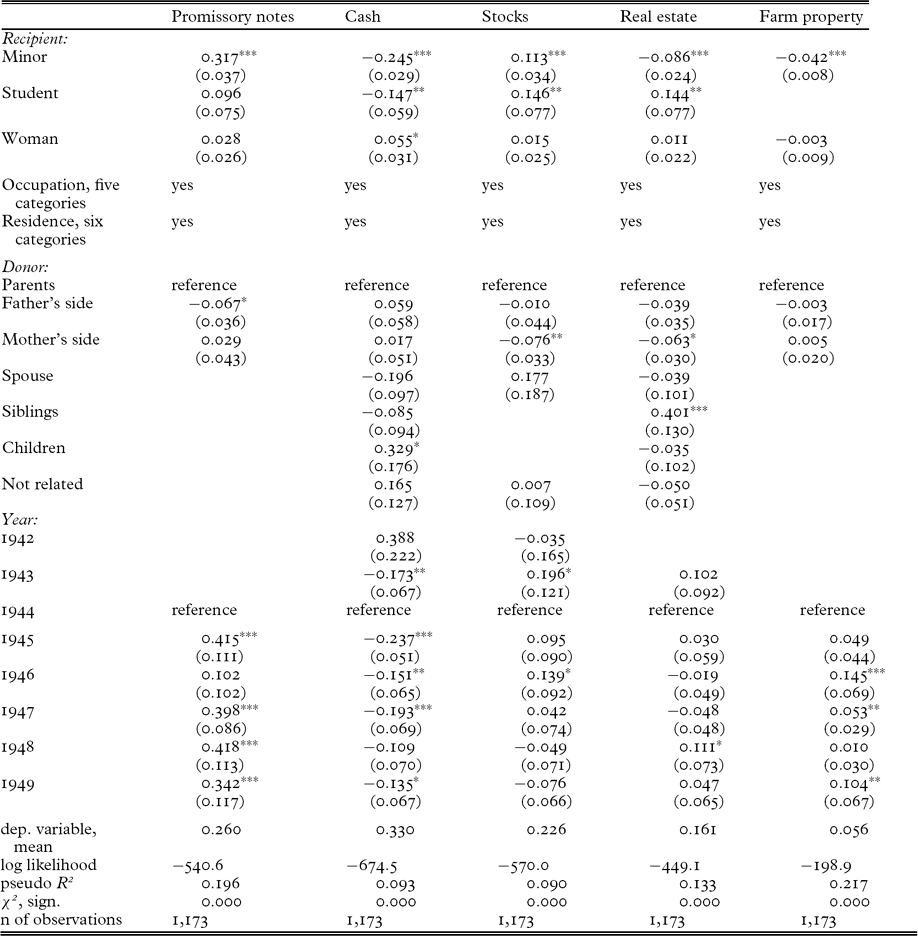
In some cases a gift consists of several different assets. I have used a wide definition of the dependent variable in the probability models. It equals one if the particular asset is included among the assets given, and zero otherwise. Table 3 reports the estimation results. Explanatory variables that perfectly predicted receiving or not receiving a particular asset were dropped.
Probability of giving particular assets, probit models, marginal effects
Notes: ***indicates statistical significance at 1%, **at 5%, *at 10%.
Robust standard errors within parentheses.
Minors were more likely than others to receive promissory notes and stocks, but less likely than others to receive cash, real estate and farm property. Compared to others, adult students were more likely to receive stocks and real estate, while they were less likely to receive cash. There were no gender differences in the types of assets received. There are few significant results for the dummy variables measuring the relationship between donor and recipient.
Promissory notes were more likely during 1945 and 1947–9 compared to the reference years, while cash was a less likely type of gift during 1943 and 1945–7. Receiving farm property was more likely during 1946 and 1947 compared to the reference years.
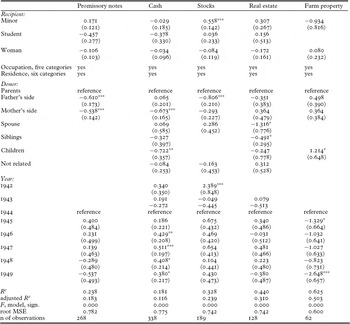
Third, I have estimated conditional models for amounts in different asset categories. In this case, however, I need to use a more narrow definition of the dependent variable. The observation is only included if the particular asset is the sole asset given. Table 4 reports the estimation results.
Gift amounts received, logarithm, OLS

Notes: ***indicates statistical significance at 1%, **at 5%, *at 10%.
Robust standard errors within parentheses.
It is clear from the table that minors received higher amounts in stocks than others. Relatives from the father's side gave lower stock amounts and promissory note amounts than parents. Relatives from the mother's side, on the other hand, gave lower cash amounts and promissory note amounts. There are few significant results for the year dummy variables. It can, however, be noted that cash amounts were significantly higher in 1947 than in the reference year.
I would like to emphasise the following from the econometric analyses. The estimations show that:
• Gift amounts had already started to increase in 1945. This is consistent with expectations about future tax changes affecting behaviour.
• Minors got higher amounts than others and parents gave higher amounts than others. When a parent gave to a minor child, the parent lost less control over the resources than if a gift had been made to someone else.
• Promissory notes were more likely during 1945 and 1947–9 compared to the previous years. The choice of promissory notes, instead of giving financial or real assets, was a way of still keeping as much economic power as possible.
• The gender of the recipient did not seem to matter for gift amounts and type of asset when controlling for other factors.
6. Concluding remarks
A first objective of this article was to study the revenue from taxing inter vivos gifts, inheritances and estates in Sweden. The inheritance tax replaced an estate tax in 1894, while the tax on gifts was added in 1915. During the period 1948–58 there was also an estate tax in addition to the gift and inheritance tax. The gift and inheritance tax was repealed in 2004.
These taxes were always controversial. One might say that they have generated more controversy than tax revenue. Inter vivos gifts, inheritances and estates were never important sources of tax revenue. Such tax revenue as a share of GDP had already reached a peak in the 1930s.
Instead, these taxes became symbols for the ideological tension between the political right and the political left. Property rights arguments stood against arguments about equity and equality of opportunity. The main role of these taxes was to provide integrity for other tax bases, in particular the wealth tax. The existence of a gift tax made it, in other words, more difficult to avoid the wealth tax by giving wealth to others.
A second objective of the article was to focus on a unique episode during the second half of the 1940s. Sweden was struck by an epidemic of sudden generosity during this period. At least, so it seems, if one looks at gift tax revenue. Gift tax revenue in 1947 was 20 times higher than the annual averages before and after. This episode has never before been discussed in the research literature. It gives an extremely clear illustration of behavioural response to taxes in general, and the impact of expectations of future tax increases in particular.
Gift tax revenue during the 1940s started to increase long before a new estate tax and increased wealth taxation were decided and implemented. It began to increase even before the legislative process started. This underlines how important expectations are.
One might ask why households had not taken advantage of the design of the gift tax, for instance the exemption, by starting to give much earlier. There is evidence that people are reluctant to give inter vivos. This has been interpreted as an indication that people do not want to give up the economic power that wealth gives. A third objective of the article is to try to find empirical evidence consistent with this hypothesis.
I have constructed a rich micro-data set of all gifts reported during the period 1942–9 in one county. Using this data set I can show that both the number and the average value of gifts increased. The most common way to give was to write promissory notes. This has a very special interpretation. To give by writing promissory notes, rather than to give financial or real assets directly, can be viewed as a way to combine avoiding taxes and keeping economic power.
The econometric analysis also shows that minors got higher amounts than others and that parents gave higher amounts than others. When a parent gave to a minor child, the parent lost less control over the resources compared to making a gift to someone else.
It is a different question whether it was optimal for parents to advance their transfers to younger generations. It was quite obvious that it was rational to take the actions that the households did in the short run as the estate tax on gifts did not apply to gifts made before 1948. In the longer run, however, this becomes more of an open question. It depends on how much earlier a transfer was made compared to when it had been made as a bequest or as a later gift. This is an important topic for future research as it will shed more light on the question of the effects of taxes on behaviour.
Acknowledgements
Helpful comments and suggestions from Lennart Berg, Per-Anders Edin, Rodney Edvinsson, Nils Elvander, C.-H. Hermansson, Sven-Olov Lodin, Johan Lönnroth, Leif Mutén, Katarina Nordblom, Jesper Roine, Agnar Sandmo, Håkan Selin, Daniel Waldenström, two anonymous referees, and from seminar participants at Lund (Economic History), Umeå (Economics) and Uppsala (Economics, Economic History) are gratefully acknowledged. The usual disclaimer applies. Some of the work was done when I enjoyed the hospitality of LEM, Université Panthéon-Assas, Paris II. My deceased father, Knut Ohlsson, was a historian and archive man. I am pretty sure that this would have been his favourite among my papers.
Appendix 1. Data sources and descriptive statistics
Appendix 1.1. Macro-data
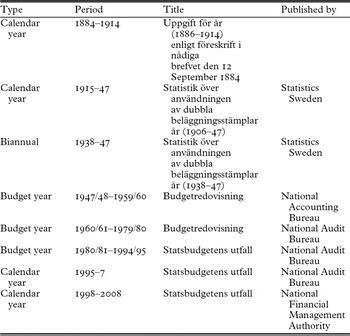
I have collected tax revenue from the following sources reported in Table A1.1. The data can be downloaded from my web page: www.anst.uu.se/henryos/.
Sources for revenue from inheritance, estate and gift taxes

The source of the time series for GDP by activity, basic prices, 1884–2000, is Rodney Edvinsson's Current values of GDP and other aggregate variables in Sweden 1800–2000, www.historia.se/tableB.xls. The GDP data for 2001–8 are from the National Accounts.
The source of the time series for central government revenue 1884–2003 is Fregert and Gustafsson (Reference Fregert and Gustafsson2007). The revenue data for 2004–8 are from Statsbudgetens utfall; see Table A1.1.
Appendix 1.2. Micro-data
The source of the micro-data from Dalarna is: Länsstyrelsen i Kopparbergs län, Landskontoret, Diarier för gåvo- och kvarlåtenskapsskatt. This register has the reference code SE/ULA/11031/B I h: 1 in the National Archival Database.Footnote 29 It can be found in the Regional Archives in Uppsala.
Descriptive statistics

I have punched the following variables from the register:
• diary number
• date
• family name
• first names
• maiden name
• gender (coded from the first names)
• title (minor and occupation can be coded from the title)
• street address
• postal address
• first gift amount
• first gift type
• second gift amount
• second gift type
• relationship to donor
• tax amount
• comments
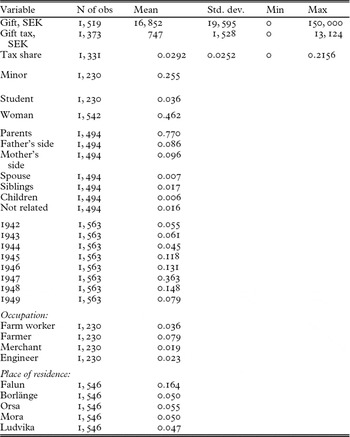
Each gift is one observation. Some recipients get more than one gift, and some donors give more than one gift. Table A1.2 reports the descriptive statistics for the main variables used in the article. The standard deviations are not reported for dummy variables as the spread follows from the mean.
Appendix 2. The design of transfer taxes
Table A2.1 reports the top marginal tax rates for different types of recipient during the period 1884–2004. There were up to four different tax schedules depending on consanguinity. The table also reports some other information about the design of the transfer taxes.
Transfer tax rates, 1884–2004
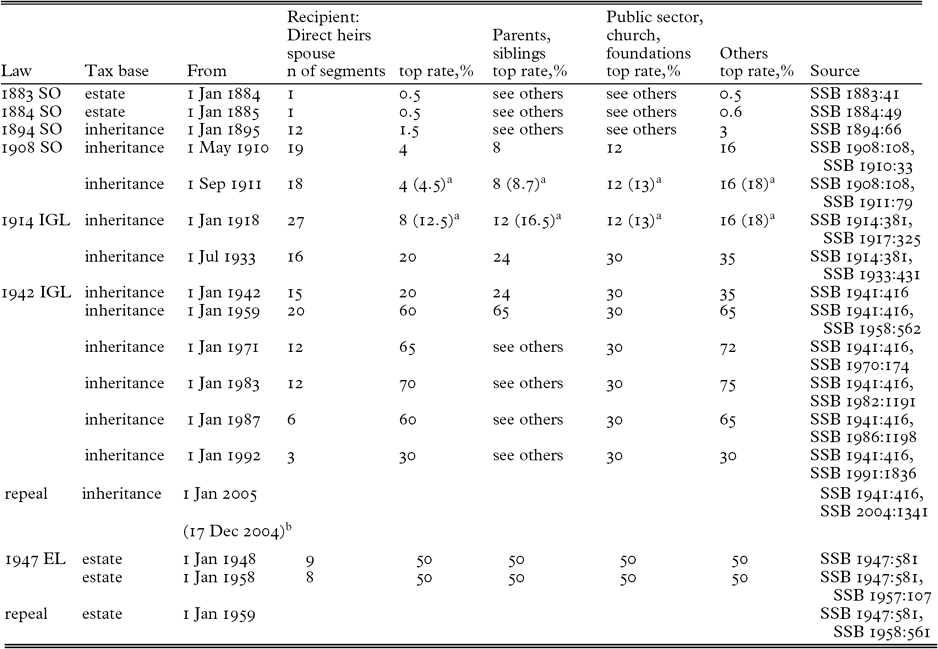
Notes: SO is Stamp Ordinance, IGL (AGL) is Inheritance and Gift Tax Law, EL is Estate Tax Law, SSB (SFS) is Swedish Statute Book.
a The tax schedule was partly regressive. The tax segment next to the top segment had the highest marginal tax rate, reported within parentheses.
b The tax was exempted 17–31 Dec 2004 because of the large number of Swedes killed in the Asian Tsunami of 26 Dec 2004.
It should also be stressed that the tax on gifts and inheritances was integrated: the inter vivos gift amounts received were added to the inheritances received when calculating the taxable amount. There was, however, a separate annual tax-exempt gift amount.
Appendix 3. The gift tax rates in the mid 1940s
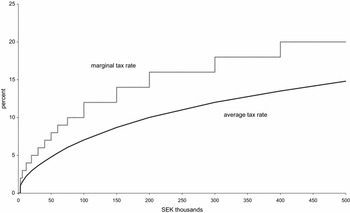
The tax schedules that applied during the gift explosion in 1947 were introduced in 1942, but there were no major changes compared to the rates introduced at the beginning of the 1930s. There were four different schedules depending on consanguinity. The basic exemption for gifts to children was SEK 3,000. The top marginal tax rate was 20 per cent; it applied to gift amounts higher than SEK 400,000. Taxable gift amounts were integrated with the inheritance tax.
Marginal and average tax rates on gifts to children, mid 1940s (percentage)

The average gift from parents to children in the Dalarna sample was SEK 19,100. The marginal tax rate for this amount was 4 per cent, while the average tax rate was 2.7 per cent. Total taxes on parents’ gifts to children as a share of parents’ total gifts to children was 4.3 per cent.