Bùi Minh Quốc left for the border in late 2001. His clandestine trip, which took nearly a month to complete on a 50cc Honda Cub motorcycle, retraced the perimeter of Việt Bắc, the name for the mountainous region that stretches across ten provinces in northeastern Vietnam. Quốc, a poet of considerable repute, documented the highpoints of the ride in verse.Footnote 1 But the region’s rugged beauty, which holds a prominent place in official histories of the anti-colonial struggle against the French and those who collaborated with them, was not the real reason for his quest. Nor was the region’s more recent reincarnation as a socialist battleground during the Third Indochina War with the People’s Republic of China, a conflict that killed and wounded an estimated one hundred thousand people in the space of a month.Footnote 2 Instead, Quốc’s self-appointed task was to find the current location of “Kilometer Zero” (Cấy số không) along the Sino-Vietnamese border—a difficult proposition since it appears nowhere on official maps of the country. Nonetheless, the toponym is commonly used to refer to the precise spot in Lạng Sơn Province where National Highway 1A, the only paved road to traverse the entire length of Vietnam, begins its long journey south.
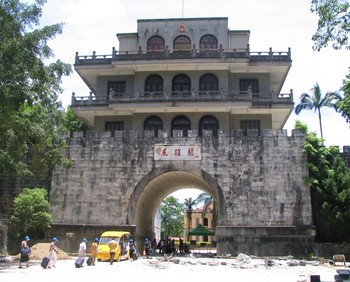
For many Vietnamese, Kilometer Zero is inextricably linked to Ải Nam Quan, an arched gateway first constructed perhaps as early as the fifteenth century. Located in a narrow mountain pass, the gateway helped delineate the ambiguous frontier then separating the pre-modern state of Great Viet (Đại Việt) from territories under the administrative control of its powerful neighbor to the north, the Empire of the Great Ming. Ải Nam Quan has since been rebuilt on several occasions, most recently during the late twentieth century when Soviet-style architectural influences were giving way to neo-traditional ones in both Vietnam and China (Figure 1).
Ải Nam Quan. Author’s photo (2006).

The same structure has also been officially renamed at least six times, again most frequently during the twentieth century. However, repeated efforts to replace the old with the new have not been entirely successful, since several of the structure’s previous names remain in common use today. They do so because each of the names corresponds to a different moment in the life of the “nation,” which enables government officials, dissidents, and segments of the country’s diaspora to narrate the terms of Sino-Vietnamese relations and their respective territorial claims in conflicting ways.Footnote 3
The most conspicuous example of this is Ải Nam Quan itself, which means “Southern Gate” in Sino-Vietnamese. Some Vietnamese reject the Sino-centric view of the frontier implicit in this name and instead refer to the structure as the “Northern Gate” (Bắc-Quan). But a majority continues to use the Sino-Vietnamese term since it is widely recognized and closely linked to the restoration of “Vietnamese” independence following two decades of imperial rule by the Ming (1406–1427), the last time hostile “Chinese” forces occupied territory south of the arched gateway for any substantial length of time until 1979.
Regardless of the name used, the gateway continues to hold a prominent place in the historical imagination as the northernmost part of the country. Indeed, when asked about the location of Kilometer Zero, most Vietnamese will quickly respond with a line of verse schoolchildren continue to memorize in state schools: “Our country runs from Ai Nam Quan to the cape of Ca Mau” (Đất nước ta chạy dài từ Ải Nam Quan đến mũi Cà Mau).Footnote 4 These childhood certainties were thrown into doubt in late 2000 when detailed rumors emerged that the arched gateway and other sites of politico-historical significance now stood on foreign soil as a result of a treaty the Communist Parties of Vietnam and China had negotiated and signed in secret two years earlier.
Despite concerted efforts by government officials to discredit the rumors, they steadily gained strength as people inside and outside Vietnam began to post different kinds of “evidence” online that allegedly showed where, how, and why the country’s territorial boundaries had changed. Precise figures varied depending on the sources and maps used, but the general consensus was that the Communist Party of Vietnam had transferred to China approximately 750 square kilometers of land and, after two more “secret” agreements were reached in 2000, over 8,000 square kilometers of the Tonkin Gulf.Footnote 5 Some critics conjectured the agreements were a prerequisite the Chinese Communist Party imposed upon the Vietnamese to the full normalization of bilateral relations, which had yet to fully recover from the Third Indochina War. But most claimed high-ranking Vietnamese officials had instead “sold the nation” for personal gain, though opinions remained divided over whether the motivation for their “treachery”—the Vietnamese expression (bán nước) conveys both meanings simultaneously—was primarily political or financial in nature.Footnote 6
For reasons I will explain, efforts to determine the factual basis of these conflicting accounts were greatly hampered by “technological revisionism.” This is my term for the different ways materials in digitized form can be copied, modified, forged, or deleted online by others, but never entirely erased since electronic traces always remain. Indeed, it was this continuing state of uncertainty over the veracity and integrity of the materials posted online that prompted Quốc, a former Communist Party member, to embark on his fact-finding mission to the Sino-Vietnamese border, which he completed in mid-December of 2001.Footnote 7 His luck, however, did not last.
Security officials quietly arrested Quốc at a train station outside Hanoi in January 2002 before he was able to share his findings with several other well-known intellectuals the Communist Party regards as dissidents for publicly articulating opinions that diverge from its own. Officials interrogated Quốc for three days and then escorted him back to central Vietnam, where he was placed under house arrest without trial for two years. News of Quốc’s arrest did not appear in the mass media, which the state still closely controls. Nonetheless, information regarding what had happened spread quickly via different social networks that link politically active Vietnamese inside the country with those abroad, nearly all of whom interpreted his detention as proof the leaders of the Communist Party had something to hide.Footnote 8
Since Vietnamese security officials do not yet have the resources to systematically monitor and to restrict what people read and send to one another online, the Internet quickly became the primary medium where (mis-) information concerning the “secret” territorial agreements was exchanged.Footnote 9 Though the number of Vietnamese with Internet access was at the time very modest—only 3 percent of the population—this group nonetheless formed an important constituency since nearly all of the adult users were well-educated urban professionals, a substantial portion of whom either worked for the government or had family that did. To prevent this group from being drawn into the debate, high-ranking Party officials initiated a three-pronged crackdown, which included the arrest of domestic computer users suspected of distributing “propaganda” or revealing “state secrets” through the Internet, a public relations campaign that offered alternate views on the territorial agreements, and renewed efforts to control by technological means what was accessible online.
The above tactics and those used to counter them are featured in this essay. But I should stress that their theoretical and methodological significance is not limited to those Vietnamese with a stake in the controversy’s outcome. Close attention to the socio-cultural and technological practices in play here offers important insights into how digital archives shape not only political dissent, but official efforts to suppress it as well. Moreover, placing both within the same analytical frame makes it possible to more fully understand how each produces the form and the content of the other as well as how they change over time. Such concerns are of obvious significance in authoritarian settings where freedom of expression remains limited and in situations where states and their nation(s) in diaspora find themselves in conflict.Footnote 10 But they also extend to include the still broader question of how digital objects—the generic term for items that can be retrieved via the Internet—are affected by the spaces through which they move.
SPACES OF CIRCULATION
As others have noted, divergences between the digital archives and their physical counterparts are readily apparent in terms of their form, content, and modes of access.Footnote 11 But surprisingly little attention has been directed at how digital objects travel between virtual collections or the problem multiple and slightly different copies of the same “original” pose for those interested in determining the provenance of a particular electronic item. Both problems intersect with contemporary debates over intellectual property, especially ongoing legal efforts to define where copyright protection ends and “fair use” begins in online environments. The emphasis here however is on the political and epistemological problems that arise when digital materials are copied from one archive—typically without permission—and then reposted on a different one.
The unauthorized movement of digital objects is noteworthy for several reasons. First, reposting multiplies the number of locations where it is possible to view the “same” digital object. While this practice reduces the effectiveness of Internet censorship, it increases the likelihood that copies will acquire unintended meanings since the interpretive contexts they reappear in differ from the object’s original one. Second, reposting is not random; rather, it strategically targets some virtual collections and the constituencies they serve, but not others. Consequently, digital objects, particularly controversial ones, acquire “biographies” as they move through and between different computer networks that constitute the Internet.Footnote 12 Third, reposting fosters the growth of interpretive communities, which emerge to debate both the authenticity of the digital objects in question and the significance of the paths they travel. Over time, the interplay between these objects, the directionality of their flows, and the bodies of commentary that accumulate around them result in what Benjamin Lee and Edward LiPuma have described as “cultures of circulation.”Footnote 13
While Lee and LiPuma used this term to conceptualize the mobility of finance capital and the social imaginary it produces—a unified cosmopolitan culture—a more general conclusion can be drawn from their effort to provide a cultural account of the role circulation plays in the further globalization of capitalism. Namely, spaces of circulation are not empty. Nor do spaces of circulation passively transmit what passes through them. To the contrary, the socio-cultural and technological practices that make different forms circulation possible actively produce meaning as well, though we are rarely cognizant of how this occurs.Footnote 14
The Internet offers a particularly fitting example, since icons, pull-down menus, and other graphic interfaces have fostered the illusion that we understand how it works even though the processes and protocols that enable materials to circulate online are anything but “transparent.”Footnote 15 To make these interfaces less transparent, this essay focuses on how technological forms of revisionism (reposting among them) have shaped both the form and content of the transnational debate regarding the legitimacy of the territorial agreements. Doing so also foregrounds a paradigmatic difference between archives and their digital counterparts. Whereas the former are traditionally premised upon the preservation of fixed forms of information (typically documents), the latter enable others to add, modify, and delete their contents in a variety of ways.Footnote 16 Consequently, many of the theoretical and methodological assumptions that inform historiographic practice offline do not necessarily hold online due to the unstable and impermanent nature of what is posted on most digital archives.
The inevitable questions digital objects invite regarding their authenticity and integrity help explain why the controversy has not produced two neatly opposed narratives. Instead, what one finds posted on the digital archives in question are hundreds of competing accounts of territorial possession and loss that critically engage each other rather than the late nineteenth-century treaties, which transformed the Sino-Vietnamese frontier into an international boundary. There are several reasons why this has occurred. Chief among them is sharp disagreement over which sources can be used as a point of departure for determining when, how, and why Kilometer Zero has repeatedly moved over the past century. Since nearly all of the facts are in dispute, efforts to locate the surprisingly mobile Kilometer Zero have taken an unusual return. Accounts of its movements are rarely freestanding ones; instead, they depend upon “evidence” strategically excerpted from other accounts, which are then recombined into new ones to advance particular claims.
Such accounts, which frequently emulate academic conventions and include footnotes and bibliographies to further buttress their arguments, are notable in three respects. First, the composite nature of the accounts means they are best understood not as separate “texts,” but as dynamic elements within a larger networked whole—one where new interpretive possibilities are continually generated by the ways they reference each other and how these patterns change over time thanks to reposting and other forms of technological revisionism.Footnote 17 Second, due to the unauthorized movement of digital objects across archives, it is common to find multiple accounts that use the same piece of “evidence” (e.g., a border map) to advance conflicting conclusions regarding the legitimacy of the territorial agreements. Lastly, the above practices, because they both create and delete connections between divergent accounts, make it difficult to determine with real confidence where ideologically orthodox positions on the changing nature of Sino-Vietnamese relations end and heterodox ones begin.
To support these contentions, the next section provides further background on the political and cultural tensions the search for Kilometer Zero made manifest, since they directly inform the discussion that follows. I then provide additional details on the emergence of Vietnamese-language digital archives and why the very practices that enable computer users to overcome official efforts to control what crosses Vietnam’s digital frontier simultaneously limit our ability to assess their provenance. I explicate this paradox through a case study that partially reconstructs the social lives of three maps of Kilometer Zero. More than a dozen different maps of Kilometer Zero can be found on the Internet, but these three are of particular interest since government officials “leaked” each of them, along with other details regarding the territorial agreements, to different publics inside and outside Vietnam. Consequently, close attention to what strategically located individuals claim was disclosed, to whom, and why, offers the means to examine how digital archives affect how political secrets are negotiated and historical lies are constructed online.Footnote 18 At the end of the essay, I outline the broader significance of these socio-technological struggles.
A SYMBOLIC BAROMETER
Kilometer Zero, unlike other sites the Communist Party of Vietnam ceded to China, is not a physical structure or a clearly identifiable part of the landscape, though many Vietnamese continue to equate it with the Ải Nam Quan gateway. Kilometer Zero is instead a symbolic marker, and for this reason its precise whereabouts have repeatedly changed, especially during the twentieth century when violent conflicts erased the international boundary at some moments and forcefully reasserted it at others. Thus, a focus on Kilometer Zero and its movements makes visible concerns that a broader study of all three “secret” territorial agreements and the areas affected by them cannot.
Most obviously, the controversy surrounding Kilometer Zero brings Sino-Vietnamese relations, which date back more than three millennia, into sharp relief. Due to the Communist Party’s continued stress on the unbroken tradition of “resistance against foreign aggression” in official narratives, which project the existence of a unified and coherent Vietnamese “nation” anachronistically back through time, it is impossible to forget these relations were initially forged in the context of empire. Although this is merely one aspect of a vastly more complex history of interaction—one long overdue for critical reevaluation—much of what is now northern and central Vietnam was indeed part of southern “China” for a thousand years (111 B.C.E.–938 C.E.).Footnote 19
The “Period of Northern Domination” (Giai đoạn Bắc thuộc), as it is known, informs the transnational debate over the territorial agreements in two important ways. It helps establish the official parameters of Vietnamese national identity, which is still formed in complex relation to what is imagined to constitute “Chinese-ness.”Footnote 20 It also serves as a point of departure for genealogies that morally justify the Communist Party’s monopoly on political affairs by positioning it at the end of long line of heroes who fought either to defend or to liberate the Vietnamese “nation.”Footnote 21 Ongoing efforts to normalize relations with China, of which the border agreements form a crucial part, therefore invite difficult questions about the continued relevance of both narratives as well as the preeminent place the Communist Party claims for itself within them.Footnote 22
Questioning these narratives, which have long defined what it means to be “Vietnamese” in official terms, does not mean rejecting them altogether, however. Some elements of the narratives remain indispensable, a social fact that helps explain why the border agreements have provoked so much controversy among those preoccupied with the territorial integrity of the nation’s “geo-body.”Footnote 23 Normally, irredentist claims are animated by the desire to redeem those parts of the ethnic nation living under foreign rule. But in this case the land in question has few permanent inhabitants beyond wandering ghosts of the war dead. Yet, for many dissidents at home and critics abroad this is more than sufficient. The ghosts are their ancestors and for this reason, they claim, the Party’s decision to cede any territory to the Chinese undermines not only its claims to legitimacy, but betrays all Vietnamese who sacrificed their lives for the nation.
Such views, as I will show, are widespread online and appear to be genuinely held; moreover, they serve a strategic purpose. The constant emphasis on the inviolability of the country’s boundaries obviates the need to acknowledge a point the Communist Party of Vietnam has regularly made in its defense. Namely, Chinese negotiators had to relinquish some territory of their own to secure the agreements, including a narrow strip of land China seized during the Third Indochina War when its troops forcibly relocated Kilometer Zero approximately 400 meters south of its pre-1979 position. That Vietnamese negotiators regained half of this amount as a result of the “secret” 1999 agreement, one self-proclaimed patriot explained to me, was irrelevant. “To lose one inch of soil from the land border,” he emphasized, “is to commit a crime against the Fatherland (Để mất dù một tấc đất biên cương là có trọng tội với Tổ quốc).”Footnote 24 The next section provides further details on the role digital archives played in shaping how such statements circulated and the political effects that efforts to censor them produced both on- and offline.
SOCIO-TECHNOLOGICAL ENTANGLEMENTS
Digital archives no less than their non-digital counterparts are “epistemological experiments” that result from the complex “entanglement” of their physical structure with the materials they contain.Footnote 25 The information architecture determines not only how the content of a digital archive is internally structured and outwardly presented, but also the particular ways users are permitted to access their holdings.Footnote 26 Thus the very practices that organize an archive, categorize its contents, and make retrieval possible, simultaneously create particular configurations of “facts” at the expense of others, which helps define the limits of the thinkable at any given historical moment by shaping what questions can be legitimately posed about the past.Footnote 27 But while form shapes content in both cases, it does so differently in each.
Digital archives, as noted earlier, privilege flexibility and change rather than stability and preservation. Numerous factors have contributed to this shift away from the classic “read-only” model of an archive, chief among them the dramatic reduction in the cost of computer memory, bandwidth, and the emergence of Web 2.0 technologies, such as social networking sites, wikis, and blogs that now enable people to “read-write.” These new architectures of participation have radically expanded how digital content is created, stored, used, and disseminated. They have also contributed to the ever-growing amount of user-generated content available online—though the lifespan of much of it remains comparatively short-lived due to continued changes in data storage technologies and “link rot,” the process by which hyperlinks embedded in a webpage die as the separate sites they connect to disappear, change, or redirect to different servers on the Internet.
For these reasons, search engines remain indispensable for identifying and retrieving information from multiple archives, even though the algorithms they use continue to locate only a highly partial representation of what is actually available online at any given moment. Web 3.0 applications, currently under development, promise to more fully integrate these separate archives into a single, searchable one. Regardless of whether this occurs, a broader conclusion can already be drawn: meaning resides less in what digital archives contain than in how the data is subsequently re-combined, re-configured, and re-contextualized by others.Footnote 28
While most of the digital archives in question possess only limited interactivity, they do permit users to post, edit, copy, and link different materials to them. Indeed, the transnational debate over the “secret” territorial agreements would have been impossible without these digital archives, because no other interface currently exists for members of different publics to interact with one another.Footnote 29 The technical conditions of possibility for this debate are quite recent, however, since the Government of the Socialist Republic of Vietnam did not authorize email or electronic file transfers until 1994. At that time, the country’s telecommunications infrastructure was so limited it could only support a maximum of ten simultaneous users. Moreover, return messages, when they arrived at the Institute of Information Technology in Hanoi, frequently had to be delivered by hand. By 1999, the situation had improved dramatically and the Communist Party, once fiercely resistant to the Internet, made sure the electronic version of its daily, Nhân Dân (The People), was among the first online.Footnote 30
Since then, the number and types of websites have exploded. Steps to streamline administrative procedures and to cautiously promote the private sector via different forms of e-government, a process that started in 2001, have also continued to progress, albeit slowly. Vietnamese-language sites abroad have of course undergone far more rapid growth, in part because they have faced fewer restrictions on content. The overall effect has been an exponential increase in the amount of materials available online concerning Vietnamese history, literature, religion, popular culture, politics, and so on. This, coupled with the government’s investment in the country’s information technology infrastructure, has greatly accelerated the speed and volume with which information, commodities, services, remittances, and cultural forms of interest to Vietnamese now circulate globally.
These developments, although not unique to Vietnamese populations, have nonetheless produced political effects particular to them. Most obviously, digital archives have eroded many of the spatial and conceptual boundaries ordinary people and state officials alike previously used to determine where “Vietnam” ended and its diaspora began.Footnote 31 As one sign of this, news-oriented archives now permit a far wider array of Vietnamese, at home and abroad, to follow current affairs, to discuss controversial issues online with others, and in some cases to organize political action in response to them. Significantly, the source of such critical information is no longer limited to dissidents, but now includes state-owned newspapers. Several of these papers, especially Lao Động (Labor) and Tuổi Trẻ (Youth), have begun to regularly publish investigative reports on corruption and other forms of criminal misconduct involving government officials, both online and in hardcopy. Although clear limits continue to exist on what can be covered and whose misdeeds revealed, such coverage has made it increasingly difficult for the Communist Party to convincingly portray its members as the primary agents of “unity” and “progress” within Vietnamese society.Footnote 32
The growth in the coverage of actually existing forms of governance in Vietnam has, of course, made it easier for international as well as overseas Vietnamese human rights and media organizations to compile information and to produce reports on the abuse of state power and resources. To limit the impact these “foreign” reports might have upon domestic politics, the Communist Party has taken step to restrict the ability of computer users to access them from within the country. To do so, state agencies in Vietnam emulate many of the techniques pioneered by the People’s Republic of China, including the pervasive use of firewalls, which normally combine hardware and software to protect a network from unauthorized access or use by others.Footnote 33 However, in this instance, the firewalls are configured to prevent broader access to the Internet itself by means of filters that screen requests for information by cross-referencing domain names and URL addresses against an evolving list of blocked sites.
A Vietnamese official who discussed this process with me explained his staff simply zoned the Internet into one of two basic categories: “green” or “black.” “The green Internet has social value,” he explained. Whereas the black Internet, meaning pornography and political tracts critical of the Communist Party, he stressed, “is poisonous” (xấu độc)” and should be blocked “for the people’s benefit” (lợi ích cho nhân dân).Footnote 34 His views are still widely shared. When asked, many if not most Vietnamese officials will justify the need for surveillance, censorship, and state-sponsored propaganda as ongoing. They do so in resolutely paternalistic rather than authoritarian terms. Nonetheless, attempts to prevent access to the “black Internet” still meet with mixed success despite a state monopoly on gateways prior to 2003.
There are several reasons for this partial control. Due to intense competition, both bureaucratic and financial in nature, no single state entity is wholly responsible for regulating access in Vietnam to the Internet.Footnote 35 This competition, while significant, is less relevant here than the fact that no single repository with materials related to the Sino-Vietnamese border has achieved dominance. Instead, dozens of digital archives of significance have emerged, the majority of which are hosted on servers located in the United States or France. Despite this geographic clustering, the archives serve vastly different constituencies, a point the mission statements of the organizations and individuals who maintain them make clear.
These particularities further manifest themselves in the information architecture of the digital archives, which can vary from the rudimentary to the highly sophisticated, as does the degree of inclusiveness. Some archives, for example, only feature materials related to the Sino-Vietnamese border, whereas others house thousands of documents on a much wider array of issues of concern, of which this topic merely constitutes one. Equally crucial here is the lack of connectivity. Only a fraction of the digital materials in question are hyperlinked across archives. In some cases, this absence of connections signifies the presence of inter-organizational rivalries. In others, the decision to self-publish rather than cross-post reflects a personal decision to appear ideologically neutral and politically unaffiliated. Regardless of the reason, other factors ensure security officials will remain unable to locate all of the digital archives that contain materials related to the border controversy and then prevent access to them from computers inside Vietnam.
First, the Internet continually copies much of itself through mirror sites, proxy servers, and cache snapshots. These processes, originally intended to reduce search and download times by redistributing exact duplicates across different computer networks, also mean a copy is likely to exist somewhere online even after security officials have censored the original. Second, state-sponsored firewalls rely heavily on keyword searches to identify politically suspect sites, which mean they often fail to prevent access to non-text based forms of information and materials archived on sites that require passwords to access.Footnote 36 Third, materials posted on the Internet commonly contain information, such as filename extensions, not technically necessary for the web pages they are embedded in to work properly. These details, which many designers disparage as useless “cruft,” offer yet another way for computer users to circumvent firewalls and locate information since firewalls rarely screen for them. In sum, alternate pathways almost always exist. This is because the Internet, like Deleuze and Guattari’s “rhizome,” is multiple, dynamic, and consists of a potentially infinite number of interconnected entry and exit points, including bits of code that are ordinarily invisible to us.Footnote 37
To illustrate these points, a case study follows. In it, I partially reconstruct the controversial lives of three separate maps of Kilometer Zero, each reputedly “leaked” by government officials to different Vietnamese publics. The details highlight why the very practices that enable these maps to circulate simultaneously limit our ability to assess their significance.
A MAP IN TEXTUAL FORM
Bùi Minh Quốc’s arrest in January of 2001 prompted demands from Vietnamese inside and outside the country for details on the “secret” territorial agreements. The pressure was sufficient to force an official, if indirect, response. During February and March, “evidence” that the border negotiations had been conducted fairly and equitably appeared on a number of government-controlled websites. The items included digital versions of three articles originally published in hard copy in specialized Party journals, an English-language version of the Government’s 1982 white paper on the country’s maritime claims, as well as speeches and interviews from high-ranking officials. Critics of the agreements immediately emailed copies of these materials to politically active individuals and groups overseas, who then reposted them on their archives, often with additional commentary attached.Footnote 38 The discussion that follows, however, is limited to the statements provided by Lê Công Phụng, the Deputy Foreign Minister, as they directly concern the location of Kilometer Zero.
VASC-Orient, a state-owned news agency (now known as Vietnam.net), interviewed the Deputy Foreign Minister almost immediately after Quốc’s detention. The transcript of their discussion was posted online shortly afterwards, in early February.Footnote 39 In it, Phụng offered intriguing details about the border demarcation process, including the role he played as head of the Committee on Border Affairs, which represented the Communist Party of Vietnam during the negotiations. But, judging from the tenor of his responses, the main purpose of the interview was to forcefully refute accusations that high-ranking Party officials had “sold land [and] conceded the seas” (bán nước, nhượng biển) for personal gain. To counter these claims, Phụng noted the dispute was based on conflicting interpretations of the two nineteenth-century Sino-French treaties that established the international boundary but failed to clearly delimit it on the ground.Footnote 40 After this, he directed the majority of his comments to the difference between Kilometer Zero and Ải Nam Quan.
According to the Deputy Foreign Minister, Kilometer Zero and the arched gateway had always been separate entities. The problem, he stressed, was a terminological one, because most Vietnamese fail to carefully distinguish between a “border gate” (quan) and a “frontier pass” (ải)—two terms embedded in the most widely used name for the arched gateway: Ải Nam Quan. Both, he pointed out, are loan words from classical Chinese and each carries slightly different meanings than their closest equivalents in modern Vietnamese.Footnote 41 Thus, according to Phụng, the arched gateway and the international boundary, although physically close to one another, were never the same despite popular misconceptions to the contrary. By his reckoning, the arched gateway was approximately 200 meters north of the position Kilometer Zero was moved to in 1999, which meant it had always belonged to the People’s Republic of China. To emphasize this point, Phụng employed a semantic strategy of his own. He repeatedly referred to the arched gateway as the “Southern Peace Gate” (Mục Nam Quan), using the name Chairman Mao Zedong allegedly gave to the structure in 1949 rather than the “Friendship Gate” (Hữu Nghị Quan), the territorially more neutral name later adopted by Hồ Chí Minh in the mid-1960s.
Phụng’s arguments failed to convince. Almost immediately after the interview was posted online, Đỗ Việt Sơn, a respected Party member since 1947, submitted an open letter to the country’s four highest-ranking officials. The text of the letter implored the National Assembly, the country’s highest elected body, not to ratify the territorial agreements since they ceded too much territory. These views, Sơn noted, were not his alone, but were shared by a number of old revolutionaries who belonged to the Bạch Đằng Club, an unregistered group named after the northeastern river where “Vietnamese” forces famously defeated troops invading from the north in 938, 981, and 1288 C.E. (According to official histories, the first battle ended a millennia of “Chinese” imperial rule and created the political space for the independent state of Đại Việt [Great Viet] to emerge.) To drive his point home, Sơn reminded readers that the country’s feudal rulers, their other faults notwithstanding, had refused to relinquish “one inch of soil, one small island” (một tác đất, một hòn đảo) to their more powerful counterparts to the north despite repeated efforts by successive dynasties over the next ten centuries to reassert their control.Footnote 42
The comparison struck a chord. During February and March, well-known dissidents, many of whom were also former Party members, separately sent two dozen letters of protest to state officials, including the President of China, to counter statements made online by the Deputy Foreign Minister and other official spokesmen.Footnote 43 In most cases, the dissidents followed Đỗ Việt Sơn’s example and “borrowed history to comment on contemporary affairs” (mượn lịch sử để nói về hiện đại). But instead of using allusions to express their concerns, as is normally the case, the dissidents directly attacked the moral basis of the Communist Party’s legitimacy by contrasting its decision to secretly relinquish territory with the heroism of those who fought in the past to defend it.
Many dissidents, due to the nature of the criticism, took a further precaution and emailed copies of the letters to their contacts abroad in the hope that if they were arrested this would enable them to mobilize international opinion. Shortly thereafter, politically-active individuals and organizations overseas began to circulate their own essays, which featured different kinds of historical “evidence,” some of it strategically excerpted from Party- as well as dissident-authored accounts, to advance their own claims about how and why the country’s borders had changed. By the end of April, only four months after Bùi Minh Quốc’s arrest, more than two hundred different accounts could be found on several dozen digital archives, as could a steadily growing number of French, Chinese, and Vietnamese government documents, travelogues, chat room threads, poems, patriotic songs, photographs, audio files, video footage, and maps concerning the border.Footnote 44
Security officials, alarmed by this rapid proliferation of “propaganda against the state” (tuyên truyền chống Nhà nước), moved to reinforce the country’s digital frontier. As a first step, hackers, allegedly hired by the Communist Party’s information agencies, mounted a denial-of-service attack on several overseas sites, most notably the hannamquan.com mirror site, which provided an anonymous proxy that allowed computer users to bypass the firewall and access such “propaganda.”Footnote 45 The attack flooded the site’s server with information requests and temporarily forced it offline for repairs; however, it also damaged parts of the country’s primary computer network managed by the state-owned Vietnam Data Communication Company.Footnote 46 To avoid further damage, security officials shifted their attention to removing controversial materials located on servers inside Vietnam.
Among the first things to disappear was the Deputy Foreign Minister’s interview with VASC-Orient. This failed to prevent overseas Vietnamese from reposting extant copies onto other websites, often with substantial commentary added, but it did mean domestic computer users would now have to circumvent the firewall to reach them.Footnote 47 The government land office (Trung tâm Thông tin—Lưu trữ Tư liệu Địa chính) also moved its entire digital archive offline after critics declared that a triangulation map posted on the agency’s website proved the Communist Party had ceded far more territory than the Deputy Foreign Minister had admitted. The archive’s sudden disappearance has made it impossible to verify the authenticity of the digital “copy” reposted on Ykien.net (Opinion.net), a prominent politically oriented archive in Brussels that features hundreds of essays on the Sino-Vietnamese border.Footnote 48 But comments attached to the map make clear that the editors did not regard the lack of corroborating details as an evidentiary problem, which needed to be resolved. Instead, they cited the missing archive as proof of an official cover-up, which they likened to an electronic version of “blind man’s bluff” (chơi trò bịt mắt bắt dê).Footnote 49
Since reposting limited the ability of security officials to censor materials already online, they also took steps to suppress the controversy at its source. During 2002 and 2003, police separately arrested eight “cyber-dissidents.” Several were later charged with treason and, after brief trials, sent to prison for emailing “propaganda” abroad regarding the territorial agreements and what they perceived to be the unequal terms of Sino-Vietnamese relations. While the crackdown sharply reduced the number of open letters coming from well-known dissidents in Vietnam, it increased the use of web-based email accounts, chat rooms, and instant messaging. Such technologies are more difficult to monitor in real time and provide a somewhat higher degree of anonymity; they are, however, far from foolproof. Security officials, for example, arrested Lê Chí Quang, a lawyer, in early 2002 after an Internet Service Provider (ISP) informed them he regularly used a cybercafé in Hanoi to send essays to a blacklisted “reactionary” group in France.Footnote 50
Once again, efforts to suppress the controversy failed to have their intended effect. The highly publicized arrest inflamed Vietnamese public opinion abroad and prompted Human Rights Watch, Amnesty International, and related organizations to issue public statements of concern. Domestic computer users, apparently undeterred by the threat of prison, also continued to speculate online as to what the Communist Party was hiding. So when critical statements next appeared on TTVN Online, then the country’s most popular youth-oriented discussion forum, the Ministry of Public Security ordered it be shut down. The Ministry of Culture and Information next issued a decree that made the owners of cybercafés and Vietnamese ISPs legally responsible for what their customers read and wrote online.Footnote 51 In response, the editors of Opinion.net posted a short manual that explained how to circumvent the firewall and what could be done to preserve their anonymity online.Footnote 52
The techniques worked, and information continued to flow abroad to overseas groups, which enabled some of them to engage in unprecedented forms of coordinated action. The most visible example was the “Vietnamese Federation to Protect the Fatherland’s Territorial Integrity” (Hội Đồng Việt Nam Bảo Toàn Đất Tổ), a coalition formed in 2002 to protest the agreements. Since then, the seventy-one groups that make up the coalition have conducted dozens of major events on four continents, including two international conferences on the Sino-Vietnamese border, each of which attracted hundreds of participants.Footnote 53 Details of these events and those organized by related groups were regularly posted online and then hyperlinked to other overseas websites. This strategy made it easier to reach non-members and to involve them in digital forms of advocacy, such as online petitions that called on the United Nations Security Council to arbitrate the border dispute and the Vietnamese government to release the imprisoned “cyber-dissidents.”Footnote 54
In the midst of these struggles, the Communist Party quietly posted a digitized copy of the 1999 Land Border Treaty on the Nhân Dân (The People) website in late August of 2002, though its location—an internal page—made it difficult to locate.Footnote 55 More strikingly, no mention of the Treaty was made in the hard copy of the newspaper, which is the daily of record in Vietnam. Instead, the text of the thirteen-page agreement was made available to those with Internet access and then only temporarily, as it was removed from the site approximately two weeks later. A copy of the scanned original was, of course, reposted on websites overseas before it disappeared. This made little difference, however, since the technical prose was far from transparent, and the details, which primarily consisted of long lists of mountains and streams identified by elevation rather their precise coordinates, revealed even less. Consequently, the treaty was virtually meaningless without a copy of the official map. Yet, that crucial document was not included.
Again, critics of the agreements interpreted the decision to “leak” some details, but not others, as still another sign the Communist Party had not acted in the country’s best interests. These criticisms forced the Deputy Foreign Minister, who was likely acting on instructions from his superiors, to release yet further information regarding the land border in mid-September. However, he did so in the Vietnam News, a state-owned daily that publishes information only in English, which reduced rather than enlarged the number of Vietnamese who could read the interview.Footnote 56 While it remains unclear if Lê Công Phụng did this for strategic reasons, the technical details he disclosed were highly significant and provided the basis for several counter maps, which I discuss later.
The relevant parties, Phụng explained, separately created provisional “maps of borderline orientation” based upon their respective assessments of the nineteenth-century treaties that established, but did not fully delimit the international boundary separating northern Indochina from southern China. They then compared the maps, which revealed significant agreement—except for 164 sites where overlapping territorial claims existed. These disputed areas, collectively referred to as “Areas C,” totaled 227 square kilometers and required thirty-five rounds of talks between 1993 and 2000 to resolve. The process, which involved large numbers of diplomats, government officials, military personnel, lawyers, and technical experts, was designed to resolve not only the long-standing territorial disputes, but to reestablish “an environment of friendship” between Vietnam and China. This larger goal, Phụng continued, justified both the climate of secrecy in which the negotiations were conducted and the Communist Party’s decision to make minor adjustments to Vietnam’s borders. Toward this end both sides agreed to divide “Areas C” in half in terms of total area, with China receiving one more square kilometer than did Vietnam, according to Phụng.
The solution, he continued, served as the basis for the 1999 agreement and the official map of the new boundary (1:50,000), which reportedly covers thirty-four pieces of paper. Attached documents also outlined an ambitious plan to erect 1,533 permanent markers along the new boundary by the end of 2005. But due to a range of problems, including the deliberate misplacement of some markers and the surreptitious removal of others, officials do not expect it to be completed until late 2008.Footnote 57 Until then, the full contours of the border, like the official map that depicts it, remain unknown.
DIAGRAMMING HISTORY
The first counter-maps of the Sino-Vietnamese border appeared simultaneously on several digital archives overseas on 4 February 2002, three days after VASC-Orient published the transcript of its interview with the Deputy Foreign Minister. The maps in question were embedded in an eleven-page essay fittingly titled, “Reading Lê Công Phụng’s Interview,” which originally appeared in the twenty-first installment of Đối Thoại (Dialogue), a popular newsletter on Vietnamese politics that circulates via photocopies and emails despite being banned.Footnote 58 Although the total readership of Dialogue is unknown, security officials seized and burned hard copies of the newsletter that same month as part of their periodic efforts to stop the circulation of “undeclared propaganda” (truyền đơn không khai).Footnote 59 This effort did not prevent the circulation of electronic copies, including one sent abroad using hannamquan.com’s anonymous proxy. Hackers reputedly employed by state security officials shut the controversial site down ten days later, but by then the essays had been reposted on a half-dozen different digital archives outside Vietnam.Footnote 60 Perhaps for these reasons, the true identity of the author, Lý Công Luận, who admits only to being a resident of Hanoi, remains unknown. Nonetheless, the pen name provides important clues on how to interpret the maps in his essay.
The middle and personal names form a compound noun, “public opinion,” which in the Vietnamese context asserts the right to pass moral judgment on those who transgress the boundaries of acceptable conduct. This interpretation is further emphasized by the surname, Lý, which translates as “reason” or “common-sense,” but is also modern gloss of a much older concept, the Confucian virtue of “propriety,” the basis of morally correct behavior. The surname also carries important historical connotations because the same word invokes the considerable achievements of the Lý Dynasty, which established the first independent state to arise after the “Period of Northern Domination” ended. Over the next two centuries, successive Lý kings oversaw the establishment of a prosperous and highly centralized state with sufficient resources to defeat repeated invasions from the north. The most famous of these occurred in 1077 when General Lý Thường Kiệt routed Song Dynasty troops that sought to cross the Cầu River after having forced their way through several frontier passes, including the one where Ải Nam Quan was later built. To commemorate the victory, he composed a short poem, Nam quốc sơn hà (Rivers and mountains of the South Nation), which many Vietnamese regard as their first Declaration of Independence. Collectively, these historical events, which children study in school, reinforce a point repeatedly made by other dissidents: where the feudal rulers of the past defended the country against foreign aggressors, the Communist Party “betrayed the nation and [our] ancestors” (bán nước, bán đất, phản bội tổ tong) by signing the agreements. “A truly ungrateful [act],” the author continued, that “repaid good with evil” (thật là vô ơn bạc nghĩa, lấy oán trả ân).
To prove his point, Luận presented a graphic depiction of the land border, which he claimed unidentified staff as the Ministry of Foreign Affairs “leaked” to interested parties, who then provided him with a digital copy to repost online. According to these inside sources, the Vietnamese and Chinese Border Committees reached a compromise on all but ten of the 164 disputed points that constituted “Areas C.” Three of the ten points concerned the “national” status of the arched gateway and Bản Giốc, a famous waterfall located along the international boundary in the neighboring province of Cao Bằng. Reportedly, the Vietnamese Border Committee advised the members of the Politburo not to sign the treaty until all ten disputed points had been resolved in the country’s favor. However, Lê Khả Phiêu, the General Secretary at the time, allegedly over-ruled them and opted instead to cede them to China to further his own objectives.
These allegations, which may or may not be true, prompt Luận to pose a number of intriguing questions that he does not answer in his essay. Did the “leak” signify factional disagreements within the Ministry of Foreign Affairs over the border demarcation process? Or was it a pre-emptive measure to deflect criticism from the Ministry for failing to secure all of the disputed points along the Sino-Vietnamese border? Alternatively, was the “leak” part of a broader strategy designed to discredit the General Secretary and his supporters, as others have alleged? None of these explanations are mutually exclusive of one another. Nor do they explain what Lê Khả Phiêu gained by ceding territory to China. Although these questions will probably never be fully answered, they serve a different purpose here, which is to raise doubts about the legitimacy of the treaty by suggesting it was the result of political opportunism rather than genuine respect for Vietnamese national interests.
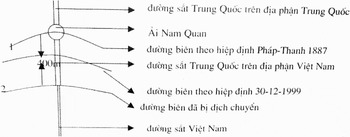
Again, unlike most of the other critics of the agreements, Luận fails to cite his sources. This makes particularly difficult the task of assessing the maps he offers, especially since the images Luận presents are not maps of the border per se, but diagrams of the disputed “points” relative to the location of the arched gateway and the Bản Giốc waterfall. Both diagrams appear to be scans of another document, the format of which suggests they were in fact prepared by a skilled professional using a computer.Footnote 61 Moreover, the red date stamp, barely visible on the bottom right corner of the diagram of the waterfall, closely resembles those used to certify official documents. Together, these details lend credence to Luận’s claims concerning the “leak.” Yet, the odd manner in which the diagrams are presented undercuts these same semiotic claims to bureaucratic authenticity. Most conspicuously, the diagrams of the arched gateway and the waterfall are both harshly cropped. Since no explanation is offered for this, a crucial question arises: Was the decision to remove the surrounding information based on its presumed irrelevance, or, conversely, did it threaten to reveal too much?
The abstract diagram of Kilometer Zero makes it particularly difficult to answer this question because it consists of little more than several geometric shapes. A circle depicts the location of the arched gateway, while a series of arrows, which horizontally bisect these shapes, extends toward the right margin of the scanned diagram where the graphics give way to a brief line of text. Each arrow, and the text that accompanies it, identifies different points in space and, importantly, in time (Figure 2).Footnote 62 The visual elements reveal Kilometer Zero to have moved three times and for quite different reasons: imperial treaty (1887), military force (1979), and secret agreement (1999). But instead of pursuing these themes, which define Sino-Vietnamese relations in conflicting ways, Luận shifts the discussion to yet another historical moment—to a time when relations between the two socialist states was still fraternal, though perhaps disingenuously so.
Diagram of Kilometer Zero. Source: reposted in Lý Công Luận (2002).

The moment in question features an apocryphal but not entirely implausible conversation between “Uncle” Mao and “Uncle” Hồ. Luận does not provide details to establish the historicity of their discussion, so its exact location remains unknown. As does the precise year in which it may have happened, though he notes the exchange occurred during the “Period of Resistance against America” (thời kháng chiến chống Mỹ), which would place it between 1954, when the rail line between Hanoi and the gateway was rebuilt with Chinese assistance, and 1969, when Hồ Chí Minh died. What Luận offers instead is a snippet of one-sided dialogue where Mao Zedong notes current arrangements for shipping military supplies and other goods across China’s southern border to the Democratic Republic of Vietnam to be inconvenient. (At the time, all cross-border cargo had to be unloaded, transported through the gateway, and then reloaded on a different train, since they operated on different gauge tracks.) To speed delivery, Mao offered to extend Chinese wide-gauge track into Vietnamese territory and to construct a storage depot at the line’s new terminus in Đồng Đăng. As a final inducement, Mao further promised to remove the infrastructure “when peace returned” (khi nào hòa bình rồi). “Uncle” Hồ, Luận tells us, “happily consented” (vui vẻ nhận lời) to these seemingly generous terms.
The anecdote helps clarify the significance of the other symbolic element featured on the diagram of Kilometer Zero: two sets of parallel lines that represent the different gauge tracks used by the People’s Republic of China (1.2 meters) and the Democratic Republic of Vietnam (0.9 meters), respectively. In the diagram, the wide-gauge Chinese track extends 400 meters beyond the arched gateway, well south of the international boundary established in 1887. Moreover, Luận reminds us, the rail extension was not removed after national reunification in 1975 as allegedly promised. Instead, the People’s Liberation Army used the track to re-supply troops after it seized a sizeable strip of Vietnamese territory along the length of the northern border during the Third Indochina War. While large-scale military operations ended a month later, violent skirmishes continued for years and all official border crossings remained closed until 1991. According to local residents, it was during this period that Chinese troops moved or destroyed many of the colonial-era border markers, including those on either side of Kilometer Zero.Footnote 63
Taken together, the diagram and the tale offer an account that differs from those of most other critics. Although Luận similarly condemns the Communist Party for its treachery, he notes it may have been influenced by the obligation to “repay a debt of gratitude” (trả ân), by which he meant the material assistance the People’s Republic of China had provided in the past. But, Luận stresses, the decision to cede territory ultimately lies with the former General Secretary, who he portrays as a younger brother honoring an earlier promise to his “older brother” (đàn anh), the Communist Party of China. The word choice is strategic, since it emphasizes not only Lê Khả Phiêu’s weak bargaining position relative to his Chinese counterparts, but also that he placed his older “sibling’s” interests ahead of his own compatriots.
Why were Chinese negotiators so intent on regaining the arched gateway as part of the 1999 territorial agreement? Why did this swathe of uninhabited land matter so much, especially as modern weaponry has rendered moot the military importance of this particular mountain pass? Such questions rarely appear in essays critical of the agreements. Again, Luận is an exception, and he shifts registers from historical forms of evidence to cultural ones to support the validity of his unusual diagram.
According to Luận, the significance of the arched gateway lies in its physical placement within the surrounding landscape; together, these man-made and natural features produce an auspicious alignment of “wind-water” (phong thủy), the Vietnamese expression for geomancy. The arched gateway, like other structures built to conform to these principles, is oriented along a north-south axis to facilitate the flow of positive and negative energy through the mountain pass. The combination of “wind-water” also served as a border alarm: people living nearby reported having felt a sudden chill each time Chinese soldiers illegally entered Vietnamese territory. Such claims offer one explanation of why Chinese negotiators agreed to move Kilometer Zero 200 meters north to secure the 1999 “secret” agreement—but no farther. It was the geomantic power of the mountain pass as a whole that prompted the struggle over this particular section of the border: whoever possessed it would be ensured of good fortune and prosperity in the market-driven future.Footnote 64
There are, of course, other possibilities. Immediately after the “secret” agreement was reached, the Guangxi Zhuang Autonomous Region announced it would invest nearly U.S.$16 million to construct a “tourist belt” showcasing important historical and cultural sites located along its land border with Vietnam. While none of the Vietnamese traders with whom I spoke was aware of the timing of this announcement, which was not reported in Vietnam, they agreed their government should pursue a similar strategy.Footnote 65 In their view, improving cross-border trade was more important than the question of how many meters Kilometer Zero had moved at different moments in time.Footnote 66
THE PURLOINED COMMUNIQUE
Nguyễn Ngọc Giao and the materials he circulated on the Internet provide the final example of technological revisionism. Giao is the editor-in-chief of Diễn Đàn (Forum), an influential bilingual electronic journal based in France. Diễn Đàn features essays on a wide variety of topics, especially cultural and literary matters, but also current affairs. In recent years, Giao has contributed a dozen essays to the journal, one-third of which addressed the controversial border agreements. Of these, the essays published in April and May of 2003 are most relevant since they directly pertain to the location of Kilometer Zero.Footnote 67 Giao’s arguments defy easy categorization and his actual position on the border agreements, like the authenticity of his sources, remains open to conflicting interpretations. However, what most distinguishes Giao’s contribution to the debate is his evidence, which features two secret documents allegedly prepared by the Politburo and then “leaked” to others.
The first is “Communique No. 56,” a thirteen-page document dated 31 March 2002 that lists Phan Diễn, a standing member of the Politburo, as its author.Footnote 68 At first glance, the Communique, which has a large box with the word “secret” typed in bold in the upper-left corner, appears consistent in both format and style with other official documents of its kind. The bottom of the document includes the requisite bullet-point list indicating to whom it was sent: Party members and state officials holding provincial-level positions or higher. The official seal and Phan Diễn’s barely legible signature are also present, as is a note in bold text on the document’s footer: “Do not publish information by way of the mass media.” However, as was the case with Lý Công Luận’s diagram of the Sino-Vietnamese border, a more careful examination raises questions regarding its authenticity.
Most obviously, the Communique is missing the motto—“Independence, Freedom, and Happiness” (Độc Lập, Tự Do, Hành Phúc)—that appears on the header of every official document in the country, which by its very omission makes it a forgery. Other features support this conclusion. The Communique is a scanned reproduction rather than a photograph of the original document; but more crucially, it consists of two separate .jpg files that are embedded within Giao’s account of Kilometer Zero.Footnote 69 In other words, the rest of the Communique, nearly everything of substance that falls between its header and its footer (approximately twelve pages of text) has been excised without explanation. Giao, apparently unconcerned with such matters, proceeds to quote from page eight.
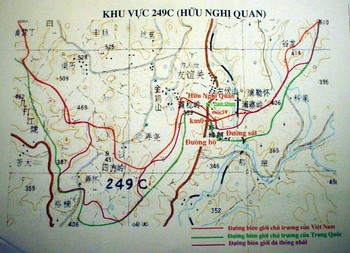
According to the “excerpt,” the boundary pillar representing Kilometer Zero is still in its original location, as agreed in the 1886 procès-verbal between France and the Qing court and shown on an unnamed 1894 map of the border markers. However, the “excerpt” also explains that the international boundary, as then defined, did not bisect the arched gateway. Instead, it cuts farther south, which Giao asserts is consistent with the text of the 1999 Land Border Treaty. These explosive claims are depicted graphically in the other secret document provided by Giao: a map entitled “Area 249C (Friendship Gate),” which was allegedly affixed to the Communique (Figure 3).Footnote 70
Map of Area 249C. Source: reposted in Nguyễn Ngọc Giao (2003) (128).

The map of “Area 249C” depicts three different boundaries. The key, located in the bottom right-hand corner, explains that the uppermost line, in orange, follows the boundary initially desired by Vietnam during negotiations to resolve the 164 border points claimed by both Communist Parties. The bottommost line, in green, indicates the boundary proposed by the People’s Republic of China. A third line that snakes unevenly between the other two, in red, marks the boundary both sides secretly agreed to in 1999. By Giao’s assessment, each country received approximately 50 percent of the total area of the territory in question, which meant the negotiations were resolved equitably. More importantly, Giao declares the “evidence,” which he reposted in the essay, definitively proves Ải Nam Quan and Kilometer Zero were never one and the same. And, though he knows he will be attacked for saying so publicly, Giao declares this means the arched gateway has always stood on Chinese soil.
Giao’s contrarian spirit also extends to the question of whether the General Secretary of the Party voluntarily stepped down or, alternatively, other influential figures forced him to do so. Whereas most accounts attribute this outcome to his own political miscalculations, Giao provides an alternative version of events that locates the origins of the controversy in a skillfully organized, transnational campaign to discredit him. By doing so, Giao effectively substitutes one public secret for another.
Giao’s account begins in mid-2000 when the political maneuvering in advance of the Ninth Party Congress, scheduled for April the following year, became particularly fierce.Footnote 71 While the details are too arcane to discuss fully here, one deserves brief mention because it bears on the search for Kilometer Zero. It concerns a “whisper campaign” organized by Đỗ Mười, the former General Secretary of the Party, and Lê Đức Anh, the former President of Vietnam, to block Lê Khả Phiêu’s efforts to win reelection. According to Giao, the men compiled a list of seven charges against Phiêu, which included the now hackneyed accusation that he ceded too much territory to China to gain backing for a second term. While it remains unclear whether the charges had a factual basis, the campaign apparently worked; Party delegates voted to replace Phiêu with Nông Đức Mạnh, who is widely rumored to be Hồ Chí Minh’s illegitimate son.
Giao further claims the political elites behind the campaign also leaked information regarding the territorial agreements to prominent revolutionary-era figures, many of who have left the Communist Party to become dissidents. During the height of the controversy, twenty of them sought to use their moral prestige to convince the National Assembly to delay ratification of the agreements until further details, including maps of the proposed borders, were released and publicly debated.Footnote 72 But according to Giao, careful examination of the open letter’s content reveals the dissidents’ views were based less on historical fact than on the disinformation campaign cleverly designed to force Lê Khả Phiêu to retire. The claims, if true, suggest the boundary separating official narratives from dissident counter-narratives is less clear than is commonly believed.
Giao’s arguments did not go uncontested. Perhaps his most prominent critic was Trương Nhân Tuấn, who holds a doctorate in physics, but has become an authority on the territorial agreements due to his careful work with colonial-era sources held at the Centre des Archives d’Outres Mer in Aix-en-Provence, France. To date, Tuấn has posted more than seventy research papers related to the Sino-Vietnamese border on his digital archive, which served as the basis for his 850-page book on the topic.Footnote 73 Of these documents, five focus on Giao’s defense of the 1999 Land Border Treaty. While most of Tuấn’s objections to Giao’s analysis of the “secret” Communique are highly technical and draw upon his interpretation of colonial-era documents, he makes several other points that are far more devastating by virtue of their simplicity.Footnote 74
For Giao to have photographed the Communique, Tuấn reminds us, he would need to have known high-ranking officials in Vietnam willing to commit treason, a potentially capital offense. While it is conceivable that Tuấn, who resides in France, had such contacts in the government, the political context makes such an exchange highly unlikely. During the period Giao allegedly obtained and reposted excerpts from the “top secret” Communique in his essay, security officials separately arrested eight people, five of whom later received lengthy prison terms for emailing “disinformation” abroad. Alternatively, Tuấn sarcastically points out, Giao has the skills of a “007 spy” (điệp viên 007).
There is, of course, another possibility: someone else forged the documents, which Giao later photographed. What makes this hypothesis particularly intriguing, according to Tuấn, is the map of “Area 249C” itself. The brightly colored lines, each of which depicts a different boundary, foregrounds the viewer’s eye and distracts attention away from the modern Chinese fonts that faintly appear, along with topographic lines and roads, in the map’s background. The simplified characters, officially used only by the People’s Republic of China and Singapore, are much easier to read than the stylistically more complex ideographs still favored by residents of Hong Kong, Macau, Taiwan, and most overseas Chinese communities. For this reason, Tuấn concludes the mysterious map is probably not of Vietnamese origin. Moreover, by defending its accuracy, Giao appears to be, if not a spy, then an apologist for the Communist Party of China. To date, Giao has not responded publicly to these pointed allegations nor has he written any further essays on the Sino-Vietnamese border. His only response has been to remove the essays. But thanks to the ease with which digital materials can be replicated, Giao’s essays can still be downloaded from other archives that have reposted them, including the one maintained by Tuấn.
POINT/COUNTER-POINT
What are we to make of these factually suspect maps and the political struggles their unauthorized movements helped sustain both on- and offline? What broader desires and anxieties did these conflicting depictions of the Sino-Vietnamese border make manifest? Official statements, such as those offered by Deputy Foreign Minister Lê Công Phụng, either downplay the concerns at the heart of the controversy or ignore them altogether. Instead, the rhetorical emphasis is on the larger process of political and economic normalization, of which the 1999 Land Border Treaty is a part. For example, state officials, when asked about the location of Kilometer Zero and the national status of the arched gateway, often refuse to answer; instead, they prefer to talk about the “Principle of the Sixteen Characters” (Phương châm mười sáu chữ). The slogan, also adopted in 1999, is shorthand for the official values said to now define bilateral relations: “Good-neighborly friendship, all-round cooperation, long-term stability, and orientation towards the future.” Old suspicions, in other words, have no place in the new economic order of things, which currently places a premium on expanding cross-border trade.
Recent statistics bear this view out. In late 2003, Vietnam and China established a Joint Committee on Economic and Trade Cooperation. Within a year, cross-border trade reached a record U.S.$7.2 billion and it continues to surge.Footnote 75 Current forecasts project bilateral trade to surpass U.S.$15 billion by 2010, which will further strengthen China’s economic significance since it is already the largest source of Vietnam’s total imports and the third biggest market for its exports.Footnote 76 From this perspective, China’s economic growth has certainly been a crucial component of Vietnam’s own rapid development, particularly in the country’s north.
By contrast, those opposed to the territorial agreements typically reject the possibility of rapprochement and view the “Principle of the Sixteen Characters” to be dangerously revisionist. Lê Chí Quang, as noted earlier, made these widely shared concerns explicit in his controversial eight-page essay, “Hãy Cảnh Giác với Bắc Triều” (Beware of imperialist China). The outspoken directness with which the Hanoi-based lawyer expressed himself prompted many to conclude Quang purposefully sacrificed himself to expand the transnational debate to include the threat China allegedly poses towards Vietnam’s sovereignty. If this was Quang’s intent, he succeeded. Security officials arrested him in February of 2002, approximately one month after poet Bùi Minh Quốc, and he was later sentenced to four years in prison followed by three years of house arrest for emailing “propaganda against the Government of the Socialist Republic of Vietnam” abroad. The sentence prompted an outpouring of support from not only Vietnamese organizations overseas, but also foreign politicians and advocacy groups around the world. Among them, Human Rights Watch, which awarded Quang a prestigious Hellman/Hammett Prize in recognition of the persecution he faced because of his political views.
Concerns regarding China’s territorial ambitions are not limited to dissidents like Lê Chí Quang or prominent critics overseas, however. Ordinary people regularly express them on different electronic forums, including chatrooms inside Vietnam where the need to “borrow history to talk about the present,” remains strongest. Surprisingly, the person most commonly cited is not a military hero, but Nguyễn Trãi (1380–1442), the celebrated Confucian poet-scholar who served as an advisor to General Lê Lợi during his successful guerrilla campaign to expel Ming Dynasty forces from Đại Việt. To commemorate the victory that ended two decades of foreign rule (1406–1427), Nguyễn Trãi composed Bình Ngô Đại Cáo” (A great proclamation upon the pacification of the Wu), which is widely regarded as the first clear expression of a Vietnamese national identity.Footnote 77 The choice to reproduce this poem, either in part or in whole, is particularly telling since Nguyễn Trãi was later accused of treason and executed. Two decades later, King Lê Thánh Tông overturned the charges and granted a full pardon to his physical remains. For those familiar with this famous episode, references to the poem provide an indirect way to convey to others that they expect history to judge the imprisoned cyber-dissidents (Lê Chí Quang among them) to be patriots rather than traitors.Footnote 78
Such references highlight the continued relevance of the “Period of Northern Domination” to contemporary Vietnamese politics as well as its central contradiction. On one hand, the era heralds the initial diffusion of bureaucratic models and procedures from “China” to “Vietnam”—a complex and contested process that, ironically, made the first pre-modern state of Đại Việt organizationally possible. On the other hand, this same process of diffusion, which continues today, means that official efforts to define a national subject were and remain very much dependent upon the constitution of an alien one: China.Footnote 79 Resolving these tensions remains difficult because cultural forms and practices drawn from northern Vietnam continue to be privileged over those of other regions in the name of the “nation” as a whole. This despite the fact the north was and remains today the most thoroughly Sinicized part of the county. So much so that one critic, when speaking with me, disparagingly described state socialism with Vietnamese characteristics as “China Lite,” by which he meant a copy that was less than authentic due to its derived nature.Footnote 80 Another critic echoed this point, but in more idiomatic terms. He said the relationship between Vietnam and China was: “Like lips to teeth; when the lips are gone, the teeth are cold” (như răng với môi; môi hở thì răng lạnh). The proverb, he explained, normally meant when one neighbor suffers so does the other. But in this instance it was intended as a warning. “Not all neighbors are equal,” he pointed out. “China remains the neighbor with teeth.”Footnote 81
CONCLUSIONS
The conflicting views outlined above suggest it will remain impossible to constitute “Vietnam” without taking “China” into account for the foreseeable future. The same can also be said about the continued salience of the “nation” as a master symbol. Clearly, emotional appeals to protect Vietnam’s territorial integrity still exert a powerful mobilizing force for many Vietnamese, even as large numbers of them seek ways to reduce barriers to the freer flow of people, information, capital, consumer goods, and cultural forms across the country’s borders. Such tensions are not unique to Vietnamese populations; nonetheless, they have taken on particularly Vietnamese forms due to the proliferation of digital archives with political content.
These archives now enable Vietnamese with Internet access to obtain a far greater range of detailed information on actually existing governance in Vietnam, including investigative reports on corruption and other forms of official misconduct, than was possible only a few years ago. These same archives, because of their interactive features, also permit people who visit them to express their views on current affairs and to comment on the previous postings of others. Both developments offer ethnographically rich insights into how Vietnamese differently conceptualize the rapid changes taking place following two decades of reforms collectively known as “Renovation” (Đổi mới) and the country’s gradual reintegration into the global order of things.
However, it would be premature to equate the digital archives and the forms of interaction they enable with the emergence of a universal “public sphere.”Footnote 82 A significant number of obstacles continue to make it difficult for Vietnamese to openly and rationally debate politically sensitive issues with others who hold divergent views without fear of personal or legal repercussions. This holds true for many Vietnamese communities abroad as well as those in Vietnam. Moreover, efforts to engage in discussions across these differences, such as those described in this essay, have directly contributed to the increase in the number and type of restrictions on freedom of expression online in Vietnam, rather than their decrease.Footnote 83 Thus it remains unclear whether these discursive spaces, which on the surface promise greater transparency and accountability, will actually strengthen civil liberties over time much less contribute to the emergence of multi-party politics in what remains one the world’s last single-party states.
Regardless of what the future holds, the controversy that the search for Kilometer Zero set in motion remains notable for several other reasons. Surprisingly, the competing accounts of territorial possession and loss did not neatly reproduce the ideological positions of the Cold War era, which literally divided Vietnam in half and later plunged the entire region into violent chaos for decades. Admittedly, the accusations and counter-accusations commonly found in these particular narratives were not wholly absent from the debate, as genuine reconciliation between those who supported different national projects in the past has yet to occur.Footnote 84 However, the overwhelming focus of the accounts was upon a quite different issue. Namely the authenticity and integrity of the “evidence” they contained regarding if, how, and why the Sino-Vietnamese border moved at different moments in time.
Efforts to resolve doubts about both concerns were made vastly more complicated by different forms of technological revisionism, reposting among them. These practices, since they permitted interested parties to copy, modify, forge, and delete what others could access online from inside as well as outside Vietnam, facilitated the movement of “evidence” across digital archives at some moments and arrested it at others. Close attention to the particularities of these movements and the significance that different interpretive communities attributed to them revealed how technological forms of revisionism shaped the conditions of possibility for both political dissent and official attempts to censor it. These same forms of revisionism also explain why the same piece of “evidence,” such as a map of Kilometer Zero, could be used to advance quite different claims regarding the legitimacy of the border agreements.
Significantly, these claims were not limited to the agreements; they extended more broadly to the official parameters of Vietnamese nationalism. The Communist Party has long justified its continued monopoly on political affairs in moral terms by positioning itself at the end of a long line of heroes who fought to defend or to liberate the Vietnamese “nation” from foreign aggressors.Footnote 85 But, as the case study demonstrated, this particular history of the present has become increasingly problematic. The territorial agreements have enabled some Vietnamese (both resident and in diaspora) to publicly call for a more strident form of nationalism than the Communist Party finds politically acceptable given the complexities of its current relationship with China.Footnote 86 Since this development has helped confuse rather than clarify where orthodox positions on the changing nature of Sino-Vietnamese relations end and heterodox ones begin, the long-term implications of this new development remain unknown. Nonetheless, they illustrate why further attention needs to be directed at how digital objects circulate within and across different social spaces and the effects these have upon the ways “events” are documented, manipulated, and understood by others. Until we take these spaces and their effects seriously, both will remain “transparent” and thus analytically invisible to us.