On October 30, 1924, G. H. Colvin, vice president of the Farmers and Mechanics National Bank of Fort Worth, invited a group of fourteen local businessmen to a protest meeting against heavy taxes on the rich. The purpose of the meeting was to demand a reduction in estate taxes and in the highest marginal rates of income tax. The assembled citizens denounced these taxes as “a serious handicap in financing development enterprises necessary to the progress and growth of our section of the country.” After discussing the evils of high tax rates and the merits of the tax cuts proposed by Treasury Secretary Andrew Mellon, they voted to urge Mellon to consider even deeper income tax cuts for the rich—a maximum surtax rate of 15 percent would be ideal, they agreed, instead of the current 40 percent, or Mellon’s preferred 25 percent. They then elected a resolutions committee that would draft petitions communicating their demands to the Treasury and to their Congressman, Fritz Lanham, who had voted against the Mellon tax cuts the previous spring. They also delegated a group of “leading taxpayers and most active business men” of Fort Worth to meet with Lanham and deliver their message in person. “[W]hile we may not be able to convert him to our way of thinking,” Colvin wrote after the meeting had adjourned, “we will at least deliver our souls and discharge our responsibility as citizens to our government.” With that, the first Texas tax club had formed.Footnote 1
Within three months, there were more than two hundred such clubs in cities and small towns throughout the state, and within a year G. H. Colvin was the chairman of a statewide league of dues-paying Texas tax clubs with its own letterhead that was sending grassroots delegations to Washington, D.C., to lobby for the so-called Mellon Plan, which targeted tax cuts to the richest Americans.Footnote 2 Both contemporary observers and subsequent scholars have credited the Texas tax clubs with swaying Congress, and Representatives William Green (R-Iowa) and John Nance Garner (D-Tex.) in particular, in favor of the Mellon Plan, and thereby bringing about the tax cuts in the Revenue Act of 1926—which included the steepest cut in top marginal tax rates in American history.Footnote 3
But who were these tax club activists, and why did they mobilize a grassroots movement in support of the Mellon Plan? The tax club movement appears to present a sociological anomaly—a movement demanding collective benefits for people richer than themselves. Few of the activists could have expected to receive a tax cut if their demands were granted. Almost no one in Texas owed income tax at the top rates. The income of the United States was heavily concentrated in the cities of the industrialized Northeast, and generations of agrarian radicals had fought for the progressive income tax precisely because it favored the sectional interests of the rural South and West.Footnote 4 Most observers in the 1920s would have assumed that a steeply progressive federal income tax was good for Texas.
Previous scholars have attempted to explain this anomalous movement by depicting the Texas tax clubs as puppets of an eastern industrial and financial establishment. Most accounts of the Mellon Plan focus on “corporate elites” or “financiers and industrialists” who used their financial power to create a “vast propaganda machine” on behalf of the tax plan.Footnote 5 The implication is either that the tax clubs were hired or that they were misled. I will argue instead that the tax club activists knew what was in the Mellon plan and supported it because they believed it dovetailed with interests of their own. The tax clubs were organized by mortgage bankers who saw income tax cuts as a way to deprive their competitors of capital. In particular, they reasoned that cutting the top rates of income tax would deprive the newest entrants into the farm mortgage market—the so-called land banks—of a valuable tax exemption.
The Politics of Mortgage-Backed Securities
The land banks were a new category of lending institution created by the Federal Farm Loan Act of 1916. The American Bankers’ Association had pushed for this legislation, whose purpose was to reduce the risks of farm mortgage lending, thereby providing more income security for lenders and easing the availability of credit for farmers. The law combined several innovations inspired by Danish and German cooperative farm loan associations. One was the mortgage-backed security. The law created two new categories of land banks, the Federal Land Banks and the Joint Stock Land Banks, both of which were authorized to issue bonds backed by mortgage certificates. This innovation reduced the risks of nonpayment by bundling together mortgages. Another such innovation was cooperative governance: each Federal Land Bank was to be governed by an association of farmers, who would use their local knowledge to screen borrowers, and who were incentivized to screen carefully by the requirement that they collectively co-sign each mortgage note. The land banks were supposed to expand and stabilize the market. They were subject to lending limits and detailed regulations that, it was thought, would limit their competition with existing banks.Footnote 6
The American Bankers’ Association had supported this legislation in hopes of creating a new category of intermediary institutions that could reduce the risks of mortgage lending in the volatile farm real estate market. But under pressure from organized farmers, Congress included a provision that made it easier for the new land banks to raise money independently—and thereby transformed them from potentially stabilizing intermediaries to potentially destabilizing competitors. In particular, farmers lobbied successfully for a federal subsidy for the land banks in the form of a tax exemption for the interest income on the mortgage bonds that they issued.Footnote 7 With this tax exemption, the new land banks could raise money independently of existing country banks—and on more favorable terms. Existing farm mortgage banks could only raise capital by issuing stock or taxable loan instruments such as certificates of deposit—unless they reorganized themselves as Joint Stock Land Banks, and thereby subjected themselves to new regulations and lending limits that could substantially curtail their profits.
Bankers denounced the tax exemption as “socialistic” and “class legislation.”Footnote 8 The American entrance into World War I delayed implementation of the Act, but when the land banks began to issue loans after the war, the mortgage banks responded with a renewed campaign to repeal the tax exemption. The Farm Mortgage Bankers’ Association of America described the tax exemption as a “life or death” issue for its members. It distributed a circular warning rural mortgage banks that “the Federal land bank and joint-stock land banks are covering the best fields and loan in such sums of money that no legitimate mortgage company can long meet the competition if the tax exemption feature is allowed to remain.” Senator Reed Smoot introduced legislation to repeal the tax exemption, and the Senate Committee on Banking and Currency held hearings on the issue in 1920.Footnote 9
The struggle over the tax exemption almost put an end to the nascent land banking system. In 1919, Charles E. Smith, a shareholder in the Kansas City Title and Trust Company, sued in U.S. District Court to enjoin the company from investing in tax-exempt land bank bonds on the grounds that they were authorized by an unconstitutional law. It was openly acknowledged that this was a test case brought on behalf of the mortgage banking industry.Footnote 10 The suit effectively froze the land banks’ market share by stopping them from issuing of their bonds. Although the case took years to wind its way upward to the Supreme Court, in the meantime the mere fact of the lawsuit created the perception of a substantial risk that the land banks might be declared unconstitutional—and therefore that their bonds might not be repayed. It was enough to make the bonds unmarketable until the case was resolved.Footnote 11
But the resolution of the case was not favorable for country bankers. The Supreme Court finally ruled that the land banks were constitutional in February 1921 (Smith v. Kansas City Title and Trust Company [255 U.S. 180]), unleashing new federally subsidized competitors in the farm mortgage banking market—just as a farm investment bubble burst. High agricultural profits during World War I had led many farmers to expand production, and to finance that expansion with debt that they found they could not pay off when prices fell. The recession of 1920 triggered a wave of mortgage defaults and foreclosures that undermined the solvency of small, rural banks. Even after farm prices began to recover, the bank failure rate continued to climb as small banks that were close to failing sought to recover their losses by betting on ever-riskier investments. It was the first great systemic bank failure of the twentieth-century United States.Footnote 12
Rural mortgage bankers saw the Mellon plan as a solution because it promised to reduce competition in the industry—by taking away the advantage of tax-exempt financing enjoyed by the land banks. The promise of abolishing tax-exempt financing was in fact the crux of the plan as it was outlined in Mellon’s 1924 tract, Taxation: The People’s Business. The thesis of the book was what would later come to be called a supply-side argument for tax cuts: Mellon argued that cutting income tax rates would actually bring more income tax revenue, not less, because cutting rates would encourage economic growth and thereby give the government more income to tax. But unlike later versions of the supply-side doctrine, Mellon’s version asserted that the particular problem with high tax rates was not that they discouraged investment altogether. It was that they encouraged “the flight of capital away from taxable investments” and toward tax-exempt bonds. Mellon’s preferred solution was a constitutional amendment to eliminate the tax exemption for government bonds. In the meantime, he argued for lowering tax rates on the rich on the grounds that it would decrease the value of the tax exemption.Footnote 13
As Mellon described it, the point of cutting taxes on the rich was to make taxable investments more attractive, and thereby to increase government revenue. If tax rates fell, then more rich people would invest in taxable securities rather than tax-exempt bonds; more income would start to show up on the tax returns of rich investors; and more revenue would start to flow into the Treasury. The tax club activists agreed that cutting the tax rates on the rich was an important step to lure investors away from tax-exempt bonds. But the way they saw it, the point of luring investors away from tax-exempt bonds was not to increase government revenue. It was to take away the unfair advantage enjoyed by the land banks.
The Tax Club Movement
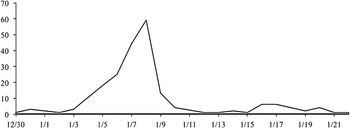
The country bankers’ enthusiasm for the Mellon plan took even supporters of the plan by surprise. The organizer J. A. Arnold had traveled around other states of the South for months trying to stir up sentiment for the Mellon plan without much success. And then he arrived in Texas. The October 30 meeting in Fort Worth was just the start. The tax club idea spread, slowly at first—Dallas on November 6, Houston on November 10, Beaumont on November 25—and then rapidly. From December 30 to the end of January 1925, there were 216 tax conferences in small- and medium-sized towns throughout the state (see Figure 1). Arnold was stunned at how rapidly the tax clubs took hold in even the remotest Texas towns. “Remarkable as it may seem,” he wrote, “we find small towns show much deeper interest than the large ones, at least they are more expressive.”Footnote 14
Reported Texas tax conferences per day, December 30, 1924, to January 22, 1925.
Source: Nathan Adams to Andrew Mellon, January 10, 1925; and Nathan Adams to Andrew Mellon, January 27, 1925, both in Office of the Treasury (RG 56), Correspondence, Central Files of the Office of the Secretary of the Treasury, 1917–1932 (Entry 191), Box no. 163, Folder Tax (General), January-April 1925.
Note: The figure omits twenty-one meetings reported to have taken place in January 1925, the precise dates of which were not recorded.

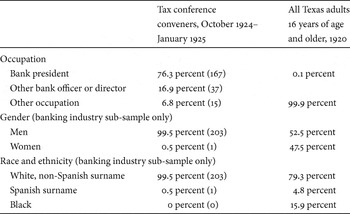
The participants in the tax clubs were overwhelmingly bankers (see Table 1). Systematic data on the activists come from a petition signed by the taxpayers who chaired the Texas tax conferences. Comparison of their names and towns to the directory listing in the September 1924 edition of Polk’s Bankers’ Encyclopedia yields the conclusion that bank presidents made up the great majority of tax conference chairmen, at 76 percent; other bank officers and directors made up the next largest group, at 17 percent; and all other occupations—comprising 99.9 percent of Texas adults—presumably accounted for the remaining 7 percent of the tax conference chairmen.Footnote 15 Some additional information about the gender and ethnicity of the participating bankers could be inferred from their directory listings. Only one of them was a woman (Mrs. Anna Martin, president of the Commercial Bank in Neches). Only one had an identifiably Spanish surname (Mr. F. Vaello Puig, president of the Merchants’ Exchange Bank in Victoria). We may infer that none were African American from the fact that none of the tax conference chairmen worked for any of the state’s handful of black-owned banks.Footnote 16 These statistics represent chairmen who called the tax conferences. The citizens who showed up for the conferences were slightly more occupationally diverse, but not much. A petition from a taxpayers’ conference in Fort Worth on October 30, 1924, lists the occupation of every individual on the “resolutions committee”; seven of fourteen were bankers, three were merchants, two were cattlemen, one owned a lumberyard, and one listed his occupation merely as “capitalist.”Footnote 17 At a Houston meeting of November 15, the thirty-four signatories were all businessmen, and the nine who indicated their occupation more specifically than that were all bankers.Footnote 18 Compared to the population of Texas, the tax club activists were a homogeneous group of white male bankers.
The social base of the Texas tax clubs: white men in charge of banks

Source:
Nathan Adams to Andrew Mellon, January 10, 1925; and Nathan Adams to Andrew Mellon, January 27, 1925, Box 163, Folder Tax (General), January–April 1925, RG 56, Entry 191.
Few of these tax club activists can have been rich enough to enjoy lower tax rates under the Mellon plan. Any taxpayer who exceeded Mellon’s proposed top marginal rate was making at least $68,000, an income that was far above the pay of the typical Texas bank executive: the Federal Reserve Bulletin reports that the average federal reserve member bank in the Dallas district in 1924 was paying a total of $27,481 in wages, salaries, and dividends to all of its employees and investors combined.Footnote 19 Fewer than 188 income taxpayers in the entire state of Texas in 1924 would benefit personally from the proposed reduction in the top marginal tax rate.Footnote 20 It is safe to assume that most of these rich taxpayers were concentrated in a few big cities. The typical tax conference, by contrast, took place in a rural county where fewer than seven people had taxable incomes over $10,000.Footnote 21 For the most part, the tax club activists who spoke up for the rich were not pleading for lower taxes on their own incomes.
It was not high incomes that united the tax club activists. It was their position in the farm mortgage industry. As we shall see, their objection to the income tax was the threat that high tax rates advantaged their competitors in the financial industry. In particular, bankers feared that high tax rates would lead investors to put their savings in tax-exempt bonds—which most rural mortgage banks could not issue, but which their competitors could.
The Productive and the Unproductive
All of the Texas tax clubs identified high surtax rates on the top income brackets as a threat to business, especially business in Texas. The citizens assembled for the Dallas tax meeting two weeks later asserted that cutting the top rate of income tax was “essential to maintaining our financial equilibrium and to the development of the Southwest.”Footnote 22 The assembled chairmen of the Texas tax conferences signed a petition to their senators that described high tax rates in the top brackets as “a National emergency” because high tax rates interfered with “the business requirements of the country.”Footnote 23
But why did they perceive high tax rates as an emergency? The activists who spoke for the tax clubs invariably seized on the existence of tax-exempt debt as the first—and sometimes the only—grievance that led them to favor income tax cuts. The tax conference at Fort Worth began its petition for income tax cuts by complaining that the Revenue Act of 1924 had failed to effect “the diversion of capital from tax exempt to productive securities.”Footnote 24 Businessmen from Houston opened their petition with the same complaint: “At a conference of business men here today, the effect of the present revenue act upon business activity of this section was reviewed and we find that the surtax and inheritance tax rates in the higher brackets are diverting capital into tax exempt securities and discouraging business activities.”Footnote 25 The chairman of the Dallas tax conference called the assembled citizens to order with a call for “tax reform which will divert the flow of capital from tax exempt securities to private enterprises.”Footnote 26 The petition of the state’s tax conference chairmen to their senators made this demand explicit: their priority was an income tax reduction; but “if we cannot have tax reduction, then we should have tax reform with the least possible delay with the schedules so revised that the source of revenue will not be destroyed, but rather enlarged, by more nearly equalizing the income from tax-exempt and taxable securities.”Footnote 27 J. A. Arnold, who had helped to recruit many of the tax club chairmen, wrote to the Treasury to report that this was their top priority: “Our people are as much concerned in reducing the surtax rates to a point where capital will be released for investment in productive enterprises as in tax reduction as such.”Footnote 28 Ending the tax privilege for bonds was the most important thing; cutting the top income tax rate was a means to an end. The first bulletin of the American Taxpayers’ League, issued in January 1925, reported on tax conferences in Texas, Louisiana, and Virginia that had demanded even deeper tax cuts than those proposed in the Mellon Plan. The bulletin justified their demands by providing careful estimates of how lower income tax rates would affect the high-income investor’s choice between stocks and tax-exempt bonds.Footnote 29 The tax exemption was the issue.
Activists distinguished between investors in “productive” enterprise and investors in tax-exempt land banks, which they implicitly disparaged as unproductive. The letterhead of the American Taxpayers’ League drew this line in the sand by describing it as an organization “To Protect and Promote the Interests of those Engaged in Productive Pursuits.”Footnote 30 The adjective might seem odd—it was an association of bankers, not farmers, or manufacturers, or laborers—but in the discourse about the Mellon Plan, “productive” was used as a term that distinguished equity investment and taxable debt instruments from tax-exempt bonds. Mellon himself called tax-exempt bonds “safe but unproductive forms of investment” in Taxation: The People’s Business. In other passages, he treated “productive” as the semantic opposite of “tax-exempt.”Footnote 31 So did many tax activists—as in the petition of the tax club chairmen, which spoke of the need to “divert capital from tax exempt to productive securities.”Footnote 32 To say that the League favored the interests of those engaged in productive pursuits, then, was to say it did not favor the interests of the land banks.
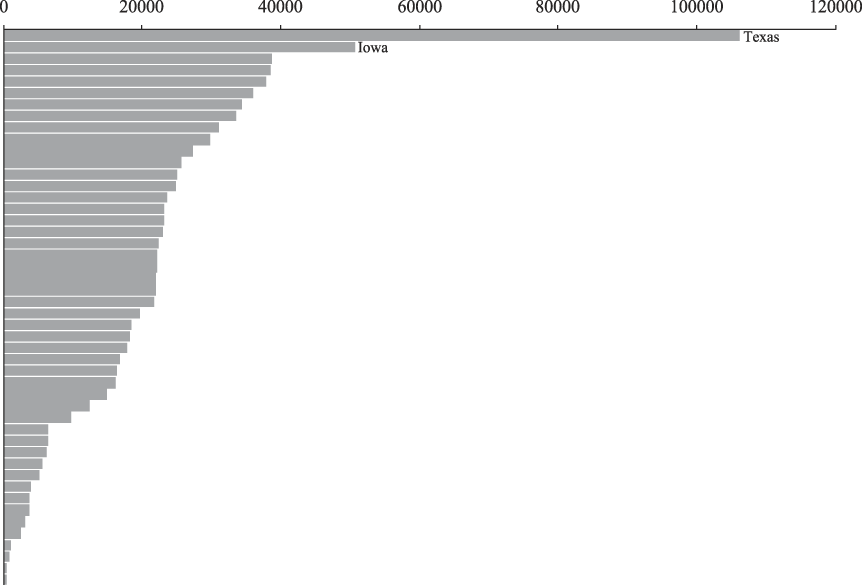
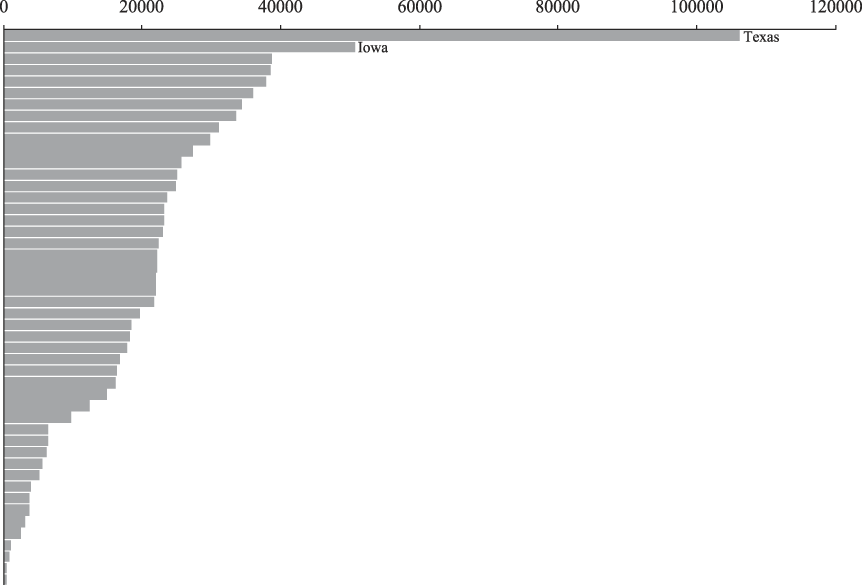
Comparative evidence also supports the hypothesis that the perceived threat posed by the land banks was indeed the proximate cause of mobilization. The two states in which the tax clubs took root most rapidly, organized in greatest numbers, and sent delegations to testify before Congress were Iowa and Texas.Footnote 33 These states were set apart from other farming states not by their high incomes, nor by the severity of the farm mortgage crisis; farm mortgage foreclosure rates were among the highest in the country in Iowa, and somewhat below average in Texas.Footnote 34 The characteristic these states shared that set them apart from other states was the market penetration of the federal land banks. The six land banks licensed to lend in Texas had distributed $106 million in mortgage loans by October 31, 1924, more than twice as much as the next state (Iowa, at $51 million). No other state came close (see Figure 2).Footnote 35
Why were Texas and Iowa the centers of tax club agitation? Total federal land-bank mortgage loans in $1,000s, by state, August 7, 1916, to October 31, 1924
A final piece of evidence comes from the comparison of the activist banks—those whose officers and directors chaired tax meetings—to a representative group of nonactivist banks. The former were in counties with more farm mortgages, and held more assets (including mortgage notes), than the latter. They were also more likely to belong to the American Bankers’ Association.
These conclusions come from a statistical analysis of a sample of Texas banks operating in the fall of 1924. The analysis is complicated by observational dependence among the banks: there was only one tax conference per town, and therefore one tax conference chairman, so many bank officers in larger towns failed to convene tax conferences simply because the role of chairman was already taken by one of the other bankers in town. In order to focus the comparison on bankers who actually had the opportunity to participate as tax conference chairmen, I took a stratified random sample of Texas banks operating in September 1924 from Polk’s Bankers’ Encyclopedia. The sample included all banks whose directors or officers chaired tax conferences, and one randomly selected bank from each Texas town listed in the Encyclopedia that did not have a tax conference. The result was a sample of 955 banks, of which 204 had led tax meetings. For each bank in the data set, I recorded selected financial and organizational information and town characteristics reported in the Encyclopedia. I also merged each record geographically with county-level data on 1924 tax returns, election returns, agricultural property relations, and population characteristics.Footnote 36 The resulting sample yielded 845 cases with complete data, including 167 tax conference conveners and 658 other banks.
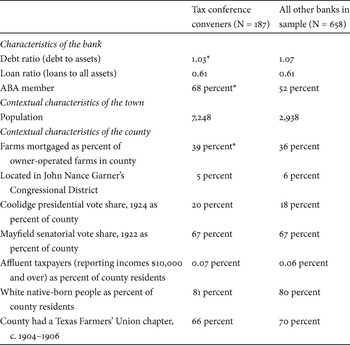
The comparison supports the view that farm mortgage exposure made a difference. Table 2 reports a brief descriptive profile of the two groups of banks. The banks differed slightly, but measurably, in their ratio of debt to assets, suggesting that large asset-holders were more likely to support the Mellon Plan. They also differed slightly in the percentage of mortgaged farmers in their counties, suggesting that the participating banks probably held a relatively high proportion of their assets in farm mortgage notes. This difference is consistent with the hypothesis that the tax clubs were led by people who faced competition from the land banks.
Social and political context did not distinguish the participating banks

* Difference is statistically significant at the p<.05 level. Means are weighted to adjust for stratified sample.
The participating banks were also substantially more likely than nonparticipating banks to belong to the American Bankers’ Association, the principal organization that had lobbied against the tax exemption for federal land banks. We should regard membership in this association only as a proxy for prior political mobilization and contact among bankers; the ABA itself did not contribute resources to the formation of tax clubs. Although the national ABA endorsed the Mellon Plan, the leadership was anxious to distinguish itself from the tax clubs, and even insisted that the latter change the name of their network from the American Bankers’ League to the American Taxpayers’ League in order to avoid any confusion on the subject.Footnote 37 That did not stop the ABA member banks from using their contacts with one another to propagate the tax club model throughout Texas.Footnote 38
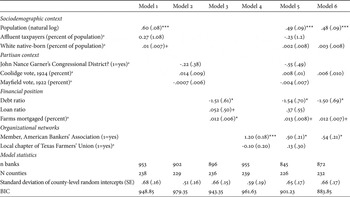
Membership in the ABA and exposure to the farm mortgage market appear to have made a difference even after controlling for other characteristics of banks and their communities. Table 3 reports the results of a series of multi-level logistic regression models that treat the probability of convening a tax conference as a function of bank-level and county-level covariates.Footnote 39 The table shows that banks with low self-reported ratios of debt to assets were especially likely to participate. This conventional measure of financial strength suggests that the participating banks were those at the least immediate risk of business failure due to a bank run by depositors. But the greater threat in rural banking in this period was on the asset side of the ledger: the risk of farm mortgages that would never be repaid. The participating banks were indeed in counties where an unusually high percentage of owner-operated farms were mortgaged, suggesting that many of their assets probably took the form of default-prone farm mortgage notes. Finally, the participating banks were clearly distinguished by their membership in the ABA, net of all these other factors.
Financial position and organizational networks predicted banks’ involvement: Results from multilevel logistic regression models

a county-level covariate; + p<.10; * p<.05; ** p<.01; *** p<.001.
Most other characteristics of banks and their communities appear to have made no difference. The local availability of rich patrons does not help us distinguish participating banks: the presence of affluent taxpayers (those reporting $10,000 or more in taxable income) made no measurable difference net of other covariates. In most other respects, participating and nonparticipating banks were similar. Their social contexts were nearly identical. Their counties were comparably white and had comparable proportions of high-bracket income tax payers. They were not politically distinguishable, whether in their propensity to vote for Calvin Coolidge, whose administration produced the Mellon Plan, or in their propensity to vote for the Ku Klux Klan–identified Democratic Senator Earle Mayfield. Nor were they concentrated in the congressional district of John Nance Garner, who was a prominent opponent of the Mellon Plan.
The greatest difference between the social contexts of participants and nonparticipants concerned the size of their respective communities. The average tax club chairman was in charge of a bank in a town of 7,248 people, compared to 2,938 people for nonactivist banks. Contrary to J. A. Arnold’s first impression, it appears that bankers in large and medium-sized towns were more likely to convene tax conferences than bankers in small towns—perhaps because larger towns were more likely to provide a critical mass of bankers and business owners.
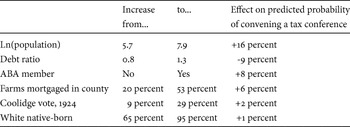
The last column of Table 3 reports a trimmed model that includes only those independent variables that attained significance at the p<.20 level in at least one specification. This relatively parsimonious statistical model is strongly preferred by the Bayesian Information Criterion (BIC). For ease of interpretation, Table 4 translates the coefficients from this trimmed model into marginal effects, representing the change in the simulated probability of holding a tax conference associated with an increase of each independent variable from one standard deviation below its mean to one standard deviation above its mean, if all the other variables could have been held constant at their mean values. The two greatest effects in absolute value are the local population, which increased the probability that a bank would convene a tax conference by 16 percentage points, and the debt-to-assets ratio, which decreased it by nine percentage points. But the third greatest effect was associated with membership in the ABA, which increased the probability of convening a tax conference by eight percentage points.
The big effects: large towns, small debts, prior organization, and lots of loans to farmers

Note:
Effects are calculated from trimmed model 6. For continuous variables, these effects represent the increase in the predicted probability associated with an increase from one standard deviation below the mean to one standard deviation above the mean, holding all other variables constant at their observed values.
In short, the comparison of participating and nonparticipating banks supports the hypothesis that the Texas Tax Club movement was not motivated by activists’ own quest for tax breaks. Instead, it was an attempt to reshape the farm mortgage market by depriving land banks of capital. Country bankers thought the Farm Loan Act tilted the playing field in favor of the federal land banks. They sought to tilt it back.
Conclusion: Bankers into Populists
This article solves a historical and sociological puzzle—how the Mellon Plan, which targeted deep tax cuts to a handful of America’s richest citizens, inspired grassroots mobilization by people who were not themselves rich enough to enjoy very great tax cuts under the plan. Contemporary progressives saw the tax clubs as a catspaw for the Mellon Treasury and the eastern financial establishment. Their judgment has been echoed by scholars who have portrayed the tax club participants as dupes or as stooges. This article presents evidence that the tax club activists were responding to local conditions in their industry. The clubs were peopled by country bankers in markets where they were competing with federal land banks. Their demands indicated that they saw the Mellon Plan primarily as a way to equalize the tax rates between tax-exempt debt and taxable securities. Farm mortgage lenders saw tax cuts for the rich as a way to increase the return on investment for people much richer than they were—and thereby lure those rich investors away from tax-exempt securities that were fueling the expansion of land banks.