Introduction
The neotropical genus Hiraea Jacq. (Malpighiaceae) comprises c.70 species of vines, shrubs, and small trees. It is easily recognised by the epipetiolar stipules and the axillary umbellate inflorescences with yellow flowers; the fruit is a schizocarp breaking into three samaras, each with two large lateral wings. Although Hiraea has received attention in floristic studies during the past 80+ years (e.g. Cuatrecasas, Reference Cuatrecasas1958; W. R. Anderson, Reference Anderson1981, Reference Anderson1994), the genus has not been treated as a whole since Niedenzu’s account for Das Pflanzenreich in 1928. Niedenzu had only limited material with which to work and recognised 21 species. Many of the names accepted by him have been broadly applied to the more abundant collections available since his time. Study of gatherings assigned such traditionally used names often shows them to comprise more than one species (e.g. C. Anderson, Reference Anderson2013). Two such ‘species’ from eastern Brazil are considered here. Of the novelties here described, Hiraea hatschbachii and H. occhionii had generally been assigned to H. cuneata, and H. reitzii and H. restingae to H. wiedeana (= H. macrophylla). Some of the specimens cited below were seen only as images in online catalogues; such collections are indicated by an asterisk next to the herbarium code.
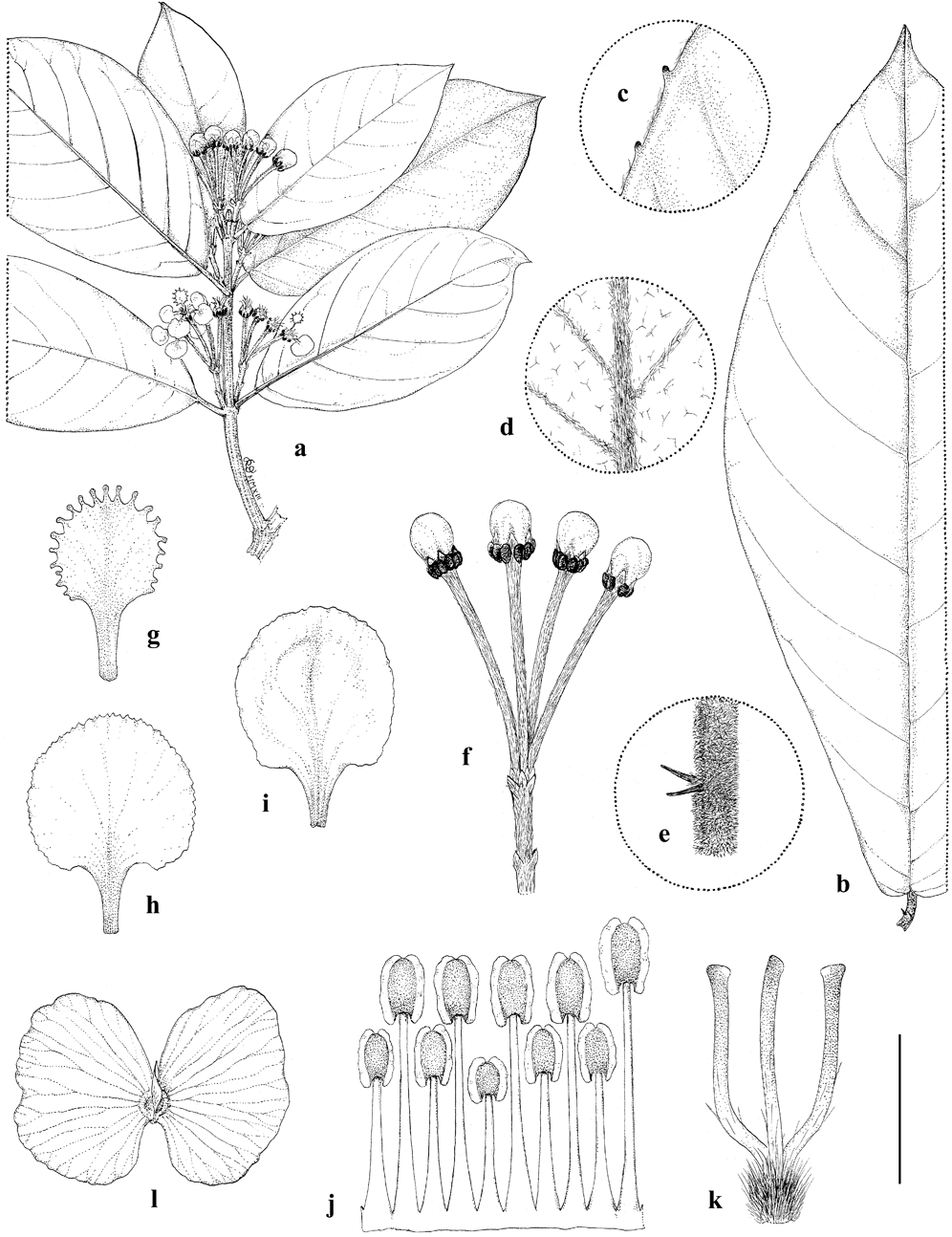
All species treated here have opposite leaves, i.e. none are ternate. The flowers are grouped in 4-flowered umbels, i.e. none in compound arrangements or in globose multi-flowered umbels. Each flower terminates a pedicel subtended by a bract and pair of bracteoles (a floriferous peduncle is absent in Hiraea). Each umbel is borne on an axis bearing a pair of bracts. The portion above the bracts is the peduncle, that below the bracts is the inflorescence axis. The latter may be very short to absent, and the peduncle is then subsessile or sessile. In some other species of Hiraea a lateral peduncle bearing a 4-flowered umbel arises from each bract, and the inflorescence is composed of three umbels; in all species discussed here, each inflorescence has only one 4-flowered umbel (e.g. Fig. 5f).
Hiraea cuneata, H. hatschbachii, and H. occhionii
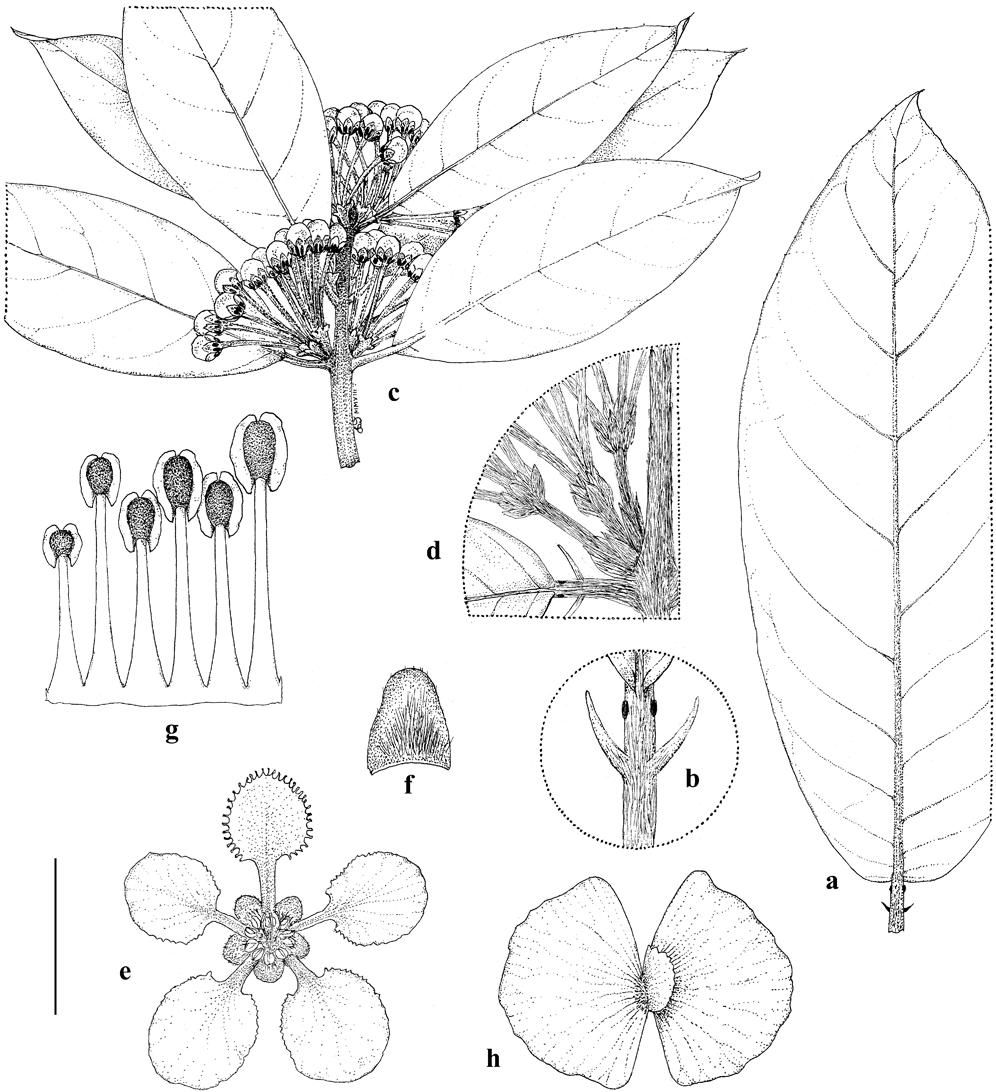
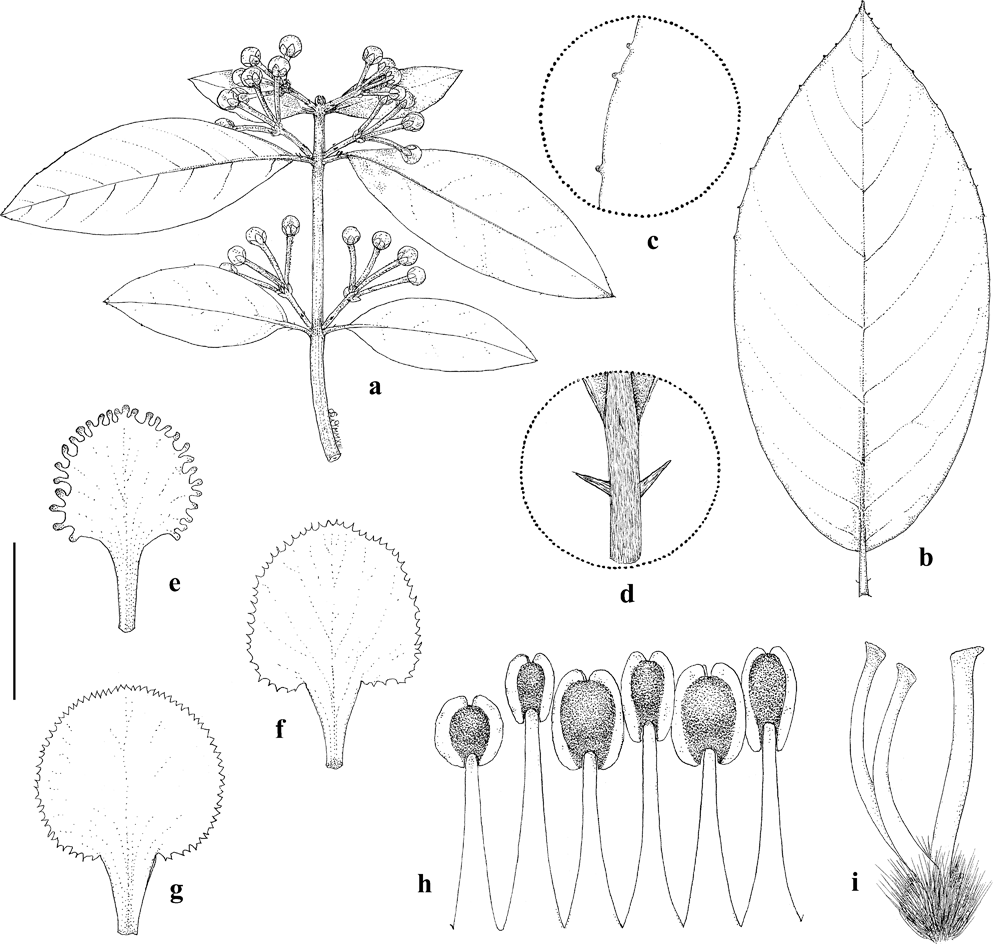
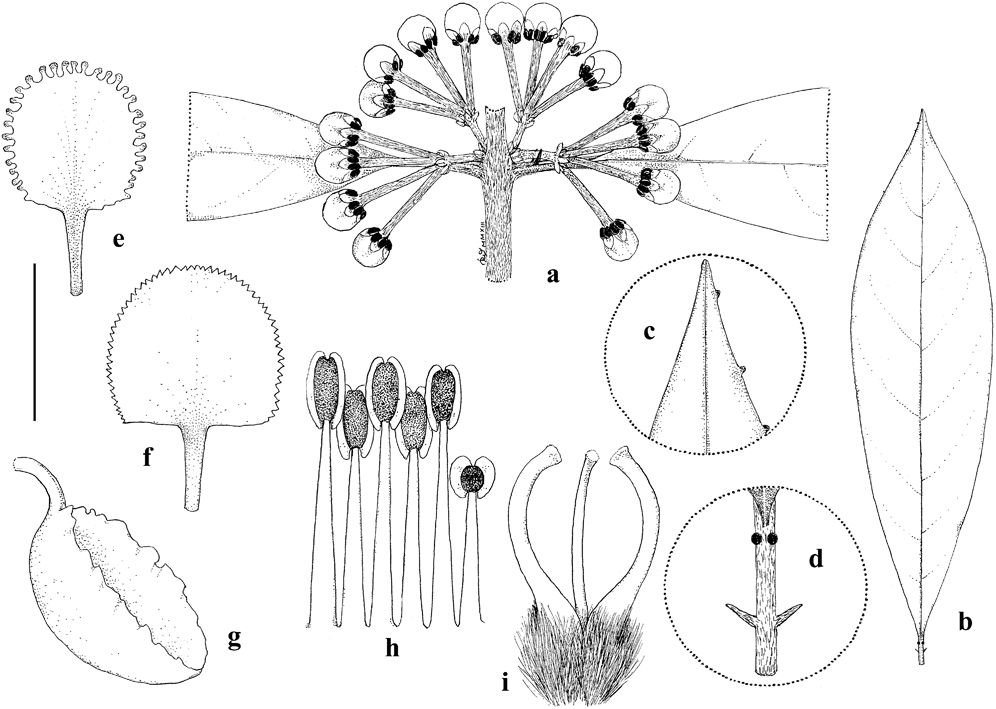
The name Hiraea cuneata has been applied to diverse specimens with glabrate to glabrous laminas from the state of Rio de Janeiro and parts south. This assemblage was found to include, in addition to Hiraea cuneata, two novelties, H. occhionii from Rio de Janeiro and H. hatschbachii from Paraná; some collections placed by Niedenzu (Reference Niedenzu1906, Reference Niedenzu and Engler1928) in his H. cuneata var. acuminata f. eglandulosa are here assigned to H. reitzii (see below). In Hiraea cuneata, H. hatschbachii, and H. occhionii the young laminas are sericeous abaxially; this abaxial vesture is usually soon sloughed off, though some hairs are commonly retained on and along the costa and major veins. Hiraea cuneata is easily recognised by its adaxially sericeous sepals (Fig. 1f), an unusual character in the genus which, until recently, has been overlooked (C. Anderson, Reference Anderson2013). It is a robust species with two to three inflorescences per leaf axil (Fig. 1d), whereas Hiraea occhionii bears two inflorescences per axil (Fig. 3a). In both, rarely only one inflorescence develops in an axil, but the usual number is found at other nodes on a flowering branch. Hiraea hatschbachii always has only one inflorescence per leaf axil (Fig. 2a) and also differs in its eglandular petioles. Hiraea occhionii is notable for its narrow elongate laminas.
Hiraea cuneata Griseb., Linnaea 13: 246 (1839). – Hiraea cuneata var. obtusa Nied., Verz. Vorles. Königl. Lyceum Hosianum Braunsberg 1906/07: 12 (1906), nom. superfl. – Hiraea cuneata var. obtusa f. glandulifera Nied., Verz. Vorles. Königl. Lyceum Hosianum Braunsberg 1906/07: 12 (1906), nom. superfl. – Type: Brazil, Minas Gerais, ‘Praesidio de S. J. Baptista’ [= Visconde do Rio Branco], ii 1819 (y fr), Sellow III. it. B. 1850, c. 1321 (holo B†; lecto, here designated G; iso CGE, K-2 sheets, NY-fragment). Fig. 1.
Fig.1.Hiraea cuneata Griseb. a. Large leaf, adaxial view. b. Distal portion of petiole with a pair of stipules and base of lamina, adaxial view. c. Flowering branch. d. Detail showing insertion of three inflorescences, each with a 4-flowered umbel, in a leaf axil. e. Flower. f. Sepal, adaxial view, showing pubescence. g. Portion of androecium, stamen at left opposite posterior petal. h. Samara, abaxial view. Scale bar equivalents: a, c, 4 cm; b, 8 mm; d, 1.3 cm; e, 1 cm; f, 4 mm; g, 2.7 mm; h, 1.3 cm. Based on: a, Glaziou s.n. (P); b–g, Glaziou 3887 (C); h, Sellow III. it. B. 1850, c. 1321 (CGE).

Hiraea gaudichaudiana f. eglandulosa Nied., Verz. Vorles. Königl. Lyceum Hosianum Braunsberg 1906/07: 11 (1906). – Type: Brazil, Rio de Janeiro, Serra dos Órgãos, 14 xi 1872 (fl), Glaziou 6104 (holo B†; lecto, here designated K; iso C, GOET).

Small shrub to 1.5 m (or woody vine?); stems densely sericeous when young, soon glabrous. Leaves opposite; petioles 6.5–10 mm long, c.2 mm wide, densely sericeous, with a pair of glands at apex of petiole, each gland 1–1.3 mm long; stipules 2–5 mm long, borne at middle to distal 1/4 of petiole; laminas of the larger leaves 6.5–22 × 3–9 cm, elliptical to slightly obovate, apex mucronate to apiculate or short-acuminate, base acute to slightly cordate, adaxially and abaxially when young with sessile to subsessile, straight to wavy hairs 0.4–1.5 mm long, soon glabrescent to glabrous but often with some hairs retained abaxially on and along the costa and major veins; margin with scattered glands 0.2–0.3 mm in diameter in distal 1/4–1/2; costa and secondary veins prominent abaxially. Inflorescences (1–)2–3 axillary 4-flowered umbels; umbel without a gland in the centre; inflorescence axes 0–3(–4) mm long, bracts 2–4 × 1.8–2.5 mm; peduncles (1.5–)3–13 mm long, bracts and bracteoles subtending pedicels 2–3.5 × 1.5–2.5 mm; pedicels 12.5–22 mm long, 0.5–0.7 mm wide; axes, abaxial surface of bracts and bracteoles, and pedicels densely sericeous. Sepals 3–3.5 × 2.5–3 mm, triangular, adaxially sericeous in the centre to base, the marginal 0.3–0.5 mm glabrous, abaxially sericeous; anterior sepal eglandular, the lateral four biglandular or eglandular, glands 1.2–2 mm long, prominent. Petals yellow, glabrous; lateral petals with the claw c.2.5 mm long, limb 6.5–7 × 6.5–7 mm, orbicular, margin of anterior-lateral petals subentire or irregularly denticulate, margin of posterior-lateral petals irregularly denticulate, teeth to 0.1 mm long; posterior petal with the claw 3.5–4 mm long and thicker than that of lateral petals, limb 5.5–6 × 5.5–6 mm, orbicular, margin glandular digitate-fimbriate, fimbriae to 0.5 mm long. Stamens glabrous, filaments basally connate; stamen opposite anterior sepal: filament 3.5–3.7 mm long, anther 1.3–1.4 mm long; stamens opposite anterior-lateral petals: filaments 2.5–3 mm long, anthers 1.2–1.3 mm long; stamens opposite anterior-lateral sepals: filaments 3.2–3.3 mm long, anthers c.1.2 mm long; stamens opposite posterior-lateral petals: filaments 2.5–2.6 mm long, anthers 1.2–1.3 mm long; stamens opposite posterior-lateral sepals: filaments 3–3.5 mm long, anthers 1.1–1.2 mm long; stamen opposite posterior petal: filament 2–2.5 mm long, anther 0.8–0.9 mm long. Styles 3–3.5 × 0.3–0.4 mm, apex extended into a spur to 0.05 mm long, glabrous, anterior style slightly incurved, posterior styles strongly incurved; ovary 1.8–2 mm long, densely villous. Samara butterfly-shaped; lateral wings 1.5–2 cm long, 1.3–1.7 cm wide; dorsal wing 3–5 mm long, 2.5–4.5 mm high, irregularly dentate; mature seed not seen.
Distribution. Brazil (Minas Gerais, Rio de Janeiro); none of the collections seen included notes on habitat.
Additional specimens examined. Brazil. Rio de Janeiro: Mpio. Silva Jardim, Reserva Biológica do Poço das Antas, 8 xi 1979 (fl), Araújo 3427 (MICH); Serra dos Órgãos, Serra d’Estrella, 14 xi 1874 (fl), Glaziou 7540 (C, NY, P); ‘cult. à S. Christovão’, without date (fl), Glaziou s.n. (NY, P); between Magé and Freichal, without date (fl), Miers 4322 (P).
Hiraea cuneata is distinguished by the adaxially sericeous sepals, which separate it immediately from all other species of Hiraea in Rio de Janeiro. Also, the fertile branches of these robust plants bear two or three 4-flowered umbels per leaf axil. All collections, other than the type and the cultivated plant, are from the Serra dos Órgãos. The Sellow type may indicate that Hiraea cuneata is found elsewhere in the Serra do Mar, but the locality associated with Sellow’s collection may be a mistake introduced during the labelling of his gatherings after his untimely death.
Hiraea hatschbachii C.E.Anderson, sp. nov.
A Hiraea cuneata sepalis adaxaliter glabris, petiolis eglandulosis et umbellis solitariis axillaribus differt. – Type: Brazil, Paraná, Joaquim Tavora, arredores, 20 xi 1977 (fl), Hatschbach 39289 (holo MICH; iso FURB*, RB*). Fig. 2.
Fig.2.Hiraea hatschbachii C.E.Anderson. a. Branch with inflorescences in bud. b. Large leaf, adaxial view. c. Detail showing marginal leaf glands. d. Base of lamina and petiole bearing a pair of stipules. e. Posterior petal. f. Posterior-lateral petal. g. Anterior-lateral petal. h. Portion of androecium, abaxial view, the stamen at left opposite posterior petal. i. Gynoecium, anterior style at right. Scale bar equivalents: a, b, 4 cm; c, e–g, 5.7 mm; d, 8 mm; h, i, 2.7 mm. Based on: a, e–i, Hatschbach 39289 (MICH); b–d, Hatschbach 39249 (MICH).
Vine; stems densely sericeous when young, soon glabrous. Leaves opposite; petioles 5–13 × 1–1.5 mm, densely sericeous, glands absent; stipules 1–2.5 mm long, borne at the middle to distal 1/4 of petiole; laminas of the larger leaves 6.5–16 × 3–7.5 cm, elliptical to obovate, apex mucronate to apiculate, base acute, adaxially sericeous when young but soon glabrous, abaxially when young with sessile or subsessile, straight hairs 0.4–1.3 mm long, soon glabrescent to glabrous but often with some hairs retained on and along the costa and major veins; margin with scattered glands c.0.2 mm in diameter in distal 1/4–2/3 or only near the apex; costa and secondary veins prominent abaxially. Inflorescences single axillary 4-flowered umbels; umbel without a gland in the centre; inflorescence axis 1–3 mm long, bracts 1–2 × 1–1.3 mm; peduncles 4–7.5 mm long, bracts and bracteoles subtending pedicels 1–2 × 1–1.8 mm; pedicels 7–18.5 × c.0.5 mm; axes, abaxial surface of bracts and bracteoles, and pedicels densely sericeous. Sepals 2–2.5 × 2–2.7 mm, triangular, adaxially glabrous, abaxially sericeous; anterior sepal eglandular, the lateral four all biglandular or eglandular, glands 1.8–2.2 mm long, prominent. Petals yellow or marked with red, glabrous; lateral petals orbicular, margin mostly denticulate but erose towards the base, teeth to 0.2–0.3 mm long, the claw 2.5–3 mm long, limb of anterior-lateral petals 7.5–8 × 7.5–8 mm, limb of posterior-lateral petals 6–7 × 6–7 mm; posterior petal with the claw 3.5–4.5 mm long and thicker than that of lateral petals, limb 5–6 × 5–6 mm, orbicular, margin glandular digitate-fimbriate, fimbriae to 0.8(–1) mm long. Stamens glabrous, filaments basally connate; stamen opposite anterior sepal: filament 3.5–4 mm long, anther 1.4–1.6(–1.9) mm long; stamens opposite anterior-lateral petals: filaments 2.7–3 mm long, anthers 1.4–1.6(–1.9) mm long; stamens opposite anterior-lateral sepals: filaments 3.3–4 mm long, anthers 1.4–1.5(–1.8) mm long; stamens opposite posterior-lateral petals: filaments 2.5–2.8 mm long, anthers 1.1–1.3 mm long; stamens opposite posterior-lateral sepals: filaments 3.3–4 mm long, anthers 1.2–1.5 mm long; stamen opposite posterior petal: filament 2–2.5(–2.8) mm long, anther 0.9–1(–1.2) mm long. Styles 3.5–4 × 0.4–0.5 mm, apex extended into a spur up to 0.2 mm long or without a spur; glabrous or with scattered hairs in the proximal 1/4–1/3; anterior style very slightly incurved, posterior styles strongly incurved; ovary 1.5 mm long, densely villous. Mature samara not seen; immature samara butterfly-shaped, dorsal wing present.
Distribution. Brazil (Paraná).
Habitat. In capoeira and wet forest and at forest edge.
Etymology. The epithet hatschbachii commemorates the late Gerdt Guenther Hatschbach (1923–2013), botanist extraordinaire and founder of the Museu Botânico de Curitiba. His encyclopedic knowledge of Brazilian plants and floristics as well as his many excellent collections have immeasurably furthered and enriched our understanding of the Brazilian flora.
Additional specimens examined. Brazil. Paraná: Mpio. Ribeirão do Pinhal, Barra do Penacho, 19 xii 2000 (fl), Carneiro 1021 (RB*); Mpio. Curitiba, Parque Náutico, 8 xii 1993 (fl), Cordeiro 1113 & Soares (MICH, RB*); Mpio. Cerro Azul, Rio Ponta Grossa, 20 xi 1957 (fl), Hatschbach 4249 (MICH, US); Mpio. Quatigua, Rod. PR-092, 19 xi 1976 (fl), Hatschbach 39249 (C, MICH); Mpio. Cerro Azul, Cab. Rib. do Tigre, 23 xi 1979 (y fr), Hatschbach 42599 (MICH, MO, NY, US); Mpio. Tunas do Paraná, Pacas, 15 i 2000 (fl), Ribas & Abe 3120 (C, HUEFS); Mpio. São Pedro do Ivaí, Fazenda Santa Bárbara, 21 xii 2004 (fl), Ribas et al. 5701, 5717 (RB*); Mpio. Tunas do Paraná, Pacas, 15 xii 1999 (fl), Silva & Abe 3120 (MICH); Floresta Godoy, Londrina, 20 i 1989 (fl), Soares & Silva 188 (RB*).
Hiraea hatschbachii, a vine of the interior of Paraná, is recognised by its glabrate to glabrous laminas, borne on sericeous eglandular petioles, and the single 4-flowered umbels borne in each leaf axil of flowering shoots.
Hiraea occhionii C.E.Anderson, sp. nov.
A Hiraea cuneata sepalis adaxaliter glabris et laminis angustis differt. – Type: Brazil, Rio de Janeiro, Mpio. Cachoeiras de Macacu, Reserva Estadual do Paraíso, limite com o Mpio. Magé, 28 x 1999 (fl), Amorim et al. 3147 (holo NY; iso MICH, RB*). Fig. 3.
Fig.3.Hiraea occhionii C.E.Anderson. a. Node with two inflorescences in each leaf axil. b. Large leaf. c. Detail of leaf apex with marginal glands. d. Base of lamina and petiole bearing a pair of glands and a pair of stipules. e. Posterior petal. f. Posterior-lateral petal. g. Anterior-lateral petal. h. Portion of androecium, abaxial view, the stamen at right opposite posterior petal. i. Gynoecium, anterior style in centre. Scale bar equivalents: a, 2 cm; b, 4 cm; c, 8 mm; d, 1.3 cm; e–g, 5.7 mm; h, i, 2.7 mm. Based on: a–d, h, i, Occhioni 6363 (MICH); e–g, Amorim et al. 3147 (MICH).
Scandent shrub to 3 m; stems densely sericeous only when very young, the thin bark soon exfoliating and the underlying axes smooth. Leaves opposite; petioles 5–13 mm long, 1.5–2 mm wide, densely sericeous, with a pair of glands at or up to 1 mm below apex of petiole, each gland (0.1–)0.3–1 mm long; stipules 2–3 mm long, borne near the base or to the middle of the petiole; laminas of the larger leaves 8–16 × 2.5–4.3 cm, narrowly elliptical or narrowly oblanceolate or narrowly obovate, apex mucronate to short-acuminate, base acute, adaxially glabrous, abaxially with sessile, straight hairs 0.4–1.4 mm long when young, soon glabrescent to glabrous but often with some hairs retained on and along the costa and major veins; margin with scattered glands 0.2–0.3 mm in diameter in distal 1/4–1/3; costa and secondary veins prominent abaxially. Inflorescences (1–)2 axillary 4-flowered umbels; umbel without a gland in the centre; inflorescence axes 0–0.5 mm long, bracts 1–2.7 × 1–2 mm; peduncles 1.5–8 mm long, bracts and bracteoles subtending pedicels 1–2 × 0.8–1.8 mm; pedicels 8–16.5 × 0.4–0.5 mm; axes, abaxial surface of bracts and bracteoles, and pedicels densely sericeous. Sepals 2.5 × 2.3–2.5 mm, triangular, adaxially glabrous, abaxially sericeous; anterior sepal eglandular, the lateral four biglandular, or all biglandular, glands 1.8–2.2(–2.5) mm long, prominent. Petals yellow, glabrous; lateral petals with the claw 2.5–3 mm long, limb of anterior-lateral petals 6.5–7 × 6.5–7 mm, orbicular, margin slightly erose to subentire, limb of posterior-lateral petals 6–6.5 × 6–6.5 mm, orbicular, margin irregularly denticulate or fimbriate, teeth/fimbriae to 0.2(–0.4) mm long; posterior petal with the claw 3–3.5 mm long and thicker than that of lateral petals, limb c.5 × c.5 mm, orbicular, margin glandular digitate-fimbriate, fimbriae to 0.5(–1) mm long. Stamens glabrous, filaments basally connate; stamen opposite anterior sepal: filament 3.5 mm long, anther 1.3–1.5 mm long; stamens opposite anterior-lateral petals: filaments 2.5–2.6 mm long, anthers 1.2–1.3 mm long; stamens opposite anterior-lateral sepals: filaments 3.5 mm long, anthers 1.3–1.4 mm long; stamens opposite posterior-lateral petals: filaments 2.3–2.6 mm long, anthers 1.2–1.3 mm long; stamens opposite posterior-lateral sepals: filaments 3–3.5 mm long, anthers 1–1.1 mm long; stamen opposite posterior petal: filament 2–2.2 mm long, anther 0.7–0.8 mm long. Styles 3.5–4 × 0.4–0.5 mm, apex blunt or extended into a spur up to 0.05 mm long, glabrous; anterior style very slightly incurved, posterior styles strongly incurved; ovary 1.5 mm long, densely villous. Mature samara not seen; immature samara butterfly-shaped, dorsal wing present.
Distribution. Brazil (Rio de Janeiro).
Habitat. In wet primary forest and thickets of the Serra dos Órgãos.
Etymology. This species is dedicated to Paulo Occhioni (1915–2000), professor of botany and director of the herbarium of the Instituto de Biología da Universidade Federal de Rio de Janeiro. His fine collections, especially from the state of Rio de Janeiro, have aided in elucidating the flora of that region, so rich in endemics.
Additional specimens examined. Brazil. Rio de Janeiro: Nova Friburgo, Macaé de Cima, Sítio Bakus, 31 i 2008 (fl), Filardi 842 (RB*); [Fazenda] Mandioca, 27 viii 1823 (fl), Langsdorff & Riedel [613] (K); Serra dos Órgãos, prox. Morro Garafão, ii 1974 (fl), Occhioni 6137 (MICH); Serra dos Órgãos, Dedo de Deus, 5 x 1974, Occhioni 6312 (fr), 6325 (fl) (MICH); Serra dos Órgãos, Limoeiro, 20 x 1974 (fl), Occhioni 6363 (MICH); Serra dos Órgãos, Caneca fina, xii 1974 (fl), Occhioni 6621 (MICH); without locality and date (fl), Weir 60 (K).
Hiraea occhionii is recognised by its elongate narrow laminas borne on sericeous petioles, with a pair of glands commonly placed c.1 mm below the lamina base. The two 4-flowered umbels in each leaf axil have an inflorescence axis only up to 0.5 mm long or even absent, i.e. the peduncle sessile to subsessile and subtended by the pair of bracts.
Hiraea macrophylla, H. reitzii, and H. restingae
Colla (Reference Colla1833) published two species under the heading ‘Banisteriae dubiae’ that he based on specimens collected in Brazil and sent to him by Martius: Banisteria velutina (non Banisteria velutina A.Juss, Reference Jussieu1840) and Banisteria macrophylla (non Banisteria macrophylla A.Juss, Reference Jussieu1843). Both names had been neglected by botanists, because Colla’s descriptions are vague. The late W. R. Anderson surmised that Banisteria macrophylla belongs to Hiraea, given Colla’s characterisation of the inflorescence as ‘…floribus axillaribus sub-corymbosis…’, and listed the name as equivalent to ‘Hiraea sp.’ in the nomenclature section of the Malpighiaceae website (W. R. Anderson et al., 2006–July 2013). Laura Guglielmone of TO kindly provided images and comments that led me to believe that Colla’s specimen agrees with Hiraea wiedeana A.Juss. In a recent review of Martius collections sent to Colla, de Moraes et al. (Reference De Moraes, de Smedt, Esser, Gallagher and Guglielmone2013) studied the type of Colla’s Banisteria macrophylla and found it conspecific with the type of Hiraea wiedeana A.Juss.; they therefore proposed the combination in Hiraea. Regrettably, they did not find any specimens at TO that refer to Colla’s Banisteria velutina, and that name remains an enigma.
An additional name that belongs in the synonymy of Hiraea macrophylla is Hiraea houlletiana A.Juss. (1843), which was based on a greenhouse-raised sterile plant grown from stock collected by Guillemin and Houllet in the surroundings of Rio de Janeiro. Jussieu himself noted the affinity with Hiraea wiedeana. Grisebach (Reference Grisebach and Martius1858) in his treatment of the Malpighiaceae for Flora brasiliensis listed Hiraea houlletiana as a synonym of H. wiedeana, as did Niedenzu (Reference Niedenzu1906, Reference Niedenzu and Engler1928), who demoted H. wiedeana to varietal status under H. ternifolia (H.B.K.) A.Juss, a species of northern South America.
The name Hiraea wiedeana has been used for specimens from the state of Rio de Janeiro and coastal regions of Paraná and Santa Catarina in which the laminas are abaxially abundantly pubescent with Y-, V-, and T-shaped hairs. Those from the region of Rio de Janeiro belong to Hiraea macrophylla and the novelty H. restingae. Those from Paraná and Santa Catarina are here newly described as Hiraea reitzii, including collections cited by Niedenzu (Reference Niedenzu1906, Reference Niedenzu and Engler1928) as H. cuneata var. acuminata f. eglandulosa. Hiraea macrophylla is readily separated from H. reitzii by the pair of prominent glands at the apex of the petiole and the presence of two inflorescences per leaf axil; H. reitzii has eglandular petioles and only one inflorescence per leaf axil. Hiraea restingae bears a pair of glands at the apex of the petiole and one inflorescence per leaf axil. It is distinguished from Hiraea macrophylla and H. reitzii by its decussate leaves with ovate or broadly elliptical laminas borne on very short petioles (to 6 mm long). In Hiraea reitzii the abaxial vesture of mature laminas may be thinning and eventually sloughed off; in H. restingae it is shed often in patches and mature laminas may be glabrate. In both species some hairs remain on and near the costa and major veins.
Hiraea macrophylla (Colla) P.L.R.Moraes & Guglielmone. – Banisteria macrophylla Colla, Herb. Pedem. 1: 479 (1833), non Banisteria macrophylla A.Juss. (1843). – Type: Brazil, [Rio de Janeiro?; see de Moraes et al., 2013, for discussion about type locality], ‘Estrada de Minas’, without date (fl), unknown collector [Martius?] (lecto, designated by Moraes & Guglielmone in de Moraes et al., 2013: TO). Fig. 4.
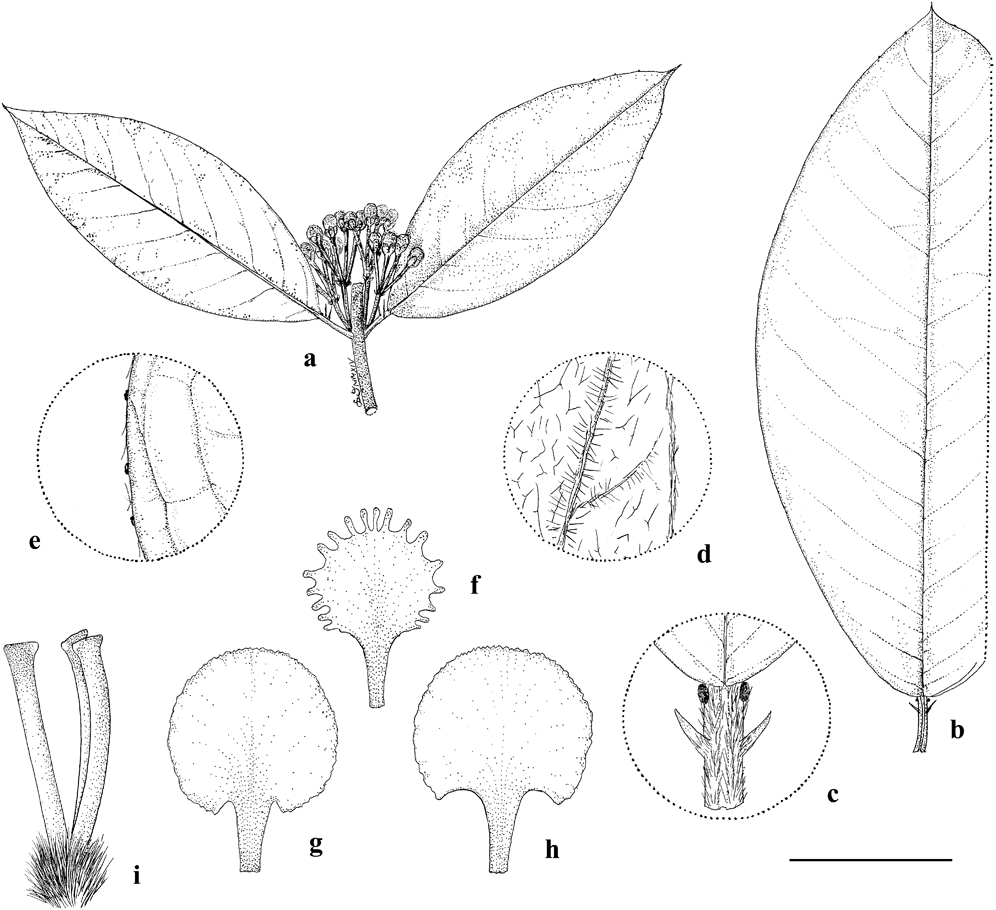
Fig.4.Hiraea macrophylla (Colla) P.L.R.Moraes & Guglielmone. a. Node with a pair of leaves and two inflorescences in each axil. b. Large leaf, adaxial view. c. Base of leaf and distal portion of petiole with a pair of glands and a pair of stipules. d. Detail of abaxial leaf surface. e. Detail of lamina, adaxial surface, showing marginal glands. f. Posterior petal. g. Posterior-lateral petal. h. Anterior-lateral petal. i. Gynoecium, anterior style at left. Scale bar equivalents: a, b, 4 cm; c, 8 mm; d, e, 4 mm; f–h, 5.7 mm; i, 2.7 mm. Based on: a, c–i, Wilkes Expedition s.n. (NY); b, ‘Houllet s.n.’ (BR).
Hiraea houlletiana A.Juss., Arch. Mus. Hist. Nat. 3: 575 (1843). – Type: specimen prepared from living plant collected by Guillemin and Houllet near Sebastianopolis [= Rio de Janeiro, Brazil] and raised in the Jardin des Plantes, Paris (holo P-JU 11735; iso BR).
Hiraea wiedeana A.Juss., Ann. Sci. Nat. Bot., sér. 2, 13: 257 (1840). – Hiraea ternifolia var. wiedeana (A.Juss.) Nied., Verz. Vorles. Königl. Lyceum Hosianum Braunsberg 1906/07: 10 (1906). – Type: Brazil, Rio de Janeiro: ‘Muribeca’ [Fazenda Muribeca, on the Rio Itapaboana, ‘21°–22°S, 40°–41°W, where the village of Batalha (= Batelão) is located today’, fide Avila-Pires, Reference Avila-Pires1965], Wied s.n. (holo BR; iso BR, LD*).
Vine (?; ‘caulis scandens, …’ fide Jussieu, 1843); stems with a mixture of T- and Y-shaped hairs when young, soon glabrous. Leaves opposite; petioles 5–10(–16) × 1.5–1.8(–2) mm, densely velutinous, with a pair of glands at apex of petiole or partly on the base of the lamina, each gland 0.8–1.3 mm long; stipules 1.8–2 mm long, borne at the middle to distal 1/4 of petiole; laminas of the larger leaves 6.9–12(–17) × 3–7(–8.5) cm, elliptical, apex mucronate to apiculate, base acute to slightly cordate, adaxially when young with T-shaped hairs, subsessile or with a stalk to 0.1 mm, trabecula 0.5–1.2 mm long, straight, soon glabrescent to glabrous, abaxially velutinous, the hairs subsessile or with a stalk to 0.1 mm long, arms of Y-shaped hairs 0.1–0.4 mm long, trabecula of T-shaped hairs 0.7–1.2 mm long; margin with scattered glands 0.2–0.3 mm in diameter in distal 1/3–1/5; costa and secondary veins prominent abaxially. Inflorescences (1–)2 axillary 4-flowered umbels; umbel without a gland in the centre; inflorescence axis 0–4 mm long, bracts 1.2–1.5 × 0.8–1 mm wide, velutinous; peduncles 4.5–11 mm long, velutinous, bracts and bracteoles subtending pedicels 1–1.3 × 0.8–1 mm; pedicels 16–21 × c.0.5 mm; abaxial surface of bracts and bracteoles, and pedicels densely sericeous. Sepals 2–2.2 × 2–2.2 mm, triangular, adaxially glabrous, abaxially sericeous, anterior sepal eglandular, the lateral four all biglandular, or all eglandular, glands c.1.5 mm long, prominent. Petals yellow, glabrous; lateral petals with the claw c.2.5 mm long, limb of anterior-lateral petals 6.5–7 × 6.5–7 mm, orbicular, margin irregularly denticulate to erose near the base, teeth to 0.1 mm long, limb of posterior-lateral petals c.6 × c.6 mm, orbicular, margin irregularly denticulate-erose, teeth to 0.1 mm long; posterior petal with the claw c.3.5 mm long and thicker than that of lateral petals, limb c.5 × 5 mm, orbicular, margin glandular digitate-fimbriate, fimbriae to 0.5(–0.7) mm long. Stamens glabrous, filaments basally connate; stamen opposite anterior sepal: filament c.3.7 mm long, anther c.1.6 mm long; stamens opposite anterior-lateral petals: filaments c.3 mm long, anthers c.1.6 mm long; stamens opposite anterior-lateral sepals: filaments c.3.3 mm long, anthers c.1.5 mm long; stamens opposite posterior-lateral petals: filaments c.2.2 mm long, anthers c.1.3 mm long; stamens opposite posterior-lateral sepals: filaments c.3.3 mm long, anthers c.1.5 mm long; stamen opposite posterior petal: filament c.2 mm long, anther c.0.9 mm long. Styles c.3.5 × c.0.4 mm, apex abaxially rounded or extended into a spur up to 0.05 mm long, glabrous; anterior style slightly incurved, posterior styles incurved; ovary c.1.7 mm long, densely villous. Samara not seen.
Distribution. Brazil (Rio de Janeiro).
Additional specimens examined. Brazil. Rio de Janeiro: near Rio de Janeiro, without date (fl), Wilkes expedition s.n. (NY, US).
Hiraea macrophylla is characterised by the presence of two 4-flowered umbels in each leaf axil of fertile shoots and by the velutinous vesture that covers the axes, petioles, and the abaxial surfaces of laminas, but is sloughed off from older stems and branches. This species is known only from a few collections from the state of Rio de Janeiro. None is accompanied by data on habitat or flowering time. De Moraes et al. (Reference De Moraes, de Smedt, Esser, Gallagher and Guglielmone2013) propose several interpretations for the notation ‘Estrada de Minas’ accompanying the holotype of Hiraea macrophylla. I agree with their suggestion that it likely refers to the route that led Martius and Spix to Langsdorff’s ‘Fazenda da Mandioca’ near present-day Magé (Becher, Reference Becher1987; not Macaé, as cited by de Moraes et al., 2013) and beyond into Minas Gerais, rather than a locality in Bahia. Perhaps Hiraea macrophylla persists in protected areas.
Hiraea reitzii C.E.Anderson, sp. nov.
A Hiraea macrophylla petiolis eglandulosis et umbellis solitariis axillaribus differt. – Type: Brazil, Paraná, Mpio. Antonina, Rio Cotia, 21 xii 1976 (fl), Hatschbach 39313 (holo NY; iso C, MICH, US). Fig. 5.
Fig.5.Hiraea reitzii C.E.Anderson. a. Flowering branch. b. Large leaf, adaxial view. c. Detail of lamina, showing marginal glands. d. Detail of abaxial leaf surface. e. Portion of petiole with pair of stipules. f. Inflorescence. g. Posterior petal. h. Posterior-lateral petal. i. Anterior-lateral petal. j. Androecium laid out, abaxial view, the stamen fifth from left opposite posterior petal. k. Gynoecium, anterior style in centre. l. Samara, abaxial view. Scale bar equivalents: a, b, 4 cm; c, d, 4 mm; e, 8 mm; f, 1 cm; g–i, 5.7 mm; j, k, 2.7 mm; l, 2 cm. Based on: a, Hatschbach 39313 (C); b–e, Anderson 13622 (MICH); f–k, Hatschbach 39313 (MICH); l, Hatschbach 59786 (MICH).
Hiraea cuneata var. eglandulosa Griseb. in Martius, Fl. Bras. 12(1): 99 (1858). – Type: Brazil, Rio Grande do Sul (fide Grisebach, 1858), without date (fl), Tweedie s.n. (lecto, here designated K).
Hiraea cuneata var. acuminata f. eglandulosa Nied., Verz. Vorles. Königl. Lyceum Hosianum Braunsberg 1906/07: 12 (1906). – Type: Brazil, Santa Catarina, ‘im Garciawalde bei Blumenau’, xii 1888 (fr), Ule 997 (lecto, here designated US; isolecto NY-fragment).
Vine; stems densely sericeous when young, soon glabrous. Leaves opposite; petioles 4–11 × 1.5 mm, densely covered by a mixture of short-stalked T- and Y-shaped hairs, glands absent; stipules 1.2–2 mm long, borne at the middle to distal 1/5 of petiole; laminas of the larger leaves 5.5–17(–23) × 3–7.5(–10) cm, elliptical to obovate, apex mucronate to apiculate to short-acuminate, base acute to briefly truncate, adaxially sericeous when young but soon glabrous, the hairs sessile to subsessile, straight or wavy, 0.4–1.3 mm long, abaxially with a mixture of T-shaped hairs (stalk 0.05–0.2 mm long, trabecula 0.3–1.3 mm long), V-shaped sessile hairs, and Y-shaped hairs (stalk to 0.1 mm long, arms 0.2–0.6 mm long), the abaxial vesture thinning and old laminas eventually glabrescent, the hairs retained in patches and on/along the costa and major veins; margin with scattered glands c.0.2 mm in diameter in distal 1/4–1/2 or only near the apex or sometimes glands absent; costa and secondary veins prominent abaxially. Inflorescences single axillary 4-flowered umbels; umbel without a gland in the centre; inflorescence axis 0–4.5 mm long, bracts 1–1.8 × 1–1.8 mm; peduncles 2–7(–10) mm long, bracts and bracteoles subtending pedicels 1–1.8 × 1–1.3 mm; pedicels (7–)10–20 × c.0.5 mm; axes, abaxial surface of bracts and bracteoles, and pedicels densely sericeous. Sepals 1.8–2.2 × 1.8–2.2 mm, triangular, adaxially glabrous, abaxially sericeous; anterior sepal eglandular, the lateral four all biglandular, or all biglandular or all eglandular, glands (1.5–)1.8–2 mm long, prominent. Petals yellow, glabrous; lateral petals with the claw 2.5 mm long, limb 6–8 × 6–8 mm, orbicular, margin irregularly denticulate or only distally so or sometimes subentire, teeth to 0.1(–0.2) mm long; posterior petal with the claw 3–3.5 mm long and thicker than that of lateral petals, limb 4–5 × 4–5 mm, orbicular, margin glandular digitate-fimbriate, fimbriae to 0.6(–0.8) mm long. Stamens glabrous, filaments basally connate; stamen opposite anterior sepal: filament 3–4.5 mm long, anther 1.2–2 mm long; stamens opposite anterior-lateral petals: filaments 2.5–3 mm long, anthers 1.1–1.8 mm long; stamens opposite anterior-lateral sepals: filaments 3–4 mm long, anthers 1.2–1.8 mm long; stamens opposite posterior-lateral petals: filaments 2–2.5 mm long, anthers 1.1–1.8 mm long; stamens opposite posterior-lateral sepals: filaments 3–4 mm long, anthers 1.1–1.5 mm long; stamen opposite posterior petal: filament 2–2.3 mm long, anther 0.6–1 mm long. Styles (3.2–)3.6–4 × 0.3–0.4 mm, apex blunt or extended into a spur up to 0.05(–0.1) mm long, with scattered hairs in the proximal 1/4–1/3 or glabrous; anterior style very slightly incurved, posterior styles incurved; ovary (1–)1.5 mm long, densely villous. Samara butterfly-shaped; lateral wings 2.2–2.6 cm long, 1.5–1.9 cm wide; dorsal wing 6–7 mm long, 2.2–2.3 mm high, irregularly dentate; mature seed not seen.
Distribution. Brazil (Paraná and Santa Catarina, Rio Grande do Sul?).
Habitat. Near the coast in capoeira and wet forest and at forest margin; sea level to 200 m.
Etymology. The name honours the Brazilian naturalist Raulino Reitz (1919–1990), an expert on the flora of Santa Catarina and co-editor with R. M. Klein of the influential series Flora Ilustrada Catarinense.
Additional specimens examined. Brazil. Paraná: Mpio. Antonina, Reserva Biológica da Sapitanduva, 21 i 1990 (sterile), Anderson 13622 (MICH); Mpio. Pontal do Paraná, Ponta do Sul, 16 xii 1999 (fl), Cruz & Cordeiro 225 (MICH); Morretes, 1977 (fl), Dombrowski 9108 (US); Alexandra, 15 xii 1909 (y fr), Dusén 8674 (GH, MO, US); Mpio. Morretes, Col. Sambaqui, 10 vii 1968 (fl), Hatschbach 19477 (MICH, P); Mpio. Morretes, Pitinga, 7 xii 1979 (fl), Hatschbach 42620 (MICH); Mpio. Antonina, Rio do Meio, 26 xi 1982 (fl), Hatschbach 45744 (MICH); Mpio. Guaraqueçaba, Serra Negra, 30 xi 1983 (fl), Hatschbach 47171 (MICH); Mpio. Guaraqueçaba, Batuva, 16 xii 1993 (y fr), Hatschbach 59786 (C, MICH, NY); Mpio. Antonina, Rio Xaxim, 19 xi 1998 (fl), Hatschbach et al. 68844 (MICH). Santa Catarina: Itajaí, Cunhas, 29 xi 1954 (fl), Klein 844 (MICH, P); Itajaí, Morro da Fazenda, 7 xii 1955 (fl), Klein 1795 (MICH, P); Itajaí, Playa Brava, c.26°57′S, 48°35′W, 6 xii 1981 (fl), Landrum 3982 (MICH); Pirão Frio, Sombrio, 11 xii 1959 (y fr), Reitz & Klein 9399 (MICH, P).
Hiraea reitzii has eglandular petioles and only one 4-flowered umbel per leaf axil of flowering branches. As in some other species of Hiraea, the distinctive spreading abaxial pubescence of the lamina may be shed with age, and older leaves may be only glabrate; however, the hairs are usually retained along the costa and major veins, preventing confusion with H. hatschbachii, in which the leaves are abaxially initially sericeous and soon glabrous. Hiraea reitzii occurs in coastal regions of Paraná and Santa Catarina, but its range may extend both north and south. Grisebach listed the Tweedie collection from Rio Grande do Sul; the sheet annotated by him at K bears only the note ‘S. Brazil’.
Hiraea restingae C.E.Anderson, sp. nov.
A Hiraea macrophylla foliis decussatis non oppositis, petiolis 3–6 mm longis non 5–10(–16) mm et umbellis tantum solitariis axillaribus differt. – Type: Brazil, Guanabara [= Rio de Janeiro]: Rio de Janeiro, Barra de Tijuca, 21 x 1964 (fl), W. Hoehne 5827 (holo NY; iso RB*). Fig. 6.
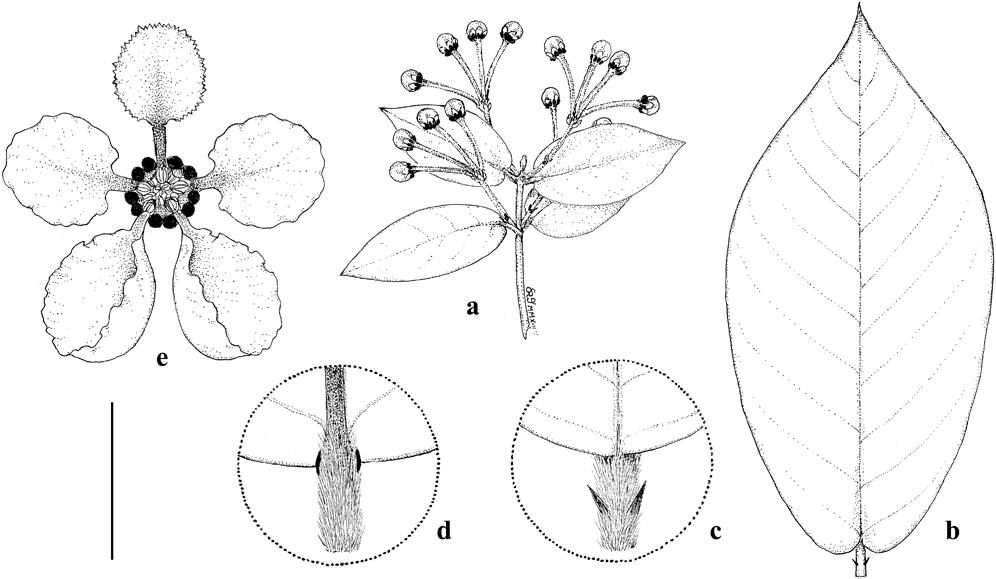
Fig.6.Hiraea restingae C.E.Anderson. a. Branch with inflorescences in bud. b. Large leaf. c. Base of lamina, adaxial view, and petiole bearing a pair of stipules. d. Base of lamina, abaxial view, with a pair of glands at the insertion of the petiole. e. Flower. Scale bar equivalents: a, b, 4 cm; c, d, 8 mm; e, 1 cm. Based on: a, e, Hoehne 5827 (NY); b, Kuhlmann s.n. RB26349 (RB); c, d, Anderson 11195 (MICH).
Woody vine to 4 m or small shrub to 0.5 m; stems densely covered with a mixture of T- and Y-shaped hairs when young, soon glabrous. Leaves opposite, decussate; petioles 3–6 × 1.2–2 mm, densely covered with a mixture of T- and Y-shaped hairs, with a pair of glands at apex of petiole or partly on the abaxial surface of the lamina, each gland 0.4–1 mm long; stipules 1.5–2 mm long, borne at middle of petiole; laminas of the larger leaves 4.5–14 × 2.7–6.5 cm, ovate or broadly elliptical, apex mucronate to apiculate to short-acuminate in the largest, base truncate to cordate, adaxially and abaxially when very young with subsessile straight and/or Y-shaped hairs, older laminas adaxially glabrous, abaxially initially velutinous and often mixed with T-shaped hairs, the vesture sometimes retained or patchy, usually soon shed and hairs remaining only on and along the costa, T-shaped hairs subsessile or with the stalk 0.1–0.3 mm long, trabecula 0.6–1.2 mm long, Y-shaped hairs with the stalk 0.1–0.3 mm long, arms 0.05–0.5 mm long, the smaller ovate laminas associated with the inflorescences commonly glabrous or abaxially with scattered sessile or subsessile straight hairs; marginal glands absent; costa and secondary veins prominent abaxially. Inflorescences single axillary 4-flowered umbels; umbel without a gland in the centre; inflorescence axis 0–6 mm long, bracts 1 × 1 mm; peduncle 8.5–13.5 mm long, bracts and bracteoles subtending pedicels 1.2–1.5 × 1–1.5 mm; pedicels 16–19.5 × 0.5–0.6 mm; axes, abaxial surface of bracts and bracteoles, and pedicels densely sericeous. Sepals 2.2–2.3 × 2.2–2.3 mm, triangular, adaxially glabrous, abaxially sericeous; all sepals biglandular or the anterior sepal eglandular, glands 1.8–2 mm long, prominent. Petals yellow, glabrous; lateral petals with the claw 2.5–3 mm long, the limb orbicular, margin subentire, limb of anterior-lateral petals 7.5–8 × 7.5–8 mm, limb of posterior-lateral petals 6.5–7 × 6.5–7 mm; posterior petal with the claw 3.5–4 mm long and thicker than that of lateral petals, limb c.6 × 6 mm, orbicular, margin dentate/fimbriate, teeth/fimbriae to 0.2(–0.4) mm long. Stamens glabrous, filaments basally connate; stamen opposite anterior sepal: filament 3.2–3.3 mm long, anther 1.3–1.4 mm long; stamens opposite anterior-lateral petals: filaments 2.5–2.7 mm long, anthers 1.2–1.3 mm long; stamens opposite anterior-lateral sepals: filaments 3–3.2 mm long, anthers 1.3–1.4 mm long; stamens opposite posterior-lateral petals: filaments 2.2–2.5 mm long, anthers 1.2–1.3 mm long; stamens opposite posterior-lateral sepals: filaments 3–3.3 mm long, anthers 1.2–1.3 mm long; stamen opposite posterior petal: filament 2–2.2 mm long, anther 0.9–1 mm long. Styles 3.2–4 × 3.2–4 mm, apex extended into spur 0.05–0.1 mm long, abaxially with a few scattered hairs in the basal 1/4 or glabrous; anterior style slightly incurved, posterior styles strongly incurved; ovary 1.5–1.7 mm long, densely villous. Mature samara not seen; immature samara butterfly-shaped, dorsal wing present.
Distribution. Brazil (Rio de Janeiro).
Habitat. In woodlands and shrubby areas of restingas; c.sea level.
Additional specimens examined. Brazil. Rio de Janeiro: restinga c.11 km W of Barra da Tijuca, 1 ii 1975 (y fr), Anderson 11195 (MICH); restinga, Barra da Tijuca, xi 1936 (y fr), Brade 15488 (RB*); Mpio. Macaé, Loteamento Lagomar, mata de restinga remanescente, 29/20 xi 1994 (fl), Farney 3443 (RB*); Mpio. Cabo Frio, Tamoios, estrada para Fazenda da Pedra, próxima ao Rio São João, floresta de restinga, 10 xi 2000 (fl), Farney 4315 (RB*); Mpio. Saquarema, restinga de Ipitangas, 25 xi 1988 (fl, y fr), Freitas 17 (RB*); Barra da Tijuca, 10 xii 1931 (fl), J. Kuhlmann s.n. RB26349 (RB); restinga da Barra da Tijuca, 5 v 1932 (fl), ‘Director’ [J. Kuhlmann] 2330 (RB*); Barra da Tijuca, restinga, xii 1934 (fr), Pilger & Brade s.n. RB34502 (RB*); Estrada Alto de Boa Vista–Vale Encantado, 4 i 1972 (y fr), Sucre 820 (RB*).
Hiraea restingae is distinctive in its decussate leaves with ovate to broadly elliptical laminas that lack marginal glands and are borne on very short petioles. This species is endemic to restingas, a dry open coastal vegetation type of low trees and shrubs found on sandy and nutrient-poor soils. It is known only from the state of Rio de Janeiro and should be sought in the restingas of adjacent coastal regions.
Acknowledgements
It is with great sadness that I express my gratitude to the late William R. Anderson for his comments on this paper and for a lifetime of advice on Malpighiaceae. I am also indebted to the late Gerdt Hatschbach who, for many years, sent duplicates of his fine collections to MICH. Laura Guglielmone of TO kindly responded to questions and sent images of the type of Banisteria macrophylla Colla. Karin Douthit drew the beautiful illustrations. I am grateful to Mark Newman, Tiina Särkinen, and two anonymous reviewers for their comments and corrections. I thank the curators of the following herbaria for providing access to their collections and extending many courtesies during visits: BR, C, CGE, G, GH, GOET, HUEFS, K, MICH, MO, NY, P, RB, US. This study was supported in part by a grant from the National Science Foundation to the University of Michigan (DEB-0543909).