INTRODUCTION
Potentially curative external beam radiotherapy is usually considered in patients with localised advanced lung cancer unsuitable for surgery. The international standard clinical radiotherapy schedule is 60–66 Gy delivered with once daily 2 Gy fractions over 6–6·5 weeks.
There is evidence that reducing overall treatment time has a beneficial effect on survival both in head and neck tumours and in non-small-cell lung cancer (NSCLC).Reference Marcu Loredana 1 – Reference Sause, Kolesar and Taylor 4
Several trials have implemented altered fractionation schedules in the form of accelerated radiotherapy improved treatment outcome. Continuous hyperfractionation accelerated radiotherapy (CHART) has enrolled 563 patients randomised to undergo either altered fractionation (hyperfractionated-accelerated radiotherapy consisting of 54 Gy in 36 fractions of 1·5 Gy fraction size delivered three times daily for 12 consecutive days) or conventional radiotherapy (60 Gy in 30 fractions of 2 Gy/day in 6 weeks). Therapeutic gain was achieved by improving survival after 2 years from 20 to 29% also reducing the relative risk of local progression in 27% of patients without significant differences in acute or late toxicity between the two schedules. 3
Furthermore, the feasibility of the high-dose version of CHART (HI CHART) for unresectable NSCLC has been trialled in a phase I/II study with the dose being delivered in three steps according to the risk for radiation pneumonitis as follows: from 61·2 Gy/34 fractions/23 days to 64·8 Gy/36 fractions/24 days to 68·4 Gy/38 fractions/25 days, with 1·8 Gy fraction size twice daily at 8-hour intervals. This altered fractionation schedule delivering a biological equivalent dose of about 80 Gy when administered in 2 Gy fractions was shown to be feasible for inoperable NSCLC.Reference De Ruysscher, Wanders and van Haren 5 Chemotherapy, whether neoadjuvant or concurrent was shown by other effective in terms of improving tumour control with manageable normal tissue toxicity, thus increasing therapeutic ratio.Reference Bonomi, Blanco-Savorio and Cerchietti 6 – Reference Zwitter, Kovac, Smrdel and Strojan 8 However, randomised clinical trials are still needed to validate the efficacy of various chemotherapeutic agents on advanced NSCLC.
Within the United Kingdom, National Institute for Health and Clinical Excellence recommends that CHART or a radiobiological equivalence should be used in the potentially curative treatment of NSCLC. The most commonly used fractionation schedule in the United Kingdom, though it has not been validated in randomised phase III trials is 55 Gy in 20 fractions over 4 weeks. This regimen shortens the overall treatment time which is believed to be beneficial in terms of tumour repopulation. According to literature, both head and neck tumours and NSCLC lung tumours show similarly rapid repopulation rates after 3–4 weeks of radiotherapy, corresponding to clonogenic doubling times of 3–3·5 days.Reference Fowler 9 A recent audit pooled together existing data from four UK centres to produce the largest published series for the hypofractionation schedule of 55 Gy in 20 fractions.Reference De Ruysscher, Wanders and van Haren 5 These data showed respectable results for patients with outcomes comparable to those reported for similar schedules.
The purpose of this study is to review the results of applying a hypofractionated radiotherapy schedule for advanced lung cancer patients who have received induction or concurrent chemotherapy.
PATIENTS AND METHOD
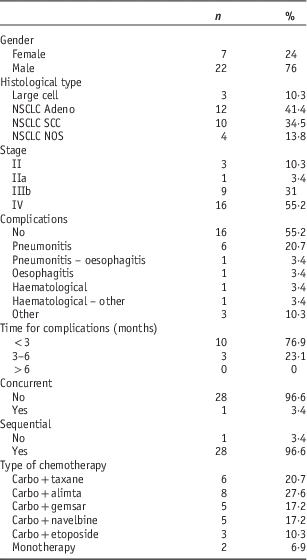
A total of 29 patients (mean age 65·5 years) with inoperable lung cancer were treated between May 2011 and May 2013. Patient and tumour characteristics are shown in Table 1. All patients had a histological non-metastatic lung cancer—stage II–IV, which was inoperable. The histological type was large cell carcinoma in 10·3% of the cases, NSCLC Adeno in 41·4%, NSCLC SCC in 34·5% and NSCLC other in 13·8%. More than half of the patients (55·2%) had stage IV. Induction chemotherapy had almost all patients (96·6%).
Patient and clinical characteristics

Abbreviation: NSCLC, non-small-cell lung cancer; NOS, not otherwise specified; SCC, squamous cell carcinoma.
The median follow-up of patients was 36 months.
Follow up
Patients were reviewed in 3 months following treatment, carrying out contrast enhanced computed tomography (CT) scan of the chest. The staging was done according to the 7th International Association for the Study of Lung Cancer classification.Reference Detterbeck, Boffa and Tanoue 10 Toxicity assessment was done according to Common Terminology Criteria for Adverse Events v4.0 but not limited to routine haematology, renal and hepatic function as well as bone biochemistry tests. Patients were also followed up for radiotherapy-related adverse events as oesophagitis and pneumonitis.
Complete history report was taken, including smoking habit, co-morbidities, weight loss, performance status, taking into account the risk of metastases in those patients. Other investigations were performed on recurrence suspicion (bronchoscopy, endoscopy).
Simulation and treatment planning
In terms of patient immobilisation and simulation, patients were positioned supine with arms immobilised above the head holding a T-bar device. CT scans of 3–5 mm slices were obtained for target definition, delineation and radiation treatment planning. CT images were Digital Imaging and Communications in Medicine imported into the treatment planning system (Oncentra TPS v4.5, Elekta, Stockholm, Sweden). Positron emission tomography-CT scans, where appropriate, were used to aid volume definition.
3D conformal radiation technique with 6 MV photon beam energy was used. Lung, spinal cord, heart and oesophagus were identified as the organs at risk and the percentage volume of total lung excluding planning target volume receiving greater than 20 Gy (V20) was calculated. The policy was to ensure a V20 of less than 35% according to Quantitative Analysis of Normal Tissue Effects in the Clinic criteria.Reference Marks, Yorke and Jackson 11
Radiobiological issues
The potential doubling time (T pot) for NSCLC has been determined to be short, similar to the average value found for head and neck tumours.Reference Fowler 9 Applying this value through the biologically effective dose (BED) equation to lung tumour modelling it can be shown that if overall treatment times for lung cancer could be reduced from 6 or 7 weeks to 2·5–3 weeks, 3-year survival rates could be doubled to 40–50%.Reference Fowler 9 , Reference Mehta, Scrimger and Mackie 12
Analytically, the linear quadratic equation to obtain BED for NSCLC is given by:
 $${\rm BED}{\equals}nd\left( {1{\plus}{d \mathord{\left/ {\vphantom {d {\left( {{\alpha \mathord{\left/ {\vphantom {\alpha \beta }} \right. \kern-\nulldelimiterspace} \beta }} \right)}}} \right. \kern-\nulldelimiterspace} {\left( {{\alpha \mathord{\left/ {\vphantom {\alpha \beta }} \right. \kern-\nulldelimiterspace} \beta }} \right)}}} \right){\minus}K{\rm (}T{\minus}T_{k} {\rm )}$$
where K, in units of Gy/day, is the daily BED equivalent for repopulation: K=ln2/αΤ pot. Assuming α=0·3–0·4 Gy−1 and T pot=3 days, K is found in the range 0·6–0·7 Gy/day. Values of Tk (days of delayed onset repopulation) have been referencedReference Koukourakis, Patlakas and Froudarakis 13 about 21 days (i.e., after 3rd week of radiotherapy).
Applying the above values to the BED formula, with α/β=10 Gy, the conventional regimen of 60–66 Gy in 30–33 fraction (total treatment of 40–45 days) results in BED value of 55·2–62·4 Gy whereas the hypofractionation schedule of 55 Gy in 20 fractions (total treatment of 25 days) results in BED value of 67·3 Gy, that is 11–12% higher.
Statistical analysis
Quantitative variables were expressed as mean values (SD) or as median values (interquartile range). Qualitative variables are expressed as absolute and relative frequencies. Life table analyses were used to calculate cumulative survival rate (standard errors) for specific time intervals. Fisher’s exact tests were used for the comparison of complication rates. Kaplan–Meier survival estimates were graphed over the follow-up period. Log rank tests were used to compare survival curves. All reported p values are two-tailed. Statistical significance was set at p<0·05 and analyses were conducted using SPSS statistical software (version 19.0).
Overall survival was calculated from date of diagnosis until death from any cause and progression-free survival was calculated from date of diagnosis to tumour progression.
RESULTS
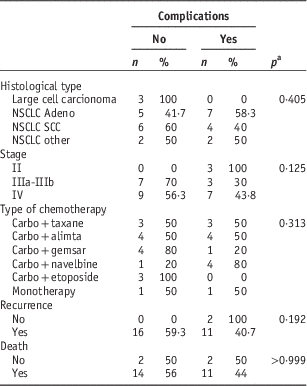
Table 2 shows results for the presence of complications according to clinical characteristics. Complications were present in 44·8% of the patients and the most common complication (20·7%) was pneumonitis alone. In most cases the time for complication appearance was <3 months. In total, 27 patients (93·1%) had recurrence and 25 patients died (86·2%). The complication rate was not significantly different according to histological type, stage, type of chemotherapy, presence of recurrence or death.
Presence of complications according to clinical characteristics

Note: aFisher’s exact test.
Abbreviation: NSCLC, non-small-cell lung cancer; SCC, squamous cell carcinoma.
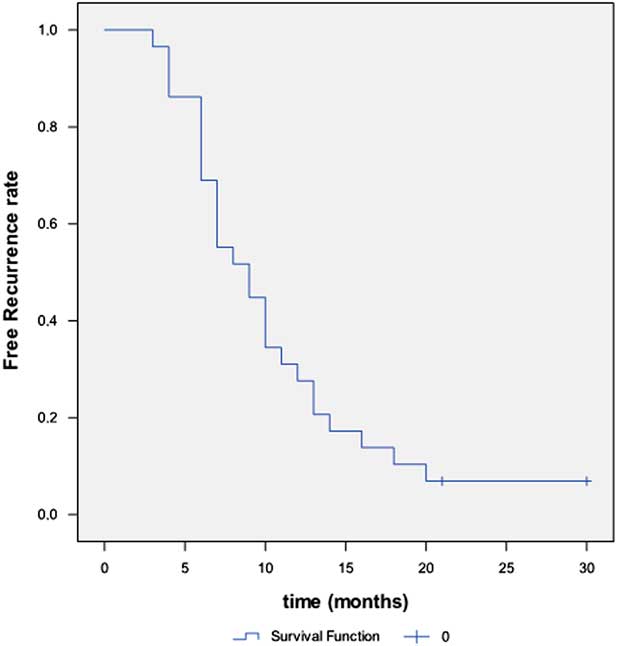
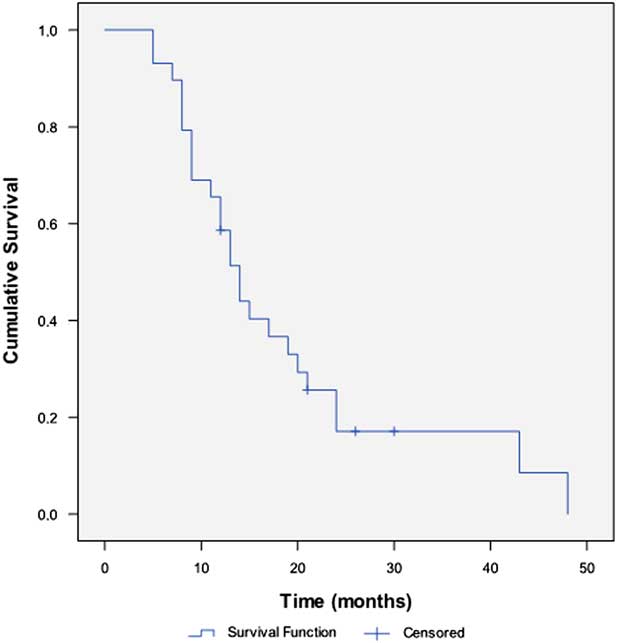
The mean survival time was 16·5 months (SD=10·4) with median equal to 13 months (interquartile range from 9·0 to 21·0 months). The mean free-recurrence time was 10·2 (SD=6·1) months with median equal to 9 months (interquartile range from 6·0 to 13·0 months). The cumulative recurrence-free rates for 6 months, 1 year and 2 years were 86·0% (SE=6·1), 66·0% (SE=9·0) and 6·0% (SE=5·0), respectively. The cumulative survival rates for 6 months, 1 year and 2 years were 93·0% (SE=5·1), 31·0% (SE=9·2) and 25·0% (SE=8·0), respectively. Kaplan–Meier estimates for overall survival and recurrence-free rate are shown in Figures 1 and 2, respectively.
Recurrence-free rate for the study sample.

Survival rate for the study sample.

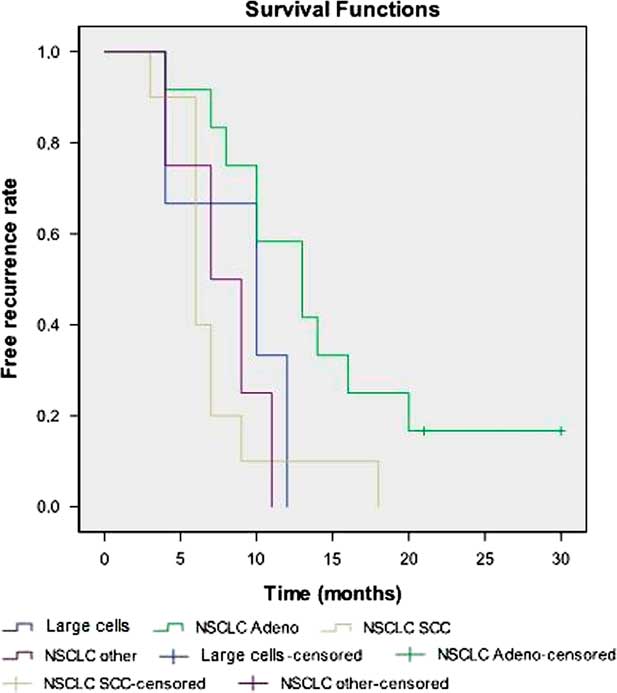
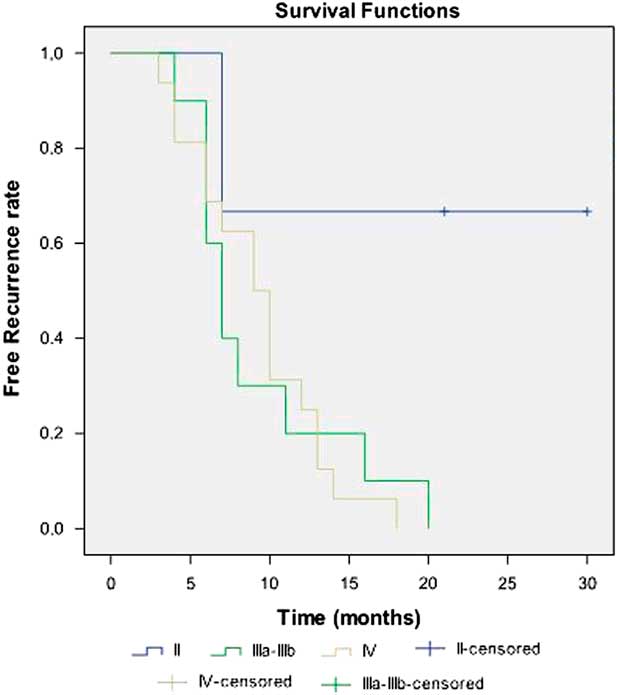
The survival rates were not different according to histological type, stage, type of chemotherapy and presence of complication. A significant difference in the recurrence-free rates (log rank test, p=0·028) was found according to histological type (Figure 3). The risk for recurrence was lower in NSCLC Adeno type as compared with NSCLC squamous cell carcinoma (SCC) and NSCLC not otherwise specified. Also, the recurrence-free rates (log rank test, p=0·049) were different according to stage (Figure 4), and the outcome was better for stage II patients in comparisons with stage III or IV patients.
Kaplan–Meier estimates for recurrence-free rate according to histological type.

Kaplan–Meier estimates for recurrence-free rate according to disease stage.

DISCUSSION
The largest published series for the hypofractionation schedule used in this study refers to four UK centres contributed data.Reference Din, Harden and Hudson 14 For the total of 609 patients with 90% histologically confirmed NSCLC, the 1 year overall survival reported is 81% and the 2 year overall survival reported is 50%. These survival rates are much higher compared to the survival rates reported in this study (1 year overall survival 31%) but patient population is very different especially in terms of stage disease: 49% of patients had stage I and only 0·3% had stage IV in the UK published series whereas in our study 55% of patients had stage IV.
Results from studies evaluating results of concurrent chemoradiotherapy in stage IIIa,b NSCLC refer to a median survival time of 15–23 months.Reference Gandara, Chansky and Albain 15 – Reference Furuse, Fukuola and Kawahara 18 All above studies refer to conventional radiotherapy of 33–35 fractions of 1·8–2 Gy/fraction. Results from these studies compare favourably with results reported in this study in terms of median survival time.
As there are no randomised trials comparing different chemotherapy regimens in the locally advanced NSCLC setting, the optimal chemotherapy regimen for use with concurrent radiotherapy is not yet known. The two most common regimens (cisplatin/etoposide and carboplatin, paclitaxel) are the subject of phase III clinical trials. Cisplatin-based regimens improve outcomes over carboplatin-based regimens. The use of pemetrexed is indicated in patients with non-squamous NSCLC. The use of induction chemotherapy before concurrent chemoradiotherapy was associated with increased toxicity, with no benefit at survival, reduction in distant metastases or decrease in locoregional progression outcomes. However, in certain instances, induction chemotherapy before definitive therapy should be considered if the gross disease cannot be safely encompassed in a radiotherapy portal without leading to unacceptably high risk of radiation-associated side effects. In such cases, a trial of induction chemotherapy can be used and subsequent definitive therapy can be utilised if an adequate response to the induction therapy is obtained. Patients with locally advanced NSCLC undergoing concurrent chemoradiotherapy seem to obtain a median survival time between 21 and 26 months, similar to our study’s findings.
A large randomised phase 3 study by Bradley et al.Reference Bradley, Paulus and Komaki 19 for patients with stage III NSCLC, comparing standard dose (60 Gy in 30 fraction) versus high-dose conformal radiotherapy (70 Gy in 35 fraction) concludes that the second radiation regimen plus concurrent chemotherapy is not better than the first one. Median overall survival was 28·7 months for patients who received standard dose radiotherapy and 20·3 months for those who received high-dose radiotherapy. These findings support the fact that prolonging the treatment time has no advantage in tumour control for lung cancer and on the contrary they support the feasibly of shorter treatment schedules, as suggested in this study, taking into account radiobiological benefits already discussed.
Regarding toxicity, no grade III or greater toxicities were documented and pneumonitis (RTOG grade II) was less than 21% which corresponds to other reports in the literature. 3 , Reference Mehta, Scrimger and Mackie 12 , Reference Faria, Souhami and Portelance 20 The minor reported oesophagitis (3%) was mild and there have been no reported cases of myelitis or spinal cord damage. The complication rate was not significantly different according to histological type, stage, type of chemotherapy, presence of recurrence or death.
CONCLUSION
These data show respectable results for patients treated with accelerated hypofractionated radiotherapy for advanced lung cancer and this hypofractionation schedule could be considered as an alternative to the conventional regimen of 60–66 Gy given in 30–33 fractions taking into account radiobiological benefits by reducing overall treatment time.
Acknowledgements
None.
Financial support
This research received no specific grant from any funding agency, commercial or not-for-profit sectors.
Conflicts of Interest
None.