


1. INTRODUCTION
What if in situation A individuals follow the rule behaviour X, but in situation B they follow the rule behaviour Y? What if not all individuals follow the same behaviour rule when faced with the same situation? Although most theories of the mind in social science conceptualize social behaviours as stable systems, there is abundant evidence that social behaviours tend to vary across different situations. Experimental studies suggest that individuals have types and are likely to adapt their behaviour to their immediate environment (e.g. Fischbacher et al. Reference Fischbacher, Gachter and Fehr2001). Individuals also change behaviour according to the situation of their play (e.g. Zan and Hildebrandt Reference Zan and Hildebrandt2005) and may adopt different behaviour rules according to their situation in life and the society in which they live (e.g. Henrich et al. Reference Henrich, Boyd, Bowles, Camerer, Fehr and Gintis2004). Integrated social environments would decrease conformity to Nash predictions, and instead encourage subjects to be motivated by social norms reflective of moral principles.
Within a game theory framework, moral principles are usually taken into account as other-regarding payoff transformations, a concept first discussed by Edgeworth (Reference Edgeworth1893[1997]). The key to this approach is the assumption that a player’s utility is a twofold function, related to both his welfare as well as the welfare of the other player(s). Individuals are assumed to care about how payoffs are allocated depending on the partner, the game situation, and how the allocation is made. Redefining the utility function in this way preserves the omnipotence of the Nash behaviour rule. However, including other-regarding components in the utility function indicates that moral agents are concerned only with outcomes rather than with actions, which is a peculiar, albeit incomplete, interpretation of moral principles.
In this paper, we posit that moral principles are governed by social norms that are situation specific. That is, every social group supports a number of standard types of social interaction, each of which includes a nexus of social practices that indicate appropriate behaviour for that type of interaction. As do Eckel and Gintis (Reference Eckel and Gintis2010), we grant that individuals may be other-regarding, but moreover that purely self-oriented individuals may also adopt social practices that reflect moral principles. We examine whether complementary behaviour rules and equilibrium concepts may be intertwined with the Nash rule by allowing individuals the capacity to adapt their behaviour to the situation. In some games, such as zero-sum game situations where self-oriented utility maximization is sufficient to drive action, the Nash rule would be adopted. In others, such as games involving collective action, complementary rules that encompass moral principles would drive actions instead. This situational perspective has analogies with the rule-following behaviour approach proposed by Vanberg (Reference Vanberg2008) and is more generally inspired by the situational approach in social psychology, according to which personality is construed not as a generalized or a contextual tendency but as a set of ‘If . . . then’ contingencies that spawn behaviours of the ‘If situation X, then behaviour Y’ type (Mischel and Shoda Reference Mischel and Shoda1995).
We focus on how to play conventional games such as prisoner’s dilemma (PD) or trust games, and examine one possible complementary behaviour rule to the Nash rule, along with its associated equilibrium concept. Our behavioural hypothesis is that, in many interactive situations, players support each other by mutually choosing actions that maximize the welfare of others. We assert that, independently of their preferences and utility functions, individuals play in this way because they expect others to reciprocate, in which case it would be in their own interest to adopt this behaviour rule. Real-life examples are numerous and related to the notion of savoir vivre, a set of behaviours such as respect for others, self-esteem, honesty, politeness and courtesy. To examine mutual support in social interactions, we consider an old concept known as the Berge equilibrium (Berge Reference Berge1957a; Zhukovskii Reference Zhukovskii and Kenderov1985). We find this concept appropriate for two main reasons. First and most importantly, one possible interpretation of Berge equilibrium is that it fosters mutual support (Colman et al. Reference Colman, Körner, Musy and Tazdaït2011). Secondly, as we shall see, Berge equilibrium shares several common theoretical properties with Nash, making it particularly appropriate and easy to handle from a situational game perspective.
The principal achievement of this paper is to provide the first step toward a consistent, formalized behavioural theory that accounts for the fact that individuals follow different behaviour rules in different situations. We define and interpret the Berge behaviour rule and equilibrium as complementary to the Nash rule and equilibrium, and we establish an operational method that describes how an individual’s decision to apply one rule or the other is situation-specific.
The paper is organized as follows. Section 2 introduces the concept of a Berge equilibrium, wherein we discuss its historical development. We then interpret a Berge equilibrium, we discuss the reasons why individuals may choose to mutually support each other and propose a simple method to bridge the Nash and Berge concepts. Section 3 defines the Berge behaviour rule, we discuss agent rationales and establish an operational approach that describes the situations in which the same individual may adopt a Nash versus a Berge behaviour rule. The last section offers several conclusions.
2. BERGE EQUILIBRIUM
Nash equilibrium has become the ‘test’ against which all solutions for any game must be measured, and as stressed by Rasmussen (Reference Rasmussen2007: 27), ‘Nash equilibrium is so widely accepted that the reader can assume that if a model does not specify which equilibrium concept is being used, it is Nash equilibrium’. The reasons behind this success are manifold. In particular, Nash equilibrium constitutes the minimal stability concept that can be defined in a non-cooperative game setting. It is also a relevant and appropriate concept for use in the study of competition situations, and it admits only a few competitors that are not refinements. However, despite its advantages, one may argue that Nash equilibrium does not adequately capture the logic of collective action and therefore may not be appropriate in the study of every game situation. From this perspective, we reintroduce and present Berge equilibrium as a complementary notion to Nash equilibrium.
2.1. The History of a Little-known Concept
After the first conceptualizations of Berge equilibrium were published in the middle of the 20th century, some 50 years elapsed before its existence conditions were to be explicitly articulated. The initial intuition of the concept came from the mathematician Claude Berge (Reference Berge1957a), who defined coalitional equilibria in the ‘General theory of n-player games’.Footnote 1
Berge’s book made only a minor ripple in the academic pool, and it is rarely cited.Footnote 2 However, it provides an impressive assessment of the state of research on game theory in the 1950s. From our contemporary perspective, two features of the book are particularly striking. First, the ‘General theory of n-player games’ remains current; any up-to-date textbook striving to provide a general theory of games includes similar content. In five chapters, Berge’s book covers the major themes that have been the motivation for game-theoretic research in the last 50 years: games with complete information (ch. 1), topological games (ch. 2), games with incomplete information (ch. 3), convex games (ch. 4) and coalitional games (ch. 5). Second, the book is an impressive contribution to the literature in its provision of a compilation of theorems related to n-player games. Though some were new and others were already known, Berge also provided alternative proofs, including, for example, the theorem on uniqueness and the existence of the Shapley value and of the Von-Neumann Morgenstern solution.
In our view, there are four major reasons for the lack of impact made by Berge’s book. First, it was published in French, which has limited its diffusion at the international level. Second, it was not aimed at economists: Berge was first and foremost a mathematician and wrote his book from this perspective. There are no examples or applications of his results, which likely disappointed 1950s social scientists who were not well-acquainted with mathematical techniques. Third, Berge defines strategies and equilibria using graph theory and topology. Again, social scientists may not have been fluent in this mix of mathematical techniques. Fourth, in 1957, Luce and Raiffa published their seminal work (see Luce and Raifa Reference Luce and Raifa1957), which provides a more pedagogical contribution and contains more accessible examples and applications.
Turning to reviews of Berge’s work, we find two articles. The first is by the mathematician John Peck (Reference Peck1960), and the second is by the economist Martin Shubik (Reference Shubik1961). Peck (Reference Peck1960: 348) criticizes Berge’s work for its misleading claims of simplicity: ‘In his preface, the author states that he has taken care to write for a reader who knows no more than the elements of algebra and set theory, and a little topology for chapters 2 and 4. He might have added that a mathematical maturity is also required, for this is not an easy book for a beginner. With a multiplicity of new notions, some defined on almost every page, and some (e.g. cooperative) perhaps not at all, an index of terminology is sorely missed’. Shubik (Reference Shubik1961: 821) echoes this sentiment, stating ‘the argument is presented in a highly abstract manner and no consideration is given to applications to economics’.
Though Berge’s book was translated into Russian in 1961, the first Russian reference to Berge equilibrium is Zhukovskii (Reference Zhukovskii and Kenderov1985), a mathematician who reformulated the Berge coalitional equilibrium from an individualistic perspective and named it the Berge equilibrium. Zhukovskii’s paper does not focus exclusively on Berge equilibrium: it is some 90 pages long and discusses the design of a research programme for differential games. In it, the author highlights ten topics, the tenth being Berge equilibrium. According to Zhukovskii (Reference Zhukovskii and Kenderov1985), this equilibrium notion should be introduced into differential games because it exhibits several convenient features, in particular existence in several games with no pure Nash equilibria. Though this observation was not useful in justifying the use of one equilibrium notion over another, it was enough for Russian mathematicians to begin studying the conditions for existence and the properties of Berge equilibrium in differential games.Footnote 3
It was not until the middle of the years 2000 that existence theorems for pure-strategy Berge equilibrium in normal form games were proposed (Abalo and Kostreva Reference Abalo and Kostreva2004, Reference Abalo and Kostreva2005; Nessah et al. Reference Nessah, Larbani and Tazdaït2007). Extending these works, Larbani and Nessah (Reference Larbani and Nessah2008) studied the existence and the properties of the Berge-Nash equilibrium (which is both a Berge and a Nash equilibrium). Musy et al. (Reference Musy, Pottier and Tazdaït2012) offered a new existence theorem for pure-strategy Berge equilibrium based on ‘best support strategies’ in an analogy to the ‘best response strategies’ associated with Nash equilibrium. Finally, in a paper related to the current one, Colman et al. (Reference Colman, Körner, Musy and Tazdaït2011) explored some properties of the equilibrium and located Berge equilibrium in relation to existing game theory. Interpreting mutual support as a product of altruistic motivations, they presented several examples in detail, including potential applications.
2.2. Definition and Interpretation
Consider a game G = ⟨N, Si, ui⟩ where N = {1, . . ., n} denotes the set of players, Si is player i’s set of pure strategies and  $u_{i}:\prod _{i\in N}S_{i}\rightarrow \mathbb {R}$ is player’s i payoff function. If each Si is a finite set, then G is a finite game. As usual, let s − i be the (n − 1)-dimensional vector such that s − i = (s 1, . . ., s i − 1, s i + 1, . . ., sn). We denote by S − i the set of strategy profiles for players other than i, S − i = ∏j ∈ N\{i}Sj, and for convenience let S = Si × S − i be the set of all strategy profiles when we want to distinguish player i.
We start with the definition of Nash equilibrium and proceed to the definition of Berge equilibrium (Zhukovskii Reference Zhukovskii and Kenderov1985).
Definition 2.1A strategy profile s* = (s*1, . . ., sn*) is a Nash equilibrium of G if and only if, for all players i ∈ N and all si ∈ Si,
 \begin{equation*}
u_{i}(s^{\ast })\ge u_{i}\left( s_{i},s_{-i}^{\ast }\right).
\end{equation*}
As is well known, the Nash equilibrium is immune to unilateral deviations: player i has no incentive to deviate from his Nash strategy given that other players do not deviate either.
Definition 2.2A strategy profile s* = (s*1, . . ., sn*) is a Berge equilibrium of G if and only if, for all players i ∈ N and all s − i ∈ S − i,
 \begin{equation*}
u_{i}(s^{\ast })\ge u_{i}\left( s_{i}^{\ast },s_{-i}\right).
\end{equation*}
This definition means that when playing strategy s*i, player i cannot obtain his maximum payoff unless every other player plays his Berge equilibrium strategy as well. An implication is that at a Berge equilibrium, no player can make any other player better off by deviating from his Berge strategy. In what follows, we argue that there is a rationale to play in this fashion because of the reciprocal dimension it embeds.
Let us illustrate Berge equilibrium by considering a simple example; the two-player PD. Assume two players face a choice between two pure-strategies that we label C and D.
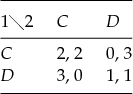
It is easy to verify that (D, D) is the unique pure-strategy Nash equilibrium for the game. This equilibrium is Pareto-inefficient. Let us now examine the Berge equilibrium of this game. Observe that outcome (C, C) fulfils definition (2.2):
 \begin{equation*}
u_{1}(C,C)>u_{1}(C,D)\quad\text{and}\quad u_{2}(C,C)>u_{2}(D,C).
\end{equation*}
This is not true for (D, D):
 \begin{equation*}
u_{1}(D,C)>u_{1}(D,D)\quad\text{and}\quad u_{2}(C,D)>u_{2}(D,D).
\end{equation*}
We deduce that (C, C) is a pure-strategy Berge equilibrium and (D, D) is not. The Pareto-optimal outcome in the PD is obtained when both players follow their Berge strategies. Next, we argue that players may play this way by interpreting Berge equilibrium as a rule of reciprocity.
Consider a player j who can either play his Berge strategy or not, given that the N − 1 other players play their Berge strategy. According to definition (2.2) and letting s*− i − j ∈ S − i − j = ∏h ∈ N\{i, j}Sh, we have:
 \begin{equation*}
u_{i}(s_{i}^{\ast },s_{-i-j}^{\ast },s_{j}^{\ast })\ge u_{i}(s_{i}^{\ast },s_{-i-j}^{\ast },s_{j}),\quad \text{ for each } i\in N,\; s_{j}\in S_{j}.
\end{equation*}
When playing his Berge strategy, player j maximizes the payoff of i. This is true for any i ∈ N. In fact, player j maximizes the utility of all other players. When playing Berge strategies, the other players reciprocate, maximizing the utility of j. As noted by Larbani and Nessah (Reference Larbani and Nessah2008), this definition calls to mind the behaviour rule of the Three Musketeers: ‘one for all, and all for one’. In other words, at a Berge equilibrium a player supports others by choosing an action that maximizes their utilities, and others support him in the same way. This makes Berge equilibrium a mutual support equilibrium (Colman et al. Reference Colman, Körner, Musy and Tazdaït2011), and our assumption is that individuals adopt such behavioural norms because it is beneficial to them. For Brennan and Pettit (Reference Brennan and Pettit2000), behavioural norms are rule-following behaviours driven by the forces of esteem and disesteem, where reciprocation is controlled by each party’s interest in enjoying esteem. According to these authors, ‘spontaneous offerings in the domain of favourable attention, testimony and association are generally going to be correlated positively with reciprocation. People are free to make these offerings in one or another quarter and it should not be surprising if, in general, they choose to make them where the returns are relatively good, not where they are relatively bad’ (Brennan and Pettit Reference Brennan and Pettit2000: 93). In a related way, the Berge behaviour rule is one of these norms, and players do not deviate from it because it prescribes an exchange of mutual support that is beneficial for everyone. This suggests that playing the Berge rule does not make individuals more altruistic or fair; instead, they are simply better economists, since respecting this social practice enables them to reach social efficiency. As is nicely discussed by Pettit (Reference Pettit2005), it is possible for one to follow other-regarding principles from a position of self-goal attainment. This is precisely the underlying idea of the Berge equilibrium: I maximize your utility because you maximize mine. For example, in a trust game, when the respondent is a stranger, there is no point in adding an other-regarding component to his utility function. We believe the respondent honours trust by following a rule of reciprocity that directs the whole of society to be trustworthy and thus efficient.
Let us now present a method that enables the easy computation of the pure-strategy Berge equilibria in any two-by-two game. We consider the game G = ⟨S 1, S 2, u 1, u 2⟩ and define the associated game  $\overline{G}=\left\langle S_{1},S_{2},v_{1},v_{2}\right\rangle$ such that v 1 = u 2 and v 2 = u 1. As shown in Colman et al. (Reference Colman, Körner, Musy and Tazdaït2011), a strategy profile s* ∈ S is a pure-strategy Nash equilibrium of game G if and only if s* is a pure-strategy Berge equilibrium of game
 $\overline{G}.$ In other words, the set of pure-strategy Berge equilibria in the two-player game coincides with the set of pure-strategy Nash equilibria in the corresponding game in which the utility of the two players is permutated. We deduce that in order to compute the pure-strategy Berge equilibria of a game between two players, we simply need to permute the players’ utilities and to compute the pure-strategy Nash equilibria resulting from this new situation.Footnote 4
We end this section with an illustration of this computation method using the simple example of the PD considered above. Permuting utilities, we obtain the following modified game:
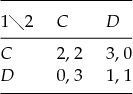
which admits a unique pure-strategy Nash equilibrium given by (C, C). Our computation method shows that this is also the unique pure-strategy Berge equilibrium of the initial game.
It follows that analysing the choices of agents who mutually support each other is technically equivalent to analysing the choices of agents acting egoistically in a modified game where utilities are permutated. In other words, existence results for Berge equilibria in two-person games can be deduced from those for Nash equilibria. Three corollaries apply: (1) if in the modified game, the set of pure-strategy Nash equilibria is empty, there is no pure-strategy Berge equilibrium in the initial game; (2) if there are several pure-strategy Nash equilibria in the modified game, there are also several pure-strategy Berge equilibria in the initial game; (3) if the modified game coincides with the initial game, pure-strategy Nash and Berge equilibria also coincide.
3. NASH VERSUS BERGE BEHAVIOUR RULE
3.1. The situational perspective
In assuming that individual decision-making is governed by distinct behaviour rules, the most important question is which behaviour rule will dominate in a given situation. This question is not new: it has fed the social psychology trait-situation debate for several decades.Footnote 5 Many have criticized the situational approach for its lack of conceptualization and failure to address an operational theory of the mind. For example, Kenny et al. (Reference Kenny, Mohr and Levesque2001: 129) claim that ‘there is no universally accepted scheme for understanding what is meant by situation. It does not even appear that there are major competing schemes, and all too often the situation is undefined’. Reis (Reference Reis2008) presents a taxonomy characterizing various situations. He reviews the several attempts made to formulate a situation-based theory of personality and, drawing on Interdependence Theory, derives a taxonomy comprising six dimensions of outcome interdependence: (1) the extent to which individual outcomes depend on the actions of others; (2) whether individuals have mutual or asymmetric power over one another’s outcomes; (3) whether individual outcomes correspond or conflict with those of others; (4) whether partners need to coordinate their activities to produce satisfactory outcomes or the actions of either partner are sufficient to determine the other’s outcomes; (5) the temporal structure of the situation: whether it involves short or long term interaction; and (6) information certainty: whether partners have the necessary information to make good decisions or they are uncertain about the future.
In contrast to most situational approaches in social psychology, the situational context we examine is relatively simple as we consider only two behaviour rules and focus on simple 2-player game situations. Using the taxonomy described above, one could conjecture that Berge equilibrium is especially relevant when individuals have mutual power over one another’s outcomes, when outcomes do not correspond, when there is a need for partners to coordinate to produce the desired outcome, when the situation is replicated, and when all necessary information is available. Although it would be interesting to test these hypotheses experimentally, we limit our discussion to the development of an operational approach in order to determine which rule is preferred and when.
By choosing a Nash rule, an individual egoistically maximizes his utility while holding the strategy of the other constant. In contrast, we assume that an individual plays according to the Berge rule when the other player does the same, with the knowledge that doing so will achieve the best outcome. In other words, we posit that whatever the behaviour rule chosen, agents are always motivated by individual utility maximization. While they may play according to either a self-oriented or a mutually supportive behaviour rule, in all cases they are motivated by success.
In order to illustrate this point, let us first consider a game situation where the Berge behaviour rule is inappropriate because it is incompatible with self-interest. Consider a two-player zero sum game where u 1 is the utility function of player 1, and u 2 is the loss function of player 2, u 2 = −u 1. We know that (s*1, s 2*) is a Berge equilibrium if:
 \begin{eqnarray*}
u_{2}(s_{1},s_{2}^{\ast }) &\le &u_{2}(s_{1}^{\ast },s_{2}^{\ast }),\text{ for all } s_{1}\in S_{1}, \\
u_{1}(s_{1}^{\ast },s_{2}) &\le &u_{1}(s_{1}^{\ast },s_{2}^{\ast }),\text{ for all } s_{2}\in S_{2}.
\end{eqnarray*}
As u 2 = −u 1, player 1 obtains the maximum payoff if player 2 plays a Berge strategy s*2 that maximizes his loss (i.e.,  ${\arg \max _{s_{2}\in S_2}}[u_{1}(s_{1}^{\ast },s_{2})]={\arg \max _{s_{2}\in S_2} }[-u_{2}(s_{1}^{\ast },s_{2})]$). Similarly, player 2 obtains the lowest loss if player 1 plays a Berge strategy s*1 so as to minimize his utility (i.e.,
 ${\arg \min _{s_{1}\in S_1} }[u_{2}(s_{1},s_{2}^{\ast })]={\arg \min _{s_{1}\in S_1} }[-u_{1}(s_{1},s_{2}^{\ast })]$). Playing the Berge rule in this game situation is sacrificial behaviour and is not compatible with self-interested utility maximization. More generally, competitive situations involve mutually exclusive goal attainment and are not suitable for mutually supportive rule-following behaviour. In these cases, individuals have incentives to adopt Nash-type behaviour. Thus, mutual support and the Berge rule seem most appropriate in situations where agents must coordinate their activities in order to produce satisfactory outcomes. Yet in all cases, as is suggested by experimental evidence, there is no rule of thumb: the environment within which players interact significantly affects the behaviour rule they choose to follow. In particular, the perception of the other’s intent is a critical determinant of the choices made in most bargaining and social dilemma games (Messick and Brewer Reference Messick and Brewer1983). Individuals in close relationships respond differently to conflicts of interest depending on whether they perceive their partners to be open minded and responsive, or self-serving and hostile (Murray et al. Reference Murray, Holmes and Collins2006). Finally, individuals are much more likely to approach a stranger who they expect to like them than someone who they suspect may not like them (Berscheid and Walster Reference Berscheid and Walster1978). Thus a key component in the choice of how to act is related to how players perceive their partners will react.
3.2. Situations and disposition: An operational approach
The disposition approach of Gauthier (Reference Gauthier1986) tells us whether a given game situation should be played using one disposition or another.Footnote 6 He assumes that an individual chooses his disposition before choosing a strategy. Focusing on the PD, Gauthier (Reference Gauthier1986: 167) assumes that each individual can adopt one of two dispositions: (i) ‘straightforward maximization’, a behaviour rule according to which an individual ‘seeks to maximize his utility given the strategies of those with whom he interacts’ ; or (ii) ‘constrained maximization’, a behaviour rule according to which an individual ‘seeks in some situations to maximize his utility, given not the strategies but the utilities of those with whom he interacts’ . Given these possibilities, Gauthier shows that it is in the interest of players to choose constrained maximization in the PD.
Complementing this work, Brennan and Hamlin (Reference Brennan and Hamlin2000) consider the set of dispositions available to an individual. They propose substituting the hypothesis of blind self-interest with the hypothesis of competing motivations, of which self-interest is only one among many. They argue that: ‘the disposition of rational egoism is not necessarily the disposition that will make your life go best for you. Your expected lifetime pay-off may be larger if you were to have a different disposition (the analysis of rational trustworthiness is a relevant example here). If this is true, the disposition of rational egoism (the strict homo economicus disposition) is self-defeating in Parfit’s sense, and it would be in your own interest to choose a different disposition if only that is possible’ (Brennan and Hamlin Reference Brennan and Hamlin2008: 81). This perspective is very similar to the one we develop in this paper, and in what follows we use Gauthier’s approach in order to examine whether a utility maximizer should choose to follow a Berge or a Nash disposition based on the situation in which he plays.
Consider a population of individuals involved in pairwise interactions. Each couple plays a game and players individually choose from among one of two dispositions: the Nash behaviour rule (NR) and the Berge behaviour rule (BR). A player following the NR disposition maximizes his individual utility given the strategy adopted by the other. A player following the BR disposition maximizes the utility of the other player when the other does the same. In other words, the BR disposition is a conditional disposition in that, if the other player adopts an NR disposition, a BR player will maximize his own payoff. As in Gauthier (Reference Gauthier1986), we assume that players choose the disposition that produces the highest expected utility given the expected disposition of the other. In other words, a player chooses to adopt a particular disposition because it is in his interest to do so. It follows that NR and BR dispositions are consistent with rational choice theory.Footnote 7 We add that this framework makes sense if the two behaviour rules lead to different strategies. Indeed, when behaviour rules induce the same strategies, the expected utilities are identical and players are indifferent between rules. Below we offer two examples illustrating this method.
First, we consider a well known social dilemma situation, the trust game:
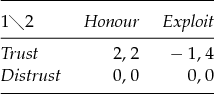
Observe that for player 2, Exploit is a weakly dominant strategy. The Nash equilibrium (Distrust, Exploit) is unique as is the Berge equilibrium (Trust, Honour). The two behaviour rules thus lead to different outcomes and we must determine which behaviour rule produces the highest expected utility in order to ascertain which is preferred.
Players are randomly paired and for the sake of clarity, we consider that they can be either NR or BR players, with α ∈ [0, 1] denoting the share of BR players in the population. As the game is asymmetric, we suppose that all players can Trust/Distrust others or Honour/Exploit others with equal probability. In other words, both NR and BR players play in the position of player 1 and player 2 with an equal probability of 1/2.Footnote 8
We initially assume that each player is able to recognise another’s disposition. If a player adopts a Berge behaviour rule, he becomes a BR player. In position 1, he will meet another BR player with probability α. He will then choose Trust, the other player will choose Honour, and both will obtain payoff 2. Similarly, he will meet an NR player with probability 1 − α, and will choose Distrust while the NR player will choose Exploit, and both will collect payoff 0. In position 2, he will meet another BR player with a probability α. The other player will opt for Trust, and he will choose Honour, each obtaining payoff 2. He will play with an NR player with a probability 1 − α and will choose Exploit while the NR player will choose Distrust, netting payoff 0 each. We deduce that the expected utility of a BR player is  $Eu(BR)=\frac{1}{2}[2\alpha +0(1-\alpha )]+\frac{1}{2}[2\alpha +0(1-\alpha )]=2\alpha$. Similarly, we evaluate the expected utility of an NR player, which is Eu(NR) = 0. For any α > 0, the expected utility of a BR player is strictly higher than the expected utility of an NR player. In other words, to be a BR player improves welfare as soon as there are other BR players in the population with whom trustworthy relations can be established. If α = 0, the expected utilities of the two types of players are the same. It follows that when players are able to recognize others’ dispositions, it is not costly to be a BR player even if all players in the population have an NR disposition. The reason for this is that recognizing the disposition of others prevents a BR player from maximizing another’s utility if he is not a BR player.
Interestingly, if we relax the assumption that individuals can identify the disposition of their partner, the result remains robust under certain conditions. To demonstrate this, assume that BR players can fail to identify the disposition of those with whom they interact. Let β ∈ [0, 1] be the probability that BR players identify each other when they meet and θ ∈ [0, 1] the probability that they fail to identify NR players. As above, we examine the expected utilities of BR and NR players. When playing in position 1, a BR player obtains α(2β + 0(1 − β)) + (1 − α)( − 1θ + 0(1 − θ). When playing in position 2, he obtains α(2β + 0(1 − β)) + (1 − α)(0θ + 0(1 − θ). We deduce that the expected utility of a BR player is  $Eu(BR)=2\alpha \beta -(1-\alpha )\frac{\theta }{2}$. Similarly, we can show that the expected utility of an NR player is Eu(NR) = 2αθ. It follows that an individual chooses to be a BR player if:
 \begin{equation}
\frac{\beta }{\theta }>\frac{1+3\alpha }{4\alpha }
\end{equation}
If condition (3.1) is fulfilled, it is rational for players to choose a BR disposition even though they may unknowingly interact with players adopting an NR disposition in this situation. Two remarks follow. First, when the proportion of BR players increases, β/θ also increases, lowering the risk of mistaking NR players for BR players. Second, when the relative gain from cooperation increases, condition (3.1) becomes less constraining, making BR more attractive. We deduce that individuals will be more likely to adopt BR when situations are such that the magnitude of the social dilemma is important and when their social environment is not too egoistic. To illustrate this observation, let α = 1/2. Individuals choose to follow BR only if β/θ is at least equal to 5/4. That is, when the probability of achieving mutual recognition is at least 1.25 times higher than the probability of failing to recognize an NR player.
Other game situations could lead to the opposite result, causing the same players to prefer the NR behaviour rule. This applies to competitive situations such as zero-sum games as well as games where interests do not conflict. Consider, for example, the following game in which two players choose between strategies A and B:
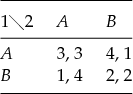
There is a unique Nash equilibrium at (A, A) and a unique Berge equilibrium at (B, B). Allowing individuals to choose their disposition before the game starts, we deduce that the best option for players is to play in a Nash fashion. To demonstrate this conclusion, we first assume that individuals are able to identify the disposition of their partners. We have: Eu(NR) = 3 and Eu(BR) = 3 − α, so that for any α > 0, it pays to choose an NR disposition. Now let us assume that BR players can fail to identify the disposition of their partner. We have Eu(NR) = αθ + 3 and Eu(BR) = α(2θ − β) + 3 − 2θ, and we deduce that Eu(NR) > Eu(BR) leads to the inequality  $\frac{\beta }{\theta }>\frac{\alpha -2}{\alpha }$. This is always true, meaning that individuals always choose the NR disposition.
4. CONCLUSION
There are three avenues of further research in this area that we find particularly appealing. The first would be an experimental paper to justify the assumptions made here. Along the lines of Henrich et al. (Reference Henrich, Boyd, Bowles, Camerer, Fehr and Gintis2004), we are interested in better understanding when individuals tend towards one behaviour rule or another. In this pursuit, it may be helpful to follow the situational taxonomy of Reis (Reference Reis2008), in particular. The second enquiry is theoretical and relates to one of our companion papers on the properties of n-player Berge equilibria. Berge equilibria are Pareto-optimal for PD and trust games. However, there are also many game situations in which Berge equilibria are Pareto inefficient. An interesting research area would define the classes of games for which Berge equilibria are Pareto-optimal and always Pareto-dominated. Finally if the Berge rule is appropriate to understand human behaviours in several situations, while the Nash rule may be more appropriate in others, we suspect that additional rules may complement these two. Careful scrutiny of other behaviour rules and their theoretical properties present the next step for defining a situational theory of decision making.
ACKNOWLEDGEMENTS
We would like to thank Denis Bouyssou, Geoffrey Brennan, Marie-Laure Cabon-Dhersin, Bertrand Crettez, Nathalie Etchart-Vincent, Kate Farrow, Charles Figuières, Olivier Musy, David Newlands, Jean-Christophe Péreau, Antonin Pottier, Lionel Richefort, Sébastien Rouillon, Emmanuelle Tangourdeau, Thomas Vallée and Murat Yildizoglu for their helpful comments on previous versions of this paper. The participants of the Workshop ‘Altruisme et Altruité dans les Sciences Sociales’ (HEC, Jouy en Josas, 2012), the 11th Journées Louis-André Gérard-Varet, Conference in Public Economics (Aix Marseille School of Economics, 2012), and the 14th Annual Conference of the Association for Public Economic Theory (Lisbon, 2013), together with the editors Christian List, Martin van Hees and John A. Weymark, as well as four anonymous referees are gratefully acknowledged.


