Institutionally reared children are deprived of a stable, responsive caregiver due to high child-to-caregiver ratios and frequent turnover in caregivers (Smyke et al., Reference Smyke, Koga, Johnson, Fox, Marshall and Nelson2007; Vorria et al., Reference Vorria, Papaligoura, Dunn, van, Steele and Kontopoulou2003). Because infants in institutional care spend much less time interacting with caregivers than home-reared infants do (Lee, Reference Lee2000), they have greatly reduced opportunity for the reciprocal, mutually rewarding face-to-face interactions that are essential for normal neural and behavioral development (National Scientific Council on the Developing Child, 2012). In addition to this profound relational deprivation, institutionalized children may also be exposed to malnutrition and insufficient cognitive and social stimulation (Gunnar, Bruce, & Grotevant, Reference Gunnar, Bruce and Grotevant2000). Currently institutionalized children have high rates of emotional and behavioral problems, including psychiatric diagnoses (Zeanah et al., Reference Zeanah, Egger, Smyke, Nelson, Fox and Marshall2009).
For children who are adopted internationally from institutional settings, early deprivation is followed by an abrupt, dramatic shift to an adoptive family setting. Adoption represents a profound multilevel intervention, in which children are placed into family environments that provide rich cognitive and social stimulation and one-on-one attention from a stable caregiver, in addition to meeting nutritional and medical needs. Despite remarkable recovery in many developmental domains (Judge, Reference Judge2004; van IJzendoorn & Juffer, Reference van IJzendoorn and Juffer2006), postinstitutionalized (PI) children continue to be at higher risk of internalizing and externalizing problems throughout their childhoods compared to nonadopted (NA) children reared with their biological families (Gunnar & van Dulmen, Reference Gunnar and van Dulmen2007; Hawk & McCall, Reference Hawk and McCall2010; Hoksbergen, Rijk, Van Dijkum, & Ter Laak, Reference Hoksbergen, Rijk, Van Dijkum and Ter Laak2004; Judge, Reference Judge2004; Juffer & van IJzendoorn, Reference Juffer and van IJzendoorn2005; Wiik et al., Reference Wiik, Loman, Van Ryzin, Armstrong, Essex and Pollak2011). The increase in behavioral problems may reflect, in part, a broader spectrum of risk factors associated with international adoption. In one study of middle childhood, not only PI children but also children who had been internationally adopted from foster care (FC) had higher levels of externalizing and internalizing problems by parent report compared to NA children (Wiik et al., Reference Wiik, Loman, Van Ryzin, Armstrong, Essex and Pollak2011), though a recent review suggests that more externalizing and internalizing problems are reported for PI children than for FC children (Hawk & McCall, Reference Hawk and McCall2010). Children internationally adopted from FC share with PI children the experience of international adoption, including separation from their caregivers in their home country and the transition to their new parents, as well as a new country and language. Thus, all internationally adopted children experience a disruption in caregiving. Further, children who are internationally adopted, whether from institutions or from FC, may have prenatal and genetic risks that contribute to the likelihood of behavior problems independent of early care experiences (Johnson, Reference Johnson and Nelson2000). It is important to study children from both types of preadoption care so that we do not attribute outcomes specifically to a history of institutional care that may be common to both foster and institutional care.
While it is likely that the persistent higher levels of internalizing and externalizing problems in internationally adopted children are multiply determined, lower emotion understanding may well be a contributing factor. Emotion understanding is an umbrella term that includes foundational abilities such as labeling discrete emotions and affective perspective taking, as well as more advanced abilities such as recognizing masked emotions (Izard et al., Reference Izard, Fine, Schultz, Mostow, Ackerman and Youngstrom2001). For typically developing children, the abilities to read emotional cues and label emotions facilitate the development of social competence, whereas deficits in emotion understanding contribute to behavior problems (Denham et al., Reference Denham, Blair, DeMulder, Levitas, Sawyer and Auerbach-Major2003; Izard et al., Reference Izard, Fine, Schultz, Mostow, Ackerman and Youngstrom2001). Children who misread or overlook emotional cues in peer interactions may become increasingly socially isolated, leading to an increase in negative emotions and ultimately to risk for internalizing problems (Trentacosta & Fine, Reference Trentacosta and Fine2010). Further, when children misperceive anger or aggressive intent in others, they may be more likely to engage in externalizing behaviors (Schultz, Izard, & Ackerman, Reference Schultz, Izard and Ackerman2000).
Among typically developing children, emotion understanding is linked to higher social competence and lower levels of internalizing and externalizing problems. In the preschool years, children with more advanced emotion understanding are viewed as more likable by their peers (Denham, McKinley, Couchoud, & Holt, Reference Denham, McKinley, Couchoud and Holt1990) and have better emotion regulation (Miller et al., Reference Miller, Fine, Gouley, Seifer, Dickstein and Shields2006). In elementary school age children, deficits in emotion labeling are linked to teacher-reported social withdrawal (Schultz, Izard, Ackerman, & Youngstrom, Reference Izard, Fine, Schultz, Mostow, Ackerman and Youngstrom2001) and predict parent-reported negative social behaviors 4 years later (Izard et al., Reference Izard, Fine, Schultz, Mostow, Ackerman and Youngstrom2001). A meta-analytic review of studies conducted with community and clinical samples concluded that in childhood and adolescence, emotion understanding is associated with higher social competence and lower levels of internalizing problems, with modest but consistent effect sizes (Trentacosta & Fine, Reference Trentacosta and Fine2010). The same meta-analysis found that the association of lower levels of emotion understanding with externalizing problems varies by age and population, with larger effect sizes observed in clinical and adolescent samples (Trentacosta & Fine, Reference Trentacosta and Fine2010). It has not been established whether the association between behavior problems and lower levels of emotion understanding observed in typically developing and clinical samples extends to currently institutionalized children or to internationally adopted PI or FC children.
However, there is an emerging literature examining emotion understanding in both currently institutionalized children and PI children. Studies of currently institutionalized children through the Bucharest Early Intervention Project indicate that while the ability to discriminate basic facial emotional expressions is not impaired by institutional rearing, there may be deficits in higher level emotional processing. In a longitudinal event-related potential study at an orphanage in Bucharest, while at 30 and 42 months there were differences between currently institutionalized and NA children in their early perceptual processing of emotion faces, specifically smaller amplitude and longer latency for P1, N170, and P400 occipital components, there were no group differences in neural discrimination of fearful versus happy faces (Moulson, Fox, Zeanah, & Nelson, Reference Moulson, Fox, Zeanah and Nelson2009). Thus, in total, these results suggest conservation of basic emotional face processing abilities. Further, at 42 months, as compared to NA children and previously institutionalized children who had been placed in FC, the currently institutionalized children were equally capable of behaviorally discriminating among facial emotional expressions as indexed by preferential looking times (Jeon, Moulson, Fox, Zeanah, & Nelson, Reference Jeon, Moulson, Fox, Zeanah and Nelson2010). Thus, by preschool, both neural and receptive behavioral measures indicate that the ability to discriminate between basic emotions is spared in institutionally reared children. However, at age 8 years, the currently institutionalized children had difficulty inhibiting response to fear faces on a button-press task and showed an attenuated neural response to angry faces compared to the NA children, indicating that emotional processing on a more complex task was altered by institutional rearing at both the behavioral and the neural levels (Nelson, Westerlund, McDermott, Zeanah, & Fox, Reference Nelson, Westerlund, McDermott, Zeanah and Fox2013). In a different sample, Sloutsky (Reference Sloutsky1997) found that 6- and 7-year-old currently institutionalized Russian orphans had poorer affective perspective taking compared to community NA children. Taken together, these studies suggest that children who remain in an institutional rearing environment show detrimental effects on higher level emotional face processing and emotion understanding. However, because adoption represents a profound intervention, it is a separate question whether children internationally adopted from institutional care would show enduring difficulties with emotion understanding following their adoption.
Overall, the few studies that have examined emotion understanding in PI children suggest that they are at risk for lower levels of emotion understanding. Four- and 5-year-old PI children internationally adopted from Russia and Romania showed poorer performance than did NA children in labeling facial expressions and in affective perspective taking tasks, which require selecting the facial expression corresponding to how a character would feel in a given scenario (Fries & Pollak, Reference Fries and Pollak2004). A study of preschool PI children adopted from China and Eastern Europe found that both groups performed worse than NA children on receptive emotion labeling, that is, identifying the face matching a stated emotion, and on affective perspective taking tasks (Camras, Perlman, Fries, & Pollak, Reference Camras, Perlman, Fries and Pollak2006). Conversely, we have reported that 6- and 7-year-old PI and FC children who had been adopted by age 3 did not differ from NA children in emotion labeling and affective perspective taking tasks (Tarullo, Bruce, & Gunnar, Reference Tarullo, Bruce and Gunnar2007). However, the children were mostly at ceiling on these tasks. It may be that, despite eventually mastering basic emotion labeling and affective perspective taking, older PI children would have difficulty with more complex emotion understanding tasks, though this has not previously been studied to our knowledge. If PI children's emotion understanding skills lag behind their peers' skills at any given age, there may be adverse consequences for social interactions and socioemotional functioning.
While PI children as a group tend to have lower levels of emotion understanding, there are marked individual differences in their performance on these tasks. Despite this group-level difference, many PI children are performing at the same level as children who have not experienced early adversity, which raises the question of what factors account for the heterogeneity in PI children's emotion understanding abilities. Duration of institutionalization has been related to poorer performance on emotion labeling and affective perspective taking tasks (Fries & Pollak, Reference Fries and Pollak2004), but much of the variation in emotion understanding is not accounted for by variation in preadoption experiences. This may be due in part to limitations in our measures of preadoption experiences. Genetic differences in innate potential or in biological sensitivity to context could also play a role. However, one largely neglected factor is the influence of the postadoption environment on developmental outcomes. The current study examines one aspect of the postadoption environment: parents' use of mental state language.
In typically developing populations, parental talk about mental states, including desires, emotions, thoughts, and beliefs, is positively associated with children's emotion understanding (Doan & Wang, Reference Doan and Wang2010; Martin & Green, Reference Martin and Green2005; Mcquaid, Bigelow, McLaughlin, & MacLean, Reference Mcquaid, Bigelow, McLaughlin and MacLean2008; Racine, Carpendale, & Turnbull, Reference Racine, Carpendale and Turnbull2007; Taumoepeau & Ruffman, Reference Taumoepeau and Ruffman2006). For example, in a sample of 3- to 5-year-old children, parental talk about emotions was associated with the child's concurrent emotion understanding (Racine et al., Reference Racine, Carpendale and Turnbull2007). Maternal mental state language during a storybook task was linked to 3-year-old children's performance on an emotion situation task (Doan & Wang, Reference Doan and Wang2010). Martin and Green (Reference Martin and Green2005) reported that maternal emotion talk was associated with emotion understanding in 3-year-old boys, but not girls, though this gender difference has not been reported in other studies. Maternal mental state language has also been consistently associated, both concurrently and longitudinally, with another key aspect of social cognition: children's development of theory of mind (Ensor, Devine, Marks, & Hughes, Reference Ensor, Devine, Marks and Hughes2014; Meins et al., Reference Meins, Fernyhough, Wainwright, Das Gupta, Fradley and Tuckey2002; Racine et al., Reference Racine, Carpendale and Turnbull2007; Ruffman, Slade, Devitt, & Crowe, Reference Ruffman, Slade, Devitt and Crowe2006). Parental mental state language use also predicts the child's own mental state language use (Ruffman, Taumoepeau, & Perkins, Reference Ruffman, Taumoepeau and Perkins2012).
Frequent parental use of mental state language may draw children's attention to mental states as well as giving them the vocabulary to think about and talk about these concepts, thereby facilitating both emotion labeling and the development of emotional perspective taking abilities. Ruffman et al. (Reference Ruffman, Taumoepeau and Perkins2012) posit that this process may in part reflect statistical learning. The repeated association of the mother's mental state labels with the child's own internal experiences enables the child to label these experiences and develop concepts of mental states. Maternal desire talk with 15-month-olds, particularly references to the child's own desires, uniquely predicted both children's desire talk and children's emotion understanding at 24 months (Taumoepeau & Ruffman, Reference Taumoepeau and Ruffman2006), while in the same sample, maternal talk about thoughts and knowledge at 24 months predicted emotion understanding at 33 months (Taumoepeau & Ruffman, Reference Taumoepeau and Ruffman2008). It has been suggested that desire talk, and talk about the child's own current internal states, are most commonly used by mothers of very young children, and that talk about thinking, knowing, and other people's mental states becomes increasingly prominent as children get older (Ruffman et al., Reference Ruffman, Taumoepeau and Perkins2012). This pattern of maternal mental state language use reflects developmentally appropriate scaffolding: mothers begin by focusing on the mental state most salient to toddlers, that is, their own current desires, and build to more complex mental states and perspective taking as the child develops cognitively and linguistically.
The current study will examine whether the association observed in typically developing populations between parental use of mental state language and preschool children's emotion understanding extends to internationally adopted preschool children and their adoptive parents. If this is the case, then supporting parents in increasing mental state talk might be a viable intervention to help children develop better emotion understanding skills. Assessing emotion understanding abilities in PI children entails a potential confound with language ability, because standard emotion understanding measures have linguistic task demands, including comprehending the vocabulary in affective perspective taking vignettes. Given these task demands, it is not surprising that in typically developing children, language ability (Bosacki & Moore, Reference Bosacki and Moore2004; Pons, Lawson, Harris, & de Rosnay, Reference Pons, Lawson, Harris and de Rosnay2003) is associated with better performance on emotion understanding tasks. Further, children with language impairments (Spackman, Fujiki, & Brinton, Reference Spackman, Fujiki and Brinton2006) exhibit impaired performance on emotion understanding tasks. In PI children, the presence of language delays (Croft et al., Reference Croft, Beckett, Rutter, Castle, Colvert and Groothues2007; Desmarais, Roeber, Smith, & Pollak, Reference Desmarais, Roeber, Smith and Pollak2012; Judge, Reference Judge2004; Loman, Wiik, Frenn, Pollak, & Gunnar, Reference Loman, Wiik, Frenn, Pollak and Gunnar2009) is well established. Thus, in the current study, we measured language in order to examine the role of these cognitive abilities in performance on emotion understanding measures.
We assessed parental use of mental state language as a predictor of emotion understanding in PI, FC, and NA children. Our first aim was to determine if there were group differences in emotion understanding. Second, we examined whether parent mental state talk would mitigate the effects of group status on emotion understanding performance. Third, we wanted to assess whether lower levels of emotion understanding would relate to behavior problems. Three-year-old PI, FC, and NA children participated in a picture book task with their parents to assess parent mental state language, and the children were assessed for basic emotion understanding abilities, as well as language. At a follow-up visit at 5.5 years, emotion understanding and language were measured again, as well as parent report of child internalizing and externalizing problems. We expected that parental use of mental state language at age 3 would be positively related to emotion understanding at both ages. We further expected that poorer emotion understanding performance would be related to higher levels of internalizing and externalizing problems.
Method
Participants
At age 3 years (range = 36.0–38.0 months), 91 children participated in a laboratory visit. Each child met criteria for one of three groups: the PI group (n = 27; 24 female) had spent at least 75% of their lives prior to adoption in institutions and no more than 2 months in family based care, and at the time of adoption were at least 10 months old and less than 18 months old; the FC group (n = 26; 10 female) had spent at least 75% of their lives prior to adoption in a family-based setting (e.g., FC or relative care) and no more than 2 months in institutional care, and at the time of adoption were less than 18 months old; and the NA group (n = 37; 30 female) were born and raised in their biological families in the Midwestern United States. All of the adopted children were born outside of the United States and were adopted by families living in the Midwestern United States. Four children (2 PI, 1 FC, and 1 NA) were later diagnosed with a medical problem related to prenatal development (e.g., fetal alcohol spectrum disorder) or a genetic abnormality. These 4 children were excluded from all analyses, so the sample size at age 3 was 87 children. At age 5.5 years, 72 of the children from the 3-year-old visit returned (PI n = 22, FC n = 19, and NA n = 31). Three addition children (1 PI, 1 FC, and 1 NA) also participated at 5.5 years who had been recruited in an earlier wave of data collection and had not participated at age 3. These 3 children are included in the analyses that are cross-sectional at age 5.5 years, for a total sample size of 75 (PI n = 23, FC n = 20, and NA n = 32). The retention rate from 3 to 5.5 years was 79.12%, and attrition was not related to group status, age at adoption, or any of the 3-year-old variables of interest (emotion understanding, language ability, and parent and child use of mental state language).
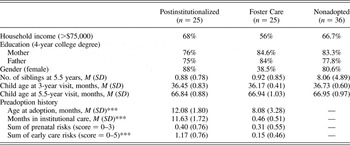
The family demographics were similar across all three groups with regard to parent education, family income, and number of siblings (see Table 1). The adopted groups differed in country of origin because at the time these children were born, their countries of origin generally had either a FC system or an institutional system in place to care for wards of the state. Type of care was largely determined by which system the child's country of origin had in place, rather than any factors specific to the child. The PI children were born in China (68%), Russia (20%), Ukraine (8%), and Guatemala (4%). The FC children were born in Korea (66.7%), China (20.8), and Guatemala (12.5%). The PI and FC groups also differed significantly from each other in age at adoption (see Table 1); t (47) = 5.31, p < .001, d = 1.55, because countries using FC tend to have procedures in place that permit international adoption when children are younger (Gunnar et al., Reference Gunnar, Bruce and Grotevant2000). The NA children were predominantly female to approximate the gender ratio in the PI group. However, the FC group did not have this gender ratio because every available and willing participant who met criteria for this group was included in the study.
Demographic information by group
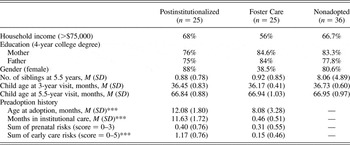
***p < .001. Mean difference between groups.
Preadoption and prenatal risks were assessed based on parent report using the methods of Bruce, Tarullo, and Gunnar (Reference Bruce, Tarullo and Gunnar2009). PI children had a larger number of preadoption risk factors than FC children, t (48) = 5.73, p < .001, d = 1.65, including any indication of physical abuse, physical neglect, or social neglect, three or more living arrangements prior to adoption, and belonging to a minority group discriminated against in the child's country of origin. There were no differences between PI and FC children in the number of prenatal risk factors, including prenatal exposure to alcohol or drugs, prenatal malnourishment, and premature birth. Age at adoption, gender, and number of preadoption risk factors were unrelated to any of the outcomes examined. Therefore, they are not confounding factors in the current study and were not considered in the main analyses.
Procedures
The children in the current study were selected based on having participated in an earlier assessment at age 18–20 months (Garvin, Tarullo, Van Ryzin, & Gunnar, Reference Garvin, Tarullo, Van Ryzin and Gunnar2012; Tarullo, Garvin, & Gunnar, Reference Tarullo, Garvin and Gunnar2011). The children in the internationally adopted groups had been recruited at age 18 months from a registry that at that time included over 3,000 internationally adopted children. Children were included on the registry after their parents returned a postcard expressing a willingness to participate in research. Parents who adopted from two large adoption agencies handling international adoption were sent a letter soliciting participation in this registry. The NA children had been recruited at age 18 months from a department-maintained participant list of children whose parents indicated an interest in research. Parents of all children born in the metropolitan area were solicited for this department-maintained list through a mailing received soon after the child's birth. When children were 3 years (36–38 months) of age, their parents were contacted and invited to bring the children back for a 1.5-hr laboratory session. When children were 5.5 years old, their parents were again contacted and invited to bring the children back for a follow-up visit, which lasted approximately 2.5 hr. Both studies were approved by the university institutional review board, and parents gave informed consent prior to each study. Parents were present or watching via closed-circuit television for the entire session and were advised that they were free to end the session at any time and to decline any aspect of the protocol.
Measures
Mental state language
At the 3-year-old visit, parent–child dyads were given a book of 10 photographs, and parents were instructed to look at the book with their children and talk about the photographs. The photo stimuli were selected from the International Affective Picture System (Lang, Bradley, & Cuthbert, Reference Lang, Bradley and Cuthbert2008). Half the photos depicted scenes of children or adults who appeared emotional, such as a boy yelling or children laughing and playing with an adult. The other photos also showed scenes of children or adults, but with emotionally neutral expressions, such as a girl reading. Five minutes of parent–child conversation were transcribed from videotape, and transcripts were coded for parent and child use of mental state language using the methods of Ruffman, Slade, and Crowe (Reference Ruffman, Slade and Crowe2002). Coders counted the frequency of words that refer to mental state (e.g., think, feel, know, remember, happy, and angry), yielding a measure of the total frequency of mental state utterances for the parent and for the child. The frequency of non-mental state utterances, such as physical state words (crying and laughing), perception (see and hear), and causal language (because and why), was also measured. This allowed for differentiation of the use of mental state language specifically from the quantity and richness of total linguistic output. Children's names were excluded from the transcripts; thus, the coders were blind to gender. Because coders never saw the videotapes, they were also blind to the group status of the child. The coders were two graduate students in psychology. They overlapped on 20% of transcripts and had a Cohen κ of 0.79 for mental state utterances and 0.77 for nonmental state utterances.
Emotion understanding
At the 3-year-old visit, emotion understanding was assessed using Denham's (Reference Denham1986) emotion labeling and affective perspective taking tasks, which have been validated for use with 2- and 3-year-old children. Children completed the emotion labeling task to assess receptive and expressive identification of basic emotions (happy, sad, angry, and fearful) depicted on cloth faces (possible range = 0–8). They then participated in an affective perspective taking task consisting of 20 vignettes an experimenter enacted using words and puppets. Following each vignette, children were asked to point to the cloth face that showed how the puppet character was feeling. For each vignette, the children were scored as to whether they correctly identified the emotion depicted by the puppet character (possible range = 0–20). The measures of emotion labeling and affective perspective taking were highly correlated (r = .52, p < .001), so they were converted to standard scores and combined to yield a composite emotion understanding score (Cronbach α = 0.75). This variable was previously published in Garvin et al. (Reference Garvin, Tarullo, Van Ryzin and Gunnar2012).
At 5.5 years, children completed a real versus apparent emotion task (Harris, Donnelly, Guz, & Pitt-Watson, Reference Harris, Donnelly, Guz and Pitt-Watson1986). Each child heard two stories, one depicting a situation in which it would be appropriate to really feel a positive emotion but hide it, and one situation in which it would be appropriate to really feel a negative emotion but hide it. Boys heard stories concerning a protagonist named David, and for girls, the protagonist was named Diana. Children were first familiarized with three drawings of David/Diana depicting happy, sad, and neutral facial expressions. The meaning of each expression was explained, and children were asked to point to one of three faces to indicate how David/Diana might feel if something positive, neutral, or negative happened. Experimenters then read children each vignette while also showing illustrations depicting each scenario to aide in understanding. After each story, children first had to pass two control questions to ensure that they understood the scenarios. When a child failed a control question, the vignette was read again, up to three additional times, until the child passed. Children were then shown the drawings of facial expressions and asked to point to the one that showed how the protagonist really felt on the inside and how the protagonist looked on his or her face and to justify their claims. Children then received points if they indicated the protagonist looked less happy or sad than they felt on the inside. They also received points if their justifications explained how the protagonist would look and feel, with appropriate references to events in the story. Two coders scored the justifications with 97% agreement. Disagreements were consensus scored. Children received a total score for this measure based on the number of correct responses (range = 0–6).
Behavioral functioning
At 5.5 years, behavioral functioning was assessed with the MacArthur Health and Behavior Questionnaire, Parent Version (HBQ-P). The HBQ-P is validated for use with 4- to 8-year-old children and has strong test–retest reliability and cross-informant agreement (Essex et al., Reference Essex, Boyce, Goldstein, Armstrong, Kraemer and Kupfer2002). Current analyses focused on the internalizing symptoms and externalizing/attention-deficit/hyperactivity disorder (ADHD) symptoms composite scores. The internalizing scale consists of 29 items and includes the subscales for depression, overanxious, and separation anxiety. The externalizing/ADHD symptoms composite consists of 46 items and includes the subscales related to externalizing (oppositional defiant, conduct problems, overt hostility, and relational aggression) and ADHD symptoms (inattention and impulsivity). Parents scored each item on a 3-point scale (0 = never or not true, 2 = often or very true). The internalizing symptoms and externalizing/ADHD symptoms scales were computed as the mean of item scores within that scale (Cronbach α = 0.70 for internalizing and 0.78 for externalizing/ADHD). Clinical cutoffs based on prior research with a slightly older sample were a score of 0.68 for externalizing and 0.71 for internalizing (Lemery-Chalfant et al., Reference Lemery-Chalfant, Schreiber, Schmidt, Van Hulle, Essex and Goldsmith2007).
Language
At the 3-year-old visit, expressive language was assessed with the MacArthur Communicative Development Inventory III parent report, a measure of expressive vocabulary, grammar, and language usage validated for use with 30- to 37-month-old children (Feldman et al., Reference Feldman, Dale, Campbell, Colborn, Kurs-Lasky and Rockette2005). The three subscores were highly correlated (rs = .65–.83, p < .001) and therefore were standardized and averaged into a composite 3-year language score. At 5.5 years, language ability was measured using the Clinical Evaluation of Language Fundamentals: Preschool—Second Edition, which is a widely used measure in clinical and research contexts, validated for use with ages 3 years, 0 months to 6 years, 11 months (Wiig, Secord, & Semel, Reference Wiig, Secord and Semel2004). The Clinical Evaluation of Language Fundamentals yields age-normed scaled scores (with M = 10) for sentence structure, word structure, and expressive vocabulary, as well as a standard score for core language (M = 100). The standard core language score was used in the current analyses.
Analysis plan
Approach to covariates
We evaluated a number of potential confounding factors: concurrent child language ability, gender, age at adoption, prenatal and early care risk, household income, maternal and paternal education, sibling number, and age at each assessment. To qualify as a confounding factor, the variable needed to be related to both the independent and dependent variables in a given analysis. Gender, age at adoption, prenatal and early care risk, household income, maternal and paternal education, sibling number, and age at each assessment were unrelated to any of the outcomes examined. Therefore, they are not confounding factors in the current study and were not considered in the main analyses.
Child language ability was a confounding factor in some analyses; in those specific analyses, we statistically controlled for child language ability by including it as a covariate.
Main analyses
Group differences between the PI, FC, and NA children in 3- and 5.5-year emotion understanding were examined using one-way analyses of variance (ANOVAs), with Fisher least significant difference (LSD) post hoc tests to follow up significant group differences. To determine whether mental state language uniquely predicted emotion understanding, separate stepwise regression models were tested in which 3- and 5.5-year emotion understanding were each regressed on group status and parent and child mental state language. In predicting 5.5-year emotion understanding, 3-year emotion understanding was also included in the model. To test whether the association between parent mental state language and 5.5-year emotion understanding was moderated by early care history, ordinary least squares regression analysis was conducted using the PROCESS macro in SPSS (Hayes, Reference Hayes2013). Parent mental state language was the independent variable, the dependent variable was 5.5-year emotion understanding, and 3-year child language was included as a covariate. PI status and internationally adopted status were entered as dichotomous moderator variables. Bias corrected bootstrapped confidence intervals at the 95% level based on 5,000 samples were employed to test for interaction effects, and significant interactions were followed up using simple linear regressions. Finally, group differences in internalizing and externalizing/ADHD symptoms were assessed using one-way ANOVAs, and associations of internalizing and externalizing/ADHD symptoms with 5.5-year emotion understanding were tested using Pearson correlations.
Results
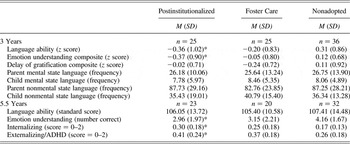
Descriptive statistics for behavioral measures in each group are presented in Table 2, and correlations between the behavioral measures are provided in Table 3. Parent use of mental state language was positively skewed and violated the assumptions of normality. Therefore, a square root transformation was used.
Descriptive statistics for behavioral measures by group
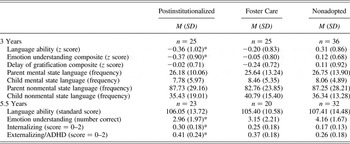
Note: For language, delay of gratification, and emotion understanding scores, higher numbers indicate better performance. For mental state and nonmental state language, scores indicate the number of utterances in a 5-min period. For internalizing and externalizing/ADHD, higher numbers indicate more symptoms reported. ADHD, Attention-deficit/hyperactivity disorder.
*p < .05. Mean difference from nonadopted group.
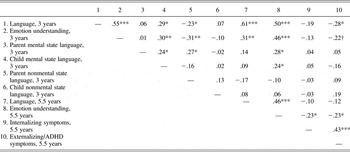
Correlations among behavioral measures
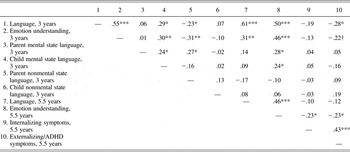
Note: ADHD, Attention-deficit/hyperactivity disorder.
†p < .10. *p < .05. **p < .01. ***p <. 001.
Group differences in 3- and 5.5-year emotion understanding
A univariate ANCOVA indicated that group status was unrelated to emotion understanding after controlling for 3-year language. Language was included as a covariate in the analysis of group status and 3-year emotion understanding because it was a confounding factor related to both the variables of interest. At age 5.5, a one-way ANOVA indicated a group difference in emotion understanding, F (2, 72) = 3.14, p = .049. Fisher LSD tests indicated that PI children scored significantly lower than NA children on 5.5-year emotion understanding, with the FC children not differing significantly from either group. There was no group difference in language ability at age 5.5, so it was not a confounding factor.
Prediction of 3- and 5.5-year emotion understanding
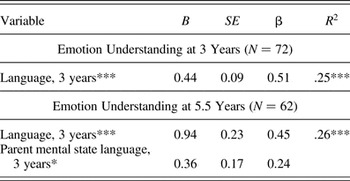
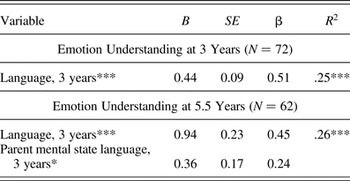
To examine the association of mental state language with emotion understanding, a stepwise regression was conducted in which 3-year emotion understanding was regressed on child mental state language, parent mental state language, and group status, controlling for the confounding factor of 3-year language. Only 3-year language was a unique predictor in the final model, F (1, 71) = 24.80, p < .001, R 2 = .25 (see Table 4).
Regression models for variables predicting children's emotion understanding
*p < .05. ***p < .001.
In a separate stepwise regression, 5.5-year emotion understanding was regressed on parent and child use of mental state language, group status, and 3-year emotion understanding, with 3-year language ability included as a covariate because it was associated both with the dependent variable and with several of the predictors. As shown in Table 4, in the final model, after controlling for 3-year language ability, parent use of mental state language uniquely accounted for variance in 5.5-year emotion understanding. This model was significant, F (2, 60) = 11.81, p < .001, R 2 = .26.
Moderation of the association between parent mental state language and emotion understanding by early care history
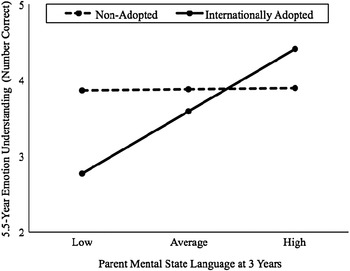
To assess whether the observed association of parent mental state language and 5.5-year emotion understanding was moderated by early care history, ordinary least squares regression analysis was conducted with 5.5-year emotion understanding as the dependent variable and parent mental state language as the independent variable. Internationally adopted status and PI status were entered as dichotomous moderator variables in the models, and 3-year language ability was included as a covariate. The interaction effect with PI status was not significant (confidence interval [CI] = –1.31–0.60), indicating that a history of institutional rearing did not moderate this association. However, results did support a significant interaction between internationally adopted status and parent mental state language in predicting 5.5-year emotion understanding, with the 95% CI excluding zero (CI = 0.06–1.56). Inclusion of this interaction effect significantly improved the model, R 2 change = .05, F (1, 57) = 4.72, p = .03, indicating that internationally adopted status moderated the prediction of 5.5-year emotion understanding from parent mental state language (see Figure 1). This interaction was followed up using simple linear regression analyses for internationally adopted and NA children separately. For the internationally adopted children (combined PI and FC groups), the model was significant, F (2, 32) = 7.06, p = .003, with higher levels of 5.5-year emotion understanding uniquely predicted both by parent mental state language (β = 0.42, p = .008) and by 3-year child language (β = 0.33, p = .03). For the NA children, the model was also significant, F (2, 26) = 6.53, p = .005, but only 3-year child language was a significant predictor of 5.5-year emotion understanding (β = 0.58, p = .001).
Association of parent mental state language with 5.5-year emotion understanding as a function of adoption status. Low, average, and high parent mental state language values are defined as 1 SD below the mean, at the mean, and 1 SD above the mean, respectively. Emotion understanding score is the number correct out of 6. The internationally adopted children include both the foster care and postinstitutionalized groups.

Group differences in behavioral problems and associations of behavioral problems with emotion understanding
One-way ANOVAs indicated a main effect of group on HBQ internalizing symptoms, F (2, 73) = 4.87, p = .01, and on HBQ externalizing/ADHD symptoms, F (2, 73) = 3.95, p = .024. Fisher LSD post hoc tests indicated that PI children had significantly more internalizing and externalizing/ADHD symptoms than did NA children, with FC children not differing significantly from either group. While there was a significant group difference in mean levels, it is important to note that very few children in any group were above clinical cutoffs (1 PI and 1 FC for internalizing; 3 PI, 1 FC, and 1 NA for externalizing/ADHD).
At age 5.5, lower emotion understanding performance was associated with higher scores on HBQ internalizing symptoms, r (75) = –.23, p = .045, and higher scores on HBQ externalizing/ADHD symptoms, r (75) = –.23, p = .048.
Discussion
We examined emotion understanding development and internalizing and externalizing problems in internationally adopted PI children, internationally adopted FC children, and NA children. Given that PI children are at risk for lower levels of emotion understanding, we were interested in assessing whether emotion understanding was associated with internalizing and externalizing problems. Further, while the heterogeneity in PI children's developmental outcomes is not fully explained by measures of preadoption risk, little is known about the influence of the postadoption environment. To begin to address this gap, we examined the role of one specific aspect of the postadoption environment, parental use of mental state language, in predicting emotion understanding development. At age 3 years, we measured emotion understanding, global language ability, and parent and child use of mental state language. At age 5.5 years, children completed emotion understanding and global language measures, and parents reported on children's behavioral problems. At 3 years, there was no group difference in emotion understanding task performance controlling for language ability, but by age 5.5 years, the PI children had lower levels of emotion understanding performance that could not be attributed to language ability. PI children may score lower on emotion understanding tasks compared to NA children as the tasks become more complex. Parental use of mental state language at 3 years predicted 5.5-year emotion understanding. Further analyses indicated that this association was moderated by adoption status, such that parental use of mental state language uniquely predicted 5.5-year emotion understanding for the internationally adopted children (PI and FC), but not for the NA children. At age 5.5 years, PI children were reported to have more internalizing and externalizing problems than did NA children. Moreover, lower emotion understanding scores at 5.5 years were concurrently related to higher levels of internalizing and externalizing problems.
Findings demonstrate the developmental trajectory of emotion understanding in PI children across a 2.5-year span from early preschool to kindergarten, as compared to NA children, extending prior cross-sectional reports of PI children's emotion understanding performance in this age range (Camras et al., Reference Camras, Perlman, Fries and Pollak2006; Fries & Pollak, Reference Fries and Pollak2004). One key question is the extent to which PI children's poorer performance on emotion understanding tasks reflects a specific difficulty with emotion understanding per se, as opposed to difficulty with other task demands such as language. In the current study, language was related to emotion understanding task performance at both ages, suggesting that performance may reflect these task demands. However, at age 3, there was only a nonsignificant trend for a group difference in emotion labeling and affective perspective taking tasks even before accounting for pronounced group differences in language ability. In contrast, at age 5.5, the group difference between PI and NA children could not be attributed to language. In our relatively low-risk sample, all of whom were adopted before 18 months, the PI children had caught up to NA children in language ability by age 5.5 years. This is not to suggest that PI children were making no progress in emotion understanding: the real versus apparent emotion task employed at 5.5 years was more challenging than the basic emotion labeling and affective perspective taking tasks employed at 3 years. We previously reported, with a different group of participants, that these basic emotion understanding abilities were intact in PI 6- and 7-year-old children (Tarullo et al., Reference Tarullo, Bruce and Gunnar2007); thus, the children in the current sample might well have been able to succeed at these simple tasks by 5.5 years. On the age-appropriate real versus apparent emotion task, however, which required recognizing that people's internal feelings may not match their external emotional expression, PI children scored lower than NA children. It is important to note that a mean difference between PI and NA children in emotion understanding performance does not necessarily mean that the PI children were impaired in emotion understanding, simply that they scored lower than the NA children. However, it is striking that a group difference in emotion understanding emerged with age, rather than fading out with increasing time in the adoptive environment as the language difference did. PI children may have increasing difficulty with emotion understanding as they enter school age and expectations for emotional perception become increasingly sophisticated. It is possible that difficulty in reading subtle emotional cues from others could contribute to the impaired socioemotional functioning and increased behavioral problems observed in some PI children.
Emotion understanding was stable across time and across tasks; performance on simple emotion labeling and affective perspective taking tasks at age 3 predicted performance on the real versus apparent emotion task at age 5.5, but after accounting for global language ability, the only other unique predictor of 5.5-year-old emotion understanding was parent use of mental state language. It is not simply that parents use more mental state language with children who are already emotionally perceptive or linguistically advanced. At age 3, parental use of mental state language was unrelated to children's concurrent emotion understanding or language ability, or to early care history. It may be that parent mental state language becomes important for performance on more sophisticated emotion understanding tasks. Regardless of children's level of emotion understanding or language ability at age 3, parental mental state language promoted emotion understanding development.
To our knowledge, the current study is also the first to demonstrate that parental use of mental state language predicts emotion understanding in internationally adopted preschool children. This association is well established in typically developing children, but it was unknown whether this association would extend to internationally adopted children at risk for emotion understanding difficulties. We thought it possible that children who had experienced early deprivation might be less able to take advantage of exposure to mental state talk. However, our results indicate that children whose parents used mental state language more frequently at age 3 were likely to have better emotion understanding at age 5.5. Further, moderation analyses showed that the association of emotion understanding with parent mental state language was significant for the internationally adopted children, PI and FC alike, but was absent in the NA children. Thus, if anything, parent mental state talk was particularly important for children who had experienced early deprivation. This finding that the associations of mental state language with emotion understanding varied by early care history is preliminary given small sample sizes within each group, but it does suggest that examining the developmental interplay of mental state language, emotion understanding, and early care history is a promising direction for future research.
The predictive value of mental state language for emotion understanding in our sample is consistent with Ruffman et al.'s (2012) suggestion that parental use of mental state language serves both to call children's attention to mental states and to give them the language to think and talk about mental states, thereby facilitating development of emotion understanding. In using mental state vocabulary, parents may be giving children the tools they need to recognize and learn about mental states in themselves and in others. We did not measure mental state language at 5.5 years, but we do not assume that the children whose parents talked less about mental states would still lack this vocabulary at age 5.5 years. Rather, children who are exposed to more mental state language from their parents at an early age may develop the capacity to begin to associate others' mental states with their overt behavior or situational factors at an earlier point in development, and therefore by age 5.5 have had a longer developmental window in which to learn to make inferences about other people's emotions. Further, a parental focus on mental states conveys to the child the message that mental states are important to attend to. Thus, in addition to teaching the child mental state vocabulary, the parent is also teaching the child a lens for viewing the world, emphasizing internal states instead of relying only on overt behaviors. This may affect children's attention to internal states of themselves and others, thereby increasing their opportunities to develop emotion understanding. While these are plausible mechanisms and parent mental state talk does longitudinally predict emotion understanding, the current data do not demonstrate that parents' mental state talk has a causal role in emotion understanding development. It could be that mental state talk covaries with other parental characteristics, such as parental sensitivity or positive emotional expressiveness, which could contribute to emotion understanding development. Demonstration of causality would require examining effects on emotion understanding development of parent training to increase parent mental state talk.
Two criteria would have to be met for an effective parent mental state talk intervention. First, the training would need to change the frequency of parent mental state talk. Second, children's emotion understanding scores would need to improve. Existing studies support the feasibility of meeting these criteria. Van Bergen, Salmon, Dadds, and Allen (Reference Van Bergen, Salmon, Dadds and Allen2009) randomly assigned mothers of typically developing 3.5- to 5-year-olds to emotional reminiscing training or a control condition. Immediately and at 6-month follow-up, both the mothers and the children used more emotion talk. Similarly, parent training in emotional reminiscing for parents of oppositional preschool children led to increased parent and child emotion talk compared to a control condition (Salmon, Dadds, Allen, & Hawes, Reference Salmon, Dadds, Allen and Hawes2009). In Van Bergen et al.'s study, this parent training also led to improved emotion cause knowledge in the children. Other studies have demonstrated preschool children's emotion understanding improves as a function of experimental manipulations in adult mental state talk. Four sessions of emotion cause talk with a researcher was related to improved use of emotion labeling (Salmon et al., Reference Salmon, Evans, Moskowitz, Grouden, Parkes and Miller2013). Preschool children who engaged in conversational language games with a researcher to promote use of mental state language showed improved emotion understanding and understanding of mental state language (Gavazzi & Ornaghi, Reference Gavazzi and Ornaghi2011). Taken together, these studies show promise that parent mental state talk is amenable to parent training, and that increases in exposure to mental state language can lead to improvements in children's emotion understanding.
The current results have the potential to inform intervention and prevention efforts with parents of internationally adopted children and perhaps parents of other children who have suffered early social deprivation. There was significant variability in the frequency with which parents used mental state terms, and this variability was unrelated to early care history or to the child's current functioning. Thus, frequency of parent mental state talk may be relatively independent of child characteristics. In our experience, parents of internationally adopted children are often highly motivated to support their children's development. Parent training to increase mental state talk could be beneficial for this population that is at risk both for emotion understanding deficits and for related internalizing and externalizing difficulties. Future studies should implement parent training in mental state talk with this and similar populations using randomized controlled designs and examine longitudinal effects on parent mental state talk, emotion understanding, and behavior problems.
PI children in the current sample had more parent-reported internalizing and externalizing problems at 5.5 years compared to NA children, consistent with numerous other reports of internalizing and externalizing problems in PI children (Judge, Reference Judge2004; Juffer & van IJzendoorn, Reference Juffer and van IJzendoorn2005; Wiik et al., Reference Wiik, Loman, Van Ryzin, Armstrong, Essex and Pollak2011). Few children in any group were above clinical cutoffs. As compared to most of these prior studies, PI children in the current study were adopted relatively young, at 12 months on average, and all of them prior to 18 months. Thus, while results suggest that even infant exposure to institutional rearing is associated with a higher mean level of behavior problems at age 5.5, this does not imply clinically significant behavioral difficulties
We had expected that the FC children might also have higher levels of parent-reported internalizing and externalizing symptoms, as Wiik et al. (Reference Wiik, Loman, Van Ryzin, Armstrong, Essex and Pollak2011) reported for FC children in middle childhood. Given our smaller sample size, we lacked the statistical power to detect small mean differences between the NA and FC groups. However, FC children in the current study had intermediate internalizing and externalizing scores compared to the PI and NA children. This is also the pattern of mean differences reported by Wiik et al., so the current results are not inconsistent with the notion that higher levels of behavior problems may not be specific to PI children.
Emotion understanding at 3 years did not predict behavior problems at 5.5 years, so early measures of foundational emotion understanding may not be significant in identifying who is likely to have higher levels of behavior problems. Rather, difficulty at 5.5 years with the far more complex task of attributing concealed emotional states to others, the real versus apparent emotion task, was associated concurrently with both internalizing and externalizing problems. To our knowledge, this is the first study to demonstrate that the link between emotion understanding and behavior problems observed in typically developing children (Izard et al., Reference Izard, Fine, Schultz, Mostow, Ackerman and Youngstrom2001; Schultz et al., Reference Schultz, Izard, Ackerman and Youngstrom2001; Trentacosta & Fine, Reference Trentacosta and Fine2010) extends to internationally adopted children as well. This finding is consistent with the notion that children who misjudge their peers' emotional reactions may be prone to respond aggressively themselves (Schultz et al., Reference Schultz, Izard and Ackerman2000). Further, parents often use inductive discipline approaches, that is, pointing out the emotional effects of a child's externalizing behaviors on others, to teach children to control their behavior (Hoffman, Reference Hoffman2000). This strategy may be less effective with children who have difficulty with emotional perspective taking, and particularly with understanding that a person may be distressed even without overt expressions of distress. Future longitudinal studies of PI children that extend across the elementary school years with repeated measures of both emotion understanding and behavior problems would be valuable to explore the interplay between these two domains of functioning across development.
Several limitations of the current study should be noted. Our measures of prenatal risk and early care risk were based on retrospective adoptive parent report. These measures are flawed, because adoptive parents may have incomplete or inaccurate information about their children's preadoptive experiences. The measures did not relate to any of our outcome variables of interest, but that is not to say that individual differences in preadoptive experiences were unimportant; rather, we may not have had a sufficiently accurate or sensitive measure to capture those effects. This is a common limitation in international adoption research, due to unavailability of direct information about children's preadoption experiences. Age at adoption indicates duration of deprivation, and thus is a rough proxy for exposure to adversity, though it does not capture the degree of deprivation prior to adoption. In the current sample, age at adoption was unrelated to the variables of interest, though all PI and FC children in the current sample were adopted by 18 months of age. It would be valuable to study developmental trajectories of later-adopted children in future studies. It also would be optimal to obtain more information about the internationally adopted children whose families declined to participate, to assess the possibility of a selection bias in the PI and FC children whose families agreed to participate. Another limitation is that the sample sizes of the PI, FC, and NA groups were relatively small. This likely constrained our ability to detect modest differences between the FC and NA groups or between the PI and FC groups, as well as to examine predictors of emotion understanding separately within groups. Finally, at age 5.5 we measured one aspect of emotion understanding using a real versus apparent emotion task. Given that there are several distinct components of emotion understanding (Pons, Harris, & de Rosnay, Reference Pons, Harris and de Rosnay2004), future studies should include a battery of emotion understanding tasks to explore how parent mental state talk and children's internalizing and externalizing symptoms relate to specific aspects of emotion understanding.
This study demonstrates that lower levels of emotion understanding in PI children as compared to NA children persist throughout the preschool period and that, by the time children are entering elementary school, these difficulties cannot be attributed to an ancillary language deficit. It will be important to find ways to facilitate emotion understanding development in PI children. The current study identifies parent mental state talk as a candidate for intervention efforts. Parent mental state talk did not erase the effects of early adversity on emotion understanding development, but it did predict emotion understanding development in internationally adopted children. Future studies should test the effectiveness of parent training interventions to increase parent mental state talk and promote emotion understanding development in internationally adopted children.