Implications
According to several animal rights movements (Bio Suisse, Naturland), the conventional cages in the commercial rabbit farms are too small, and the rabbit does’ movement possibilities are limited. The objective of the present study was to compare production and animal welfare of rabbit does housed in conventional and alternative (large) cages equipped or not with plastic footrests, wire or plastic-mesh platform. We concluded that housing the does in cages larger than commercial ones slightly improved kit weaning weight, but increased production costs (as these cages are larger and require more space). However, these cages gave more opportunity for animal movement and reduced prevalence of sore hocks when provided with plastic footrests and/or plastic-mesh platforms.
Introduction
Research aiming to optimize housing conditions for rabbits is gaining importance (Szendrő and Dalle Zotte, Reference Szendrő and Dalle Zotte2011; Szendrő and McNitt, Reference Szendrő and McNitt2012; Trocino et al., Reference Trocino, Majolini, Tazzoli, Filiou and Xiccato2013; Xiccato et al., Reference Xiccato, Trocino, Majolini, Tazzoli and Zuffellato2013). Although there are no EU-based directives for rabbit housing, there are some national recommendations (Germany: Hoy, Reference Hoy2012; Switzerland: WBF, 2013). Determining the optimal housing requirements of rabbits, without anthropomorphic and emotional influences, is of great importance and requires detailed knowledge of the behaviour of European wild rabbits and of domesticated rabbits under various housing conditions (Szendrő and Dalle Zotte, Reference Szendrő and Dalle Zotte2011; Szendrő and McNitt, Reference Szendrő and McNitt2012).
Important factors that affect the well-being of rabbit does include their ability to move, cage size, floor type and environmental enrichment. The cages of does could be too small, uncomfortable and excessively limit movement. Therefore, solutions are either an increase in cage size or environmental enrichment, for example, equipping cages with platforms (Rommers and Meijerhof, Reference Rommers and Meijerhof1998; Mirabito, Reference Mirabito2007), although platforms may enable the rabbit does to avoid nursing attempts of the kits. Furthermore, there is no definitive proof that larger cages or those equipped with platforms provide the expected benefits. For example, the productivity of rabbit does did not improve in cages that were larger or higher (Rommers and Meijerhof, Reference Rommers and Meijerhof1998; Mirabito, Reference Mirabito2007). Furthermore, in most cases, equipping cages with platforms had no effect on kindling rate, litter size, suckling mortality and weight gain of kits (Mirabito, Reference Mirabito2007). The platform in the cage should provide a place for the rabbit does to escape from the nursing attempts of their kits (Szendrő and McNitt, Reference Szendrő and McNitt2012). However, once the kits leave the nest box, they can also visit the platform (Mirabito, Reference Mirabito2007).
From the animal welfare perspective, the type of the cage floor is critical (Szendrő and McNitt, Reference Szendrő and McNitt2012). The percentage of does in Spanish commercial farms with sore hocks ranged from 12% to 70% (Rosell and De la Fuente, Reference Rosell and De la Fuente2009). In that regard, footrests reduced the development of sore hocks (Rosell and De la Fuente, Reference Rosell and De la Fuente2009; Rommers and De Jong, Reference Rommers and De Jong2011).
The aim of the experiment was to compare four commercial cages: conventional cages with footrests; conventional cages without footrests; alternative (large) cages equipped with wire-mesh platforms and footrests; and alternative (large) cages with plastic-mesh platforms and without footrests. In addition to reproductive performance, nursing behaviour, the occurrence of sore hocks and, in cages with platforms, the location preference of rabbit does and platform utilization of the kits were also monitored.
Material and methods
Animals, feeding and experimental conditions
Crossbred rabbit does (n=108) were used in this experiment, which was conducted at the rabbit farm of Kaposvár University. The temperature of the rabbitry ranged from 15ºC to 28ºC, depending on the season; the lighting schedule was 16 h light (0600 to 2200 h) and 8 h dark. Each cage was equipped with a feeder and a nipple drinker. Rabbits (does and their kits) were fed ad libitum a commercial pellet (11.1 MJ/kg DE, 18% CP and 15% crude fibre), and water was available ad libitum.
Does were first inseminated at 16.5 weeks of age. All does were inseminated on the same day, 11 days after kindling (42 days reproductive rhythm, single-batch system). The does did not receive hormonal treatments or biostimulation to induce oestrus. Litter size of the first and subsequent parities was standardized to 8 and 10 kits, respectively. Cross-fostering was practiced within groups. The entrance hole of the nest box was opened and the does could nurse their kits freely. Rabbits were weaned at 35 days of age. Rabbit does with bad body conditions (health problem or poor body condition) or remaining non-pregnant after two successive inseminations were culled and not replaced. The percentage of discarded does was similar in the groups: it ranged from 25% to 29%. Reproductive performance of up to five consecutive kindlings was evaluated. The performance of rabbit does that were culled or died was also evaluated. The initial BW and BW at first artificial insemination (AI) were similar in the groups.
Rabbit does were randomly allocated to four groups with the following cage types:
CN: conventional wire-mesh flat-deck cage (86×38×30 cm, including the 25×38 cm floor sized nest box, total surface for the does and their kits: 0.33 m2; wire diameter of the cage floor was 2 mm and the hole size of wires was 48×10.5 mm), without footrest (n=30);
CF: as CN cage, with plastic footrest (40×25 cm, width of the plastic-mesh: 17 mm; hole size: 64×12 mm; n=30);
ECWP: enlarged cage (102.5×38×61 cm, including the 25×38 cm floor sized nest box) with wire-mesh platform, the cage floor was wire-mesh (wire diameter 2.5 mm, hole size of wires: 60×12.5 mm), the platform (28.5×38 cm) was 26.5 cm above the cage floor, a plastic footrest (40×25 cm, width of the plastic-mesh: 17 mm, hole size: 64×12 mm) was on the lower level, 2/3 part of the footrest was below the platform; the total surface (floor and platform) for the does and their kits was 0.50 m2 (n=24);
ECPP: extra enlarged cage (102.5×52.5×97 cm, including the 21.5×52.5 cm floor sized nest box) with plastic-mesh platform, the cage floor was wire-mesh (wire diameter: 3 mm, hole size of wires: 73×12 mm), the platform (41.5×52.5 cm) was 25 cm above the cage floor; the total surface (floor and platform) for the does and their kits was 0.76 m2 (width of the plastic-mesh: 16 mm; hole size: 60×13 mm) (n=24).
Reproductive performance
The BW of rabbit does at kindling, kindling rate, total number of kits born, number of kits born alive and stillborn, litter size at 21 and 35 days, litter and individual weight at 21 and 35 days of age, and the mortality of kits were recorded.
Nursing behaviour
Video recordings were continuously carried out from kindling till day 20 of the third lactation using IR cameras (12 pieces of KPC-S50 NV, B/W CCD IR cameras, fixed on the ceiling above the cages, GeoVision GV-800 System, Multicam Surveillance System 6.1 software) (CF=10, ECWP=10, ECPP=10 randomly selected does). The events above were recorded and evaluated:
-
∙ the number of daily nest visits when the doe enters into the nest box without nursing;
-
∙ the number of daily nursing events;
-
∙ the length of nursing events starting from the moment when the doe is staying in a special hunchbacked body posture above the kits to the moment when it jumps out of the nest box.
Altogether the total length of the video recordings was 14 400 h, and during this period 846 nursing events were observed.
Sore hocks
At each insemination, severity of sore hocks was scored according to Rommers and De Jong (Reference Rommers and De Jong2011): 0=intact foot pads; 1=no hairs, callus formed (<2.5 cm); 2=no hairs, callus formed (>2.5 cm); 3=callus opened, cracks present; and 4=wounds. Foot pads of rabbit does showing scores 3 or 4 were treated with Cyclo Spray (p.a. chlorotetracycline 200 mg/ml; Bimeda, Ireland).
Location preference
At the third and fifth kindling, location of does (n=31) within the cages and number of kits on the platform were evaluated in enlarged cages. IR cameras were placed above the cages, and 24 h videos of 16 rabbit does in the enlarged cages (ECWP) and 15 individuals in the extra enlarged cages (ECPP) were recorded. The location preference of the rabbit does was observed twice weekly on the same days (every Tuesday and Friday) from kindling to 31 days postpartum (nine times per lactation). The location of the rabbits was given according to time of day (0500 to 1100 h; 1100 to 1700 h; 1700 to 2300 h; and 2300 to 0500 h). The periods 1100 to 1700 h and 2300 to 0500 h were called resting and active periods, respectively, because wild and domestic rabbits are more active during the dark and they rest during the light period, mainly during the middle of the day (Stodart and Meyers, Reference Stodart and Meyers1964; Podberscek et al.,Reference Podberscek, Blackshaw and Beattle1991; Selzer and Hoy, Reference Selzer and Hoy2003). The location of the rabbit does on the platform, below the platform or in front of the platform was recorded every 30 min (48 times a day, 432 times/lactation). Concurrently, from the time of leaving the nest box, the number of kits located on the platform was also determined. Location of the does was expressed in percentage of frequency they were observed on the different parts of the cages (total=100%), and the platform usage of kits was expressed as percentage of the number of kits present in the cages.
Statistical analyses
Performance measurements (weight of does at kindling, litter size, litter weight and individual BW) were considered as repeated measures and analysed using a mixed model (PROC MIXED). The model contained type of cage and insemination order as fixed effects, and the rabbit does as random effect (preliminary analyses showed that interaction between the fixed effects was not significant). The length of the nursing events and the number of nest visits were evaluated with the same procedure (PROC MIXED). The model contained type of cage and day of lactation as fixed effects, and the rabbit does as random effect (preliminary analyses showed that interaction between the fixed effects was not significant). Sore hocks score was evaluated with a multinomial logistic regression (PROC GLINMIX). The model contained as fixed effects type of cage (flat-deck cages without footrest was used as the reference) and insemination order (insemination 5 was used as the reference) and rabbit does as random effect (preliminary analyses showed that interaction between the fixed effects was not significant). Daily number of nursing events in the different cage types, kindling rate and mortality of kits in the different groups, and location of rabbit does and kits in enlarged cages were compared by χ 2 test (PROC FREQ). Besides, location of the rabbit does was also evaluated by separate χ 2 tests for the different day parts (2300 to 0500 h; 0500 to 1100 h; 1100 to 1700 h; 1700 to 2300 h). All statistical analyses were performed using SAS 9.3 software (SAS Institute Inc., 2011).
Results
Reproductive performance
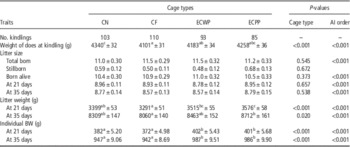
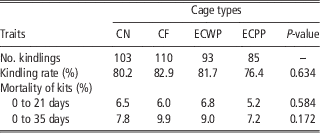
Kindling rate, litter size (born total, born alive and stillborn, at 21 and 35 days) (Table 1) and kit mortality (Table 2) were not significantly influenced by the cage types, although BW of does at kindling (Table 1) differed between the groups CN and CF (P<0.05). There were no significant differences between the two conventional cages (CN and CF), and between the two enlarged cages with platforms (ECWP and ECPP) in litter and individual weight at 21 and 35 days; however, comparing the conventional cages (CN and CF) with enlarged cages (ECWP and ECPP), these characteristics were higher in the enlarged cages (P<0.001 and P<0.01).
Effect of cage type and insemination order (AI) on rabbit doe performance (least squares means±s.e.)

AI=artificial insemination; CN=flat-deck cages without footrest; CF=flat-deck cages with footrest; ECWP=pens with wire-mesh platform and footrest on the bottom level; ECPP=pens with plastic-mesh platform.
a,b,cMeans within the same row with different superscripts differ significantly (P<0.05).
Effect of cage type on rabbit does’ kindling rate and on the mortality of kits (%)

CN=flat-deck cages without footrest; CF=flat-deck cages with footrest; ECWP=pens with wire-mesh platform and footrest on the bottom level; ECPP=pens with plastic-mesh platform.
Sore hocks
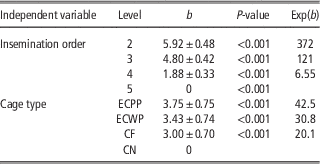
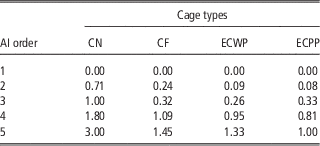
Because there were no sore hocks at the first insemination of the study, only the subsequent insemination orders were analysed. Both the effects of cage type and insemination order were significant, as the estimated logistic regression coefficients were all significant (Table 3). The logistic regression coefficients can be converted to odds ratios by exponentiating them (Table 3). The severity of this phenomenon increased significantly with advancing insemination order (Tables 3 and 4). Compared with the fifth insemination, at the second insemination, the rabbit does had the highest odds to have a sore hocks score of 0. Taking the cages without footrest (CN) as a reference, the odd ratios showed that the most favourable cage type was the enlarged cage with plastic-mesh platform followed by enlarged cage with wire-mesh platform and footrest on the bottom level; however, even flat-deck cage with footrest was much better for the rabbits than the CN cages.
Effect of insemination order and cage type on the rabbits’ sore hocksFootnote 1 scores (b Footnote 2 ±s.e.)

ECPP=pens with plastic-mesh platform; ECWP=pens with wire-mesh platform and footrest on the bottom level; CF=flat-deck cages with footrest; CN=flat-deck cages without footrest.
1 Sore hocks scores: 0=intact foot pads; 1=no hairs, callus formed (<2.5 cm); 2=no hairs, callus formed (>2.5cm); 3 callus opened, cracks present; 4=wounds.
2 Logistic regression coefficients.
Average sore hocksFootnote 1 scores of does in different cage types at different inseminations

CN=flat-deck cages without footrest; CF=flat-deck cages with footrest; ECWP=pens with wire-mesh platform and footrest on the bottom level; ECPP=pens with plastic-mesh platform.
1 Sore hocks scores: 0=intact foot pads; 1=no hairs, callus formed (<2.5 cm); 2=no hairs, callus formed (>2.5 cm); 3=callus opened, cracks present; 4=wounds.
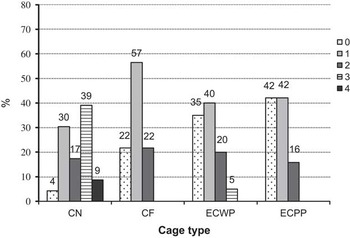
At the last period of examination (fifth AI), the most severe sore hocks were observed in CN cages (no footrest) (Figure 1). The most favourable results were observed in the ECPP group (platform made of plastic mesh) where 84% of the rabbits had sore hocks score 0 and 1, and 16% had no severe injuries (score 2).
The percentage of rabbit does in each type of cage with different scores for sore hocks at the fifth artificial insemination. 0=intact foot pads, 1=no hairs, callus formed (<2.5 cm), 2=no hairs, callus formed (>2.5 cm), 3=callus opened, cracks present, 4=wounds, CN=flat-deck cages without footrest, CF=flat-deck cages with footrest, ECWP=pens with wire-mesh platform and footrest on the bottom level, ECPP=pens with plastic-mesh platform.

In cages with footrest (CF), problems of sore hocks were not serious. The occurrence rate of sore hocks was intermediate in the ECWP cages. The proportion of rabbits with no or only slight injuries (score 0 and 1) was high (75%), but score 2 to 3 was also frequently detected (25%) (Table 4).
Nursing behaviour
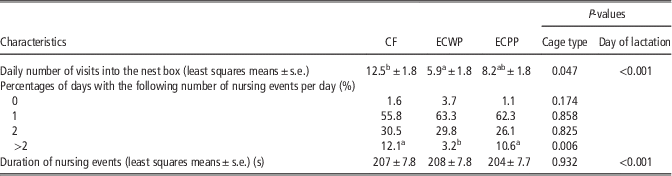
Does in conventional cages (CF) entered the nests twice as frequently than the animals in enlarged cages (12.5 and 7.0 nest visits per day in conventional cages and enlarged cages with platform, respectively, P<0.05). The difference between the CF and ECWP groups was significant (Table 5). The frequency of multiple nursing events (>2) was also significantly higher in the CF group than in the ECWP group.
Characteristics of nursing behaviour of does in various cage types

CF=flat-deck cages with footrest; ECWP=pens with wire-mesh platform and footrest on the bottom level; ECPP=pens with plastic-mesh platform.
a,bValues within a row with superscripts differ significantly at P<0.05.
Location preference
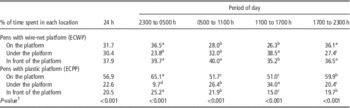
The percentage of platform preference in the 24 h period was 25.2% greater in the ECPP cages than in the ECWP cages (P<0.001; Table 6). However, rabbits in the ECWP cages were found more often below and in front of the platform than in the ECPP group.
Location preference of rabbit does in enlarged cages with platform, depending on the periods of the day

a,b,c,dValues within a row with different superscripts differ significantly at P<0.05.
1 P-value shows difference between the locations of does in the different cage types within each time period.
In the ECPP cages, at the beginning (1700 to 2300 h) and during the active period (2300 to 0500 h), does were found more often on the platform than during the light (resting) period (0500 to 1700 h) (Table 6). On the contrary, percentage of time when the rabbits were observed under the platform was 2.5 to 3.5 times higher between 0500 and 1700 h than during the dark period (2300 to 0500 h). The effect of the periods of the day was smaller in the ECWP cages. The rabbit does were also found more often on the platform between 1700 and 0500 h than between 0500 and 1700 h.
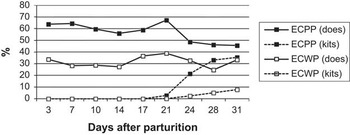
The platform usage of does and their kits in the enlarged cages, between days 3 and 31 of lactation, are shown on Figure 2. In the ECPP cages, the percentage of observations that the does were observed on the platform ranged between 55.9% and 64.4% during the first 17 days of lactation. However, once the kits left the nest boxes, utilization of the platform by does increased substantially and reached a peak on day 21 (67.1%). Thereafter, the increased use of platform by the kits was associated with decreased usage of platform by the does. Lesser use of the platform by the does (25% to 38%) occurred in the ECWP group compared with the ECPP group between kindling and weaning, but the changes in platform usage were similar in both cage types. When the kits left the nest boxes, the does used the platform more often, and then after day 21, when the kits started to visit the platform, the platform usage by the does decreased.
Platform usage of does and their kits in different types of platform cages. ECWP=wire-mesh platform, ECPP=plastic-mesh platform. The presence of rabbit does on the platform is expressed as the percentage of observations. The presence of kits on the platform is expressed as the percentage of number of kits in the cage. The platform usage of the does during the whole observed period and the platform usage of their kits after day 21 of lactation differed significantly (P<0.05) in the groups ECPP and ECWP.

The kits started to visit the platform at the age of 17 days, and the platform usage of the kits increased until weaning (Figure 2). The use of the wire-mesh platform by kits was lower than that of the plastic platform (P<0.001).
Discussion
Theoretically, in larger cages, rabbit does can move more, which may influence their performance. In fact, we observed an improved trend (higher weaning weight of kits) in larger cages. However, previous studies did not find different reproductive performance in does housed in larger or higher cages compared with conventional cages (Rommers and Meijerhof, Reference Rommers and Meijerhof1998; Mirabito et al., Reference Mirabito, Galliot, Souchet, Dumont and Thomeret2005b), or in cages with platform compared with cages without platform (Mirabito et al., Reference Mirabito, Buthon, Cialdi, Galliot and Souchet1999, Reference Mirabito, Galliot and Souchet2005a; Mirabito, Reference Mirabito2007). According to Mirabito et al. (Reference Mirabito, Buthon, Cialdi, Galliot and Souchet1999, Reference Mirabito, Galliot and Souchet2005a) and Mirabito (Reference Mirabito2002, Reference Mirabito2007), a platform did not appear to be a means for does to escape from their kits and remain undisturbed, and did not affect the kits’ nursing attempts. Doe escapes (i.e. visiting the platform) and the kits’ usage of the platform did not influence the difference for the 21-day litter and individual weights as the kits had left the nest box only few days earlier. The lower weight of kits in conventional cages may depend on the higher disturbance to sleeping kits because of the higher number of visits to the nest boxes and the higher frequency of more than two nursing events per day of rabbit does compared with those of enlarged cages with platforms. Similarly, Hoy et al. (Reference Hoy, Seitz, Selzer and Schüddemage2000) observed higher number of nursing events per day and percentage of days with >2 nursing events in larger than in conventional-sized get-away cages.
Although the size of cages and platform preference of does and kits were substantially different between the ECWP and ECPP groups, there were no significant differences in reproductive performances. It seems, in this case, that the reproductive performances of does were independent of the size of cages and the material of the platform.
The incidence and severity of sore hocks was the highest in conventional cages without footrest. The impact of footpad or plastic-mesh platform on reproductive performance has not been demonstrated. When the callus was opened and cracks had been formed, foot pads were treated by Cyclo Spray to prevent pain and suffering, and also to avoid decreasing of the performance. It should be noted that the diameter of the wire was appropriate because comparing the 2 and 3 mm thick wire, the 3 mm thick wire floor did not reduce sore hocks (Rommers and De Jong, Reference Rommers and De Jong2011). The present study proved that both plastic-mesh platforms and/or plastic footrests in enlarged and conventional cages have the potential to improve animal welfare. Similarly, Rosell and De la Fuente (Reference Rosell and De la Fuente2009) and Rommers and De Jong (Reference Rommers and De Jong2011) reported that plastic footrests reduced sore hocks.
Examining the platform utilization of rabbit does, we confirmed previous results that state the influence of the presence of kits (Mirabito, Reference Mirabito2002, Reference Mirabito2007): in the presence of kits, the does stayed more frequently on the platform (Mirabito et al., Reference Mirabito, Buthon, Cialdi, Galliot and Souchet1999, Mirabito, Reference Mirabito2007). In fact, non-lactating does visited the platform less frequently than those nursing their kits (Mirabito et al., Reference Mirabito, Buthon, Cialdi, Galliot and Souchet1999). Besides, based on our results, we can state that platform preference was highly dependent on its type (plastic v. wire) and on the level of provided comfort: does were found more often on platforms when it was made of plastic mesh compared with wire mesh (56.9% v. 31.7%). The presence of comfortable plastic footrests below wire-mesh platform could have contributed to reduce the preference of does towards the platform in the ECWP cages we used.
In the experiment by Mirabito et al. (Reference Mirabito, Buthon, Cialdi, Galliot and Souchet1999), at 5 weeks of lactation, 16% of the kits were located on the platform. In our study, the difference in platform preference of the kits was mainly attributed to platform type (wire-mesh or plastic-mesh) because the plastic-mesh was probably more comfortable for the kits as well. The size of the platform also has to be taken into account, as it was double size in the ECPP cages compared with the ECWP cages.
In the ECWP group, when the doe stayed on the platform, there was space for only a few kits. As the does spent 68.3% of their time on the lower level, the platform usage of the does only partially restricted opportunities for kits to visit the platform.
As Mirabito et al. (Reference Mirabito, Buthon, Cialdi, Galliot and Souchet1999) restricted their observations to time with visible light they could not report outcomes throughout the entire day. In our study, platform preference of does was greater during the active period, whereas during the resting period does preferred to stay under the platform. These findings may be explained by behaviour characteristics of the European wild rabbit. They prefer living in the shelter of dense scrub, and during the light (resting) period they stay in their warrens for safety (Pérez et al., Reference Pérez, Jacksic, Meriggi and Rosin2008).
In conclusion, plastic-mesh platforms or footrests have the potential to improve doe welfare because of the reduced incidence of sore hocks. Housing rabbit does in enlarged cages with platform is advantageous because kit weaning weight increased, but the number of rabbits per rabbit house is reduced, and thus production costs are also higher.
Acknowledgements
Financial support of TECH_08_A3/2-2008-0384, National Development Agency and KMR 12-1-2012-004 is gratefully acknowledged. It was also supported by the European Union and the State of Hungary, co-financed by the European Social Found in the framework of TÁMOP 4.2.4. A/2-11-1-2012-0001 ‘National Excellence Program’. We thank John Kastelic for valuable comments and suggestions that improved the manuscript.