Implications
Lameness detection in dairy cattle is based on changes in locomotion variables of walking cows compared with the normal walk of this specific cow. However, this study shows that gait variables can also vary due to environmental (e.g. whether or not the walking surface is wet) or cow factors (e.g. gestation stage or growth of the calf). When implementing these influencing factors in the detection algorithms for lameness, the number of false alerts for lameness in non-lame cows decreased.
Introduction
During the last decades, the dairy industry has intensified in terms of keeping more cattle on fewer farms and more animals per caretaker. Consequently, the farmer’s time to monitor all individual cows drastically decreased. Sensors are being developed to support the farmers in their daily tasks, especially by monitoring the cows’ health so farmers can apply proper treatment or make thorough management decisions. As lameness is one of the most costly health problems in dairy cows also technology to detect lame cows is being investigated. Several sensors have been tested for their ability to register cow locomotion variables that are related to lameness; for example, weight distribution (Pastell and Kujala, Reference Pastell and Kujala2007), gait pattern (Maertens et al., Reference Maertens, Vangeyte, Baert, Jantuan, Mertens, De Campeneere, Pluk, Opsomer, Van Weyenberg and Van Nuffel2011) or posture pattern like arching of the back (Van Hertem et al., Reference Van Hertem, Viazzi, Steensels, Maltz, Antler, Alchanatis, Schlageter-Tello, Lokhorst, Romanini, Bahr, Berckmans and Halachmi2014) (reviewed by Van Nuffel et al., Reference Van Nuffel, Zwertvaegher, Van Weyenberg, Pastell, Thorup, Bahr, Sonck and Saeys2015). Such lameness detection systems are based on the assumption that the lameness-relevant-variables change when a cow develops lameness, for example, shorter step length or more arching of the back. Next, these locomotion variables are combined in an algorithm that is used to alert the farmer if a cow shows a significant change in the variable and hence is becoming lame. However, not all changes in locomotion variables are related to lameness.
Indeed, several environmental factors such as flooring features are shown to alter locomotion characteristics. Phillips and Morris (Reference Phillips and Morris2000) found that cows showed a different walking pattern on dry v. wetted concrete. The cows in their study reduced the arcs of the hind limbs on wet concrete suggesting the cows found a wet floor more slippery compared to dry concrete floor. The presence of slurry, particularly deep slurry, reduced the walking speed of cattle and altered their limb conformation during the support phase, giving them a different walking pattern from cows on dry or wetted concrete, probably to reduce the risk of slipping (Phillips and Morris, Reference Phillips and Morris2000). Cows studied by Telezhenko and Bergsten (Reference Telezhenko and Bergsten2005) walked with longer strides and steps, but without speed difference on a continuous rubber floor compared to a slatted floor covered with rubber. In addition, the acceleration of the legs was found to be lower on rubber flooring compared with concrete, indicating a smoother walking pattern (Chapinal et al., Reference Chapinal, de Passille, Pastell, Hanninen, Munksgaard and Rushen2011). The most impaired walking pattern was found on slippery concrete floor resulting in lower speed, shortened strides and a negative overlap. Similar results were also reported in the study by Rushen and De Passille (Reference Rushen and de Passille2006), where a thin layer of slurry increased the slipping frequency and the number of strides, while it decreased the speed. These authors suggested that increasing the compressibility of the walk surfaces can improve cow locomotion independent of the roughness of the surface. For cows to walk normally, the optimal coefficient of friction has been reported to be between 0.4 and 0.5 N/N (Phillips and Morris, Reference Phillips and Morris2001). Lower coefficients of friction cause cows to walk ‘stiffer and less confident’, that is quicker with shorter steps and less range of motion (van Der Tol et al., Reference van Der Tol, Metz, Noordhuizen-Stassen, Back, Braam and Weijs2005). Higher coefficients of friction have been associated with longer swing phases combined with long strides to reduce friction (Phillips and Morris, Reference Phillips and Morris2001). Phillips et al. (Reference Phillips, Morris, Lomas and Lockwood2000) reported that the optimal light intensity for normal walking lies between 39 and 119 lux. The cows in their study were found to take shorter but quicker steps in a dark environment to increase their stability.
In addition, Van Nuffel et al. (2013) showed that the majority of the variation in walking variables is attributed to differences between cows (>97%) compared with within cows (<3%) suggesting that cow-specific features can influence gait. These results were also found in Telezhenko (Reference Telezhenko2009). Locomotion score has been reported to increase with age (Ward, 1999; Manske et al., 2002; Bicalho et al., 2008). As the size of the udder increases with age – reasonably independently of milk production – the more bulky udders of mature cows can force the hind legs to circumvent the udder, preventing free movement of the hind legs (Greenough et al., 1981; Boelling and Pollot, Reference Boelling and Pollot1998) limiting their strides and steps (Van Dorp et al., Reference Van Dorp, Boettcher and Schaeffer2004; Telezhenko and Bergsten, Reference Telezhenko and Bergsten2005). Several researchers reported a significant change in abduction of the hind legs caused by the change in volume of the udder (Flower et al., Reference Flower, Sanderson and Weary2006; Chapinal et al., Reference Chapinal, de Passille and Rushen2009; O’Driscoll et al., Reference O’Driscoll, Gleeson, O’Brien and Boyle2010 and Reference O’Driscoll, Gleeson, O’Brien and Boyle2011). Especially during early (O’Driscoll et al., Reference O’Driscoll, Gleeson, O’Brien and Boyle2010) and peak lactation, disruption from normal locomotion is caused by swinging of the hind legs around the distended udder to reduce the possible discomfort associated with increased milk accumulation (Gleeson et al., Reference Gleeson, O’Brien, Boyle and Earley2007). Blackie et al. (Reference Blackie, Bleach, Amory and Scaife2011) could not find any difference in stride length (both in front and hind limbs) or tracking up between week 1, 6 and 12 of lactation. Flower et al. (Reference Flower, Sanderson and Weary2006) showed that cows walk with longer strides, higher stride heights, shorter stride duration and faster walks after milking compared with before milking. This might be either due to their high motivation to go back to the barn or pasture for feeding, or to the different weight carried between the hind legs because of less udder distension after milking. Subjective assessment of tracking up and reluctance to bear weight also improved after milking. In their study on the effect of once or twice-daily milking on udder firmness Tucker et al. (Reference Tucker, Dalley, Burke and Clark2004) could not find a decrease in stride length caused by discomfort for cows with different udder firmness while walking towards the milking parlour.
In addition, Chapinal et al. (Reference Chapinal, de Passille and Rushen2009) suggested that the state of late pregnancy also needs to be considered when studying the walking pattern of cows as the weight of the foetus might influence how cows distribute their weight between their legs and hence influences how cows walk. After calving, a decrease in gait asymmetry was found together with an increase in arching of the back. In the 1st week after calving, cows often appear to be walking stiffer which may be attributed to discomfort in the hindquarters following calving (Blackie et al., Reference Blackie, Bleach, Amory and Scaife2011).
All above-mentioned influencing factors of age, lactation stage, milking or gestation stage seem to be closely associated with the changes in volume and firmness of the udders. The only study on the variation of udder volume during gestation and lactation was found in goats (Linzell, Reference Linzell1965). The rate of mammary growth was highest in late pregnancy, probably due to an increase in extracellular fluid in the udder at term (in average doubling in the last 6 weeks). Udder volumes decreased drastically after milking after which an increase reoccurs until the next milking.
Finally, the motivation to walk away from an aversive stimulus (impatient milker or dominant cow) or towards food may also influence cow walking pattern in terms of speed-related variables. Carvalho et al. (Reference Carvalho, Bucklin, Shearer, Naas, Neto, Souza and Massafera2007) reported that trimmed cows had a more confident and stable walk. This was confirmed by Aoki et al. (Reference Aoki, Kamo, Kawamoto, Zhang and Yamada2006) who quantitatively indicated that walking characteristics improved after trimming by increasing walking rate, step length and stepping rate. Limb angles also showed less ‘on tiptoe’ locomotion after trimming. Maertens et al. (Reference Maertens, Vangeyte, Baert, Jantuan, Mertens, De Campeneere, Pluk, Opsomer, Van Weyenberg and Van Nuffel2011) illustrated that the effect of ‘routine’ trimming on the gait of cows was similar to that of a lesion and the associated treatment. Such change in walking might indeed be caused by the increased sensitivity of the hoof by removing the excessive hoof horn (Dyer et al., Reference Dyer, Neerchal, Tasch, Wu, Dyer and Rajkondawar2007) or might be caused by slow changes in walking due to the development of long toes before the hoof trimming, leading to recovery of the normal speed and symmetry in stance time and step length within a few days. However, in a study of Chapinal et al. (Reference Chapinal, de Passille and Rushen2010), cows exhibited either no change or deterioration in walking after trimming.
In addition, other disease-related causes such as mastitis or abomasal displacement might influence cow locomotion due to a general feeling of sickness or painful body parts (e.g. painful udder for mastitis) (Milne et al., Reference Milne, Nolan, Cripps and Fitzpatrick2003; Leslie and Petersson-Wolfe, Reference Leslie and Petersson-Wolfe2012; Fitzpatrick et al., Reference Fitzpatrick, Chapinal, Petersson-Wolfe, DeVries, Kelton, Duffield and Leslie2013). As such, monitoring changes in cow locomotion might be of added value for the detection systems for other diseases besides lameness.
As literature shows that cow and/or environmental factors do change the locomotion in non-lame cows, such changes might result in false alerts to the farmer. The percentages of false alerts for non-lame cows in lameness detection systems under development range from <5% to 24% (based on the papers reviewed in Van Nuffel et al., Reference Van Nuffel, Zwertvaegher, Van Weyenberg, Pastell, Thorup, Bahr, Sonck and Saeys2015), which would result in 25 to 125 of non-lame cows that are falsely alerted as lame every day in a herd of 500 cows. Such high numbers of cows that are falsely alerted as lame are not feasible in practice and would drastically reduce the confidence of the farmer in any lameness detection system. Hence, possible approaches to reduce the number of false alerts should be investigated.
One approach to reduce the number of false alerts is to take non-disease-related factors that can change the cow locomotion into account in a detection algorithm. Based on the review of Van Nuffel et al. (Reference Van Nuffel, Zwertvaegher, Van Weyenberg, Pastell, Thorup, Bahr, Sonck and Saeys2015), the majority (79%) of the studies on lameness detection systems do not include any environmental or cow factor into the algorithm. Only those studies that used a combination of available sensor data that was present on farm (e.g. milk yield and other milking data, feeding behaviour data), include some form of cow-related factors into their detection algorithm. However, performance of the algorithms do not seem to be improved compared with algorithms using solely locomotion variables.
To further improve the performance of lameness detection systems by reducing the number of false alerts for non-lame cows, the following research questions were investigated: (1) do environmental (wet walking surface, dark environment) and/or cow-related factors (age, parity, production level, lactation and gestation stage) affect the locomotion of non-lame cows? And if so, (2) can the number of false alerts be decreased by including these influencing factors into the detection algorithms? The latter will be investigated by comparing the performance of two detection algorithms: one solely based on cow locomotion data and a second algorithm, based on cow locomotion data combined with additional cow and environmental data.
Material and methods
Experimental set-up
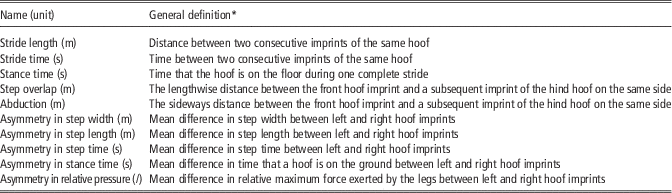
Data for this experiment was collected at Institute for Agricultural and Fisheries Research research farm (Melle, Belgium) where the Holstein Friesian cows were housed in a deep litter barn with straw bedding and had access to pasture from approximately mid of April until the end of November. The cows were milked twice a day in a 2×3 auto-tandem milking parlour. The average milk yield was about 9000 l/cow per year. In the retour alley after the milking parlour, the locomotion of individual cows was measured using the Gaitwise after milking (Maertens et al., Reference Maertens, Vangeyte, Baert, Jantuan, Mertens, De Campeneere, Pluk, Opsomer, Van Weyenberg and Van Nuffel2011). Gaitwise measures spatial (e.g. step length), temporal (e.g. stance time) and force-related gait variables of claw–floor interactions of cows walking over the measurement zone. The 10 gait variables measured by the Gaitwise system are summarised in Table 1 and were calculated as explained in Maertens et al. (Reference Maertens, Vangeyte, Baert, Jantuan, Mertens, De Campeneere, Pluk, Opsomer, Van Weyenberg and Van Nuffel2011).
Definitions of the gait variables as measured by the Gaitwise system (Maertens et al., Reference Maertens, Vangeyte, Baert, Jantuan, Mertens, De Campeneere, Pluk, Opsomer, Van Weyenberg and Van Nuffel2011)

* Some definitions are based on spatial gait parameters from Telezhenko (Reference Telezhenko2009).
Simultaneous to the Gaitwise measurements, video recordings were stored for locomotion scoring of the cows by a trained observer (K=0.85). For locomotion scoring, a list of frequently used lameness attributes was used: non-flexible joint movement, tender placement of the hoofs, arched back, low speed, irregular footfall in time or place, tracking up, abduction and head bobs. Finally, the locomotion was scored as ‘non-lame’ when the cow did not show any of these lameness attributes (locomotion score 1); ‘mildly lame’ if a lameness attribute was present (locomotion score 2) and as ‘severely lame’ if a single lameness attribute showed a clear impediment in locomotion or multiple lameness attributes were present (locomotion score 3) (Van Nuffel et al., Reference Van Nuffel, Sprenger, Tuyttens and Maertens2009). In order to have useful video footage, artificial lighting was present during the measurements. Locomotion scoring was performed on the videos acquired on Mondays and Thursdays.
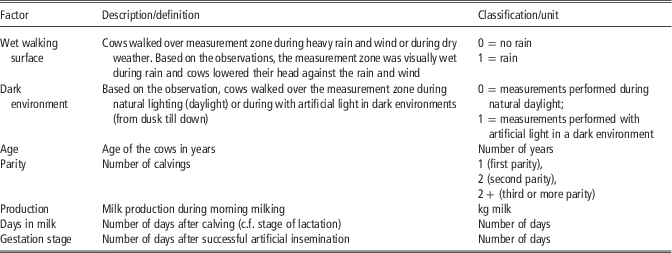
All cows were motivated to return to the pasture or barn to find food. The cows were used to the Gaitwise system and were visually observed to walk over it in an undisturbed way. The cow and environmental factors considered in this study are summarised in Table 2. The factors ‘wet walking surface’ and ‘dark environment’ were recorded by the observer based on the video footage. All other factors were obtained from the farm records. Data were collected during the summer for a measuring period of 5 months.
Summary of the environmental and cow factors considered in this study and their definitions and classification

Cows
Experiment 1
For the first experiment, only cows that did not show any signs of lameness during the 5-month measuring period were selected according to the following criteria: (1) not reported for mastitis, lameness or any other health problem during the measurement period by the animal caretaker and farm records; (2) scored as ‘non-lame’ by the trained observer during the measurement period and (3) not trimmed during or 14 days before the measurement period. Based on these criteria, measurements of 30 cows were withheld for further analyses. To avoid possible confounding effects associated with morning v. evening milking routine, only morning measurements were considered. Selection according to these criteria resulted in a total of 951 measurements (from 30 cows, over a period of 5 months with an average of two measurements a week due to the frequency of locomotion scoring). Within this group, 12 cows were in their first parity, six were in their second parity and 12 were in the third or higher parity.
Experiment 2
To check the effect of cow and environmental factors on the performance of a lameness detection model, 100 cow measurements for every lameness status (n=300) were randomly selected during the 5-month measurement period. The lameness status of these 100 non-lame, 100 mildly lame and 100 severely lame cows were based on the videos that were scored by the trained observer.
Statistical analysis
Experiment 1
To determine the effect of environmental and cow data on the gait variables (dependent variables), linear mixed models were built with time as repeated variable within subject cow to correct for repeated measurements on each cow. The covariance between the repeated measurements was modelled using the autoregressive structure (AR1). Rain, darkness, age, parity, production, days in milk (DIM) and gestation stage were added as independent variables (see Table 1). First, univariate associations were tested. Statistical significance in this step was assessed at P<0.25. Next, Pearson correlations between all significant variables were calculated to discover multicollinearity. As expected, high correlations were found between age and parity (R²=0.83), between DIM and gestation stage (R²=0.69) and between milk production and DIM (R²=0.72) and gestation stage (R²=0.65), respectively. Age and DIM were withheld to be tested in further model building when combinations of these variables were significant in the univariate analyses. In the next step, multivariate models were fit for all dependent variables using a backwards stepwise regression. Statistical significance was assessed at P<0.05. Least squares means were calculated to report mean values and standard deviations in tables. Finally, model fitting of the final models was done by visual inspection of the normal probability plots of the residuals. All analyses were performed in SAS 9.4 (SAS Institute Inc., Cary, NC, USA).
Experiment 2
In the second experiment, two lameness detection algorithms were developed. Mildly lame and severely lame cows were grouped together in a lame cow group. The first algorithms was solely based on gait variables as measured by the Gaitwise, the second algorithm was based in the gait variables combined with cow and environmental variables that had a significant effect on cow locomotion in the first experiment. The gait variables for the first model were selected using a GLM. Significant variables were then used to construct a linear discriminant analysis (LDA) model to predict the lameness status. Similarly, the second LDA model was constructed by adding extra environmental and cow data to the selected significant gait variables using a GLM. All statistical analyses were performed using SAS (version 9.4; SAS Institute Inc.).
Results
Experiment 1
On average 31.7±8.6 measurements were successfully collected per cow during the measurement period.
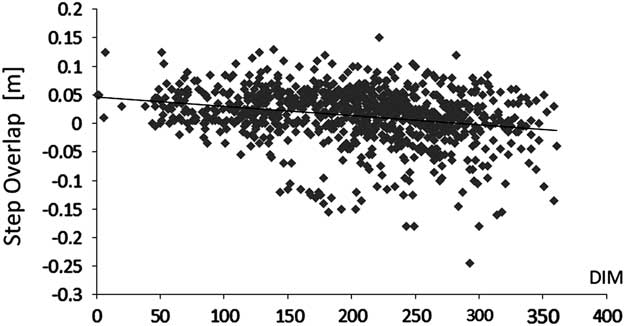
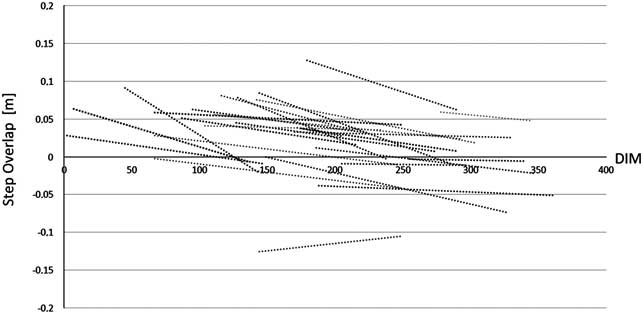
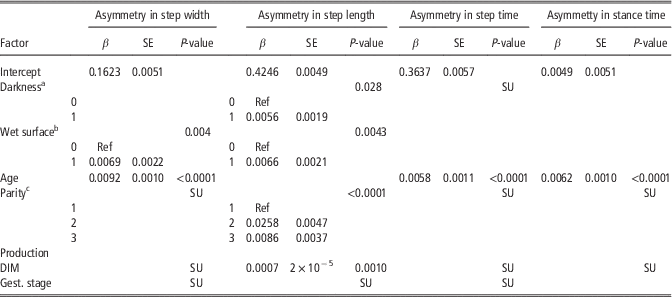
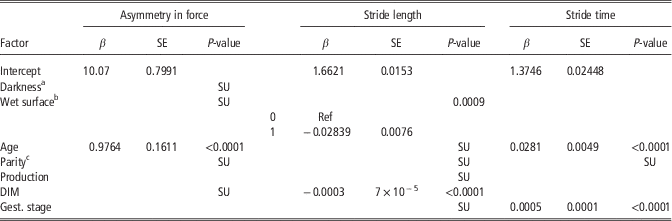
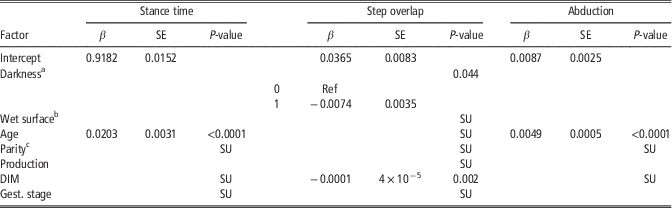
The factors associated with the specific gait variables included in the final model are summarised in Tables 3, 4 and 5. Darkness significantly increased the asymmetry in step length and step overlap in the final model. In rainy weather, cows took shorter and more asymmetrical steps. In general, older cows had a more asymmetrical gait and they walked slower, with more abduction. Parity showed a significant increase in asymmetry in step length. Lactation stage, calculated as DIM, showed significant association with more asymmetric step lengths and shorter steps, and less step overlap. As illustrated in Figure 1, step overlap decreased with increasing number of DIM and became negative towards the end of the lactation. Cows with a negative step overlap place their hind limbs after the imprint of the fore limb that has just been lifted, hence, there is no step overlap. As every cow has her own way of walking, there is a large variation in the regression lines for the step overlap as a function of DIM for the different cows, as can be seen in Figure 2.
Scatter plot and regression line for step overlap (m) against days in milk (DIM) (not corrected for clustering).

Regression lines for every individual cow based on step overlap (m) against days in milk (DIM).

Final multilevel linear model describing the factors influencing gait variables with β; SE; significant P-values are shown for the multilevel model (SU)

β=linear regression coefficient; SU=variables were significant (P<0.05) at the univariable level but not at the multivariable level; Ref=reference; DIM=days in milk; Gest. stage=gestation stage.
a Dark environment → 0 or 1=absence or presence of the influencing factor ‘dark environment’.
b Wet surface → 0 or 1=absence or presence of the influencing factor ‘wet walking surface’.
c Parity → 1, 2 or 3=first, second or third+parity.
Final multilevel linear model describing the factors influencing gait variables with β; SE; significant P-values are shown for the multilevel model (SU)

β=linear regression coefficient; SU=variables were significant (P<0.05) at the univariable level but not at the multivariable level; Ref=reference; DIM=days in milk; Gest. stage=gestation stage.
a Dark environment → 0 or 1=absence or presence of the influencing factor ‘dark environment’.
b Wet surface → 0 or 1=absence or presence of the influencing factor ‘wet walking surface’.
c Parity → 1, 2 or 3=first, second or third+parity.
Final multilevel linear model describing the factors influencing gait variables with β; SE; significant P-values are shown for the multilevel model (SU)

β=linear regression coefficient; SU=variables were significant (P<0.05) at the univariable level but not at the multivariable level; Ref=reference; DIM=days in milk; Gest. stage=gestation stage.
a Dark environment → 0 or 1=absence or presence of the influencing factor ‘dark environment’.
b Wet surface → 0 or 1=absence or presence of the influencing factor ‘wet walking surface’.
c Parity → 1, 2 or 3=first, second or third+parity.
Experiment 2
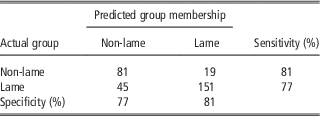
From the randomly selected cows, lactation stage data of four cows was missing (one mildly lame cow and three severely lame cows), hence these cows were omitted from this experiment resulting in 296 measurements. The variables that were selected during the modelling procedure for the first model using solely the gait variables were asymmetry in stride length, asymmetry in stance time and asymmetry in stride time together with stride length, stance time, step overlap and abduction. In the second model all cow and environmental factors were added to the data set, but only lactation stage (DIM) and age were withheld by the algorithm during model building. The results of both the algorithm using solely gait variables and the results of the algorithm that combines gait variables with cow factors are summarised in Tables 6 and 7, respectively.
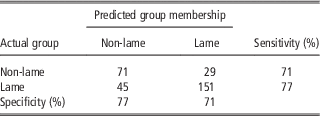
Summary of classifications of non-lame and lame cows using solely cow-gait variables obtained from the Gaitwise system based on the training data set

Summary of classifications of non-lame and lame cows using a combination of cow-gait variables obtained from the Gaitwise system and cow and environmental factors

Discussion
In the present study, the effect of environmental and cow-related factors on locomotion variables acquired for non-lame, healthy cows was investigated. A dark environment was found to have a significant influence in terms of more asymmetry in step length and less step overlap compared with locomotion during natural daylight. Although the light intensity of the artificial light that was present during dark periods was not measured, these results suggest that more artificial light might be needed for the cows to show similar walking behaviour as performed during natural daylight. In rainy weather and hence on wet walking surface, cows did take shorter and more asymmetrical steps compared with non-rainy weather. Based on the video footage, cows were noticed to walk slowly with their head down in the rainy and windy weather. Based on these observations, the shorter and more asymmetrical strides can explain their adaptations to a slower and more cautious locomotion to reduce the risk of slipping or the lower motivation to walk through rainy and windy weather. The present results are in line with those of the studies of Phillips and Morris (Reference Phillips and Morris2000) and van Der Tol et al. (Reference van Der Tol, Metz, Noordhuizen-Stassen, Back, Braam and Weijs2005), in which wet or slippery surfaces were significantly associated with reduced speed assuming that the rainy weather condition in this study, did change the slipperiness of the rubber flooring of the measurement zone.
Older cows walked slower, with more abduction and in general more asymmetry compared with the younger and hence more agile cows. Although udder size was not measured in this study, the reduction in speed and step overlap and the increase in abduction with increasing age can – besides the decrease in agility of older cows – most likely be attributed to an increase in udder size with age, as reported by other researchers (Boelling and Pollot, Reference Boelling and Pollot1998; Telezhenko and Bergsten, Reference Telezhenko and Bergsten2005). Larger udders might force cows to swing their hind legs around the udder resulting in more abduction and might also hinder the hind legs in the forward movement resulting in shorter steps with the hind legs and hence, less step overlap.
Due to the high correlation of production level with DIM and gestation stage, production was not withheld in the final model. During univariable testing, however, both stride length and step overlap were significantly decreased with increased production. Under the assumption that the size of the udders is positively correlated with the production level, the shorter strides and less step overlap could be assigned to the larger udders. In literature, however, no clear evidence can be found between production level and size of the udder. In addition, measurements were specifically performed after milking to prevent possible impacts of the filling of the udder on the locomotion of the cows.
Increasing lactation stage, calculated as DIM, showed significant associations with more asymmetrical and shorter strides with less step overlap compared with earlier in lactation. Again, these finding could be allocated to the udder size although no measurements were performed with full udders or during peak lactation (as most cows are used for feeding experiments during the first months of lactations and hence are housed in a barn where no Gaitwise measurements could be performed). However, due to the high correlation between lactation stage and gestation stage (R²=0.69), the stage of gestation might be a better explanation for the more asymmetrical, shorter – and hence slower – locomotion with less step overlap. The presence of a growing – and hence heavier – foetus in the uterus of the cows can hinder the gait of the cows, mainly the step overlap. Step overlap even tended to be negative during the last months of the gestation, meaning that the imprints of the hind legs did not reach the imprints of the front legs (Figure 1). Even though – except for one cow – step overlap in every cow declined towards the end of the gestation period, a large variation between cows was noticed (Figure 2). Only 3% of the variation in step overlap could be explained by DIM, so other influencing factor – besides those included in this study – should be accounted for. One possible explanation might be that cows tend to walk more carefully towards the end of the gestation. Carrying weight has been linked to slower and shorter strides in equine and human gait (Martin and Nelson, Reference Martin and Nelson1986; Pascoe et al., Reference Pascoe, Pascoe, Wang, Shim and Kim1997; Wickler et al., Reference Wickler, Hoyt, Cogger and Hall2001). Hence, the presence of heavier calves by the end of the gestation period might be the explanation for the slower and more asymmetrical locomotion towards the end of the lactation (c.f. gestation), as suggested by Chapinal et al. (Reference Chapinal, de Passille and Rushen2009). In the majority of pregnancies in dairy cattle, the foetus is carried in the right uterine horn. In addition, more calves in these right-sided pregnancies are male and thus often heavier than those in the left horn (Foote et al., Reference Foote, Tyler and Casida1959; Morrow et al., Reference Morrow, Roberts and McEntee1968; Giraldo et al., Reference Giraldo, Hylan, Bondioli and Godke2010; Gharagoslou et al., Reference Gharagozlou, Vojgani, Akbarinejad, Niasari-Naslaji, Hemmati and Youssefi2013). Unequal distribution of extra weight during pregnancies might indeed induce a more asymmetric gait.
Cows in early lactation enroled in this study did show less asymmetry in their stride lengths compared with further in lactation, which might be similar to the decrease in asymmetry and arching of the back after calving that was found in the study of Chapinal et al. (Reference Chapinal, de Passille and Rushen2009). However, no analysis on the difference in asymmetric gait variables before v. after calving of individual cows was done in this study due to the lack of gait data before calving (dry cows are housed in different barn) and data after calving as most of the cows were enroled in feeding experiments after calving and could therefore not measured by the Gaitwise. As the Gaitwise system is based on measurements of claw-floor variables, no automated measurements of arched back were performed.
As several cow and environmental factors that were selected into the final model influence the locomotion of non-lame cows, a pilot study was performed to investigate the effect of adding these influencing factors to a lameness detection system on the number of false alerts. This added value was investigated by comparing the performance of two lameness detection models: one using solely the measured gait variables and a second one using the measured gait variables combined with the influencing factors of experiment 1. During the LDA using solely the cow-gait variables, three variables of asymmetry (in stride length, stride time and stance time) and stride length, step overlap and abduction were withheld for model building. Out of the 100 non-lame cows based on the reference scoring of the trained observer, 29 cows were misclassified as lame by the model (Table 6).
When also the cow and environmental data were added to the data set for model building, 10 non-lame cows that were falsely alerted as lame by the first model, were now correctly scored as non-lame resulting in an increase in sensitivity for the classification of non-lame cows from 71% to 81% (Tables 6 and 7). In the second model, only lactation stage (DIM) and age were withheld as additional variables to the measured gait variables. Similar to the approach used in the first experiment, both gestation stage and parity were not used in this model due to the high correlation with lactation stage and age, respectively. Due to the lack of any relation between production and cow-gait variables, also production was omitted from the data set. None of the environmental variables (wet surface or dark environment) seemed to be of added value based on this pilot study. Hence, in this pilot study, adding information on the lactation stage and the age of the cows decreases the number of false alerts. However, other approaches to combine environmental and cow factors into a model with lameness-related variables might be more suited as the correlation between these variables within cows should be taken into account during model building.
Conclusion
The effect of cow and environment factors on the gait variables of non-lame, healthy cows has been investigated using measurements of 30 cows during 5 months. Cows tend to walk with smaller strides, less step overlap and more asymmetry in stride length towards the end of the lactation or the end of the gestation and when they get older. In dark environments and on wet walking surfaces cows took shorter, more asymmetrical strides with less step overlap. During model building, age and lactation stage were withheld into the model based on cow locomotion variables and the sensitivity for detecting non-lame cow increased from 71% to 81%. Hence, the number of false alerts of lame cows that were actually non-lame, decreased.
The tested factors of this pilot study were limited and a follow up study with more factors and more cows, during all days of lactation and gestation could provide more information about the influence of these factors on cow locomotion.
Acknowledegements
Special thanks are due to the technical staff and the animal keepers of Institute for Agricultural and Fisheries Research.