Coalition theory: a veto players’ approach
Theories and empirical research on coalition formation have been a very important part of political science for the last 50 years. This literature is very diverse: it ranges from cooperative game theory (which for the most part ignores the policy positions of parties) to non-cooperative game theory (which minimizes party distances, and calculates the ‘continuation value’ of a coalition formation game), to empirical studies (which identify the policy positions of different parties in the coalition formation process and their influence). We argue that coalitions depend not only on characteristics of parties but also on the institutional characteristics of a political system, in particular the agenda setting rules regulating interaction between government and parliament.
We argue that if governments are interested in the policymaking phase (not just the coalition formation game), then they will try to become more influential, either by using positional advantage (centrality) or the institutional advantage provided by existing legislation. Because institutional advantage precedes the coalition formation process, parties will include information about the institutions in their coalition formation calculations: if the government has strong agenda setting powers, all parties would be willing to be part of the government; if the agenda setting powers are low, only centrally located parties and parties close to each other will be able to have a policy impact and not be rolled on the floor of parliament. Consequently, in the absence of single-party majorities, parties to the left or the right of the political spectrum will be able to govern a country only if there are strong agenda setting institutions.
The implications of these analyses for the study of political systems are significant. For example, instead of arguing that Italy (of the first Republic) is a consensus system (Lijphart, Reference Lijphart1981, Reference Lijphart1999), or that the Netherlands are a case of extreme pluralism (Sartori, Reference Sartori1976), we argue that both countries have institutional structure attributing weak agenda setting powers to their governments, and as a result are governed by centrist coalitions.
In order to develop this argument, we organize this paper into five sections. First, we discuss the coalition formation literature. Second, we discuss the literature on agenda setting in parliamentary systems (Doering, Reference Doering1995a, Reference Doeringb) and the literature on executive dominance (Lijphart, Reference Lijphart1981, Reference Lijphart1999) that has not yet been connected to the coalition formation literature. Third, we explain how the agenda control and executive dominance literature can be merged to generate expectations on the subject of coalition formation. In the following two sections, we describe the data and empirical models employed and present our findings. In the final section, we discuss the implications of these empirical results.
Theories of coalitions
The goal of this paper is to examine the interactive impact of positional and institutional advantages on the policymaking process that, so far, has been ignored in the coalition formation literature. This paper presents a very partial but focused account of coalition formation models: we do not include models that deal with elections and coalition formation (Austin-Smith and Banks, Reference Austin-Smith and Banks1988; Lupia and Strøm, Reference Lupia and Strom1995); nor do we discuss arguments that posit that coalitions are formed as a result of party leaders striving to keep their positions (Luebbert, Reference Luebbert1986).
The initial coalition theories based on cooperative game theory were policy-blind. They held that coalitions would form only to include the parties that were necessary to form a winning (majoritarian) coalition (Von Neumann and Morgenstern, Reference von Neumann and Morgenstern1944; Riker, Reference Riker1962; Leiserson, Reference Leiserson1966). More sophisticated studies such as Laver and Schofield (Reference Laver and Schofield1990), Sened (Reference Sened1996), Schofield (Reference Schofield1995), and McKelvey and Schofield (Reference McKelvey and Schofield1986, Reference McKelvey and Schofield1987) have also developed models in multiple dimensions addressing the lack of equilibrium by identifying other solution concepts that would produce centrist results, even if there exists no ‘core’ (i.e. a set of outcomes common in all possible majority coalitions). These models produced expectations that government coalitions will be centrally located, but because they were based on cooperative game theory (where agreements are enforceable) they ignored the institutions that regulate coalition bargaining, in particular the importance of a ‘formateur’ party (i.e. a party that is assigned the task of forming the government). This party is selected by the head of state (king or president), who thus selects the future prime minister. The rules for this selection are either fixed in the constitution, the product of enduring unwritten norms, which the head of state obeys, or the product of other calculations (see below).
Non-cooperative game-theoretic models paid attention to this institutional detail and developed very different outcomes of the coalition formation process depending on the rule of selection. In particular, Baron (Reference Baron1991) develops a model with three parties in two dimensions based on two rules of selection: (1) a sequential rule for the selection of a formateur; or (2) a random selection rule (where the probability of selection of a party is proportional to its size). Each process produced significantly different outcomes. The logic of Baron's (Reference Baron1991) model is that the formateur will apply a mixed strategy regarding which party to whom he will make the offer to join him in the government formation, and that each party will estimate its ‘continuation value’ in the government formation game (i.e. it will see what its own utility is from rejecting the offer and letting the game continue according to the rules). In equilibrium, these utilities would be equal to each other. (The proposing party is indifferent between the two alternative proposals it can make, and both recipients are indifferent between accepting and rejecting.) As a result of this logic, ‘equilibrium policy proposals reflect the preferences of the parties out, as well as in, the government’ (Baron, Reference Baron1991: 156).
Another property of the model, as Baron explains, is that ‘the policies considered here are not intended to represent policies that need either legislative approval or agreement within the cabinet for their implementation. The formation of a government thus need not be cemented by the allocation of portfolios or ministries but, instead, is identified by a policy program that is sustained by a majority on a vote of confidence’ (Baron, Reference Baron1991: 139–140). According to this logic, there are two central conditions in the model. First, it ignores the effects of portfolio allocation (for alternative non-cooperative models, see Crombez (Reference Crombez1996) and Kalandrakis (Reference Kalandrakis2000)). Second, it assumes that coalition bargaining is distinct from policymaking. We will focus on this point, which is the fact that the agreements examined in his model are independent from ratification by parliaments or governments. Yet the reason that governments are formed is for the selection and implementation of policies.
There has been a model that focuses on both policy production and implementation: Laver and Shepsle's (Reference Laver and Shepsle1996) model of portfolio allocation focuses on the agenda setting role of government. The model assumes that each minister has exclusive jurisdiction over his area of expertise, and that agreements are not enforceable; this means that each minister will implement his own preferences when he receives his portfolio. Consequently, the only choices available in the coalition formation process concern which portfolio will be allocated to which party. (This way the infinite space of outcomes that defeat the status quo in a multidimensional model gets reduced to a finite one.) This model has the additional advantage of coming to specific predictions, not just producing existence results. However, Warwick (Reference Warwick1996) has raised serious questions about the empirical reliability of this model and we echo his concerns.
In this paper, we take a different tack than both Laver and Shepsle (Reference Laver and Shepsle1996) and Baron (Reference Baron1991): unlike Laver and Shepsle (Reference Laver and Shepsle1996), we will assume that governments have a collective responsibility and select and implement the agreements they make. Also, in contrast to the Baron (Reference Baron1991) approach, these agreements need to be ratified by parliament, and thus one has to examine the institutions regulating the interaction between governments and parliaments (‘agenda setting’ or ‘executive dominance’). Because governments may have more or less power to do as they wish, this information should enter into our calculations of how and which coalitions form.
Executive dominance and agenda control
In political science, a classic and fundamental distinction among different countries is their regime type: are they presidential or parliamentary systems? The distinction between these regime types is clear: a division of powers in presidential systems, stemming from separate elections of the executive and legislature and the lack of political responsibility of one to the other, and a collaboration of powers in parliamentary systems originating only from the election of the legislature, and the ability of the legislature and the executive to dissolve each other and go back to elections. The literature on these distinctions and on the characteristics of the two different systems is expansive and ever-growing (for a recent literature review, see Elgie, Reference Elgie2005).
Recently, more nuanced approaches have emerged concerning the study of regime type. These unify the different regimes and examine their properties regardless of regime type; the first example of this is Lijphart's consociationalism approach as presented in his books Democracies (1981) and Patterns of Democracy (1999); the second is Tsebelis’ veto player approach in Veto Players (2002). Lijphart (Reference Lijphart1981, Reference Lijphart1999) consociationalism approach divides political systems based on whether regimes are majoritarian (a regime that assigns decisions to a simple majority of the people) or consensus (a regime that assign decisions to ‘as many people as possible’) (1999: 2). On the other hand, Tsebelis’ (Reference Tsebelis2002) veto players’ approach focuses on the number and ideological distance of individual or collective actors whose agreement is necessary to change a status quo (SQ).
Both of these approaches identify differences between presidential and parliamentary systems, but not in the rigid way that is inherent in the definitions used in the traditional regime-types literature. In the consociationalism approach, the difference exists in the ‘executive dominance’ variable, while in the veto players’ approach, the difference lies in the number of veto players and their ideological distances as well as agenda setting power. Presidential systems have (on average) a greater number of veto players, and thus larger ideological distances among them than parliamentary systems. In addition, in presidential systems the legislative agenda is controlled by the legislature; in parliamentary systems by the executive. Other rational choice models also point out that the distribution of agenda setting power is a major difference between presidential and parliamentary systems (Diermeier and Feddersen, Reference Diermeier and Feddersen1998; Persson and Tabellini, Reference Persson and Tabellini2000). These analyses point to the general conclusion that policymaking power is concentrated in the hands of governments in parliamentary systems and in the hands of parliaments in presidential ones – exactly the opposite of what their names would suggest.
Lijphart focuses on the ‘executive dominance’ variable, which measures ‘the relative power of the executive and legislative branches of government’. He asserts that, ‘for parliamentary systems, the best indicator [for executive dominance] is cabinet durability’ (1999: 129). This ‘executive dominance’ variable has been criticized by Tsebelis (Reference Tsebelis2002) on grounds of logical consistency, but we will use it here as an indicator of what a prominent political scientist believes to be the relationship between the executive and the legislature. The empirical results will demonstrate that it is indeed relevant and helpful.
A more convincing and theoretically coherent approach to the relationship between governments and parliaments is offered by Doering (Reference Doering1995a, Reference Doeringb) in a series of articles about agenda setting.
Doering (Reference Doering1995a, Reference Doeringb) explains that the power of agenda setting is the reason why governments in parliamentary systems dominate the policymaking process. Among the many possible policy solutions available, the government is able to select their preferred policy choice to propose before the parliament; and they have the institutional means to defend the policy and prevent it from being altered on the floor of the parliament. Doering (Reference Doering1995a, Reference Doeringb) identifies seven variables that contribute to the agenda setting powers of governments when producing common legislation.
-
1. Authority to determine the plenary agenda of parliament. This variable has seven modalities; the two extremes are that the agenda can be determined by the government or by the parliament alone.
-
2. Money bills as government prerogative. While this prerogative belongs to the government in all countries, in some countries members of parliament are restricted from proposing money bills.
-
3. Is the committee stage of a bill restricted by a preceding plenary decision?
-
4. Authority of committees to rewrite government bills. This addresses the question of whether the government bill reaches the floor with comments by the committee, or does the committee amend the government bill and submit its own proposal to the floor?
-
5. Control of the timetable in legislative committees.
-
6. Curtailing debate before the final vote of a bill in the plenary.
-
7. Maximum lifespan of a bill pending approval, after which it lapses if not adopted. The shorter the lifespan of a bill if not adopted by parliament, the more imperative the agenda setting power of the government.
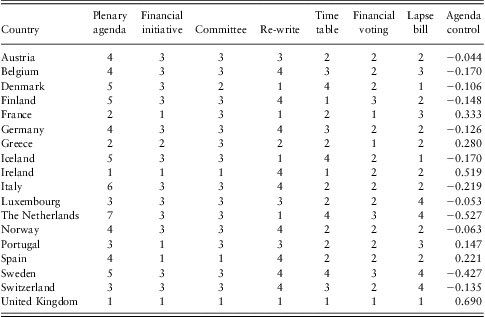
Table 1 provides the score of each country in each of the seven agenda control variables, along with the first factor of a principal components analysis performed by Tsebelis (Reference Tsebelis2002). The first eigenvalue explained 47% of the variance. Doering's (Reference Doering1995a, Reference Doeringb) assessment of agenda setting powers remains the most advanced indicator in the literature of parliamentary systems because he has compiled a series of objective indicators about agenda control, regardless of the regime type (i.e. parliamentary, semi-presidential, and presidential systems).Footnote 1 Doering's (Reference Doering1995a, Reference Doeringb) agenda control and Lijphart's (Reference Lijphart1981, Reference Lijphart1999) executive dominance indicators both revolve around the same idea: the critical variable is the ability of governments to select the policies they prefer as opposed to having them massively amended by parliaments. Having discussed these two different groups of theories, we will now connect them and show the relevance of agenda setting for coalition formation.
Government Agenda Control (Doering, Reference Doering1995a)

Veto players: merging coalition theories and agenda control
There are a series of findings replicated in the empirical literature that could be attributed to several theoretical approaches, and then there is one that has been effectively orphaned, left unchallenged (empirically) and unexplained (theoretically). We explain this as yet unverified finding through a combination of the coalition theories presented in the first part of this paper, and the agenda setting ones presented in the second.
The findings that corroborate several theories are the following: first, government formateurs are centrally located parties; second, other parties have a higher probability of participating in governments the closer they are ideologically to the formateurs and the further the formateurs are from the center of the political spectrum. The finding that is an ‘orphan’ stems from the fact that government characteristics, not parliamentary ones, account for the longevity of parliamentary governments.
The centrality of government formateurs and parties has been tested by Warwick (Reference Warwick1998) and confirmed through a different methodology by Martin and Stevenson (Reference Martin and Stevenson2001). Warwick (Reference Warwick1998) tests theoretical models by Crombez (Reference Crombez1996) based on non-cooperative game theory and Sened (Reference Sened1996) based on cooperative game theory. The reason for the centrality of government formateurs is that centrist parties (if they are selected as formateurs) can find parties located close to them in every direction in the policy space while for extremist parties this is only true in one direction – toward the center. Non-centrist parties (if they are selected as formateurs) can find more parties in close proximity toward the center than at the extremes (and they may not find other extremist parties if they are extremists themselves). Given that all the ideological models consider minimizing ideological distances as one of the components of party goals (the other being maximizing government seats for each party), centrist governments will indicate a higher goal achievement than extremist ones.
The other half of this finding is that government survival depends on government characteristics (i.e. decreases with the number of parties in government and their ideological distance) and not on parliamentary characteristics as other coalition theories predict. This finding is surprising because game-theoretic models of coalition formation calculate the ‘continuation value’ of the different party moves (i.e. what will happen if a proposal is not accepted). All of these calculations are based on the characteristics of the parliament that forms the different coalitions, since it is the parliament that will accept or reject any coalition formation. How do we make sense of these two different interpretations?
One could think that government and parliament characteristics correlate, since multiparty systems generally give birth to multiparty governments. This expectation on the average is true, but there are several multiparty systems that generate single-party minority governments (Norway) or single-party majority governments (Greece). When Warwick (Reference Warwick1994) introduced both parliament and government characteristics in his empirical estimations of government duration, the parliamentary features dropped out and only the ideological distances of parties remained a significant variable. These results were corroborated by Saalfeld (Reference Saalfeld2010) who finds that it is the number of parties in government (not their distances) that matters. Here we provide a unified framework that explains all of these empirical features and generates additional empirical expectations that will be confirmed in the final part of this paper.
Parties participate in parliamentary government because they are strongly interested in policies and because governments more or less control the agenda in parliamentary systems. Discussing the issue of agenda setting, Tsebelis (Reference Tsebelis2002) has argued that there are institutional, positional, and partisan advantages. In the coalition formation game we ignore the partisan advantages (since we are discussing coalitions it means that there are no stable partisan majorities) and we instead focus on institutional and positional advantages.
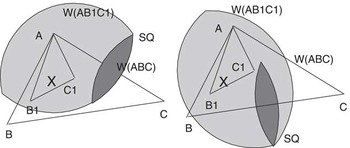
First, let us explain why coalition partners prefer to minimize the ideological distances among them. If they are interested in policymaking as this article assumes, they are seeking to increase the winset of the SQ, that is, they want to increase the number of alternatives they have for policymaking. In Figure 1, we present a simple case of a three-party coalition where all distances among the parties can decrease at the same time. This is a case where the smaller distance solution is preferred no matter where the SQ is located. It should not be perceived as a general formula able to predict which party will enter a coalition, because the outcome usually depends on the position of the SQ. Consider that party A is the formateur, and has a choice among two possible situations: the two other coalition partners are closer (parties B1 and C1) or further away (parties B and C) from its ideological position. Figure 1 shows that no matter where the legislative SQ is located party A will have more options in coalition AB1C1 than in coalition ABC. This is because the winset of the SQ with respect to ABC is contained within the winset of AB1C1, no matter where SQ is located. Both parts of Figure 1 indicate that if party A controls the policymaking agenda it can select its own ideal point if the coalition is AB1C1, but will have to accept something less with ABC.
Effects of ideological distance on policymaking.

However, it should not be taken for granted that the formateur, in this case the prime minister, controls the agenda. While some of the literature has made this point (Huber, Reference Huber1996), other authors maintain that the prime minister is in charge (Laver and Shepsle, Reference Laver and Shepsle1996), or in some cases the minister of finance (Hallerberg and von Hagen, Reference Hallerberg and von Hagen1999). There is no systematic evidence in the literature by which to investigate the veracity of all these claims. In Figure 1, we can dispute this assumption, and attribute agenda setting power to B or B1 (in the case of the ABC or AB1C1 coalition). Still, the formateur (party A) is better off with a coalition AB1C1 than ABC. Indeed, if B controls the policymaking agenda it will select the point closer to it in W(ABC), which is further away from A than B1 (the point that will be selected if B1 controls the agenda). Finally, we can consider another assumption that the government divides agenda setting rights among its different components, so that the whole process is as if the actual agenda setter is somewhere in the triangle ABC or AB1C1. Still, the conclusions are not altered, because this fictitious actor will make his best proposal within the winset of the SQ, and again this proposal will be better for actor A in the AB1C1 case than in ABC. In Figure 1, we have drawn the indifference curves of an actor X located somewhere inside the triangle AB1C1.
Thus, our argument is that the reason parties minimize the distances among coalition government partners is because they will be able to implement more plans, or respond to more shocks, the closer they are to each other. This point, though constantly assumed in the literature, is nevertheless rarely clearly articulated or substantiated. In addition, because the policymaking aspect has been ignored, the institutions regulating the interaction between government and parliament have not been included in the analysis. To this unexplored point we now turn.
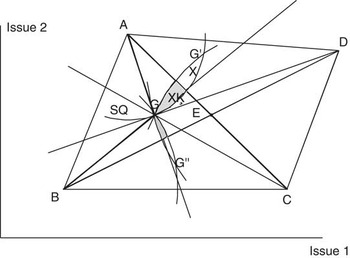
Why should the formateur be a centrist party instead of an extremist one? In the non-cooperative game-theoretic literature formateur selection is either random, or given through an exogenous rule; also, (under complete information) the first formateur will be able to form a government, regardless of his policy position (Baron, Reference Baron1991). By contrast here we endogenize formateur selection and connect it to the policymaking process leading to different expectations. Think of a party without a parliamentary majority (say, the formateur of a parliamentary government) who has to select partners for a coalition. First, we will give a narrow interpretation of Figure 2, then we will use the argument surrounding Figure 1 for a wider interpretation. In the more narrow interpretation, Figure 2 presents a five-party parliament with parties of relatively equal strength (a majority requires three of them) and explains why it is more reasonable that the formateur will be selected in the center of the political spectrum (party G) and will select other parties as a function of the agenda setting powers available.
Effect of centrality of formateur.

Any one of the peripheral parties will require a stable three-party majority. In order for this majority to include party G (like ABG or BCG), the formateur party will have to offer G more policy advantages than it could get by itself (otherwise G would not be willing to participate in the government), and if it does not include G (like ADC or BCD) they will have to be able to make proposals that will get a majority despite the lack of support by G. In all cases, the analysis would have to include what G is able to do by itself in terms of policy.
The entire policy space can be divided into three mutually exclusive and collectively exhaustive subsets: the points preferred to G by a majority (the interior of two lenses called GG′ and GG′′ in the figure), the points for which a majority is indifferent to G (the broader of the two lenses), and the points that are defeated by G by a majority (the rest of the plane).
As a result G will be a very expensive partner to be included in a coalition, and a coalition without G has very little chance of policy success. Chances are that nobody else will be nominated to form a government, and even if they were, they would not accept the offer.
So far we have discussed a narrow interpretation according to which G was a single, minority party. However, on the basis of the argument just presented concerning the hypothetical policy agenda setter in Figure 1 (point X in that figure), G could already be a minority coalition (if it were a majority coalition it would most likely not have a problem of selecting further allies). But will G agree to form a government if it is in a minority?
Step by step, we will examine the policy advantages that G has if it forms a minority government under a series of different agenda setting rules. In particular, we will focus on the relation between institutional and positional advantages. We will demonstrate that the institutional agenda setting advantages to the government, while always welcome, are more important for an extremist agenda government than for a centrist one. We will consider three different rules. First, we consider a closed rule (the government can bring a ‘take it or leave it’ proposal to the floor of the parliament). Then we will consider agenda setting rules that include the ability of the government to make the last amendment on the floor of the parliament (assuming that the corresponding minister can offer the last amendment, or an MP who belongs to party G). This rule is what Weingast (Reference Weingast1992) has called ‘fighting fire with fire’, and which Heller (Reference Heller2001) has demonstrated exists in many countries. Finally, we will consider an open rule according to which members of parliament can modify the government's proposal any way they want.
1. Under the closed rule, G can have its own preference voted by a majority in parliament as long as the SQ is not included in the lenses GG′ or GG′′. From the findings in Figure 2 it is obvious that as G approaches the intersection E of the two diagonal lines connecting the four extreme parties the size of these lenses shrinks.Footnote 2 If the SQ is located inside the shaded part of the lenses, the government cannot guarantee itself a better outcome, so it will probably leave the SQ as it is. If it is in the non-shaded part of the lenses, it can propose something inside the shaded area that will prevail (the symmetric of SQ with respect to the corresponding diagonal gets a majority).
2. Under the ‘fire by fire’ rule, the only amendments that can defeat G are inside the two lenses. If such an amendment is proposed in the shaded areas the government will let it stand; if it is in the non-shaded areas of the lenses, the government will counterpropose another amendment that falls within the shaded part of the corresponding lens and this amendment will be the final outcome.
3. Under open rule, when the government proposes its own ideal point, anything inside the lenses GG′ and GG′′ can be proposed on the floor, and it will defeat G.
In conclusion, a minority government of G has the ability to obtain outcomes inside the shaded area of the two lenses under the closed rule or fire by fire rule, and inside the whole lenses under the open rule. The area of the final outcome shrinks as the government moves to the center of parliament. In other words, the government has two distinct advantages: the centrality of its location inside parliament (positional advantage), and the agenda setting rules (institutional advantage).
Figure 2 is an example of an unusual feature: if G is located in the intersection of the two diagonals, it is the multidimensional median in the (two dimensional) policy space. However, the argument we made above is more general than the five parties and two dimensions presented in Figure 2. If the number of parties and policy dimensions increases, instead of focusing on the intersection of the two dimensions, one would have to see the distance of the government party or coalition from the center of the yolk (Ferejohn et al., Reference Ferejohn, McKelvey and Packell1984; Tsebelis, Reference Tsebelis2002) of the party system. As this distance increases, the positional advantage of the government decreases.
These two advantages (the institutional and positional) are not simultaneously attributed to governments. The institutional advantage is pre-existing, inscribed in the institutional rules of agenda setting (studied and formalized explicitly by Doering (Reference Doering1995a, Reference Doeringb) and implied by Lijphart (Reference Lijphart1981, Reference Lijphart1999), in their indicators). The positional advantage is generated with the coalition formation process. A government without institutional or positional agenda setting advantages cannot have its policy proposals accepted. As a result, the positional advantage will be more worthwhile in policymaking terms the lower the level of agenda setting privileges that a government has. Governments with lots of agenda setting powers will not care very much about positional advantages, while governments with low agenda setting powers will be as effective as their positional advantages permit.
This relationship between institutional and positional advantages is the focus of the empirical investigation of this paper. As shown in Figure 1, it is always better to have smaller ideological distances among coalition partners, and it is always better for the government to be centrally located, as is displayed in Figure 2. However, institutional advantages in agenda setting may subsume these positional advantages. In the absence of institutional advantages, centrality of the formateur and small ideological distances among coalition partners will be necessary. So, our hypotheses can be summarized as follows:
Hypothesis 1: As a government has less institutional advantage at its disposal, central policy position of formateur becomes necessary.
Hypothesis 2: As a government has less institutional advantage at its disposal, small policy distance among coalition partners becomes necessary.
Out of the two hypotheses, the second is expected to have stronger empirical corroboration, because it depends on the political actors that participate in the government coalition. The first one (formateur selection), however, is determined by multiple factors, not just by the political game. For example, in certain countries (e.g. Greece) it is determined by the constitution. In others, there are strong norms to appoint the largest party. Finally, the choice is made by the head of state (king or president) and it depends on his understanding of the situation (e.g. whether the first party won or lost in the last election, how close this party is to his/her own policy positions). An interesting example in that respect is Sandro Pertini who, as president of the Republic of Italy, avoided appointing a Christian Democrat to the position of prime minister, despite the presence of a strong norm. Being a Socialist himself, he appointed the first Socialist prime minister of Italy (Betino Craxi in 1983) as well as a prime minister from the small Republican party (PRI; Giovanni Spandolini in 1981). He even made unsuccessful attempts to appoint other small party prime ministers (Ugo La Malfa from the PRI). The most recent government formation negotiations in Italy where President Napolitano, after selecting the person with a majority of votes in the Lower House (who failed to secure a majority in the Senate), is now focusing on the selection of the appropriate personality outside party establishments, indicates that parties in parliament may not be the only factors determining formateur selection. All these factors are expected to produce a significant amount of noise in the data, and therefore Hypothesis 1 will have weak (if any) corroboration.
Data and models for analysis
Policy position is a major determining factor in the process of the coalition formation of parliamentary governments. Warwick (Reference Warwick1998) has studied the positional advantage of coalition governments, but he did not condition that positional advantage on agenda setting powers. The empirical analysis of this paper replicates Warwick's (1998) positional findings, and then remedies its shortcomings by conditioning them on the agenda setting indicators of Doering (Reference Doering1995a, Reference Doeringb) (i.e. agenda control) as well as Lijphart (Reference Lijphart1999) (i.e. executive dominance). Following the established theoretical findings of the literature, we consider a two-step process in our model: first, the selection of a formateur, and second, the formation of the government (conditional upon the selection of a formateur).
Data
Dependent variables
The two dependent variables are formateur party selection, a dummy variable coded ‘1’ for formateur parties and ‘0’ for non-formateur parties, and government membership status, a dummy variable coded ‘1’ for parties that entered the government and ‘0’ for parties that did not. The formateur party is the party of the individual who forms the government.
Positional variables
The three positional variables – party and formateur non-centrality, party-formateur distance, and party-system polarization – used in this paper are generated by the same process as employed by Warwick (Reference Warwick1998). We will not give a detailed report on the data generating process here. However, what is interesting to note is that the positional data used in this paper were generated in a cumulative way: starting with an article by Crombez (Reference Crombez1996), developed in the following work by Warwick (Reference Warwick1998) and then expanded in our research. Warwick found that the government formation process (conditional upon the selection of a formateur) leads to the inclusion of more parties when the formateur is smaller or not centrally located, and even more so if these parties are in ideological proximity with the formateur.
We expand Warwick (Reference Warwick1998) dataset up to 2003 by using the Comparative Manifestos Project (CMP) dataset.Footnote 3 We first extracted two-dimensional factor scores from the CMP data and then calculated three positional variables following Warwick's definitions (1998).Footnote 4 First, party noncentrality (or formateur non-centrality) is calculated in each parliament as the squared distance of the party (or the formateur) from the centroid of all parties’ positions divided by the sum of all parties’ squared distances from the centroid. Second, party-formateur distance – the distance between a party's policy position and that of the formateur – is measured by the squared distance between the two parties’ positions divided by the sum of all parties’ squared distances from the centroid. Finally, party system polarization – the degree of policy distance among all parties – is measured by means of the standard deviation of the parliamentary party system.Footnote 5
Agenda setting power
Agenda control and executive dominance are measured by Doering (Reference Doering1995a, Reference Doeringb) and Lijphart (Reference Lijphart1981, Reference Lijphart1999), respectively. The interaction terms between positional variables and agenda setting power are used to examine how the pre-existing institutional power reduces the impact of positional advantage on government formation.
The other variables used for the analysis are the party size and formateur size, representing, respectively, the proportions of parliamentary seats held by the party and the party that actually formed the government. Pro-system fractionalization is Laakso-Taagepera's (Reference Laakso and Taagepera1979) ‘effective number’ of pro-system parties in the legislature. High party system fractionalization may enhance the formation of minority governments because it hinders the formation of winning coalitions (Dodd, Reference Dodd1976). It may also do so by improving the largest party's bargaining position (Crombez, Reference Crombez1996). Total party system fractionalization is likely to be highly correlated with party system polarization because a fragmented parliament tends to be polarized. To make the effect with numbers alone, following Warwick (Reference Warwick1998), we use only the pro-system parties, the parties that are involved in coalition bargaining.Footnote 6 The newly generated variables in this paper are all highly and strongly (P < 0.000) correlated with the initial ones generated by Warwick (Reference Warwick1998).Footnote 7
Models
In this paper, we build a series of regression estimates of formateur party selection (Table 2) and government membership (Table 3) between 1945 and 2003 for 17 West European parliamentary governments: Austria, Belgium, Denmark, Finland, France, Germany, Greece, Iceland, Ireland, Italy, Luxembourg, Netherlands, Norway, Portugal, Spain, Sweden, and the United Kingdom. The observations in the analysis are based on the number of parties in the legislature. Since the focus is on coalition governments, we exclude parliaments with majority parties (See Crombez, Reference Crombez1996; Warwick, Reference Warwick1998). For the period under consideration (1945–2003), this yields 388 parliamentary governments and 2671 parties.Footnote 8
Impact of positional advantage and agenda setting power on formateur selection

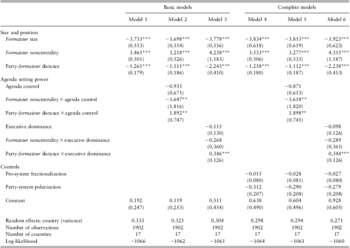
Notes: Multilevel logit model.
Units of analysis are individual parties.
The dependent variable is coded ‘1’ to indicate that the party is a formateur party and ‘0’ otherwise.
Standard errors are given in parentheses.
Statistical significance is based on the two-tailed tests.
***P < 0.01, **P < 0.05, *P < 0.1.
Impact of positional advantage and agenda setting power on government membership

Notes: Multilevel logit model.
Units of analysis are individual parties.
The dependent variable is coded ‘1’ to indicate that the party is a member of the government and ‘0’ otherwise.
Standard errors are given in parentheses.
Statistical significance is based on the two-tailed tests.
***P < 0.01, **P < 0.05, *P < 0.1.
The dataset used for this research has a hierarchical structure: parties (level 1) are nested within government formation opportunities (level 2), which themselves are nested within countries (level 3). The model includes predictors from each level as well as cross-level interactions. Running a standard logit model (as Warwick, Reference Warwick1998, did) would ignore the multilevel structure of the data. As a consequence, the resulting confidence intervals for the coefficients of the higher-level variables would be too small. For instance, the agenda control and executive dominance variables vary only by country. However, the unit of analysis is individual parties. Therefore, the standard error estimates of the country-level variables will be based on more observations (number of parties) than there actually are (number of countries). Ignoring this clustering in the data would violate the assumption that the observations are independent (Steenbergen & Jones, Reference Steenbergen and Jones2002; Gelman & Hill, Reference Gelman and Hill2007). The preferred model is thus a multilevel logit model, which takes into account the clustering in the data. We first estimated a three-level mixed-effects logit model. However, the results suggested that there was very little variance (close to zero) of the random effects for the second level (government formation opportunity), making it sufficient to account for the two-level structure (parties and countries). We thus estimate a two-level mixed-effects logit model and present the results in Tables 2 and 3.Footnote 9
Results of multilevel logit analysis
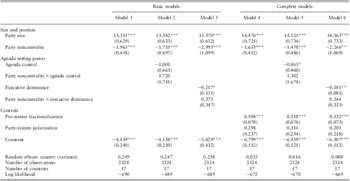
Table 2 presents the impact of the positional variable (i.e. party noncentrality) and agenda setting power (i.e. agenda control and executive dominance) on formateur party selection. Basic models (Models 1, 2, and 3) include party size and noncentrality, and complete models (Models 4, 5, and 6) include pro-system fractionalization and party-system polarization as additional controls. Models 1 and 4 replicate Warwick's (Reference Warwick1998) tests and report the results without the interaction of party noncentrality with agenda setting power. Models 2 and 5 include interactions of party noncentrality with agenda control, and Models 3 and 6 introduce its interactions with executive dominance. The basis variable (agenda control or executive dominance) is introduced in the models with interaction terms in order to produce results that do not depend on the unit of analysis, but there is no expectation concerning signs or significance. All else being equal, centrally located parties tend to be selected as the formateur, yet if the agenda setting power is strong in the government, this positional advantage should matter less for the selection process. The expectation is that noncentrality is negatively associated with formateur selection, but the interactive terms (party noncentrality × agenda control and party noncentrality × executive dominance) are positively associated with it.
The results in Table 2 show that party size and party noncentrality, respectively, are positively and negatively associated with formateur selection with strong statistical significance. As expected, formateur parties tend to be formed by larger and more centrally located parties. The interactive terms have the expected opposite (positive) signs despite weak statistical significance. The results are robust even when additional controls such as pro-system fractionalization and party-system polarization are included in the complete models. The results indicate that even when a party is less centrally located, if the government has stronger agenda control and executive dominance, the party still tends to become a formateur party.Footnote 10
Table 3 presents the impact of positional variables (i.e. formateur centrality and party-formateur distance) and agenda setting power (i.e. agenda control and executive dominance) on government membership. Basic models (Models 1, 2, and 3) include formateur size, formateur noncentrality, and party-formateur distance, while the complete models (Models, 4, 5, and 6) include additional controls for pro-system fractionalization and polarization. Both of the models are the same as used in policy tests conducted by Warwick (Reference Warwick1998); a logit model of the inclusion of parties in government, conditional upon the selection of the formateur. But unlike Warwick (Reference Warwick1998), we also take into account the multilevel structure of the data. Models 1 and 4 replicate Warwick's (Reference Warwick1998) tests and report the results without the interaction variables. Models 2 and 5 include the interactions of formateur noncentrality and party-formateur distance with agenda setting, and Models 3 and 6 include their interactions with executive dominance. Other things being equal, formateur parties that are more centrality located should form smaller governments and the formateur parties should seek partners from their ideological neighbors and should be successful in attracting partners as the ideological distance is closer. However, formateur parties should care less about these positional advantages when agenda setting power is strong. Therefore, formateur noncentrality and party-formateur distance are expected to have positive and negative signs, respectively. However, their interactive terms with agenda control and executive dominance should produce opposite signs (i.e. negative and positive signs).
The results in Table 3 strongly support our expectations. Formateur noncentrality and party-formateur distance, respectively, show a significant positive and negative impact on the odds of government membership. The results clearly support the hypotheses that the centrality of a formateur party should increase its likelihood of forming a smaller government and that larger policy distance from the formateur should reduce a party's likelihood of participating in the government. The coefficients for the interactive terms are highly significant with expected opposite signs with interaction terms, and agenda control producing more significant results than those with executive dominance. The results also hold even when other party characteristics such as pro-system fractionalization and party-system polarization are taken into account in the complete models. The results strongly confirm our argument that the existence of strong agenda setting institutions leads governments to pay less attention to positional advantages. As we expected, size and noncentrality effects are very apparent indicators for government membership patterns, but not as strong for formateur selection (the signs are correct but conventional statistical significance is absent).
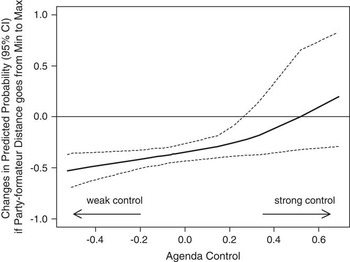
While the coefficient and standard error estimates presented in Tables 2 and 3 give us a first look at the conditional relationships between institutional and positional advantages in the choice of both formateur and government formation, the appropriate test for an interactive logit model is to look at the specific shape of the 95% confidence interval (See Franzese, Reference Franzese2003a, Reference Franzeseb). Figures 3 and 4 are derived from the complete models with interaction terms (Models 5 and 6) in Table 3. Figure 3 presents the combined effects of a party's distance to the formateur and the level of agenda control on the probability of government membership. The theoretical expectation is that parties are less likely to be in the coalition if their ideological distance to the formateur increases, but that this effect is conditional on the agenda setting power of the government. Formateurs should care more about the size of the coalition if agenda setting power is weak, and less if agenda setting power is strong. Therefore, the effect of party-formateur distance is expected to decrease, as agenda control increases.
Changes in predicted probability of government membership as a function of party-formateur distance and agenda control.

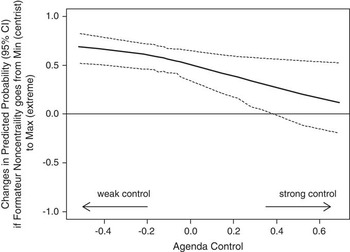
Changes in predicted probability of government membership as a function of formateur noncentrality and agenda control.

Figure 3 illustrates this effect. The y-axis shows the changes in predicted probability of government membership when party-formateur distance changes from its minimum to its maximum value, the solid line indicating the changes and the dotted lines indicating the 95% confidence interval of these changes. The x-axis shows the varying levels of agenda control.Footnote 11 As expected, the size of the effect of party-formateur distance shrinks as agenda control increases. Take for instance a country where agenda control is weak (e.g. the Netherlands). In such a system, the probability of a party being in government decreases significantly, by about 0.4, when it is far away from the formateur (maximum) compared with when it has the same position as the formateur (minimum). As agenda control increases, this decrease in membership probability gets smaller. When agenda control is strong (e.g. the United Kingdom), there is no statistically significant difference (i.e. the 95% confidence interval includes zero) in the probability of a party being included in government when party-formateur distance is large rather than small. The figure indicates that party-formateur distance makes no difference when agenda control is roughly bigger than 0.22.
Figure 4 shows the combined effect of formateur noncentrality and agenda control. Here, the theoretical expectation was that centrist formateurs should care less about coalition size due to their positional advantage, but should care more if they are not centrally located in the ideological space. Again, this effect is conditional on agenda control power. When agenda control power is low, the probability that a party is included in government increases substantially (by roughly 0.55) when the formateur's policy position is extreme rather than centrist. Once agenda control increases and reaches a threshold (roughly 0.4), there is no statistically significant difference in the probability that a party is included in the government when the formateur is extreme not centrist.
Similar tests (not presented here but available upon request) for the interaction terms between party noncentrality and agenda setting power on formateur selection in Table 2 indicate that our predictions are still valid. According to our graphic analysis on the combined effect (like our analysis on Figures 3 and 4 above), the probability of a party being selected as a formateur decreases by 0.1 when it is extreme rather than centrist, yet this positional advantage becomes statistically insignificant when agenda control power is stronger than 0.13.
Conclusion
The main contribution of this paper is analytical. Theories of coalition formation have assumed that the positions of parties matter without explaining why. As a result, formateurs are assumed to be centrist unconditionally, and the distances of coalition partners are minimized unconditionally. We argue that party positions matter because of the policymaking process. Therefore, their significance depends on the agenda setting process that attributes different powers to governments vis-à-vis parliaments. These institutional advantages are always there, because governments control the agenda in parliamentary systems. However, they can vary from moderate levels to almost exclusive agenda setting rights, reducing the parliament to little more than a rubber stamp for government decisions. Our argument is that when institutional advantages are low, the government formation process will focus on the positional advantages of agenda setting (central location of formateur, small number of parties in government, and small ideological distances among parties). While the existing empirical literature has identified all these tendencies, it has never conditioned them on the prevailing institutional setting.
Understanding how coalitions form has been an important intellectual enterprise with which political science has been wrestling for some 50 years, as well as an important substantive task precisely because governments control the agenda, and as a result promote their own preferences in policymaking. The empirical evidence presented in this paper provides strong corroboration of the expectation generated by our argument. In addition, these expectations are corroborated with different datasets (besides the Manifesto data, which attribute different positions to the parties over time, we run models with expert opinions in one dimension – Warwick's (Reference Warwick1998) left-right position data –which come to the same results), different methods (e.g. conditional logit, and Bayesian estimates), executive dominance indicators or agenda setting indicators. Thus, there is a reasonable degree of reliability in the results. Our findings indicate that the government formation process depends not only on positions occupied by the different parties as the literature so far has amply demonstrated, but also on the agenda setting institutions prevailing in different countries in such a way that the first compensates for the second.
This analysis leads to some significant big picture implications for multiparty systems. Thus far, the literature has considered multiparty systems with one of two different lenses, best exemplified in the work of Sartori (Reference Sartori1976) and Lijphart (Reference Lijphart1981). Sartori (Reference Sartori1976) was inspired by his own country (Italy)Footnote 12 and classified countries with many parties as ‘polarized’, stating that they were examples of ‘extreme’ pluralism.Footnote 13 Polarized pluralism is characterized by the existence of parties that occupy the ideological center, sending other parties to extreme (and sometimes anti-system) positions. Sartori (Reference Sartori1976) considers different cutoff points between moderate and extreme pluralism and concludes that the difference is somewhere between five and six parties. Consequently, a party system with more than six parties qualifies as a polarized and extreme pluralist one. On the other hand, Lijphart (Reference Lijphart1981, Reference Lijphart1999), inspired by his country (the Netherlands), identifies countries as consociational when multiple parties participate in the government. Unlike Sartori's (Reference Sartori1976) single number of parties criterion, there are multiple characteristics of consociationalism: proportional electoral system, multiparty system, coalition governments, and lack of executive dominance.
What is interesting to note is that on the basis of Lijphart's (Reference Lijphart1981, Reference Lijphart1999) criteria Italy would be a consociational country (like the Netherlands), while on the basis of Sartori's (Reference Sartori1976) criteria the Netherlands would be an extreme pluralist society (like Italy).Footnote 14 Both countries have had centrist governments and are characterized by low agenda setting powers of the government (a quick glance at Table 1 in this article will demonstrate that both countries score low in the indicator used in this analysis), but it is not at all obvious that they should both be classified either as consociational or as extreme pluralism.
In addition, Italy has evolved in the 1990s and 2000s into a country with alternating political coalitions in government. In a recent paper, Francesco Zucchini (Reference Zucchini2011) points out that governments have increased their agenda setting powers during this period (compared with the past) and attributes this change to the alternation patterns prevailing during this period. His argument is that when the SQ is far away from the current coalition (as is the case in Italy today) the government needs significant agenda setting powers to modify it. He concludes that alternation will cause the development of significant agenda setting powers. He actually correlates agenda setting powers (exactly the same indicator as in this study) with alternation across European countries and finds a very strong positive correlation.
So, here are the emerging patterns from the research: Both Lijphart (Reference Lijphart1981, Reference Lijphart1999) and Sartori (Reference Sartori1976) use a terminology that implies societal attributes (consociationalism, polarized pluralism) too encompassing to account for the diversified government features that they want to describe. Italy and the Netherlands cannot be accurately classified in the same box (in addition, Italy seems to be changing boxes over time).
If countries with low government agenda setting powers select centrist parties (as we demonstrate in this article), then they will present a pattern of centrist governments. If countries with low alternation (as Zucchini claims) have low agenda setting powers, we will find that these two characteristics will coexist. Putting the two arguments together, one has to conclude that the three characteristics are locked together: limited agenda setting powers, centrist governments, and low alternation. Politics will be more centrist in countries with low agenda setting powers, and there will be low levels of alternation. But this does not necessarily have societal implications. Whether the centrist formateur parties will find other parties close to them in order to form coalitions or not depends (as we already know) on the polarization of the country, not on the number of parties (extreme pluralism) or consociationalism. As Tables 2 and 3 indicate, because Italy is more polarized, it is likely to have more minority governments than Holland.
One final question remains: how do the causal mechanisms operate – from agenda setting to central policy positions and lack of alternation (as we argue) or from alternation to agenda setting as Zucchini expects? Are the two causal relations opposing and contradicting each other, or can they be combined in an interactive process where they jointly determine different equilibria? Analytically the latter seems to be the case, because in both models parties adapt optimally to their environment. But empirically, in order to even start thinking about these issues we would need a time series of agenda setting powers of governments in different countries. Thus, future researchers have an important and interesting puzzle to pursue in parsing out the simultaneous reaction of social and political polarization to institutions and how institutions are changed to adapt to the degree of polarization.
Acknowledgments
The authors would like to thank Paul Warwick for providing us with his dataset and endless support, and Tasos Kalandrakis, Amie Kreppel, Jeff Lewis, and Francesco Zucchini, and three anonymous reviewers for stimulating advice. They are also grateful to Heather Campbell, Dong-wook Lee, Rachelle Andrus, Cassandra Grafstrom, Nick Cain, and Brett Kocher for their various assistances for this article.